Agentic Machine Tending Market Size, Share, Growth and Forecast (2026 - 2036)

The Agentic Machine Tending Market is segmented by Automation Function, by Deployment Model, by Machine Type, by End-Use Industry, by Buyer Type, and by Region. Forecast for 2026 to 2036.

What is the agentic machine tending market forecast to be worth by 2036?

USD 0.24 billion in 2026 to USD 2.05 billion by 2036, at 23.9% CAGR.

  • The agentic machine tending market crossed a valuation of USD 0.18 billion in 2025.
  • Revenue is estimated to increase from USD 0.24 billion in 2026 to USD 2.05 billion by 2036.
  • The market is forecast to record 23.9% CAGR from 2026 to 2036.
  • Growth is supported by CNC users that want unattended loading, adaptive sequencing and faster recovery after machine stops.
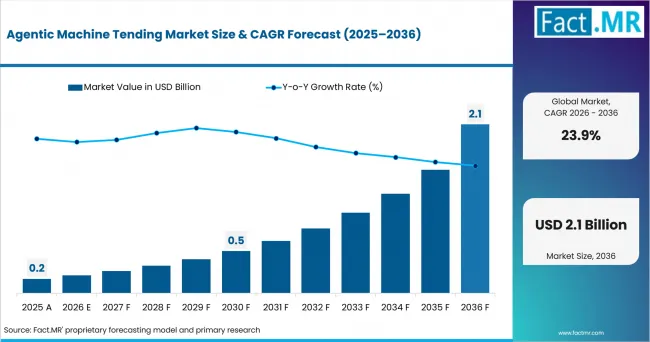
Agentic Machine Tending Market Market Value Analysis

What are the defining numbers behind agentic machine tending growth?

USD 1.81 billion absolute opportunity by 2036, led by China and India.

  • Demand Drivers in the Market
    • CNC shops need unattended loading when operators supervise more than one machine during late shifts.
    • Factories use adaptive work sequencing when batch sizes are smaller and part mixes change faster.
    • Metalworking suppliers specify exception handling to reduce stoppages after alarms, misloads or tool wear signals.
    • System integrators use machine status orchestration to connect robots with doors and fixtures. Programs and safety signals complete the cell logic.
  • Key Segments Analyzed
    • By Automation Function: Loading and Unloading is expected to hold 36.0% share in 2026 due to direct value from spindle uptime.
    • By Deployment Model: Cobot Cell is projected to capture 39.0% share in 2026, supported by easier retrofit in active workshops.
    • By Machine Type: CNC Machines are forecast to hold 44.0% share in 2026 due to repetitive part transfer and batch changeovers.
    • By End-Use Industry: Metalworking is estimated to account for 30.0% share in 2026, led by machining capacity pressure.
    • By Buyer Type: Large OEMs are expected to hold 32.0% share in 2026 due to larger automation budgets and safety teams.
    • By Geography: China is projected to record 26.6% CAGR through 2036 due to robot deployment scale and domestic supplier depth.
  • Analyst Opinion at Fact.MR
    • Shambhu Nath Jha, Senior Analyst at Fact.MR, states, “Agentic machine tending is becoming the practical entry point for autonomous workshops. Buyers are asking whether a cell can recover from routine machine events without calling an operator every time. Suppliers that combine robot hardware, machine signals and simple recovery logic can win the first repeat orders.”
  • Strategic Implications
    • Robot OEMs should package tending templates around CNC doors, fixtures and machine status signals.
    • Machine shops need payback models that compare unattended spindle time with integration cost.
    • Controls suppliers should link agent workflows with PLCs, CNC systems and plant networks.
    • System integrators need repeatable safety files and training packages for brownfield deployments.

Industrial robot data supports the sizing logic. The International Federation of Robotics reported 542,000 industrial robots installed in 2024. [1] This creates a wide base of factory robot systems that can be upgraded with agentic tending software.

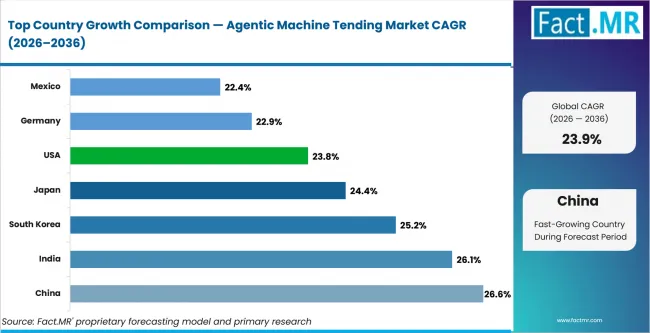
China is projected to record 26.6% CAGR through 2036 due to large robot deployment scale. India is expected to expand at 26.1% CAGR with a smaller automation base. South Korea is forecast at 25.2% CAGR through 2036, led by dense electronics automation. Japan is expected to advance at 24.4% CAGR due to machine tool depth. The United States is projected to rise at 23.8% CAGR through 2036. Germany is forecast at 22.9% CAGR and Mexico is expected to post 22.4% CAGR.

How does the agentic machine tending market break down by segment?

Loading and Unloading leads at 36.0%; Cobot Cell leads at 39.0%.

Which automation function dominates?

Loading and Unloading holds 36.0% share in 2026.

Loading and Unloading is expected to hold 36.0% share in 2026 due to its direct link with spindle utilization. Buyers start with part transfer before adding sequencing, tool response and exception logic. The function also fits robot arms that already serve repeat handling tasks in factories.

Which deployment model dominates?

Cobot Cell holds 39.0% share in 2026.
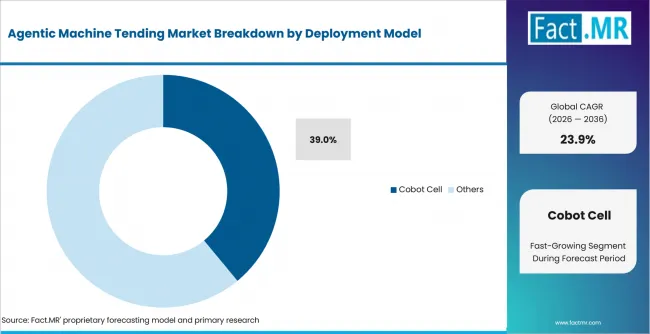
Agentic Machine Tending Market Analysis By Deployment Model

Cobot Cell leads due to compact fit near occupied machines. The model is projected to hold 39.0% share in 2026 due to lower layout disruption and simpler operator access. Demand for robot cells is strongest where SMEs want one or two machines tended first.

Which machine type dominates?

CNC Machines hold 44.0% share in 2026.
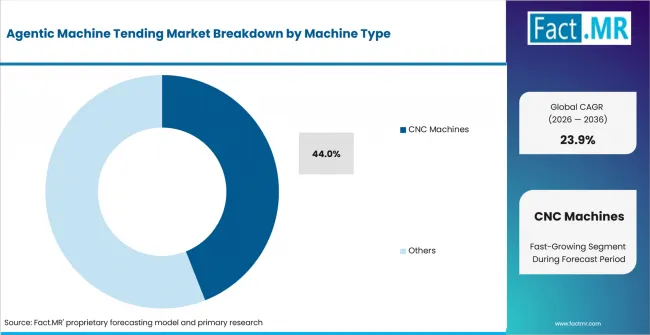
Agentic Machine Tending Market Analysis By Machine Type

CNC Machines lead due to visible loading cycles and program status. Door control also helps the tending workflow. The segment is forecast to hold 44.0% share in 2026. Demand links closely with milling machines and turning centers that run repeat parts.

Which end-use industry dominates?

Metalworking holds 30.0% share in 2026.
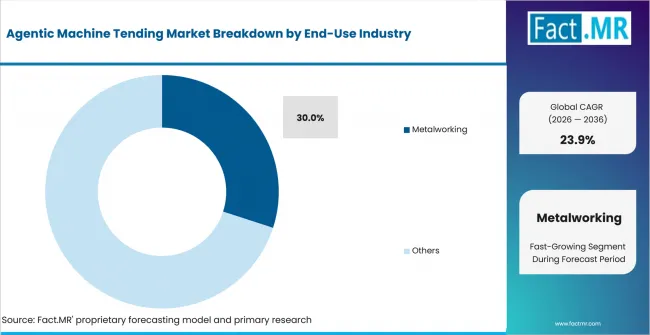
Agentic Machine Tending Market Analysis By End Use Industry

Metalworking leads early demand due to labor limits and tight delivery schedules. The segment is estimated to hold 30.0% share in 2026. Tool wear response and part transfer both matter in this setting. One failed cycle can interrupt an unattended run.

Which buyer type dominates?

Large OEMs hold 32.0% share in 2026.
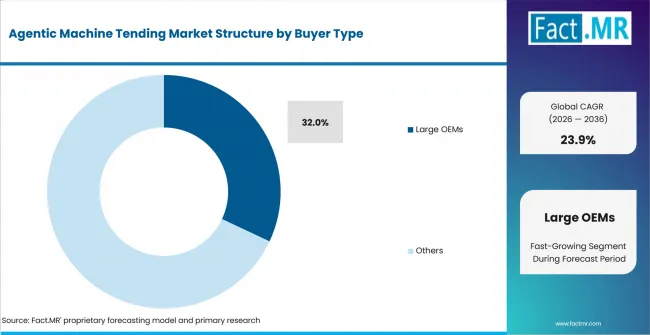
Agentic Machine Tending Market Analysis By Buyer Type

Large OEMs are expected to account for 32.0% share in 2026 due to their ability to fund integration and safety review together. Operator training is usually part of the same budget. Tier suppliers and SMEs follow with faster unit growth. Smaller buyers need packaged cells and local service before wider rollout.

What is accelerating agentic machine tending demand, and what is holding it back?

Perception-led tending and industrial AI agents accelerate it; machine interface variation restrains it.

Agentic Machine Tending Market Opportunity Matrix Growth Vs Value

The main driver is the move from fixed loading paths to cells that understand machine context. Siemens introduced industrial AI agents for automation in May 2025. The company stated that these agents aim to increase productivity by up to 50% for industrial companies. [11] This supports industrial automation control systems that coordinate robots, controllers and work orders.

The main restraint is the variety of machine interfaces in brownfield workshops. Older CNC machines expose different alarm, door and program signals. Integrators must map these signals before the cell can act safely. The International Organization for Standardization lists ISO 10218-2:2025 for robot applications and robot cells. [9] The same issue affects robot control systems when plants mix equipment from several brands.

Where do the biggest agentic machine tending opportunities sit?

CNC retrofit cells, perception-based tending and control-layer agents.

  • CNC Retrofit Cells: Integrators can build packages that connect robot loading with doors, chucks and machine cycle signals.
  • Perception-Based Tending: Suppliers can use autonomous grippers and vision tools to reduce fixture dependence in high-mix batches.
  • Control-Layer Agents: Software firms can coordinate sequencing, alarm recovery and maintenance messages across the shop floor.

Which countries are scaling agentic machine tending fastest?

China leads at 26.6%. India follows at 26.1%. South Korea, Japan, the United States, Germany and Mexico complete the top seven.

Based on regional analysis, the agentic machine tending market is segmented into six regional clusters. North America and Latin America are included. Europe and East Asia are included. South Asia and Pacific and Middle East and Africa complete the regional view.

Top Country Growth Comparison Agentic Machine Tending Market Cagr (2026 2036)

Country CAGR
China 26.6%
India 26.1%
South Korea 25.2%
Japan 24.4%
United States 23.8%
Germany 22.9%
Mexico 22.4%

Agentic Machine Tending Market Cagr Analysis By Country

What powers China’s lead?

26.6% CAGR, driven by robot deployment scale and domestic supplier depth.

China gives agentic tending a large retrofit base. The International Federation of Robotics reported that China had an operational stock of around 2 million industrial robots. [2] China is projected to record 26.6% CAGR through 2036 due to domestic robot supply and factory users seeking fewer manual touches per machine. Suppliers with modular tending packages can use China to test lower-cost deployment models.

Why is India a fast mover?

26.1% CAGR, supported by record robot installations and automotive supplier investment.

India starts from a smaller automation base, which leaves more room for new tending cells. The International Federation of Robotics stated that India reached 9,120 industrial robot installations in 2024. [3] India is expected to expand at 26.1% CAGR through 2036, as automotive parts suppliers adding automation around machining and assembly. Buyers are likely to prefer compact cobot packages with service and training included.

What supports South Korea’s outlook?

25.2% CAGR, led by dense electronics automation and operator-light production.

Agentic Machine Tending Market South Korea Market Share Analysis By Deployment Model

South Korea already uses robots intensively in electronics and automotive production. The International Federation of Robotics reported the world’s highest robot density in the Republic of Korea at 1,220 robots per 10,000 manufacturing employees. [4] South Korea is forecast to grow at 25.2% CAGR through 2036, driven by semiconductor and precision component manufacturers. Faster growth depends on integrators proving recovery behavior inside compact production layouts.

Why is Japan important for agentic tending?

24.4% CAGR, supported by machine tool depth and conservative validation.

Agentic Machine Tending Market Japan Market Share Analysis By Automation Function

Japan combines machine tool expertise with a large installed robot base. The International Federation of Robotics reported about 13,000 industrial robot installations in Japan’s automotive industry during 2024. [5] Japan is expected to advance at 24.4% CAGR through 2036, supported by buyers that require stable process proof before wider deployment. Suppliers that connect tending agents to CNC controllers are better placed in this market.

What supports the United States outlook?

23.8% CAGR, driven by job-shop retrofits and machine tending ROI.
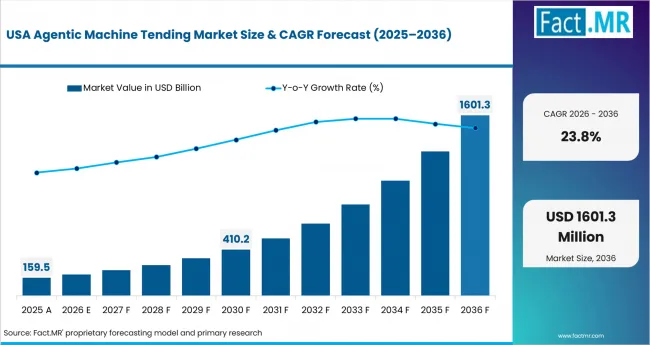
Agentic Machine Tending Market Country Value Analysis

United States buyers evaluate tending cells through labor availability and payback. The International Federation of Robotics recorded 393,700 industrial robots working in United States factories in 2024. [6] The United States is projected to rise at 23.8% CAGR through 2036, reflecting retrofit demand among machining suppliers and OEM plants. The rate sits near the global benchmark due to integration cost among smaller buyers.

What underpins Germany’s growth?

22.9% CAGR, backed by engineering standards and EU machinery compliance.

Germany has a deep installed base, but buyers specify safety files before changing production cells. The European Commission states that machinery placed on the European Union market before 20 January 2027 must comply with the current Machinery Directive. [7] Germany is forecast at 22.9% CAGR through 2036, supported by high-value CNC and machinery users. Compliance planning keeps certification evidence central to retrofit decisions.

How is Mexico building demand?

22.4% CAGR, supported by automotive concentration and North American supply links.

Mexico’s opportunity is tied to automotive suppliers that need more throughput near United States customers. The U.S. International Trade Administration reported overseas tractor-truck shipments from Mexico at approximately USD 52 billion in 2024. [8] Mexico is expected to post 22.4% CAGR through 2036, led by nearshoring and machining capacity additions. Channel growth depends on local integrators that can support service calls and operator training.

Who leads the agentic machine tending landscape?

Universal Robots, FANUC, ABB, KUKA and Yaskawa lead through robot hardware, software access and integrator ecosystems.

Agentic Machine Tending Market Analysis By Company

Universal Robots has early visibility in agentic tending through its machine-tending demo at IMTS. [10] ABB is building vision AI capability through its LandingAI collaboration. [12] Siemens supports the control layer through industrial AI agents. KUKA is positioning around Physical AI and KUKA AMP. These moves connect industrial robotics with software that can adjust machine work in real time.

FANUC, Yaskawa, Mitsubishi Electric and Omron remain important where buyers prefer established robot controllers and plant-level service. DMG MORI adds machine tool integration depth through automation systems for CNC users. Competition through 2036 is expected to depend on industrial robot components, machine interface access and field service quality.

Providers that combine robots, grippers and machine signals are better placed than hardware-only suppliers. Agent software adds the recovery layer. System integrators hold a large role given that each cell must match door actuation and part fixturing. Buyers are likely to choose vendors that reduce commissioning risk and support mobile industrial robots where one cell serves several machines.

Which companies are the key players?

Universal Robots, FANUC, ABB, KUKA, Yaskawa, Siemens, Rockwell Automation, Omron, Mitsubishi Electric and DMG MORI.

  • Universal Robots A/S
  • FANUC Corporation
  • ABB Robotics
  • KUKA AG
  • Yaskawa Electric Corporation
  • Siemens AG
  • Rockwell Automation Inc.
  • Omron Corporation
  • Mitsubishi Electric Corporation
  • DMG MORI Company Limited

Bibliography

  • [1] International Federation of Robotics. (2025, September 25). World Robotics 2025 report: Industrial robots released by IFR. International Federation of Robotics.
  • [2] International Federation of Robotics. (2026, May 5). China makes AI-powered robots core of national strategy. International Federation of Robotics.
  • [3] International Federation of Robotics. (2025, September 25). India rises to sixth in global factory robot installations. International Federation of Robotics.
  • [4] International Federation of Robotics. (2026, April 8). Robot density surges in Europe, Asia and Americas. International Federation of Robotics.
  • [5] International Federation of Robotics. (2025, July 15). Japan’s car industry has highest robot installations in five years. International Federation of Robotics.
  • [6] International Federation of Robotics. (2025, September 25). U.S. lags China in factory robot deployment by 5 to 1 ratio. International Federation of Robotics.
  • [7] European Commission. (2026). Machinery. European Commission.
  • [8] U.S. International Trade Administration. (2026, February 11). Mexico: Automotive industry. U.S. Department of Commerce.
  • [9] International Organization for Standardization. (2025). Robotics standards. International Organization for Standardization.
  • [10] Universal Robots. (2024, August 28). Universal Robots shows deep learning-based part detection for machine tending cobots at IMTS. Universal Robots.
  • [11] Siemens. (2025, May 12). Siemens introduces AI agents for industrial automation. Siemens.
  • [12] ABB. (2025, September 17). ABB and LandingAI unleash the power of generative AI for robotic vision. ABB.

This Report Addresses

  • Strategic intelligence on agentic machine tending across automation function, deployment model and buyer type.
  • Segment analysis covering Loading and Unloading, Cobot Cell, CNC Machines, Metalworking and Large OEMs.
  • Regional outlook covering China, India, South Korea, Japan, the United States, Germany and Mexico.
  • Competitive analysis of Universal Robots, FANUC, ABB, KUKA, Yaskawa, Siemens, Rockwell Automation, Omron, Mitsubishi Electric and DMG MORI.
  • System assessment covering cobot cells, industrial robot cells, mobile manipulators and CNC-integrated workflows.
  • Standards assessment covering ISO 10218 and European Union Machinery Regulation readiness.
  • Primary interviews, provider checks, official source review and robot deployment validation support the forecast.

What does the agentic machine tending market cover?

Robot cells and workflow software that load, unload and supervise production machines.

The agentic machine tending market covers robot cells and grippers. It also covers machine interfaces and software workflows that supervise production machines with task-level autonomy. The market differs from standard machine tending. Its service focus is adaptive work sequencing and exception handling. It also includes system integration tied to CNC machines and presses.

What is included in the scope?

Cobot cells, machine interfaces and tending software.

The scope includes AI-driven loading and unloading and adaptive work sequencing. It covers tool wear response, exception handling and machine status orchestration. It includes cobot cells and industrial robot cells. Mobile manipulators, CNC-integrated cells and cloud-assisted workflows are also included. It also covers safety packages and commissioning support for brownfield machine shops.

What is excluded from the scope?

Standalone robot arms and machine tools without agentic tending capability.

The scope excludes standard CNC machines sold without tending automation. It excludes stand-alone robot arms that do not connect to machine status or workflow software. It also excludes warehouse-only robots, manual loading services and general automation consulting without machine tending deployment.

How was the analysis built?

100+ sources, 45+ company portfolios, 25+ countries, 22+ interviews.

  • Primary Research:
    • Primary research includes interviews with robot OEM application teams and CNC system integrators. It includes input from plant automation managers and machine tool distributors.
  • Desk Research:
    • Desk research reviews International Federation of Robotics data, ISO robot standards and European machinery rules. It covers robot OEM portfolios, cobot application pages and industrial AI announcements.
  • Market-Sizing and Forecasting:
    • Forecasting uses robot installation data, CNC retrofit intensity and software attach rates. Price assumptions were checked against typical cobot cell and industrial robot cell deployment ranges.
  • Data Validation and Update Cycle:
    • Forecasts are validated through supplier checks and deployment evidence from 2024 to 2026. Company launches and robotics statistics help confirm market direction.

What is the report’s scope and coverage?

Agentic Machine Tending Market Breakdown By Automation Function, Deployment Model, And Region

Attribute Details
Quantitative Units USD Billion in 2026 to USD Billion by 2036 at CAGR
Market Definition Robot cells and software workflows that load, unload and supervise production machines with task-level autonomy
Automation Function Loading and Unloading, Work Sequencing, Tool Wear Response, Exception Handling, Status Orchestration
Deployment Model Cobot Cell, Robot Cell, Mobile Manipulator, CNC Cell, Cloud Workflow
Machine Type CNC Machines, Presses, Injection Molding, Die Casting, Inspection Stations
End-Use Industry Metalworking, Automotive, Electronics, Machinery, Aerospace, Medical Devices, Packaging, Consumer Goods
Buyer Type Large OEMs, Tier Suppliers, SMEs, System Integrators, Contract Manufacturers, Machine Builders
Regions Covered North America, Latin America, Europe, East Asia, South Asia and Pacific, Middle East and Africa
Countries Covered China, India, South Korea, Japan, United States, Germany, Mexico
Key Companies Profiled Universal Robots, FANUC, ABB, KUKA, Yaskawa, Siemens, Rockwell Automation, Omron, Mitsubishi Electric, DMG MORI
Forecast Period 2026 to 2036
Approach Hybrid top-down and bottom-up approach using robot installations, CNC retrofit intensity, software attach rates and supplier validation

How is the market segmented?

  • By Automation Function:

    • Loading and Unloading
    • Work Sequencing
    • Tool Wear Response
    • Exception Handling
    • Status Orchestration
  • By Deployment Model:

    • Cobot Cell
    • Robot Cell
    • Mobile Manipulator
    • CNC Cell
    • Cloud Workflow
  • By Machine Type:

    • CNC Machines
    • Presses
    • Injection Molding
    • Die Casting
    • Inspection Stations
  • By End-Use Industry:

    • Metalworking
    • Automotive
    • Electronics
    • Machinery
    • Aerospace
    • Medical Devices
    • Packaging
    • Consumer Goods
  • By Buyer Type:

    • Large OEMs
    • Tier Suppliers
    • SMEs
    • System Integrators
    • Contract Manufacturers
    • Machine Builders
  • By Region:

    • North America
      • United States
      • Canada
      • Mexico
    • Latin America
      • Brazil
      • Argentina
      • Rest of Latin America
    • Europe
      • Germany
      • United Kingdom
      • France
      • Italy
      • Spain
      • Rest of Europe
    • East Asia
      • China
      • Japan
      • South Korea
    • South Asia and Pacific
      • India
      • ASEAN
      • Australia and New Zealand
    • Middle East & Africa
      • GCC Countries
      • South Africa
      • Rest of Middle East & Africa

- Frequently Asked Questions -

Which automation function leads the Agentic Machine Tending Market?

Loading and Unloading leads with 36.0% share in 2026 due to direct value from spindle uptime.

Which country expands fastest in the Agentic Machine Tending Market?

China is projected to record 26.6% CAGR through 2036 due to robot deployment scale and domestic supplier depth.

How does India perform in the Agentic Machine Tending Market?

India is expected to expand at 26.1% CAGR through 2036 due to record robot installations and supplier automation investment.

How does South Korea perform in the Agentic Machine Tending Market?

South Korea is forecast at 25.2% CAGR through 2036 due to dense electronics automation and operator-light production needs.

How does Japan perform in the Agentic Machine Tending Market?

Japan is expected to advance at 24.4% CAGR through 2036 due to machine tool depth and careful automation validation.

How does the United States perform in the Agentic Machine Tending Market?

The United States is projected to rise at 23.8% CAGR through 2036 due to job-shop retrofits and machine tending ROI.

How does Germany perform in the Agentic Machine Tending Market?

Germany is forecast at 22.9% CAGR through 2036 due to engineering standards and European machinery compliance.

How does Mexico perform in the Agentic Machine Tending Market?

Mexico is expected to post 22.4% CAGR through 2036 due to automotive concentration and North American supply links.

What is the primary driver in the Agentic Machine Tending Market?

The primary driver is the need to load machines and recover from routine stops with less operator intervention.

What is the main restraint in the Agentic Machine Tending Market?

The main restraint is machine interface variation across older equipment and mixed-brand brownfield workshops.

Table of Content

  1. Key Takeaways
    • Market Size and CAGR
    • Top Growth Driver
    • Fastest Growing Segment
    • Leading Region
    • Key Companies
    • Emerging Opportunities
  2. Executive Summary
    • Global Market Outlook
    • Demand-side Trends
    • Supply-side Trends
    • Technology Roadmap Analysis
    • Analysis and Recommendations
    • Analyst Perspective (What is happening? Why now? What should investors know?)
    • Key Questions Answered
      • How large is the market?
      • What is the CAGR?
      • What are key trends?
      • Which region dominates?
      • Who are the leaders?
  3. Market Overview
    • Market Coverage / Taxonomy
    • Market Definition / Scope / Limitations
  4. Research Methodology
    • Chapter Orientation
    • Analytical Lens and Working Hypotheses
      • Market Structure, Signals, and Trend Drivers
      • Benchmarking and Cross-market Comparability
      • Market Sizing, Forecasting, and Opportunity Mapping
    • Research Design and Evidence Framework
      • Desk Research Programme (Secondary Evidence)
      • Expert Input and Fieldwork (Primary Evidence)
      • Tooling, Models, and Reference Databases
    • Data Engineering and Model Build
    • Quality Assurance and Audit Trail
  5. Market Background
    • Market Dynamics (Drivers, Restraints, Opportunity, Trends)
    • Scenario Forecast (Optimistic, Likely, Conservative)
    • Impact Analysis
      • AI Impact
      • Sustainability Impact
      • Regulatory Impact
      • Technology Impact
    • Consumer / Buyer Analysis
      • Purchase Drivers
      • Adoption Barriers
      • Buyer Journey
    • Opportunity Map Analysis
    • Product Life Cycle Analysis
    • Supply Chain Analysis
    • Investment Feasibility Matrix
    • Value Chain Analysis
    • PESTLE and Porter's Analysis
    • Regulatory Landscape
    • Regional Parent Market Outlook
    • Production and Consumption Statistics
    • Import and Export Statistics
  6. Global Market Analysis and Forecast, 2021 to 2036
    • Historical Market Size Value (USD Billion) Analysis, 2021 to 2025
    • Current and Future Market Size Value (USD Billion) Projections, 2026 to 2036
      • Y-o-Y Growth Trend Analysis
      • Absolute $ Opportunity Analysis
  7. Global Market Pricing Analysis, 2021 to 2036
  8. Global Market Analysis and Forecast, By Automation Function, 2021 to 2036
    • Introduction / Key Findings
    • Historical Market Size Value (USD Billion) Analysis By Automation Function, 2021 to 2025
    • Current and Future Market Size Value (USD Billion) Analysis and Forecast By Automation Function, 2026 to 2036
      • Loading Unloading
      • Others
    • Y-o-Y Growth Trend Analysis By Automation Function, 2021 to 2025
    • Absolute $ Opportunity Analysis By Automation Function, 2026 to 2036
  9. Global Market Analysis and Forecast, By Deployment Model, 2021 to 2036
    • Introduction / Key Findings
    • Historical Market Size Value (USD Billion) Analysis By Deployment Model, 2021 to 2025
    • Current and Future Market Size Value (USD Billion) Analysis and Forecast By Deployment Model, 2026 to 2036
      • Cobot Cell
      • Others
    • Y-o-Y Growth Trend Analysis By Deployment Model, 2021 to 2025
    • Absolute $ Opportunity Analysis By Deployment Model, 2026 to 2036
  10. Global Market Analysis and Forecast, By Machine Type, 2021 to 2036
    • Introduction / Key Findings
    • Historical Market Size Value (USD Billion) Analysis By Machine Type, 2021 to 2025
    • Current and Future Market Size Value (USD Billion) Analysis and Forecast By Machine Type, 2026 to 2036
      • CNC Machines
      • Others
    • Y-o-Y Growth Trend Analysis By Machine Type, 2021 to 2025
    • Absolute $ Opportunity Analysis By Machine Type, 2026 to 2036
  11. Global Market Analysis and Forecast, By End-Use Industry, 2021 to 2036
    • Introduction / Key Findings
    • Historical Market Size Value (USD Billion) Analysis By End-Use Industry, 2021 to 2025
    • Current and Future Market Size Value (USD Billion) Analysis and Forecast By End-Use Industry, 2026 to 2036
      • Metalworking
      • Others
    • Y-o-Y Growth Trend Analysis By End-Use Industry, 2021 to 2025
    • Absolute $ Opportunity Analysis By End-Use Industry, 2026 to 2036
  12. Global Market Analysis and Forecast, By Buyer Type, 2021 to 2036
    • Introduction / Key Findings
    • Historical Market Size Value (USD Billion) Analysis By Buyer Type, 2021 to 2025
    • Current and Future Market Size Value (USD Billion) Analysis and Forecast By Buyer Type, 2026 to 2036
      • Large OEMs
      • Others
    • Y-o-Y Growth Trend Analysis By Buyer Type, 2021 to 2025
    • Absolute $ Opportunity Analysis By Buyer Type, 2026 to 2036
  13. Global Market Analysis and Forecast, By Region, 2021 to 2036
    • Introduction
    • Historical Market Size Value (USD Billion) Analysis By Region, 2021 to 2025
    • Current Market Size Value (USD Billion) Analysis and Forecast By Region, 2026 to 2036
      • North America
      • Latin America
      • Western Europe
      • Eastern Europe
      • East Asia
      • South Asia and Pacific
      • Middle East & Africa
    • Market Attractiveness Analysis By Region
  14. North America Market Analysis and Forecast, By Country, 2021 to 2036
    • Historical Market Size Value (USD Billion) Trend Analysis By Market Taxonomy, 2021 to 2025
    • Market Size Value (USD Billion) Forecast By Market Taxonomy, 2026 to 2036
      • By Country
        • USA
        • Canada
        • Mexico
      • By Automation Function
      • By Deployment Model
      • By Machine Type
      • By End-Use Industry
      • By Buyer Type
    • Market Attractiveness Analysis
      • By Country
      • By Automation Function
      • By Deployment Model
      • By Machine Type
      • By End-Use Industry
      • By Buyer Type
    • Key Takeaways
  15. Latin America Market Analysis and Forecast, By Country
    • Historical Market Size Value (USD Billion) Trend Analysis By Market Taxonomy, 2021 to 2025
    • Market Size Value (USD Billion) Forecast By Market Taxonomy, 2026 to 2036
      • By Country
        • Brazil
        • Chile
        • Rest of Latin America
      • By Automation Function
      • By Deployment Model
      • By Machine Type
      • By End-Use Industry
      • By Buyer Type
    • Market Attractiveness Analysis
      • By Country
      • By Automation Function
      • By Deployment Model
      • By Machine Type
      • By End-Use Industry
      • By Buyer Type
    • Key Takeaways
  16. Western Europe Market Analysis and Forecast, By Country
    • Historical Market Size Value (USD Billion) Trend Analysis By Market Taxonomy, 2021 to 2025
    • Market Size Value (USD Billion) Forecast By Market Taxonomy, 2026 to 2036
      • By Country
        • Germany
        • UK
        • Italy
        • Spain
        • France
        • Nordic
        • BENELUX
        • Rest of Western Europe
      • By Automation Function
      • By Deployment Model
      • By Machine Type
      • By End-Use Industry
      • By Buyer Type
    • Market Attractiveness Analysis
      • By Country
      • By Automation Function
      • By Deployment Model
      • By Machine Type
      • By End-Use Industry
      • By Buyer Type
    • Key Takeaways
  17. Eastern Europe Market Analysis and Forecast, By Country
    • Historical Market Size Value (USD Billion) Trend Analysis By Market Taxonomy, 2021 to 2025
    • Market Size Value (USD Billion) Forecast By Market Taxonomy, 2026 to 2036
      • By Country
        • Russia
        • Poland
        • Hungary
        • Balkan & Baltic
        • Rest of Eastern Europe
      • By Automation Function
      • By Deployment Model
      • By Machine Type
      • By End-Use Industry
      • By Buyer Type
    • Market Attractiveness Analysis
      • By Country
      • By Automation Function
      • By Deployment Model
      • By Machine Type
      • By End-Use Industry
      • By Buyer Type
    • Key Takeaways
  18. East Asia Market Analysis and Forecast, By Country
    • Historical Market Size Value (USD Billion) Trend Analysis By Market Taxonomy, 2021 to 2025
    • Market Size Value (USD Billion) Forecast By Market Taxonomy, 2026 to 2036
      • By Country
        • China
        • Japan
        • South Korea
      • By Automation Function
      • By Deployment Model
      • By Machine Type
      • By End-Use Industry
      • By Buyer Type
    • Market Attractiveness Analysis
      • By Country
      • By Automation Function
      • By Deployment Model
      • By Machine Type
      • By End-Use Industry
      • By Buyer Type
    • Key Takeaways
  19. South Asia and Pacific Market Analysis and Forecast, By Country
    • Historical Market Size Value (USD Billion) Trend Analysis By Market Taxonomy, 2021 to 2025
    • Market Size Value (USD Billion) Forecast By Market Taxonomy, 2026 to 2036
      • By Country
        • India
        • ASEAN
        • Australia & New Zealand
        • Rest of South Asia and Pacific
      • By Automation Function
      • By Deployment Model
      • By Machine Type
      • By End-Use Industry
      • By Buyer Type
    • Market Attractiveness Analysis
      • By Country
      • By Automation Function
      • By Deployment Model
      • By Machine Type
      • By End-Use Industry
      • By Buyer Type
    • Key Takeaways
  20. Middle East & Africa Market Analysis and Forecast, By Country
    • Historical Market Size Value (USD Billion) Trend Analysis By Market Taxonomy, 2021 to 2025
    • Market Size Value (USD Billion) Forecast By Market Taxonomy, 2026 to 2036
      • By Country
        • Kingdom of Saudi Arabia
        • Other GCC Countries
        • Turkiye
        • South Africa
        • Other African Union
        • Rest of Middle East & Africa
      • By Automation Function
      • By Deployment Model
      • By Machine Type
      • By End-Use Industry
      • By Buyer Type
    • Market Attractiveness Analysis
      • By Country
      • By Automation Function
      • By Deployment Model
      • By Machine Type
      • By End-Use Industry
      • By Buyer Type
    • Key Takeaways
  21. Key Countries Market Analysis
    • USA
      • Pricing Analysis
      • Market Share Analysis, 2025
        • By Automation Function
        • By Deployment Model
        • By Machine Type
        • By End-Use Industry
        • By Buyer Type
    • Canada
      • Pricing Analysis
      • Market Share Analysis, 2025
        • By Automation Function
        • By Deployment Model
        • By Machine Type
        • By End-Use Industry
        • By Buyer Type
    • Mexico
      • Pricing Analysis
      • Market Share Analysis, 2025
        • By Automation Function
        • By Deployment Model
        • By Machine Type
        • By End-Use Industry
        • By Buyer Type
    • Brazil
      • Pricing Analysis
      • Market Share Analysis, 2025
        • By Automation Function
        • By Deployment Model
        • By Machine Type
        • By End-Use Industry
        • By Buyer Type
    • Chile
      • Pricing Analysis
      • Market Share Analysis, 2025
        • By Automation Function
        • By Deployment Model
        • By Machine Type
        • By End-Use Industry
        • By Buyer Type
    • Germany
      • Pricing Analysis
      • Market Share Analysis, 2025
        • By Automation Function
        • By Deployment Model
        • By Machine Type
        • By End-Use Industry
        • By Buyer Type
    • UK
      • Pricing Analysis
      • Market Share Analysis, 2025
        • By Automation Function
        • By Deployment Model
        • By Machine Type
        • By End-Use Industry
        • By Buyer Type
    • Italy
      • Pricing Analysis
      • Market Share Analysis, 2025
        • By Automation Function
        • By Deployment Model
        • By Machine Type
        • By End-Use Industry
        • By Buyer Type
    • Spain
      • Pricing Analysis
      • Market Share Analysis, 2025
        • By Automation Function
        • By Deployment Model
        • By Machine Type
        • By End-Use Industry
        • By Buyer Type
    • France
      • Pricing Analysis
      • Market Share Analysis, 2025
        • By Automation Function
        • By Deployment Model
        • By Machine Type
        • By End-Use Industry
        • By Buyer Type
    • India
      • Pricing Analysis
      • Market Share Analysis, 2025
        • By Automation Function
        • By Deployment Model
        • By Machine Type
        • By End-Use Industry
        • By Buyer Type
    • ASEAN
      • Pricing Analysis
      • Market Share Analysis, 2025
        • By Automation Function
        • By Deployment Model
        • By Machine Type
        • By End-Use Industry
        • By Buyer Type
    • Australia & New Zealand
      • Pricing Analysis
      • Market Share Analysis, 2025
        • By Automation Function
        • By Deployment Model
        • By Machine Type
        • By End-Use Industry
        • By Buyer Type
    • China
      • Pricing Analysis
      • Market Share Analysis, 2025
        • By Automation Function
        • By Deployment Model
        • By Machine Type
        • By End-Use Industry
        • By Buyer Type
    • Japan
      • Pricing Analysis
      • Market Share Analysis, 2025
        • By Automation Function
        • By Deployment Model
        • By Machine Type
        • By End-Use Industry
        • By Buyer Type
    • South Korea
      • Pricing Analysis
      • Market Share Analysis, 2025
        • By Automation Function
        • By Deployment Model
        • By Machine Type
        • By End-Use Industry
        • By Buyer Type
    • Russia
      • Pricing Analysis
      • Market Share Analysis, 2025
        • By Automation Function
        • By Deployment Model
        • By Machine Type
        • By End-Use Industry
        • By Buyer Type
    • Poland
      • Pricing Analysis
      • Market Share Analysis, 2025
        • By Automation Function
        • By Deployment Model
        • By Machine Type
        • By End-Use Industry
        • By Buyer Type
    • Hungary
      • Pricing Analysis
      • Market Share Analysis, 2025
        • By Automation Function
        • By Deployment Model
        • By Machine Type
        • By End-Use Industry
        • By Buyer Type
    • Kingdom of Saudi Arabia
      • Pricing Analysis
      • Market Share Analysis, 2025
        • By Automation Function
        • By Deployment Model
        • By Machine Type
        • By End-Use Industry
        • By Buyer Type
    • Turkiye
      • Pricing Analysis
      • Market Share Analysis, 2025
        • By Automation Function
        • By Deployment Model
        • By Machine Type
        • By End-Use Industry
        • By Buyer Type
    • South Africa
      • Pricing Analysis
      • Market Share Analysis, 2025
        • By Automation Function
        • By Deployment Model
        • By Machine Type
        • By End-Use Industry
        • By Buyer Type
  22. Market Structure Analysis
    • Competition Dashboard
    • Competition Benchmarking
    • Market Share Analysis of Top Players
      • By Regional
      • By Automation Function
      • By Deployment Model
      • By Machine Type
      • By End-Use Industry
      • By Buyer Type
      • Emerging Startups
      • Innovation Benchmarking
    • Competition Analysis
      • Competition Deep Dive
        • Universal Robots A/S
          • Overview
          • Product Portfolio
          • Profitability by Market Segments (Product/Age /Sales Channel/Region)
          • Sales Footprint
          • Strategy Overview
            • Marketing Strategy
            • Product Strategy
            • Channel Strategy
        • FANUC Corporation
        • ABB Robotics
        • KUKA AG
        • Yaskawa Electric Corporation
        • Siemens AG
        • Rockwell Automation Inc.
        • Omron Corporation
    • Case Studies
    • Success Stories
    • Recent Developments
  23. Assumptions & Acronyms Used

List Of Table

  • Table 1: Global Market Value (USD Billion) Forecast by Region, 2021 to 2036
  • Table 2: Global Market Value (USD Billion) Forecast by Automation Function, 2021 to 2036
  • Table 3: Global Market Value (USD Billion) Forecast by Deployment Model, 2021 to 2036
  • Table 4: Global Market Value (USD Billion) Forecast by Machine Type, 2021 to 2036
  • Table 5: Global Market Value (USD Billion) Forecast by End-Use Industry, 2021 to 2036
  • Table 6: Global Market Value (USD Billion) Forecast by Buyer Type, 2021 to 2036
  • Table 7: North America Market Value (USD Billion) Forecast by Country, 2021 to 2036
  • Table 8: North America Market Value (USD Billion) Forecast by Automation Function, 2021 to 2036
  • Table 9: North America Market Value (USD Billion) Forecast by Deployment Model, 2021 to 2036
  • Table 10: North America Market Value (USD Billion) Forecast by Machine Type, 2021 to 2036
  • Table 11: North America Market Value (USD Billion) Forecast by End-Use Industry, 2021 to 2036
  • Table 12: North America Market Value (USD Billion) Forecast by Buyer Type, 2021 to 2036
  • Table 13: Latin America Market Value (USD Billion) Forecast by Country, 2021 to 2036
  • Table 14: Latin America Market Value (USD Billion) Forecast by Automation Function, 2021 to 2036
  • Table 15: Latin America Market Value (USD Billion) Forecast by Deployment Model, 2021 to 2036
  • Table 16: Latin America Market Value (USD Billion) Forecast by Machine Type, 2021 to 2036
  • Table 17: Latin America Market Value (USD Billion) Forecast by End-Use Industry, 2021 to 2036
  • Table 18: Latin America Market Value (USD Billion) Forecast by Buyer Type, 2021 to 2036
  • Table 19: Western Europe Market Value (USD Billion) Forecast by Country, 2021 to 2036
  • Table 20: Western Europe Market Value (USD Billion) Forecast by Automation Function, 2021 to 2036
  • Table 21: Western Europe Market Value (USD Billion) Forecast by Deployment Model, 2021 to 2036
  • Table 22: Western Europe Market Value (USD Billion) Forecast by Machine Type, 2021 to 2036
  • Table 23: Western Europe Market Value (USD Billion) Forecast by End-Use Industry, 2021 to 2036
  • Table 24: Western Europe Market Value (USD Billion) Forecast by Buyer Type, 2021 to 2036
  • Table 25: Eastern Europe Market Value (USD Billion) Forecast by Country, 2021 to 2036
  • Table 26: Eastern Europe Market Value (USD Billion) Forecast by Automation Function, 2021 to 2036
  • Table 27: Eastern Europe Market Value (USD Billion) Forecast by Deployment Model, 2021 to 2036
  • Table 28: Eastern Europe Market Value (USD Billion) Forecast by Machine Type, 2021 to 2036
  • Table 29: Eastern Europe Market Value (USD Billion) Forecast by End-Use Industry, 2021 to 2036
  • Table 30: Eastern Europe Market Value (USD Billion) Forecast by Buyer Type, 2021 to 2036
  • Table 31: East Asia Market Value (USD Billion) Forecast by Country, 2021 to 2036
  • Table 32: East Asia Market Value (USD Billion) Forecast by Automation Function, 2021 to 2036
  • Table 33: East Asia Market Value (USD Billion) Forecast by Deployment Model, 2021 to 2036
  • Table 34: East Asia Market Value (USD Billion) Forecast by Machine Type, 2021 to 2036
  • Table 35: East Asia Market Value (USD Billion) Forecast by End-Use Industry, 2021 to 2036
  • Table 36: East Asia Market Value (USD Billion) Forecast by Buyer Type, 2021 to 2036
  • Table 37: South Asia and Pacific Market Value (USD Billion) Forecast by Country, 2021 to 2036
  • Table 38: South Asia and Pacific Market Value (USD Billion) Forecast by Automation Function, 2021 to 2036
  • Table 39: South Asia and Pacific Market Value (USD Billion) Forecast by Deployment Model, 2021 to 2036
  • Table 40: South Asia and Pacific Market Value (USD Billion) Forecast by Machine Type, 2021 to 2036
  • Table 41: South Asia and Pacific Market Value (USD Billion) Forecast by End-Use Industry, 2021 to 2036
  • Table 42: South Asia and Pacific Market Value (USD Billion) Forecast by Buyer Type, 2021 to 2036
  • Table 43: Middle East & Africa Market Value (USD Billion) Forecast by Country, 2021 to 2036
  • Table 44: Middle East & Africa Market Value (USD Billion) Forecast by Automation Function, 2021 to 2036
  • Table 45: Middle East & Africa Market Value (USD Billion) Forecast by Deployment Model, 2021 to 2036
  • Table 46: Middle East & Africa Market Value (USD Billion) Forecast by Machine Type, 2021 to 2036
  • Table 47: Middle East & Africa Market Value (USD Billion) Forecast by End-Use Industry, 2021 to 2036
  • Table 48: Middle East & Africa Market Value (USD Billion) Forecast by Buyer Type, 2021 to 2036

List Of Figures

  • Figure 1: Global Market Pricing Analysis
  • Figure 2: Global Market Value (USD Billion) Forecast 2021-2036
  • Figure 3: Global Market Value Share and BPS Analysis by Automation Function, 2026 and 2036
  • Figure 4: Global Market Y-o-Y Growth Comparison by Automation Function, 2026-2036
  • Figure 5: Global Market Attractiveness Analysis by Automation Function
  • Figure 6: Global Market Value Share and BPS Analysis by Deployment Model, 2026 and 2036
  • Figure 7: Global Market Y-o-Y Growth Comparison by Deployment Model, 2026-2036
  • Figure 8: Global Market Attractiveness Analysis by Deployment Model
  • Figure 9: Global Market Value Share and BPS Analysis by Machine Type, 2026 and 2036
  • Figure 10: Global Market Y-o-Y Growth Comparison by Machine Type, 2026-2036
  • Figure 11: Global Market Attractiveness Analysis by Machine Type
  • Figure 12: Global Market Value Share and BPS Analysis by End-Use Industry, 2026 and 2036
  • Figure 13: Global Market Y-o-Y Growth Comparison by End-Use Industry, 2026-2036
  • Figure 14: Global Market Attractiveness Analysis by End-Use Industry
  • Figure 15: Global Market Value Share and BPS Analysis by Buyer Type, 2026 and 2036
  • Figure 16: Global Market Y-o-Y Growth Comparison by Buyer Type, 2026-2036
  • Figure 17: Global Market Attractiveness Analysis by Buyer Type
  • Figure 18: Global Market Value (USD Billion) Share and BPS Analysis by Region, 2026 and 2036
  • Figure 19: Global Market Y-o-Y Growth Comparison by Region, 2026-2036
  • Figure 20: Global Market Attractiveness Analysis by Region
  • Figure 21: North America Market Incremental Dollar Opportunity, 2026-2036
  • Figure 22: Latin America Market Incremental Dollar Opportunity, 2026-2036
  • Figure 23: Western Europe Market Incremental Dollar Opportunity, 2026-2036
  • Figure 24: Eastern Europe Market Incremental Dollar Opportunity, 2026-2036
  • Figure 25: East Asia Market Incremental Dollar Opportunity, 2026-2036
  • Figure 26: South Asia and Pacific Market Incremental Dollar Opportunity, 2026-2036
  • Figure 27: Middle East & Africa Market Incremental Dollar Opportunity, 2026-2036
  • Figure 28: North America Market Value Share and BPS Analysis by Country, 2026 and 2036
  • Figure 29: North America Market Value Share and BPS Analysis by Automation Function, 2026 and 2036
  • Figure 30: North America Market Y-o-Y Growth Comparison by Automation Function, 2026-2036
  • Figure 31: North America Market Attractiveness Analysis by Automation Function
  • Figure 32: North America Market Value Share and BPS Analysis by Deployment Model, 2026 and 2036
  • Figure 33: North America Market Y-o-Y Growth Comparison by Deployment Model, 2026-2036
  • Figure 34: North America Market Attractiveness Analysis by Deployment Model
  • Figure 35: North America Market Value Share and BPS Analysis by Machine Type, 2026 and 2036
  • Figure 36: North America Market Y-o-Y Growth Comparison by Machine Type, 2026-2036
  • Figure 37: North America Market Attractiveness Analysis by Machine Type
  • Figure 38: North America Market Value Share and BPS Analysis by End-Use Industry, 2026 and 2036
  • Figure 39: North America Market Y-o-Y Growth Comparison by End-Use Industry, 2026-2036
  • Figure 40: North America Market Attractiveness Analysis by End-Use Industry
  • Figure 41: North America Market Value Share and BPS Analysis by Buyer Type, 2026 and 2036
  • Figure 42: North America Market Y-o-Y Growth Comparison by Buyer Type, 2026-2036
  • Figure 43: North America Market Attractiveness Analysis by Buyer Type
  • Figure 44: Latin America Market Value Share and BPS Analysis by Country, 2026 and 2036
  • Figure 45: Latin America Market Value Share and BPS Analysis by Automation Function, 2026 and 2036
  • Figure 46: Latin America Market Y-o-Y Growth Comparison by Automation Function, 2026-2036
  • Figure 47: Latin America Market Attractiveness Analysis by Automation Function
  • Figure 48: Latin America Market Value Share and BPS Analysis by Deployment Model, 2026 and 2036
  • Figure 49: Latin America Market Y-o-Y Growth Comparison by Deployment Model, 2026-2036
  • Figure 50: Latin America Market Attractiveness Analysis by Deployment Model
  • Figure 51: Latin America Market Value Share and BPS Analysis by Machine Type, 2026 and 2036
  • Figure 52: Latin America Market Y-o-Y Growth Comparison by Machine Type, 2026-2036
  • Figure 53: Latin America Market Attractiveness Analysis by Machine Type
  • Figure 54: Latin America Market Value Share and BPS Analysis by End-Use Industry, 2026 and 2036
  • Figure 55: Latin America Market Y-o-Y Growth Comparison by End-Use Industry, 2026-2036
  • Figure 56: Latin America Market Attractiveness Analysis by End-Use Industry
  • Figure 57: Latin America Market Value Share and BPS Analysis by Buyer Type, 2026 and 2036
  • Figure 58: Latin America Market Y-o-Y Growth Comparison by Buyer Type, 2026-2036
  • Figure 59: Latin America Market Attractiveness Analysis by Buyer Type
  • Figure 60: Western Europe Market Value Share and BPS Analysis by Country, 2026 and 2036
  • Figure 61: Western Europe Market Value Share and BPS Analysis by Automation Function, 2026 and 2036
  • Figure 62: Western Europe Market Y-o-Y Growth Comparison by Automation Function, 2026-2036
  • Figure 63: Western Europe Market Attractiveness Analysis by Automation Function
  • Figure 64: Western Europe Market Value Share and BPS Analysis by Deployment Model, 2026 and 2036
  • Figure 65: Western Europe Market Y-o-Y Growth Comparison by Deployment Model, 2026-2036
  • Figure 66: Western Europe Market Attractiveness Analysis by Deployment Model
  • Figure 67: Western Europe Market Value Share and BPS Analysis by Machine Type, 2026 and 2036
  • Figure 68: Western Europe Market Y-o-Y Growth Comparison by Machine Type, 2026-2036
  • Figure 69: Western Europe Market Attractiveness Analysis by Machine Type
  • Figure 70: Western Europe Market Value Share and BPS Analysis by End-Use Industry, 2026 and 2036
  • Figure 71: Western Europe Market Y-o-Y Growth Comparison by End-Use Industry, 2026-2036
  • Figure 72: Western Europe Market Attractiveness Analysis by End-Use Industry
  • Figure 73: Western Europe Market Value Share and BPS Analysis by Buyer Type, 2026 and 2036
  • Figure 74: Western Europe Market Y-o-Y Growth Comparison by Buyer Type, 2026-2036
  • Figure 75: Western Europe Market Attractiveness Analysis by Buyer Type
  • Figure 76: Eastern Europe Market Value Share and BPS Analysis by Country, 2026 and 2036
  • Figure 77: Eastern Europe Market Value Share and BPS Analysis by Automation Function, 2026 and 2036
  • Figure 78: Eastern Europe Market Y-o-Y Growth Comparison by Automation Function, 2026-2036
  • Figure 79: Eastern Europe Market Attractiveness Analysis by Automation Function
  • Figure 80: Eastern Europe Market Value Share and BPS Analysis by Deployment Model, 2026 and 2036
  • Figure 81: Eastern Europe Market Y-o-Y Growth Comparison by Deployment Model, 2026-2036
  • Figure 82: Eastern Europe Market Attractiveness Analysis by Deployment Model
  • Figure 83: Eastern Europe Market Value Share and BPS Analysis by Machine Type, 2026 and 2036
  • Figure 84: Eastern Europe Market Y-o-Y Growth Comparison by Machine Type, 2026-2036
  • Figure 85: Eastern Europe Market Attractiveness Analysis by Machine Type
  • Figure 86: Eastern Europe Market Value Share and BPS Analysis by End-Use Industry, 2026 and 2036
  • Figure 87: Eastern Europe Market Y-o-Y Growth Comparison by End-Use Industry, 2026-2036
  • Figure 88: Eastern Europe Market Attractiveness Analysis by End-Use Industry
  • Figure 89: Eastern Europe Market Value Share and BPS Analysis by Buyer Type, 2026 and 2036
  • Figure 90: Eastern Europe Market Y-o-Y Growth Comparison by Buyer Type, 2026-2036
  • Figure 91: Eastern Europe Market Attractiveness Analysis by Buyer Type
  • Figure 92: East Asia Market Value Share and BPS Analysis by Country, 2026 and 2036
  • Figure 93: East Asia Market Value Share and BPS Analysis by Automation Function, 2026 and 2036
  • Figure 94: East Asia Market Y-o-Y Growth Comparison by Automation Function, 2026-2036
  • Figure 95: East Asia Market Attractiveness Analysis by Automation Function
  • Figure 96: East Asia Market Value Share and BPS Analysis by Deployment Model, 2026 and 2036
  • Figure 97: East Asia Market Y-o-Y Growth Comparison by Deployment Model, 2026-2036
  • Figure 98: East Asia Market Attractiveness Analysis by Deployment Model
  • Figure 99: East Asia Market Value Share and BPS Analysis by Machine Type, 2026 and 2036
  • Figure 100: East Asia Market Y-o-Y Growth Comparison by Machine Type, 2026-2036
  • Figure 101: East Asia Market Attractiveness Analysis by Machine Type
  • Figure 102: East Asia Market Value Share and BPS Analysis by End-Use Industry, 2026 and 2036
  • Figure 103: East Asia Market Y-o-Y Growth Comparison by End-Use Industry, 2026-2036
  • Figure 104: East Asia Market Attractiveness Analysis by End-Use Industry
  • Figure 105: East Asia Market Value Share and BPS Analysis by Buyer Type, 2026 and 2036
  • Figure 106: East Asia Market Y-o-Y Growth Comparison by Buyer Type, 2026-2036
  • Figure 107: East Asia Market Attractiveness Analysis by Buyer Type
  • Figure 108: South Asia and Pacific Market Value Share and BPS Analysis by Country, 2026 and 2036
  • Figure 109: South Asia and Pacific Market Value Share and BPS Analysis by Automation Function, 2026 and 2036
  • Figure 110: South Asia and Pacific Market Y-o-Y Growth Comparison by Automation Function, 2026-2036
  • Figure 111: South Asia and Pacific Market Attractiveness Analysis by Automation Function
  • Figure 112: South Asia and Pacific Market Value Share and BPS Analysis by Deployment Model, 2026 and 2036
  • Figure 113: South Asia and Pacific Market Y-o-Y Growth Comparison by Deployment Model, 2026-2036
  • Figure 114: South Asia and Pacific Market Attractiveness Analysis by Deployment Model
  • Figure 115: South Asia and Pacific Market Value Share and BPS Analysis by Machine Type, 2026 and 2036
  • Figure 116: South Asia and Pacific Market Y-o-Y Growth Comparison by Machine Type, 2026-2036
  • Figure 117: South Asia and Pacific Market Attractiveness Analysis by Machine Type
  • Figure 118: South Asia and Pacific Market Value Share and BPS Analysis by End-Use Industry, 2026 and 2036
  • Figure 119: South Asia and Pacific Market Y-o-Y Growth Comparison by End-Use Industry, 2026-2036
  • Figure 120: South Asia and Pacific Market Attractiveness Analysis by End-Use Industry
  • Figure 121: South Asia and Pacific Market Value Share and BPS Analysis by Buyer Type, 2026 and 2036
  • Figure 122: South Asia and Pacific Market Y-o-Y Growth Comparison by Buyer Type, 2026-2036
  • Figure 123: South Asia and Pacific Market Attractiveness Analysis by Buyer Type
  • Figure 124: Middle East & Africa Market Value Share and BPS Analysis by Country, 2026 and 2036
  • Figure 125: Middle East & Africa Market Value Share and BPS Analysis by Automation Function, 2026 and 2036
  • Figure 126: Middle East & Africa Market Y-o-Y Growth Comparison by Automation Function, 2026-2036
  • Figure 127: Middle East & Africa Market Attractiveness Analysis by Automation Function
  • Figure 128: Middle East & Africa Market Value Share and BPS Analysis by Deployment Model, 2026 and 2036
  • Figure 129: Middle East & Africa Market Y-o-Y Growth Comparison by Deployment Model, 2026-2036
  • Figure 130: Middle East & Africa Market Attractiveness Analysis by Deployment Model
  • Figure 131: Middle East & Africa Market Value Share and BPS Analysis by Machine Type, 2026 and 2036
  • Figure 132: Middle East & Africa Market Y-o-Y Growth Comparison by Machine Type, 2026-2036
  • Figure 133: Middle East & Africa Market Attractiveness Analysis by Machine Type
  • Figure 134: Middle East & Africa Market Value Share and BPS Analysis by End-Use Industry, 2026 and 2036
  • Figure 135: Middle East & Africa Market Y-o-Y Growth Comparison by End-Use Industry, 2026-2036
  • Figure 136: Middle East & Africa Market Attractiveness Analysis by End-Use Industry
  • Figure 137: Middle East & Africa Market Value Share and BPS Analysis by Buyer Type, 2026 and 2036
  • Figure 138: Middle East & Africa Market Y-o-Y Growth Comparison by Buyer Type, 2026-2036
  • Figure 139: Middle East & Africa Market Attractiveness Analysis by Buyer Type
  • Figure 140: Global Market - Tier Structure Analysis
  • Figure 141: Global Market - Company Share Analysis

Agentic Machine Tending Market

Buy Report Now