- Market Value (2025): USD 0.9 Bn
- Estimated Value (2026): USD 1.2 Bn
- Forecast Value (2036): USD 13.9 Bn
- CAGR (2026-2036): 28.3%
What is the AI Agent Management Services Market forecast to be worth by 2036?
USD 1.2 billion in 2026 to USD 13.9 billion by 2036 at 28.3% CAGR.
- The AI Agent Management Services Market was valued at USD 0.9 billion in 2025, with enterprises shifting agent pilots toward live workflow support.
- Demand is projected to increase from USD 1.2 billion in 2026 to USD 13.9 billion by 2036.
- The market is forecast to record 28.3% CAGR from 2026 to 2036 owing to deployment control and lifecycle support.
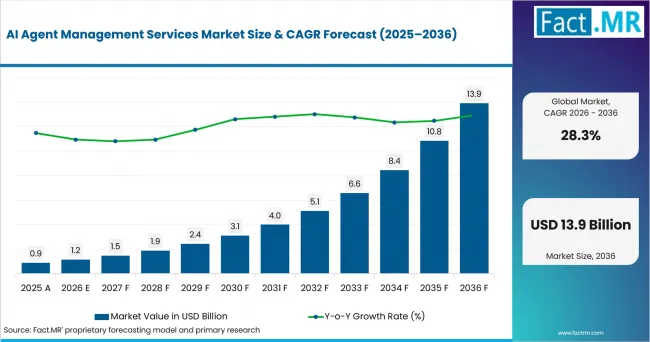
Ai Agent Management Services Market Value Analysis | Source: Fact.MR
What are the defining numbers behind AI Agent Management Services Market growth?
USD 12.7 billion absolute opportunity by 2036, led by Agent deployment & integration alongside Fully managed delivery and Technology end use.
- Demand Drivers in the Market
- Operations teams need deployment playbooks that connect agents to business systems with clear permissions.
- Customer service leaders need supervised agents that escalate cases when human review is required.
- Technology teams need monitoring evidence because agents call tools and retrieve internal data.
- Procurement heads need managed service terms that cover tuning, lifecycle control and AI cost review.
- Key Segments Analyzed
- By Service: Agent deployment & integration is expected to hold 31.0% share in 2026 due to connector and workflow mapping needs.
- By Deployment Model: Fully managed delivery is projected to account for 52.0% share in 2026 since enterprises need outside ownership after launch.
- By End-Use: Technology is anticipated to capture 29.0% share in 2026 because software teams test agentic workflow tools early.
- Analyst Opinion at Fact.MR
- Shambhu Nath Jha, Principal Consultant at Fact.MR states, "Agent services are drawing attention because deployment is not the hard stop. Production contracts are expected to depend on governance, cost control and monitored handoffs. Providers should combine integration depth with AI agent assurance."
- Strategic Implications
- CIOs should approve agent access rules before service-level negotiations begin.
- Risk teams should require security gates because the UK Cyber Security Breaches Survey 2025/2026 reported that 24% of businesses using, adopting or actively considering AI had cyber security practices or processes in place to manage AI-related risks.
- Procurement teams should test whether providers can support AgentOps services after initial workflow launch.
- Service providers should bundle integration, monitoring and AI agent assurance into repeatable managed packages.
Australia is projected to post 30.1% CAGR through 2036 supported by SME AI use. The United States is expected to record 29.5% CAGR because large enterprises are scaling AI. Canada is forecast to advance at 29.2% CAGR due to AI funding and business adoption. The United Kingdom is anticipated to reach 29.1% CAGR through service-sector use. Germany is estimated at 28.1% CAGR as generative AI planning expands. Japan records 27.8% CAGR as cautious implementation raises service needs.
How does the AI Agent Management Services Market break down by segment?
Agent deployment & integration leads Service at 31.0%; Fully managed delivery leads Deployment Model at 52.0%.
Which service dominates?
Agent deployment & integration is projected to account for 31.0% share in 2026.
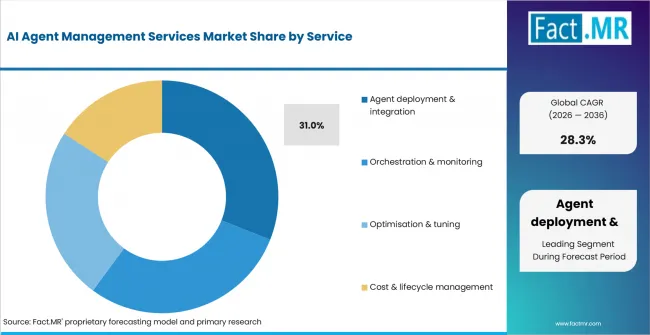
Ai Agent Management Services Market Analysis By Service | Source: Fact.MR
Agent deployment & integration is projected to lead Service because enterprises need agents connected to CRM and ERP systems before release. Orchestration and monitoring follows where agent behavior needs review.
What leads the Deployment Model segment?
Fully managed delivery is expected to hold 52.0% share in 2026.
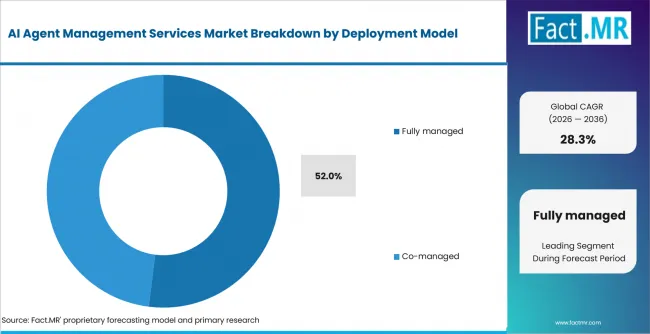
Ai Agent Management Services Market Analysis By Deployment Model | Source: Fact.MR
Fully managed delivery is expected to lead Deployment Model since many enterprises lack internal agent operations teams. Co-managed work remains material where clients retain workflow ownership. Wipro announced in August 2025 that it had developed 200 production-ready agentic AI solutions with Google Cloud across industries and business functions.
How does End-Use shape demand?
Technology is anticipated to lead with 29.0% share in 2026.
Technology is anticipated to lead End-Use with 29.0% share in 2026 because software firms increasingly test agents across customer support, engineering and internal workflow environments. Demand is supported by the need to evaluate agent reliability, workflow integration and operational performance before wider enterprise deployment.
What is accelerating AI Agent Management Services Market adoption, and what is holding it back?
Production deployment drives it; accountability gaps restrain it.
Drivers Impact Analysis
| Driver | (~) % Impact on CAGR | Geographic Relevance | Impact Timeline |
|---|---|---|---|
| Production agent deployment | +4.8% | United States, United Kingdom, Canada | Short term (<= 2 years) |
| Managed lifecycle ownership | +4.2% | Large-enterprise markets | Short term (<= 2 years) |
| Orchestration and monitoring | +3.6% | Technology and BFSI clusters | Medium term (2-4 years) |
| Customer-service automation | +2.9% | BPO and contact-center hubs | Medium term (2-4 years) |
| AI cost and tuning control | +2.1% | Cloud-heavy enterprises | Long term (>= 4 years) |
- Production agent deployment: Enterprise accounts are expected to move from experiments to workflow launch. Accenture expanded AI Refinery in March 2025 with an AI agent builder for business users.
- Managed lifecycle ownership: Live agents require versioning and failure review after deployment. Infosys launched Agentic AI Foundry in May 2025 to support enterprise AI journeys.
- Orchestration and monitoring: Multi-agent workflows need routing visible to business owners. TCS said in October 2025 that Gemini Enterprise supports agent-to-agent communication.
Opportunity Impact Analysis
| Opportunity | (~) % Impact on CAGR | Geographic Relevance | Impact Timeline |
|---|---|---|---|
| Managed AgentOps retainers | +2.0% | United States, Canada, Australia | Short term (<= 2 years) |
| BFSI control packages | +1.6% | United States, United Kingdom, Germany | Medium term (2-4 years) |
| Context engineering services | +1.3% | Technology end users | Medium term (2-4 years) |
| Compliance-linked assurance | +1.0% | Europe and Japan | Long term (>= 4 years) |
- Managed AgentOps retainers: Enterprises are anticipated to buy ongoing support when agents need monitoring after release. Retainers can cover updates and feedback loops.
- BFSI control packages: Banks and insurers need access approvals before agents reach customer data. Service partners are expected to package audit logs and exception routing.
- Context engineering services: Agents depend on clean knowledge sources before they act on enterprise data. Demand for context engineering services is expected to rise beside deployment support.
- Compliance-linked assurance: European customers are expected to align agent projects with AI Act conformity. Clear evidence records can convert assurance into recurring monitoring.
Restraints Impact Analysis
| Restraint | (~) % Impact on CAGR | Geographic Relevance | Impact Timeline |
|---|---|---|---|
| Unclear accountability | -2.0% | Global enterprise accounts | Short term (<= 2 years) |
| Security and data exposure | -1.6% | United States, Australia, United Kingdom | Short term (<= 2 years) |
| Skills and handover gaps | -1.2% | Australia, Japan, Germany | Medium term (2-4 years) |
| Integration cost pressure | -0.9% | Midmarket accounts | Medium term (2-4 years) |
- Security and data exposure: Agents can retrieve sensitive records if controls are weak. The FBI reported on 6 April 2026 that cyber-enabled crimes caused nearly USD 21 billion in reported losses in 2025.
- Skills and handover gaps: Internal teams need enough AI operations knowledge to supervise provider work. Training is projected to decide co-managed service scale.
- Integration cost pressure: Agents need connectors and permission testing before workflow release. Buyers are anticipated to stage projects until providers prove measurable savings.
Which countries are scaling AI Agent Management Services Market fastest?
- The country comparison spans 2.30 percentage points across the forecast period.
- Australia remains 0.55 percentage point above the United States due to SME AI use and external implementation need.
- The United States remains 0.36 percentage point above Canada through enterprise software depth and consulting capacity.
- Canada remains 0.10 percentage point above the United Kingdom as public AI funding supports managed adoption.
- The United Kingdom remains 1.00 percentage point above Germany through service-sector AI programs.
- Germany remains 0.29 percentage point above Japan as corporate generative AI planning expands faster.
- Japan closes the displayed range as cautious rollout raises training and handover needs.
Comparable CAGRs create different entry conditions due to AI maturity, cloud readiness and cybersecurity review. Full report coverage includes North America; Latin America; Europe; East Asia; South Asia and Pacific; Middle East and Africa.
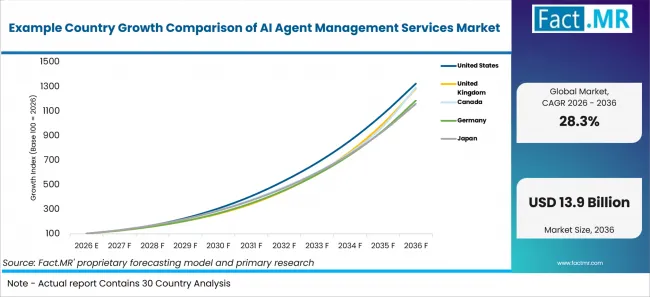
Example Country Growth Comparison Of Ai Agent Management Services Market | Source: Fact.MR
| Country | CAGR (2026-2036) |
|---|---|
| Australia | 30.1% |
| United States | 29.5% |
| Canada | 29.2% |
| United Kingdom | 29.1% |
| Germany | 28.1% |
| Japan | 27.8% |
What supports Australia adoption?
30.1% CAGR, backed by SME AI use and external workflow deployment.
Australia’s growth reflects rising AI adoption across businesses and SMEs. ABS reported that 12% of Australian businesses used AI in 2024–25, while the National AI Centre reported that 43% of Australian SMEs showed some level of AI adoption across December 2025 to February 2026. Cybersecurity exposure, skills gaps and uncertainty around provider pricing may slow managed-agent deployment.
How is the United States scaling demand?
29.5% CAGR, supported by large-firm AI use and service delivery depth.
United States growth is supported by strong enterprise AI adoption and a large technology-services workforce. The U.S. Census Bureau reported that 37% of firms with at least 250 employees used AI, while revised
BLS data showed about 2,369.2 million seasonally adjusted jobs in computer systems design and related services in June 2026. Cybercrime exposure, approval complexity and cost-control concerns may constrain deployments.
What underpins Canada growth?
29.2% CAGR, shaped by business AI use and trusted implementation needs.
Canada’s growth is supported by rising business AI adoption and government-backed implementation programs. Statistics Canada reported that 19.2% of businesses had used AI to produce goods or deliver services over the previous 12 months in Q2 2026, while Canada’s AI for All strategy includes CAD 500 million to expand the Regional Artificial Intelligence Initiative. Cybersecurity reviews, privacy requirements and bilingual documentation may lengthen managed-service approvals.
How is the United Kingdom developing service demand?
29.1% CAGR, driven by business AI use and national AI delivery programs.
United Kingdom growth reflects rising enterprise AI use and expanding national investment. ONS reported that 26% of businesses used at least one type of AI technology in March 2026, while the UK government reported that five AI Growth Zones across Great Britain were generating GBP 28.2 billion in investment. Cyber breaches, readiness gaps and documentation demands may slow deployment.
What supports Germany adoption?
28.1% CAGR, supported by AI use and wider generative AI planning.
Germany’s growth is supported by broader enterprise AI adoption and accelerating generative AI planning. Destatis reported that 26% of German enterprises used AI in 2025, while Bundesbank data indicated that the share of firms using or planning to use generative AI was expected to rise to 56% in 2026. Cybersecurity risks, legal uncertainty and legacy-system integration may restrain deployment.
How does Japan perform?
27.8% CAGR, led by GENIAC activity and careful enterprise implementation.
Japan’s growth reflects active generative AI development and cautious enterprise governance. METI reported that a GENIAC results session featured 24 selected foundation-model developers presenting their achievements, while three newly selected Data and Generative AI Utilization Demonstration participants presented outlines of their projects. Lower workplace AI use, training requirements and extensive change-control needs may slow managed-agent deployment.
Who leads the AI Agent Management Services Market?
Accenture and Cognizant show the direct service relevance. Infosys, TCS, Capgemini and Wipro broaden the managed delivery field.
Accenture shows direct relevance through AI Refinery and its industry agent portfolio. Cognizant supports enterprise agent buildout through its Neuro AI Multi-Agent Accelerator and Services Suite. Infosys adds more than 200 enterprise AI agents released in May 2025. TCS strengthens agentic orchestration through cloud integration experience. Capgemini and Wipro extend the field through agentic AI services tied to customer operations.
Which companies are the key providers?
Key providers include Accenture; Cognizant; Infosys; TCS; Capgemini; and Wipro.
- Accenture
- Cognizant
- Infosys
- TCS
- Capgemini
- Wipro
Bibliography
- Accenture. (2025, January 6). Accenture launches AI Refinery for Industry to reinvent processes and accelerate agentic AI journeys.
- Accenture. (2025, March 18). Accenture expands AI Refinery and launches new industry agent solutions to accelerate agentic AI adoption.
- Australian Bureau of Statistics. (2026, June 25). Characteristics of Australian Business, 2024–25 financial year.
- Australian Signals Directorate. (2025, October 14). Australian Signals Directorate releases the Annual Cyber Threat Report 2024–25.
- Capgemini. (2025, March 19). Capgemini accelerates enterprise adoption of agentic AI for industries with NVIDIA.
- Canadian Centre for Cyber Security. (2026, January 28). Ransomware threat outlook 2025–2027.
- Cognizant. (2025, January 16). Cognizant leads enterprises into next generation of AI adoption with Neuro® AI Multi-Agent Accelerator and Multi-Agent Services Suite.
- Statistisches Bundesamt. (2025, November 24). Enterprises using artificial intelligence (AI) technologies, by employment size class, 2025.
- Deutsche Bundesbank. (2026, March 26). Sectoral structural change and its impact on productivity growth in the euro area.
- Federal Bureau of Investigation. (2026, April 6). Cryptocurrency and AI scams bilk Americans of billions.
- Innovation, Science and Economic Development Canada. (2026, June 8). Canada's National Artificial Intelligence Strategy: AI for All.
- Department for Science, Innovation and Technology. (2026, January 29). AI Opportunities Action Plan: One Year On.
- Infosys. (2025, May 28). Infosys launches Agentic AI Foundry, part of Infosys Topaz™, to accelerate enterprise AI journey.
- Infosys. (2025, May 29). Infosys launches over 200 enterprise AI agents, part of Infosys Topaz™ AI offerings and Google Cloud.
- Organisation for Economic Co-operation and Development. (2025, November 28). Artificial intelligence and the labour market in Japan. OECD Publishing.
This Report Answers
- The report provides strategic intelligence on the AI Agent Management Services Market across Service and Deployment Model choices.
- Segment analysis covers Agent deployment & integration and Fully managed delivery as the share leaders within the 2026 market.
- Country outlook evaluates Australia and the United States alongside Canada, the United Kingdom, Germany and Japan.
- Competitive analysis profiles Accenture and Cognizant alongside Infosys, TCS, Capgemini and Wipro.
- Service assessment covers deployment, orchestration and lifecycle management. Monitoring and managed infrastructure services complete the operating view.
What does the AI Agent Management Services Market cover?
AI agent management services cover professional and managed services used to move enterprise agents into controlled production.
The market includes deployment planning; workflow integration; orchestration support; monitoring; tuning; and lifecycle management. Coverage connects to frontier AI red-teaming where testing supports release decisions.
What is included in the scope?
The scope includes deployment and integration services alongside orchestration and monitoring.
Optimisation and tuning are included where providers improve performance after release. Fully managed and co-managed models are covered where cloud managed services experience supports monitoring.
What is excluded from the scope?
The scope excludes standalone AI agent software sold without managed services.
Basic chatbot development and general IT outsourcing are excluded when they do not manage AI agents.
How Was the Analysis Built?
The analysis draws on 120+ sources, 35+ company portfolios, 25+ countries, and more than 20 industry interviews.
- Primary Research: Primary research includes discussions with manufacturers, service providers, technology developers, distributors, end users, procurement teams, and subject-matter experts. These conversations examine purchasing priorities, product adoption, operational challenges, approval requirements, competitive positioning, and the factors that influence wider market acceptance.
- Desk Research: Desk research covers government statistics, regulatory publications, company filings, trade data, technical studies, industry associations, standards, public policy, and other authoritative sources. Every source used in the analysis is documented in the bibliography.
- Market Sizing and Forecasting: Market estimates combine historical performance, demand indicators, pricing and volume trends, segment shares, company participation, country-level growth, adoption patterns, investment activity, and barriers to market expansion.
- Data Validation and Update Cycle: Findings are validated by comparing primary interviews with public data, company activity, regulatory changes, trade patterns, and industry developments. Regular updates review new product launches, capacity changes, partnerships, approvals, procurement trends, and shifts in commercial adoption.
What is the report's scope and coverage?
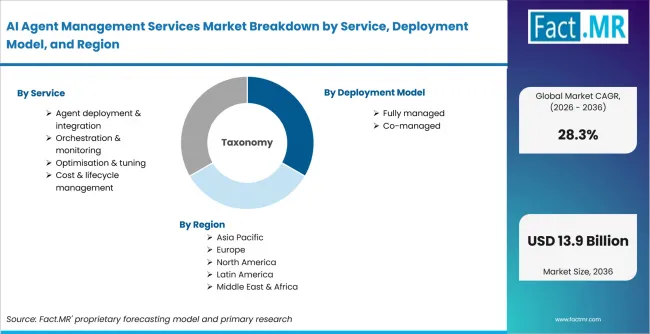
Ai Agent Management Services Market Breakdown By Service, Deployment Model, And Region | Source: Fact.MR
| Attribute | Details |
|---|---|
| Quantitative Units | USD billion in 2026 to USD billion by 2036 at CAGR |
| Market Definition | Managed professional services used to deploy, integrate, monitor, tune and govern enterprise AI agents after pilots move into production |
| Service | Agent deployment & integration; Orchestration & monitoring; Optimisation & tuning; Cost & lifecycle management |
| Deployment Model | Fully managed; Co-managed |
| End-Use | Technology; BFSI; Customer service & BPO; Healthcare; Retail |
| Regions Covered | North America; Latin America; Europe; East Asia; South Asia and Pacific; Middle East and Africa |
| Countries Covered | Australia; United States; Canada; United Kingdom; Germany; Japan |
| Key Companies Profiled | Accenture; Cognizant; Infosys; TCS; Capgemini; Wipro |
| Forecast Period | 2026 to 2036 |
| Approach | Hybrid top-down and bottom-up approach using AI adoption evidence, enterprise service intensity, agent deployment patterns, managed-service demand, country-level indicators, provider portfolio checks and company development review |
How is the market segmented?
-
By Service:
- Agent deployment & integration
- Orchestration & monitoring
- Optimisation & tuning
- Cost & lifecycle management
-
By Deployment Model:
- Fully managed
- Co-managed
-
By End-Use:
- Technology
- BFSI
- Customer service & BPO
- Healthcare
- Retail
-
By Region:
- North America
- Europe
- East Asia
- South Asia & Pacific
- Latin America
- Middle East & Africa