- Market Value (2025): USD 1.3 Bn
- Estimated Value (2026): USD 1.7 Bn
- Forecast Value (2036): USD 16.1 Bn
- CAGR (2026-2036): 25.6%
What is the AI Governance Managed Services Market forecast to be worth by 2036?
USD 1.7 billion in 2026 to USD 16.1 billion by 2036 at 25.6% CAGR.
- The AI Governance Managed Services Market was valued at USD 1.3 billion in 2025, with enterprise AI moving beyond pilot projects.
- Demand is projected to increase from USD 1.7 billion in 2026 to USD 16.1 billion by 2036.
- The market is forecast to record 25.6% CAGR from 2026 to 2036 as risk teams, audit groups and AI product owners formalize control work.
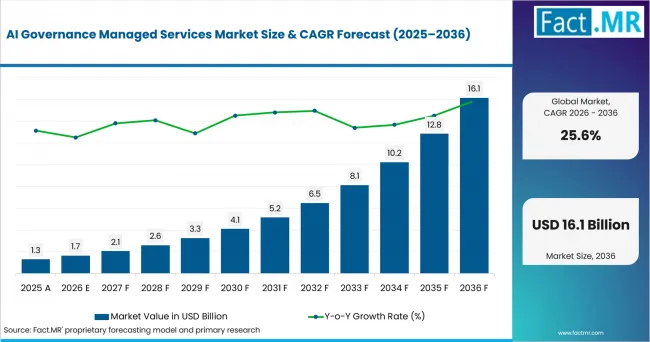
Ai Governance Managed Services Market Value Analysis | Source: Fact.MR
What are the defining numbers behind AI Governance Managed Services Market growth?
USD 14.5 billion absolute opportunity by 2036, led by Model risk & compliance, Fully managed delivery and BFSI.
- Demand Drivers in the Market
- Risk leaders need external operating support when AI policies must become model inventories, validation files and committee-ready evidence.
- AI product owners need monitoring partners so deployed models remain tied to approvals, threshold changes and exception logs.
- Privacy teams need managed documentation when business users apply third-party AI tools to customer, employee or operational data.
- Internal audit teams need repeatable assurance packs because model changes must remain explainable after launch.
- Key Segments Analyzed
- By Service: Model risk & compliance is expected to hold 30.0% share in 2026 owing to its direct role in model inventories and approval evidence.
- By Deployment Model: Fully managed is projected to account for 56.0% share in 2026 because many enterprises need outsourced operating capacity.
- By End-Use: BFSI is anticipated to capture 32.0% share in 2026 as banks and insurers require audit trails around AI decisions.
- By Organization Size: Large enterprises are estimated to represent 68.0% share in 2026 due to wider AI estates and board-level review expectations.
- Analyst Opinion at Fact.MR
- Shambhu Nath Jha, Principal Consultant at Fact.MR, states, “Managed governance is becoming the evidence desk behind enterprise AI. Demand is expected to favor providers that keep model records and monitoring logs current. Clear service cases combine policy knowledge, technical testing and defined ownership.”
- Strategic Implications
- Boards should ask for a single AI control record before approving customer-facing models.
- Risk teams should separate advisory work from recurring monitoring so service scope stays measurable.
- Service providers should build reusable control libraries for BFSI, healthcare and public-sector accounts.
- Investors should distinguish managed governance revenue from one-time consulting around AI policy drafts.
Australia is forecast to record 27.7% CAGR through 2036, supported by SME AI use. Canada is projected to post 27.0% CAGR as privacy oversight widens governance needs. The United States is anticipated to advance at 26.2% CAGR due to federal AI procurement guidance. France is estimated to reach 26.2% CAGR as adoption programs expand. The United Kingdom is forecast to hold 25.8% CAGR owing to formal policy gaps. Germany is projected to record 25.7% CAGR as data-protection concerns shape deployments.
How does the AI Governance Managed Services Market break down by segment?
Model risk & compliance leads Service at 30.0%; Fully managed leads Deployment Model at 56.0%.
Which service dominates?
Model risk & compliance is projected to hold 30.0% share in 2026.
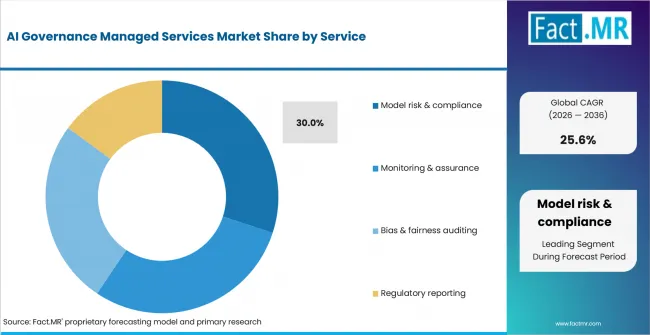
Ai Governance Managed Services Market Analysis By Service | Source: Fact.MR
Model risk & compliance is projected to lead Service with 30.0% share in 2026 because enterprises need clear ownership of model inventories, validation evidence and governance controls. Demand is expected to rise as organizations formalize AI oversight, document model decisions and strengthen compliance processes across regulated and customer-facing applications.
What leads the Deployment Model segment?
Fully managed is expected to hold 56.0% share in 2026.
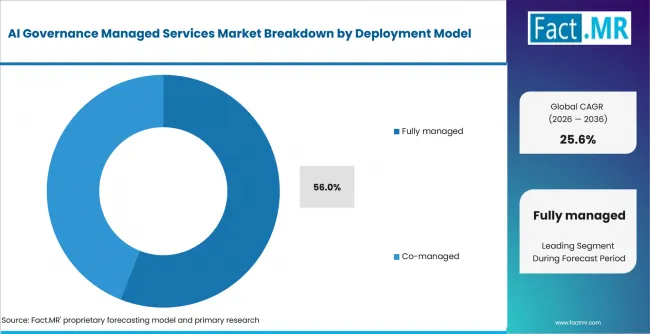
Ai Governance Managed Services Market Analysis By Deployment Model | Source: Fact.MR
Fully managed services are expected to lead Deployment Model with 56.0% share in 2026 because many enterprises lack specialist AI-control resources after deployment. The UK Business Data Survey 2026 reported in June 2026 that 17% of AI-using businesses had an AI policy or guidelines.
How does End-Use shape demand?
BFSI is anticipated to hold 32.0% share in 2026.
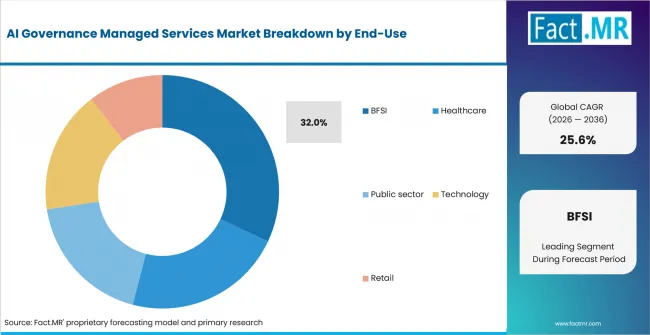
Ai Governance Managed Services Market Analysis By End Use | Source: Fact.MR
BFSI is anticipated to lead End-Use with 32.0% share in 2026 because financial institutions already rely on structured model validation, audit trails and customer-impact documentation. Growing AI use across lending, fraud detection and customer service is expected to increase demand for independent governance, monitoring and compliance support.
What supports Large enterprises within Organization Size?
Large enterprises are estimated to represent 68.0% share in 2026.
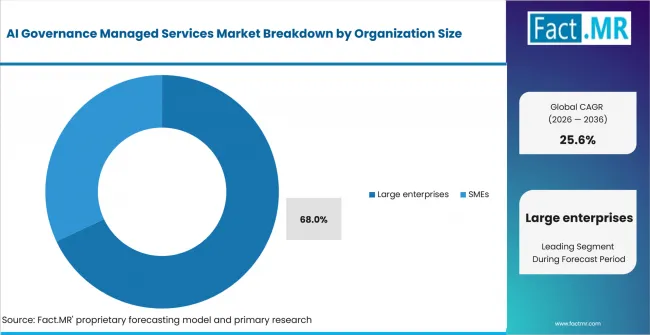
Ai Governance Managed Services Market Analysis By Organization Size | Source: Fact.MR
Large enterprises are estimated to lead Organization Size with 68.0% share in 2026 because governance complexity rises with business-unit count and board scrutiny. ONS reported in January 2026 that 44% of businesses with 250 employees or more were using some form of AI technology in late December 2025, indicating a substantial large-enterprise base for AI governance and oversight.
What is accelerating AI Governance Managed Services Market adoption, and what is holding it back?
Regulatory evidence drives it; accountability gaps restrain it.
Drivers Impact Analysis
| DRIVER | (~) % IMPACT ON CAGR | GEOGRAPHIC RELEVANCE | IMPACT TIMELINE |
|---|---|---|---|
| Regulatory evidence burden | +5.8% | USA, United Kingdom, EU | Short term (<= 2 years) |
| Agentic AI control needs | +4.7% | USA, Canada, Australia | Short term (<= 2 years) |
| Model inventory and monitoring | +3.9% | BFSI, healthcare and technology | Medium term (2-4 years) |
| Third-party data governance | +3.3% | Europe and North America | Medium term (2-4 years) |
| Internal audit readiness | +2.4% | Large enterprises | Long term (>= 4 years) |
Source: Fact.MR analysis. Updated Aug 18, 2026
- Regulatory evidence burden: Governance work is shifting from policy writing to proof management. Enterprises are expected to favor providers that keep model records current.
- Agentic AI control needs: Agent workflows add identity and data-access risks after deployment. Providers test tool use and exceptions after release.
- Model inventory and monitoring: Large AI estates require inventory discipline before risks are ranked. Buyers are projected to value evidence exports that shorten audit preparation.
- Third-party data governance: Enterprises use vendor models that touch sensitive data. Managed services map permissions, retention rules and contractual controls.
- Internal audit readiness: Audit committees ask how AI decisions are controlled after launch. Providers translate AI behavior into board-readable evidence.
Opportunity Impact Analysis
| OPPORTUNITY | (~) % IMPACT ON CAGR | GEOGRAPHIC RELEVANCE | IMPACT TIMELINE |
|---|---|---|---|
| Managed AI policy desks | +2.0% | United Kingdom, Canada | Short term (<= 2 years) |
| Agent audit programs | +1.8% | USA and Australia | Medium term (2-4 years) |
| AI Act readiness support | +1.5% | Germany and France | Medium term (2-4 years) |
| SME evidence automation | +1.1% | Canada, France, Australia | Long term (>= 4 years) |
Source: Fact.MR analysis. Updated Aug 18, 2026
- Managed AI policy desks: Enterprises need help turning policy into user guidance and model-owner duties. Service desks route high-risk use cases.
- Agent audit programs: Agentic workflows need testing across prompts and tool use. Managed programs are expected to pair technical checks with reviewer sign-off.
- AI Act readiness support: European enterprises need classification and conformity support for high-risk systems. Providers package obligation mapping with control tests.
- SME evidence automation: Smaller companies need light controls without large governance teams. Automated evidence templates make managed services easier to buy.
Restraints Impact Analysis
| RESTRAINT | (~) % IMPACT ON CAGR | GEOGRAPHIC RELEVANCE | IMPACT TIMELINE |
|---|---|---|---|
| Unclear accountability | -2.2% | Global | Short term (<= 2 years) |
| Skilled reviewer shortage | -1.8% | USA, Europe, Australia | Short term (<= 2 years) |
| Data access limits | -1.4% | BFSI and healthcare | Medium term (2-4 years) |
| Service scope creep | -1.0% | Large enterprises and SMEs | Long term (>= 4 years) |
Source: Fact.MR analysis. Updated Aug 18, 2026
- Unclear accountability: AI governance spans legal, risk and technology teams. Contract value is expected to depend on clear decision rights.
- Skilled reviewer shortage: Governance services need people who understand controls and AI behavior. Review capacity is anticipated to lag demand in regulated sectors.
- Data access limits: Sensitive models cannot always be tested with full production data. Buyers are anticipated to require secure workspaces before outsourcing review work.
- Service scope creep: Governance engagements can expand into consulting and platform work. Providers should define review frequency, evidence outputs and escalation paths at signing.
Which countries are scaling AI Governance Managed Services Market fastest?
- The country comparison spans 2.00 percentage points.
- Australia remains 0.65 percentage point above Canada through SME AI use.
- Canada remains 0.82 percentage point above the United States through privacy oversight.
- The United States remains 0.03 percentage point above France through federal procurement guidance and enterprise AI use.
- France remains 0.38 percentage point above the United Kingdom as national adoption programs expand support needs.
- The United Kingdom remains 0.12 percentage point above Germany through policy formalization.
- Germany closes the displayed range as data-protection concerns convert AI use into governance-service demand.
Comparable CAGRs create different entry conditions due to regulation, cloud readiness and sector mix. Full coverage includes North America, Latin America, Europe, East Asia, South Asia and Pacific, Middle East and Africa.
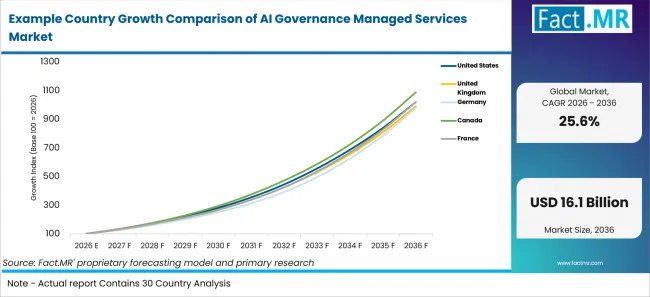
Example Country Growth Comparison Of Ai Governance Managed Services Market | Source: Fact.MR
| Country | CAGR |
|---|---|
| Australia | 27.7% |
| Canada | 27.0% |
| United States | 26.2% |
| France | 26.2% |
| United Kingdom | 25.8% |
| Germany | 25.7% |
Source: Fact.MR analysis. Updated Aug 18, 2026
How is Australia scaling demand?
27.7% CAGR through 2036, supported by business AI use and managed-risk education.
Australia’s growth is supported by expanding business AI adoption and rising demand for formal governance. ABS reported 12% of businesses used AI in 2024-25, while more than one-third of SMEs had adopted AI. Cybersecurity exposure, limited internal skills and complexity around governance templates may restrain faster service uptake.
How is Canada developing demand?
27.0% CAGR through 2036, backed by business AI diffusion and privacy oversight.
Canada’s growth reflects expanding AI use and stronger privacy-governance requirements. The Privacy Commissioner reported 16% of surveyed businesses used AI, while ISED targets business adoption rising from 12% to 60% by 2034. Cybersecurity concerns, provincial differences and human-review requirements may lengthen governance-service implementation.
What is powering United States adoption?
26.2% CAGR through 2036, driven by large-enterprise AI use and federal AI governance.
United States growth is supported by expanding business AI adoption and formal federal governance requirements. U.S. Census Bureau data showed that the national business AI-use rate reached 19.8% for the data-collection period ending May 3, 2026, while OMB issued revised federal policies governing AI use and procurement. Cybercrime exposure, fragmented policy requirements and shadow AI may increase governance complexity.
What supports France growth?
26.2% CAGR through 2036, shaped by business AI expansion and national adoption programs.
France’s growth is supported by rising enterprise AI use and government-led adoption programs. INSEE reported that 18% of French enterprises with 10 or more employees used at least one AI technology in 2025, while France’s Osez l’IA plan targets AI adoption by 2030 across 100% of large companies, 80% of SMEs and ETIs, and 50% of TPEs. Skills shortages, localization needs and governance ownership challenges may slow implementation.
How is the United Kingdom scaling service demand?
25.8% CAGR through 2036, supported by AI adoption and formal-policy gaps.
United Kingdom growth reflects expanding business AI use and demand for stronger internal policies. ONS reported in January 2026 that 25% of businesses were using some form of AI technology in late December 2025, while UK AI policy initiatives address business-data access and governance, including the use of proprietary and sensitive data. Cybersecurity incidents, budget discipline and procurement assurance requirements may support cautious, structured governance-service adoption.
What underpins Germany demand?
25.7% CAGR through 2036, led by enterprise AI use and data-protection pressure.
Germany’s growth is supported by strong enterprise AI adoption and strict data-protection expectations. ECB reported 47% of German firms used AI moderately or significantly in late 2025. Privacy concerns, works-council reviews and cross-border data requirements are expected to increase demand for structured governance while extending approval cycles.
Who leads the AI Governance Managed Services Market?
Accenture and Deloitte show the managed-service relevance, while IBM strengthens the platform-linked governance layer.
Accenture combines AI operating models, platform implementation and managed service delivery. Deloitte brings regulatory and assurance depth for model governance evidence. IBM supports the field through watsonx.governance capabilities for monitoring and compliance workflows. IBM announced agent monitoring and security metrics in October 2025. PwC, Capgemini and EY extend the provider set through technology risk and assurance work.
Which companies are the key providers?
Companies include Accenture, Deloitte, IBM, PwC, Capgemini, and EY.
- Accenture
- Deloitte
- IBM
- PwC
- Capgemini
- EY
How is the market segmented?
-
By Service
- Model risk & compliance
- Monitoring & assurance
- Bias & fairness auditing
- Regulatory reporting
-
By Deployment Model
- Fully managed
- Co-managed
-
By End-Use
- BFSI
- Healthcare
- Public sector
- Technology
- Retail
-
By Organization Size
- Large enterprises
- SMEs
-
By Region
- North America
- Latin America
- Europe
- East Asia
- South Asia and Pacific
- Middle East and Africa
Bibliography
- Accenture. (2025, March 18). Accenture expands AI Refinery and launches new industry agent solutions to accelerate agentic AI adoption.
- Australian Bureau of Statistics. (2026, June 25). Characteristics of Australian Business, 2024–25 financial year.
- Australian Signals Directorate. (2025, October 14). Annual Cyber Threat Report 2024–2025.
- Department for Science, Innovation and Technology. (2026, April 30). Cyber security breaches survey 2025/2026. GOV.UK.
- Statistisches Bundesamt. (2025, November 24). Reasons against the use of artificial intelligence technologies, by employment size class, 2025.
- European Central Bank. (2026, February 2). Survey on the Access to Finance of Enterprises in the euro area – Fourth quarter of 2025.
- Eurostat. (2025, December 11). 20% of EU enterprises use AI technologies.
- Federal Bureau of Investigation. (2026, April 6). Cryptocurrency and AI scams bilk Americans of billions.
- Department for Science, Innovation and Technology. (2026, June 18). UK Business Data Survey 2026. GOV.UK.
This Report Answers
- The report provides strategic intelligence on the AI Governance Managed Services Market across service choices and deployment models that shape outsourced governance programs.
- Segment analysis covers Model risk & compliance and Fully managed delivery as the share leaders within the 2026 market.
- Country outlook evaluates Australia and Canada alongside the United States, France, the United Kingdom and Germany.
- Competitive analysis profiles Accenture and Deloitte alongside IBM and PwC. Capgemini and EY complete the provider set.
- Service assessment covers monitoring, bias auditing and regulatory reporting alongside organization-size demand.
What does the AI Governance Managed Services Market cover?
The market covers managed programs for AI inventories and model-risk reviews. It overlaps with AI governance software when service teams record approval evidence.
Coverage includes monitoring and release evidence after deployment. Adjacent ModelOps platforms are included only when the provider operates client governance.
The market includes readiness work for high-risk AI systems. AI Act conformity services remain adjacent without recurring governance operation.
What is included in the scope?
The scope includes recurring contracts for model risk and bias evidence. Managed synthetic data governance is included when synthetic data affects model approval.
Enterprise programs covering data location and model access are included where service teams operate controls. Sovereign AI enablement stays in scope only when governance support is managed.
What is excluded from the scope?
The scope excludes AI consulting that ends at strategy advice. It also excludes financial services GenAI when engagements lack governance operation.
General IT outsourcing remains outside unless it operates AI governance controls. Standard cloud managed services are excluded when coverage is infrastructure only. Cybersecurity monitoring is excluded unless tied to AI model risk or data-use governance. Standalone managed security services are outside the scope without AI-specific evidence.
How Was the Analysis Built?
The analysis draws on 120+ sources, 35+ company portfolios, 25+ countries and more than 20 industry interviews.
- Primary Research: Primary research includes discussions with service providers, AI governance leaders, risk officers and enterprise technology buyers. These conversations examine service scope and evidence needs.
- Desk Research: Desk research covers government statistics, regulator publications, company releases, public policy, standards and company portfolios. Every third-party evidence source retained in the published analysis appears in the bibliography.
- Market Sizing and Forecasting: Market estimates combine historical performance, adoption indicators, segment shares, country growth, service contracts and barriers to expansion.
- Data Validation and Update Cycle: Findings are validated against public data, company activity, regulatory changes and service developments. Updates review launches, guidance changes and enterprise adoption.
Segmentation
What is the report’s scope and coverage?
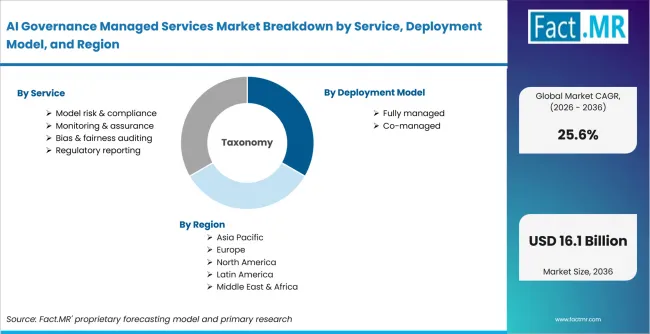
Ai Governance Managed Services Market Breakdown By Service, Deployment Model, And Region | Source: Fact.MR
| Attribute | Details |
|---|---|
| Quantitative Units | USD billion in 2026 to USD billion by 2036 at CAGR |
| Market Definition | Outsourced services that operate AI governance programs covering model risk, compliance, monitoring, fairness auditing, reporting and control evidence |
| Service | Model risk & compliance; Monitoring & assurance; Bias & fairness auditing; Regulatory reporting |
| Deployment Model | Fully managed; Co-managed |
| End-Use | BFSI; Healthcare; Public sector; Technology; Retail |
| Organization Size | Large enterprises; SMEs |
| Regions Covered | North America; Latin America; Europe; East Asia; South Asia and Pacific; Middle East and Africa |
| Countries Covered | Australia; Canada; United States; France; United Kingdom; Germany |
| Key Companies Profiled | Accenture; Deloitte; IBM; PwC; Capgemini; EY |
| Forecast Period | 2026 to 2036 |
| Approach | Hybrid top-down and bottom-up approach using AI adoption indicators; risk spending; managed-service contracts; regulatory activity; country patterns; segment shares; company portfolio review and interviews |
Source: Fact.MR analysis. Updated Aug 18, 2026
Frequently Asked Questions
How big is the AI governance managed services market in 2026?
What is the CAGR of the AI governance managed services market from 2026 to 2036?
Which service leads the AI governance managed services market?
Which deployment model leads the AI governance managed services market?
Who are the leading companies in the AI governance managed services market?
Who worked on this report


Preview the report firsthand - request a free sample
Free SampleGet the brochure for pricing and purchase details
Download PDF