- Market Value (2025): USD 140.7 Mn
- Estimated Value (2026): USD 167.8 Mn
- Forecast Value (2036): USD 979.9 Mn
- CAGR (2026-2036):19.3%
What is the AI-Optimization for Quantum Computing Market forecast to be worth by 2036?
USD 167.8 million in 2026 to USD 979.9 million by 2036, at 19.3% CAGR.
- The AI-Optimization for Quantum Computing Market crossed a valuation of USD 140.7 million in 2025 as enterprise experimentation moved toward repeatable software workflows.
- Demand is projected to increase from USD 167.8 million in 2026 to USD 979.9 million by 2036 across circuit and control optimization use cases.
- The market is forecast to record a 19.3% CAGR from 2026 to 2036 as enterprise research teams and quantum developers automate expensive tuning cycles.
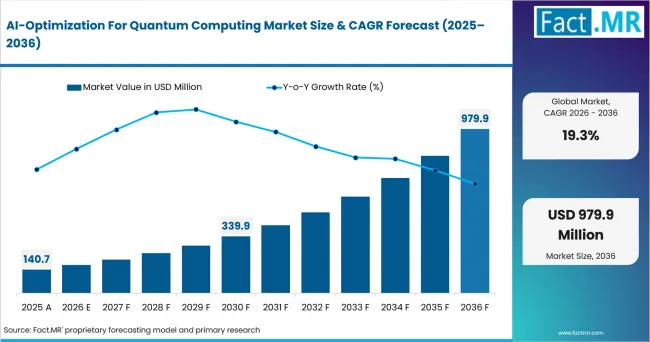
Ai Optimization For Quantum Computing Market Market Value Analysis | Source: Fact.MR
What are the defining numbers behind AI-Optimization for Quantum Computing Market growth?
USD 812.1 million absolute opportunity by 2036, led by Software and Cloud deployment alongside BFSI enterprise programs.
- Demand Drivers in the Market
- Quantum developers need automated circuit synthesis because manual gate-level tuning slows algorithm portability across quantum processors that use different hardware constraints.
- Enterprise research teams need cross-hardware optimization supported by cloud orchestration that preserves workflow logic when experiments move between quantum backends.
- Quantum operations teams need error-aware calibration owing to unstable device behavior that requires repeated measurement and parameter adjustment before useful computation begins.
- Financial modeling groups need hybrid workflow orchestration shaped by costly quantum access and classical preprocessing requirements across optimization and risk-analysis programs.
- Key Segments Analyzed
- By Component: Software is estimated to account for 31.7% share in 2026, supported by demand for reusable synthesis and transpilation layers across diverse hardware.
- By Deployment: Cloud is projected to account for 44.5% share in 2026, owing to remote access models and centralized optimization services.
- By Organization Size: SME is anticipated to capture 46.6% share in 2026, shaped by hosted tools that reduce specialist infrastructure requirements.
- By Application: Workflow Automation is estimated to represent 24.8% share in 2026, attributable to repeated compilation and execution management across experimental programs.
- By End Use: BFSI is forecast to account for 40.7% share in 2026, driven by portfolio optimization and fraud-analysis research programs.
- Analyst Opinion at Fact.MR
- Shambhu Nath Jha, Senior Analyst at Fact.MR states, “Commercial attention is shifting toward software that shortens the costly trial cycle between an abstract algorithm and usable hardware execution. Adoption is expected to favor vendors that prove optimization gains across multiple quantum architectures while documenting classical computing dependencies. The clearest commercial route combines circuit synthesis and control adjustment with traceable benchmarks that enterprise engineering teams reproduce independently.”
- Strategic Implications
- Quantum software vendors should publish reproducible circuit and execution benchmarks that separate optimizer gains from changes in hardware quality or access conditions.
- Cloud platform teams should expose optimization controls through stable APIs so enterprise developers compare runs without rebuilding entire workflow pipelines.
- Enterprise research heads should separate experimental quantum value from software efficiency gains before approving wider budgets for optimization tooling and services.
- System integrators should build hardware-neutral orchestration layers that preserve workflow definitions when clients switch processors or combine quantum and classical resources.
Classiq Technologies expanded its work with Sumitomo Corporation and Mizuho-DL Financial Technology in March 2025 by applying automated synthesis to a financial simulation use case. The project fits this market boundary because the software converts business constraints into compressed quantum circuits before execution. Enterprise teams then compare optimized circuit designs on selected quantum systems without rebuilding the workflow at gate level.
India is expected to record a 21.1% CAGR during the forecast period, supported by National Quantum Mission research hubs and expanding software capability. China is projected to post a 20.4% CAGR between 2026 and 2036, due to quantum-AI consortia and application programs. Australia is anticipated to advance at a 19.1% CAGR during the forecast period, owing to grant-backed commercialization and a specialized quantum software base. The United Kingdom is estimated to record an 18.8% CAGR by 2036, reinforced by sustained public investment and national computing infrastructure. The United States is forecast to register an 18.6% CAGR over the forecast window, shaped by shared testbeds and formal utility-scale benchmarking programs.
How does the AI-Optimization for Quantum Computing Market break down by segment?
Software leads with 31.7% share and Cloud deployment accounts for 44.5% share in 2026.
Which Component dominates?
Software accounts for 31.7% share in 2026.
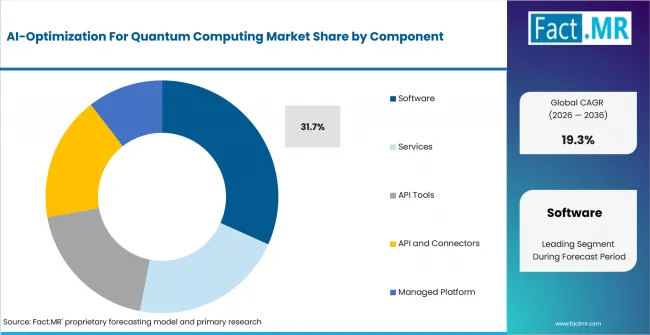
Ai Optimization For Quantum Computing Market Analysis By Component | Source: Fact.MR
Software is projected to represent 31.7% share in 2026, supported by reusable synthesis and transpilation layers that sit above changing hardware. Services remain relevant for architecture selection and custom workflow redesign across enterprise experiments before wider production qualification begins. API Tools and API Connectors support teams that integrate optimization steps into existing development environments. Managed Platforms package orchestration and execution support for accounts with limited specialist staffing during early qualification and benchmarking work. Classiq reported in May 2025 that its platform uses algorithmic circuit compilation to synthesize hardware-agnostic programs for execution across quantum systems.
Which Deployment is projected to account for the largest share?
Cloud leads with 44.5% share in 2026.
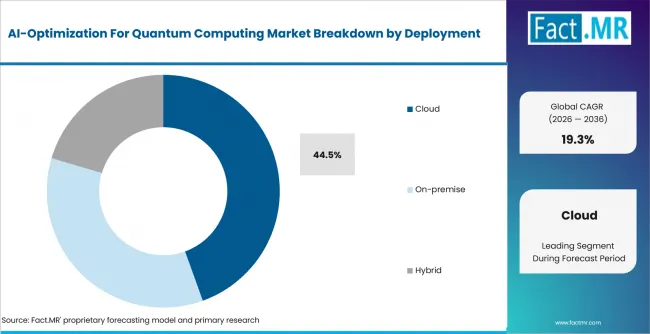
Ai Optimization For Quantum Computing Market Analysis By Deployment | Source: Fact.MR
Cloud is projected to account for 44.5% share in 2026, owing to remote processor access and centralized optimization services across experimental workloads. On-premise deployments serve controlled research environments that need local data handling and closer integration with internal computing systems. Hybrid deployment connects enterprise infrastructure with hosted quantum backends when workflow control must remain inside existing orchestration layers. In July 2025 IBM explained that Qiskit Function templates support its hosted service or deployment in a customer-selected cloud environment. That deployment flexibility supports portable optimization workflows across enterprise computing arrangements with different control and governance requirements.
How does Organization Size shape demand?
SME records 46.6% share in 2026.
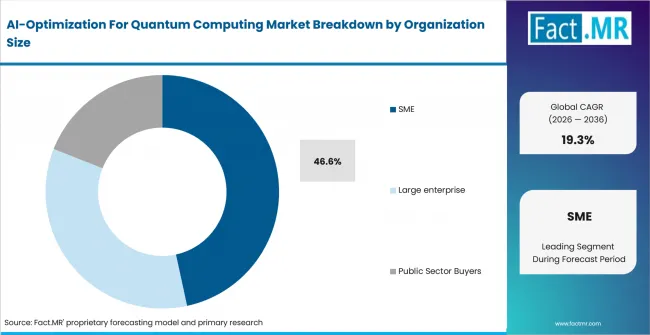
Ai Optimization For Quantum Computing Market Analysis By Organization Size | Source: Fact.MR
SME is anticipated to capture 46.6% share in 2026, shaped by hosted access that lowers the infrastructure burden for specialist development teams. Large Enterprise accounts use broader governance and integration controls when optimization experiments touch internal data systems or multiple cloud environments. Public sector buyers emphasize reproducibility and auditability before adopting tools for funded research programs and formal procurement reviews. In July 2025, the Australian government announced significant grants for 14 feasibility project consortia. Those consortia create practical entry points for smaller optimization software teams within applied research and commercialization programs.
What supports Workflow Automation within Application?
Workflow Automation holds 24.8% share in 2026.
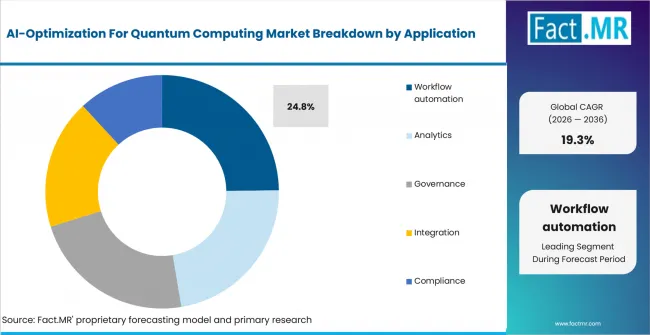
Ai Optimization For Quantum Computing Market Analysis By Application | Source: Fact.MR
Workflow Automation is estimated to represent 24.8% share in 2026, attributable to repeated compilation and execution tasks that consume scarce specialist time. Analytics and Governance tools support experiment comparison while preserving optimizer settings for formal review across regulated enterprise research programs. Integration and Compliance functions connect classical pipelines with quantum services while maintaining controlled access and record retention requirements. By November 2025 DARPA had moved 11 companies into Stage B of its Quantum Benchmarking Initiative. Formal validation pressure raises the value of repeatable workflow records across enterprise and public-sector quantum computing programs.
Which End Use is forecast to capture the largest share?
BFSI captures 40.7% share in 2026.
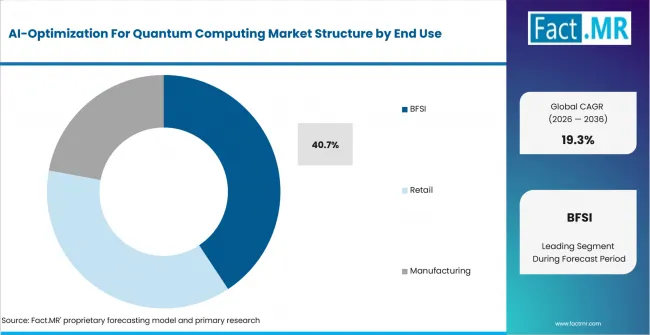
Ai Optimization For Quantum Computing Market Analysis By End Use | Source: Fact.MR
BFSI is forecast to account for 40.7% share in 2026, driven by portfolio optimization and fraud-analysis research that require measurable workflow improvement. Retail users explore scheduling and logistics optimization problems where classical baselines remain essential for evaluating quantum results. Manufacturing programs focus on production planning and material workflows that connect algorithm design to operational constraints. The United Kingdom committed £121 million to quantum technology programs in April 2025 including work related to fraud and money-laundering detection. Policy attention keeps financial optimization programs close to enterprise procurement discussions and longer-term research budgeting decisions.
What is accelerating AI-Optimization for Quantum Computing Market adoption, and what is holding it back?
Automated circuit efficiency drives adoption; weak benchmark comparability restrains procurement.
Drivers Impact Analysis
| Driver | (~) % Impact on CAGR | Geographic Relevance | Impact Timeline |
|---|---|---|---|
| AI-guided circuit compilation | +2.4% | Global | Medium term (2-4 years) |
| Automated calibration and error suppression | +2.0% | North America and Asia Pacific | Short term (<= 2 years) |
| Hybrid quantum-classical orchestration | +1.6% | North America and Europe | Medium term (2-4 years) |
| Cloud access and API standardization | +1.3% | Europe and Asia Pacific | Short term (<= 2 years) |
| Industry-specific optimization workflows | +1.0% | India, China and United Kingdom | Long term (>= 4 years) |
Source: Fact.MR analysis. Updated Jul 8, 2026
- AI-guided circuit compilation: Automated synthesis reduces the manual search needed to map high-level algorithms onto hardware with different gate and connectivity constraints. In September 2025 the U.S. National Science Foundation committed USD 16 million to four National Quantum Virtual Laboratory design teams that include shared hardware and software access. Enterprise software teams are expected to value compilation tools that document measurable changes before paid processor execution begins.
- Automated calibration and error suppression: Processor instability creates recurring tuning work that software measures and adjusts before application runs start across repeated operating cycles. In May 2025 Q-CTRL announced an autonomous calibration partnership with QuantWare and TreQ that reduced stated test times from days to hours. Adoption is projected to expand where control software records parameter changes and demonstrates improvement under repeated operating conditions.
- Hybrid quantum-classical orchestration: Practical workflows divide preparation and optimization work between classical infrastructure and quantum processors that remain expensive to access. The European Commission inaugurated PIAST-Q in June 2025 as the first of eight quantum computers planned within the EuroHPC acquisition program. Workflow platforms are anticipated to gain value where orchestration hides backend differences without obscuring compute dependencies.
- Cloud access and API standardization: Hosted access allows development teams to test optimization logic without owning a quantum processor or maintaining specialized control infrastructure. By February 2026 the European High Performance Computing Joint Undertaking had procured six quantum computers across Europe under a shared infrastructure program. Demand is estimated to favor APIs that preserve workload definitions while accounts compare processor architectures.
- Industry-specific optimization workflows: Enterprise accounts need software that translates operational constraints into formulations suitable for quantum and hybrid solvers. Commercial adoption is forecast to broaden where software teams pair domain modeling with reproducible optimization benchmarks.
Opportunity Impact Analysis
| Opportunity | (~) % Impact on CAGR | Geographic Relevance | Impact Timeline |
|---|---|---|---|
| Managed optimization for SMEs | +0.9% | India and Australia | Short term (<= 2 years) |
| BFSI workflow accelerators | +0.8% | United Kingdom, United States and China | Medium term (2-4 years) |
| Error-correction optimization layers | +0.7% | North America and Europe | Medium term (2-4 years) |
| Cross-platform benchmarking services | +0.6% | Global | Long term (>= 4 years) |
Source: Fact.MR analysis. Updated Jul 8, 2026
- Managed optimization services: Smaller quantum software teams need hosted development and managed execution services because dedicated control infrastructure remains difficult to justify. Opportunity is expected to widen where managed platforms combine optimization guidance with transparent usage controls for project-based accounts.
- BFSI workflow accelerators: Financial research programs need reusable templates for portfolio and risk problems before teams commit to processor-specific implementation. Sector packages reduce repeated model translation and keep benchmark preparation consistent across recurring experiments and internal review cycles. Opportunity is projected to favor vendors that separate classical baseline improvement from gains produced by quantum workflow changes.
- Error-correction optimization layers: Fault-tolerant systems require software that tunes decoders and connects error signals with control decisions at low latency. In June 2026 the U.S. National Science Foundation selected five additional National Quantum Virtual Laboratory teams receiving USD 20 million collectively. Demand is anticipated to expand for optimization layers that integrate calibration and decoding workflows across diverse control stacks.
- Cross-platform benchmarking services: Enterprise accounts struggle to compare optimizer performance when hardware quality and queue conditions change between test runs. In October 2025 a Joint Research Centre assessment found that the European Union accounted for 32% of worldwide quantum technology companies. Opportunity is estimated to favor neutral benchmark services that make software gains comparable across regional ecosystems.
Restraints Impact Analysis
| Restraint | (~) % Impact on CAGR | Geographic Relevance | Impact Timeline |
|---|---|---|---|
| Weak benchmark comparability | -1.4% | Global | Short term (<= 2 years) |
| Hardware-specific optimization overhead | -1.1% | Global | Medium term (2-4 years) |
| Specialist skill scarcity | -0.9% | India and Europe | Medium term (2-4 years) |
| Procurement proof burden | -0.7% | Public sector and BFSI | Long term (>= 4 years) |
Source: Fact.MR analysis. Updated Jul 8, 2026
- Weak benchmark comparability: Optimizer claims are difficult to compare when circuit structure and device noise change at the same time. In November 2025 the Defense Advanced Research Projects Agency maintained a 2033 utility-scale objective for its Quantum Benchmarking Initiative. Procurement is forecast to remain cautious where software vendors cannot isolate optimizer impact from changing hardware performance.
- Hardware-specific optimization overhead: Compiler and control methods often need architecture-specific tuning that reduces portability across enterprise experiments and research partnerships. In May 2025 D-Wave made its Advantage2 annealing system with more than 4,400 qubits generally available for customer application work. Adoption is expected to remain selective where optimization teams must rebuild logic for each backend before meaningful comparison begins.
- Specialist skill scarcity: Optimization software still needs teams that understand circuit behavior and classical solvers alongside domain constraints for the intended use case. The June 2025 UK Quantum Skills Taskforce report estimated around 1,700 people employed across the national quantum sector using HMRC analysis. Demand is projected to face slower conversion where enterprise accounts lack staff prepared to challenge benchmark assumptions and interpret results.
- Procurement proof requirements: Early enterprise accounts require technical evidence before integrating quantum optimization tools into governed workflows or recurring research budgets. A July 2025 Joint Research Centre review counted more than 440 quantum companies operating worldwide. Procurement is anticipated to favor providers that publish test conditions and maintain repeatable support processes across customer environments.
Which countries are scaling AI-Optimization for Quantum Computing Market fastest?
India 21.1%; China 20.4%; Australia 19.1%; United Kingdom 18.8%; United States 18.6%; Germany 18.3%; Japan 18.0%.
Regional coverage spans North America and Europe alongside East Asia and South Asia while Oceania completes the geographic framework.
| Country | CAGR |
|---|---|
| India | 21.1% |
| China | 20.4% |
| Australia | 19.1% |
| United Kingdom | 18.8% |
| United States | 18.6% |
| Germany | 18.3% |
| Japan | 18.0% |
Source: Fact.MR analysis. Updated Jul 8, 2026
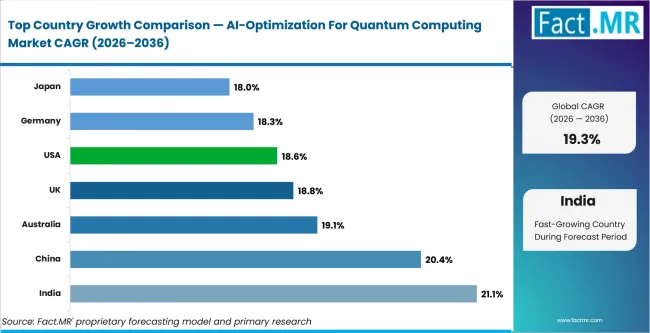
Ai Optimization For Quantum Computing Market Cagr Analysis By Country | Source: Fact.MR
What is powering India’s position?
21.1% CAGR, supported by National Quantum Mission software research and scalable processor targets during the forecast period.
India’s quantum optimization software market is gaining depth as mission-backed research shifts toward broader software experimentation and reusable tooling. In October 2024, India established four National Quantum Mission thematic hubs that connect software research with computing and communication work across participating institutions. The market is expected to record a 21.1% CAGR between 2026 and 2036 due to a broader base of research teams and startup programs. Commercial gains will depend on converting funded research into reusable software tools that enterprise accounts can test against measurable workflow outcomes.
How is China scaling optimization software demand?
20.4% CAGR, attributable to quantum-AI consortia and application-oriented research programs between 2026 and 2036.
China is building a stronger application pipeline by linking quantum algorithm research with enterprise-oriented artificial intelligence programs. Shanghai brought 12 research institutions and companies into its Joint Quantum AI Initiative during September 2025 to connect algorithm research with practical applications. China is projected to post a 20.4% CAGR over the assessment period due to expanding collaboration between computing researchers and enterprise use-case teams. Software providers can improve commercial access where optimization tools address finance and logistics problems already under evaluation through local application programs.
What supports the Australia outlook?
19.1% CAGR, owing to commercialization grants and a specialized local quantum software base during the forecast period.
Australia is strengthening its commercial position through targeted funding that connects specialized software developers with prospective enterprise users. Australia’s quantum industry included 38 domestic and international firms according to a government release published during November 2024. The market is anticipated to advance at a 19.1% CAGR during the forecast period due to commercialization programs that connect smaller technology teams with end users. Enterprise accounts are likely to prioritize providers that combine optimization software with practical experimental support during early qualification work.
What underpins the United Kingdom outlook?
18.8% CAGR, reinforced by public investment and national quantum computing infrastructure by 2036.
The United Kingdom is creating stronger software commercialization routes by connecting national infrastructure with sector-specific application testing programs. In May 2025, Innovate UK announced five additional Quantum Missions pilot winners after the first ten projects had already been selected for the programme. Demand is estimated to record an 18.8% CAGR by 2036 as national facilities and sector testing programs expand access to validation environments. Procurement pathways improve when software teams validate optimization workflows alongside funded application projects and regulated enterprise partners.
How is the United States developing market demand?
18.6% CAGR, supported by shared testbeds and formal government benchmarking programs over the forecast window.
The United States is expanding the technical foundation for market adoption through shared infrastructure and structured performance evaluation programs. The U.S. Department of Energy announced USD 625 million in November 2025 to renew five National Quantum Information Science Research Centers. The market is forecast to register an 18.6% CAGR from 2026 to 2036 due to shared research infrastructure and formal performance evaluation. Enterprise research teams gain confidence when providers expose optimizer settings and preserve sufficient run information for independent technical review.
Who leads the AI-Optimization for Quantum Computing Market?
Classiq Technologies and Q-CTRL lead direct optimization software coverage while IBM and Quantinuum strengthen compilation and hybrid workflow tooling.
Classiq Technologies focuses on high-level quantum modeling and automated circuit synthesis that converts constraints into processor-ready implementations. Q-CTRL covers control optimization and error suppression through Boulder Opal and Fire Opal software used across processor development programs. IBM adds cloud transpilation and workflow services through Qiskit while its January 2025 developer update described AI-based methods for efficient circuit transpilation. These providers compete on measurable circuit improvement and hardware portability alongside integration depth for enterprise research and engineering accounts.
Quantinuum combines TKET compilation with Nexus workflow access across its software stack and external hardware access pathways. D-Wave Quantum provides Ocean tools and Leap cloud access for optimization programs using annealing and hybrid methods. Riverlane develops Deltaflow error-correction infrastructure while NVIDIA supplies CUDA-Q tooling and Ising models for calibration and decoding workflows. Competition is expected to be shaped by reproducible benchmarks and multi-backend support alongside software integration with control infrastructure.
Which companies are the key providers?
Classiq Technologies, Q-CTRL, IBM, Quantinuum, D-Wave Quantum Inc., Riverlane, NVIDIA
- Classiq Technologies
- Q-CTRL
- IBM
- Quantinuum
- D-Wave Quantum Inc.
- Riverlane
- NVIDIA
Bibliography
- Australian Government Department of Industry, Science and Resources. (2024, November 13). First State of Australian Quantum Report reveals deep investment in tech industry. Australian Government.
- Australian Government Department of Industry, Science and Resources. (2025, July 17). $5.74 million to fast-track Aussie quantum solutions. Australian Government.
- Classiq Technologies. (2025, March 25). Classiq powers quantum breakthrough with Sumitomo Corporation and Mizuho–DL Financial Technology. Classiq Technologies.
- Classiq Technologies. (2025, May 14). Classiq raises $110M in largest-ever quantum software funding round. Classiq Technologies.
- Defense Advanced Research Projects Agency. (2025, November 6). Stage B selection. U.S. Department of Defense.
- Department for Science, Innovation and Technology. (2025, April 14). £121 million boost for quantum technology set to tackle fraud, prevent money laundering and drive growth. GOV.UK.
- Department of Science and Technology, Government of India. (2024, October 1). T-Hubs announced to lead India’s quantum revolution. Government of India.
- D-Wave Quantum Inc. (2025, May 20). D-Wave announces general availability of Advantage2 quantum computer, its most advanced and performant system. D-Wave Quantum Inc.
- European Commission Joint Research Centre. (2025, October 13). Quantum technology: 32% of the companies, but only 6% of patents are from the EU. European Commission.
- European High Performance Computing Joint Undertaking. (2026, February 12). Inauguration of Euro-Q-Exa: Expanding the European quantum computing infrastructure. European Union.
- IBM. (2025, July 10). Access the latest research with Qiskit Function templates. IBM Quantum.
- NVIDIA. (2026, April 14). NVIDIA Ising introduces AI-powered workflows to build fault-tolerant quantum systems. NVIDIA Developer Blog.
- Q-CTRL. (2025, May 6). Q-CTRL delivers autonomous calibration solutions to enable rapid integration with ecosystem partners QuantWare and TreQ. Q-CTRL.
- Quantinuum. (2025, August 20). Built for all: Introducing our new software stack. Quantinuum.
- Riverlane. (2025, December 17). Riverlane unveils first hardware decoder to deliver real-time, scalable quantum error correction. Riverlane.
- Shanghai Municipal People’s Government. (2025, September 23). Shanghai bets big on quantum AI with new alliances. Shanghai Municipal People’s Government.
- U.S. National Science Foundation. (2025, September 4). NSF National Quantum Virtual Laboratory speeds into the design phase. U.S. National Science Foundation.
- U.S. National Science Foundation. (2026, June 24). NSF selects five additional teams in National Quantum Virtual Laboratory design competition. U.S. National Science Foundation.
- UK Research and Innovation. (2025, May 13). Quantum Missions pilot competition: Further winners announced. UK Research and Innovation.
- U.S. Department of Energy. (2025, November 4). Energy Department announces $625 million to advance the next phase of National Quantum Information Science Research Centers. U.S. Department of Energy.
This Report Addresses
- The report provides strategic intelligence on Component and Deployment choices that shape optimization software procurement across quantum computing development programs.
- Segment analysis identifies Software and Cloud deployment as the leading segments within the 2026 market structure and forecast framework.
- Regional outlook evaluates India and China alongside Australia while the United Kingdom and United States complete the country growth comparison.
- Competitive analysis profiles Classiq Technologies and Q-CTRL alongside IBM and Quantinuum while D-Wave Quantum, Riverlane and NVIDIA complete the provider set.
- Technology assessment covers Software and Services alongside API Tools and API Connectors while Managed Platforms complete the Component framework.
- Use-case assessment covers Workflow Automation and Analytics alongside Governance and Integration while Compliance completes the Application framework used for forecasting.
What does the AI-Optimization for Quantum Computing Market cover?
Circuit synthesis, transpilation optimization, control calibration and error-correction software used to improve quantum computing workflows.
The AI-optimization for quantum computing market covers software and services that use automated search or machine learning to improve quantum workflow efficiency. Included functions span circuit synthesis and transpilation optimization alongside calibration and error-management tasks before or during quantum execution.
The market differs from the broader quantum computing category because commercial value comes from optimization software and related services instead of processor hardware. Quantum processors and unrelated security software remain outside the boundary unless optimization functionality is sold directly as part of a quantum computing workflow.
What is included in the scope?
AI-Optimization for Quantum Computing systems used in circuit design and execution workflows across cloud and on-premise environments.
The scope includes Software and Services for circuit synthesis and transpilation optimization across Cloud and On-premise deployments. Hybrid deployments are included when automated search methods improve circuit mapping and calibration while reducing execution error. Coverage also includes API Tools and API Connectors that pass optimized workloads between classical orchestration layers and quantum backends. Related Fact.MR analysis of quantum computing systems provides parent-category context for hardware access and workload execution. Research on quantum simulation platforms informs adjacent algorithm-testing workflows and broader studies of distributed quantum computing architectures. BFSI and Retail accounts are included when purchased software directly optimizes a quantum computing workflow while Manufacturing accounts follow the same functional test.
What is excluded from the scope?
Hardware-only quantum processors and unrelated quantum-security software are outside the scope.
The scope excludes quantum processor revenue and cryogenic control hardware sold without a software optimization function tied to computing workloads. Post-quantum cryptography and quantum sensing software are also excluded unless the purchased product directly optimizes a quantum computing circuit or execution workflow.
How was the analysis built?
130+ sources, 45+ company portfolios, 30+ countries, 25+ interviews.
- Primary Research
- Primary research includes interviews with quantum computing platform providers, AI optimization software developers, quantum algorithm researchers and enterprise innovation leaders. It also covers input from cloud service providers, quantum hardware specialists, research institutions and technology strategists evaluating AI-driven quantum performance improvements.
- Desk Research
- Desk research reviews official technology and research publications, quantum computing development updates, AI optimization frameworks, company product portfolios and cloud quantum service offerings. Patent activity, technical white papers, industry announcements and provider documentation are also assessed to evaluate market developments and competitive positioning.
- Market-Sizing and Forecasting
- Forecasting uses quantum computing investment trends, AI software adoption, research and development activity, enterprise experimentation levels and commercialization progress across major countries. Models consider cloud-based quantum access, optimization software deployment, algorithm-development activity and strategic partnerships influencing market expansion.
- Data Validation and Update Cycle
- Forecasts are validated through provider checks and expert interviews that test assumptions on technology adoption, platform deployment and commercialization potential. Portfolio mapping, country-level innovation assessment and stakeholder feedback help confirm market direction, while ongoing reviews of product launches, research breakthroughs and investment activity support forecast updates.
Segmentation
What is the report’s scope and coverage?
| Attribute | Details |
|---|---|
| Quantitative Units | USD million |
| Market Definition | Software and related services that apply automated search or machine learning to improve quantum circuit design, transpilation, calibration, error suppression, workflow orchestration and execution efficiency across quantum computing environments |
| Component | Software; Services; API Tools; API Connectors; Managed Platforms |
| Deployment | Cloud; On-premise; Hybrid |
| Organization Size | SME; Large Enterprise; Public Sector Buyers |
| Application | Workflow Automation; Analytics; Governance; Integration; Compliance |
| End Use | BFSI; Retail; Manufacturing |
| Regions Covered | North America; Europe; East Asia; South Asia; Oceania |
| Countries Covered | India; China; Australia; United Kingdom; United States |
| Key Companies Profiled | Classiq Technologies; Q-CTRL; IBM; Quantinuum; D-Wave Quantum Inc.; Riverlane; NVIDIA |
| Forecast Period | 2026 to 2036 |
| Approach | Hybrid top-down and bottom-up approach using quantum software spending; cloud-access activity; enterprise research programs; circuit optimization adoption; workflow automation needs; deployment mix; company portfolio validation and official quantum program evidence |
Source: Fact.MR analysis. Updated Jul 8, 2026
How is the market segmented?
-
By Component
- Software
- Services
- API Tools
- API Connectors
- Managed Platforms
-
By Deployment
- Cloud
- On-premise
- Hybrid
-
By Organization Size
- SME
- Large Enterprise
- Public Sector Buyers
-
By Application
- Workflow Automation
- Analytics
- Governance
- Integration
- Compliance
-
By End Use
- BFSI
- Retail
- Manufacturing
-
By Region
- North America
- United States
- Canada
- Europe
- Germany
- United Kingdom
- France
- Italy
- Spain
- Asia Pacific
- India
- China
- Japan
- South Korea
- Australia
- Latin America
- Brazil
- Argentina
- Mexico
- Chile
- Middle East & Africa
- UAE
- Saudi Arabia
- South Africa
- North America
Frequently Asked Questions
Which component type is expected to lead in 2026?
How much deployment demand comes from Cloud?
What is the estimated SME share in 2026?
Why does Workflow Automation dominate in 2026?
What share is attributed to BFSI in 2026?
Which country is expected to grow fastest?
What growth rate is projected for China?
What CAGR is projected for Australia?
How fast is the United Kingdom market forecast to grow?
What CAGR is anticipated for the United States?
What factor is estimated to drive adoption?
What constraint is expected to slow procurement?
Why does Software retain commercial importance?
Why is BFSI expected to generate strong demand?
Who worked on this report


Preview the report firsthand - request a free sample
Free SampleGet the brochure for pricing and purchase details
Download PDF