- Market Value (2025): USD 143.7 Mn
- Estimated Value (2026): USD 155 Mn
- Forecast Value (2036): USD 332 Mn
- CAGR (2026-2036): 7.9%
What is the Aircraft Galley Waste Compaction Systems Market forecast to be worth by 2036?
USD 155 million in 2026 to USD 332 million by 2036 at a 7.9% CAGR.
- The Aircraft Galley Waste Compaction Systems Market reached USD 143.7 million in 2025.
- Demand is projected to increase from USD 155 million in 2026 to USD 332 million by 2036.
- The market is forecast to record a 7.9% CAGR from 2026 to 2036.
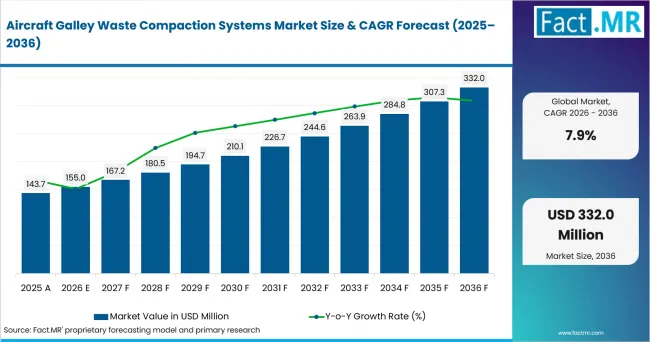
Aircraft Galley Waste Compaction Systems Market Value Analysis | Source: Fact.MR
What are the defining numbers behind Aircraft Galley Waste Compaction Systems Market growth?
An absolute opportunity of USD 177 million is expected between 2026 and 2036.
- Demand Drivers in the Market
- Single-aisle aircraft production expands the line-fit installation base for galley equipment. Airbus projects 33,920 typically single-aisle aircraft deliveries from 2026 to 2045, so each new-aircraft configuration cycle creates another opportunity for airlines and airframers to specify waste compaction within the galley.
- Airlines use compaction to increase usable waste capacity without adding galley footprint. Safran states that its T900 trash compactor doubles trash collection capacity and reduces the number of waste trolleys required, linking compaction directly to space use and onboard handling.
- Cabin waste is subject to operating and disposal rules that vary across jurisdictions. IATA identifies cabin waste management as a regulated operational issue, while EU animal by-products rules apply specific treatment to catering waste originating from international transport. Enclosed waste systems help crews contain material before ground handling and disposal.
- Cabin refurbishment creates a second demand channel after original installation. Bucher documented a 2026 refurbishment program for Lufthansa Group A320 and A321 galleys originally delivered in 2011, showing that galley structures can be retained and upgraded as aircraft remain in service.
- Crew ergonomics and equipment weight affect galley insert selection because cabin crews handle waste repeatedly during service. Safran and Collins Aerospace position current trash-compactor products around lower handling burden and reduced equipment weight. Their space-saving designs support replacement of manual waste storage where operating economics justify the change.
- Key Segments Analyzed
- Narrow-body aircraft account for 47.0% of Aircraft Type in 2026, supported by the volume of single-aisle aircraft entering airline fleets and the repeated galley-specification decisions attached to new deliveries.
- Electric trash compactors represent 56.0% of Product Type in 2026 because powered compaction increases waste capacity within the galley while reducing manual compression by cabin crew.
- Line-fit (OEM) accounts for 62.0% of Fit in 2026 as airlines can integrate the compactor, electrical interfaces and galley layout during aircraft configuration before delivery.
- Analyst Opinion at Fact.MR
- Shambhu Nath Jha, Principal Consultant at Fact.MR, states, "Airlines buy galley waste compaction systems to solve a constrained-space operating problem. Electric compactors lead because they increase waste capacity without expanding the galley envelope, while line-fit installation remains important because integration is simpler when power, mounting and monument layout are resolved during aircraft configuration. Retrofit demand remains relevant where cabin refresh programs can justify the certification work and aircraft downtime."
- Strategic Implications
- Compactor suppliers should design around standard galley insert envelopes and clearly document electrical, mounting and waste-bag interfaces so integrators can assess line-fit and replacement compatibility early in a program.
- Airlines evaluating electric units should compare usable compaction with unit weight. Bag-change procedure and noise also affect crew workflow. Maintenance access influences operating cost.
- Galley monument manufacturers can strengthen their offer by integrating qualified compactor options into new-aircraft configurations rather than leaving waste equipment to a later cabin engineering decision.
- Retrofit programs are more attractive when suppliers can reuse existing galley structure and limit modification scope, since certification effort and aircraft downtime can otherwise outweigh the operating benefit.
- Aftermarket support matters because electric compactors remain in service across long aircraft lifecycles. Spares availability and repair capability can influence airline supplier selection after the initial installation.
How does the Aircraft Galley Waste Compaction Systems Market break down by segment?
The market is segmented by Aircraft Type, Product Type and Fit.
Why does Narrow-body lead Aircraft Type?
Narrow-body leads Aircraft Type in 2026.
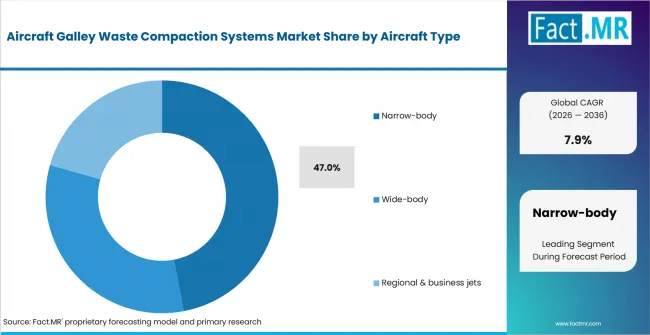
Aircraft Galley Waste Compaction Systems Market Analysis By Aircraft Type | Source: Fact.MR
Narrow-body aircraft lead because airlines buy and replace single-aisle aircraft in high volumes, creating repeated line-fit demand for complete galley configurations. Waste equipment shares the constrained monument envelope with ovens and carts. Storage also competes for this space, so compact systems that preserve working area have a clear operational role.
Airbus projects 33,920 typically single-aisle aircraft deliveries from 2026 to 2045 compared with 8,140 typically widebody aircraft. That fleet mix supports a broader installation base for narrow-body galley equipment, even though long-haul wide-body aircraft may generate more waste per flight.
Why do Electric trash compactors lead Product Type?
Electric trash compactors lead Product Type in 2026.
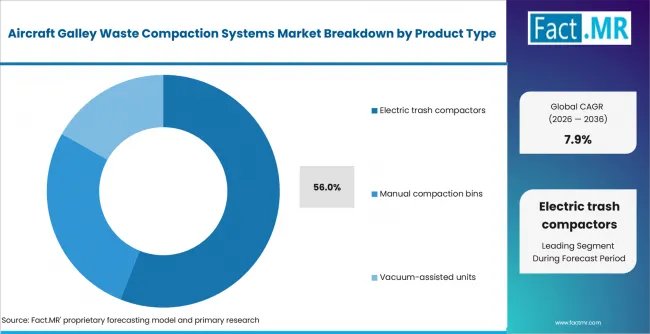
Aircraft Galley Waste Compaction Systems Market Analysis By Product Type | Source: Fact.MR
Electric units lead because powered compression increases the amount of waste that can be stored in a fixed galley position. This reduces dependence on manual compression and can lower the number of waste containers that cabin crew must manage during a flight.
Safran says its T900 doubles trash collection capacity and reduces waste-trolley requirements. Collins Aerospace markets an integrated galley trash compactor designed for space-efficient onboard waste handling, while Iacobucci HF Aerospace states that its Wastepak system delivers a 3:1 reduction ratio. These product characteristics connect directly to airline purchasing criteria around space use and crew handling.
Why does Line-fit (OEM) lead Fit?
Line-fit (OEM) leads Fit in 2026.
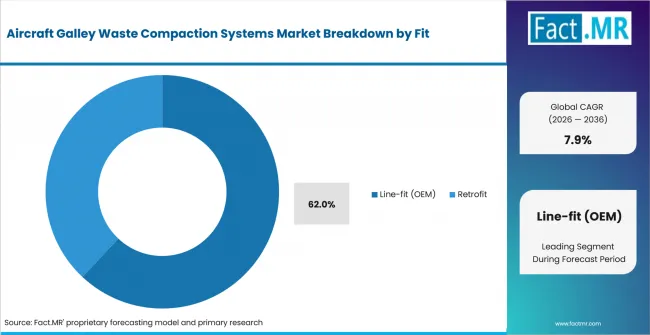
Aircraft Galley Waste Compaction Systems Market Analysis By Fit | Source: Fact.MR
Line-fit leads because the compactor can be engineered with the galley monument, electrical supply and surrounding inserts before the aircraft enters service. The airline avoids a separate modification program and can confirm equipment interfaces during cabin configuration.
Retrofit remains relevant, particularly during cabin refreshes, but material changes to an in-service aircraft can require approved design changes. This makes installation scope and certification effort part of the purchase decision. Bucher's 2026 refurbishment of Lufthansa Group A320 and A321 galleys illustrates how retained galley structures can be modernized when the business case supports continued service.
What is accelerating Aircraft Galley Waste Compaction Systems Market adoption, and what is holding it back?
Drivers Impact Analysis
| Driver | (~) % Impact on CAGR | Geographic Relevance | Impact Timeline |
|---|---|---|---|
| Rising narrow-body production rates driving line-fit galley compactor demand | +0.7% | Global | Near term |
| Airline focus on galley waste-volume reduction to cut weight and servicing cost | +0.6% | North America, Europe | Near term |
| Cabin-waste and EU catering-waste rules requiring contained waste handling | +0.4% | Europe | Mid term |
| Retrofit of electric compactors replacing manual bins on in-service fleets | +0.3% | North America, Asia-Pacific | Mid term |
Source: Fact.MR analysis. Updated Aug 19, 2026
Opportunity Impact Analysis
| Opportunity | (~) % Impact on CAGR | Geographic Relevance | Impact Timeline |
|---|---|---|---|
| Electric compactors with data-logging and fill-level sensing for airline sustainability reporting | +0.5% | North America, Europe | Mid term |
| Vacuum-assisted compaction for wide-body and long-haul aircraft galleys | +0.4% | Global | Mid term |
| Regional and business jet galley compaction as cabin configurations evolve | +0.3% | North America, Europe | Long term |
Source: Fact.MR analysis. Updated Aug 19, 2026
Restraints Impact Analysis
| Restraint | (~) % Impact on CAGR | Geographic Relevance | Impact Timeline |
|---|---|---|---|
| High unit cost of electric compactors relative to manual bins limiting adoption by low-cost carriers | -0.5% | Asia-Pacific, Latin America | Near term |
| Long aircraft service life extending replacement cycles and limiting retrofit frequency | -0.4% | Global | Mid term |
| Certification and STC requirements for retrofit galley-equipment installations adding cost and timeline | -0.3% | North America, Europe | Mid term |
Source: Fact.MR analysis. Updated Aug 19, 2026
Which countries are scaling the Aircraft Galley Waste Compaction Systems Market through 2036?
- United States: Demand is supported by aircraft assembly and cabin-equipment activity in the country, together with a large base of in-service single-aisle aircraft that can receive equipment during scheduled cabin modification. Local support from cabin-interiors suppliers also reduces service friction for airline operators.
- France: Toulouse hosts Airbus final assembly for the A320 Family and other commercial aircraft. Line-fit galley specification therefore connects French aerospace engineering and cabin-supply activity directly with new-aircraft production.
- Germany: Hamburg is an A320 Family final-assembly location and Germany has a developed cabin-interiors supplier base. Galley refurbishment work for Lufthansa Group aircraft also supports a practical retrofit channel for in-service fleets.
- Canada: Aircraft assembly at Mirabel and continuing fleet renewal by Canadian carriers support demand for cabin equipment tied to new deliveries and interior upgrades. Buyers place emphasis on systems that can be maintained across long domestic and transborder operations.
- Japan: JAMCO's aircraft-interiors business gives the country established galley engineering capability serving Airbus and Boeing programs. This supports local access to design, qualification and aftermarket expertise for waste-management equipment integrated into cabin monuments.
- United Kingdom: Fleet renewal and cabin-upgrade activity among UK carriers create line-fit and retrofit opportunities. easyJet's 2026 NEO delivery milestone and planned cabin retrofits show how cabin modification programs can run alongside continued single-aisle fleet expansion.
Country CAGR (2026-2036)
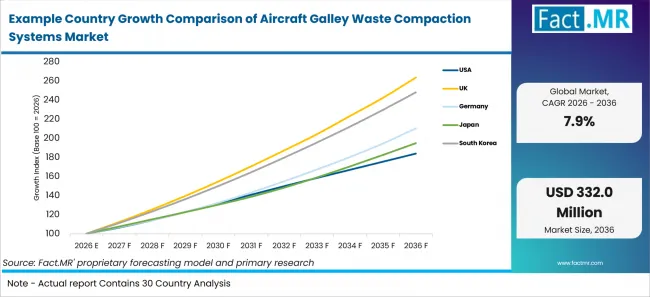
Example Country Growth Comparison Of Aircraft Galley Waste Compaction Systems Market | Source: Fact.MR
| Country | CAGR (2026-2036) |
|---|---|
| United States | 9.7% |
| France | 8.9% |
| Germany | 7.5% |
| Canada | 9.5% |
| Japan | 7.4% |
| United Kingdom | 8.7% |
Source: Fact.MR analysis. Updated Aug 19, 2026
What is driving growth in the United States through 2036?
United States is forecast to expand at a 9.7% CAGR from 2026 to 2036.
Demand conditions include a combination of new-aircraft installation and retrofit demand. Airbus operates A320 Family final assembly in Mobile, Alabama, while Collins Aerospace offers an integrated galley trash compactor for commercial and business aviation. For airlines, local engineering and support capacity can shorten the path from equipment selection to fleet installation.
What is driving France's growth through 2036?
France is forecast to expand at an 8.9% CAGR from 2026 to 2036.
France combines Airbus commercial-aircraft final assembly in Toulouse. Airbus opened a second modernized A320 Family final assembly line there in 2026, increasing the number of aircraft moving through cabin configuration and final integration. Galley equipment specified at this stage feeds line-fit demand for compaction systems and related inserts.
What is driving Germany's growth through 2036?
Germany is forecast to expand at a 7.5% CAGR from 2026 to 2036.
Germany combines A320 Family assembly in Hamburg with cabin-interiors engineering and refurbishment capability. Bucher's 2026 program for Lufthansa Group A320 and A321 galleys shows an operating route for retaining core galley structures while integrating required upgrades. This supports demand from both delivery programs and in-service aircraft work.
What is driving Canada's growth through 2036?
Canada is forecast to expand at a 9.5% CAGR from 2026 to 2036.
Canada has Airbus A220 final assembly in Mirabel and an airline fleet that continues to receive new narrow-body aircraft. The market therefore includes line-fit demand attached to deliveries and retrofit demand when carriers renew cabin standards. Suppliers with North American service coverage are better placed to support repairs and spares over the aircraft lifecycle.
What is driving Japan's growth through 2036?
Japan is forecast to expand at a 7.4% CAGR from 2026 to 2036.
Japan has an established aircraft-interiors supply base through JAMCO, which manufactures galleys for Airbus and Boeing programs. Local engineering capability supports integration and qualification work, while airline cabin renewal creates additional demand for replacement inserts and waste-management equipment.
What is driving growth in the United Kingdom through 2036?
United Kingdom is forecast to expand at an 8.7% CAGR from 2026 to 2036.
Demand conditions include continuing single-aisle fleet renewal and cabin refurbishment. In 2026, easyJet took delivery of its 100th Airbus NEO Family aircraft and said it would retrofit 81 A320neo and A321neo aircraft with cabin enhancements. Programs of this type create decision points for galley equipment that improves space use and crew workflow.
Who leads the Aircraft Galley Waste Compaction Systems Market?
Competition includes dedicated galley-insert manufacturers and cabin-interiors suppliers that integrate waste equipment into complete galley monuments.
Safran Cabin is positioned as a key provider through its dedicated trash-compactor line and broader galley-insert portfolio. The T900 is designed to increase trash capacity while reducing trolley requirements. Collins Aerospace competes with an integrated galley trash compactor in its Essence inserts collection, while Iacobucci HF Aerospace supplies Wastepak compactors in multiple aviation-standard formats.
Diehl Aviation participates through galley waste-disposal technology that directs small and partly liquid waste into aircraft waste tanks. Bucher Leichtbau AG and JAMCO Corporation compete through galley engineering and line-fit programs. Their refurbishment capability allows waste equipment to be integrated within a wider cabin-interiors package.
Supplier selection depends on installation envelope and compaction performance. Buyers also assess weight and electrical integration. Certification compatibility and service support remain procurement considerations. Airlines also consider bag handling and maintenance access because the equipment is used repeatedly by cabin crews and remains installed across long aircraft service cycles.
Which companies are the key providers?
Key companies include Safran Cabin; Collins Aerospace; Diehl Aviation; Bucher Leichtbau AG; JAMCO Corporation; and Iacobucci HF Aerospace S.p.A.
- Safran Cabin
- Collins Aerospace
- Diehl Aviation
- Bucher Leichtbau AG
- JAMCO Corporation
- Iacobucci HF Aerospace S.p.A.
Market Breakdown by Segments
-
By Aircraft Type:
- Narrow-body
- Wide-body
- Regional & business jets
-
By Product Type:
- Electric trash compactors
- Manual compaction bins
- Vacuum-assisted units
-
By Fit:
- Line-fit (OEM)
- Retrofit
-
By Region:
- North America
- Latin America
- Western Europe
- Eastern Europe
- East Asia
- South Asia & Pacific
- Middle East & Africa
Research Sources and Bibliography
- International Air Transport Association. (2026). Sustainable Cabin: Cabin Waste. IATA.
- European Parliament and Council of the European Union. (2009). Regulation (EC) No 1069/2009 on Animal By-Products. European Union.
- Airbus. (2026). Global Market Forecast 2026-2045. Airbus.
- Airbus. (2026). Production: The Life Cycle of an Aircraft. Airbus.
- easyJet. (2026). easyJet Marks Its 100th NEO Delivery in Hamburg. easyJet plc.
- Safran Cabin. (2026). T900 Trash Compactor. Safran.
- Collins Aerospace. (2026). Essence Inserts Collection. RTX.
- Diehl Aviation. (2026). GWDU - Galley Waste Disposal Unit. Diehl Aviation.
- Bucher Leichtbau AG. (2026). Galley Refurbishment Extends Lifecycles. Bucher Group.
- JAMCO Corporation. (2025). Sustainability Report 2025. JAMCO Corporation.
- Iacobucci HF Aerospace S.p.A. (2026). Galley Insert: Wastepak Trash Compactor. Iacobucci HF Aerospace.
This Report Answers
- The report examines demand by Aircraft Type and Product Type. Fit is assessed separately, with regional analysis used to compare adoption conditions.
- Segment analysis explains the operating reasons behind leadership within each main market category.
- Country analysis evaluates how aircraft production, fleet renewal and cabin modification activity shape demand through 2036.
- Competitive analysis reviews the listed companies and the roles they play in trash compaction, waste disposal or galley integration.
- The analysis considers installation compatibility and certification requirements. It also examines crew workflow and aftermarket support that influence purchasing decisions.
What does the Aircraft Galley Waste Compaction Systems Market cover?
The market covers trash compactors and waste-management units installed in aircraft galleys to reduce cabin waste volume and improve onboard waste handling.
It includes electric trash compactors, manual compaction bins and vacuum-assisted units supplied for narrow-body, wide-body, regional and business-jet aircraft through line-fit or retrofit installation.
What is included in the scope?
The scope includes complete galley waste compaction equipment supplied for new aircraft and for approved cabin refurbishment. Products are counted when waste compression or vacuum-assisted disposal is an integral function of the installed galley unit.
Demand from aircraft OEM programs, galley integrators, airlines and retrofit channels is included where the equipment falls within the Aircraft Type, Product Type and Fit segmentation used in this report.
What is excluded from the scope?
The scope excludes airport waste-handling equipment, ground catering waste systems and cabin waste carts or trolleys that do not contain compaction or vacuum-assisted disposal capability.
Lavatory waste systems, standalone galley monuments without a qualifying waste unit, and spare parts sold separately from the equipment are outside the market. Adjacent cabin-interiors products are considered only where they are integrated with an included waste compaction system.
How Was the Analysis Built?
Fact.MR is of the opinion that this assessment combines primary research with a structured review of public information and industry evidence relevant to the market.
- Primary Research: Interviews focus on galley-insert manufacturers, cabin-interiors integrators, airline engineering and procurement teams, MRO providers and certification specialists. These discussions examine equipment selection, line-fit versus retrofit decisions, maintenance requirements and supplier qualification.
- Desk Research: The review covers cabin-waste guidance, airworthiness and waste regulations, aircraft production outlooks, airline cabin programs and official product documentation from the companies included in the competitive assessment. Sources used in the analysis are listed in the bibliography.
- Market Sizing and Forecasting: Estimates combine commercial-aircraft delivery activity, galley equipment content, retrofit cycles, product mix and country-level adoption. Forecasting also considers aircraft service life, cabin refurbishment timing and the balance between electric, manual and vacuum-assisted waste systems.
- Data Validation and Update Cycle: Evidence is reviewed against the defined market scope, segment boundaries and forecast period. The assessment is updated when source data, technology conditions, regulation or supplier activity materially changes the outlook.
Segmentation
Research Scope and Coverage
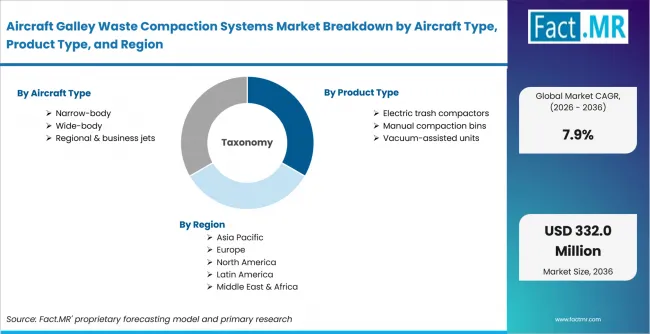
Aircraft Galley Waste Compaction Systems Market Breakdown By Aircraft Type, Product Type, And Region | Source: Fact.MR
| Attribute | Details |
|---|---|
| Quantitative Units | USD Million |
| Market Definition | Trash compactors and waste-management units installed in aircraft galleys to reduce cabin waste volume and streamline onboard handling. |
| Segments Covered | Aircraft Type; Product Type; Fit |
| Regions Covered | North America; Latin America; Western Europe; Eastern Europe; East Asia; South Asia & Pacific; Middle East & Africa |
| Countries Covered | United States; France; Germany; Canada; Japan; United Kingdom |
| Key Companies Profiled | Safran Cabin; Collins Aerospace; Diehl Aviation; Bucher Leichtbau AG; JAMCO Corporation; Iacobucci HF Aerospace S.p.A. |
| Forecast Period | 2026 to 2036 |
| Base Year | 2025 |
| Market Value, 2026 | USD 155 million |
| Market Value, 2036 | USD 332 million |
| CAGR, 2026-2036 | 7.9% |
| Absolute Opportunity | USD 177 million |
| Approach | Hybrid top-down and bottom-up sizing using aircraft deliveries, installed galley equipment, retrofit cycles, product mix, country growth and supplier activity. |
Source: Fact.MR analysis. Updated Aug 19, 2026
Frequently Asked Questions
What is the Aircraft Galley Waste Compaction Systems Market value in 2026?
At what CAGR is the market projected to grow?
What is the projected market value by 2036?
Which Aircraft Type leads the market?
Which Product Type leads the market?
Which Fit leads the market?
Which listed country leads country growth?
What is the primary driver in this market?
What is the main restraint?
Which companies are included in the market assessment?
Who worked on this report


Preview the report firsthand - request a free sample
Free SampleGet the brochure for pricing and purchase details
Download PDF