- Base Value(2025): 3.2 Bn
- Estimated Value(2026): 3.3 Bn
- Forecast Value (2036): 5.2 Bn
- CAGR (2026 - 2036): 4.7%
Noise Cancelling Tyres Market Forecast 2026 to 2036
In 2025, the noise cancelling tyres market was valued at USD 3.2 billion. Based on Future Market Insights' analysis, demand for noise cancelling tyres is estimated to grow to USD 3.3 billion in 2026 and USD 5.2 billion by 2036. FMI projects a CAGR of 4.7% during the forecast period.
The absolute dollar growth from 2026 to 2036 is USD 1.9 billion. This growth is primarily driven by the rising demand for advanced automotive solutions that improve driving comfort and reduce noise, particularly in electric vehicles (EVs) and luxury cars. However, challenges such as high manufacturing costs and the complexity of integrating new technologies into tyres may limit growth in certain markets.
India leads with a CAGR of 5.6%, driven by expanding automotive production and increasing demand for quieter vehicles. China follows with a 5.3% CAGR, supported by the rapid growth of its automotive industry, particularly in electric vehicles. Mexico grows at 4.9%, fueled by growing automotive manufacturing and demand for advanced tyre technologies. Thailand experiences 4.7% growth, driven by the increasing focus on noise reduction in automotive design. Indonesia grows at 4.5%, supported by rising automotive production and consumer interest in more comfortable driving experiences. The USA shows slower growth at 3.1%, driven by the established demand for noise reduction in vehicles. Germany and Japan experience slower growth at 2.6% and 2.4%, respectively, reflecting mature automotive markets with established noise control solutions.
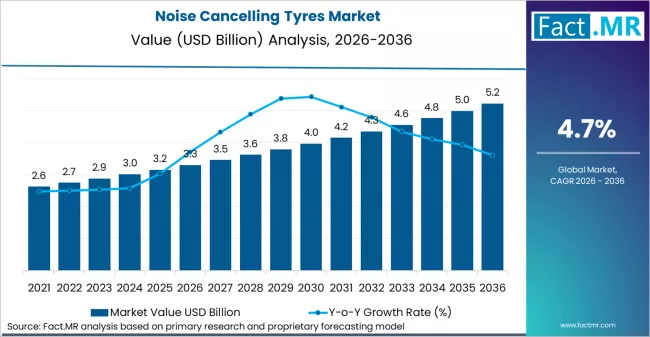
Noise Cancelling Tyres Market Market Value Analysis | Source: Fact.MR
Noise Cancelling Tyres Market Definition
The noise cancelling tyres market refers to the production and sale of tyres engineered to reduce noise generated during tyre‑road interaction. These tyres incorporate technologies such as internal acoustic foams or optimized tread structures that absorb vibrations and dampen noise, improving in‑cabin comfort and reducing exterior sound emission. The primary industrial function is noise mitigation while maintaining grip, wear performance, and safety. Key end uses include passenger cars, light commercial vehicles, SUVs, and electric vehicles where low cabin noise enhances perceived quality and comfort.
Market Inclusions
This report covers global and regional market size estimates for noise cancelling tyres over a defined forecast period. It includes breakdowns by vehicle type (passenger cars, light commercial vehicles, SUVs), technology type (internal foam liners, acoustic tread designs), and sales channel (OEM fitment, aftermarket). Pricing trends, raw material and compound supply, and trade flow analysis are included to capture market dynamics.
Market Exclusions
The scope excludes standard tyres without noise‑reducing features and unrelated automotive components such as suspension or NVH systems not integral to tyre construction. It also omits finished vehicles and non‑tyre noise control products like interior cabin soundproofing or road surface treatments. Niche tyre technologies aimed solely at racing or off‑road performance without acoustic focus are not covered.
Research Methodology
- Primary Research: Interviews were conducted with tyre engineers, OEM procurement specialists, and industry analysts.
- Desk Research: Data was sourced from industry reports, tyre maker publications, and automotive market statistics.
- Market‑Sizing and Forecasting: A hybrid approach was applied, combining top‑down estimates of tyre demand with bottom‑up shipment and production data.
- Data Validation and Update Cycle; Findings were validated through expert review and cross‑checked with recent market data, with periodic updates.
Noise Cancelling Tyres Market Summary
- Noise Cancelling Tyres Market Definition
- The noise cancelling tyres market refers to the production and sale of tyres specifically designed to reduce road noise and improve driving comfort by minimizing vibrations and sound transmission between the road and the vehicle. These tyres incorporate advanced technologies such as foam liners, tread pattern optimization, and resonance damping inserts to absorb and dampen noise, enhancing the acoustic comfort inside the vehicle cabin. The primary industrial function is noise reduction while maintaining grip, wear performance, and safety. Key end uses include passenger cars, light commercial vehicles, SUVs, and electric vehicles, where quieter cabins contribute to a higher perceived quality and comfort during the driving experience.
- Demand Drivers in the Market
- Growing Demand for Quieter Driving Experiences: As consumer preferences for quieter and more comfortable vehicles rise, noise cancelling tyres have become a critical technology for both OEMs and aftermarket sales, particularly for premium and electric vehicles.
- Regulatory Pressure for Noise Reduction: Governments and regulatory bodies are increasingly enforcing noise regulations for vehicles, which is driving automakers to integrate noise-reducing technologies in tyres, particularly for urban environments where noise pollution is a concern.
- Rise in Electric and Hybrid Vehicle Production: Electric and hybrid vehicles, which are inherently quieter, highlight the need for noise control solutions, such as noise cancelling tyres, to ensure a smooth and comfortable driving experience.
- Technological Advancements in Tyre Design: Ongoing innovation in tyre technology, including the integration of internal foam liners and advanced tread designs, supports the adoption of noise cancelling tyres as a standard feature in various vehicle types.
- Key Segments Analyzed in the FMI Report
- Vehicle Type: Passenger Cars are projected to dominate the market, capturing 67% of the market share by 2026, driven by rising demand for quieter vehicles that offer improved driving comfort.
- Technology: Foam Liner (Acoustic Foam) technology is expected to lead the market, holding 63% of the share by 2026. This technology effectively absorbs sound waves and reduces road noise, making it a preferred choice for a wide range of vehicles, from luxury cars to everyday passenger vehicles.
- Sales Channel: OEM Fitment is anticipated to be the leading sales channel due to its widespread adoption by vehicle manufacturers incorporating noise reduction features in new models.
- Analyst Opinion at FMI
- Fact MR analysts predict that "The noise cancelling tyres market will continue to expand as automotive manufacturers increasingly prioritize quiet, comfortable driving experiences, particularly in electric and hybrid vehicles. The growing focus on environmental noise reduction and consumer demand for luxury vehicles equipped with advanced noise mitigation technologies will fuel the market’s growth."
- Strategic Implications/Executive Takeaways
- Focus on Emerging Markets: Fast-growing automotive sectors in regions such as India, China, and Mexico present significant opportunities for noise cancelling tyre adoption, driven by increasing production and growing demand for premium vehicle features.
- Invest in Innovation and R&D: Companies should continue to invest in research and development to enhance the performance of noise cancelling tyres, particularly focusing on sustainable materials and cost-effective manufacturing techniques.
- Regulatory Compliance: Manufacturers should prioritize compliance with international noise standards and regulations, positioning their products as solutions that meet both consumer expectations and regulatory requirements.
- Methodology
- Primary Research: Interviews with tyre engineers, OEM procurement specialists, and industry analysts provided insights into current market trends, consumer demands, and emerging technologies within the noise cancelling tyres sector.
- Desk Research: Data was sourced from industry reports, tyre maker publications, and automotive market statistics to assess demand dynamics and forecast future growth in the market.
- Market Sizing and Forecasting: A hybrid approach, combining top-down estimates of tyre demand with bottom-up shipment and production data, was used to forecast market growth and size.
Segmental Analysis
Noise Cancelling Tyres Market Analysis by Vehicle Type
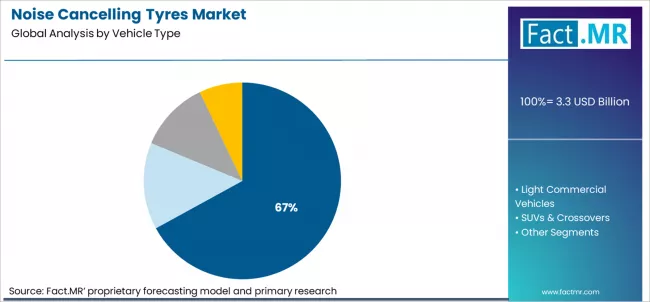
Noise Cancelling Tyres Market Analysis By Vehicle Type | Source: Fact.MR
- Market Overview: Passenger cars are expected to hold 67% of the noise cancelling tyres market by 2026. As consumer demand for quieter and more comfortable driving experiences increases, the adoption of noise-cancelling technologies in tyres, especially for passenger vehicles, is expected to rise significantly.
- Demand Drivers:
- Increased Focus on Driving Comfort: As passenger cars become more sophisticated, the demand for quieter cabins is growing. Noise-cancelling tyres help reduce road noise, making them a popular choice for enhancing overall driving comfort.
- Technological Advancements in Tyre Design: The integration of advanced noise reduction technologies into tyres is becoming a standard feature in passenger vehicles, driven by the automotive industry’s focus on improving in-vehicle comfort.
- Consumer Preferences for Quiet Vehicles: As more consumers opt for high-quality, premium vehicles, noise control features, including noise-cancelling tyres, are becoming a key selling point for manufacturers, boosting demand in the passenger car segment.
Noise Cancelling Tyres Market Analysis by Technology
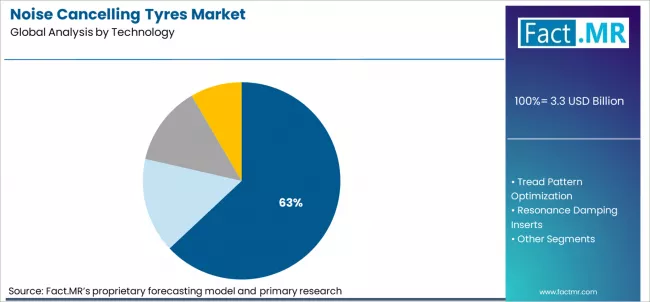
Noise Cancelling Tyres Market Analysis By Technology | Source: Fact.MR
- Market Overview: Foam liner (acoustic foam) technology is projected to dominate the market, capturing 63% of the market share by 2026. Foam liners are integrated within the tyre to absorb and dissipate sound waves, significantly reducing road noise and providing a quieter driving experience.
- Demand Drivers:
- Superior Noise Reduction: Foam liners are highly effective at dampening road noise by absorbing vibrations and sound waves that would typically travel into the vehicle cabin. This makes them a popular choice for both premium and everyday vehicles seeking quieter rides.
- Manufacturing Integration: The foam liner technology is easy to integrate into existing tyre manufacturing processes, contributing to its widespread use in both original equipment (OE) and replacement markets.
- Rising Consumer Expectations for In-Car Experience: With increasing consumer demand for vehicles with advanced comfort features, including noise reduction, foam liner technology offers a viable solution for automakers looking to differentiate their products in a competitive market.
Noise Cancelling Tyres Market Drivers, Restraints, and Opportunities
FMR analysts observe that the noise cancelling tyres market is in a growth‑transition phase driven by rising consumer expectations for quieter ride quality, especially in electric and premium vehicles where tyre noise is more noticeable. Historically, standard tyre treads offered limited noise control, and acoustic concerns were secondary to traction and wear performance. The 2026 valuation reflects this structural shift as OEMs and aftermarket players adopt tyre designs with integrated noise‑reducing features (foam inserts, tread pattern optimization) to meet comfort and regulatory noise criteria.
While demand for conventional tyres remains large, noise‑cancelling and low‑noise tyre technologies are gaining share. These enhanced tyres carry higher per‑unit prices, contributing to net market value growth even though unit volumes are tied to broader tyre replacement cycles. The market exists at its current size because tyre manufacturers balance noise reduction with performance and cost, and regulatory and consumer demands increasingly favor products with measurable acoustic benefits.
- Consumer Comfort Demand: Passenger preference for quieter cabin environments, especially in EVs, drives uptake of tyres with built‑in noise‑reducing technologies, replacing basic tread designs.
- Regulatory Noise Standards: Standards such as the EU Tyre Noise Regulation (Regulation (EU) 2020/740) require lower sound emission limits, pushing OEMs toward certified low‑noise tyre solutions.
- Regional Adoption Trends: In Europe and North America, stringent exterior noise limits and comfort expectations accelerate adoption of noise cancelling tyres, while in some Asia‑Pacific markets cost‑led alternatives remain significant.
Regional Analysis
The market analysis covers key global regions, including South Asia and Pacific, East Asia, Latin America, North America, and Western Europe. It is segmented geographically, with specific market dynamics for each region. The full report provides a detailed market attractiveness analysis.
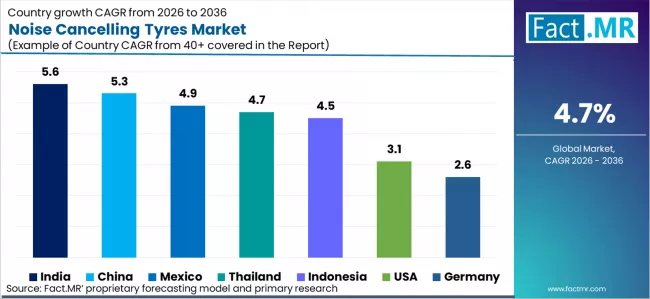
Noise Cancelling Tyres Market Cagr Analysis By Country | Source: Fact.MR
| Country | CAGR (2026-2036) |
|---|---|
| India | 5.6% |
| China | 5.3% |
| Mexico | 4.9% |
| Thailand | 4.7% |
| Indonesia | 4.5% |
| USA | 3.1% |
| Germany | 2.6% |
| Japan | 2.4% |
Source: Fact.MR analysis. Updated Feb 19, 2026
Source: Fact MR (FMR) analysis, based on proprietary forecasting model and primary research.
South Asia and Pacific:
South Asia and Pacific are "key emerging markets" for noise cancelling tyres, driven by growing demand in the automotive industry, particularly for noise reduction technologies in vehicles.
- India: Demand for noise cancelling tyres in India is projected to rise at 5.6% CAGR through 2036. India’s growing automotive sector and increased focus on vehicle noise reduction contribute to market growth.
- Thailand: Demand for noise cancelling tyres in Thailand is projected to rise at 4.7% CAGR through 2036. The increasing automotive manufacturing in Thailand, coupled with a growing awareness of noise pollution in vehicles, drives market expansion.
- Indonesia: Demand for noise cancelling tyres in Indonesia is projected to rise at 4.5% CAGR through 2036. The rise in vehicle production and growing focus on eco-friendly vehicle technologies in the country support the demand for noise-reducing tyres.
East Asia:
China is a dominant market for noise cancelling tyres, with substantial growth driven by increased vehicle manufacturing, urbanization, and environmental regulations focused on noise reduction.
- China: Demand for noise cancelling tyres in China is projected to rise at 5.3% CAGR through 2036. China’s automotive sector and regulatory push for quieter vehicles are major factors driving the adoption of noise reducing technologies.
- Japan: Demand for noise cancelling tyres in Japan is projected to rise at 2.4% CAGR through 2036. Japan’s advanced automotive technologies and demand for quiet, eco-friendly vehicles continue to support steady growth in this market.
Latin America:
In Latin America, Mexico stands out with growing automotive production and a rising demand for noise reducing solutions in both domestic and export markets.
- Mexico: Demand for noise cancelling tyres in Mexico is projected to rise at 4.9% CAGR through 2036. The increased demand for vehicles and growing automotive manufacturing sector support the adoption of noise cancelling tyres.
North America:
The USA remains a stable market for noise cancelling tyres, driven by consumer demand for quieter vehicles and advancements in automotive technologies.
- USA: Demand for noise cancelling tyres in the U.S. is projected to rise at 3.1% CAGR through 2036. The increased focus on vehicle soundproofing and regulatory standards for noise reduction continue to support market growth in the region.
Western Europe:
In Western Europe, Germany and Japan continue to lead demand for noise cancelling tyres, driven by strict noise regulations and a focus on vehicle comfort and sustainability.
- Germany: Demand for noise cancelling tyres in Germany is projected to rise at 2.6% CAGR through 2036. Germany's stringent environmental regulations and demand for high-performance, quiet vehicles continue to support demand for noise reducing tyres.
- Japan: Demand for noise cancelling tyres in Japan is projected to rise at 2.4% CAGR through 2036. Japan’s preference for premium vehicles and advancement in noise reduction technologies contribute to steady growth in the market.
Fact MR's analysis of the Noise Cancelling Tyres Market in South Asia and Pacific, East Asia, Latin America, North America, and Western Europe consists of country-wise assessments that include India, China, Mexico, Thailand, Indonesia, the United States, Germany, and Japan. Readers can find detailed trends, regulatory updates, and company-specific investments shaping the market’s growth in these countries.
How Are Key Players Competing in the Noise Cancelling Tyres Market?
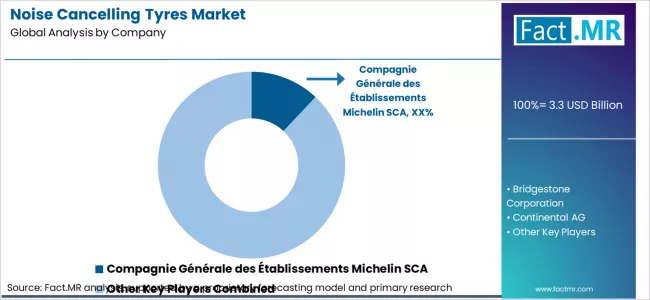
Noise Cancelling Tyres Market Analysis By Company | Source: Fact.MR
The noise cancelling tyres market is marked by competition between established global players like Compagnie Générale des Établissements Michelin SCA, Bridgestone Corporation, and Continental AG, who are leading the charge with innovative tyre technologies aimed at reducing road noise for enhanced driving comfort. The Goodyear Tire & Rubber Company and Pirelli & C. S.p.A. are focusing on advanced noise-reducing solutions, including sound-absorbing tyre structures, in response to growing demand from both consumers and regulatory bodies for quieter driving experiences. Hankook Tire & Technology Co., Ltd., The Yokohama Rubber Co., Ltd., and Sumitomo Rubber Industries, Ltd. are leveraging their extensive R&D capabilities to refine tyre materials and tread designs that improve noise suppression. Toyo Tire Corporation and Kumho Tire Co., Inc. are enhancing their competitive positioning by investing in the development of tyres with better acoustic performance, ensuring they meet the needs of eco-conscious consumers and OEMs. Companies are focusing on reducing tyre noise levels while maintaining performance, durability, and environmental sustainability
Recent Industry Developments
- Patent-Noise reducing tyre with an internal sound-absorbing device component (Granted / Published Jun 20, 2023): Apollo Tyres’ patent describes a pneumatic tyre design that mounts a perforated sound-absorbing component inside the tyre cavity to reduce interior “cavity noise.”
- Product launch-Continental ExtremeContact XC7 with ContiSilent foam-based cavity-noise reduction (Announced Jul 31, 2024): Continental launched the ExtremeContact XC7 featuring “CSS 2-in-1 Noise Reduction Technology,” combining ContiSilent polyurethane foam with ContiSeal to suppress cabin noise across frequency ranges.
- Product launch-Bridgestone Turanza 6 with ENLITEN, positioned with reduced noise levels (Announced Feb 10, 2025): Bridgestone launched Turanza 6 in Asia Pacific, stating ENLITEN-powered improvements include an 8% reduction in noise levels aimed at a quieter ride.
Key Players of the Noise Cancelling Tyres Market
- Compagnie Générale des Établissements Michelin SCA
- Bridgestone Corporation
- Continental AG
- The Goodyear Tire & Rubber Company
- Pirelli & C. S.p.A.
- Hankook Tire & Technology Co., Ltd.
- The Yokohama Rubber Co., Ltd.
- Sumitomo Rubber Industries, Ltd.
- Toyo Tire Corporation
- Kumho Tire Co., Inc.
Report Scope
| Metric | Value |
|---|---|
| Quantitative Units | USD 3.3 billion (2026) to USD 5.2 billion (2036), at a CAGR of 4.7% |
| Market Definition | The Noise Cancelling Tyres Market includes tyres designed to reduce road noise and enhance comfort through various noise-dampening technologies, used in vehicles such as passenger cars, SUVs, and commercial vehicles. |
| By Vehicle Type | Passenger Cars, Light Commercial Vehicles, SUVs & Crossovers, Other |
| By Technology | Foam Liner (Acoustic Foam), Tread Pattern Optimization, Resonance Damping Inserts, Other |
| By Sales Channel | OEM Fitment, Replacement Aftermarket, Other |
| By Rim Size | Up to 16 inch, 17-19 inch, 20 inch and above, Other |
| Regions Covered | North America, Latin America, Europe, East Asia, South Asia, Oceania, Middle East and Africa |
| Countries Covered | United States, Canada, Mexico, Brazil, Argentina, Germany, France, United Kingdom, Italy, Spain, China, India, Japan, South Korea, Indonesia, Australia, and 40+ countries |
| Key Companies Profiled | Compagnie Générale des Établissements Michelin SCA, Bridgestone Corporation, Continental AG, The Goodyear Tire & Rubber Company, Pirelli & C. S.p.A., Hankook Tire & Technology Co., Ltd., The Yokohama Rubber Co., Ltd., Sumitomo Rubber Industries, Ltd., Toyo Tire Corporation, Kumho Tire Co., Inc. |
| Forecast Period | 2026 to 2036 |
| Approach | Hybrid top-down and bottom-up market modeling validated through primary interviews with manufacturers and supported by trade data benchmarking and market research. |
Source: Fact.MR analysis. Updated Feb 19, 2026
Bibliographies
- Patent - Noise Reducing Tyre with an Internal Sound-Absorbing Device Component: Apollo Tyres. (2023, June 20). Noise reducing tyre with an internal sound-absorbing device component. Google Patents. [1]
- Product Launch - Continental ExtremeContact XC7 with ContiSilent Foam-Based Cavity-Noise Reduction: Continental. (2024, July 31). Continental launches ExtremeContact XC7 with ContiSilent foam-based cavity-noise reduction. PR Newswire UK. [2]
- Product Launch - Bridgestone Turanza 6 with ENLITEN, Positioned with Reduced Noise Levels: Bridgestone. (2025, February 10). Bridgestone launches Turanza 6 with ENLITEN, positioned with reduced noise levels. Bridgestone. [3]
Segmentation
Noise Cancelling Tyres Market Key Segments
-
By Vehicle Type
- Passenger Cars
- Light Commercial Vehicles
- SUVs & Crossovers
- Other
-
By Technology
- Foam Liner (Acoustic Foam)
- Tread Pattern Optimization
- Resonance Damping Inserts
- Other
-
By Sales Channel
- OEM Fitment
- Replacement Aftermarket
- Other
-
By Rim Size
- Up to 16 inch
- 17-19 inch
- 20 inch and above
- Other
-
Region
- North America
- USA
- Canada
- Mexico
- Europe
- Germany
- UK
- France
- Italy
- Spain
- Nordic Countries
- BENELUX
- Rest of Europe
- Asia Pacific
- China
- Japan
- South Korea
- India
- Australia
- Rest of Asia Pacific
- Latin America
- Brazil
- Argentina
- Rest of Latin America
- Middle East and Africa
- Kingdom of Saudi Arabia
- United Arab Emirates
- South Africa
- Rest of Middle East and Africa
- Other Regions
- Oceania
- Central Asia
- Other Markets
- North America
Frequently Asked Questions
How large is the demand for Noise Cancelling Tyres in the global market in 2026?
What will be the market size of Noise Cancelling Tyres in the global market by 2036?
What is the expected demand growth for Noise Cancelling Tyres in the global market between 2026 and 2036?
Which vehicle type is expected to dominate the market?
Which region is expected to show the highest growth rate for Noise Cancelling Tyres?
How significant is the growth outlook for China in this market?
What is the growth outlook for the United States in this report?
What is the growth forecast for Germany in the Noise Cancelling Tyres market?
Which company is identified as a leading player in the Noise Cancelling Tyres market?
What are Noise Cancelling Tyres used for?
What does the Noise Cancelling Tyres market include in this report?
How is the market forecast developed in this report?
What is meant by the Noise Cancelling Tyres market in this report?
Who worked on this report


Preview the report firsthand - request a free sample
Free SampleGet the brochure for pricing and purchase details
Download PDF