- Base Value(2026): 1.4 Bn
- Forecast Value (2036): 2.9 Bn
- CAGR (2036): 7.4%
Allergy Clinical Trial Services Market Forecast and Outlook 2026 to 2036
Global allergy clinical trial services market stands positioned for robust expansion, valued at USD 1.4 billion in 2026 and projected to reach USD 2.9 billion by 2036, registering 7.4% CAGR throughout evaluation period.
Key Takeaways from Allergy Clinical Trial Services Market
- Allergy Clinical Trial Services Market Value (2026): USD 1.4 billion
- Allergy Clinical Trial Services Market Forecast Value (2036): USD 2.9 billion
- Allergy Clinical Trial Services Market Forecast CAGR (2026-2036): 7.4%
- Leading Service Line: Clinical operations and monitoring (24.0%)
- Key Players: IQVIA, ICON, Parexel, Syneos Health, Labcorp Drug Development
- Key Growth Regions: China, India, Brazil, United States, Germany, United Kingdom, France
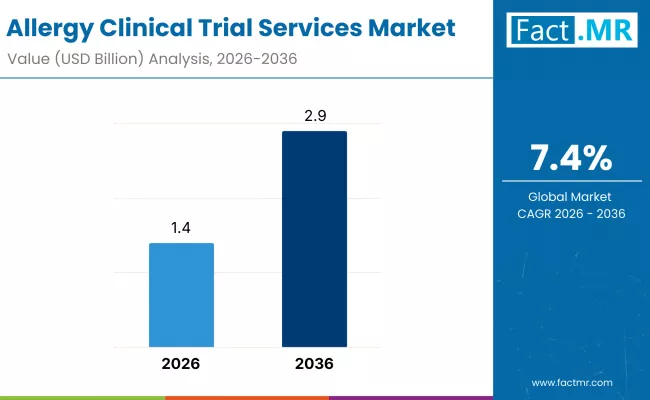
Allergy Clinical Trial Services Market By Industry | Source: Fact.MR
While traditional antihistamine trials continue anchoring pharmaceutical pipelines, precision immunotherapy technologies are establishing structural relevance within allergology and respiratory portfolios. “Standardizing clinical trial endpoints and adaptive trial designs is central to unlocking truly disease-modifying allergy therapies rather than relying on symptomatic endpoints alone.” - Prof. Giorgio Walter Canonica. Industry consolidation around evidence-backed mechanisms signals maturation beyond symptomatic management toward clinically validated desensitization systems.
Allergy clinical trial management operates at intersection of immunology science, patient safety protocols, and regulatory compliance frameworks. Cellular mechanisms underlying hypersensitivity reactions are increasingly understood, enabling targeted therapeutic development. Trial initiations throughout 2025 reflect strategic emphasis on combination immunotherapy protocols, where oral tolerance induction synergizes with biologic interventions to address both immediate and delayed allergic responses.
Allergy Clinical Trial Services Market
| Metric | Value |
|---|---|
| Estimated Value in (2026E) | USD 1.4 billion |
| Forecast Value in (2036F) | USD 2.9 billion |
| Forecast CAGR (2026 to 2036) | 7.4 % |
Source: Fact.MR analysis. Updated Feb 4, 2026
Category
| Category | Segments |
|---|---|
| Service Line | Study design & protocol development, Site management & patient recruitment, Clinical operations & monitoring, Bioanalytical & immunoassay services, Data management & biostatistics, Regulatory & medical writing |
| Trial Focus / Indication | Allergic rhinitis, Asthma (allergic), Atopic dermatitis, Food allergy, Urticaria / anaphylaxis |
| End User | Pharma sponsors, Biotech sponsors, Academic medical centers, Device / diagnostic companies, Government / NGO sponsors |
| Region | North America; Europe; Asia Pacific; Latin America; Middle East & Africa |
Source: Fact.MR analysis. Updated Feb 4, 2026
Segmental Analysis
Why do clinical operations and monitoring services command lead position in allergy trial service lines?
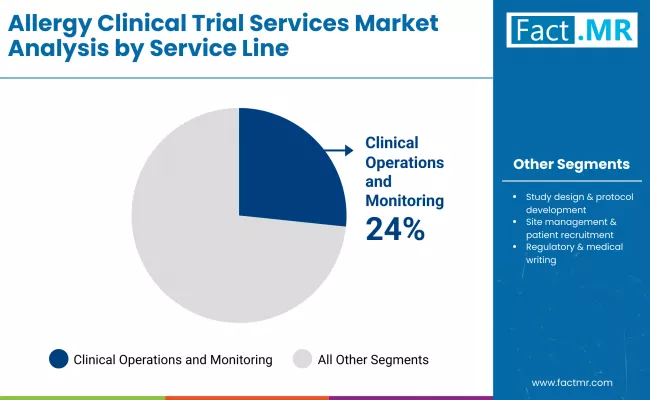
Allergy Clinical Trial Services Market Service Line | Source: Fact.MR
Clinical operations and monitoring account for 24.0% share because allergic reactions require intensive real-time oversight that exceeds standard trial monitoring protocols. Hypersensitivity manifestations can escalate rapidly from mild symptoms to anaphylaxis, necessitating on-site medical personnel during allergen exposure challenges and continuous safety surveillance throughout treatment phases. Food allergy trials conducting oral immunotherapy require medically supervised dose escalations where participants consume increasing allergen quantities under emergency-equipped conditions, creating labor-intensive monitoring requirements. Corporate investment reflects strategic positioning: CROs deploy specialized allergy monitoring platforms combining electronic adverse event capture with immediate clinician notification systems, establishing premium pricing through safety infrastructure that prevents trial interruptions while maintaining participant protection standards exceeding general therapeutic area requirements.
How does allergic rhinitis establish dominance within allergy trial focus indications?
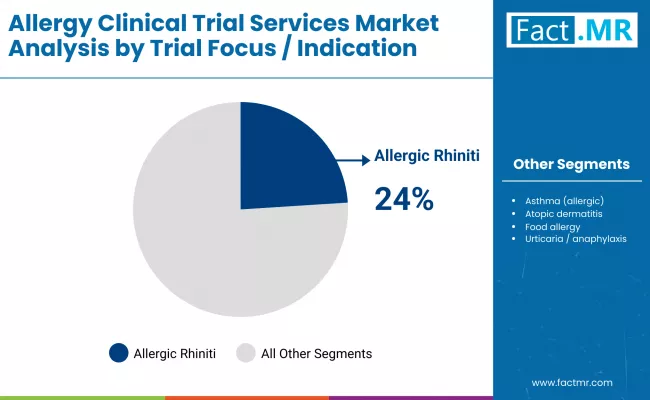
Allergy Clinical Trial Services Market By Trial Focus | Source: Fact.MR
Allergic rhinitis captures 24.0% of trial focus because high disease prevalence creates commercially viable patient populations supporting large-scale efficacy trials across multiple geographies. Unlike food allergies requiring carefully controlled exposure protocols, seasonal rhinitis enables natural allergen challenges during pollen seasons, reducing protocol complexity while maintaining clinical relevance. Market research demonstrates that sublingual immunotherapy tablets targeting grass, ragweed, and dust mite allergens generate sustained pharmaceutical investment due to favorable regulatory pathways and chronic treatment models supporting recurring revenue. Trial availability spans early-phase dose-finding through post-marketing surveillance, creating multiple engagement points for CRO services matching sponsor development stage and regulatory requirements across regional health authorities.
Market Dynamics
- Drivers: Rising pediatric food allergy prevalence has intensified beyond traditional allergen avoidance strategies toward active desensitization protocols. Educational campaigns from allergy advocacy organizations and ingredient-focused parental communities have elevated understanding of multi-allergen sensitization patterns, oral immunotherapy mechanisms, and sustained unresponsiveness endpoints. This knowledge expansion creates demand for transformative interventions rather than symptom management approaches. Simultaneously, regulatory innovation in needle-free delivery and home-use epinephrine systems are democratizing access to emergency treatments previously confined to injectable formats, expanding addressable trial populations beyond procedurally comfortable participants to anxiety-driven avoiders seeking alternative administration routes. FDA approval of neffy nasal spray has accelerated investment in human factors trials and comparative bioavailability studies, providing regulatory pathways that encourage innovation in patient-centered delivery technologies.
- Restraints: Patient recruitment challenges create trial timeline extensions and enrollment failures across specialized allergic populations. Geographic variation in allergen exposure patterns limits site viability for seasonal rhinitis trials, while competition for pediatric food allergy participants intensifies across simultaneous studies targeting identical sensitization profiles. This recruitment bottleneck drives premature study termination before achieving statistical power, exemplified by multiple grass pollen immunotherapy trials abandoned due to insufficient enrollment. Additionally, biomarker validation complexity continues expanding with mechanistic endpoints including allergen-specific IgG4 ratios and regulatory T cell populations requiring extensive preliminary evidence demonstrating clinical relevance before regulatory acceptance, limiting innovation adoption beyond traditional symptom scores that lack differentiation capacity for disease-modifying therapies.
- Trend 1: Component-Resolved Diagnostic Integration Trial design is shifting from crude allergen extract testing toward molecular allergen component identification that addresses specific protein epitopes driving patient reactions. This precision diagnostics evolution enables targeted immunotherapy selection matching individual sensitization patterns rather than population-level allergen exposure assumptions. CROs incorporating component-resolved testing platforms differentiate through mechanistic patient stratification supporting personalized protocol adaptations, positioning early adopters for premium trial segments where sponsors invest in biomarker-guided development over empirical dose escalation approaches.
- Trend 2: Artificial Intelligence Patient Recruitment Machine learning algorithms analyzing electronic health records are accelerating patient identification for complex allergic phenotype criteria. Natural language processing extracts allergy-relevant information from clinical documentation including specific food reactions and anaphylaxis histories, enabling targeted recruitment outreach that reduces screening failures. CROs investing in AI-powered recruitment platforms demonstrate enrollment timeline reductions approaching 30% compared to traditional site-based identification methods, creating competitive advantages in sponsor selection decisions where trial startup speed influences development program success.
Allergy Clinical Trial Services Market Analysis by Key Country
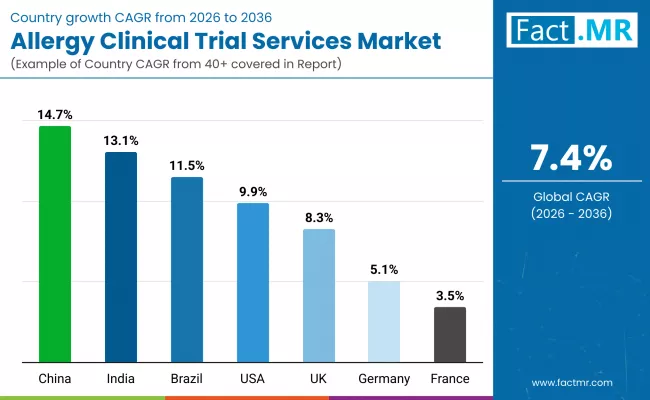
Allergy Clinical Trial Services Market By Country | Source: Fact.MR
| Country | CAGR (2026-2036) |
| China | 14.7% |
| India | 13.1% |
| Brazil | 11.5% |
| USA | 9.9% |
| UK | 8.3% |
| Germany | 5.1% |
| France | 3.5% |
Source: Fact.MR analysis. Updated Feb 4, 2026
What factors drive China to lead regional expansion in allergy clinical trial services?
China leads regional growth at 14.7 percent CAGR following NMPA implementation of the 30-day IND pathway for innovative drugs in 2025, reducing clinical startup timelines by 50 percent compared to previous 60-day standards. This regulatory acceleration dramatically shortened the interval from protocol submission to first patient enrollment, making China increasingly attractive for first-in-human trials and early-phase allergy therapeutic development. The pathway applies to Category I innovative drugs including biologics, small molecules, and traditional Chinese medicines addressing allergic conditions, with eligibility extending to nationally prioritized research programs and globally synchronized clinical trials. China maintains approximately one-third of the global new drug pipeline and initiated 39 percent of worldwide oncology trials in 2024, demonstrating infrastructure and expertise transferable to allergy research and creating substantial opportunity for service providers with regional regulatory knowledge.
How do regulatory frameworks and clinical infrastructure position India for growth?
India achieves significant expansion at 13.1 percent CAGR through implementation of New Drugs and Clinical Trials Rules 2019 and subsequent 2025 amendments strengthening ethical oversight and data integrity standards. These regulatory enhancements increased global biopharma confidence in Indian trial quality, prompting companies including Novartis and Bristol Myers Squibb to double clinical site footprints within the country by 2026. The massive patient population provides access to treatment-naive subjects and diverse genetic backgrounds enabling pharmacogenomics analyses, while cost advantages relative to Western markets reduce per-patient enrollment expenses without compromising quality.
How is Brazil emerging within allergy clinical trial services?
Brazil exhibits robust market expansion at 11.5 percent CAGR, driven by ANVISA regulatory reforms streamlining clinical trial approval processes. These reforms increased registration of Phase III trials for respiratory allergies and infectious disease-linked allergic conditions, positioning Brazil for greater participation in multinational development programs. Rapid urbanization and industrial growth have elevated asthma and allergic rhinitis rates, creating large patient populations for recruitment while environmental pollutant exposure patterns enable studies examining pollution-allergy interactions. The combination of regulatory agility, growing disease burden, and cost-competitive trial execution relative to North American and European markets positions Brazil for sustained growth in Phase IV post-marketing surveillance and observational studies.
What accounts for the United States achieving the highest regional growth rate in allergy clinical trial services?
The United States demonstrates exceptional expansion at 9.9 percent CAGR, propelled by FDA regulatory focus on non-injectable emergency treatments and precision medicine initiatives. FDA guidance emphasizing patient-centered endpoints and real-world evidence has created demand for novel trial designs incorporating telemedicine-enabled monitoring and patient-reported outcome measures. Rising pediatric food allergy prevalence, particularly multi-allergen sensitivities, drives investment in oral immunotherapy protocols requiring extensive safety monitoring across multiple treatment phases, substantially expanding the scope of clinical services required per study.
How does United Kingdom regulatory innovation support in allergy trial services?
United Kingdom achieves notable expansion at 8.3 percent CAGR through MHRA introduction of 14-day Phase I assessment procedures in early 2026, creating fast-track routes for early-phase research and development. This regulatory acceleration increased healthy volunteer trials by 16 percent, positioning the UK for first-choice consideration in dose-finding studies and initial safety evaluations for novel allergy therapeutics. Imperial College National Heart and Lung Institute has advanced pioneering research including virus-like particle technology for peanut allergy vaccines, demonstrating UK academic leadership in innovative immunotherapy approaches.
How do Germany-specific regulatory requirements influence its growth trajectory?
Germany exhibits steady expansion at 5.1 percent CAGR, anchored by Therapy Allergen Ordinance programs requiring rigorous registration data for allergy immunotherapies. The Paul-Ehrlich-Institute oversees comprehensive review processes demanding pivotal Phase III evidence for sublingual and subcutaneous immunotherapy products, creating sustained demand for large-scale efficacy trials. Companies including Allergy Therapeutics conduct multi-year studies evaluating grass pollen allergen extracts and other seasonal allergen formulations to satisfy German regulatory standards, which influence broader European approval strategies. The established nature of Germany allergy immunotherapy market creates competitive pressure for incremental improvements rather than breakthrough innovations, moderating growth rates while maintaining stable trial volumes for companies seeking market access in Europe largest economy.
What factors contribute to France exhibiting the most modest regional growth?
France demonstrates the slowest regional expansion at 3.5 percent CAGR, reflecting mature pharmaceutical infrastructure with limited recent regulatory innovation specific to allergy trials. The country maintains established clinical research capabilities through academic medical centers and contract research organizations, but has not implemented accelerated pathways comparable to UK MHRA reforms or emerging market regulatory streamlining. Competition from other European Union member states offering faster approval timelines or cost advantages has moderated France share of multinational trial activity, while domestic pharmaceutical focus on oncology and rare diseases limits local sponsor investment in allergy therapeutic development. Despite slower growth, France retains importance for European registration trials requiring multi-country participation and contributes specialized expertise in pediatric allergology through centers of excellence in Paris and Lyon.
Competitive Landscape
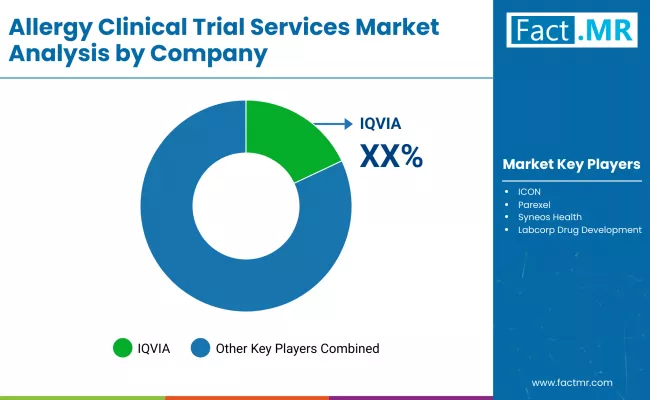
Allergy Clinical Trial Services Market By Company | Source: Fact.MR
IQVIA maintains market leadership through comprehensive service portfolios spanning bioanalytical capabilities, extensive global site networks, and specialized regulatory expertise in immunology and allergic disease trials. Company leverages integrated technology platforms connecting electronic data capture systems, patient recruitment databases, and real-time monitoring dashboards providing sponsors with visibility across multi-regional allergy studies. IQVIA bioanalytical laboratories offer specialized immunoassay capabilities including allergen-specific IgE testing, component-resolved diagnostics, and cytokine profiling required for mechanistic allergy research. Organization maintains therapeutic area centers of excellence staffed by allergists and immunologists advising on protocol design, endpoint selection, and regulatory strategy, differentiating IQVIA from generalist CROs lacking allergy-specific expertise. Strategic acquisitions expanded capabilities in real-world evidence generation and patient registry development, enabling post-approval studies examining long-term outcomes of allergy immunotherapies in routine clinical practice settings.
ICON competes through specialized pediatric research capabilities particularly relevant to food allergy and atopic dermatitis trials predominantly affecting children. Company operates dedicated pediatric units within clinical research sites, employing staff trained in child-friendly recruitment techniques and age-appropriate consent procedures required for studies involving minor subjects. ICON developed expertise managing complex food challenge protocols exposing allergic children to incremental allergen doses under medical supervision, requiring detailed safety monitoring and immediate access to emergency medications.
Recent Developments
- In February 2025, researchers at Imperial College National Heart and Lung Institute published Phase 1 first-in-human trial results for a novel peanut allergy vaccine in the Journal of Allergy and Clinical Immunology.
- In September 2024, DBV Technologies announced completion of patient screening for the Phase 3 VITESSE trial evaluating Viaskin Peanut Immunotherapy. This immunotherapy approach delivers allergen through a skin patch, representing an alternative to oral immunotherapy that avoids gastrointestinal side effects.
Key Players in in Allergy Clinical Trial Services Market
- IQVIA
- ICON
- Parexel
- Syneos Health
- Labcorp Drug Development
Bibliography
- U.S. Food and Drug Administration. 2024. Guidance for Industry: Allergic Rhinitis Clinical Development Programs for Drug Products. FDA Center for Drug Evaluation and Research.
- National Medical Products Administration (NMPA). 2025. Technical guidelines for clinical trial approval: 30-day IND pathway for innovative drugs in allergic disease treatment.
- European Medicines Agency. 2023. Guideline on clinical development of products for specific immunotherapy for treatment of allergic diseases. EMA Committee for Medicinal Products for Human Use.
- Journal of Allergy and Clinical Immunology. 2025. Phase 1 first-in-human trial results for peanut allergy vaccine employing virus-like particle technology. Imperial College National Heart and Lung Institute.
- Centers for Disease Control and Prevention. 2024. Food Allergy Among U.S. Children: Trends in Prevalence and Hospitalizations. National Center for Health Statistics.
Segmentation
Scope of Report
| Items | Values |
|---|---|
| Quantitative Units (2026) | USD 1.4 Billion |
| Service Line | Study design & protocol development, Site management & patient recruitment, Clinical operations & monitoring, Bioanalytical & immunoassay services, Data management & biostatistics, Regulatory & medical writing |
| Trial Focus / Indication | Allergic rhinitis, Asthma (allergic), Atopic dermatitis, Food allergy, Urticaria / anaphylaxis |
| End User | Pharma sponsors, Biotech sponsors, Academic medical centers, Device / diagnostic companies, Government / NGO sponsors |
| Regions Covered | North America, Europe, Asia Pacific, Latin America, Middle East & Africa |
| Countries Covered | U.S., Canada, Germany, Italy, UK, France, Japan, Australia, and other countries |
| Key Companies Profiled | IQVIA, ICON, Parexel, Syneos Health, Labcorp Drug Development |
| Additional Attributes | Dollar revenue in the allergy clinical trial services market is segmented by trial phase, allergy type, study design, service type, end user, price tier, and region. Regional demand patterns are driven by rising prevalence of allergic and immunologic disorders, increasing development of biologics and immunotherapies, stricter regulatory requirements for safety and efficacy data, and growing outsourcing of complex clinical trials to specialized CROs with expertise in allergy focused study design and patient recruitment. |
Source: Fact.MR analysis. Updated Feb 4, 2026
Allergy Clinical Trial Services Market by Segments
-
Service Line :
- Study design & protocol development
- Site management & patient recruitment
- Clinical operations & monitoring
- Bioanalytical & immunoassay services
- Data management & biostatistics
- Regulatory & medical writing
-
Trial Focus / Indication :
- Allergic rhinitis
- Asthma (allergic)
- Atopic dermatitis
- Food allergy
- Urticaria / anaphylaxis
-
End User :
- Pharma sponsors
- Biotech sponsors
- Academic medical centers
- Device / diagnostic companies
- Government / NGO sponsors
-
Region :
- Asia Pacific
- Japan
- South Korea
- China
- India
- Australia
- New Zealand
- Rest of Asia Pacific
- North America
- United States
- Canada
- Mexico
- Europe
- France
- Italy
- Spain
- Germany
- UK
- Rest of Europe
- Latin America
- Brazil
- Argentina
- Chile
- Rest of Latin America
- Asia Pacific
Frequently Asked Questions
How big is the global allergy clinical trial services market in 2026?
What will be the size of the allergy clinical trial services market in 2036?
How fast will the allergy clinical trial services market grow between 2026 and 2036?
Which service line dominates the allergy clinical trial services market?
Which trial focus represents the largest indication segment?
Who worked on this report


Preview the report firsthand - request a free sample
Free SampleGet the brochure for pricing and purchase details
Download PDF