- Base Value(2025): 7.1 Bn
- Estimated Value(2026): 7.8 Bn
- Forecast Value (2036): 21.7 Bn
- CAGR (2026 - 2036): 10.7%
Allergy Diagnostics Market Analysis and Forecast by Fact.MR
- The global allergy diagnostics market is estimated at US$ 7.1 billion in 2025 and has been forecast to expand at a CAGR of 10.7% to reach US$ 21.7 billion by 2036.
- Allergy diagnostics encompasses in vitro blood-based tests, skin prick test systems, and patch test products used to identify allergic sensitization to food, respiratory, drug, and contact allergens.
- In vitro allergy tests, including specific IgE panels and component-resolved diagnostics, account for the largest product share.
- Immunoassay technology is the dominant analytical platform.
- Food allergen testing represents the largest allergen type category by testing growth. Hospitals and diagnostic laboratories form the core testing infrastructure.
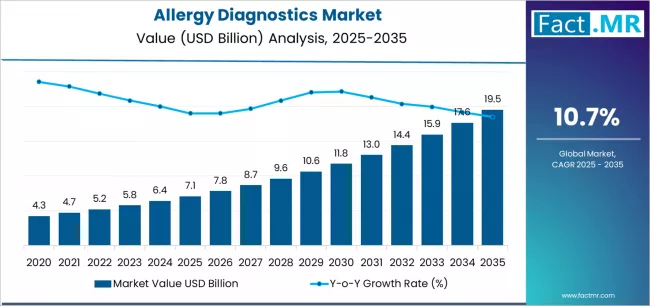
Allergy Diagnostics Market Market Value Analysis | Source: Fact.MR
Summary of Allergy Diagnostics Market
- Market Snapshot
- In 2025, the global Allergy Diagnostics Market was valued at approximately USD 7.1 billion.
- The market is estimated to reach USD 7.8 billion in 2026 and is projected to attain USD 21.7 billion by 2036.
- The allergy diagnostics market is likely to expand at a CAGR of 10.7% during the forecast period.
- The market is anticipated to create an absolute dollar opportunity of USD 13.8 billion between 2026 and 2036.
- In Vitro Allergy Tests accounts for 39.8% of product share in 2026.
- USA (11.8%) and China (11.4%) are the key growth markets during the forecast period.
- Demand and Growth Drivers
- Food allergy prevalence growth, particularly among pediatric populations in developed markets, is the primary demand catalyst for specific IgE testing and component-resolved allergen diagnostics.
- Component-resolved diagnostics (CRD) adoption, using recombinant allergen molecules rather than crude extracts, is improving diagnostic specificity and supporting allergen immunotherapy patient selection.
- Multiplex allergen microarray platforms testing 100-plus allergens from a single small blood sample are improving diagnostic comprehensiveness and laboratory workflow efficiency.
- Allergy immunotherapy prescription growth, which requires specific allergen identification for treatment formulation, is driving upstream diagnostic testing demand.
- Direct-to-consumer food sensitivity testing, though clinically controversial, is expanding consumer awareness and driving referrals to clinical allergy diagnostic testing.
- Product and Segment View
- In Vitro Allergy Tests accounts for 39.8% of the product segment in 2026, supported by strong installed base and continued procurement across primary end use channels.
- Immunoassay Technology accounts for 42.6% of the technology segment in 2026, reflecting concentrated demand across established application areas.
- Food Allergens accounts for 37.9% of the allergen type segment in 2026, with adoption rising across both developed and emerging markets.
- Key segmentation includes:
- Product: In Vitro Allergy Tests, Skin Prick Test Systems, Patch Test Systems
- Technology: Immunoassay Technology, Fluorescence Technology, Molecular Diagnostics Technology
- Allergen Type: Food Allergens, Respiratory Allergens, Drug Allergens
- End User: Hospitals and Clinics, Diagnostic Laboratories, Research Institutes
- These systems enable:
- Targeted procurement and specification alignment across buyer segments
- Performance benchmarking across product and application categories
- Regional demand mapping across 30 plus countries
- Geography and Competitive Outlook
- North America accounts for a large share of global demand, supported by established procurement channels and a mature buyer base.
- Europe shows stable demand, with Germany (9.9%) contributing through regulatory compliance and institutional procurement for allergy diagnostics products.
- Asia Pacific demand is led by China (11.4%) and India (10.7%).
- USA (11.8%) and China (11.4%) are the fastest growing country markets during the forecast period.
- Leading companies include Thermo Fisher Scientific Inc., HYCOR Biomedical LLC, EUROIMMUN Medizinische Labordiagnostika AG, Omega Diagnostics Group PLC, Lincoln Diagnostics, Inc..
- Analyst Opinion
- Shambhu Nath Jha, Principal Consultant at Fact.MR, says 'The allergy diagnostics market is experiencing a technology transition from crude extract-based testing toward molecular component-resolved diagnostics that deliver clinically actionable precision. Thermo Fisher Scientific leads through its ImmunoCAP platform and Phadia business, which commands the dominant share of the global specific IgE testing market. EUROIMMUN and Siemens compete with complementary allergen and autoimmune testing capabilities. Growth is driven by food allergy prevalence, immunotherapy adoption, and the shift toward CRD that increases per-patient testing revenue. Companies that build the broadest molecular allergen menus on automated laboratory platforms will sustain competitive advantage.'
Key Growth Drivers, Constraints, and Opportunities
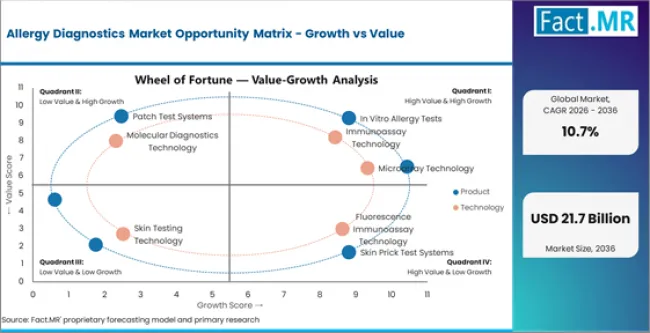
Allergy Diagnostics Market Opportunity Matrix Growth Vs Value | Source: Fact.MR
Key Factors Driving Growth
- Food allergy prevalence growth, particularly among pediatric populations in developed markets, is the primary demand catalyst for specific IgE testing and component-resolved allergen diagnostics.
- Component-resolved diagnostics (CRD) adoption, using recombinant allergen molecules rather than crude extracts, is improving diagnostic specificity and supporting allergen immunotherapy patient selection.
- Multiplex allergen microarray platforms testing 100-plus allergens from a single small blood sample are improving diagnostic comprehensiveness and laboratory workflow efficiency.
Key Market Constraints
- Skin prick testing, which is inexpensive and immediately available, continues to be used as first-line allergy diagnosis in many settings, limiting in vitro test market penetration.
- Reimbursement variability for comprehensive allergen panels across payer systems restricts the number of allergens tested per clinical encounter.
- Clinical interpretation of multiplex allergen results requires specialist allergist expertise that is concentrated in urban specialty practices and academic medical centers.
Key Opportunity Areas
- Molecular allergy diagnostics using recombinant allergen components are creating a premium testing tier with higher per-test revenue and improved clinical utility.
- Point-of-care allergy testing devices for primary care and pharmacy settings could expand testing access beyond specialist allergist practices.
- Emerging market allergy diagnostic infrastructure development is creating first-time access to standardized allergen testing in previously underserved populations.
Segment-wise Analysis of the Allergy Diagnostics Market
- In Vitro Allergy Tests holds 39.8% of the product segment in 2026, supported by established demand channels and continued procurement across primary end use applications.
- Immunoassay Technology holds 42.6% of the technology segment in 2026, supported by established demand channels and continued procurement across primary end use applications.
- Food Allergens holds 37.9% of the allergen type segment in 2026, supported by established demand channels and continued procurement across primary end use applications.
The allergy diagnostics market is segmented by product, technology, allergen type, end user, and region.
By product, the market covers In Vitro Allergy Tests, Skin Prick Test Systems, Patch Test Systems.
By technology, coverage includes Immunoassay Technology, Fluorescence Immunoassay Technology, Molecular Diagnostics Technology.
Which Product Segment Dominates the Allergy Diagnostics Market?
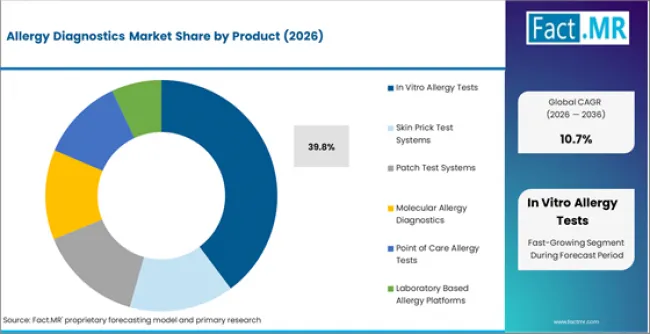
Allergy Diagnostics Market Analysis By Product | Source: Fact.MR
In Vitro Allergy Tests is expected to account for 39.8% of the product segment in 2026. Within this category, Specific IgE Blood Test Kits, Multiplex Allergy Panels, Component Resolved Diagnostics Kits represent the primary sub-segments generating procurement activity. The depth of the in vitro allergy tests installed base across product applications sustains replacement demand and limits share erosion from newer alternatives in the allergy diagnostics market.
Skin Prick Test Systems is the second largest category in the product segment, with demand concentrated in Allergen Extract Panels and Single Allergen Test Kits. Growth in skin prick test systems reflects shifting buyer requirements within the allergy diagnostics market toward this category.
Which Technology Segment Dominates the Allergy Diagnostics Market?
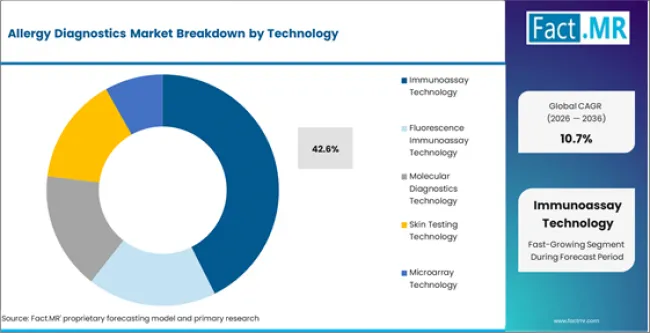
Allergy Diagnostics Market Analysis By Technology | Source: Fact.MR
Immunoassay Technology is expected to account for 42.6% of the technology segment in 2026. Within this category, ELISA Based Systems, Chemiluminescence Immunoassay Systems represent the primary sub-segments generating procurement activity. The depth of the immunoassay technology installed base across technology applications sustains replacement demand and limits share erosion from newer alternatives in the allergy diagnostics market.
Fluorescence Immunoassay Technology is the second largest category in the technology segment, with demand concentrated in Multiplex Fluorescence Platforms and Bead Based Detection Systems. Growth in fluorescence immunoassay technology reflects shifting buyer requirements within the allergy diagnostics market toward this category.
Which Allergen Type Segment Dominates the Allergy Diagnostics Market?
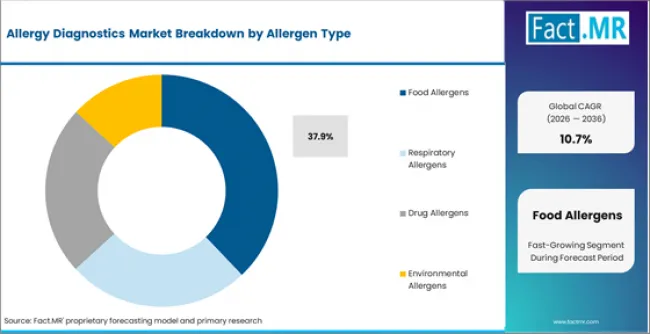
Allergy Diagnostics Market Analysis By Allergen Type | Source: Fact.MR
Food Allergens is expected to account for 37.9% of the allergen type segment in 2026. Within this category, Dairy Allergens, Seafood Allergens, Nut Allergens represent the primary sub-segments generating procurement activity. The depth of the food allergens installed base across allergen type applications sustains replacement demand and limits share erosion from newer alternatives in the allergy diagnostics market.
Respiratory Allergens is the second largest category in the allergen type segment, with demand concentrated in Pollen Allergens and Dust Mite Allergens. Growth in respiratory allergens reflects shifting buyer requirements within the allergy diagnostics market toward this category.
Which Product Trend is Shaping the Next Phase of Growth in the Allergy Diagnostics Market?
Component-resolved allergen diagnostics (CRD) is the technology advancement driving the highest clinical and commercial impact in the allergy diagnostics market. Traditional allergy testing uses crude allergen extracts that contain multiple allergenic proteins, making it difficult to distinguish between genuine food allergy and harmless cross-reactive sensitization. CRD uses individual recombinant allergen molecules to identify the specific proteins driving clinical allergy, enabling more precise diagnosis and better immunotherapy patient selection.
Thermo Fisher ImmunoCAP is the leading CRD platform, with EUROIMMUN and Siemens also offering molecular allergen testing. The clinical adoption of CRD is reshaping allergy diagnostics from a screening test into a precision diagnostic that directly informs treatment decisions. For the allergy diagnostics market, CRD creates higher per-test revenue because testing multiple individual allergen components generates more reagent consumption than a single crude extract panel. Clinical guideline incorporation of CRD is the key driver of institutional adoption.
Regional Outlook Across Key Markets
.webp "Top Country Growth Comparison Allergy Diagnostics Market Cagr (2026 2036)")
Top Country Growth Comparison Allergy Diagnostics Market Cagr (2026 2036) | Source: Fact.MR
- USA is growing at 11.8%, supported by high allergy prevalence, specialist infrastructure, and immunotherapy prescribing.
- China is growing at 11.4%, supported by rising allergy prevalence, hospital diagnostic expansion, and domestic platform development.
- India is growing at 10.7%, supported by urban allergy growth, diagnostic laboratory chain expansion, and specialist capacity improvement.
- Germany is growing at 9.9%, supported by clinical practice maturity, EUROIMMUN domestic strength, and statutory insurance coverage.
CAGR Table
| Country | CAGR (%) |
|---|---|
| USA | 11.8% |
| China | 11.4% |
| India | 10.7% |
| Germany | 9.9% |
| Brazil | 9.3% |
| Japan | 8.8% |
| Saudi Arabia | 8.1% |
Source: Fact.MR analysis. Updated May 27, 2026
Source: Fact MR (FMR) analysis, based on proprietary forecasting model and primary research.
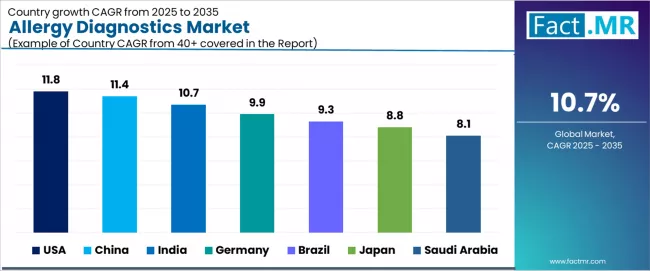
Allergy Diagnostics Market Cagr Analysis By Country | Source: Fact.MR
Market Outlook for Allergy Diagnostics in USA
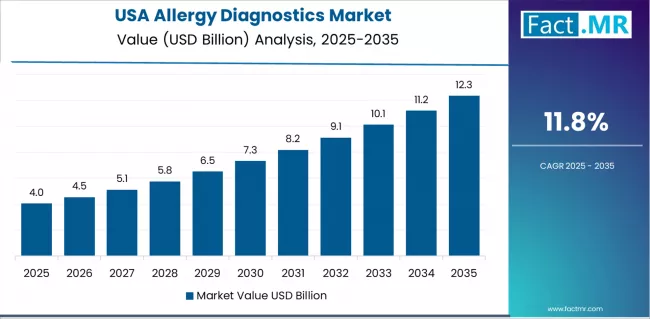
Allergy Diagnostics Market Country Value Analysis | Source: Fact.MR
The USA Allergy Diagnostics market is projected to grow at a CAGR of 11.8% through 2036. The U.S. is the largest allergy diagnostics market, driven by high allergy prevalence, specialist infrastructure, and immunotherapy prescribing.
- ACAAI and AAAAI clinical guidelines define allergy testing algorithms that drive specific IgE and skin prick test ordering patterns.
- Quest Diagnostics and Labcorp reference laboratory networks process the majority of in vitro allergy diagnostic volumes.
- Food allergy prevalence growth, particularly peanut, tree nut, and milk allergy among children, is expanding pediatric testing demand.
Allergy Diagnostics Demand Trends in China
The China Allergy Diagnostics market is projected to grow at a CAGR of 11.4% through 2036. Rising allergy prevalence and hospital diagnostic expansion support allergy diagnostics growth in China.
- Allergic rhinitis and food allergy prevalence growth in urban Chinese populations is increasing clinical testing demand.
- Hospital allergy and immunology department development in tier-1 and tier-2 cities is building diagnostic testing capability.
- Domestic diagnostics companies are developing cost-competitive immunoassay allergen testing platforms for institutional procurement.
India Allergy Diagnostics Market Growth Outlook
The India Allergy Diagnostics market is projected to grow at a CAGR of 10.7% through 2036. Growing allergy awareness and diagnostic laboratory expansion drive allergy testing market growth in India.
- Urban allergy prevalence growth, driven by air pollution and dietary changes, is increasing testing demand in metropolitan areas.
- Thyrocare, SRL, and Metropolis diagnostic laboratory chains are expanding allergen test menus across Indian cities.
- Growing allergist specialist numbers in major urban centers are improving referral rates for specific IgE and skin prick testing.
Germany Allergy Diagnostics Market Demand Analysis
The Germany Allergy Diagnostics market is projected to grow at a CAGR of 9.9% through 2036. Clinical allergy practice maturity and EUROIMMUN domestic strength sustain diagnostics demand in Germany.
- DGAKI clinical guidelines define evidence-based allergy testing algorithms for both respiratory and food allergy evaluation.
- EUROIMMUN, headquartered in Lubeck, maintains strong domestic market position in allergen and autoantibody diagnostics.
- Statutory health insurance coverage for indicated allergy testing supports patient access through physician ordering channels.
Allergy Diagnostics Market Growth Assessment in Brazil
The Brazil Allergy Diagnostics market is projected to grow at a CAGR of 9.3% through 2036. Growing allergy prevalence and diagnostic infrastructure development support allergy testing in Brazil.
- Increasing allergic rhinitis and food allergy prevalence in Brazilian urban populations is generating testing demand.
- Diagnostic laboratory chain expansion by Fleury, DASA, and others improves access to allergy testing in major cities.
- ASBAI (Brazilian Association of Allergy and Immunology) guidelines inform clinical allergy testing practices.
Allergy Diagnostics Market Opportunity Outlook in Japan
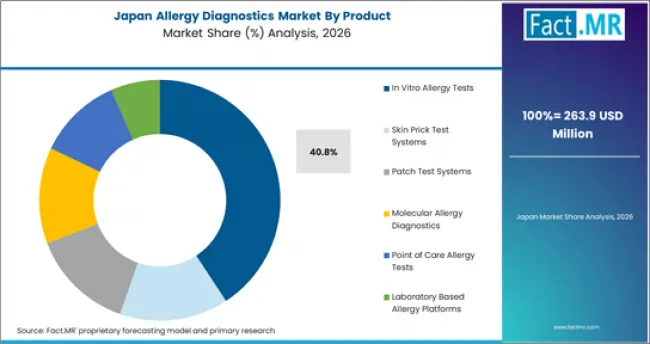
Allergy Diagnostics Market Japan Market Share Analysis By Product | Source: Fact.MR
The Japan Allergy Diagnostics market is projected to grow at a CAGR of 8.8% through 2036. High allergy prevalence and established testing infrastructure sustain allergy diagnostics demand in Japan.
- Cedar pollen allergy (sugi kafunsho) affecting over 30% of the population generates the largest single-allergen testing volume globally.
- Food allergy prevalence and mandatory food labeling requirements drive diagnostic testing for confirmed sensitization.
- JSACI guidelines define allergy testing algorithms that drive institutional IgE and skin prick test ordering.
Demand Landscape for Allergy Diagnostics in Saudi Arabia
The Saudi Arabia Allergy Diagnostics market is projected to grow at a CAGR of 8.1% through 2036. Healthcare investment and growing allergy awareness support allergy diagnostics market development in Saudi Arabia.
- Ministry of Health hospital allergy departments provide institutional access to in vitro allergen testing.
- Growing allergy prevalence linked to urbanization and dietary changes is increasing clinical testing demand.
- Hospital laboratory investment in immunoassay platforms is expanding in vitro allergy testing capability.
Competitive Benchmarking and Company Positioning
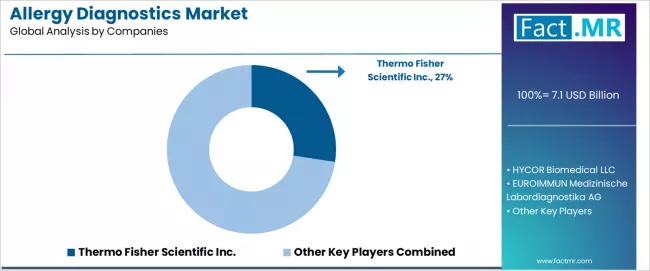
Allergy Diagnostics Market Analysis By Company | Source: Fact.MR
Allergy Diagnostics Market Analysis By Company
- Thermo Fisher Scientific Inc., HYCOR Biomedical LLC, EUROIMMUN Medizinische Labordiagnostika AG, Omega Diagnostics Group PLC hold established positions in the global allergy diagnostics market through broad product portfolios, geographic reach, and growing capabilities in higher specification categories.
- Lincoln Diagnostics, Inc., AESKU.GROUP GmbH & Co. KG, Minaris Medical America, Inc., HOB Biotech Group Corp., Ltd. participate across specific price tiers, end use segments, and regional channels, with competition shaped by product quality, service support, and distribution access.
- Allergen component menu breadth, immunoassay platform automation level, clinical guideline alignment evidence, and immunotherapy prescriber relationships are the primary competitive differentiators.
Thermo Fisher Scientific Inc. leads the allergy diagnostics market through its ImmunoCAP/Phadia platform and the broadest specific IgE allergen menu globally. HYCOR Biomedical LLC competes through its NOVEOS allergy testing platform. EUROIMMUN Medizinische Labordiagnostika AG (PerkinElmer) serves allergen and autoantibody testing. Omega Diagnostics Group PLC participates through its Allergopharma allergy business. Lincoln Diagnostics Inc. provides skin testing devices and allergen extracts.
The market is dominated by Thermo Fisher Phadia in the in vitro segment, with competitors differentiating on platform features, allergen menu, and pricing. Skin prick testing from companies like ALK-Abello and Stallergenes Greer competes as a lower-cost alternative to blood-based testing. The molecular allergen diagnostics transition is favoring companies with the deepest recombinant allergen component libraries. Laboratory consolidation and platform standardization are concentrating testing volume among fewer, larger reference and hospital laboratories.
Key Companies in the Allergy Diagnostics Market
- Thermo Fisher Scientific Inc., HYCOR Biomedical LLC, EUROIMMUN Medizinische Labordiagnostika AG, Omega Diagnostics Group PLC are among the leading players in the allergy diagnostics market globally, supported by strong brand visibility and broad product portfolios.
- Lincoln Diagnostics, Inc., AESKU.GROUP GmbH & Co. KG, Minaris Medical America, Inc., HOB Biotech Group Corp., Ltd. hold established positions across specific categories, supported by durable products and regional distribution.
Recent Industry Developments
- Thermo Fisher Scientific Inc. - 300-Component CRD Panel (January 2026)
- Thermo Fisher Scientific Inc. launched a 300-component molecular allergen microarray panel enabling the most comprehensive single-test allergen profiling available, targeting specialist allergy centers and reference laboratories.
- HYCOR Biomedical LLC - POC Allergy Device (2025)
- HYCOR Biomedical LLC introduced a point-of-care specific IgE testing device delivering results for 10 common allergens in under 20 minutes, targeting primary care physician offices and urgent care clinics.
- EUROIMMUN Medizinische Labordiagnostika AG - Food Allergy Companion (2025)
- EUROIMMUN Medizinische Labordiagnostika AG released a digital companion app that interprets component-resolved food allergy test results for patients and clinicians, providing dietary guidance based on molecular sensitization profiles.
- Omega Diagnostics Group PLC - Immunotherapy Matching (February 2026)
- Omega Diagnostics Group PLC announced a diagnostic-to-therapy matching platform that links component-resolved allergen test results with specific immunotherapy formulation recommendations for allergist prescribing.
Leading Companies Shaping the Allergy Diagnostics Market
- Thermo Fisher Scientific Inc.
- HYCOR Biomedical LLC
- EUROIMMUN Medizinische Labordiagnostika AG
- Omega Diagnostics Group PLC
- Lincoln Diagnostics, Inc.
- AESKU.GROUP GmbH & Co. KG
- Minaris Medical America, Inc.
- HOB Biotech Group Corp., Ltd.
- DASIT Group S.p.A.
- R-Biopharm AG
Sources and Research References
- Thermo Fisher Scientific Inc.. Product portfolio and corporate announcements.
- HYCOR Biomedical LLC. Product portfolio and corporate announcements.
- EUROIMMUN Medizinische Labordiagnostika AG. Product portfolio and corporate announcements.
- Industry association statistics, regulatory publications, trade databases, and company product catalogs.
- Primary interviews with manufacturers, distributors, buyers, and institutional users.
This bibliography is provided for reader reference and is not exhaustive. The full report contains the complete reference list and detailed citations.
Key Questions This Report Addresses
- What is the current and future size of the Allergy Diagnostics Market?
- How fast is the Allergy Diagnostics Market expected to grow between 2026 and 2036?
- Which product is likely to lead the market by 2026?
- Which technology segment is expected to account for the highest demand by 2026?
- What factors are driving demand in this market globally?
- How is technology adoption influencing the market structure?
- Which countries are projected to show the fastest growth through 2036?
- What is driving market expansion in USA and China?
- Who are the key companies active in the Allergy Diagnostics Market?
- How does Fact.MR estimate and validate the market forecast?
Allergy Diagnostics Market Definition
The allergy diagnostics market covers products, technologies, and services associated with product, technology, allergen type categories. The scope includes global and regional market size and forecasts for 2026 to 2036 across product, technology, allergen type, end user, and region.
Allergy Diagnostics Market Inclusions
- The scope covers global and regional market size and forecasts for 2026 to 2036 across product, technology, allergen type, end user, and region.
- It includes regional demand analysis across major geographies, based on factors such as technology adoption, regulatory requirements, institutional spending, and commercial demand patterns.
- The report includes pricing and cost analysis across entry-level, mid-range, and premium categories, including hardware, software, and service components where applicable.
- It covers technology trends, market drivers and constraints, and the competitive landscape, including product portfolios, pricing strategy, geographic reach, and distribution expansion of leading players.
Allergy Diagnostics Market Exclusions
- The scope excludes adjacent categories, general-purpose alternatives, and products not specifically classified under the allergy diagnostics market taxonomy.
- It excludes custom-built in-house solutions, informal unbranded products with low market visibility, and rental or leasing services without direct product sales.
- The report excludes military or defense-grade variants, industrial systems outside the defined scope, and non-commercial applications without market transaction data.
- It also excludes software-only platforms sold independently from hardware, unless they are part of the defined product or service taxonomy.
Allergy Diagnostics Market Research Methodology
- The methodology combines secondary research, primary interviews, and forecast modelling.
- It draws on 120 plus secondary sources and benchmarks 65 plus company product portfolios.
- Market sizing covers 30 plus countries through a demand-side model, supported by top-down validation.
- Key inputs include end use adoption rates, technology penetration, pricing benchmarks, and regional procurement patterns.
- The model cross-checks demand with shipments, pricing trends, channel mix, and product launches.
- Primary validation includes 25 plus interviews across manufacturers, distributors, buyers, and institutional users.
- Final estimates go through trade-flow checks, sales-pattern review, and sensitivity testing.
Segmentation
Scope of Analysis
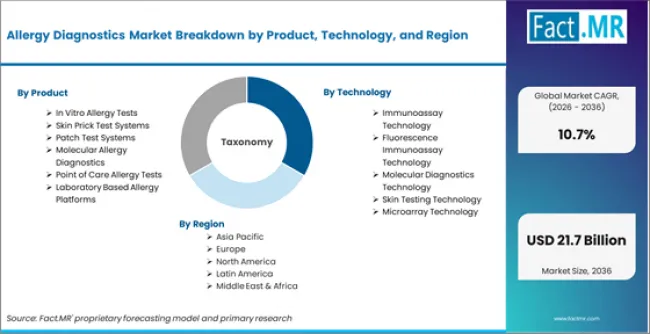
Allergy Diagnostics Market Breakdown By Product, Technology, And Region | Source: Fact.MR
| Parameter | Details |
|---|---|
| Quantitative Units | USD 7.8 billion to USD 21.7 billion, at a CAGR of 10.7% |
| Market Definition | The Allergy Diagnostics Market covers products, technologies, and services across product, technology, allergen type categories for commercial, institutional, and consumer applications. |
| Regions Covered | North America, Latin America, Europe, East Asia, South Asia and Pacific, Middle East and Africa |
| Countries Covered | USA, Canada, UK, Germany, China, India, 30 plus countries |
| Key Companies | Thermo Fisher Scientific Inc., HYCOR Biomedical LLC, EUROIMMUN Medizinische Labordiagnostika AG, Omega Diagnostics Group PLC, Lincoln Diagnostics, Inc., AESKU.GROUP GmbH & Co. KG, Minaris Medical America, Inc., HOB Biotech Group Corp., Ltd., DASIT Group S.p.A., R-Biopharm AG |
| Forecast Period | 2026 to 2036 |
| Approach | Hybrid demand-side and top-down methodology built on country-level application demand, product benchmarking, pricing analysis, shipment validation, and primary interviews across manufacturers, distributors, and end users |
Source: Fact.MR analysis. Updated May 27, 2026
Allergy Diagnostics Market Segmentation
-
Allergy Diagnostics Market Segmented by Product:
- In Vitro Allergy Tests
- Specific IgE Blood Test Kits
- Multiplex Allergy Panels
- Component Resolved Diagnostics Kits
- Skin Prick Test Systems
- Allergen Extract Panels
- Single Allergen Test Kits
- Patch Test Systems
- Standard Patch Test Kits
- Extended Patch Panels
- Molecular Allergy Diagnostics
- Allergen Component Testing Kits
- Recombinant Allergen Panels
- Point of Care Allergy Tests
- Rapid IgE Test Kits
- Cassette Based Allergy Tests
- Laboratory Based Allergy Platforms
- Automated Immunoassay Systems
- High Throughput Allergy Analyzers
- In Vitro Allergy Tests
-
Allergy Diagnostics Market Segmented by Technology:
- Immunoassay Technology
- ELISA Based Systems
- Chemiluminescence Immunoassay Systems
- Fluorescence Immunoassay Technology
- Multiplex Fluorescence Platforms
- Bead Based Detection Systems
- Molecular Diagnostics Technology
- PCR Based Allergy Testing
- Recombinant DNA Allergen Profiling
- Skin Testing Technology
- Epicutaneous Testing Systems
- Skin Prick Automation Systems
- Microarray Technology
- Allergen Microarray Chips
- Protein Microarray Platforms
- Immunoassay Technology
-
Allergy Diagnostics Market Segmented by Allergen Type:
- Food Allergens
- Dairy Allergens
- Seafood Allergens
- Nut Allergens
- Respiratory Allergens
- Pollen Allergens
- Dust Mite Allergens
- Mold Allergens
- Drug Allergens
- Antibiotic Allergens
- Latex Allergens
- Environmental Allergens
- Animal Dander Allergens
- Chemical Exposure Allergens
- Food Allergens
-
Allergy Diagnostics Market Segmented by End User:
- Hospitals and Clinics
- Allergy Specialty Clinics
- Tertiary Care Hospitals
- Diagnostic Laboratories
- Independent Diagnostic Labs
- Hospital Based Labs
- Research Institutes
- Academic Allergy Research Centers
- Biomedical Research Organizations
- Pharmaceutical and Biotechnology Companies
- Drug Development Companies
- Allergen Immunotherapy Developers
- Hospitals and Clinics
-
Allergy Diagnostics Market Segmented by Sample Type:
- Blood Samples
- Serum Based Testing
- Plasma Based Testing
- Skin Samples
- Epidermal Testing
- Intradermal Samples
- Saliva Based Samples
- Blood Samples
-
Allergy Diagnostics Market by Region:
- North America
- USA
- Canada
- Mexico
- Latin America
- Brazil
- Chile
- Rest of Latin America
- Western Europe
- Germany
- UK
- Italy
- Spain
- France
- Nordic
- BENELUX
- Rest of Western Europe
- Eastern Europe
- Russia
- Poland
- Hungary
- Balkan & Baltic
- Rest of Eastern Europe
- East Asia
- China
- Japan
- South Korea
- South Asia and Pacific
- India
- ASEAN
- Australia & New Zealand
- Rest of South Asia and Pacific
- Middle East & Africa
- Kingdom of Saudi Arabia
- Other GCC Countries
- Turkiye
- South Africa
- Other African Union
- Rest of Middle East & Africa
- North America
Frequently Asked Questions
How big is the allergy diagnostics market in 2026?
What will be the size of allergy diagnostics market in 2036?
How much will be the allergy diagnostics market growth between 2026 and 2036?
What are the key product types in the allergy diagnostics market?
Which technology segment is expected to contribute significant share in the allergy diagnostics market in 2026?
Who worked on this report


Preview the report firsthand - request a free sample
Free SampleGet the brochure for pricing and purchase details
Download PDF