- Base Value(2025): 396.8 Mn
- Estimated Value(2026): 439.7 Mn
- Forecast Value (2036): 1226.1 Mn
- CAGR (2026 - 2036): 10.8%
Anti-riot Software Market Overview, Growth Outlook, and Forecast by Fact.MR
- In 2025, the anti-riot software market was valued at USD 396.8 million.
- Based on market estimates, demand for anti-riot software is projected to grow to USD 439.7 million in 2026 and further reach USD 1,226.1 million by 2036.
- The market is anticipated to expand at a CAGR of 10.8% during the forecast period of 2026 to 2036.
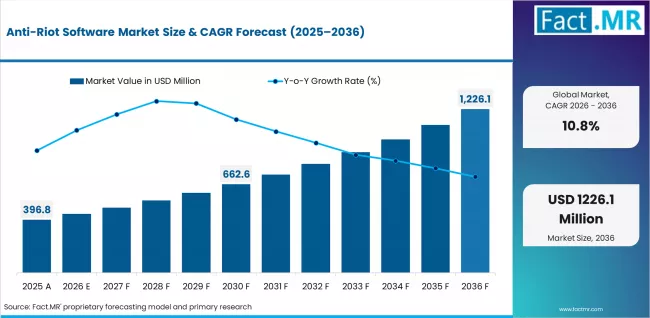
Anti Riot Software Market Value Analysis | Source: Fact.MR
Summary of the Anti-Riot Software Market
- Market Snapshot
- In 2025, the global anti-riot software market was valued at approximately USD 396.8 million.
- The market is estimated to reach USD 439.7 million in 2026 and is projected to attain USD 1,226.1 million by 2036.
- The Anti-riot Software Market is likely to expand at a CAGR of 10.8% during the forecast period.
- The market is anticipated to create an absolute dollar opportunity of USD 829.3 million between 2026 and 2036.
- Predictive Analytics Software is projected to witness the fastest growth during the forecast period owing to rising adoption of AI-based threat prediction and behavioral analytics technologies.
- Demand and Growth Drivers
- Growing adoption of AI-powered surveillance and crowd monitoring systems
- Growing need for live threat detection and public safety intelligence services
- Development of smart city and urban protection system projects
- Rising implementation of predictive analytics and facial recognition solutions for civil disability management
- Increasing funding in homeland security and law enforcement modernization programs
- Need for solutions that provide:
- Real-time crowd monitoring and behavioral analysis
- Faster incident detection and tactical response coordination
- Predictive threat intelligence and violence detection
- Enhanced situational awareness and public safety management
- Integrated command, control, and emergency communication capabilities
- Product and Segment View
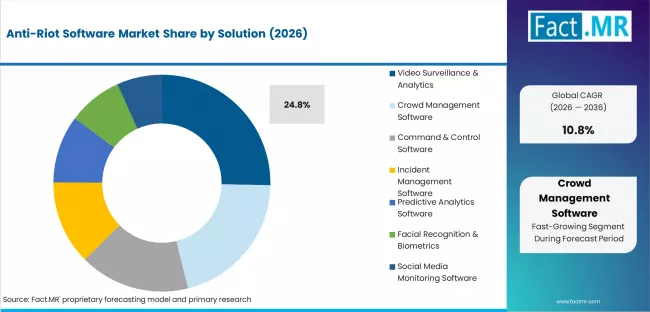
- Video Surveillance & Analytics holds 24.8% of solution segment share in 2026, emerging as the leading segment.
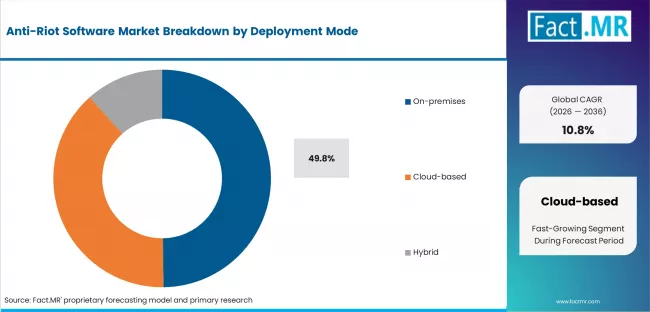
- Cloud-based deployment accounts for 38.6% of deployment mode share in 2026, positioning it as the dominant deployment model.
- Artificial Intelligence (AI) & Machine Learning represents 31.8% of technology segment share in 2026, reflecting increasing adoption of predictive surveillance and behavioral analytics systems.
- Riot Control applications hold 27.6% of application segment share in 2026, indicating the leading deployment concentration across public safety operations.
- Law Enforcement Agencies account for 33.8% of end-user share in 2026, supported by growing investments in crowd monitoring, tactical response coordination, and urban security modernization initiatives.
- Geography and Competitive Outlook
- The development is enabled in North America, Europe, East Asia, and South Asia & Pacific regions due to the growing expenditure on public safety and modernization, and AI-enabled surveillance infrastructure.
- Leading growth countries and CAGR: India 13.5%, Japan 12.8%, China 12.5%, United States 10.3%, South Korea 9.9%, United Kingdom 9.6%, Germany 9.1%.
- Market growth is directly related to:
- Growing adoption of AI-based surveillance and crowd monitoring solutions
- Development of the smart city and integrated public safety infrastructure solutions
- Surging investment in predictive analytics, facial recognition and incident management technology
- In increasing need of situation awareness in real-time and civil unrest applications
- Major players operating in the market include Motorola Solutions, Hexagon AB, Axon Enterprise, Genetec, NEC Corporation, Verint, BriefCam, Verkada, Senstar, and more.
- Analyst Opinion
- Shambhu Nath Jha, Principal Consultant at Fact.MR, opines, “CXOs will find that the future competitive advantage in the Anti-riot Software Market will increasingly depend on AI-driven surveillance intelligence, predictive threat analytics, and real-time situational awareness capabilities rather than traditional standalone security monitoring systems.
Anti-riot Software Market— At a Glance
| Attribute | Details |
|---|---|
| Market Value 2025 | USD 396.8 Million |
| Market Value 2026 | USD 439.7 Million |
| Market Value 2036 | USD 1,226.1 Million |
| Absolute Dollar Opportunity | USD 829.3 Million |
| Total Growth | 208.90% |
| CAGR | 10.80% |
| Growth Multiple | 3.1x |
| Key Demand Theme | Rising adoption of AI-driven surveillance systems, increasing investments in public safety modernization, expansion of smart city infrastructure, growing deployment of predictive analytics for civil unrest management, and increasing demand for real-time crowd monitoring solutions |
| Leading Solution Type | Video Surveillance & Analytics |
| Solution Share | 24.8% |
| Leading Deployment Mode | Cloud-based |
| Deployment Mode Share | 38.6% |
| Leading Technology | Artificial Intelligence (AI) & Machine Learning |
| Technology Share | 31.8% |
| Leading Application | Riot Control |
| Application Share | 27.6% |
| Leading End User | Law Enforcement Agencies |
| End User Share | 33.8% |
| Key Growth Regions | East Asia, South Asia & Pacific, North America |
| Key Companies | Motorola Solutions, Hexagon AB, Axon Enterprise, Genetec, NEC Corporation, Verint, BriefCam, Avigilon, Verkada, Senstar |
| Segmentation by Solution | Crowd Management Software, Video Surveillance & Analytics, Command & Control Software, Incident Management Software, Predictive Analytics Software, Social Media Monitoring Software, Facial Recognition & Biometrics, GIS & Mapping Software |
| Segmentation by Deployment Mode | On-premises, Cloud-based, Hybrid |
| Segmentation by Technology | Artificial Intelligence (AI) & Machine Learning, Computer Vision, Internet of Things (IoT), Big Data Analytics, Drone & Robotics Integration |
| Segmentation by Application | Riot Control, Protest Monitoring, Public Event Security, Border & Homeland Security, Smart City Public Safety, Emergency Response Coordination |
| Segmentation by End User | Law Enforcement Agencies, Defense & Military, Homeland Security Agencies, Smart City Authorities, Transportation Authorities, Private Security Organizations |
| Segmentation by Region | North America, Latin America, East Asia, South Asia & Pacific, Western Europe, Eastern Europe, Middle East & Africa |
Source: Fact.MR analysis. Updated May 12, 2026
Key Growth Drivers, Constraints, and Opportunities
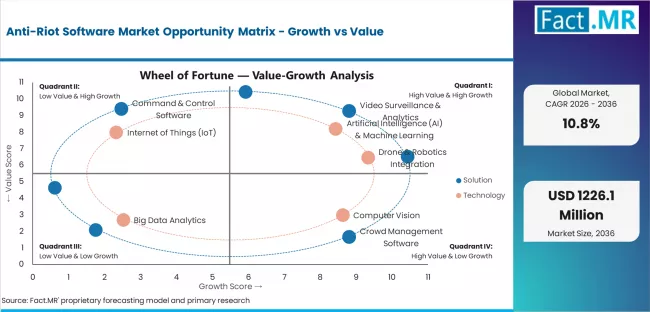
Anti Riot Software Market Opportunity Matrix Growth Vs Value | Source: Fact.MR
Key Factors Driving Growth
- The growing penetration of AI-based surveillance solutions, crowd analytics solutions, and predictive threat detection solutions is boosting the demand for the anti-riot and public safety software solutions.
- The growing investments in smart city infrastructure, modernization of public safety events, and integrated command & control centers are fueling the market growth.
- Increasing concerns regarding civil disorder, public protests, urban crowd management, and homeland security have led to an unending demand for real-time situational awareness and crowd intelligence solutions.
Key Market Constraints
- The CAAP platform is more accessible and friendly for users coming from a non-technical background. However, the high costs of implementing AI surveillance, facial recognition technology, and integrated analytics platforms can make it challenging for public agencies to afford the needed infrastructure.
- Privacy issues, regulatory oversight and data privacy regulations around surveillance and biometric tracking could limit mass adoption in some regions.
- The reliance on legacy public safety systems and disparate security infrastructure creates resistance to adopting advanced crowd intelligence and predictive analytics applications.
Key Opportunity Areas
- The proliferation of smart city initiatives, city surveillance infrastructure and AI-enabled public safety ecosystem is opening new revenue streams for software providers.
- Growing usage of cloud surveillance analytics, behavioral intelligence and predictive crowd monitoring solutions for such use cases indicates positive revenue potentials over long-term.
- Growing requirement for networked real-time command centers, drone surveillance analytics, and AI-based incident response solutions is driving advanced public safety transformation and premium technology positioning.
Segment-wise Analysis of the Anti-riot Software Market
Anti-riot Software Market Analysis by Solution
Anti Riot Software Market Analysis By Solution | Source: Fact.MR
According to the Fact.MR anti-riot software market report, the Video Surveillance & Analytics category will occupy 24.8% of the market in 2026. The category leads the market owing to the rising adoption of surveillance systems equipped with artificial intelligence, crowd monitoring systems that operate in real time, facial recognition software, and violence detection software. There is growing emphasis on installing surveillance infrastructure by governments and law enforcement organizations to monitor activities during protests, riots, and large public events.
Anti-riot Software Market Analysis by Deployment Mode
Anti Riot Software Market Analysis By Deployment Mode | Source: Fact.MR
According to the anti-riot software market report by Fact.MR, the share of Cloud deployment models is predicted to be at 38.6% in 2026. The growth in demand for Cloud-based anti-riot software is attributed to its scalability and integration capability with other software applications such as artificial intelligence algorithms to provide better analytics and coordination between agencies. The public safety organizations have shifted their focus towards cloud computing infrastructure to support crowd surveillance, analytics, and deployment of application software.
Anti-riot Software Market Analysis by Technology
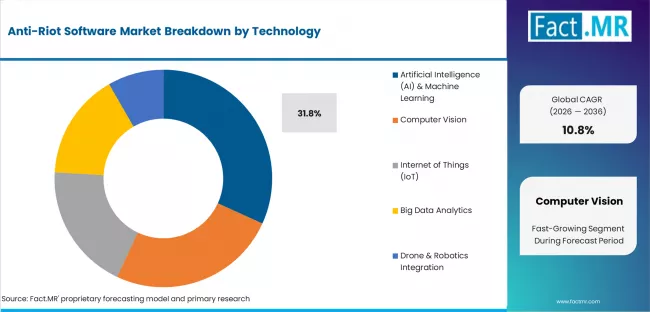
Anti Riot Software Market Analysis By Technology | Source: Fact.MR
According to the report by Fact.MR on anti-riot software market, the use of Artificial Intelligence (AI) and Machine Learning (ML) technologies in this market is projected to have a market share of 31.8% by 2026. Growth of AI and machine learning in the market is attributed to the increasing use of predictive threat analytics, automated violence detection, behavioral analysis, and facial recognition systems in public safety operations. These improve productivity with features such as live incident detection, predictive crowd surveillance and intelligent decision-making processes for police and security organizations.
Anti-riot Software Market Analysis by Application
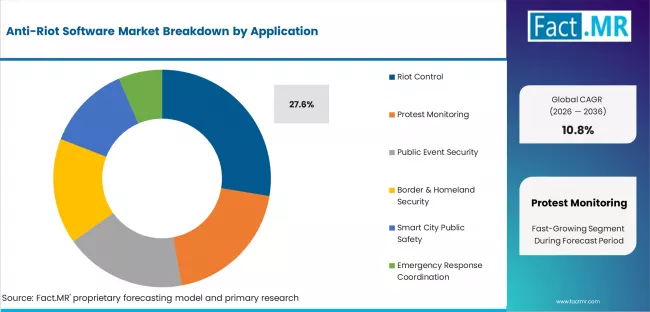
Anti Riot Software Market Analysis By Application | Source: Fact.MR
As per the findings of Fact.MR’s report on the anti-riot software market, consumption of anti-riot software through the Riot Control applications is forecasted to account for around 27.6% of the total market share by 2026. The usage of the Riot Control application segment is expected to retain its leadership position owing to the rising deployment of monitoring technologies, coordination and tactical response software solutions, and Artificial Intelligence-enabled surveillance in case of civil disturbances or mass gatherings.
Anti-riot Software Market Analysis by End User
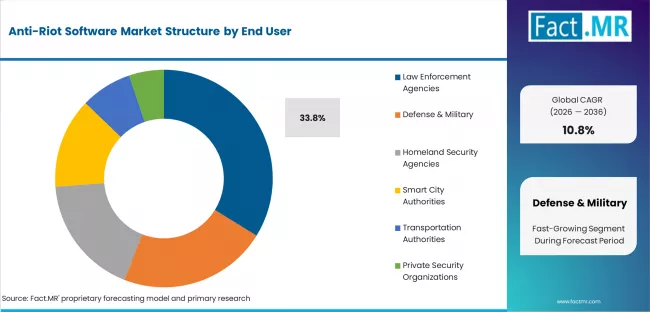
Anti Riot Software Market Analysis By End User | Source: Fact.MR
Consumption for Law Enforcement Agencies is anticipated to account for 33.8% share by 2026 according to the anti-riot software market report of Fact.MR. Law enforcement agencies are leading the market owing to increasing investments in AI surveillance systems, integrated command centers, predictive analytics platforms and real time crowd intelligence solutions. Growing concerns associated with urban demonstrations, security of public events, and modernization of tactical response are fueling strong demand of anti-riot software within police forces and specialized riot control units worldwide.
Regional Outlook Across Key Markets
The report scope includes North America, Latin America, Western Europe, Eastern Europe, East Asia, South Asia & Pacific, and Middle East & Africa. Regional analysis provides an assessment of country-level civil security spending, surveillance penetration, smart city preparedness, geopolitical risk, and opportunities for deployment within the major regional blocks. The report further includes a detailed analysis of market attractiveness by region, technology and public safety applications.
.webp "Top Country Growth Comparison Anti Riot Software Market Cagr (2026 2036)")
Top Country Growth Comparison Anti Riot Software Market Cagr (2026 2036) | Source: Fact.MR
CAGR Table
| Country | CAGR (%) |
|---|---|
| India | 13.5% |
| Japan | 12.8% |
| China | 12.5% |
| South Korea | 9.9% |
| United States | 10.3% |
| United Kingdom | 9.6% |
| Germany | 9.1% |
Source: Fact.MR analysis. Updated May 12, 2026
Source: Fact.MR (FMR) analysis, based on proprietary forecasting model and primary research.
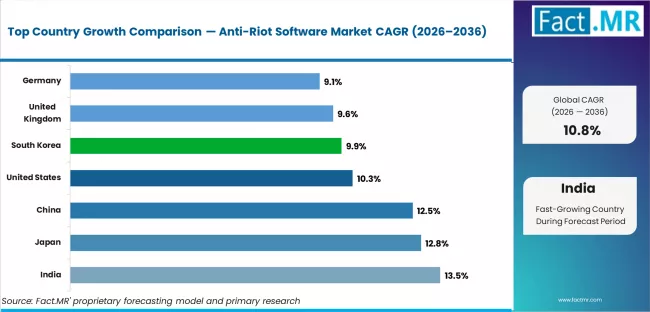
Anti Riot Software Market Cagr Analysis By Country | Source: Fact.MR
North America Anti-riot Software Market
The North American region acts as the “global command center and AI surveillance innovations center” of the Anti-riot Software market, owing to its advanced infrastructure of public safety systems, updated homeland security system, and significant investments made in the field of predictive surveillance systems. Motorola Solutions enjoys a favorable competitive stance due to its comprehensive command-center ecosystem and AI-powered public safety system, whereas Axon Enterprise excels in the provision of real-time law enforcement intelligence and connected operations technologies.
- U.S.: Demand for anti-riot software in the U.S. is projected to rise at 10.3% CAGR through 2036. Growth is driven by increasing investments in AI-enabled surveillance systems, public event security infrastructure, and real-time tactical response platforms across law enforcement and homeland security agencies. Rising adoption of predictive threat analytics and integrated command-center modernization programs continues to strengthen deployment of crowd intelligence solutions across urban security environments.
- Canada: Market expansion in Canada is supported by public safety modernization programs, smart city security initiatives, and increasing deployment of AI-based surveillance infrastructure across transportation networks and metropolitan regions. Government focuses on digital public safety transformation encouraging broader adoption of integrated crowd monitoring and emergency coordination systems.
Europe Anti-riot Software Market
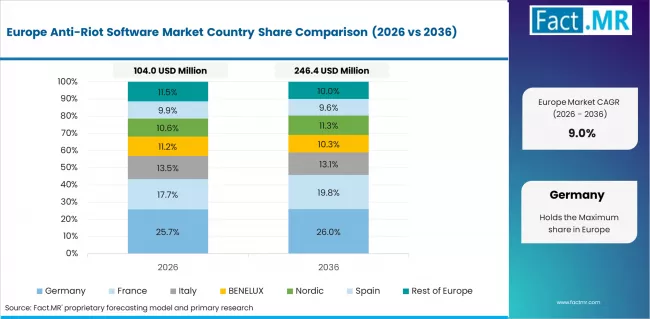
Anti Riot Software Market Europe Country Market Share Analysis, 2026 & 2036 | Source: Fact.MR
Europe acts as the “global benchmark for regulatory standards of AI surveillance governance and public safety modernization” within the Anti-Riot Software Market due to its extensive urban security facilities, smart cities initiatives, and increasing emphasis on situational awareness systems. Hexagon AB enjoys a dominant regional market share with its public safety and incident management software products. NEC Corporation is well-known for its advanced biometrics and facial recognition systems, while Verint Systems enjoys a strong market share in the market due to its artificial intelligence-based surveillance solutions.
- Germany: Demand for anti-riot software in Germany is projected to rise at 9.1% CAGR through 2036, driven by increasing investments in transportation security, smart city surveillance, and public safety analytics systems. Authorities are increasingly adopting AI-enabled monitoring technologies to strengthen operational coordination and crowd management capabilities.
- U.K.: Anti-riot software demand in the U.K. is expected to grow at 9.6% CAGR through 2036 due to rising deployment of predictive surveillance systems, integrated command centers, and crowd intelligence platforms across urban security operations and transportation infrastructure.
- France: Demand in France is supported by increasing public safety modernization initiatives, smart surveillance deployments, and growing emphasis on crowd monitoring systems during public events, demonstrations, and transportation security operations.
East Asia Anti-riot Software Market
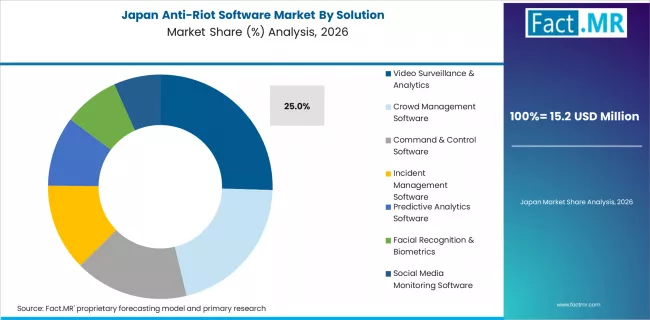
Anti Riot Software Market Japan Market Share Analysis By Solution | Source: Fact.MR
East Asia acts as the “global center for scaling AI surveillance and smart city security infrastructure” in the Anti-riot Software Market with advanced electronics manufacturing, massive smart city programs and substantial public safety spending. NEC Corporation also benefits from its strong regional presence, with the deployment of biometric surveillance and AI analytics, and Verkada and BriefCam are increasingly broadening smart video analytics capabilities across city surveillance scenarios.
- China: Demand for anti-riot software in China is projected to rise at 12.5% CAGR through 2036, driven by aggressive smart city expansion, widespread AI surveillance deployment, and increasing investments in integrated public safety infrastructure. Large-scale urban monitoring programs continue accelerating adoption of crowd intelligence and predictive analytics platforms.
- Japan: Anti-riot software demand in Japan is expected to grow at 12.8% CAGR through 2036 due to increasing investments in smart transportation security, AI-enabled public safety systems, and urban crowd monitoring technologies. Authorities are increasingly adopting predictive surveillance systems to improve emergency preparedness and operational coordination.
- South Korea: Demand for anti-riot software in South Korea is forecast to expand at 9.9% CAGR through 2036, supported by advanced digital infrastructure, smart city initiatives, and growing deployment of AI-powered surveillance systems across metropolitan security environments.
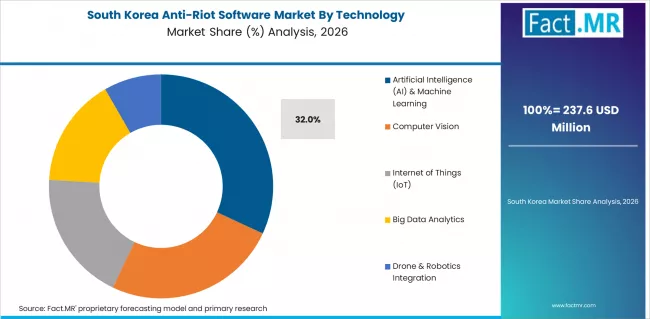
Anti Riot Software Market South Korea Market Share Analysis By Technology | Source: Fact.MR
Fact.MR's analysis of the Anti-riot Software Market consists of country-wise assessment across North America, Latin America, Europe, East Asia, South Asia & Pacific, and the Middle East & Africa. Readers can find detailed insights on regional public safety investments, AI surveillance adoption patterns, smart city deployment trends, competitive benchmarking, regulatory developments, pricing dynamics, and long-term growth outlook across major global markets.
Competitive Benchmarking and Company Positioning
Leading Companies Shaping the Anti-riot Software Market
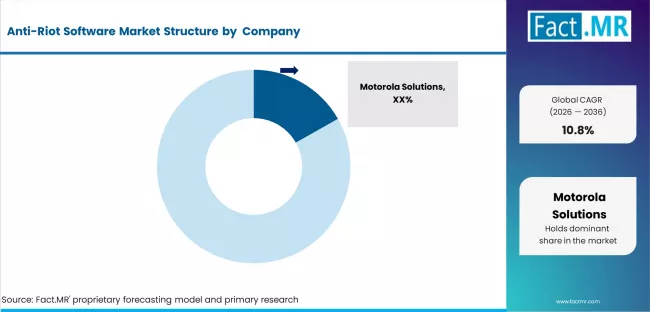
Anti Riot Software Market Analysis By Company | Source: Fact.MR
The market for Anti-Riot Software is fragmented in nature, with the rivalry involving artificial intelligence surveillance solutions providers, software for public safety, and command centers. The top vendors in the market include Motorola Solutions Inc., Hexagon AB, Axon Enterprise Inc., and Genetec Inc. Due to their extensive experience, favorable government connections, and integration with an ecosystem of public safety, these vendors can take advantage of their leadership in the market. Competitiveness has shifted from conventional monitoring systems to advanced AI surveillance, predictive analysis of threats, cloud-based security platforms, and real-time situational awareness. Government bodies follow the multi-vendor model for purchasing, which results in competitive prices.
Recent Industry Developments
- Verkada Expands AI-enabled Investigations and Perimeter Security Capabilities (2025)
- Verkada introduced AI-enabled investigations, expanded access control systems, and perimeter security solutions during VerkadaOne 2025 to strengthen cloud-based surveillance, real-time threat monitoring, and incident response capabilities. The company focused on enhancing AI-driven investigations, operational visibility, and public safety coordination across enterprise, transportation, and urban security environments.
- Motorola Solutions Completes Acquisition of Silvus Technologies (2025)
- Motorola Solutions completed the acquisition of Silvus Technologies to strengthen mission-critical communications, drone networking, and tactical wireless infrastructure capabilities for defense, homeland security, and public safety applications. The acquisition enhances Motorola Solutions’ portfolio in real-time situational awareness, autonomous surveillance operations, and integrated public safety ecosystems.
- Axon to Acquire AI-powered 911 Communications Company Prepared (2025)
- Axon Enterprise announced the acquisition of Prepared, an AI-powered emergency communications platform provider, to expand real-time incident intelligence and cloud-native emergency response capabilities. The platform integrates live video, GPS, transcription, and AI-assisted dispatch coordination to improve public safety response efficiency and operational awareness.
- Genetec and SaferWatch Launch Real-time Vehicle Intelligence Integration for Public Safety Agencies (2025)
- Genetec partnered with SaferWatch to integrate real-time vehicle intelligence and public safety alerting capabilities for law enforcement and emergency response operations. The collaboration improves situational awareness, incident coordination, and vehicle-based threat detection across urban security and public safety environments.
- Verkada Launches AI-powered Industry-specific Security Alerts (2025)
- Verkada launched AI-powered industry-specific alerts designed to improve crowd detection, person-of-interest monitoring, perimeter security, and real-time incident notifications across public safety and enterprise security applications. The solution strengthens AI-driven surveillance analytics and enhances operational response capabilities in high-risk environments.
Leading Companies Shaping the Anti-riot Software Market
- Motorola Solutions
- Hexagon AB
- Axon Enterprise
- Genetec
- NEC Corporation
- Verint
- BriefCam
- Avigilon
- Verkada
- Senstar
Sources and Research References
- [1] Verkada, “Verkada Cements AI and Cloud Leadership at VerkadaOne, Introduces AI-enabled Investigations, Expanded Access Control and Perimeter Security Product Offerings”, September 2025
- [2] Motorola Solutions, “Motorola Solutions Completes Acquisition of Silvus Technologies”, August 2025
- [3] Axon Enterprise, “Axon to Acquire AI-powered 911 Communications Company Prepared”, September 2025
- [4] Genetec, “Genetec and SaferWatch Bring Real-time Vehicle Intelligence to Public Safety Agencies”, May 2025
- [5] Verkada, “Industry-specific Alerts”, September 2025
Anti-Riot Software Market Definition
Anti-riot software market is a software solution that is used for tracking and managing riots, protests, civil disobedience, and large-scale crowd disturbances. These products employ advanced technologies including artificial intelligence (AI), computer vision, facial recognition, predictive analytics, Internet of Things (IoT), and Geographic Information System (GIS) mapping to offer real-time surveillance, threat detection, violence prediction, and coordination of tactical response. It’s a niche within general public safety software, which is the software used by a police department, that focuses on managing civil unrest and tracking situational awareness at high-risk public events. The market is expected to primarily cater to the needs of law enforcement agencies, defense organizations, homeland security entities, smart city operators, transportation agencies, and private security companies.
Anti-Riot Software Market Inclusions
The report offers the market dimensions both at global and regional levels for the market from 2026 to 2036. It has elaborate segmentation based on solution, deployment mode, technology, application, and end user. The analysis also considers regional adoption trends, competitive landscape and pricing, public safety infrastructure investments, and regulation impact related to surveillance and security technologies. Extra layers of analytics include AI-enhanced threat detection trends, adoption of predictive analytics, smart city security integration, crowd monitoring innovations, as well as a strategic opportunity analysis by law enforcement, homeland security, defense, transportation, and urban public safety.
Anti-Riot Software Market Exclusions
The scope does not include traditional public safety and emergency management solutions that are not tailored to the needs of riot control, protest monitoring, crowd analytics or civil unrest management. It also excludes generic 911 call processing systems, police records management software (RMS), standard dispatching software, simple CCTV hardware that does not have intelligent analytics, and non-AI-based surveillance systems without predictive threat detection or behavioral analysis. The study also does not include physical riot equipment like shields, barricades, drones, weapons, and protective clothing. This report concentrates on software-based solutions for anti-riot, crowd intelligence and surveillance analysis as well as tactical incident management systems.
Anti-Riot Software MarketResearch Methodology
- Primary Research
- Fact. MR held discussions with vendors of public safety software and surveillance technology, among others, to confirm trends in the market, deployment, and technology uptake for applications in riot control and crowd monitoring.
- Desk Research
- The research procured company annual reports, investor presentations, government programs for security modernization, reports on smart city development, whitepapers on surveillance technology, regulatory publications, law enforcement procurement databases, and public safety infrastructure data that is accessible to the public.
- Market-Sizing and Forecasting
- To estimate the size of the Ai application & player surveillance market, Fact.MR adopted a unique methodology, which is a mixture of the bottom-up approach and top-down approach. Fact.MR To develop the market size, Fact.MR performed the bottom-up estimation of the company revenues, surveillance deployments, and software adoption trends and the top-down evaluation of the public safety expenditure, investments in AI surveillance, and adoption of homeland security technology via world regions.
- Data Validation and Update Cycle
- Market estimates have been validated by primary interviews, vendor’s benchmarks, regional demand analysis, historical surveillance adoption trends and spending on public safety. Projections are periodically revised to take into account evolving trends in AI adoption, regulatory changes, smart city investment and public security modernization programs.
Segmentation
Scope of Analysis
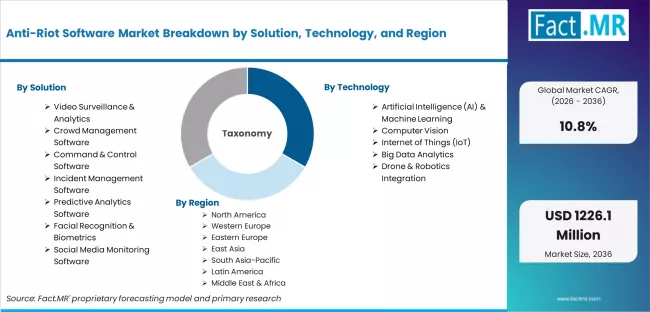
Anti Riot Software Market Breakdown By Solution, Technology, And Region | Source: Fact.MR
Parameter |
Details |
|---|---|
| Quantitative Units | USD 396.8 Million (2025) to USD 1,226.1 Million (2036), at a CAGR of 10.8% |
| Market Definition | The Anti-riot Software Market covers software platforms and intelligent surveillance systems designed for crowd monitoring, riot control, protest management, civil unrest analysis, and public safety coordination across law enforcement, homeland security, defense, transportation, and smart city applications. These solutions include crowd management software, AI-powered video surveillance & analytics, command & control systems, incident management platforms, predictive analytics software, facial recognition systems, social media intelligence platforms, and GIS-based situational awareness technologies integrated with AI, computer vision, IoT, and real-time threat detection capabilities to improve operational response, crowd intelligence, and public safety management. |
| Regions Covered | North America, Eastern Europe, Western Europe, East Asia, South Asia & Pacific, Latin America, Middle East & Africa |
| Countries Covered | USA, Canada, UK, Germany, China, Japan, India, South Korea, Brazil, Saudi Arabia, UAE, and 20+ countries |
| Key Companies | Motorola Solutions, Hexagon AB, Axon Enterprise, Genetec, NEC Corporation, Verint, BriefCam, Avigilon, Verkada, Senstar |
| Forecast Period | 2026 to 2036 |
| Approach | Hybrid demand-side and top-down methodology based on public safety modernization spending, AI surveillance adoption, smart city infrastructure expansion, civil unrest monitoring requirements, homeland security investments, and increasing deployment of predictive crowd intelligence technologies, validated through primary interviews with public safety software providers, surveillance technology vendors, law enforcement agencies, smart city authorities, homeland security officials, and AI analytics solution providers across key regions. |
Source: Fact.MR analysis. Updated May 12, 2026
Analysis by Solution, Deployment Mode, Technology, Application, End User, and Region
-
Anti-riot Software Market by Solution
- Crowd Management Software
- Video Surveillance & Analytics
- Command & Control Software
- Incident Management Software
- Predictive Analytics Software
- Social Media Monitoring Software
- Facial Recognition & Biometrics
- GIS & Mapping Software
-
Anti-riot Software Market by Deployment Mode
- On-premises
- Cloud-based
- Hybrid
-
Anti-riot Software Market by Technology
- Artificial Intelligence (AI) & Machine Learning
- Deep Learning Algorithms
- Predictive AI Models
- Behavioral Analytics AI
- Computer Vision
- Object Detection
- Motion Tracking
- Violence Detection
- Internet of Things (IoT)
- Smart Cameras
- Wearable Devices
- Sensor Networks
- Big Data Analytics
- Real-time Data Processing
- Data Mining Platforms
- Intelligence Dashboards
- Drone & Robotics Integration
- Autonomous Surveillance Drones
- Robotic Patrol Systems
- UAV Data Analytics
- Artificial Intelligence (AI) & Machine Learning
-
Anti-riot Software Market by Application
- Riot Control
- Protest Monitoring
- Public Event Security
- Border & Homeland Security
- Smart City Public Safety
- Emergency Response Coordination
-
Anti-riot Software Market by End User
- Law Enforcement Agencies
- City Police Departments
- Riot Control Units
- Special Tactical Forces
- Defense & Military
- Internal Security Forces
- Military Police
- Defense Intelligence Units
- Homeland Security Agencies
- National Security Authorities
- Counter-terrorism Agencies
- Border Security Agencies
- Smart City Authorities
- Municipal Safety Departments
- Urban Monitoring Centers
- City Operations Centers
- Transportation Authorities
- Airport Security Agencies
- Railway Security Units
- Metro Surveillance Authorities
- Private Security Organizations
- Event Security Providers
- Corporate Security Firms
- Infrastructure Protection Companies
- Law Enforcement Agencies
-
Anti-riot Software Market by Region
- North America
- USA
- Canada
- Mexico
- Latin America
- Brazil
- Chile
- Rest of LATAM
- East Asia
- China
- Japan
- South Korea
- Taiwan
- South Asia & Pacific
- India
- Singapore
- Australia
- ASEAN
- Western Europe
- Germany
- France
- U.K.
- Italy
- Spain
- BENELUX
- Nordic
- Rest of Western Europe
- Eastern Europe
- Poland
- Hungary
- Czech Republic
- Balkan & Baltics
- Rest of Eastern Europe
- Middle East and Africa
- Kingdom of Saudi Arabia
- United Arab Emirates
- South Africa
- Rest of Middle East and Africa
- North America
Frequently Asked Questions
How large is the demand for Anti-riot Software in the global market in 2025?
What will be the market size of Anti-riot Software in the global market by 2036?
What is the expected demand growth for Anti-riot Software in the global market between 2026 and 2036?
Which solution segment is expected to dominate the market?
How significant is the growth outlook for India in this market?
Which company is identified as a leading player in the Anti-riot Software Market?
Who worked on this report


Preview the report firsthand - request a free sample
Free SampleGet the brochure for pricing and purchase details
Download PDF