- Market Value (2025): USD 6.8 Bn
- Estimated Value (2026): USD 7.3 Bn
- Forecast Value (2036): USD 15.5 Bn
- CAGR (2026-2036): 7.8%
What is the Antimicrobial PPE Market forecast to be worth by 2036?
USD 7.3 billion in 2026 to USD 15.5 billion by 2036 at 7.8% CAGR.
- The antimicrobial PPE market reached USD 6.8 billion in 2025 as hospitals and controlled work sites kept funding treated protective apparel and material upgrades.
- Demand is projected to increase from USD 7.3 billion in 2026 to USD 15.5 billion by 2036.
- The market is forecast to record 7.8% CAGR from 2026 to 2036 owing to antimicrobial coatings, hospital procurement discipline and repeat demand for compliant PPE.
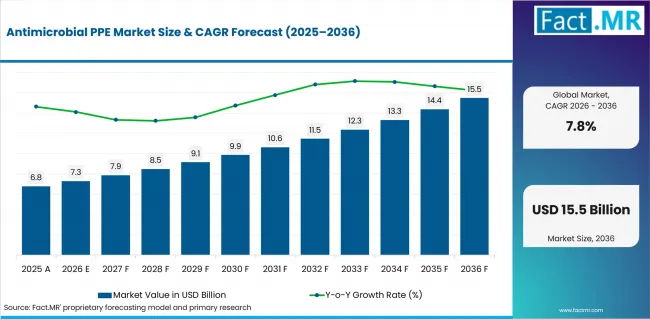
Antimicrobial Ppe Market Value Analysis | Source: Fact.MR
What are the defining numbers behind Antimicrobial PPE Market growth?
USD 8.2 billion absolute opportunity is expected by 2036.
- Demand Drivers in the Market
- Protective apparel is expected to remain the first purchasing reference because hospitals and cleanrooms review gowns and coveralls before extending treatments to other PPE types.
- Silver-based coatings are projected to gain preference where customers want familiar chemistry for fabrics. High-touch antimicrobial coatings support review where treated PPE surfaces need separate proof.
- Hospital procurement is anticipated to remain central since infection control committees compare antimicrobial claims with barrier protection and reorder reliability.
- Key Segments Analyzed
- By Product: Protective Apparel is projected to hold 40.0% share in 2026 because gowns and coveralls carry the clearest need for treated barrier materials.
- By Antimicrobial Technology: Silver-based Coatings are anticipated to hold 44.8% share in 2026 as customers prefer known treatment chemistry for fabric and surface decisions.
- By End Use: Hospitals are expected to hold 33.8% share in 2026 since staff exposure and patient contact create repeat demand for clean protective products.
- By Distribution Channel: Direct Sales is forecast to hold 41.0% share in 2026 because institutional customers often need product files before regular supply approval.
- By Material: Polypropylene is estimated to hold 43.1% share in 2026 due to its role in disposable gowns and masks. Shoe covers and PPE plastics add further volume.
- Analyst Opinion at Fact.MR
- Shambhu Nath Jha, Sr. Consultant at Fact.MR, opines, “Antimicrobial PPE demand is expected to depend on whether treated products solve a real approval problem for hospitals and industrial users. Companies that connect antimicrobial performance with barrier protection and comfort evidence are expected to gain stronger procurement support.”
- Strategic Implications
- Manufacturers should keep product claims close to the use case. Protective apparel needs treatment evidence that does not weaken barrier performance or wearer comfort.
- Companies selling through direct channels can improve conversion with procurement files and repeat supply planning. This approach fits hospital supplies where SKU reliability affects reorder decisions.
- Investors should separate antimicrobial PPE from broader medical disposables. Demand is expected to depend on treated materials and fit with protective face masks or respiratory protection needs.
Canada is projected at 5.5% CAGR during 2026 to 2036. Japan is forecast at 6.4% and the USA at 10.2%. The UK is expected to record 8.3%, followed by Germany at 9.2% and France at 7.3%. Country analysis starts with protective apparel demand. It then tests how hospital procurement and service access differ by geography.
How does the Antimicrobial PPE Market break down by segment?
Protective Apparel is expected to lead Product at 40.0% share in 2026. Silver-based Coatings are projected to lead Antimicrobial Technology at 44.8% share in 2026.
Which product dominates?
Protective Apparel is projected to account for 40.0% share in 2026.
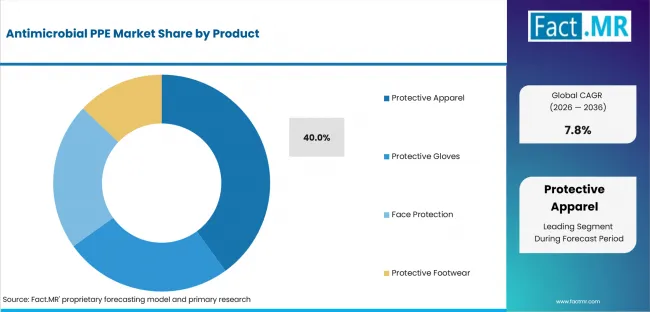
Antimicrobial Ppe Market Analysis By Product | Source: Fact.MR
Protective apparel leads because gowns and coveralls are the first PPE categories tested against staff exposure and contamination risk. Medical gloves remain relevant where contact risk and replacement cycles differ.
What leads the Antimicrobial Technology segment?
Silver-based Coatings are anticipated to account for 44.8% share in 2026.
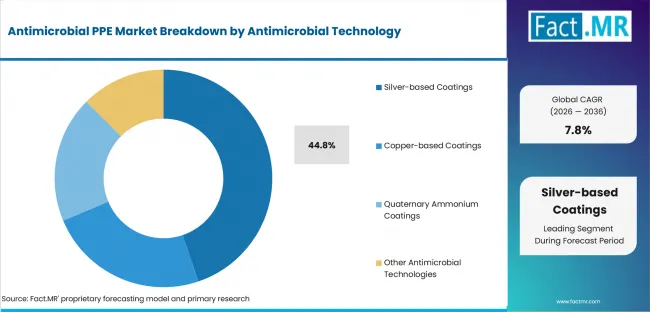
Antimicrobial Ppe Market Analysis By Antimicrobial Technology | Source: Fact.MR
Silver-based coatings lead where customers want familiar treatment chemistry and easier documentation review. Silver ion technology and silver nanoparticle coatings remain useful where durability or cost needs differ.
How does End Use shape demand?
Hospitals are expected to account for 33.8% share in 2026.
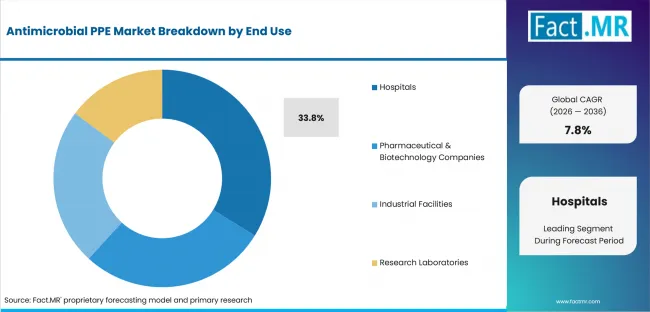
Antimicrobial Ppe Market Analysis By End Use | Source: Fact.MR
Hospitals lead because PPE choices are tied to staff contact and infection-prevention review. Pharmaceutical companies add demand through clean production areas. Industrial facilities and laboratories remain important where contamination control affects work quality.
What supports Direct Sales?
Direct Sales is forecast to account for 41.0% share in 2026.
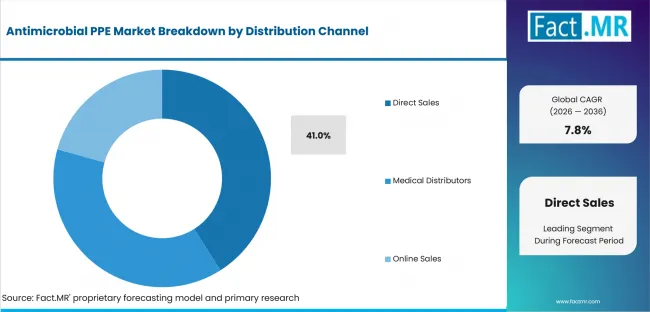
Antimicrobial Ppe Market Analysis By Distribution Channel | Source: Fact.MR
Direct sales lead when manufacturers must explain antimicrobial claims and replenishment terms directly. Medical distributors and online channels remain useful where customers need catalog access and faster procurement.
Why does Polypropylene lead Material?
Polypropylene is estimated to account for 43.1% share in 2026.
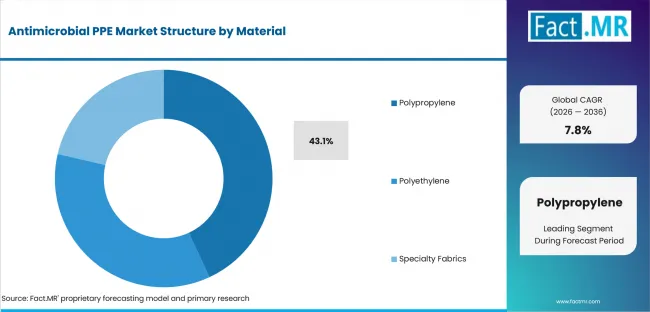
Antimicrobial Ppe Market Analysis By Material | Source: Fact.MR
Polypropylene leads because it is widely used in disposable nonwoven PPE. Medical nonwoven disposables support this material position through gowns, masks and covers that need low weight and consistent barrier performance.
What is accelerating Antimicrobial PPE Market adoption, and what is holding it back?
Demand is expected to rise as hospitals focus on protective clothing and infection prevention. Growth may be limited by changing material costs, limited performance proof and slow approval of treated PPE.
Drivers Impact Analysis
| DRIVER | (~) % IMPACT ON CAGR | GEOGRAPHIC RELEVANCE | IMPACT TIMELINE |
|---|---|---|---|
| Protective apparel specification pull | +1.9% | Canada, USA | Short term (<= 2 years) |
| Silver-based coating preference | +1.5% | Japan and Europe | Short term (<= 2 years) |
| Hospital procurement review | +1.3% | Canada, USA, UK | Medium term (2-4 years) |
| Direct-sales documentation support | +0.9% | North America and Europe | Medium term (2-4 years) |
| Polypropylene nonwoven availability | +0.7% | Global PPE supply bases | Long term (>= 4 years) |
Source: Fact.MR analysis. Updated Jul 30, 2026
- Protective apparel specification pull: Gowns and coveralls are expected to create the clearest test case for antimicrobial PPE because they stay closest to staff contact routines.
- Silver-based coating preference: Customers are expected to favor silver-based treatments when product claims include durability and material compatibility evidence.
- Hospital procurement review: Hospitals are expected to compare antimicrobial PPE with standard products through infection-control needs and recurring supply terms.
Opportunity Impact Analysis
| OPPORTUNITY | (~) % IMPACT ON CAGR | GEOGRAPHIC RELEVANCE | IMPACT TIMELINE |
|---|---|---|---|
| Protective apparel treated grades | +1.2% | Canada and USA | Medium term (2-4 years) |
| Distributor and direct-sales training | +0.9% | Japan and UK | Medium term (2-4 years) |
| Silver-based coating renewal programs | +0.8% | Hospitals and cleanrooms | Medium term (2-4 years) |
| Cleanroom and pharmaceutical use cases | +0.6% | Europe and East Asia | Long term (>= 4 years) |
Source: Fact.MR analysis. Updated Jul 30, 2026
- Protective apparel treated grades: Companies that separate antimicrobial gowns and coveralls by use case are expected to reduce procurement friction.
- Distributor and direct-sales training: Sales teams that explain validation evidence in simple language are expected to improve hospital and industrial account conversion.
- Silver-based coating renewal programs: Renewal demand is expected to improve where customers need repeat orders with the same documentation and material behavior.
Restraints Impact Analysis
| RESTRAINT | (~) % IMPACT ON CAGR | GEOGRAPHIC RELEVANCE | IMPACT TIMELINE |
|---|---|---|---|
| Raw-material cost movement | -1.1% | Global | Short term (<= 2 years) |
| Approval delays for treated PPE | -0.9% | Hospitals and cleanrooms | Short term (<= 2 years) |
| Price sensitivity around coatings | -0.7% | Japan and Europe | Medium term (2-4 years) |
| Weak customer-side validation | -0.5% | Smaller accounts | Medium term (2-4 years) |
Source: Fact.MR analysis. Updated Jul 30, 2026
- Raw-material cost movement: Polypropylene and coating input volatility can make treated PPE harder to price against standard products.
- Approval delays for treated PPE: Hospitals and cleanrooms may delay adoption until product files show antimicrobial performance without reducing barrier protection.
- Price sensitivity around coatings: Customers can resist premium products when antimicrobial benefits are not tied to a defined contamination-control problem.
Which countries are scaling Antimicrobial PPE Market fastest?
The country comparison shows the USA ahead of the listed markets. Germany and the UK form the next pair, while France, Japan and Canada follow at lower listed rates.
- The USA shows the highest listed CAGR because hospital procurement systems, documentation requirements and direct supplier relationships support faster treated-PPE adoption.
- Germany follows through industrial and institutional review habits where material consistency affects supplier approval.
- The UK develops through selective adoption in hospitals and laboratories where validation evidence matters before switching products.
- France scales through professional channels that reward clear product positioning and compliance discipline.
- Japan follows a quality-led path where product review focuses on treatment durability and repeatable material behavior.
- Canada remains important, but its listed CAGR is lower than the USA, Germany, UK and France in this comparison.
Comparable CAGRs can still lead to different entry conditions. Manufacturers need local proof around treated apparel and service depth before scaling orders.
The full report provides country-level CAGR analysis across North America and Latin America. It covers Europe and East Asia. It then covers South Asia and Oceania and the Middle East and Africa.
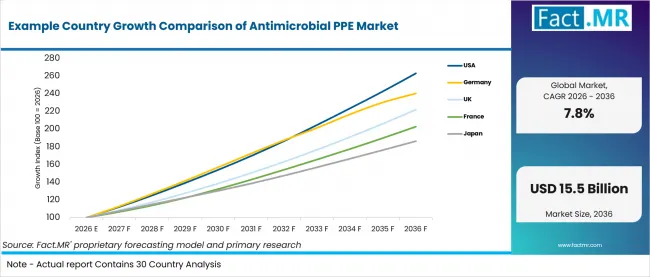
Example Country Growth Comparison Of Antimicrobial Ppe Market | Source: Fact.MR
| Country | CAGR (2026-2036) |
|---|---|
| Canada | 5.5% |
| Japan | 6.4% |
| USA | 10.2% |
| UK | 8.3% |
| Germany | 9.2% |
| France | 7.3% |
Source: Fact.MR analysis. Updated Jul 30, 2026
What supports Canada adoption?
5.5% CAGR, supported by protective apparel demand and service coverage.
Canada’s growth reflects healthcare and industrial customers that need reliable PPE access across large geographies. Antimicrobial treatment decisions are expected to move faster where product files are clear.
How does Japan perform?
6.4% CAGR, led by silver-based coatings and quality review.
Japan’s growth is tied to careful product evaluation and familiar treatment chemistry. Companies must show how antimicrobial finishes work with comfort, packaging and reordering needs.
What is shaping USA demand?
10.2% CAGR, supported by hospital procurement and documentation needs.
The USA outlook is shaped by hospital purchasing systems that require product evidence before regular adoption. Direct sales are expected to support faster product review.
How is the UK developing demand?
8.3% CAGR, driven by validation needs and channel support.
The UK is expected to develop through selective adoption in hospitals, laboratories and industrial accounts. Clear distributor support remains important for repeat orders.
What supports Germany’s outlook?
9.2% CAGR, backed by industrial use and product-performance scrutiny.
Germany’s outlook reflects customers that examine material behavior before switching products. Polypropylene formats are expected to remain important where disposable use and contamination control intersect.
How does France scale through 2036?
7.3% CAGR, supported by professional channels and compliance discipline.
France is expected to scale through hospital, laboratory and institutional purchasing. Protective apparel remains the most practical starting point for adoption.
Who leads the Antimicrobial PPE Market?
3M Company and DuPont de Nemours, Inc. have clear relevance through protective product portfolios. Other listed providers compete through documented products and dependable supply.
Competition is expected to depend on barrier protection and antimicrobial treatment evidence. Material consistency and supply continuity are expected to shape repeat orders. Demand connects with antimicrobial coatings where customers compare surface and wearable protection needs.
From 2026 to 2036, gains are expected to come from clearer positioning around treated protective apparel. Gloves, masks and related disposables create follow-on demand when product claims fit cleaning practices.
Which companies are the key providers?
Key companies include 3M Company, Honeywell International Inc., DuPont de Nemours, Inc., Kimberly-Clark Corporation, Ansell Limited, Cardinal Health, and Medline Industries, LP.
- 3M Company
- Honeywell International Inc.
- DuPont de Nemours, Inc.
- Kimberly-Clark Corporation
- Ansell Limited
- Cardinal Health
- Medline Industries, LP
Bibliography
- Centers for Disease Control and Prevention. (2024, April 2). Implementation of personal protective equipment use in nursing homes to prevent spread of multidrug-resistant organisms.
- DuPont de Nemours, Inc. (2024, February 27). DuPont announces 2023 North America Protection Innovation Award winners.
- 3M Company. (2024, April 3). 3M launches new Verify app to help tackle counterfeit personal protective equipment.
- Ansell Limited. (2024, October 20). Ansell introduces AlphaTec 53-002 and 53-003: Innovative hybrid technology redefining chemical performance.
This Report Answers
- The report provides strategic intelligence on Product and Antimicrobial Technology choices that shape protective apparel purchasing.
- Segment analysis covers Protective Apparel and Silver-based Coatings as the leading 2026 categories within the structure.
- Country outlook evaluates the USA alongside Germany and the UK. France, Japan and Canada complete the listed growth comparison.
- Competitive analysis profiles the listed providers and their role in documented protective products.
- Channel assessment covers Direct Sales and Hospital Procurement. Government Contracts and distributor routes complete the channel review.
What does the Antimicrobial PPE Market cover?
Antimicrobial PPE covers protective products treated to limit microbial contamination risk while preserving barrier protection and practical use.
The market covers protective apparel and gloves sold into hospitals and pharmaceutical facilities. It also covers face protection and footwear for industrial sites and laboratories. Antimicrobial treatments must be used directly on PPE or protective materials.
What is included in the scope?
Antimicrobial PPE is used across hospitals and pharmaceutical companies. Biotechnology companies, industrial facilities and research laboratories create additional demand.
The scope includes Product and Antimicrobial Technology. It also covers End Use, Distribution Channel and Material. Protective apparel and gloves are included when antimicrobial treatment is part of the claim. Face protection and footwear follow the same rule.
What is excluded from the scope?
General PPE without antimicrobial treatment remains outside the scope of this market.
The scope excludes unrelated infrastructure and cleaning chemicals not sold as PPE. Company revenue without a clear antimicrobial PPE connection is excluded.
How Was the Analysis Built?
The analysis draws on 120+ sources and 35+ company portfolios. It also reviews 25+ countries and more than 20 industry interviews.
- Primary Research: Interviews cover manufacturers and distributors. Procurement teams and end users test approval needs and adoption barriers.
- Desk Research: Desk research covers government statistics and company filings. Trade data and technical studies support source review.
- Market Sizing and Forecasting: Estimates combine historical performance and demand indicators. Segment shares and country growth complete the forecast.
- Data Validation and Update Cycle: Findings are checked against interviews and public data. Company activity and procurement trends support updates.
Segmentation
What is the report’s scope and coverage?
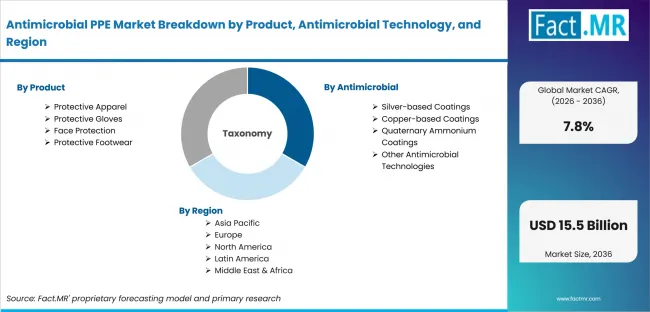
Antimicrobial Ppe Market Breakdown By Product, Antimicrobial Technology, And Region | Source: Fact.MR
| Attribute | Details |
|---|---|
| Quantitative Units | USD 7.3 billion in 2026 to USD 15.5 billion by 2036, at a 7.8% CAGR. |
| Market Definition | Protective apparel, gloves, face protection, footwear and related PPE treated or designed with antimicrobial technologies for hospital, cleanroom, industrial and laboratory use |
| Product | Protective Apparel; Gowns; Coveralls; Lab Coats; Protective Gloves; Nitrile Gloves; Latex Gloves; Neoprene Gloves; Face Protection; Face Masks; Face Shields; Respirators; Protective Footwear; Shoe Covers; Safety Boots; Protective Overshoes |
| Antimicrobial Technology | Silver-based Coatings; Silver Ion Technology; Silver Nanoparticle Coatings; Silver Composite Coatings; Copper-based Coatings; Copper Oxide Coatings; Copper Ion Technology; Copper-infused Fibers; Quaternary Ammonium Coatings; Polymer-based Coatings; Surface Antimicrobial Treatments; Long-lasting Antimicrobial Finishes; Other Antimicrobial Technologies; Zinc-based Coatings; Chitosan-based Coatings; Photocatalytic Coatings |
| End Use | Hospitals; General Hospitals; Specialty Hospitals; Emergency Care Centers; Pharmaceutical & Biotechnology Companies; Pharmaceutical Manufacturing; Biotechnology Research; Vaccine Production Facilities; Industrial Facilities; Cleanrooms; Food Processing Plants; Chemical Manufacturing; Research Laboratories; Academic Laboratories; Government Laboratories; Diagnostic Laboratories |
| Distribution Channel | Direct Sales; Hospital Procurement; Government Contracts; Industrial Supply Agreements; Medical Distributors; National Distributors; Regional Distributors; Specialty Medical Suppliers; Online Sales; B2B E-commerce; Manufacturer Websites; Healthcare Marketplaces |
| Material | Polypropylene; Spunbond Polypropylene; Meltblown Polypropylene; SMS Polypropylene; Polyethylene; High-density Polyethylene; Low-density Polyethylene; Multi-layer Polyethylene; Specialty Fabrics; Nonwoven Composites; Microfiber Fabrics; Laminated Fabrics |
| Regions Covered | North America; Latin America; Europe; East Asia; South Asia and Oceania; Middle East and Africa |
| Countries Covered | Canada; Japan; USA; UK; Germany; France |
| Key Companies Profiled | 3M Company; Honeywell International Inc.; DuPont de Nemours, Inc.; Kimberly-Clark Corporation; Ansell Limited; Cardinal Health; Medline Industries, LP |
| Forecast Period | 2026 to 2036 |
| Approach | Hybrid top-down and bottom-up approach using PPE demand indicators; segment mix; country growth; company participation; procurement patterns; material requirements; treatment technology review; channel behavior and public evidence relevant to infection-prevention products |
Source: Fact.MR analysis. Updated Jul 30, 2026
How is the market segmented?
-
By Product:
- Protective Apparel
- Gowns
- Coveralls
- Lab Coats
- Protective Gloves
- Nitrile Gloves
- Latex Gloves
- Neoprene Gloves
- Face Protection
- Face Masks
- Face Shields
- Respirators
- Protective Footwear
- Shoe Covers
- Safety Boots
- Protective Overshoes
-
By Antimicrobial Technology:
- Silver-based Coatings
- Silver Ion Technology
- Silver Nanoparticle Coatings
- Silver Composite Coatings
- Copper-based Coatings
- Copper Oxide Coatings
- Copper Ion Technology
- Copper-infused Fibers
- Quaternary Ammonium Coatings
- Polymer-based Coatings
- Surface Antimicrobial Treatments
- Long-lasting Antimicrobial Finishes
- Other Antimicrobial Technologies
- Zinc-based Coatings
- Chitosan-based Coatings
- Photocatalytic Coatings
-
By End Use:
- Hospitals
- General Hospitals
- Specialty Hospitals
- Emergency Care Centers
- Pharmaceutical & Biotechnology Companies
- Pharmaceutical Manufacturing
- Biotechnology Research
- Vaccine Production Facilities
- Industrial Facilities
- Cleanrooms
- Food Processing Plants
- Chemical Manufacturing
- Research Laboratories
- Academic Laboratories
- Government Laboratories
- Diagnostic Laboratories
-
By Distribution Channel:
- Direct Sales
- Hospital Procurement
- Government Contracts
- Industrial Supply Agreements
- Medical Distributors
- National Distributors
- Regional Distributors
- Specialty Medical Suppliers
- Online Sales
- B2B E-commerce
- Manufacturer Websites
- Healthcare Marketplaces
-
By Material:
- Polypropylene
- Spunbond Polypropylene
- Meltblown Polypropylene
- SMS Polypropylene
- Polyethylene
- High-density Polyethylene
- Low-density Polyethylene
- Multi-layer Polyethylene
- Specialty Fabrics
- Nonwoven Composites
- Microfiber Fabrics
- Laminated Fabrics
-
By Region:
- North America
- Latin America
- Europe
- East Asia
- South Asia and Oceania
- Middle East and Africa
Frequently Asked Questions
Which Product leads the market?
Which Antimicrobial Technology leads the market?
Which End Use leads the market?
Which Distribution Channel leads the market?
Which Material leads the market?
Which country records the highest listed CAGR?
What is the primary driver in this market?
What is the main restraint?
Why do hospitals lead demand?
Who worked on this report


Preview the report firsthand - request a free sample
Free SampleGet the brochure for pricing and purchase details
Download PDF