- Market Value (2025): USD 88.6 Mn
- Estimated Value (2026): USD 105 Mn
- Forecast Value (2036): USD 573.3 Mn
- CAGR (2026-2036): 18.5%
What is the apron obstacle detection market forecast to be worth by 2036?
USD 105 million in 2026 to USD 573.3 million by 2036, at 18.50% CAGR.
- The apron obstacle detection market crossed a valuation of USD 88.6 million in 2025. Demand is expected to increase from USD 105 million in 2026 to USD 573.3 million by 2036.
- The market is forecast to record 18.5% CAGR from 2026 to 2036 as airports add stand-level sensing, GSE monitoring and apron safety analytics.
- These deployments also support airport operation workflows when obstacle alerts improve turnaround planning.
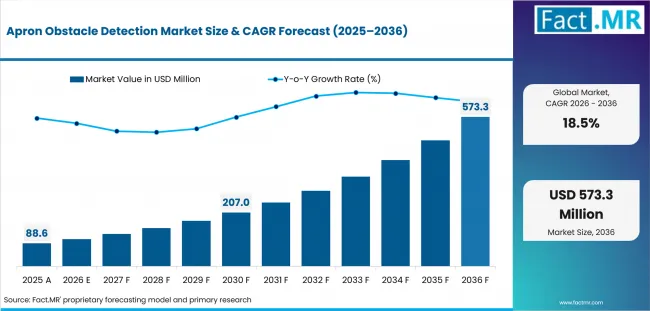
Apron Obstacle Detection Market Market Value Analysis | Source: Fact.MR
What are the defining numbers behind apron obstacle detection market growth?
USD 500 million absolute opportunity by 2036, led by sensor fusion, stand safety and integrated A-VDGS deployment.
- Demand Drivers in the Market
- Airport operators need obstacle alerts that reduce aircraft contact risk at busy stands.
- Ground handlers need GSE monitoring that improves safety during aircraft servicing.
- Airlines need safer turnaround workflows that reduce avoidable delays.
- Aviation safety regulators need better apron evidence for hazard review and incident prevention.
- Key Segments Analyzed
- By Detection Tech: Sensor fusion is expected to hold 35.0% share in 2026 because apron environments need more than one sensing method.
- By Use Case: Stand safety leads because aircraft parking zones have the clearest detection need. The segment is projected to capture 32.0% share in 2026.
- By Airport Area: Gate stands are likely to account for 38.0% share in 2026 because equipment, crew and aircraft movement overlap there.
- By Deployment: Integrated A-VDGS is expected to hold 34.0% share in 2026 because obstacle detection is often added during docking upgrades.
- By Buyer Type: Airport operators are projected to record 44.0% share in 2026 because they own apron safety and gate-performance outcomes.
- Analyst Opinion at Fact.MR
- Shambhu Nath Jha, Senior Analyst at Fact.MR, states, “Apron obstacle detection is becoming a practical safety layer for airports. The market will grow where sensors reduce aircraft contact risk, support safer GSE movement and feed useful alerts into gate operations. Suppliers that combine detection accuracy with simple integration will be better placed than vendors selling standalone cameras.”
- Strategic Implications
- Detection vendors should prove accuracy across night operations, glare and busy stand movement.
- Airport operators should prioritize high-utilization stands and cargo aprons for early deployment.
- Ground handlers should connect obstacle alerts with GSE movement rules and training.
- Systems integrators should link detection outputs with apron control and gate operations platforms.
ADB SAFEGATE won a 2024 Frankfurt project involving Safedock X and AiPRON Manager. This shows that obstacle detection is becoming part of intelligent apron management and gate safety.Sensor-led apron safety also connects with airfield ground lighting when airports improve surface guidance and stand visibility together.The United States is projected to record 20.2% CAGR through 2036 as surface safety programs and large hub upgrades expand. Singapore is expected to post 19.6% CAGR through 2036 as high-density apron operations require automated stand monitoring. Germany is likely to record 18.9% CAGR as Frankfurt-style apron modernization supports integrated A-VDGS deployment. China is forecast to advance at 18.2% CAGR as large airports and cargo aprons add AI-enabled ramp safety. India is set to record 17.4% CAGR as airport expansion and terminal modernization increase apron monitoring needs.
How does the apron obstacle detection market break down by segment?
Sensor fusion leads at 35.0%; gate stands lead at 38.0%.
Which detection technology dominates?
Sensor fusion holds 35.0% share in 2026.
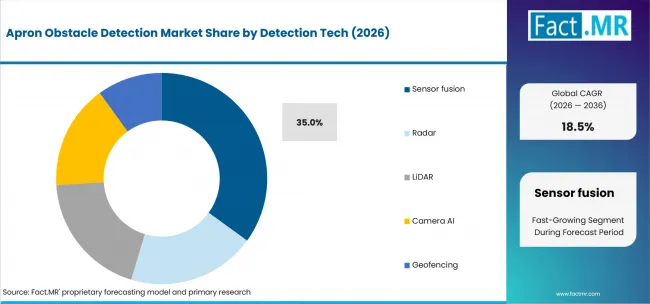
Apron Obstacle Detection Market Analysis By Detection Tech | Source: Fact.MR
Sensor fusion is expected to hold 35.0% share in 2026 because apron environments contain moving aircraft, GSE, crew and service vehicles. Camera AI helps classify objects and unsafe movement. Radar supports detection in difficult weather. LiDAR helps with distance and shape recognition. Geofencing supports virtual safety zones around aircraft and equipment. ADB SAFEGATE states that Safedock X uses infrared laser, 3D scanning and radar sensing to detect objects on the apron. [2]
Which use case dominates?
Stand safety holds 32.0% share in 2026.
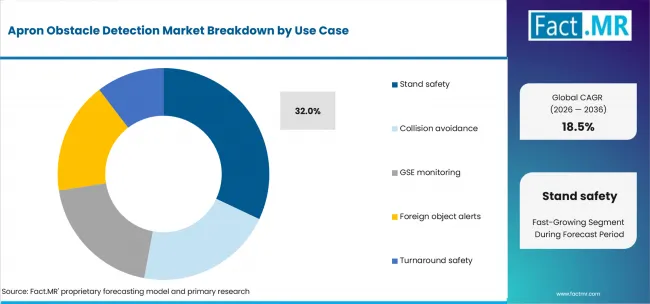
Apron Obstacle Detection Market Analysis By Use Case | Source: Fact.MR
Stand safety leads because aircraft parking zones carry high contact risk during arrival, servicing and departure. The segment is projected to capture 32.0% share in 2026 as airports deploy detection near gates and ramp lanes. Collision avoidance follows where vehicles move close to aircraft. GSE monitoring supports safer service sequencing. Foreign object alerts remain important, but this market excludes runway-only FOD systems. Xsight Systems’ FODetect uses millimeter-wave radar and electro-optical imaging for automated debris detection in airport environments. [3]
Which airport area dominates?
Gate stands dominate apron obstacle detection demand.
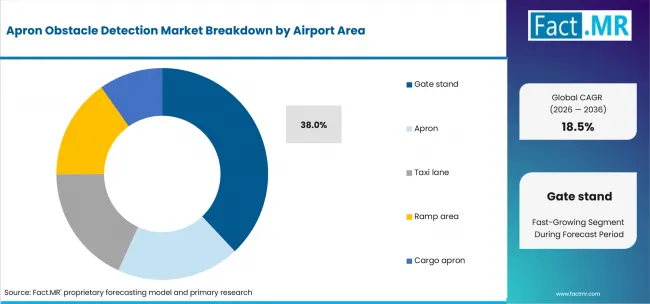
Apron Obstacle Detection Market Analysis By Airport Area | Source: Fact.MR
Gate stands lead because they combine aircraft docking, boarding bridge movement, baggage loading and service vehicle activity. The airport-area segment is likely to account for 38.0% share in 2026 as airports focus sensors on the highest-risk apron zones. General apron areas follow where wide-area monitoring is needed. Taxi lanes need alerts when aircraft and vehicles cross shared space. Ramp areas support ground-handling safety. Cargo aprons need monitoring during night and high-intensity freight operations.
Which deployment dominates?
Integrated A-VDGS holds 34.0% share in 2026.
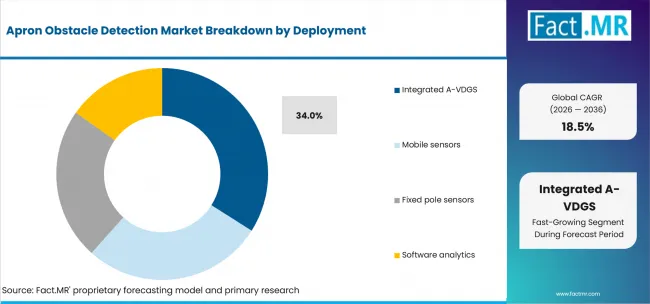
Apron Obstacle Detection Market Analysis By Deployment | Source: Fact.MR
Integrated A-VDGS leads because many obstacle detection systems are added as part of docking guidance upgrades. The deployment segment is expected to hold 34.0% share in 2026 as airports combine aircraft guidance with stand safety analytics. Fixed pole sensors follow where continuous apron monitoring is needed. Mobile sensors support temporary work zones and MRO aprons. Software analytics gain traction when airports already have camera networks. Searidge Technologies’ Digital Apron Management material describes AI tools used in airport environments to support data-driven apron applications. [4]
Which buyer type dominates?
Airport operators hold 44.0% share in 2026.
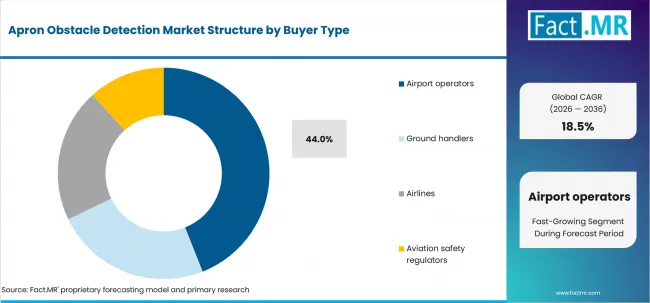
Apron Obstacle Detection Market Analysis By Buyer Type | Source: Fact.MR
Airport operators lead because they manage apron safety, stand utilization and aircraft turnaround outcomes. The buyer-type segment is projected to record 44.0% share in 2026 as operators invest in stand safety and obstacle alerts. Ground handlers follow because GSE movement creates daily risk. Airlines support adoption where aircraft damage and turnaround delay affect operations. Aviation safety regulators influence deployment through surface safety expectations. Saab’s 2024 Aerobahn Runway and Surface Safety deployment at Nashville shows how surface safety tools are expanding to improve situational awareness. [5]
What is accelerating Apron Obstacle Detection Market adoption, and what is holding it back?
Stand safety and GSE monitoring drive it; false alerts and integration burden restrain it.
Drivers Impact Analysis
| DRIVER | (~) % IMPACT ON CAGR | GEOGRAPHIC RELEVANCE | IMPACT TIMELINE |
|---|---|---|---|
| Stand safety programs reducing aircraft contact risk | +2.1% | United States, Singapore, Germany, China | Short term (≤ 2 years) |
| GSE monitoring improving ramp movement discipline | +1.8% | Large hubs globally | Short term (≤ 2 years) |
| Integrated A-VDGS adding obstacle detection to docking workflows | +1.5% | North America, Europe, Asia-Pacific | Medium term (2–4 years) |
| Camera AI improving apron activity classification | +1.3% | United States, Germany, Singapore, India | Medium term (2–4 years) |
| Cargo apron automation increasing night-operation monitoring | +1.0% | China, India, Middle East, North America | Long term (≥ 4 years) |
Source: Fact.MR analysis. Updated Jul 6, 2026
Stand safety programs
Stand safety programs are the strongest driver because aircraft contact events create repair cost, delay and safety exposure. Sensors help detect objects before an aircraft enters or leaves the stand. This reduces reliance on visual checks alone. The driver is strongest at high-use gates and widebody stands.
GSE monitoring
GSE monitoring supports adoption because service vehicles often operate close to aircraft. Detection systems can flag unsafe positioning and movement near the aircraft envelope. This improves ramp discipline and creates better incident evidence. Apron alerts can also reduce conflict with aircraft tugs during pushback and tow movement.
Integrated A-VDGS
Integrated A-VDGS supports demand because docking guidance systems already monitor the stand. Adding obstacle detection to the same workflow improves value without creating a separate control process. Airports can use A-VDGS screens and apron platforms to manage alerts. This driver is strongest in modernization projects.
Camera AI
Camera AI improves adoption because it can classify aircraft, people and equipment movement from existing or new camera feeds. It is useful for turnaround safety and post-event review. AI models must be tuned to local apron layouts. Better training data will improve confidence.
Cargo apron monitoring
Cargo apron monitoring creates demand because freight operations often run at night and use dense GSE activity. Sensors can detect objects, vehicles and unsafe movement when visibility is weaker. Cargo airports also need better records for compliance. This driver will grow as air cargo apron automation expands.
Opportunity Impact Analysis
| OPPORTUNITY | (~) % IMPACT ON CAGR | GEOGRAPHIC RELEVANCE | IMPACT TIMELINE |
|---|---|---|---|
| Sensor-fusion systems for high-risk gate stands | +1.4% | United States, Germany, Singapore, China | Short term (≤ 2 years) |
| Geofencing for GSE movement control around aircraft | +1.2% | North America, Europe, India | Medium term (2–4 years) |
| Software analytics using existing apron camera networks | +1.0% | Global, strongest in large hubs | Medium term (2–4 years) |
| Mobile sensors for MRO and temporary ramp work zones | +0.7% | United States, Japan, UAE, Singapore | Long term (≥ 4 years) |
Source: Fact.MR analysis. Updated Jul 6, 2026
Sensor-fusion systems
Sensor-fusion systems create opportunity because apron hazards can be difficult to detect with one technology. Combining radar, LiDAR and camera AI improves confidence. These systems fit high-risk stands with complex service activity. Airports will favor vendors that reduce false alerts while keeping detection sensitivity high.
Geofencing
Geofencing creates opportunity because airports can define virtual safety zones around parked aircraft. Alerts can trigger when vehicles or equipment enter restricted areas. This supports ramp discipline and training. Geofencing can also guide safer movement around aircraft tow tractors during aircraft repositioning.
Software analytics
Software analytics creates opportunity because many airports already have apron cameras. AI analytics can extract obstacle alerts from existing video infrastructure where camera quality is sufficient. This reduces hardware cost for selected stands. GSE monitoring can also connect with ground support equipment tires records when airports track fleet condition and ramp incidents together.
Mobile sensors
Mobile sensors create opportunity at MRO aprons and temporary ramp work zones. These areas may not justify permanent fixed-pole installations. Portable sensor kits can support aircraft positioning, work-zone monitoring and temporary hazard alerts. The opportunity will grow as MRO aprons handle larger aircraft and more mixed equipment.
Restraints Impact Analysis
| RESTRAINT | (~) % IMPACT ON CAGR | GEOGRAPHIC RELEVANCE | IMPACT TIMELINE |
|---|---|---|---|
| False alerts disrupting ramp and gate workflows | -1.5% | Global | Short term (≤ 2 years) |
| Integration burden across A-VDGS, CCTV and apron platforms | -1.2% | Global, strongest in brownfield airports | Medium term (2–4 years) |
| Poor visibility, glare and weather affecting camera AI accuracy | -1.0% | Europe, East Asia, Middle East | Medium term (2–4 years) |
| Unclear ownership of apron alert response | -0.8% | Global | Long term (≥ 4 years) |
Source: Fact.MR analysis. Updated Jul 6, 2026
False alerts
False alerts are the main restraint because apron teams may ignore systems that interrupt normal work too often. Busy stands have vehicles, people and temporary objects moving near aircraft. Detection thresholds must be tuned carefully. Vendors need field evidence that alerts are accurate and useful.
Integration burden
Integration burden slows adoption because obstacle alerts must connect with A-VDGS, CCTV, apron control and gate platforms. Older airports may have mixed vendors and custom procedures. Data mapping can take time. This restraint is strongest in brownfield terminals.
Camera AI limitations
Camera AI limitations matter because glare and night operations can reduce image quality. Apron layouts also vary by stand and terminal design. AI models need training and periodic review. Sensor fusion helps reduce this restraint.
Alert ownership
Alert ownership can be unclear because airport operators and airlines all work around the aircraft. A detection system must define who responds and when. Without clear procedures, alerts may not improve safety. Training and standard operating rules are essential.
Which countries are scaling apron obstacle detection fastest?
United States 20.2%; Singapore 19.6%; Germany 18.9%; China 18.2%; India 17.4%.
Based on regional analysis, the apron obstacle detection market is segmented into North America, Western Europe, East Asia, South Asia, Latin America, and Middle East and Africa.
Country CAGR
| Country | CAGR |
|---|---|
| United States | 20.2% |
| Singapore | 19.6% |
| Germany | 18.9% |
| China | 18.2% |
| India | 17.4% |
Source: Fact.MR analysis. Updated Jul 6, 2026
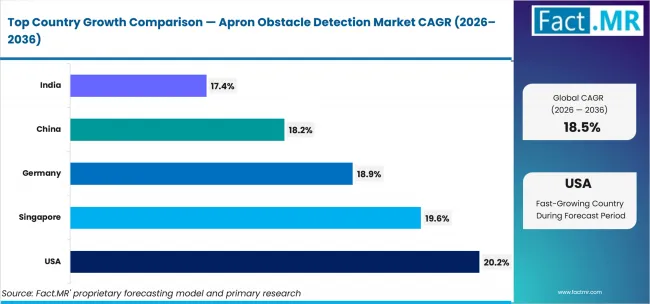
Apron Obstacle Detection Market Cagr Analysis By Country | Source: Fact.MR
What is powering the United States lead?
20.2% CAGR, driven by surface safety programs and large hub apron modernization.
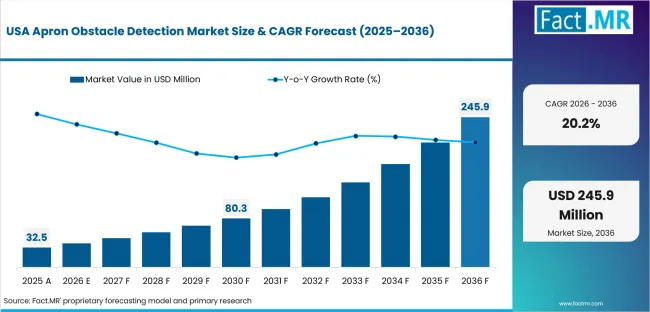
Apron Obstacle Detection Market Country Value Analysis | Source: Fact.MR
The United States is projected to record 20.2% CAGR from 2026 to 2036 as airports add safety tools around stands, taxi lanes and ramp areas. Growth will favor sensor fusion, AI video analytics and integrated A-VDGS deployment. Ground handlers will support adoption where GSE monitoring reduces contact risk.
How is Singapore scaling apron obstacle detection demand?
Singapore is at 19.6%, scaling through high-density apron operations and stand automation.
Singapore is expected to post 19.6% CAGR through 2036 as high-throughput airports increase automated stand monitoring. Detection systems will be used to support gate safety, turnaround coordination and cargo apron monitoring. Growth will favor low-false-alert analytics and resilient sensor fusion.
What supports Germany’s outlook?
18.9% CAGR, driven by Frankfurt-style apron modernization and integrated A-VDGS deployment.
Germany is likely to record 18.9% CAGR by 2036 as major airports modernize docking guidance and apron management systems. Demand will focus on gate stands, A-VDGS integration and low-visibility obstacle detection. Supplier selection will depend on sensor reliability and airport-system integration.
What underpins China’s growth?
China is at 18.2%, scaling through large hub expansion and cargo apron monitoring.
China is forecast to advance at 18.2% CAGR through 2036 as airports expand apron capacity and automate high-density operations. Sensor-fusion systems will gain traction at cargo aprons and large passenger terminals. Growth will favor fixed-pole sensors and software analytics connected with apron control platforms.
How is India scaling apron obstacle detection adoption?
17.4% CAGR, driven by new airport projects and terminal modernization.
India is set to record 17.4% CAGR through 2036 as airport expansion creates demand for safer ramp and gate operations. New terminals will support integrated A-VDGS and apron safety systems. Brownfield airports will adopt retrofit-friendly camera AI and geofencing tools first.
Who leads the apron obstacle detection market?
ADB SAFEGATE and Searidge Technologies lead direct apron intelligence coverage, while Xsight Systems strengthens foreign object detection capability.
Apron obstacle detection is supplied by A-VDGS providers, AI apron platforms, FOD detection vendors and airport surface safety companies. ADB SAFEGATE is central through Safedock, Safedock X and CORTEX Apron. Searidge Technologies is relevant through Digital Apron Management and AI-based apron monitoring. Xsight Systems supports foreign object alert capability through sensor-fusion detection.
Honeywell is relevant through airport safety and aviation-safety technology pathways. Saab supports surface safety through Aerobahn, A-SMGCS and airport vehicle tracking. TKH Airport Solutions is an adjacent smart airfield infrastructure provider rather than a direct apron obstacle detection specialist. Obstacle alerts can also improve service sequencing for belt loaders once the aircraft stand is clear.
Competition through 2036 will be shaped by detection accuracy, false-alert control, integration support and live-apron reliability. Stand-safety data can reduce timing conflicts with air start units when engine-start preparation needs safe equipment positioning.
Suppliers that connect obstacle alerts with ramp workflows will be better placed than providers offering isolated video analytics. Safer ramp sequencing also creates a practical link with aircraft refueler activity when service vehicles move inside the aircraft safety envelope.
Which companies are the key providers?
ADB SAFEGATE and Searidge Technologies are key providers. Xsight Systems and Saab are also profiled. Honeywell and TKH Airport Solutions complete the company set through airport safety and smart airfield pathways.
- ADB SAFEGATE
- Xsight Systems
- TKH Airport Solutions
- Honeywell
- Searidge Technologies
- Saab
Bibliography
- [1] ADB SAFEGATE. (2024, April 16). ADB SAFEGATE wins project to modernize advanced visual docking guidance at Frankfurt International Airport. ADB SAFEGATE.
- [2] ADB SAFEGATE. (2026). Safedock X: Advanced Visual Docking Guidance System. ADB SAFEGATE.
- [3] Xsight Systems. (2026). FODetect. Xsight Systems.
- [4] Searidge Technologies. (2025, February). Digital apron management [PDF]. Searidge Technologies.
- [5] Saab. (2024, July 15). Saab’s new cloud-based runway safety system is now operational at Nashville International Airport. Saab.
This Report Address
- Strategic intelligence on apron obstacle detection across detection tech and use case.
- Segment analysis covering Sensor Fusion and Stand Safety.
- Regional outlook covering the United States, Singapore, Germany, China and India.
- Competitive analysis of ADB SAFEGATE, Xsight Systems, TKH Airport Solutions, Honeywell, Searidge Technologies and Saab.
- Technology assessment covering camera AI, radar, LiDAR, sensor fusion and geofencing.
- Use case assessment covering stand safety, collision avoidance, GSE monitoring, foreign object alerts and turnaround safety.
- Scope screening separates apron obstacle detection from runway-only FOD detection.
- Primary interviews, provider checks and official source review support the forecast.
What does the apron obstacle detection market cover?
Sensor and analytics systems used to detect obstacles, vehicles and unsafe movement in apron areas.
The apron obstacle detection market covers camera AI and geofencing. These systems support stand safety and turnaround safety.
The market differs from broad airport surveillance because it focuses on apron and gate-zone detection. It excludes runway-only FOD detection, tower-only surveillance and generic CCTV unless the system is configured for apron obstacle analytics.
What is included in the scope?
Apron sensors and integrated stand-safety modules.
The scope includes camera AI and geofencing. Use case coverage includes stand safety and turnaround safety.
Airport-area coverage includes aprons and cargo aprons. Deployment coverage includes fixed pole sensors and software analytics. Apron detection becomes more valuable when it supports passenger boarding bridge movement after safe aircraft stop confirmation.
Buyer-type coverage includes airport operators, ground handlers, airlines and aviation safety regulators. The scope also includes stand sensors installed during A-VDGS refresh programs and apron safety projects.
What is excluded from the scope?
Runway-only FOD detection and broad airport surveillance platforms are outside the scope.
The scope excludes runway-only inspection systems and ordinary perimeter surveillance. It also excludes gate management software unless revenue is tied to obstacle detection or sensor deployment.
How was the analysis built?
100+ sources, 40+ company portfolios, 25+ countries, 20+ interviews.
- Primary Research: Primary research includes interviews with airport operators, ground handlers and apron safety teams. It includes input from A-VDGS vendors, AI video analytics suppliers, aviation regulators and systems integrators.
- Desk Research: Desk research reviews official A-VDGS pages, apron management systems, FOD detection products, surface safety releases and airport modernization programs.
- Market-Sizing and Forecasting: Forecasting uses apron stand count, A-VDGS retrofit demand, gate utilization, GSE fleet density and sensor attachment rates.
- Data Validation and Update Cycle: Forecasts are validated through provider checks and technical interviews. Detection technology mapping, airport project signals and safety-use screening help confirm market direction.
Segmentation
What is the report’s scope and coverage?
| Attribute | Details |
|---|---|
| Quantitative Units | USD Million in 2026 to USD Million by 2036 at CAGR |
| Market Definition | Sensor and analytics systems used to detect obstacles, vehicles and unsafe movement in apron areas |
| Detection Tech | Camera AI; radar; LiDAR; sensor fusion; geofencing |
| Use Case | Stand safety; collision avoidance; GSE monitoring; foreign object alerts; turnaround safety |
| Airport Area | Apron; gate stand; taxi lane; ramp area; cargo apron |
| Deployment | Fixed pole sensors; mobile sensors; integrated A-VDGS; software analytics |
| Buyer Type | Airport operators; ground handlers; airlines; aviation safety regulators |
| Regions Covered | North America; Western Europe; East Asia; South Asia; Latin America; Middle East and Africa |
| Countries Covered | United States; Singapore; Germany; China; India |
| Key Companies Profiled | ADB SAFEGATE; Xsight Systems; TKH Airport Solutions; Honeywell; Searidge Technologies; Saab |
| Forecast Period | 2026 to 2036 |
| Approach | Hybrid top-down and bottom-up approach using apron stand count, A-VDGS modernization, GSE density, sensor attachment rates and provider validation |
Source: Fact.MR analysis. Updated Jul 6, 2026
How is the market segmented?
-
By Detection Tech:
- Camera AI
- Radar
- LiDAR
- Sensor fusion
- Geofencing
-
By Use Case:
- Stand safety
- Collision avoidance
- GSE monitoring
- Foreign object alerts
- Turnaround safety
-
By Airport Area:
- Apron
- Gate stand
- Taxi lane
- Ramp area
- Cargo apron
-
By Deployment:
- Fixed pole sensors
- Mobile sensors
- Integrated A-VDGS
- Software analytics
-
By Buyer Type:
- Airport operators
- Ground handlers
- Airlines
- Aviation safety regulators
-
Region:
- North America
- United States
- Canada
- Western Europe
- Germany
- United Kingdom
- France
- Netherlands
- Spain
- East Asia
- China
- Japan
- South Korea
- South Asia
- India
- Singapore
- Thailand
- Latin America
- Brazil
- Mexico
- Chile
- Middle East & Africa
- UAE
- Saudi Arabia
- South Africa
- North America
Frequently Asked Questions
Which detection technology leads the Apron Obstacle Detection Market?
Which use case leads the Apron Obstacle Detection Market?
Which airport area leads the Apron Obstacle Detection Market?
Which deployment leads the Apron Obstacle Detection Market?
Which buyer type leads the Apron Obstacle Detection Market?
Which country expands fastest in the Apron Obstacle Detection Market?
How does Singapore perform in the Apron Obstacle Detection Market?
How does Germany perform in the Apron Obstacle Detection Market?
How does China perform in the Apron Obstacle Detection Market?
How does India perform in the Apron Obstacle Detection Market?
What is the primary driver in the Apron Obstacle Detection Market?
What is the main restraint in the Apron Obstacle Detection Market?
Why is sensor fusion important?
Why do airport operators dominate demand?
Who worked on this report


Preview the report firsthand - request a free sample
Free SampleGet the brochure for pricing and purchase details
Download PDF