- Market Value (2025): USD 10.3 Bn
- Estimated Value (2026): USD 11.8 Bn
- Forecast Value (2036): USD 45.7 Bn
- CAGR (2026-2036): 14.5%
What is the Arcade Game Machines Market forecast to be worth by 2036?
USD 11.8 billion in 2026 to USD 45.7 billion by 2036, at a 14.5% CAGR.
Arcade cabinet demand should be read beside Fact.MR's Video Games Market, since players still compare location-based play with at-home digital play.
- The arcade game machines market reached USD 10.3 billion in 2025 as family entertainment centers and game-room operators spent against a clear use case: paid location-based play that converts foot traffic into repeat coin, card, ticket and prize revenue.
- Demand is projected to increase from USD 11.8 billion in 2026 to USD 45.7 billion by 2036, at a 14.5% CAGR.
- The market is forecast to record a 14.5% CAGR from 2026 to 2036. Demand is tied to paid location-based play that converts foot traffic into repeat coin, card, ticket and prize revenue.
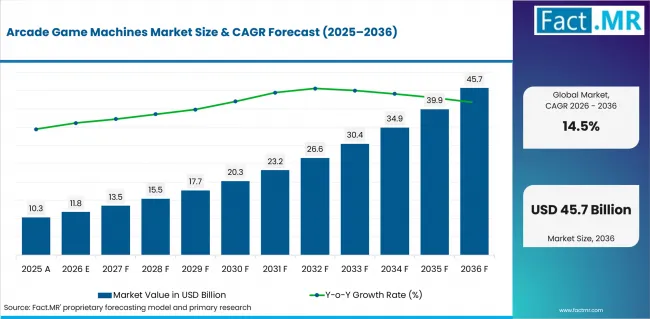
Arcade Game Machines Market Value Analysis | Source: Fact.MR
What are the defining numbers behind Arcade Game Machines Market growth?
USD 33.9 billion absolute opportunity is expected by 2036.
The capex case also links to Fact.MR's Gaming Hardware Market, because hardware refresh, uptime and part support drive the operator payback model.
- Demand Drivers in the Market
- Redemption games lead as they join play with a reward loop. Tickets, points and prizes give operators a repeat-play mechanism that pure video cabinets often struggle to match.
- Indoor specialty centers lead application demand because arcades work best when combined with birthdays, food, bowling, mini golf, VR, laser tag or other activities that keep families on-site longer.
- Family entertainment centers remain the core end user because they can manage prize counters, prepaid cards, cabinet rotation and maintenance schedules at scale.
- Direct sales lead as operators need cabinet selection, installation, parts support, revenue-share options and floor-planning help before committing capex.
- Key Segments Analyzed
- By Product Type: Redemption Games is projected to hold 36.0% share in 2026. Redemption games lead as the prize loop improves replay and gives operators a clear revenue metric per cabinet.
- By Application: Indoor Specialty Centers is projected to hold 29.1% share in 2026. Indoor specialty centers lead because arcade areas work best when they sit beside birthdays, food service, VR zones and other activities that keep families on-site longer.
- By End User: Family Entertainment Centers is projected to hold 29.1% share in 2026. Family entertainment centers lead as they can support a full game room, maintain machines, manage points or tickets and refresh cabinets by performance.
- By Distribution Channel: Direct Sales is projected to hold 30.6% share in 2026. Direct sales lead as venue operators need advice on machine mix, installation, service terms, spares and expected payback.
- By Technology: Traditional Video Arcade Technology is projected to hold 41.4% share in 2026. Traditional video arcade technology leads because proven cabinets remain easier to maintain, familiar to players and practical for operator payback, even as connected and immersive formats expand.
- Analyst Opinion at Fact.MR
- Shambhu Nath Jha, Sr. Consultant at Fact.MR, opines, "Arcade machines scale when the cabinet pays for its floor space. Redemption, serviceability and venue fit matter more than novelty alone, because operators replace machines only when the revenue case is visible."
- Strategic Implications
- Manufacturers should sell the earning model before the game theme: expected throughput, service interval, prize integration and cabinet footprint.
- Operators should review each machine by revenue per square foot, uptime, parts cost and fit with the venue's age mix.
- Distributors can win by bundling floor planning, installation, operator training and replacement-part commitments.
USA continues to be a leading market and is projected to grow at a CAGR of 18.85%; other key markets include Japan, Germany, UK, Canada, South Korea and Australia.
How does the Arcade Game Machines Market break down by segment?
Redemption Games leads Product Type at 36.0%.
Family center traffic connects with Fact.MR's Kids Recreational Services Market, where repeat visits depend on safe activities that parents can approve.
Why does Redemption Games lead Product Type?
Redemption Games is projected to account for 36.0% share in 2026.
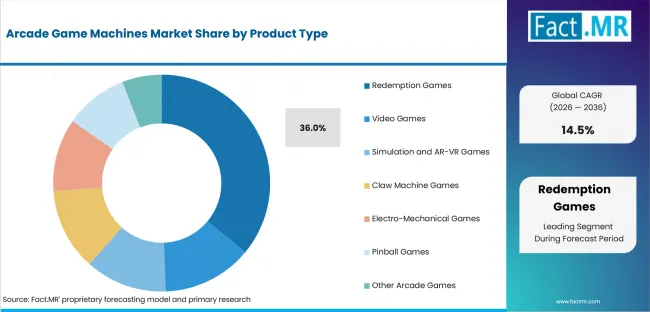
Arcade Game Machines Market Analysis By Product Type | Source: Fact.MR
Redemption games lead as the prize loop improves replay and gives operators a clear revenue metric per cabinet.
Why does Indoor Specialty Centers lead Application?
Indoor Specialty Centers is projected to account for 29.1% share in 2026.
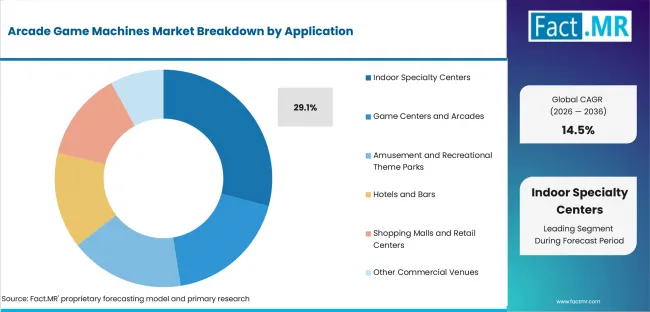
Arcade Game Machines Market Analysis By Application | Source: Fact.MR
Indoor specialty centers lead because arcade areas work best beside birthday parties, food service, VR zones and other activities that keep families on-site longer.
Why does Family Entertainment Centers lead End User?
Family Entertainment Centers is projected to account for 29.1% share in 2026.
Family entertainment centers lead as they can support a full game room, maintain machines, manage points or tickets and refresh cabinets by performance.
Why does Direct Sales lead Distribution Channel?
Direct Sales is projected to account for 30.6% share in 2026.
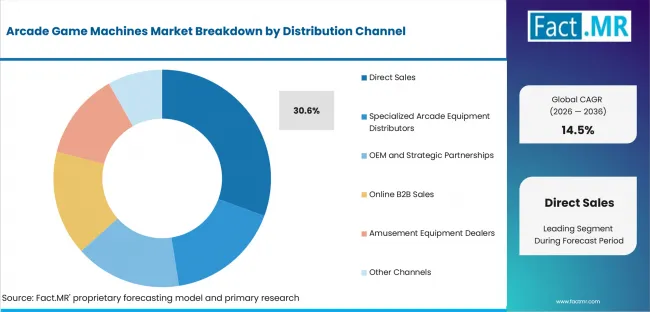
Arcade Game Machines Market Analysis By Distribution Channel | Source: Fact.MR
Direct sales lead as venue operators need advice on machine mix, installation, service terms, spares and expected payback.
Why does Traditional Video Arcade Technology lead Technology?
Traditional Video Arcade Technology is projected to account for 41.4% share in 2026.
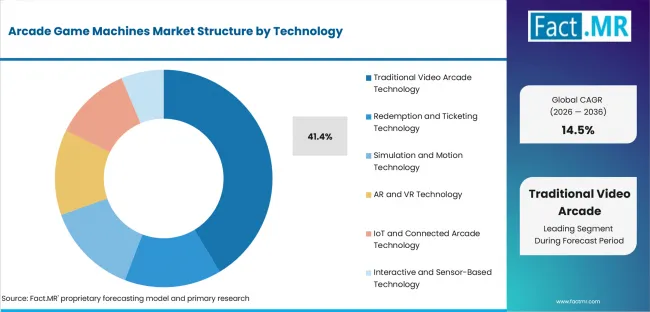
Arcade Game Machines Market Analysis By Technology | Source: Fact.MR
Traditional video arcade technology leads because proven cabinets remain easier to maintain, familiar to players and practical for operator payback, even as connected and immersive formats expand.
What is accelerating Arcade Game Machines Market adoption, and what is holding it back?
Adoption is strongest where venues can prove revenue per square foot and keep cabinets working through steady service support. High cabinet cost, downtime and local prize rules slow refresh decisions.
Connected play features can be compared with Fact.MR's Connected Game Console Market, especially when operators test loyalty, card and account-linked experiences.
Drivers Impact Analysis
| DRIVER | QUALITATIVE RELEVANCE | GEOGRAPHIC RELEVANCE | IMPACT TIMELINE |
|---|---|---|---|
| Redemption reward loop | High | South Korea | Short term (<=2 years) |
| FEC and indoor center traffic | High | USA | Short term (<=2 years) |
| Cashless card and ticket systems | Moderate | Canada | Medium term (2-4 years) |
| Cabinet refresh by revenue per square foot | Selective | Germany | Medium term (2-4 years) |
Source: Fact.MR analysis. Updated Jul 30, 2026
- Redemption reward loop: Redemption games lead as they join play with a reward loop. Tickets, points and prizes give operators a repeat-play mechanism that pure video cabinets often struggle to match.
- FEC and indoor center traffic: Indoor specialty centers lead application demand because arcades work best when combined with birthdays, food, bowling, mini golf, VR, laser tag or other activities that keep families on-site longer.
- Cashless card and ticket systems: Family entertainment centers remain the core end user because they can manage prize counters, prepaid cards, cabinet rotation and maintenance schedules at scale.
- Cabinet refresh by revenue per square foot: Direct sales lead as operators need cabinet selection, installation, parts support, revenue-share options and floor-planning help before committing capex.
Opportunity Impact Analysis
| OPPORTUNITY | QUALITATIVE RELEVANCE | GEOGRAPHIC RELEVANCE | IMPACT TIMELINE |
|---|---|---|---|
| Managed arcade and revenue-share models | High | South Korea | Medium term (2-4 years) |
| Digital loyalty and card integration | Moderate | USA | Medium term (2-4 years) |
| Hybrid VR and redemption layouts | Selective | Canada | Medium term (2-4 years) |
Source: Fact.MR analysis. Updated Jul 30, 2026
- Managed arcade and revenue-share models: Revenue-share and managed game-room contracts can reduce upfront capex for venues while giving suppliers recurring service revenue.
- Digital loyalty and card integration: Cashless card systems and digital ticketing can improve spend tracking, loyalty and prize redemption control.
- Hybrid VR and redemption layouts: Hybrid arcade, VR and redemption layouts can lift dwell time where venues need new reasons for repeat visits.
Restraints Impact Analysis
| RESTRAINT | QUALITATIVE RELEVANCE | GEOGRAPHIC RELEVANCE | IMPACT TIMELINE |
|---|---|---|---|
| High cabinet capex and payback risk | High | South Korea | Short term (<=2 years) |
| Maintenance downtime and parts availability | Moderate | USA | Medium term (2-4 years) |
| Local amusement and prize rules | Selective | Canada | Medium term (2-4 years) |
Source: Fact.MR analysis. Updated Jul 30, 2026
- High cabinet capex and payback risk: High cabinet cost and uncertain payback slow refresh cycles when foot traffic is uneven.
- Maintenance downtime and parts availability: Maintenance downtime hurts revenue because a non-working cabinet occupies the same floor space as an earning machine.
- Local amusement and prize rules: Prize regulation, local amusement rules and card-system compliance can complicate rollouts across jurisdictions.
Which countries are scaling Arcade Game Machines Market fastest?
Country rates show where buying conditions and supplier proof are already stronger.
Prize and casual-play zones give Fact.MR's Foosball Table Market a useful adjacent read for venues balancing arcade machines with lower-maintenance games.
- South Korea: The market is expected to grow at a CAGR of 11.64% from 2026 to 2036. South Korea's growth is helped by high-density malls, indoor entertainment centers and a strong gaming culture. Operators still need machine uptime and fast service support.
- USA: The market is expected to grow at a CAGR of 18.85% from 2026 to 2036. USA demand is shaped by family entertainment centers, bowling venues, resorts and route operators. Direct sales and managed game-room models support cabinet refresh.
- Canada: The market is expected to grow at a CAGR of 13.03% from 2026 to 2036. Canada follows the North American FEC model, with opportunities in malls, bowling centers and mixed-use venues that need compact high-earning cabinets.
- Germany: The market is expected to grow at a CAGR of 15.93% from 2026 to 2036. Germany's outlook is steadier because operators weigh compliance, capex and proven earning power before adding new machines.
- Australia: The market is expected to grow at a CAGR of 10.18% from 2026 to 2036. Australia benefits from indoor amusement centers and tourism-linked venues, but long service distances make parts support important.
- UK: The market is expected to grow at a CAGR of 14.48% from 2026 to 2036. UK adoption is tied to bowling centers, seaside amusement venues and FECs. The strongest cabinets show clear repeat-play economics.
- Japan: The market is expected to grow at a CAGR of 17.41% from 2026 to 2036. Japan has a mature arcade culture, so growth depends on differentiated experiences, cabinet refresh and operator confidence in footfall.
The full report provides country-level CAGR analysis across North America, Latin America, Europe, East Asia, South Asia and Oceania, and the Middle East and Africa.
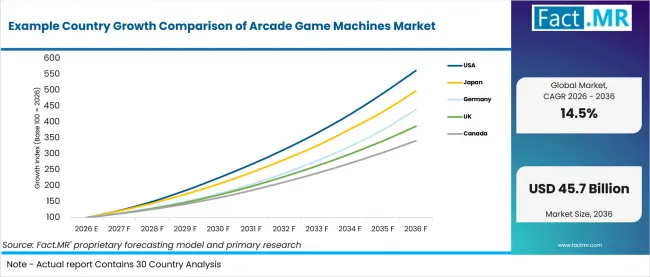
Example Country Growth Comparison Of Arcade Game Machines Market | Source: Fact.MR
| Country | CAGR (2026-2036) |
|---|---|
| South Korea | 11.64% |
| USA | 18.85% |
| Canada | 13.03% |
| Germany | 15.93% |
| Australia | 10.18% |
| UK | 14.48% |
| Japan | 17.41% |
Source: Fact.MR analysis. Updated Jul 30, 2026
What is shaping South Korea's outlook through 2036?
11.64% CAGR from 2026 to 2036.
South Korea's growth is helped by high-density malls, indoor entertainment centers and a strong gaming culture. Operators still need machine uptime and fast service support.
What is shaping USA's outlook through 2036?
18.85% CAGR from 2026 to 2036.
USA demand is shaped by family entertainment centers, bowling venues, resorts and route operators. Direct sales and managed game-room models support cabinet refresh.
What is shaping Canada's outlook through 2036?
13.03% CAGR from 2026 to 2036.
Canada follows the North American FEC model, with opportunities in malls, bowling centers and mixed-use venues that need compact high-earning cabinets.
What is shaping Germany's outlook through 2036?
15.93% CAGR from 2026 to 2036.
Germany's outlook is steadier because operators weigh compliance, capex and proven earning power before adding new machines.
What is shaping Australia's outlook through 2036?
10.18% CAGR from 2026 to 2036.
Australia benefits from indoor amusement centers and tourism-linked venues, but long service distances make parts support important.
Who leads the Arcade Game Machines Market?
Bandai Namco Entertainment America Inc.; SEGA SAMMY HOLDINGS Inc.; Konami Group Corporation; Capcom Co., Ltd. are among the visible providers in the arcade game machines market.
Bandai Namco Entertainment America Inc. and SEGA SAMMY HOLDINGS Inc. are among the most visible providers. Competition is shaped by product proof, channel access and buyer trust.
Between 2026 and 2036, market rivalry is likely to center on clearer positioning around Redemption Games, stronger documentation and better support at the point of purchase.
Which companies are the key providers?
Key companies include Bandai Namco Entertainment America Inc.; SEGA SAMMY HOLDINGS Inc.; Konami Group Corporation; Capcom Co., Ltd.; Raw Thrills, Inc.; Adrenaline Amusements; Andamiro; Bay Tek Entertainment, Inc..
- Bandai Namco Entertainment America Inc.
- SEGA SAMMY HOLDINGS Inc.
- Konami Group Corporation
- Capcom Co., Ltd.
- Raw Thrills, Inc.
- Adrenaline Amusements
- Andamiro
- Bay Tek Entertainment, Inc.
Bibliography
- IAAPA, Revenue Operations: Building an Arcade.
- IAAPA, Family Entertainment Centers.
- CPSC, Amusement Rides.
- Florida Statutes, Arcade Amusement Center Definition.
- Fact.MR, Video Games Market.
- Fact.MR, Gaming Hardware Market.
This Report Answers
- The report provides strategic intelligence on the Arcade Game Machines Market across segment choices that shape the 2026 market structure.
- Segment analysis covers Redemption Games and Indoor Specialty Centers as the share leaders within the 2026 market.
- Country outlook evaluates the listed markets by CAGR and explains the adoption conditions in each country.
- Competitive analysis profiles the named providers and evaluates competition around product proof, channel access and buyer trust.
- Related coverage connects this report with adjacent gaming, venue and amusement-equipment markets.
What does the Arcade Game Machines Market cover?
The Arcade Game Machines Market covers redemption games, video arcade cabinets, simulator machines, pinball and specialty arcade equipment used in family entertainment centers, indoor amusement centers, malls, resorts, bowling centers and route-operated venues.
The Arcade Game Machines Market covers redemption games, video arcade cabinets, simulator machines, pinball and specialty arcade equipment used in family entertainment centers, indoor amusement centers, malls, resorts, bowling centers and route-operated venues.
Adjacent spending is included only when it is part of the same purchase decision or operating use case.
What is included in the scope?
The scope includes Product Type, Application, End User, Distribution Channel, Technology and regional demand.
Coverage includes adjacent segment options only when they are purchased for the same defined market use.
What is excluded from the scope?
home gaming consoles, mobile games, casino slot machines, online gaming revenue and amusement rides that are not arcade game machines.
The scope excludes home gaming consoles, mobile games, casino slot machines, online gaming revenue and amusement rides that are not arcade game machines.
How Was the Analysis Built?
The analysis combines primary research with desk research focused on the arcade game machines market, its segment structure and country-level demand.
- Primary Research: Interviews and validation discussions test buyer priorities, adoption barriers, pricing logic and operating requirements.
- Desk Research: The assessment reviews company disclosures, public datasets, regulatory material, technical literature and industry records relevant to the market.
- Market Sizing and Forecasting: Estimates combine top-down and bottom-up checks across demand signals, segment shares, country activity, company participation and adoption constraints.
- Data Validation and Update Cycle: Findings are validated against public evidence, company activity and country-level adoption patterns before final use.
Segmentation
What is the report's scope and coverage?
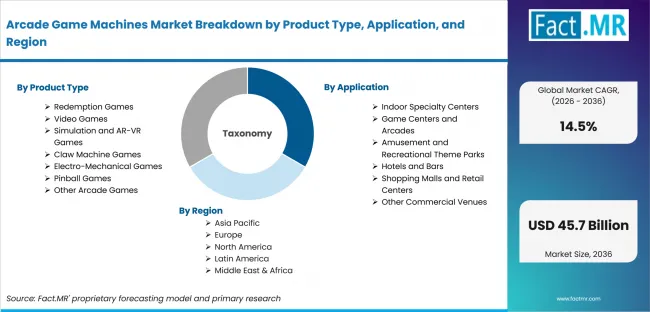
Arcade Game Machines Market Breakdown By Product Type, Application, And Region | Source: Fact.MR
| Attribute | Details |
|---|---|
| Quantitative Units | USD 11.8 billion in 2026 to USD 45.7 billion by 2036, at a 14.5% CAGR. |
| Market Definition | Arcade Game Machines Market covers redemption games, video arcade cabinets, simulator machines, pinball and specialty arcade equipment used in family entertainment centers, indoor amusement centers, malls, resorts, bowling centers and route-operated venues. |
| Product Type | Redemption Games; Ticket Redemption Games; Prize Redemption Games; Video Games; Fighting and Action Games; Rhythm and Music Games; Simulation and AR-VR Games; Racing and Driving Simulators; Virtual Reality and Motion Simulators; Claw Machine Games; Prize Claw Machines; Merchandise Crane Machines; Electro-Mechanical Games; Skill-Based Electro-Mechanical Games; Interactive Mechanical Games; Pinball Games; Classic Pinball Machines; Digital and Modern Pinball Machines; Other Arcade Games; Sports and Interactive Games; Multiplayer Social Games |
| Application | Indoor Specialty Centers; Family Entertainment Centers; Indoor Amusement Centers; Game Centers and Arcades; Traditional Arcade Centers; Competitive Gaming Arcades; Amusement and Recreational Theme Parks; Theme Park Arcade Zones; Indoor Theme Park Attractions; Hotels and Bars; Hotel Entertainment Areas; Barcades and Social Gaming Venues; Shopping Malls and Retail Centers; Mall Entertainment Zones; Retail Entertainment Centers; Other Commercial Venues; Restaurants and Food-Service Venues; Cinemas and Hospitality Venues |
| End User | Family Entertainment Centers; Family-Oriented Entertainment Venues; Multi-Activity Entertainment Centers; Arcade and Game Center Operators; Independent Arcade Operators; Chain Arcade Operators; Amusement and Theme Park Operators; Large Theme Park Operators; Regional Amusement Park Operators; Hospitality and Leisure Operators; Hotels and Resorts; Bars and Social Entertainment Venues; Shopping Mall and Retail Operators; Mall Entertainment Operators; Retail Leisure Operators; Other Commercial Operators; Restaurant and Cinema Operators; Community and Recreational Operators; Independent and Home Users; Private Arcade Collectors; Home Entertainment Users |
| Distribution Channel | Direct Sales; Direct Sales to Arcade Operators; Direct Sales to Amusement Venues; Specialized Arcade Equipment Distributors; Regional Arcade Equipment Distributors; Entertainment Equipment Dealers; OEM and Strategic Partnerships; Theme Park Equipment Partnerships; Family Entertainment Center Partnerships; Online B2B Sales; Online Equipment Marketplaces; Direct Manufacturer E-Commerce; Amusement Equipment Dealers; Local Amusement Equipment Dealers; Specialized Gaming Equipment Dealers; Other Channels; Trade Shows and Industry Events; Auction and Secondary Equipment Markets |
| Technology | Traditional Video Arcade Technology; Standard LCD and LED Cabinets; Multiplayer Video Cabinets; Redemption and Ticketing Technology; Digital Ticketing Systems; Cashless Prize Management Systems; Simulation and Motion Technology; Motion Platform Systems; Advanced Racing and Flight Simulators; AR and VR Technology; Augmented Reality Systems; Virtual Reality Arcade Systems; IoT and Connected Arcade Technology; Cloud-Connected Machines; Remote Monitoring and Analytics; Interactive and Sensor-Based Technology; Motion and Gesture Sensors; Touch and Haptic Interfaces |
| Regions Covered | North America; Latin America; Europe; East Asia; South Asia and Oceania; Middle East and Africa |
| Countries Covered | South Korea; USA; Canada; Germany; Australia; UK; Japan |
| Key Companies Profiled | Bandai Namco Entertainment America Inc.; SEGA SAMMY HOLDINGS Inc.; Konami Group Corporation; Capcom Co., Ltd.; Raw Thrills, Inc.; Adrenaline Amusements; Andamiro; Bay Tek Entertainment, Inc. |
| Forecast Period | 2026 to 2036 |
| Approach | Hybrid top-down and bottom-up assessment using demand indicators, segment mix, country growth, company participation and public evidence relevant to the category. |
Source: Fact.MR analysis. Updated Jul 30, 2026
How is the market segmented?
-
By Product Type:
- Redemption Games
- Ticket Redemption Games
- Prize Redemption Games
- Video Games
- Fighting and Action Games
- Rhythm and Music Games
- Simulation and AR-VR Games
- Racing and Driving Simulators
- Virtual Reality and Motion Simulators
- Claw Machine Games
- Prize Claw Machines
- Merchandise Crane Machines
- Electro-Mechanical Games
- Skill-Based Electro-Mechanical Games
- Interactive Mechanical Games
- Pinball Games
- Classic Pinball Machines
- Digital and Modern Pinball Machines
- Other Arcade Games
- Sports and Interactive Games
- Multiplayer Social Games
-
By Application:
- Indoor Specialty Centers
- Family Entertainment Centers
- Indoor Amusement Centers
- Game Centers and Arcades
- Traditional Arcade Centers
- Competitive Gaming Arcades
- Amusement and Recreational Theme Parks
- Theme Park Arcade Zones
- Indoor Theme Park Attractions
- Hotels and Bars
- Hotel Entertainment Areas
- Barcades and Social Gaming Venues
- Shopping Malls and Retail Centers
- Mall Entertainment Zones
- Retail Entertainment Centers
- Other Commercial Venues
- Restaurants and Food-Service Venues
- Cinemas and Hospitality Venues
-
By End User:
- Family Entertainment Centers
- Family-Oriented Entertainment Venues
- Multi-Activity Entertainment Centers
- Arcade and Game Center Operators
- Independent Arcade Operators
- Chain Arcade Operators
- Amusement and Theme Park Operators
- Large Theme Park Operators
- Regional Amusement Park Operators
- Hospitality and Leisure Operators
- Hotels and Resorts
- Bars and Social Entertainment Venues
- Shopping Mall and Retail Operators
- Mall Entertainment Operators
- Retail Leisure Operators
- Other Commercial Operators
- Restaurant and Cinema Operators
- Community and Recreational Operators
- Independent and Home Users
- Private Arcade Collectors
- Home Entertainment Users
-
By Distribution Channel:
- Direct Sales
- Direct Sales to Arcade Operators
- Direct Sales to Amusement Venues
- Specialized Arcade Equipment Distributors
- Regional Arcade Equipment Distributors
- Entertainment Equipment Dealers
- OEM and Strategic Partnerships
- Theme Park Equipment Partnerships
- Family Entertainment Center Partnerships
- Online B2B Sales
- Online Equipment Marketplaces
- Direct Manufacturer E-Commerce
- Amusement Equipment Dealers
- Local Amusement Equipment Dealers
- Specialized Gaming Equipment Dealers
- Other Channels
- Trade Shows and Industry Events
- Auction and Secondary Equipment Markets
-
By Technology:
- Traditional Video Arcade Technology
- Standard LCD and LED Cabinets
- Multiplayer Video Cabinets
- Redemption and Ticketing Technology
- Digital Ticketing Systems
- Cashless Prize Management Systems
- Simulation and Motion Technology
- Motion Platform Systems
- Advanced Racing and Flight Simulators
- AR and VR Technology
- Augmented Reality Systems
- Virtual Reality Arcade Systems
- IoT and Connected Arcade Technology
- Cloud-Connected Machines
- Remote Monitoring and Analytics
- Interactive and Sensor-Based Technology
- Motion and Gesture Sensors
- Touch and Haptic Interfaces
-
By Region:
- North America
- Latin America
- Europe
- East Asia
- South Asia and Oceania
- Middle East and Africa
Frequently Asked Questions
Which Product Type leads the market?
Which Application leads the market?
Which End User leads the market?
Which Distribution Channel leads the market?
Which Technology leads the market?
Which country records the highest listed CAGR?
What is the primary driver in this market?
What is the main restraint?
Who worked on this report


Preview the report firsthand - request a free sample
Free SampleGet the brochure for pricing and purchase details
Download PDF