- Market Value (2025): USD 12.6 Bn
- Estimated Value (2026): USD 14.7 Bn
- Forecast Value (2036): USD 68.3 Bn
- CAGR (2026-2036): 16.6%
What is the Artificial Intelligence in Food and Beverages Market forecast to be worth by 2036?
USD 14.7 billion in 2026 to USD 68.2 billion by 2036 at 16.6% CAGR.
- The Artificial Intelligence in Food and Beverages Market crossed a valuation of USD 12.6 billion in 2025.
- Demand is projected to increase from USD 14.7 billion in 2026 to USD 68.3 billion by 2036.
- The market is forecast to record 16.6% CAGR from 2026 to 2036 as food businesses use AI for planning and quality.
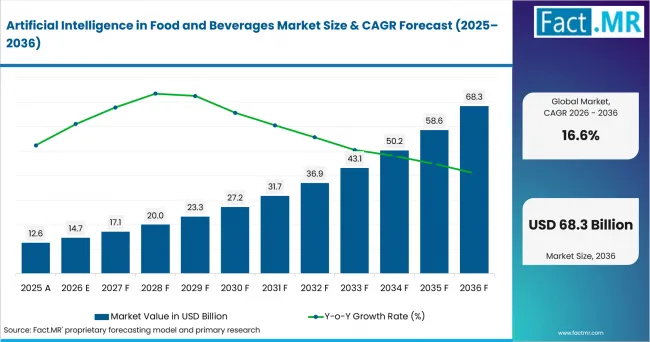
Artificial Intelligence In Food And Beverages Market Value Analysis | Source: Fact.MR
What are the defining numbers behind Artificial Intelligence in Food and Beverages Market growth?
USD 53.5 billion absolute opportunity by 2036.
- Demand Drivers in the Market
- Manufacturers benefit from stronger forecasting before committing volumes for products with a short shelf life.
- Quality teams can use inspection systems to identify visual defects and contamination signals at line speed.
- Supply-chain teams gain better control through earlier food logistics visibility before service levels decline.
- Key Segments Analyzed
- By AI Solution: Predictive Analytics Platforms are expected to hold 38% share in 2026 due to recurring demand for forecasting across perishable portfolios.
- By Food Industry Function: Production Optimization is projected to account for 36% share in 2026 as scheduling tools turn model outputs into plant decisions.
- By Application Area: Food Processing is anticipated to capture 40% share in 2026 because high-volume plants use AI across throughput and quality checks.
- By End User: Food & Beverage Manufacturers are estimated to represent 43% share in 2026 owing to control over production data and quality budgets.
- By AI Technology: Machine Learning is forecast to account for 39% share in 2026 as forecasting and anomaly detection fit recurring food operations.
- Analyst Opinion at Fact.MR
- Shambhu Nath Jha, Senior Consultant at Fact.MR, states, “The commercial test for AI in food and beverages is whether a model changes a measurable operating decision without creating a new control gap. Buyers expect forecasting systems to work with inventory rules and vision systems to work with rejection procedures. Generative tools must respect formulation and safety boundaries plus intellectual-property limits.”
- Strategic Implications
- Food and beverage manufacturers gain better results by selecting use cases with a clear decision owner and reliable operating data.
- Quality leaders can evaluate computer-vision systems at full line speed before reducing manual review.
- Supply-chain teams benefit from comparing forecasts with replenishment rules and shelf-life limits rather than relying on accuracy scores alone.
The USA leads at 17.8% CAGR through software depth. China follows at 17.2% as manufacturing data expands. Germany reaches 16.5%. Japan posts 15.9%. The UK records 15.3%. India reaches 14.8%. South Korea closes the range at 14.2%.
How does the Artificial Intelligence in Food and Beverages Market break down by segment?
Predictive Analytics Platforms are expected to lead AI Solution at 38% share in 2026. Production Optimization is projected to lead Food Industry Function at 36% share in 2026.
Which AI Solution dominates?
Predictive Analytics Platforms hold 38% share in 2026.
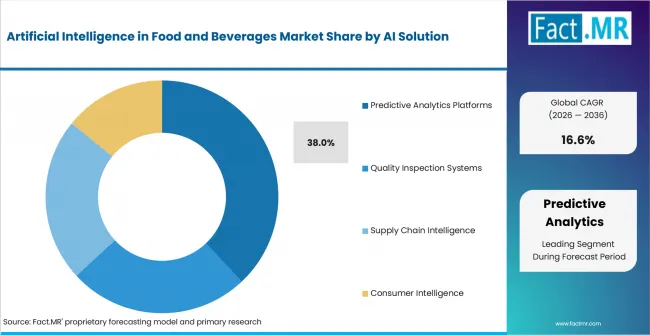
Artificial Intelligence In Food And Beverages Market Analysis By Ai Solution | Source: Fact.MR
Forecasting and inventory work give predictive platforms a clear budget route. Food teams use these tools to plan promotions and shelf-life risk. Quality Inspection Systems support food inspection devices on high-speed lines.
What leads the Food Industry Function segment?
Production Optimization accounts for 36% share in 2026.
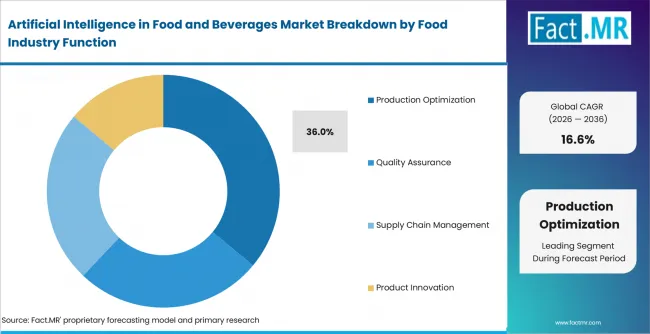
Artificial Intelligence In Food And Beverages Market Analysis By Food Industry Function | Source: Fact.MR
Production Optimization leads when plants need faster scheduling. Supervisors use AI outputs to plan changeovers and labor. Quality Assurance uses rapid food safety testing and model review without reducing accountability.
Which Application Area leads?
Food Processing leads with 40% share in 2026.
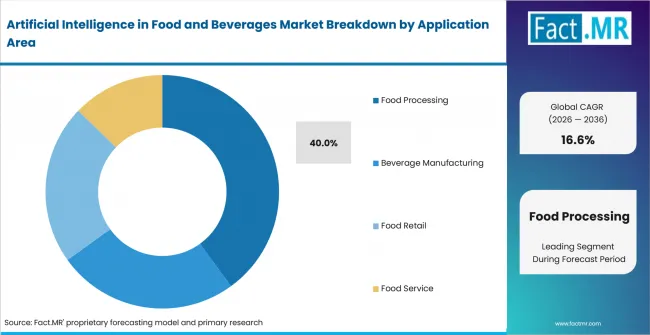
Artificial Intelligence In Food And Beverages Market Analysis By Application Area | Source: Fact.MR
Food Processing holds the lead because packaged-food plants create repeated data from batches and inspections. Beverage Manufacturing applies similar tools to non-alcoholic beverage lines. Both settings need stable fill and blend control. Sanitation control is a separate need.
Why do Food & Beverage Manufacturers lead End User demand?
Food & Beverage Manufacturers hold 43% share in 2026.
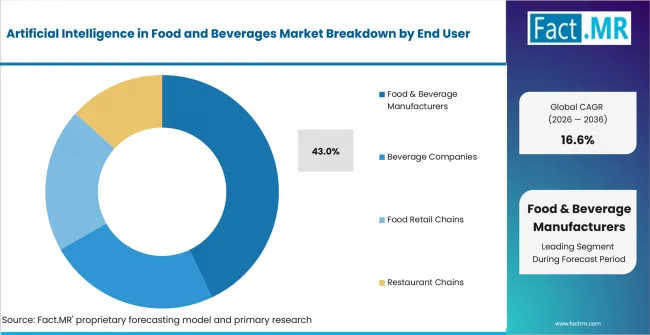
Artificial Intelligence In Food And Beverages Market Analysis By End User | Source: Fact.MR
Manufacturers own the process data and production assets needed for scale. Beverage companies and retail chains use AI to guide stock decisions. Restaurants use the same idea for menus and labor planning.
Which AI Technology leads?
Machine Learning accounts for 39% share in 2026.
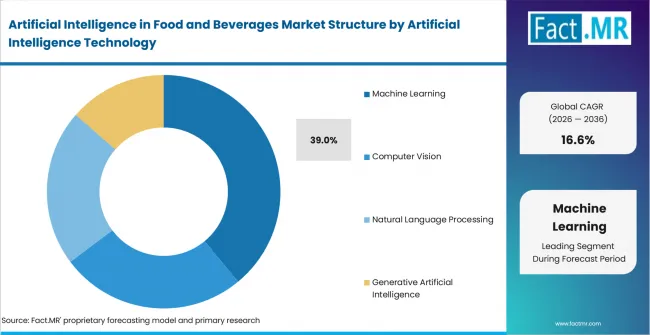
Artificial Intelligence In Food And Beverages Market Analysis By Artificial Intelligence Technology | Source: Fact.MR
Machine Learning fits recurring tasks such as forecasting and anomaly detection. Computer Vision reviews packages and line conditions. Natural Language Processing supports service work. Generative AI helps teams prepare content within food safety compliance rules.
What is accelerating Artificial Intelligence in Food and Beverages Market adoption, and what is holding it back?
Perishable-product planning and automated inspection support adoption. Fragmented data slows wider use when teams cannot prove how a model changes a decision.
Drivers Impact Analysis
| DRIVER | RELATIVE IMPACT | GEOGRAPHIC RELEVANCE | IMPACT TIMELINE |
|---|---|---|---|
| Predictive demand and inventory optimization for perishable portfolios | High | North America, China, and Europe | Short to medium term |
| AI vision for defect and contamination inspection | High | USA, Germany, Japan, and UK | Short to medium term |
| Connected supply-chain and cold-chain intelligence | High | China, India, and South Korea | Medium term |
| Production scheduling and process optimization | Medium-high | Global food and beverage manufacturers | Medium term |
| Consumer and recipe intelligence for faster product renovation | Medium | North America, Europe, and Japan | Medium to long term |
Source: Fact.MR analysis. Updated Aug 5, 2026
- Perishable planning: Forecasting has commercial value when it fits shelf-life rules and order lead times.
- Automated inspection: Computer vision is expected to add value when buyers define false-reject limits.
- Supply-chain visibility: AI is expected to guide action when forecasts work with food cold chain signals.
Opportunity Impact Analysis
| OPPORTUNITY | RELATIVE IMPACT | GEOGRAPHIC RELEVANCE | IMPACT TIMELINE |
|---|---|---|---|
| Edge computer vision integrated with production-line controls | High | USA, Germany, Japan, and South Korea | Short to medium term |
| Unified food data, traceability, and supplier intelligence platforms | High | China, India, UK, and Europe | Medium term |
| Generative AI for formulation knowledge and product content | Medium-high | North America and Europe | Medium term |
| AI for food-service ordering, personalization, and kitchen planning | Medium | Japan, UK, China, and urban India | Medium to long term |
Source: Fact.MR analysis. Updated Aug 5, 2026
- Line-side vision: Food handling robots are expected to attract demand in varied product plants. Faster setup reduces programming burden.
- Unified data platforms: Planning and quality teams need one view of orders and test records. A shared view turns model alerts into governed action.
- Recipe intelligence: Product teams are expected to use structured knowledge to compare ingredients and prepare healthy foods content.
Restraints Impact Analysis
| RESTRAINT | RELATIVE IMPACT | GEOGRAPHIC RELEVANCE | IMPACT TIMELINE |
|---|---|---|---|
| Fragmented, incomplete, or poorly labeled operational data | High | Global | Short to medium term |
| Validation and accountability for food-safety and quality decisions | High | USA, UK, European Union, and mature processors | Medium term |
| Integration with legacy equipment and enterprise systems | Medium-high | Established manufacturing bases | Medium term |
| Cybersecurity, intellectual-property, and model-governance exposure | Medium-high | Global enterprises | Medium to long term |
Source: Fact.MR analysis. Updated Aug 5, 2026
- Data readiness: Food and beverage operations often split information across plant equipment and enterprise tools.
- Validation and responsibility: A model supports contamination review or recipe work.
- Integration burden: Older equipment delays AI rollout when model outputs cannot enter work orders.
Which countries are scaling Artificial Intelligence in Food and Beverages Market fastest?
- The country comparison spans 3.6 percentage points across the forecast period.
- The USA remains 0.6 percentage point above China through software depth.
- China remains 0.7 percentage point above Germany as manufacturing data supports local AI use.
- Germany remains 0.6 percentage point above Japan through automation depth and quality systems.
- Japan remains 0.6 percentage point above the UK through quality-focused manufacturing and food-service automation.
- The UK remains 0.5 percentage point above India as traceability needs shape technology approval.
- India remains 0.6 percentage point above South Korea through food-processing growth.
Comparable CAGRs create different entry conditions due to software maturity and plant integration. Full report coverage includes North America and Europe. Asia Pacific completes the view with Central and South America plus the Middle East and Africa.
Country CAGR (2026-2036)
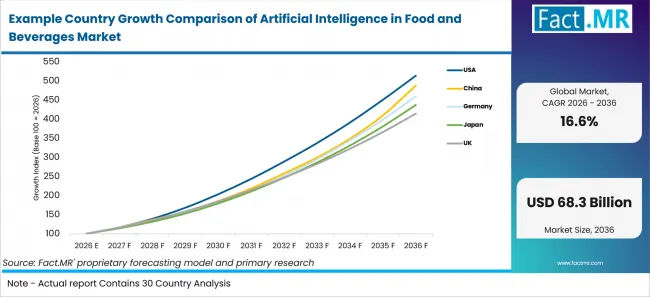
Example Country Growth Comparison Of Artificial Intelligence In Food And Beverages Market | Source: Fact.MR
| Country | CAGR (2026-2036) |
|---|---|
| USA | 17.8% |
| China | 17.2% |
| Germany | 16.5% |
| Japan | 15.9% |
| UK | 15.3% |
| India | 14.8% |
| South Korea | 14.2% |
Source: Fact.MR analysis. Updated Aug 5, 2026
What supports USA adoption?
17.8% CAGR, supported by software depth and formal digital traceability work.
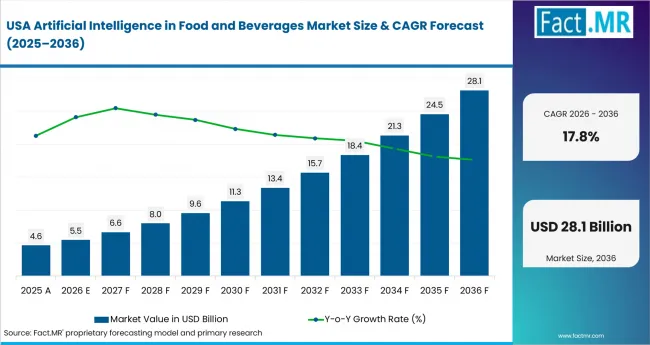
Artificial Intelligence In Food And Beverages Market Country Value Analysis | Source: Fact.MR
Large USA food manufacturers have the budgets for multi-site AI use. Their main need is a system that improves planning or quality review without weakening accountability.
How is China scaling demand?
17.2% CAGR, shaped by large manufacturing and retail data flows.
China has high-volume food production and fast channel movement. That makes AI useful when planners need better demand sensing across factories and e-commerce channels.
What is driving Germany’s growth from 2026 to 2036?
16.5% CAGR, backed by automation depth and quality systems.
Germany’s food companies are expected to value tools that work with factory controls. The buying case improves when AI supports quality checks.
How is Japan developing demand?
15.9% CAGR, attributable to labor pressure and food-service automation.
Japan’s growth path is expected to favor AI in quality review and kitchen planning. Buyers need systems that save time without new safety-review gaps.
How does the UK perform?
15.3% CAGR, supported by food-safety assurance and retailer traceability needs.
The UK is expected to favor evidence-based AI use. Retail and supplier checks make traceability and clear review records central to approval.
What supports India’s growth?
14.8% CAGR, driven by food-processing expansion and diverse regional demand.
India’s demand is expected to build around planning and logistics needs. AI tools are more useful when they help factories serve varied local markets with less waste.
How is South Korea progressing?
14.2% CAGR, supported by food-tech programs and automation capability.
South Korea is expected to use AI in retail intelligence and production planning. Its automation base gives providers a route into food robotics.
Who leads the Artificial Intelligence in Food and Beverages Market?
Microsoft Corporation and Google LLC – Google Cloud lead from the cloud and data-platform side. Amazon Web Services, Inc. adds analytics strength. IBM Corporation and NVIDIA Corporation add machine learning and accelerated computing depth.
SAP SE and Oracle Corporation bring AI closer to planning and supply-chain execution. Siemens AG and ABB Ltd. compete near plant controls. Rockwell Automation, Inc. and Honeywell International Inc. focus on site-level automation.
Which companies are the key providers?
Key companies include Microsoft Corporation, Google LLC – Google Cloud, Amazon Web Services, Inc., IBM Corporation, NVIDIA Corporation, SAP SE, Oracle Corporation, Siemens AG, ABB Ltd., Rockwell Automation, Inc., and Honeywell International Inc.
- Microsoft Corporation
- Google LLC – Google Cloud
- Amazon Web Services, Inc.
- IBM Corporation
- NVIDIA Corporation
- SAP SE
- Oracle Corporation
- Siemens AG
- ABB Ltd.
- Rockwell Automation, Inc.
- Honeywell International Inc.
Bibliography
- ABB. (2025, September 17). ABB and LandingAI unleash the power of generative AI for robotic vision. ABB.
- Microsoft. (2025, September 8). With Microsoft Fabric, Gay Lea Foods cuts reporting time from 24 days to under a day. Microsoft Customer Stories.
- Oracle. (2024, June 19). Introducing Smart Ops for Fusion SCM. The Fusion Insider.
- Siemens AG. (2025, June 4). AI-supported predictive maintenance: Siemens and Sachsenmilch are breaking new ground in the food and beverage industry. Siemens.
This Report Answers
- The report provides strategic intelligence on the Artificial Intelligence in Food and Beverages Market across AI Solution and Food Industry Function choices.
- Segment analysis covers Predictive Analytics Platforms and Production Optimization as the share leaders within the 2026 market.
- Country outlook evaluates the USA and China alongside Germany and Japan. The UK and India complete the growth comparison with South Korea.
- Competitive analysis profiles Microsoft Corporation and Google LLC – Google Cloud Amazon Web Services, Inc. is reviewed with IBM Corporation and NVIDIA Corporation.
- Technology assessment covers Machine Learning and Computer Vision. Natural Language Processing and Generative AI complete the technology view.
What does the Artificial Intelligence in Food and Beverages Market cover?
AI systems are used to improve defined food and beverage decisions. The market covers forecasting and quality review. It covers production planning and food-service workflows.
The market includes software and embedded tools used by food manufacturers and beverage companies. Retailers and restaurant chains are covered with hospitality groups. Commercial value depends on a clear AI function. The tool must predict or classify a defined workflow. Detection and recommendation are covered. Generation and automation follow the same rule.
What is included in the scope?
AI systems used to improve planning and production are included. Quality and supply-chain decisions are covered. Innovation and retail decisions are covered with food-service decisions when AI shapes the action.
The scope includes Predictive Analytics Platforms and Quality Inspection Systems. It covers Supply Chain Intelligence and Consumer Intelligence. Machine Learning and Computer Vision are included when they support a defined food or beverage workflow. Natural Language Processing and Generative AI follow the same use rule.
What is excluded from the scope?
General-purpose information technology is outside the scope when AI is not part of the purchased function.
The scope excludes standard cloud hosting and unrelated enterprise applications. It excludes sensors and cameras without an AI-enabled decision layer. Robots and controls follow the same rule.
How Was the Analysis Built?
The analysis draws on 120+ sources and 35+ company portfolios. It covers 25+ countries and more than 20 industry interviews.
- Primary Research: Primary research includes discussions with manufacturers and service providers. It covers technology developers and distributors. End users and procurement teams explain buying priorities. Subject-matter experts add the operational view. These conversations examine product adoption and approval requirements. Competitive positioning and wider market acceptance are reviewed.
- Desk Research: Desk research covers government statistics and regulatory publications. It reviews company filings and trade data. Technical studies and industry associations are included where relevant. Public policy is reviewed when it affects market context. Every source used in the analysis is documented in the bibliography.
- Market Sizing and Forecasting: Market estimates combine historical performance and demand indicators. Pricing and volume trends are reviewed with segment shares. Company participation and country-level growth are checked against investment activity. Adoption patterns are reviewed during validation.
- Data Validation and Update Cycle: Findings are validated by comparing primary interviews with public data. Company activity and regulatory changes are checked with trade patterns. Regular updates review new product launches and capacity changes. Partnerships and approvals are reviewed for commercial adoption shifts. Buying trends are checked during the same update cycle.
Segmentation
What is the report’s scope and coverage?
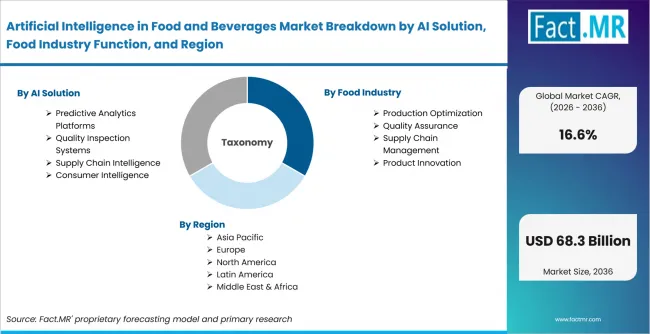
Artificial Intelligence In Food And Beverages Market Breakdown By Ai Solution, Food Industry Function, And Region | Source: Fact.MR
| Attribute | Details |
|---|---|
| Quantitative Units | USD billion in 2026 to USD billion by 2036 at CAGR |
| Market Definition | AI software, cloud services, analytics platforms, embedded systems, and integrated tools used to improve decisions across food and beverage production, quality, supply chains, retail, and food service |
| AI Solution | Predictive Analytics Platforms; Quality Inspection Systems; Supply Chain Intelligence; Consumer Intelligence |
| Food Industry Function | Production Optimization; Quality Assurance; Supply Chain Management; Product Innovation |
| Application Area | Food Processing; Beverage Manufacturing; Food Retail; Food Service |
| End User | Food & Beverage Manufacturers; Beverage Companies; Food Retail Chains; Restaurant Chains; Hospitality Groups; Cloud Kitchen Operators |
| AI Technology | Machine Learning; Computer Vision; Natural Language Processing; Generative AI |
| Regions Covered | North America; Europe; Asia Pacific; Central and South America; Middle East and Africa |
| Countries Covered | USA; China; Germany; Japan; UK; India; South Korea |
| Key Companies Profiled | Microsoft Corporation; Google LLC – Google Cloud; Amazon Web Services, Inc.; IBM Corporation; NVIDIA Corporation; SAP SE; Oracle Corporation; Siemens AG; ABB Ltd.; Rockwell Automation, Inc.; Honeywell International Inc. |
| Forecast Period | 2026 to 2036 |
| Approach | Hybrid top-down and bottom-up approach using manufacturing activity, AI adoption, software and automation spending, use-case attachment, country growth rates, and provider validation |
Source: Fact.MR analysis. Updated Aug 5, 2026
How is the Artificial Intelligence in Food and Beverages Market segmented?
-
By AI Solution
- Predictive Analytics Platforms
- Quality Inspection Systems
- Supply Chain Intelligence
- Consumer Intelligence
-
By Food Industry Function
- Production Optimization
- Quality Assurance
- Supply Chain Management
- Product Innovation
-
By Application Area
- Food Processing
- Beverage Manufacturing
- Food Retail
- Food Service
-
By End User
- Food & Beverage Manufacturers
- Beverage Companies
- Food Retail Chains
- Restaurant Chains and Hospitality Groups
- Cloud Kitchen Operators
-
By AI Technology
- Machine Learning
- Computer Vision
- Natural Language Processing
- Generative AI
-
By Region
- North America
- Latin America
- Western Europe
- Eastern Europe
- East Asia
- South Asia and Pacific
- Middle East & Africa
Frequently Asked Questions
How big is the Artificial Intelligence in Food and Beverages Market in 2026?
What is the CAGR of the Artificial Intelligence in Food and Beverages Market from 2026 to 2036?
Which AI solution leads the Artificial Intelligence in Food and Beverages Market?
Which end-user segment leads the Artificial Intelligence in Food and Beverages Market?
Who are the leading companies in the Artificial Intelligence in Food and Beverages Market?
Who worked on this report


Preview the report firsthand - request a free sample
Free SampleGet the brochure for pricing and purchase details
Download PDF