- Market Value (2025): USD 1858.6 Mn
- Estimated Value (2026): USD 2340.0 Mn
- Forecast Value (2036): USD 23413.9 Mn
- CAGR (2026-2036): 25.9%
What is the Artificial Intelligence Prompt Marketplace Market forecast to be worth by 2036?
USD 2,340.0 million in 2026 to USD 23,413.9 million by 2036, at 25.9% CAGR.
- The Artificial Intelligence Prompt Marketplace Market crossed a valuation of USD 1,858.6 million in 2025.
- Demand is projected to increase from USD 2,340.0 million in 2026 to USD 23,413.9 million by 2036.
- The market is forecast to record a 25.9% CAGR from 2026 to 2036, supported by enterprise teams and creators standardizing reusable AI instructions.
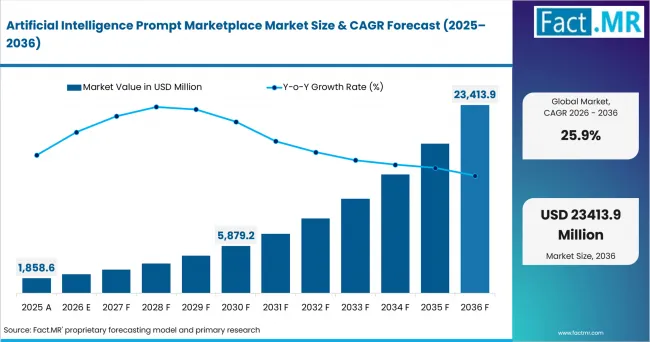
Artificial Intelligence Prompt Marketplace Market Market Value Analysis | Source: Fact.MR
What are the defining numbers behind Artificial Intelligence Prompt Marketplace Market growth?
USD 21,073.9 million absolute opportunity by 2036, led by Software, Cloud deployment and BFSI demand.
- Demand Drivers in the Market
- Enterprise operations teams need versioned prompt assets because model updates often change output behavior across repeatable business tasks.
- Prompt creators need transparent review and payout systems so tested assets remain commercially discoverable after community feeds become crowded.
- Compliance teams need approved prompt libraries while regulated users place stronger controls around data handling and instruction reuse.
- Application developers need API-ready templates owing to reusable prompts moving into automated workflows instead of isolated chat sessions.
- Key Segments Analyzed
- By Component: Software is projected to account for 36.4% share in 2026, driven by packaged prompt libraries and workflow controls.
- By Deployment: Cloud is estimated to capture 50.1% share in 2026, supported by browser access and multi-model catalog delivery.
- By Organization Size: The SME segment is anticipated to record 51.3% share in 2026, owing to low-friction access to reusable prompt assets.
- By Application: Workflow automation is forecast to capture 36.6% share in 2026, reinforced by reusable prompt execution and recurring agent workflow demand.
- By End Use: BFSI is expected to represent 32.0% share in 2026, shaped by governance needs and repeatable knowledge-work processes.
- Analyst Opinion at Fact.MR
- Shambhu Nath Jha, Senior Analyst at Fact.MR states, “Prompt marketplaces draw attention because a prompt loses commercial value quickly after model behavior changes. Adoption is expected to favor platforms that test prompts across versions and show enterprise accounts where each asset works. The stronger commercial offer combines version control with workflow integration and gives users a clearer route from purchase to repeat use.”
- Strategic Implications
- Marketplace operators should preserve model-version history and publish reproducibility checks before placing paid prompt assets into featured discovery feeds.
- Enterprise AI teams should maintain approved prompt catalogs that connect each reusable instruction to an owner and a defined workflow.
- Prompt creators should package variables and expected outputs clearly before selling assets across models that follow different instruction patterns.
- Compliance leaders should review data handling and licensing terms before purchased prompts enter customer-facing workflows or regulated decision processes.
Growing demand for reusable AI automation is driving prompt marketplaces to support agent-oriented tools and workflow-specific assets. For instance, PromptBase added an Agent Skills category in May 2026 alongside dedicated ChatGPT Skill and Claude Skill sections, while separate Cursor Skill and OpenClaw Skill categories broadened reusable agent listings. The expansion shifts prompt commerce beyond single-turn text products toward packaged operating logic that creators maintain across recurring agent workflows and changing model environments.
India is projected to record a 27.7% CAGR during the forecast period, supported by shared compute access and multilingual workflow demand. China is estimated to post a 27.0% CAGR by 2036, driven by broad generative AI adoption and expanding creator communities. Australia is anticipated to register a 25.7% CAGR over the assessment period, attributable to public-sector governance programs and enterprise productivity goals. The United Kingdom is forecast to expand at a 25.4% CAGR between 2026 and 2036, reinforced by rising business use of text-generation systems. The United States is expected to record a 25.2% CAGR across the forecast, shaped by enterprise adoption and platform depth for prompt creators.
How does the Artificial Intelligence Prompt Marketplace Market break down by segment?
Software is projected to account for 36.4% share; Cloud is estimated to capture 50.1% share.
Which Component category is projected to account for the primary share?
Software is anticipated to account for 36.4% share in 2026
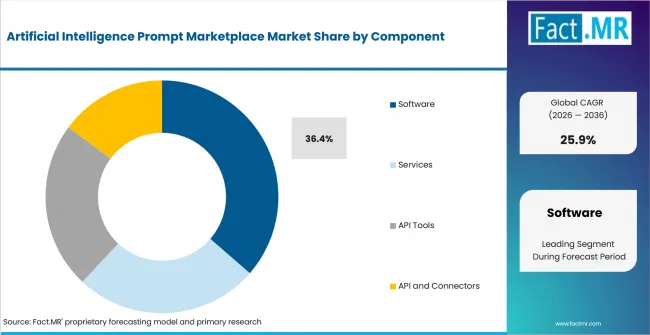
Artificial Intelligence Prompt Marketplace Market Analysis By Component | Source: Fact.MR
Software is estimated to represent 36.4% share in 2026 because marketplaces need search and validation inside the same commercial workflow. Services support prompt testing and enterprise catalog design for teams that need help moving experiments into governed reuse. API Tools support testing inside applications while API and Connectors move approved assets into managed workflows. For enterprise deployments, related context engineering services address grounding instructions in managed knowledge and controlled data sources. WIPO documented 54,000 generative AI inventions in July 2024 for the decade ending in 2023. That patent activity gives software vendors a broad base for model-specific prompt products and managed instruction libraries.
How does Deployment shape prompt marketplace demand?
Cloud is estimated to capture 50.1% share in 2026
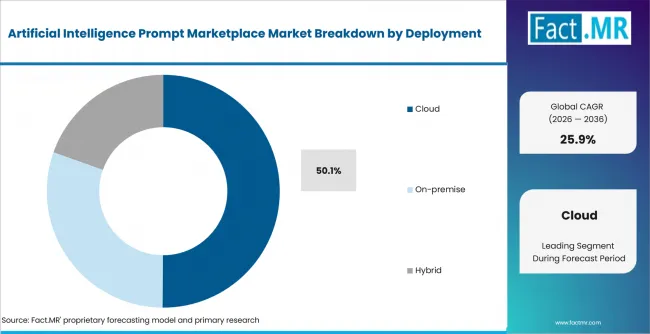
Artificial Intelligence Prompt Marketplace Market Analysis By Deployment | Source: Fact.MR
Cloud deployment is anticipated to capture 50.1% share in 2026 owing to immediate access across distributed creator and enterprise accounts. On-premises deployment serves teams that need tighter control over prompt libraries and sensitive workflow data. Hybrid deployment supports organizations that keep approved assets internally while using external models for selected tasks. In December 2025, Eurostat reported that 20.0% of EU enterprises used AI technologies during 2025. The wider enterprise user base expands the addressable audience for managed prompt access and shared catalogs.
What supports SME demand based on Organization Size?
SME segment is anticipated to record 51.3% share in 2026
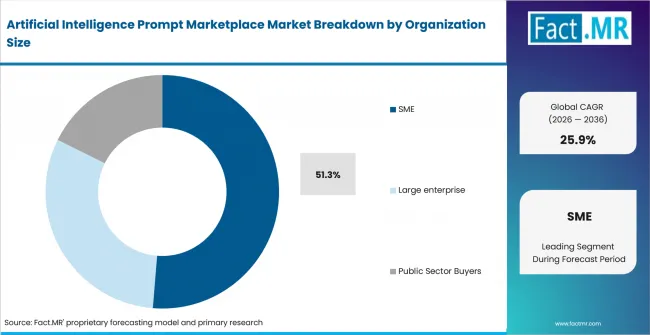
Artificial Intelligence Prompt Marketplace Market Analysis By Organization Size | Source: Fact.MR
The SME segment is forecast to hold 51.3% share in 2026 due to demand for reusable instructions that reduce experimentation time across small teams. Large enterprises require permissions and audit trails before prompt libraries move into shared operating environments across departments. Public-sector buyers place added weight on approved use cases and data-handling rules before staff reuse external instructions. In November 2025, OECD survey evidence found generative AI in use across 30.7% of surveyed SMEs. That adoption base supports packaged prompt products that reduce setup time and provide clearer workflow guidance.
Which application area is forecast to secure the leading share?
Workflow automation is forecast to capture 36.6% share in 2026.
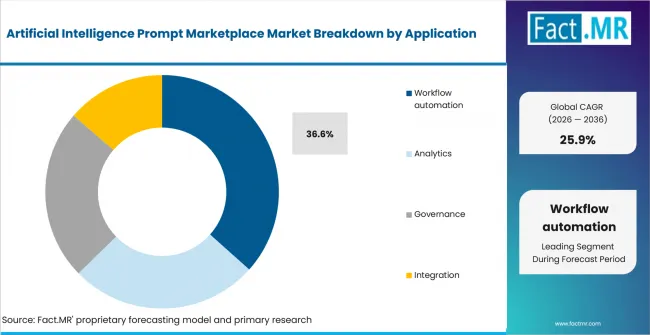
Artificial Intelligence Prompt Marketplace Market Analysis By Application | Source: Fact.MR
Workflow automation is forecast to capture 36.6% share in 2026, supported by reusable prompt execution and recurring agent workflow demand. Analytics follows as enterprise teams assess output quality and prompt performance across models. Governance tools support approved libraries and usage controls across regulated tasks. Integration systems connect prompt assets with internal applications and agent workflows. Eurostat reported in June 2026 that 31.05% of EU enterprises using AI applied it to business administration or management processes, strengthening demand for reusable prompt assets inside repeated office workflows. PromptBase added an Agent Skills category in May 2026 alongside dedicated ChatGPT Skill and Claude Skill sections.
How is BFSI positioned across End Use demand?
BFSI is expected to represent 32.0% share in 2026
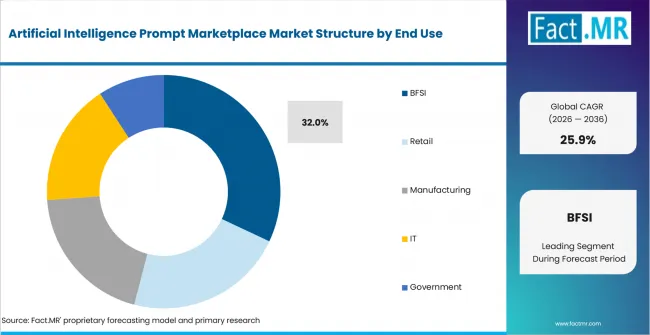
Artificial Intelligence Prompt Marketplace Market Analysis By End Use | Source: Fact.MR
BFSI is projected to account for 32.0% share in 2026 due to document-heavy workflows and tighter controls around reusable instructions. Retail teams use prompt packs for merchandising content and customer-service workflows that require consistent tone across repeated campaigns. Manufacturing users apply structured prompts to maintenance knowledge and operating documentation while IT teams need coding and support templates. In October 2025, the Bank of England reported that 75% of surveyed financial firms already used AI. That adoption depth creates room for governed prompt catalogs that standardize repeated work across regulated teams.
What is accelerating Artificial Intelligence Prompt Marketplace Market adoption, and what is holding it back?
Enterprise workflow standardization drives market growth; prompt commoditization restrains it.
Drivers Impact Analysis
| Driver | (~) % Impact on CAGR | Geographic Relevance | Impact Timeline |
|---|---|---|---|
| Enterprise AI use and workflow standardization | +4.2% | Global enterprise accounts | Medium term (2-4 years) |
| Creator monetization and reusable prompt products | +3.4% | North America and Asia Pacific | Medium term (2-4 years) |
| Multi-model prompt compatibility | +2.8% | Global cloud ecosystems | Short term (<= 2 years) |
| Governance and approved prompt libraries | +2.3% | Europe and regulated sector | Medium term (2-4 years) |
| Agent workflow expansion | +1.9% | India, China and United States | Long term (>= 4 years) |
Source: Fact.MR analysis. Updated Jul 9, 2026
- Enterprise AI use: Enterprise use creates demand for approved instructions that behave consistently across recurring tasks and user groups. In January 2026, OECD reported that 20.2% of firms used AI during 2025 across countries where data were available. Marketplace value is expected to shift toward tested assets that carry model notes and clear usage boundaries.
- Creator monetization: Prompt marketplaces give specialists a route to package reusable know-how for organizations that prefer tested assets over repeated trial work. In December 2025, Eurostat reported that 32.7% of people in the EU used generative AI tools during 2025. Commercial supply is projected to widen as creators organize prompts into repeatable workflows and model-specific products.
- Multi-model compatibility: Prompt behavior changes across model families and versions because instruction handling differs between systems. Compatibility tags and reproducibility tests reduce the risk that a purchased asset works only inside one narrow setup. Platform operators are anticipated to invest more effort in validation workflows that keep listings usable after model updates.
- Governance requirements: Enterprise accounts need approved wording and clearer ownership when prompts move into regulated or customer-facing tasks. NIST published its Generative AI Profile in July 2024 as a companion to the AI Risk Management Framework. Curated catalogs are estimated to gain relevance where governance teams need a defined record of reusable instructions and intended uses.
- Agent workflow expansion: Agent systems turn prompts into operating instructions that guide planning and tool use across multiple execution steps. In June 2026, Eurostat reported that 31.05% of EU enterprises using AI applied it to business administration or management processes. Marketplace demand is forecast to favor skill packages that document task boundaries and expected behavior before deployment.
Opportunity Impact Analysis
| Opportunity | (~) % Impact on CAGR | Geographic Relevance | Impact Timeline |
|---|---|---|---|
| Vertical prompt packs for regulated workflows | +2.6% | North America and Europe | Medium term (2-4 years) |
| Agent skills and orchestration templates | +2.3% | United States, China and India | Medium term (2-4 years) |
| Enterprise private prompt catalog | +1.8% | Europe and Australia | Medium term (2-4 years) |
| Localization and multilingual prompt products | +1.5% | India, China and Asia Pacific | Long term (>= 4 years) |
Source: Fact.MR analysis. Updated Jul 9, 2026
- Vertical prompt packs: Banks and other regulated organizations need prompt assets tied to specific tasks and review requirements. Broad instructions create extra testing work when compliance teams must document intended use before production approval. Vertical libraries are projected to gain commercial value where templates include variables and expected outputs for narrow workflows.
- Agent skills: Reusable agent skills extend the product boundary beyond a single input string and toward packaged instructions for repeated execution. Marketplaces are anticipated to create separate discovery paths for skills and prompt products because buyer needs differ. Creator revenue potential rises when a reusable package addresses a recurring workflow instead of one isolated output.
- Private prompt catalogs: Enterprise accounts increasingly need internal libraries that separate approved prompts from public experimentation. OECD reported in November 2025 that 39% of generative AI using SMEs with a skill gap said the technology helped compensate for it. Private catalogs are expected to support repeat use where teams need access control and internal workflow context.
- Localization: Multilingual prompt products create room for creators who understand local business language and task conventions. Generic English instructions often need adaptation before they fit regional customer service or document workflows. Demand is estimated to expand where marketplaces support language filters and local creator discovery across growing AI user bases.
Restraints Impact Analysis
| Restraint | (~) % Impact on CAGR | Geographic Relevance | Impact Timeline |
|---|---|---|---|
| Prompt commoditization and model-native generation | -2.4% | Global | Medium term (2-4 years) |
| Intellectual-property ownership and copying uncertainty | -1.8% | United States and Europe | Medium term (2-4 years) |
| Prompt injection and governance risk | -1.6% | BFSI and government buyers | Short term (<= 2 years) |
| Model drift and prompt obsolescence | -1.3% | Global multi-model ecosystems | Medium term (2-4 years) |
Source: Fact.MR analysis. Updated Jul 9, 2026
- Prompt commoditization: Models increasingly help users draft prompts inside the same interface that generates the final output. That capability reduces willingness to pay for simple instructions that lack testing or workflow context. Marketplaces are expected to face price pressure on generic listings while complex workflow products retain clearer differentiation.
- Intellectual-property uncertainty: Prompt sellers face copying risk because short instruction patterns are easy to reproduce and difficult to police across public platforms. The U.S. Copyright Office published Part 2 of its AI report in January 2025 on copyrightability of generative AI outputs. Commercial adoption is anticipated to remain selective where buyers cannot verify licensing terms or creator ownership claims.
- Prompt injection risk: Reusable instructions sometimes carry hidden or unsafe behavior when copied into agent workflows without review. NIST identified indirect prompt injection among the security risks considered in its January 2026 request for information on AI agents. Regulated buyers are forecast to require stronger testing and approval controls before marketplace prompts reach production systems.
- Model drift: A prompt that performs well today often weakens after model updates change instruction handling or safety behavior. Version changes create maintenance costs for creators and increase refund risk for marketplace operators serving paid users. Paid listings are estimated to retain value longer when providers retest assets and publish compatibility notes after material model releases.
Which countries are scaling Artificial Intelligence Prompt Marketplace Market fastest?
India 27.7%; China 27.0%; Australia 25.7%; United Kingdom 25.4%; United States 25.2%; Germany 24.9%; Japan 24.6%.
Artificial Intelligence Prompt Marketplace Market is segmented into North America and Europe alongside Asia Pacific and Latin America, with Middle East & Africa completing regional coverage.
| Country | CAGR |
|---|---|
| India | 27.7% |
| China | 27.0% |
| Australia | 25.7% |
| United Kingdom | 25.4% |
| United States | 25.2% |
| Germany | 24.9% |
| Japan | 24.6% |
Source: Fact.MR analysis. Updated Jul 9, 2026
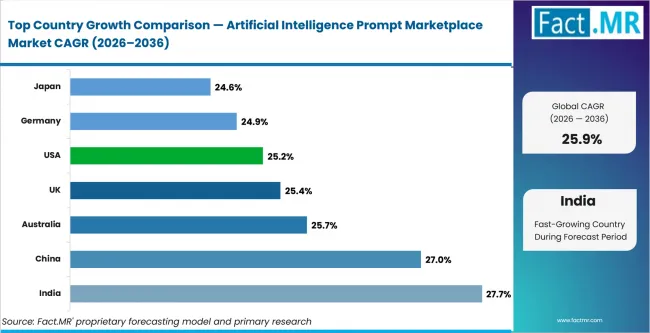
Artificial Intelligence Prompt Marketplace Market Cagr Analysis By Country | Source: Fact.MR
Why is India emerging as a major prompt marketplace growth center?
27.7% CAGR, supported by shared compute access and multilingual prompt demand.
India’s prompt marketplace is gaining depth because affordable compute access allows more developers and creators to test reusable prompt assets. In January 2025, IndiaAI announced the availability of more than 18,000 affordable AI compute units for eligible ecosystem participants. The market is projected to record a 27.7% CAGR during the forecast period as lower infrastructure barriers encourage experimentation. Multilingual workflows strengthen the commercial case for marketplaces serving regional teams beyond standard English-language prompt collections.
How does China's user scale accelerate prompt marketplace demand?
27.0% CAGR, driven by a broad generative AI user base and extensive domestic model availability.
A large installed base of generative AI users gives Chinese marketplaces substantial scope for prompt discovery and repeated instruction reuse. In February 2026, the State Council reported a 42.8% nationwide generative AI adoption rate for December 2025. Demand is estimated to post a 27.0% CAGR by 2036 owing to broader participation in model-based content and workflow creation. Marketplace operators gain channel strength when discovery systems and creator tools align closely with domestic model ecosystems.
Where are governed workflows creating prompt marketplace opportunities in Australia?
25.7% CAGR, attributable to public-sector governance and structured productivity programs.
Governed public-service adoption is creating a practical environment for curated prompt libraries with repeatable controls and defined usage boundaries. In November 2025, the Australian Government published the APS AI Plan 2025 to support responsible AI adoption across public services. Productivity Commission analysis estimated that broader AI adoption could contribute about 4.3% labour productivity growth over the next decade. The market is anticipated to record a 25.7% CAGR over the assessment period as structured prompt assets support repeatable workflows. Enterprise opportunities improve where curated libraries combine approved instructions with access controls and clear review responsibilities.
Why is business adoption widening the United Kingdom opportunity?
25.4% CAGR, reinforced by rising business AI use and shared workflow requirements.
As AI usage spreads through British businesses, shared prompt assets are gaining relevance for teams seeking more consistent outputs. In July 2026, the Office for National Statistics reported that 29% of UK businesses used at least one AI technology during June 2026. Prompt marketplace demand is forecast to record a 25.4% CAGR between 2026 and 2036 due to wider operational use. Procurement teams are likely to favor assets that demonstrate repeatable performance while supporting clear handling rules across shared environments.
What gives the United States an enterprise-scale advantage?
25.2% CAGR, shaped by enterprise adoption and deep creator-platform participation.
Enterprise adoption depth gives the United States a strong foundation for prompt catalogs designed around departmental and organization-wide workflows. In May 2026, the U.S. Census Bureau reported overall business AI usage ranging between 17% and 20% from December 2025 through early May 2026. The market is expected to post a 25.2% CAGR across the forecast as organizations formalize reusable prompt resources. Marketplace vendors can expand account value by connecting creator discovery with approval controls and shared enterprise workflow requirements.
Who leads the Artificial Intelligence Prompt Marketplace Market?
PromptBase is estimated to hold 7.9% share, while OpenAI (GPT Store) and Hugging Face broaden prompt and tool discovery.
PromptBase is positioned strongly through direct prompt commerce, subscription access, creator tools, and reusable skill categories and remains the clearest direct prompt-commerce provider in the company set. In February 2026, PromptBase introduced Select for creators as a subscription access path alongside individual marketplace purchases. OpenAI supports creator discovery through the GPT Store, where users can browse custom GPTs built around reusable instructions and tools. Anthropic contributes prompt-generation tools and reusable templates through the Claude Console for teams building repeatable model workflows.
Hugging Face provides hub infrastructure where prompt-focused Spaces and related model resources are shared across open model communities. PromptHero focuses on searchable prompt discovery across image and video models, while Snack Prompt combines community prompts with workflow and automation listings. Competition during the forecast period is expected to depend on version maintenance and validation depth across provider ecosystems. AI agent audit and assurance services create an adjacent testing need when reusable instructions enter autonomous workflows.
Which companies are the key providers?
- PromptBase
- OpenAI (GPT Store)
- Anthropic
- Hugging Face
- PromptHero
- Snack Prompt
Bibliography
- Anthropic. (2026). Prompt engineering overview. Claude Platform Docs.
- Australian Government Digital Transformation Agency. (2025, November 12). AI Plan for the Australian Public Service 2025. Australian Government.
- Bank of England. (2025, October 15). The Bank of England’s approach to innovation in artificial intelligence, distributed ledger technology, and quantum computing. Bank of England.
- Eurostat. (2025, December 11). 20% of EU enterprises use AI technologies. European Commission.
- Eurostat. (2025, December 16). 32.7% of EU people used generative AI tools in 2025. European Commission.
- Eurostat. (2026, June). Use of artificial intelligence in enterprises. European Commission.
- Hugging Face. (2026). Spaces. Hugging Face Docs.
- IndiaAI. (2025, January 31). Union Minister of Electronics & IT, Railways, and I&B announces the availability of 18,000+ affordable AI compute units. IndiaAI.
- National Institute of Standards and Technology. (2024, July 26). Artificial Intelligence Risk Management Framework: Generative Artificial Intelligence Profile. U.S. Department of Commerce.
- National Institute of Standards and Technology. (2026, January 12). CAISI issues request for information about securing AI agent systems. U.S. Department of Commerce.
- Office for National Statistics. (2026, July 2). Business insights and impact on the UK economy: 2 July 2026. Office for National Statistics.
- OpenAI. (2024, January 10). Introducing the GPT Store. OpenAI.
- OpenAI. (2026). GPTs in ChatGPT. OpenAI Help Center.
- Organisation for Economic Co-operation and Development. (2025, November 5). Generative AI and the SME Workforce: New Survey Evidence. OECD Publishing.
- Organisation for Economic Co-operation and Development. (2026, January 28). AI use by individuals surges across the OECD as adoption by firms continues to expand. OECD.
- PromptBase. (2026, February 12). Introducing PromptBase Select for Creators. PromptBase.
- PromptBase. (2026). AI Prompts | PromptBase: The #1 Marketplace for AI Prompts. PromptBase.
- PromptHero. (2026). Search prompts for AI image and video generation. PromptHero.
- Productivity Commission. (2025, December 10). Harnessing data and digital technology: Inquiry report. Australian Government.
- Snack Prompt. (2026). Snack Prompt — The AI Prompt Marketplace. Snack Prompt.
- Snack Prompt. (2026, January 7). Terms of Service. Snack Prompt.
- State Council of the People’s Republic of China. (2026, February 5). China’s internet user base hits 1.125 billion as AI adoption surges. State Council of the People’s Republic of China.
- U.S. Census Bureau. (2026, May 26). Large firms with at least 20 employees biggest AI users. U.S. Census Bureau.
- U.S. Copyright Office. (2025, January 29). Copyright and Artificial Intelligence, Part 2: Copyrightability. Library of Congress.
- World Intellectual Property Organization. (2024, July 3). China-based inventors filing most GenAI patents, WIPO data shows. WIPO.
This Report Addresses
- The report provides strategic intelligence on Component and Deployment choices that shape prompt commerce platform design and enterprise access.
- Regional outlook evaluates India and China alongside Australia while the United Kingdom and United States complete the country comparison.
- Competitive analysis profiles PromptBase and OpenAI (GPT Store) alongside Anthropic and Hugging Face while PromptHero and Snack Prompt complete the provider set.
- Component assessment covers Software and Services while API Tools address testing access and the API and Connectors category explains embedded instruction delivery into applications.
- Application assessment covers Workflow Automation and Analytics while Governance and Integration capture controlled reuse and embedded execution needs.
- End-use analysis compares BFSI and Retail alongside Manufacturing while IT and Government explain different workflow and governance requirements.
What does the Artificial Intelligence Prompt Marketplace Market cover?
Software and Services support prompt commerce across catalog and service workflows while API Tools provide testing access for application teams. The API and Connectors category distributes reusable instructions into applications where repeat execution requires stable interfaces.
The Artificial Intelligence Prompt Marketplace Market covers commercial platforms and managed libraries that distribute reusable prompts or agent instructions. Coverage includes software catalogs and service-led prompt design while API Tools provide testing access for teams integrating reusable assets. The API and Connectors category supports workflow delivery when prompts move from catalogs into repeatable application tasks.
The market differs from the broader generative AI software category because value must come from prompt distribution or prompt management. General model subscriptions and standalone AI applications remain outside the boundary unless prompt commerce or catalog management is a defined paid function.
What is included in the scope?
Prompt marketplace systems used in creator commerce and enterprise catalogs alongside workflow automation and governed AI reuse.
Scope includes cloud and on-premises prompt catalogs alongside hybrid deployments that connect internal libraries to external models. Component coverage includes software platforms and services while API Tools provide testing access for teams integrating reusable assets. The API and Connectors category supports embedded reuse when prompts move from catalogs into recurring application tasks. Organization analysis covers SME and large enterprise accounts alongside Public Sector Buyers that need different access and review controls. Application coverage includes workflow automation and analytics while governance and integration capture controlled reuse across connected systems. End-use analysis covers BFSI and retail alongside manufacturing workflows that require repeatable task instructions across operating teams. IT and government buyers are included because coding support and policy-controlled access create distinct prompt management requirements.
What is excluded from the scope?
General AI model subscriptions and standalone content-generation applications are outside the scope.
The scope excludes general-purpose model subscriptions that do not provide a prompt marketplace or managed prompt catalog. Standalone image and text applications are also excluded unless reusable prompt commerce forms a defined product function. Consulting projects without a repeatable prompt asset or catalog component remain outside the market boundary.
How was the analysis built?
130+ sources, 45+ company portfolios, 30+ countries, 25+ interviews.
- Primary Research
- Primary research includes interviews with prompt marketplace operators, AI platform providers, generative AI application developers and enterprise AI adoption leaders. It also includes input from prompt engineers, developer community managers, AI consultants and procurement teams involved in sourcing, publishing and commercializing reusable AI prompts.
- Desk Research
- Desk research reviews artificial intelligence adoption statistics, developer ecosystem reports, prompt marketplace platforms, provider product portfolios and company announcements. Platform documentation, pricing structures, creator programs, API ecosystem developments and generative AI industry publications are also assessed to evaluate market trends and competitive positioning.
- Market-Sizing and Forecasting
- Forecasting uses generative AI adoption trends, prompt marketplace participation, creator monetization activity, enterprise AI deployment, subscription spending patterns and marketplace transaction volumes across major regions. Models consider growth in large language model usage, developer engagement, prompt library expansion and demand for AI workflow optimization tools.
- Data Validation and Update Cycle
- Forecasts are validated through provider checks and industry interviews that test assumptions on marketplace adoption, prompt commercialization and enterprise usage trends. Portfolio mapping, platform activity assessment and stakeholder feedback help confirm market direction, while ongoing reviews of product launches, pricing developments and AI ecosystem investments support forecast updates.
Segmentation
What is the report’s scope and coverage?
| Attribute | Details |
|---|---|
| Quantitative Units | USD Million |
| Market Definition | Commercial platforms and libraries that distribute, sell, license, or manage reusable AI prompts and agent instructions for individual or organizational workflows. |
| Component | Software; Services; API Tools; API and Connectors |
| Deployment | Cloud; On-premises; Hybrid |
| Organization Size | SME; Large enterprise; Public Sector Buyers |
| Application | Workflow Automation; Analytics; Governance; Integration |
| End Use | BFSI; Retail; Manufacturing; IT; Government |
| Regions Covered | North America; Europe; Asia Pacific; Latin America; Middle East & Africa |
| Countries Covered | United States; Canada; United Kingdom; Germany; France; Italy; Spain; India; China; Japan; South Korea; Australia; Brazil; Mexico; Argentina; Chile; UAE; Saudi Arabia; South Africa |
| Key Companies Profiled | PromptBase; OpenAI (GPT Store); Anthropic; Hugging Face; PromptHero; Snack Prompt |
| Forecast Period | 2026 to 2036 |
| Approach | Hybrid top-down and bottom-up approach using creator listings; marketplace transactions; subscription catalog adoption; workflow attachment rates; enterprise AI uptake; creator supply; model coverage; governance checks and provider validation |
Source: Fact.MR analysis. Updated Jul 9, 2026
How is the market segmented?
-
By Component
- Software
- Services
- API Tools
- API and Connectors
-
By Deployment
- Cloud
- On-premises
- Hybrid
-
By Organization Size
- SME
- Large enterprise
- Public Sector Buyers
-
By Application
- Workflow Automation
- Analytics
- Governance
- Integration
-
By End Use
- BFSI
- Retail
- Manufacturing
- IT
- Government
-
By Region
- North America
- United States
- Canada
- Europe
- United Kingdom
- Germany
- France
- Italy
- Spain
- Asia Pacific
- India
- China
- Japan
- South Korea
- Australia
- Latin America
- Brazil
- Mexico
- Argentina
- Chile
- Middle East & Africa
- UAE
- Saudi Arabia
- South Africa
- North America
Frequently Asked Questions
Which component category leads in 2026?
How is cloud positioned across deployment in 2026?
What share is Workflow Automation expected to represent?
What supports BFSI across the end-use split?
How quickly is India expected to expand?
What is shaping China’s projected pace?
How is Australia expected to perform?
What supports the United Kingdom outlook?
Which factor supports United States expansion?
What is the primary adoption driver?
Which restraint has the clearest commercial effect?
Who worked on this report


Preview the report firsthand - request a free sample
Free SampleGet the brochure for pricing and purchase details
Download PDF