Auto Chemistry Analyzer Market Size, Share, Growth and Forecast (2026 - 2036)
The global Auto Chemistry Analyzer market is segmented by Product Type, by Throughput, by End User, by Application, by Technology, and by Region. Forecast for 2026 to 2036.
Auto Chemistry Analyzer Market Overview, Growth Outlook, and Forecast by Fact.MR
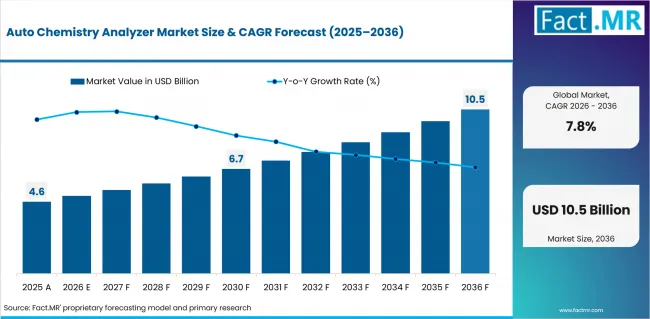
- In 2025, The Global Auto Chemistry Analyzer market was valued at approximately USD 4.6 billion.
- Based on Fact.MR analysis, demand for Auto Chemistry Analyzer is estimated to grow to around USD 5.0 billion in 2026 and USD 10.5 billion by 2036.
- The market is projected to expand at a CAGR of 7.8% during the forecast period.
Summary of Auto Chemistry Analyzer Market
- Market Snapshot
- In 2025, the global auto chemistry analyzer market was valued at approximately USD 4.6 billion.
- The market is estimated to reach around USD 5.0 billion in 2026 and is projected to attain nearly USD 10.5 billion by 2036.
- The auto chemistry analyzer market is expected to expand at a CAGR of 7.8% during the forecast period.
- The market is anticipated to create an absolute dollar opportunity of approximately USD 5.5 billion between 2026 and 2036.
- In terms of product type, Fully Automated Chemistry Analyzer holds the largest share of approximately 76.80% in 2026, driven by increasing demand for routine clinical chemistry and the adoption of random access analyzers.
- Based on technology, Random Access Analyzers represents approximately 52.60% share in 2026, driven by their high throughput capabilities, flexibility for STAT and routine testing, and integration with laboratory information systems in hospital and diagnostic lab settings
- Demand and Growth Drivers
- An increase in chronic diseases leads to more facilities using automated machines that analyze chemical components in test samples.
- Hospital expenditures are growing along with the volume of tests performed prompting more medical facilities and laboratories to buy high volume automated devices for chemical analysis.
- More and more laboratories are switching from manual methods to automated systems for testing chemicals, which is increasing the need for automated analytical systems because of the faster processes/delivery of results.
- Product and Segment View
- Medium Throughput holds a 43.80% share, driven by its suitability for mid-sized hospitals and diagnostic laboratories requiring balanced sample processing volumes, offering cost-effective automation without the complexity of high-throughput systems, along with growing demand for routine clinical chemistry and electrolyte analysis in emerging markets.
- Hospitals account for a 42.80% share, supported by the increasing volume of routine and specialty diagnostic tests, the need for rapid turn around times in emergency and inpatient settings, and the rising adoption of fully automated random access analyzers for streamlined laboratory workflows.
- Routine Clinical Chemistry represents a 48.70% share, owing to its essential role in diagnosing and monitoring chronic diseases such as diabetes, and cardiovascular conditions, enabling high-volume testing of glucose, and lipids, while driving the demand for integrated chemistry systems with robust throughput capabilities.
- Integrated Chemistry Systems hold a 29.80% share, driven by their ability to combine clinical chemistry and immunoassay testing on a single platform, reducing sample handling and turnaround time, offering operational efficiency for hospital and diagnostic laboratories, along with the growing trend toward laboratory consolidation and workflow automation.
- Geography and Competitive Outlook
- North America stands at the top of global auto chemistry analyzer market with the presence of advanced healthcare facilities, large volume of diagnostic tests performed and extensive automation in laboratories. Growing investments in healthcare laboratories and growing demand for high throughput systems will drive market demand throughout the region.
- European auto chemistry analyzer market will rank second in terms of revenue generation from the global auto chemistry analyzer market with growing number of automated laboratories and growing need for accurate diagnostic tests. Favorable healthcare reimbursement system, aging population and presence of key market players in the region will also contribute towards market growth.
- Favorable healthcare infrastructure, growing healthcare spending, rising prevalence of chronic diseases and awareness about preventive diagnostics will make Asia Pacific one of the fastest growing markets.
- Analyst Opinion
- Shambhu Nath Jha, Principal Consultant at Fact.MR, says, “Market growth in the global Auto Chemistry Analyzer market can be attributed to the focus on laboratory automation, accurate diagnostics, and timely results being made by the health care providers across the world. The increasing prevalence of chronic diseases, increase in number of testings, and emphasis on preventive health care are leading to the adoption of automated chemistry analyzers in laboratories and hospitals. Additionally, technological innovations such as integration of chemistry and immunoassays, random access capability, and lab informatics are aiding market growth."
Auto Chemistry Analyzer Market - At a Glance
| Metric | Value |
|---|---|
| Market Value 2025 | USD 4.6 billion |
| Market Value 2026 | USD 5.0 billion |
| Market Value 2036 | USD 10.5 billion |
| Absolute Dollar Opportunity | USD 5.5 billion |
| CAGR | 7.80% |
| Growth Multiple | 2.1x |
| Key Demand Theme | Increasing demand for routine clinical chemistry testing in hospitals and diagnostic laboratories, rising adoption of fully automated random access analyzers for high-throughput and STAT testing. |
| Leading Product Type | Fully Automated Chemistry Analyzer |
| Product Type Share | 76.80% |
| Leading Throughput | Medium Throughput |
| Throughput Share | 43.80% |
| Leading End User | Hospitals |
| End User Share | 42.80% |
| Leading Application | Routine Clinical Chemistry |
| Application Share | 48.70% |
| Leading Technology | Random Access Analyzers |
| Technology Share | 52.60% |
| Key Growth Regions | North America, Europe, Asia Pacific |
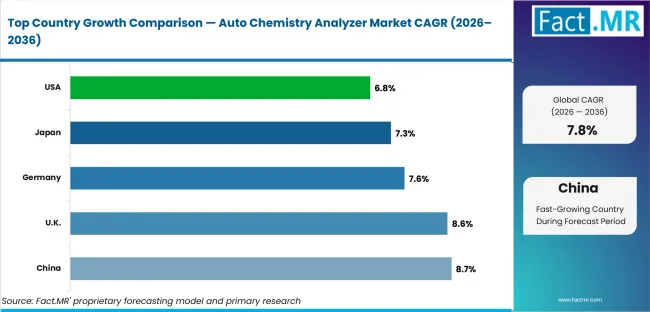
| Fastest Growing Countries | China (8.7%), U.K. (8.6%), Germany (7.6%), Japan (7.3%), U.S. (6.8%) |
| Key Companies | Genrui Biotech Inc., Roche Diagnostics, Abbott Laboratories, Labtron, Beckman Coulter, Sysmex |
| Product Type Segmentation | Fully Automated Chemistry Analyzer, Semi-Automated Chemistry Analyzer |
| Throughput Segmentation | Low Throughput, Medium Throughput, High Throughput |
| End User Segmentation | Hospitals, Diagnostic Laboratories, Pharmaceutical & Biotechnology Companies, Others |
| Application Segmentation | Routine Clinical Chemistry, Electrolyte Analysis, Therapeutic Drug Monitoring, Drug of Abuse Testing, Specialty Chemistry Testing, Other Clinical Applications |
| Technology Segmentation | Random Access Analyzers, Discrete Analyzers, Integrated Chemistry Systems |
| Regions | North America, Latin America, Europe, Middle East & Africa, Asia Pacific |
Key Growth Drivers, Constraints, and Opportunities
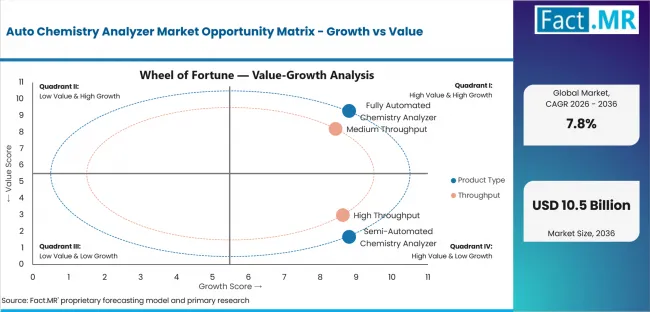
Key Factors Driving Growth
- As more people have chronic health conditions like diabetes, cardiovascular disease, kidney disease, and liver disease, the need for routine clinical chemistry testing will continue to grow and become commonplace. Consequently, automated chemistry analyzers are now being adopted globally in both diagnostic labs and hospitals.
- Increased levels of healthcare spending, the expanding level of healthcare diagnostics infrastructure will drive greater testing volumes globally. Providers are using automated analyzers because they offer enhanced efficiency, accuracy, and turnaround times.
- The continued transition to automation in laboratories is contributing to the growth of this market. Automation allows laboratories that conduct High Volume testing to significantly decrease the amount of manual intervention, reduce human error and streamline throughput.
|
Growth Driver |
Demand Impact |
Time Horizon |
Key Impact Area |
Fact.MR Insight |
|
Rising prevalence of chronic diseases such as diabetes, cardiovascular disorders, and kidney diseases |
High |
Short–Mid Term |
Diagnostic testing demand |
The increasing burden of chronic diseases is driving the need for routine clinical chemistry testing, resulting in higher adoption of automated chemistry analyzers across healthcare facilities. |
|
Growing adoption of laboratory automation and workflow optimization |
High |
Short–Mid Term |
Operational efficiency |
Hospitals and diagnostic laboratories are increasingly investing in automated analyzers to reduce manual errors, improve productivity, and enhance testing throughput. |
|
Technological advancements in analyzer platforms and integrated systems |
High |
Mid Term |
Technology advancement |
Innovations such as random-access testing, integrated chemistry-immunoassay systems, and LIS connectivity are improving analyzer performance and expanding market adoption. |
|
Expansion of diagnostic laboratory networks and reference laboratories |
High |
Mid–Long Term |
Market expansion |
The rapid growth of independent diagnostic chains and centralized laboratory facilities is increasing demand for high-throughput auto chemistry analyzers. |
|
Rising healthcare expenditure and healthcare infrastructure development |
Medium–High |
Mid–Long Term |
Healthcare investment |
Investments in hospital modernization, laboratory automation, and diagnostic capabilities are supporting market growth, particularly in emerging economies. |
Key Market Constraints
- A large-scale investment must be made to embed, construct and repair advanced automated chemistry analyzers, limiting their use to larger hospital systems, independent laboratories, and health care systems located in areas that are limited in available funds.
- In addition to the investment made for these advanced automated analyzers, the ongoing costs associated with regular maintenance and calibration costs, maintenance and calibration of the software programs, maintaining or installing quality control procedures create overhead expenses to the end users.
- The inavailability of qualified laboratory technologists and technicians will limit the ability of these analyzed systems to be fully utilized, especially in health care systems located in developing health care markets.
Key Opportunity Areas
- As the need for diagnostic testing is rapidly increasing around the globe due to the rise in chronic illnesses and preventative health care programs, there is an opportunity for increased use of advanced auto chemical analysis machines in hospitals and laboratory settings.
- Many developing nations such as those in South America, India, China, and Southeast Asia continue to rapidly develop their health care systems which create incredible opportunities for manufacturers to increase their existing customer base and better penetrate the market.
- Growing trends toward automation in laboratories and the use of digital health solutions create significant demand for automated, high throughput analyzers that can facilitate improved work flow efficiencies and reduce operating expenses.
Segment-wise Analysis of the Auto Chemistry Analyzer Market
- Fully Automated Chemistry Analyzer holds a 76.80% share in the product type segment, driven by its ability to handle high sample volumes with minimal manual intervention, reducing turnaround time and human error. It is the preferred choice for hospitals and diagnostic laboratories requiring consistent, walk-away automation for routine and STAT testing.
- Medium Throughput holds a 43.80% share in the throughput segment, supported by its ideal balance between processing capacity and operational cost for mid‑sized laboratories. It meets the daily workload of most hospital and diagnostic lab settings without the complexity or capital expense of high‑throughput systems.
- Hospitals account for a 42.80% share in the end‑user segment, driven by the high volume of inpatient and outpatient clinical chemistry tests, including emergency and critical care STAT requests. The need for rapid, reliable results from fully automated analyzers makes hospitals the largest end‑user category.
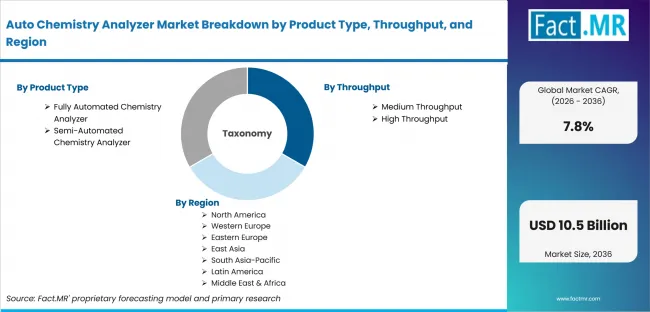
The global Auto Chemistry Analyzer market is segmented by product type, throughput, end user, application, and technology.
Which Product Type Segment Dominates the Market?
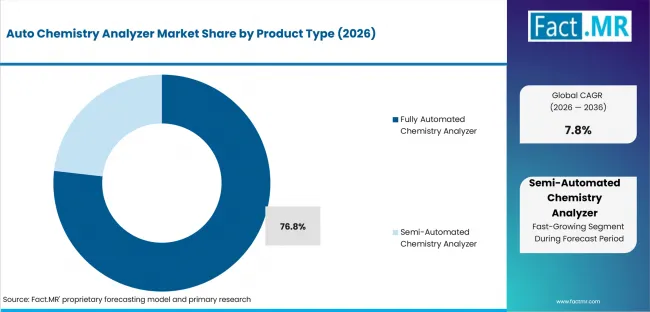
The fully automated chemistry analyzer holds the pole position with an enormous market share of 76.80%. It is expected in the future years that fully automated chemistry analyzers will also hold market dominance due to their higher efficiency and reduced human efforts required in their use for routine clinical chemistry analyses.
Which Technology Type Segment Dominates the Market?
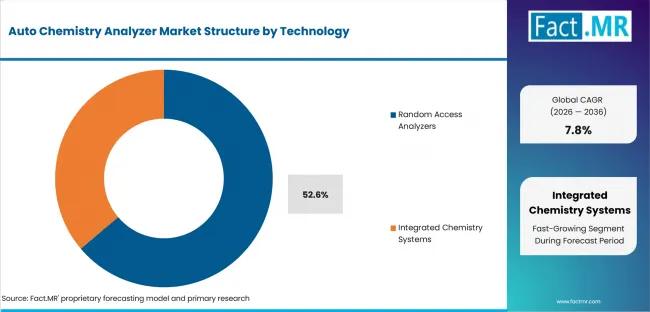
The Random Access Analyzers have captured more than 52.60% of market share, and this trend is expected to prevail in the future. Due to their flexibility in addition to the availability of on-demand STAT testing and multiparameter testing at once without batching, these instruments are quite suitable for use in hospital laboratories in order to carry out general clinical chemistry, electrolyte testing, and specialty chemistry testing.
Which Application Segment Dominates the Market?
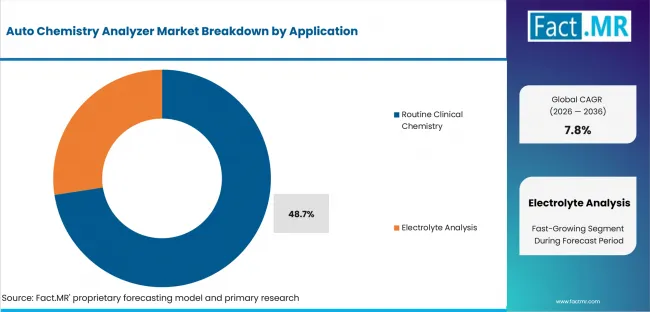
The segment Routine Clinical Chemistry has supremacy because it controls more than 48.70% of the total market share and will maintain its supremacy for many years to come. This is due to the flexibility of the tests used by this segment and their ability to diagnose and monitor various diseases, such as diabetes and other heart-related diseases.
Which Throughput Segment Dominates the Market?
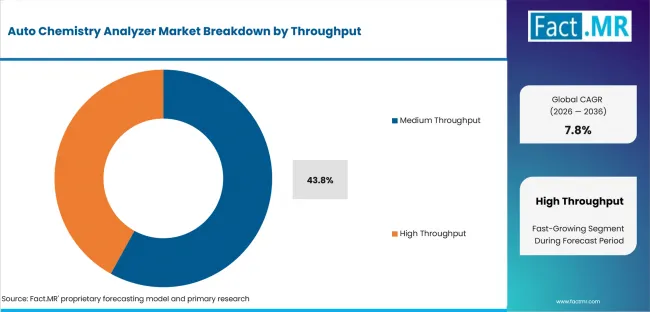
Medium Throughput dominates the market due to its market share of more than 43.80%, and it will remain dominant in the years ahead. The multi-dimensional use of medium throughput analyzers and their capability to provide optimum process capacity for medium size hospitals or laboratories make them an ideal choice where a less costly automation system without the complexities and costs involved with high throughput analyzers is required.
Which End User Segment Dominates the Market?
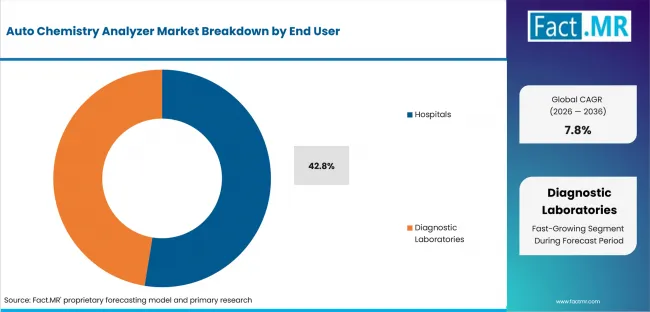
The Hospitals division holds an upper hand in terms of market share of more than 42.80%. There is a future trend in this division which states that the domination in this field will last for years to come. The versatility of hospital laboratories along with the high throughput nature of these laboratories in dealing with clinical chemistry samples makes them ideal candidates for fully automated and random access analyzers.
Regional Outlook Across Key Markets
The market analysis covers key global regions, including South Asia and Pacific, Middle East & Africa, North America, Latin America, Western Europe, and Eastern Europe. It is segmented geographically, with specific market dynamics for each region. The full report provides a detailed market attractiveness analysis.
.webp)
CAGR Table
| Country | CAGR (%) |
|---|---|
| U.S.A. | 6.8% |
| China | 8.7% |
| Japan | 7.3% |
| Germany | 7.6% |
| U.K. | 8.6% |
| India | 8.6% |
| France | 8.8% |
Source: Fact.MR analysis, based on proprietary forecasting model and primary research.
North America – The Auto Chemistry Analyzer Hub
Automation of Chemistry Analyzers is gradually gaining popularity since it is now considered to be the trend in achieving efficient test processing times, consistent batch testing, and in pharmaceutical companies.
- U.S.: Demand for auto chemistry analyzers in the U.S. is projected to grow at a CAGR of 6.8%, supported by increasing adoption of fully automated random access analyzers and growing utilization of integrated chemistry systems for routine clinical chemistry and specialty testing in hospital and diagnostic laboratory settings.
Western Europe – A Key Growth Region for Auto Chemistry Analyzers
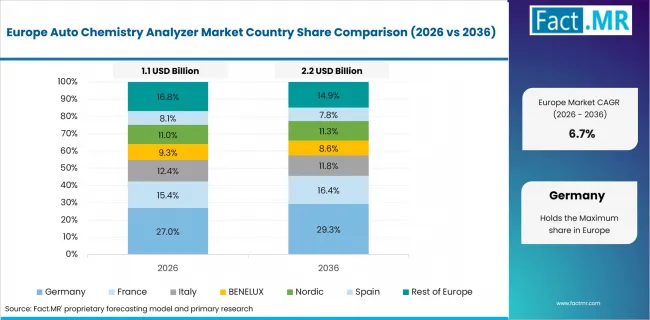
Tight quality control and regulatory requirements, the use of fully automated random access analyzers, and an increase in the demand for high-throughput clinical chemistry tests have led to the widespread use of such systems in Western Europe.
- Germany: Demand for auto chemistry analyzers in Germany is projected to grow at a CAGR of 7.6%, supported by the presence of leading diagnostic equipment manufacturers, along with the country's emphasis on efficient and high-quality healthcare delivery.
East Asia – The Engine of Auto Chemistry Analyzer Innovation
The increasing number of networks among hospitals and diagnostic laboratories will result in the acceleration of the development of automated clinical chemistry in the East Asia region. Meanwhile, together with government investments in the improvement of healthcare infrastructure and the need for early detection of diseases, this forms an ideal environment for doing business.
- China: Demand for auto chemistry analyzers in China is projected to grow at a CAGR of 8.7%, supported by the world's largest hospital network and rapidly expanding diagnostic laboratory sector, along with rising deployment of fully automated random access analyzers and integrated chemistry systems across local healthcare facilities, including major hospital groups and independent lab chains.
South Asia & Pacific – An Emerging Hub for Auto Chemistry Analyzers
The rapid development of healthcare infrastructure and establishment of diagnostic laboratory networks has resulted in the rapid adoption of automated clinical chemistry in the South Asia & Pacific region.
- India: Demand for auto chemistry analyzers in India is projected to grow at a CAGR of 8.6%, supported by the country's ambitious healthcare modernization targets, rising burden of chronic diseases such as diabetes and cardiovascular disorders, and increasing deployment of fully automated random access analyzers and medium throughput systems across hospital chains and standalone diagnostic laboratories in tier-2 and tier-3 cities.
Latin America – The Untapped Opportunity for Auto Chemistry Analyzers
A quick growth rate is expected for the Latin American market due to the recent events that have taken place in the healthcare sector of Latin America. Besides, an increasing demand for clinical chemistry tests and chronic disease monitoring has also been noticed among various hospitals and laboratories in the region.
- Brazil: Demand for auto chemistry analyzers in Brazil is projected to grow at a steady 9.0% CAGR through 2036, supported by the country's large and growing healthcare infrastructure, rising local production of diagnostic services and expansion of private laboratory chains, along with the deployment of medium throughput and fully automated chemistry analyzer.
Middle East & Africa – The Rising Market for Auto Chemistry Analyzers
The market for auto chemistry analyzers in MEA will remain strong because of higher investments in building healthcare infrastructure, expanding hospital networks, and diagnostic laboratory chains, along with an increased demand for reliable and efficient routine clinical chemistry testing, improvements in fully automated random access analyzers, and integrated chemistry systems.
- KSA: Demand for auto chemistry analyzers in Saudi Arabia is projected to grow at around 8.7% CAGR through 2036, supported by the country's Vision 2030 initiatives promoting healthcare transformation and digitalization, modernization of hospital laboratories, and increasing adoption of fully automated chemistry analyzers for chronic disease screening and diagnosis.
Fact.MR analysis provides a comprehensive regional outlook across North America, Latin America, Western Europe, Eastern Europe, East Asia, South Asia & Pacific, and the Middle East & Africa. It offers detailed country-wise insights, highlighting growth trends, demand patterns, and adoption across key industries in both developed and emerging markets.
Competitive Benchmarking and Company Positioning
Leading Companies Shaping the Auto Chemistry Analyzer Market
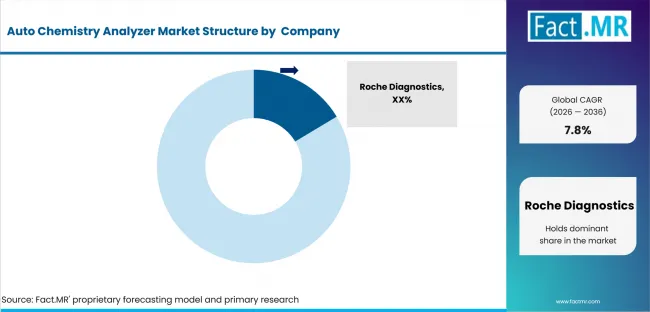
In the area of clinical chemistry automation, there are enough big companies that have entered the scene and hence rendering it as a consolidated sector because the leading firms such as Roche Diagnostics, Abbott, Beckman Coulter, Sysmex, Mindray, Genrui Biotech, Labtron, and Block Scientific hold strong positions through product breadth, installed base, automation capability, and laboratory service networks. There will be more growth prospects in the future because of increasing number of hospitals and diagnostic laboratories, quality standards like ISO 15189 and IVDR, and the increasing demand from the consumers for fast, precise, and efficient clinical chemistry tests.
Key Players of the Auto Chemistry Analyzer Market
- Trivitron Labmate
- Genrui Biotech Inc.
- Roche Diagnostics
- Abbott Laboratories
- Labtron
- Beckman Coulter
- Sysmex
- Mindray
- Diatron
- Biolab Scientific
- High Technology. Inc.
- ARKRAY
- BioBase
- Athenese-DX
- Chengdu Seamaty Technology Co., Ltd.
Recent Industry Developments
- Diatron - P780 Clinical Chemistry System Launch (July 2025)
- In July 2025, Diatron launched the P780 Clinical Chemistry System as its flagship chemistry analyzer. The system supports routine laboratory testing through a cost-focused design built around lower water and consumables use.
- YHLO - iBC 2000 Fully Automated Biochemistry Analyzer Launch (March 2025)
- In March 2025, YHLO launched the iBC 2000 Fully Automated Biochemistry Analyzer at CACLP in Hangzhou. The launch strengthened YHLO’s clinical chemistry analyzer portfolio for high-throughput laboratory workflows.
- Beckman Coulter - DxC 500i Clinical Analyzer FDA Clearance (March 2025)
- In March 2025, Beckman Coulter received U.S. FDA 510(k) clearance for the DxC 500i Clinical Analyzer. The integrated clinical chemistry and immunoassay system supports scalable testing for laboratories managing chemistry and immunoassay workloads.
- Sysmex Europe - UC-1100 Urine Chemistry Analyzer Launch (April 2026)
- In April 2026, Sysmex Europe launched the UC-1100 semi-automated urine chemistry analyzer. The system supports routine urinalysis workflows in laboratories, clinics, and near-patient settings.
Sources and Research References
- Sysmex Europe SE. (2026, April 1). Sysmex Europe launches UC-1100 semi-automated urine chemistry analyser to support flexible urinalysis workflows.
- Diatron. (2025, July 1). Diatron launches P780.
- YHLO. (2025, March 24). Product launch: YHLO iBC 2000 Fully Automated Biochemistry Analyzer.
- Beckman Coulter Diagnostics. (2025, March 10). Beckman Coulter announces FDA clearance of DxC 500i Clinical Analyzer, an integrated clinical chemistry and immunoassay system.
- ORUN Instrument. (2026, April 17). New product launch: ORUN DS8 Fully Automatic Sulfur Dioxide Analyzer officially released.
Auto Chemistry Analyzer Market Definition
Auto chemistry analyzer market can be defined as a section of the IVD industry comprising instruments that use automation or semi-automation techniques for quantitative measurement of biochemical compounds from biological samples such as blood, plasma, serum, urine, and body fluids. The analyzer can conduct various types of clinical chemistry tests such as liver function tests, kidney function tests, lipid profile tests, glucose, electrolytes, and metabolic profile tests.
Auto Chemistry Analyzer Market Inclusions
The market consists of devices and methods that analyze biochemistry parameters using automatic technology. The Auto Chemistry Analyzer market concentrates on developing such analyzers that could help increase laboratory productivity, accuracy of results, automation, and rapidness of analyses.
Auto Chemistry Analyzer Market Exclusions
Auto chemistry analyzers market excludes those diagnostic devices which are not used in clinical chemistry testing, these include stand-alone hematology analyzers, immunoassay analyzers, molecular diagnostic analyzers, microbiology analyzers, and pathology analyzers.
Auto Chemistry Analyzer Market Research Methodology
- Primary Research
- This current analysis report only covers the global market for Auto Chemistry Analyzers which refers to completely automated or semi-automated chemistry analyzers that are used in clinical diagnostics. This analysis covers trends, technology advancements, product usage, and demands from end-users in terms of competition.
- Desk Research
- Secondary research is an important aspect of this research and has been carried out based on an examination of publicly available material in the form of data from sources in the industry, healthcare organizations, governmental bodies, academic articles, and other publications. This included company annual reports, investment materials, product brochures, clinical laboratories, journal articles, and other relevant materials.
- Market-Sizing and Forecasting
- The market size of the Auto Chemistry Analyzer market in the global market has been estimated through the application of both bottom-up and top-down methodologies. The bottom-up methodology entails analyzing the contribution made by the main players involved in manufacturing fully automatic and semi-automatic chemistry analyzers in terms of revenue generation.
- Data Validation and Update Cycle
- Validation of data related to the Auto Chemistry Analyzer market on a global scale was done in a thorough manner, including the cross-verification of the same across multiple sources. Validation of market figures was carried out with the help of analysis of annual reports, investor presentations, filings, product lineups, health care database, trade journals, and other financial statements issued by top companies.
Scope of Analysis

| Parameter | Details |
|---|---|
| Quantitative Units | USD 4.6 billion in 2025 to USD 10.5 billion in 2036, at a CAGR of 7.8% |
| Market Definition | The Auto Chemistry Analyzer market comprises fully automated and semi‑automated clinical chemistry systems that integrate random access, discrete, or integrated technologies to perform routine clinical chemistry, electrolyte analysis, therapeutic drug monitoring, drug of abuse testing, and specialty chemistry testing. |
| Regions Covered | North America, Latin America, Western Europe, Eastern Europe, East Asia, South Asia & Pacific, Middle East & Africa |
| Countries Covered | USA, China, Germany, UK, Japan, India, Brazil, KSA, and 30+ countries |
| Key Companies | Roche Diagnostics, Abbott Laboratories, Beckman Coulter, Sysmex, Mindray, Genrui Biotech Inc., Labtron |
| Forecast Period | 2026 to 2036 |
| Approach | Hybrid demand‑side and top‑down methodology based on increasing adoption of auto chemistry analyzers in routine clinical chemistry testing, growing penetration of fully automated random access and integrated chemistry systems, rising integration of laboratory information systems and workflow automation, and expanding demand for high‑throughput, accurate diagnostics. |
Analysis by Product Type, by Throughput, by End User, by Application, by Technology, and by Region
-
Auto Chemistry Analyzer Market By Product Type
- Fully Automated Chemistry Analyzer
- Benchtop Fully Automated Analyzer
- Floor-standing Fully Automated Analyzer
- Semi-Automated Chemistry Analyzer
- Benchtop Semi-Automated Analyzer
- Portable Semi-Automated Analyzer
- Fully Automated Chemistry Analyzer
-
Auto Chemistry Analyzer Market By Throughput
- Low Throughput
- Up to 200 Tests/Hour
- 201–400 Tests/Hour
- Medium Throughput
- 401–800 Tests/Hour
- 801–1,200 Tests/Hour
- High Throughput
- Above 1,200 Tests/Hour
- Low Throughput
-
Auto Chemistry Analyzer Market By End User
- Hospitals
- Large Hospitals
- Small & Medium Hospitals
- Diagnostic Laboratories
- Independent Laboratories
- Reference Laboratories
- Pharmaceutical & Biotechnology Companies
- Pharmaceutical Companies
- Biotechnology Companies
- Others
- Hospitals
-
Auto Chemistry Analyzer Market By Application
- Routine Clinical Chemistry
- Electrolyte Analysis
- Therapeutic Drug Monitoring
- Drug of Abuse Testing
- Specialty Chemistry Testing
- Other Clinical Applications
-
Auto Chemistry Analyzer Market By Technology
- Random Access Analyzers
- Discrete Analyzers
- Integrated Chemistry Systems
-
Auto Chemistry Analyzer Market By Region
- North America
- USA
- Canada
- Mexico
- Latin America
- Brazil
- Chile
- Rest of LATAM
- East Asia
- China
- Japan
- South Korea
- Western Europe
- Germany
- Italy
- France
- U.K.
- Spain
- BENELUX
- Nordic
- Rest of W. Europe
- Eastern Europe
- Russia
- Hungary
- Poland
- Balkan & Baltics
- Rest of E. Europe
- Middle East and Africa
- Kingdom of Saudi Arabia
- United Arab Emirates
- South Africa
- Rest of Middle East and Africa
- North America
- Frequently Asked Questions -
How large is the demand for Auto Chemistry Analyzers in the global market in 2025?
Demand for Auto Chemistry Analyzers in the global market is estimated to be valued at USD 4.6 billion in 2025.
What will be the market size of Auto Chemistry Analyzers in the global market by 2036?
The market size for Auto Chemistry Analyzers is projected to reach USD 10.5 billion by 2036.
What is the expected demand growth for Auto Chemistry Analyzers in the global market between 2026 and 2036?
Demand for Auto Chemistry Analyzers in the global market is expected to grow at a CAGR of 7.8% between 2026 and 2036.
Which product type segment is expected to dominate the Auto Chemistry Analyzer market?
Fully Automated Chemistry Analyzer is expected to dominate the market, accounting for 76.80% share in 2026, driven by its widespread use in routine clinical chemistry testing, hospital and diagnostic laboratory automation, and industrial‑scale high‑volume testing for chronic disease monitoring, broad adoption across hospital chains and independent lab networks.
How significant is the growth outlook for the USA in this market?
USA is expected to grow at a CAGR of 6.8% through 2036, supported by increasing adoption of fully automated random access analyzers and integrated chemistry systems, rising strategic focus on improving laboratory efficiency and turnaround times, and the presence of leading diagnostic companies investing in next‑generation chemistry analyzers, laboratory information system integration, and workflow automation technologies.
Which company is identified as a leading player in the Auto Chemistry Analyzer Market?
Roche Diagnostics is identified as a leading player in the market, supported by its strong portfolio of advanced clinical chemistry systems including fully automated random access analyzers for routine clinical chemistry, integrated chemistry systems for combined testing, and discrete analyzers for specialty chemistry applications, along with strategic partnerships with hospital networks and diagnostic laboratory chains.
Table of Content
- Auto Chemistry Analyzer Market – Executive Summary
- Market Overview
- Market Definition & Introduction
- Market Taxonomy & Research Scope
- Global Auto Chemistry Analyzer Market Demand Analysis 2021-2025 and Forecast, 2026–2036
- Historical Market Volume (Units) Analysis, 2021-2025
- Current and Future Market Volume (Units) Projections, 2026–2036
- Y-o-Y Growth Trend Analysis
- Global Auto Chemistry Analyzer Market - Pricing Analysis
- Product Category and Country-Level Pricing Analysis
- Region Average Pricing Analysis Benchmark
- Price Trends and Forecasts
- Historical price trends
- Future price forecasts
- Factors Influencing Pricing
- Competitive Pricing Strategies
- Cost Structure Analysis
- Global Auto Chemistry Analyzer Market Demand (in Value or Size in US$ Mn) Analysis 2021-2025 and Forecast, 2026–2036
- Historical Market Value (US$ Mn) Analysis, 2021-2025
- Current and Future Market Value (US$ Mn) Projections, 2026–2036
- Y-o-Y Growth Trend Analysis
- Absolute $ Opportunity Analysis
- Market Background and Foundational Data Points
- Share of clinical chemistry testing in the total global in-vitro diagnostics (IVD) market (%)
- Annual growth rate of global clinical diagnostic testing volumes (%)
- Share of automated chemistry analyzers in total clinical chemistry testing equipment installed base (%)
- Penetration rate of fully automated chemistry analyzers across hospitals and diagnostic laboratories (%)
- Share of diagnostic laboratories in total clinical chemistry testing volumes (%)
- Share of hospitals in total clinical chemistry testing volumes (%)
- Annual growth rate of laboratory automation adoption in clinical diagnostics (%)
- Share of routine clinical chemistry tests in total laboratory diagnostic tests performed (%)
- Annual growth rate of chronic disease-related diagnostic testing demand (%)
- Share of high-throughput analyzers in total installed auto chemistry analyzer base (%)
- Penetration rate of Laboratory Information System (LIS)-integrated chemistry analyzers (%)
- Share of preventive healthcare screening tests in total clinical chemistry testing volume (%)
- Annual growth rate of healthcare expenditure allocated to diagnostic services (%)
- Share of centralized/reference laboratories in total clinical chemistry testing capacity (%)
- Annual growth rate of investments in laboratory modernization and diagnostic automation (%)
- Auto Chemistry Analyzer Market Opportunity Assessment
- Total Available Market (US$ Mn)
- Serviceable Addressable Market (US$ Mn)
- Serviceable Obtainable Market (US$ Mn)
- Porter’s Five Forces and PESTEL Analysis
- Investment Feasibility Analysis
- Macro-Economic Factors & Forecast Factors - Relevance & Impact
- Industry Value and Supply Chain Analysis
- List of Key Channel Partners
- Profit Margin & Operating Margin at Each Node of Supply Chain.
- Notes on Value Added at Each Node in the Value Chain
- Factors Influencing Value Chain
- Market Dynamics
- Drivers
- Restraints
- Opportunity Analysis
- Key Regulations & Certifications
- Auto Chemistry Analyzer Market Analysis 2021-2025 and Forecast 2026–2036, By Product Type
- Introduction / Key Findings
- Historical Market Size (US$ Mn) & Volume (Units) Trend Analysis By Product Type, 2021-2025
- Current and Future Market Size (US$ Mn) & Volume (Units) Analysis and Forecast By Product Type, 2026-2036
- Fully Automated Chemistry Analyzer
- Benchtop Fully Automated Analyzer
- Floor-standing Fully Automated Analyzer
- Semi-Automated Chemistry Analyzer
- Benchtop Semi-Automated Analyzer
- Portable Semi-Automated Analyzer
- Fully Automated Chemistry Analyzer
- Market Attractiveness Analysis By Product Type
- Auto Chemistry Analyzer Market Analysis 2021-2025 and Forecast 2026–2036, By Throughput
- Introduction / Key Findings
- Historical Market Size (US$ Mn) & Volume (Units) Trend Analysis By Throughput, 2021-2025
- Current and Future Market Size (US$ Mn) & Volume (Units) Analysis and Forecast By Throughput, 2026-2036
- Low Throughput
- Up to 200 Tests/Hour
- 201–400 Tests/Hour
- Medium Throughput
- 401–800 Tests/Hour
- 801–1,200 Tests/Hour
- High Throughput
- Above 1,200 Tests/Hour
- Low Throughput
- Market Attractiveness Analysis By Throughput
- Auto Chemistry Analyzer Market Analysis 2021-2025 and Forecast 2026–2036, By Application
- Introduction / Key Findings
- Historical Market Size (US$ Mn) & Volume (Units) Trend Analysis By Application, 2021-2025
- Current and Future Market Size (US$ Mn) & Volume (Units) Analysis and Forecast By Application, 2026-2036
- Routine Clinical Chemistry
- Electrolyte Analysis
- Therapeutic Drug Monitoring
- Drug of Abuse Testing
- Specialty Chemistry Testing
- Other Clinical Applications
- Market Attractiveness Analysis By Application
- Auto Chemistry Analyzer Market Analysis 2021-2025 and Forecast 2026–2036, By End User Industry
- Introduction / Key Findings
- Historical Market Size (US$ Mn) & Volume (Units) Trend Analysis By End User Industry, 2021-2025
- Current and Future Market Size (US$ Mn) & Volume (Units) Analysis and Forecast By End User Industry, 2026-2036
- Hospitals
- Large Hospitals
- Small & Medium Hospitals
- Diagnostic Laboratories
- Independent Laboratories
- Reference Laboratories
- Pharmaceutical & Biotechnology Companies
- Pharmaceutical Companies
- Biotechnology Companies
- Others
- Market Attractiveness Analysis By End User Industry
- Auto Chemistry Analyzer Market Analysis 2021-2025 and Forecast 2026–2036, By Technology
- Introduction / Key Findings
- Historical Market Size (US$ Mn) & Volume (Units) Trend Analysis By Technology, 2021-2025
- Current and Future Market Size (US$ Mn) & Volume (Units) Analysis and Forecast By Technology, 2026-2036
- Random Access Analyzers
- Discrete Analyzers
- Integrated Chemistry Systems
- Market Attractiveness Analysis By Technology
- Global Auto Chemistry Analyzer Market Analysis and Forecast, by Region
- Introduction / Key Findings
- Historical Market Size (US$ Mn) & Volume (Units) Trend Analysis by Region, 2021-2025
- Current and Future Market Size (US$ Mn) & Volume (Units) Analysis and Forecast by Region, 2026-2036
- North America
- Latin America
- Western Europe
- Eastern Europe
- East Asia
- South Asia & Pacific
- Middle East & Africa
- Market Attractiveness Analysis by Region
- North America Auto Chemistry Analyzer Market Analysis and Forecast
- Introduction / Key Findings
- Pricing Analysis
- Historical Market Size (US$ Mn) & Volume (Units) Trend Analysis by Market Taxonomy, 2021-2025
- Current and Future Market Size (US$ Mn) and Volume (Units) Analysis & Forecast by Market Taxonomy, 2026-2036
- By Country
- United States
- Canada
- Mexico
- By Taxonomy
- Market Attractiveness Analysis By Country & Taxonomy
- Market Trends
- Key Market Participants – Intensity Mapping
- Drivers and Restraints - Impact Analysis
- Latin America Auto Chemistry Analyzer Market Analysis and Forecast
- Introduction / Key Findings
- Pricing Analysis
- Historical Market Size (US$ Mn) & Volume (Units) Trend Analysis by Market Taxonomy, 2021-2025
- Current and Future Market Size (US$ Mn) and Volume (Units) Analysis & Forecast by Market Taxonomy, 2026-2036
- By Country
- Brazil
- Chile
- Rest of LATAM
- By Taxonomy
- Market Attractiveness Analysis By Country & Taxonomy
- Market Trends
- Key Market Participants – Intensity Mapping
- Drivers and Restraints - Impact Analysis
- Western Europe Auto Chemistry Analyzer Market Analysis and Forecast
- Introduction / Key Findings
- Pricing Analysis
- Historical Market Size (US$ Mn) & Volume (Units) Trend Analysis by Market Taxonomy, 2021-2025
- Current and Future Market Size (US$ Mn) and Volume (Units) Analysis & Forecast by Market Taxonomy, 2026-2036
- By Country
- Germany
- Italy
- France
- United Kingdom
- Spain
- BENELUX
- Nordics
- Rest of Western Europe
- By Taxonomy
- Market Attractiveness Analysis By Country & Taxonomy
- Market Trends
- Key Market Participants – Intensity Mapping
- Drivers and Restraints - Impact Analysis
- Eastern Europe Auto Chemistry Analyzer Market Analysis and Forecast
- Introduction / Key Findings
- Pricing Analysis
- Historical Market Size (US$ Mn) & Volume (Units) Trend Analysis by Market Taxonomy, 2021-2025
- Current and Future Market Size (US$ Mn) and Volume (Units) Analysis & Forecast by Market Taxonomy, 2026-2036
- By Country
- Russia
- Hungary
- Poland
- Balkan & Baltics
- Rest of Eastern Europe
- By Taxonomy
- Market Attractiveness Analysis By Country & Taxonomy
- Market Trends
- Key Market Participants – Intensity Mapping
- Drivers and Restraints - Impact Analysis
- East Asia Auto Chemistry Analyzer Market Analysis and Forecast
- Introduction / Key Findings
- Pricing Analysis
- Historical Market Size (US$ Mn) & Volume (Units) Trend Analysis by Market Taxonomy, 2021-2025
- Current and Future Market Size (US$ Mn) and Volume (Units) Analysis & Forecast by Market Taxonomy, 2026-2036
- By Country
- China
- Japan
- South Korea
- By Taxonomy
- Market Attractiveness Analysis By Country & Taxonomy
- Market Trends
- Key Market Participants – Intensity Mapping
- Drivers and Restraints - Impact Analysis
- South Asia & Pacific Auto Chemistry Analyzer Market Analysis and Forecast
- Introduction / Key Findings
- Pricing Analysis
- Historical Market Size (US$ Mn) & Volume (Units) Trend Analysis by Market Taxonomy, 2021-2025
- Current and Future Market Size (US$ Mn) and Volume (Units) Analysis & Forecast by Market Taxonomy, 2026-2036
- By Country
- India
- ASEAN
- Australia & New Zealand
- Rest of South Asia & Pacific
- By Taxonomy
- Market Attractiveness Analysis By Country & Taxonomy
- Market Trends
- Key Market Participants – Intensity Mapping
- Drivers and Restraints - Impact Analysis
- Middle East & Africa Auto Chemistry Analyzer Market Analysis and Forecast
- Introduction / Key Findings
- Pricing Analysis
- Historical Market Size (US$ Mn) & Volume (Units) Trend Analysis by Market Taxonomy, 2021-2025
- Current and Future Market Size (US$ Mn) and Volume (Units) Analysis & Forecast by Market Taxonomy, 2026-2036
- By Country
- Kingdom of Saudi Arabia
- Other GCC Countries
- Turkiye
- South Africa
- Other African Union
- By Taxonomy
- Market Attractiveness Analysis By Country & Taxonomy
- Market Trends
- Key Market Participants – Intensity Mapping
- Drivers and Restraints - Impact Analysis
- Country-level Auto Chemistry Analyzer Market Analysis and Forecast
- Introduction
- Market Value Proportion Analysis, By Key Countries
- Global Vs. Country Growth Comparison
- United States Auto Chemistry Analyzer Market Analysis
- Market Size (US$ Mn) & Volume (Units) Analysis by Market Taxonomy, 2021–2036
- By Product Type
- By Throughput
- By End User Industry
- By Technology
- By Application
- United States Auto Chemistry Analyzer Market Analysis
-
-
- Canada Auto Chemistry Analyzer Market Analysis
- Mexico Auto Chemistry Analyzer Market Analysis
- Brazil Auto Chemistry Analyzer Market Analysis
- Chile Auto Chemistry Analyzer Market Analysis
- Germany Auto Chemistry Analyzer Market Analysis
- France Auto Chemistry Analyzer Market Analysis
- Italy Auto Chemistry Analyzer Market Analysis
- Spain Auto Chemistry Analyzer Market Analysis
- United Kingdom Auto Chemistry Analyzer Market Analysis
- BENELUX Auto Chemistry Analyzer Market Analysis
- Nordics Auto Chemistry Analyzer Market Analysis
- Poland Auto Chemistry Analyzer Market Analysis
- Russia Auto Chemistry Analyzer Market Analysis
- Hungary Auto Chemistry Analyzer Market Analysis
- Balkan & Baltics Auto Chemistry Analyzer Market Analysis
- China Auto Chemistry Analyzer Market Analysis
- Japan Auto Chemistry Analyzer Market Analysis
- South Korea Auto Chemistry Analyzer Market Analysis
- India Auto Chemistry Analyzer Market Analysis
- ASEAN Auto Chemistry Analyzer Market Analysis
- ANZ Auto Chemistry Analyzer Market Analysis
- KSA Auto Chemistry Analyzer Market Analysis
- Other GCC Countries Auto Chemistry Analyzer Market Analysis
- South Africa Auto Chemistry Analyzer Market Analysis
- Turkiye Auto Chemistry Analyzer Market Analysis
-
- Auto Chemistry Analyzer Market Structure Analysis
- Market Analysis by Tier of Companies
- Market Concentration
- Market Share Analysis of Top Players
- Market Space for New Brands and Dollar Opportunity
- Market Presence Analysis
- Regional Footprint of Players
- Product Footprint by Players
- Auto Chemistry Analyzer Competition Analysis
- Competition Dashboard
- Pricing Analysis by Competition
- Competition Benchmarking
- Competition Deep Dive
- Genrui Biotech Inc.
- Overview
- Product Portfolio
- Sales Footprint
- Key Developments
- SWOT Analysis
- Strategy Overview
- Key Financials
- Roche Diagnostics
- Abbott Laboratories
- Labtron
- Beckman Coulter
- Sysmex
- Mindray
- Diatron
- Trivitron Labmate
- Biolab Scientific
- High Technology. Inc.
- ARKRAY
- BioBase
- Athenese-DX
- Chengdu Seamaty Technology Co., Ltd.
- Other Prominent Players
- Genrui Biotech Inc.
- Primary insights
- Assumptions & Acronyms Used
- Research Methodology & Data Forms
List Of Table
- Table 1: Global Market Value (USD Mn) Forecast by Region, 2021 to 2036
- Table 2: Global Market Volume (Units) Forecast by Region, 2021 to 2036
- Table 3: Global Market Value (USD Mn) Forecast by Product Type, 2021 to 2036
- Table 4: Global Market Volume (Units) Forecast by Product Type, 2021 to 2036
- Table 5: Global Market Value (USD Mn) Forecast by Throughput, 2021 to 2036
- Table 6: Global Market Volume (Units) Forecast by Throughput, 2021 to 2036
- Table 7: Global Market Value (USD Mn) Forecast by End User, 2021 to 2036
- Table 8: Global Market Volume (Units) Forecast by End User, 2021 to 2036
- Table 9: Global Market Value (USD Mn) Forecast by Application, 2021 to 2036
- Table 10: Global Market Volume (Units) Forecast by Application, 2021 to 2036
- Table 11: Global Market Value (USD Mn) Forecast by Technology, 2021 to 2036
- Table 12: Global Market Volume (Units) Forecast by Technology, 2021 to 2036
- Table 13: North America Market Value (USD Mn) Forecast by Country, 2021 to 2036
- Table 14: North America Market Volume (Units) Forecast by Country, 2021 to 2036
- Table 15: North America Market Value (USD Mn) Forecast by Product Type, 2021 to 2036
- Table 16: North America Market Volume (Units) Forecast by Product Type, 2021 to 2036
- Table 17: North America Market Value (USD Mn) Forecast by Throughput, 2021 to 2036
- Table 18: North America Market Volume (Units) Forecast by Throughput, 2021 to 2036
- Table 19: North America Market Value (USD Mn) Forecast by End User, 2021 to 2036
- Table 20: North America Market Volume (Units) Forecast by End User, 2021 to 2036
- Table 21: North America Market Value (USD Mn) Forecast by Application, 2021 to 2036
- Table 22: North America Market Volume (Units) Forecast by Application, 2021 to 2036
- Table 23: North America Market Value (USD Mn) Forecast by Technology, 2021 to 2036
- Table 24: North America Market Volume (Units) Forecast by Technology, 2021 to 2036
- Table 25: Latin America Market Value (USD Mn) Forecast by Country, 2021 to 2036
- Table 26: Latin America Market Volume (Units) Forecast by Country, 2021 to 2036
- Table 27: Latin America Market Value (USD Mn) Forecast by Product Type, 2021 to 2036
- Table 28: Latin America Market Volume (Units) Forecast by Product Type, 2021 to 2036
- Table 29: Latin America Market Value (USD Mn) Forecast by Throughput, 2021 to 2036
- Table 30: Latin America Market Volume (Units) Forecast by Throughput, 2021 to 2036
- Table 31: Latin America Market Value (USD Mn) Forecast by End User, 2021 to 2036
- Table 32: Latin America Market Volume (Units) Forecast by End User, 2021 to 2036
- Table 33: Latin America Market Value (USD Mn) Forecast by Application, 2021 to 2036
- Table 34: Latin America Market Volume (Units) Forecast by Application, 2021 to 2036
- Table 35: Latin America Market Value (USD Mn) Forecast by Technology, 2021 to 2036
- Table 36: Latin America Market Volume (Units) Forecast by Technology, 2021 to 2036
- Table 37: Western Europe Market Value (USD Mn) Forecast by Country, 2021 to 2036
- Table 38: Western Europe Market Volume (Units) Forecast by Country, 2021 to 2036
- Table 39: Western Europe Market Value (USD Mn) Forecast by Product Type, 2021 to 2036
- Table 40: Western Europe Market Volume (Units) Forecast by Product Type, 2021 to 2036
- Table 41: Western Europe Market Value (USD Mn) Forecast by Throughput, 2021 to 2036
- Table 42: Western Europe Market Volume (Units) Forecast by Throughput, 2021 to 2036
- Table 43: Western Europe Market Value (USD Mn) Forecast by End User, 2021 to 2036
- Table 44: Western Europe Market Volume (Units) Forecast by End User, 2021 to 2036
- Table 45: Western Europe Market Value (USD Mn) Forecast by Application, 2021 to 2036
- Table 46: Western Europe Market Volume (Units) Forecast by Application, 2021 to 2036
- Table 47: Western Europe Market Value (USD Mn) Forecast by Technology, 2021 to 2036
- Table 48: Western Europe Market Volume (Units) Forecast by Technology, 2021 to 2036
- Table 49: Eastern Europe Market Value (USD Mn) Forecast by Country, 2021 to 2036
- Table 50: Eastern Europe Market Volume (Units) Forecast by Country, 2021 to 2036
- Table 51: Eastern Europe Market Value (USD Mn) Forecast by Product Type, 2021 to 2036
- Table 52: Eastern Europe Market Volume (Units) Forecast by Product Type, 2021 to 2036
- Table 53: Eastern Europe Market Value (USD Mn) Forecast by Throughput, 2021 to 2036
- Table 54: Eastern Europe Market Volume (Units) Forecast by Throughput, 2021 to 2036
- Table 55: Eastern Europe Market Value (USD Mn) Forecast by End User, 2021 to 2036
- Table 56: Eastern Europe Market Volume (Units) Forecast by End User, 2021 to 2036
- Table 57: Eastern Europe Market Value (USD Mn) Forecast by Application, 2021 to 2036
- Table 58: Eastern Europe Market Volume (Units) Forecast by Application, 2021 to 2036
- Table 59: Eastern Europe Market Value (USD Mn) Forecast by Technology, 2021 to 2036
- Table 60: Eastern Europe Market Volume (Units) Forecast by Technology, 2021 to 2036
- Table 61: East Asia Market Value (USD Mn) Forecast by Country, 2021 to 2036
- Table 62: East Asia Market Volume (Units) Forecast by Country, 2021 to 2036
- Table 63: East Asia Market Value (USD Mn) Forecast by Product Type, 2021 to 2036
- Table 64: East Asia Market Volume (Units) Forecast by Product Type, 2021 to 2036
- Table 65: East Asia Market Value (USD Mn) Forecast by Throughput, 2021 to 2036
- Table 66: East Asia Market Volume (Units) Forecast by Throughput, 2021 to 2036
- Table 67: East Asia Market Value (USD Mn) Forecast by End User, 2021 to 2036
- Table 68: East Asia Market Volume (Units) Forecast by End User, 2021 to 2036
- Table 69: East Asia Market Value (USD Mn) Forecast by Application, 2021 to 2036
- Table 70: East Asia Market Volume (Units) Forecast by Application, 2021 to 2036
- Table 71: East Asia Market Value (USD Mn) Forecast by Technology, 2021 to 2036
- Table 72: East Asia Market Volume (Units) Forecast by Technology, 2021 to 2036
- Table 73: South Asia and Pacific Market Value (USD Mn) Forecast by Country, 2021 to 2036
- Table 74: South Asia and Pacific Market Volume (Units) Forecast by Country, 2021 to 2036
- Table 75: South Asia and Pacific Market Value (USD Mn) Forecast by Product Type, 2021 to 2036
- Table 76: South Asia and Pacific Market Volume (Units) Forecast by Product Type, 2021 to 2036
- Table 77: South Asia and Pacific Market Value (USD Mn) Forecast by Throughput, 2021 to 2036
- Table 78: South Asia and Pacific Market Volume (Units) Forecast by Throughput, 2021 to 2036
- Table 79: South Asia and Pacific Market Value (USD Mn) Forecast by End User, 2021 to 2036
- Table 80: South Asia and Pacific Market Volume (Units) Forecast by End User, 2021 to 2036
- Table 81: South Asia and Pacific Market Value (USD Mn) Forecast by Application, 2021 to 2036
- Table 82: South Asia and Pacific Market Volume (Units) Forecast by Application, 2021 to 2036
- Table 83: South Asia and Pacific Market Value (USD Mn) Forecast by Technology, 2021 to 2036
- Table 84: South Asia and Pacific Market Volume (Units) Forecast by Technology, 2021 to 2036
- Table 85: Middle East & Africa Market Value (USD Mn) Forecast by Country, 2021 to 2036
- Table 86: Middle East & Africa Market Volume (Units) Forecast by Country, 2021 to 2036
- Table 87: Middle East & Africa Market Value (USD Mn) Forecast by Product Type, 2021 to 2036
- Table 88: Middle East & Africa Market Volume (Units) Forecast by Product Type, 2021 to 2036
- Table 89: Middle East & Africa Market Value (USD Mn) Forecast by Throughput, 2021 to 2036
- Table 90: Middle East & Africa Market Volume (Units) Forecast by Throughput, 2021 to 2036
- Table 91: Middle East & Africa Market Value (USD Mn) Forecast by End User, 2021 to 2036
- Table 92: Middle East & Africa Market Volume (Units) Forecast by End User, 2021 to 2036
- Table 93: Middle East & Africa Market Value (USD Mn) Forecast by Application, 2021 to 2036
- Table 94: Middle East & Africa Market Volume (Units) Forecast by Application, 2021 to 2036
- Table 95: Middle East & Africa Market Value (USD Mn) Forecast by Technology, 2021 to 2036
- Table 96: Middle East & Africa Market Volume (Units) Forecast by Technology, 2021 to 2036
List Of Figures
- Figure 1: Global Market Volume (Units) Forecast 2021 to 2036
- Figure 2: Global Market Pricing Analysis
- Figure 3: Global Market Value (USD Mn) Forecast 2021 to 2036
- Figure 4: Global Market Value Share and BPS Analysis by Product Type, 2026 and 2036
- Figure 5: Global Market Y-o-Y Growth Comparison by Product Type, 2026 to 2036
- Figure 6: Global Market Attractiveness Analysis by Product Type
- Figure 7: Global Market Value Share and BPS Analysis by Throughput, 2026 and 2036
- Figure 8: Global Market Y-o-Y Growth Comparison by Throughput, 2026 to 2036
- Figure 9: Global Market Attractiveness Analysis by Throughput
- Figure 10: Global Market Value Share and BPS Analysis by End User, 2026 and 2036
- Figure 11: Global Market Y-o-Y Growth Comparison by End User, 2026 to 2036
- Figure 12: Global Market Attractiveness Analysis by End User
- Figure 13: Global Market Value Share and BPS Analysis by Application, 2026 and 2036
- Figure 14: Global Market Y-o-Y Growth Comparison by Application, 2026 to 2036
- Figure 15: Global Market Attractiveness Analysis by Application
- Figure 16: Global Market Value Share and BPS Analysis by Technology, 2026 and 2036
- Figure 17: Global Market Y-o-Y Growth Comparison by Technology, 2026 to 2036
- Figure 18: Global Market Attractiveness Analysis by Technology
- Figure 19: Global Market Value (USD Mn) Share and BPS Analysis by Region, 2026 and 2036
- Figure 20: Global Market Y-o-Y Growth Comparison by Region, 2026 to 2036
- Figure 21: Global Market Attractiveness Analysis by Region
- Figure 22: North America Market Incremental $ Opportunity, 2026 to 2036
- Figure 23: Latin America Market Incremental $ Opportunity, 2026 to 2036
- Figure 24: Western Europe Market Incremental $ Opportunity, 2026 to 2036
- Figure 25: Eastern Europe Market Incremental $ Opportunity, 2026 to 2036
- Figure 26: East Asia Market Incremental $ Opportunity, 2026 to 2036
- Figure 27: South Asia and Pacific Market Incremental $ Opportunity, 2026 to 2036
- Figure 28: Middle East & Africa Market Incremental $ Opportunity, 2026 to 2036
- Figure 29: North America Market Value Share and BPS Analysis by Country, 2026 and 2036
- Figure 30: North America Market Value Share and BPS Analysis by Product Type, 2026 and 2036
- Figure 31: North America Market Y-o-Y Growth Comparison by Product Type, 2026 to 2036
- Figure 32: North America Market Attractiveness Analysis by Product Type
- Figure 33: North America Market Value Share and BPS Analysis by Throughput, 2026 and 2036
- Figure 34: North America Market Y-o-Y Growth Comparison by Throughput, 2026 to 2036
- Figure 35: North America Market Attractiveness Analysis by Throughput
- Figure 36: North America Market Value Share and BPS Analysis by End User, 2026 and 2036
- Figure 37: North America Market Y-o-Y Growth Comparison by End User, 2026 to 2036
- Figure 38: North America Market Attractiveness Analysis by End User
- Figure 39: North America Market Value Share and BPS Analysis by Application, 2026 and 2036
- Figure 40: North America Market Y-o-Y Growth Comparison by Application, 2026 to 2036
- Figure 41: North America Market Attractiveness Analysis by Application
- Figure 42: North America Market Value Share and BPS Analysis by Technology, 2026 and 2036
- Figure 43: North America Market Y-o-Y Growth Comparison by Technology, 2026 to 2036
- Figure 44: North America Market Attractiveness Analysis by Technology
- Figure 45: Latin America Market Value Share and BPS Analysis by Country, 2026 and 2036
- Figure 46: Latin America Market Value Share and BPS Analysis by Product Type, 2026 and 2036
- Figure 47: Latin America Market Y-o-Y Growth Comparison by Product Type, 2026 to 2036
- Figure 48: Latin America Market Attractiveness Analysis by Product Type
- Figure 49: Latin America Market Value Share and BPS Analysis by Throughput, 2026 and 2036
- Figure 50: Latin America Market Y-o-Y Growth Comparison by Throughput, 2026 to 2036
- Figure 51: Latin America Market Attractiveness Analysis by Throughput
- Figure 52: Latin America Market Value Share and BPS Analysis by End User, 2026 and 2036
- Figure 53: Latin America Market Y-o-Y Growth Comparison by End User, 2026 to 2036
- Figure 54: Latin America Market Attractiveness Analysis by End User
- Figure 55: Latin America Market Value Share and BPS Analysis by Application, 2026 and 2036
- Figure 56: Latin America Market Y-o-Y Growth Comparison by Application, 2026 to 2036
- Figure 57: Latin America Market Attractiveness Analysis by Application
- Figure 58: Latin America Market Value Share and BPS Analysis by Technology, 2026 and 2036
- Figure 59: Latin America Market Y-o-Y Growth Comparison by Technology, 2026 to 2036
- Figure 60: Latin America Market Attractiveness Analysis by Technology
- Figure 61: Western Europe Market Value Share and BPS Analysis by Country, 2026 and 2036
- Figure 62: Western Europe Market Value Share and BPS Analysis by Product Type, 2026 and 2036
- Figure 63: Western Europe Market Y-o-Y Growth Comparison by Product Type, 2026 to 2036
- Figure 64: Western Europe Market Attractiveness Analysis by Product Type
- Figure 65: Western Europe Market Value Share and BPS Analysis by Throughput, 2026 and 2036
- Figure 66: Western Europe Market Y-o-Y Growth Comparison by Throughput, 2026 to 2036
- Figure 67: Western Europe Market Attractiveness Analysis by Throughput
- Figure 68: Western Europe Market Value Share and BPS Analysis by End User, 2026 and 2036
- Figure 69: Western Europe Market Y-o-Y Growth Comparison by End User, 2026 to 2036
- Figure 70: Western Europe Market Attractiveness Analysis by End User
- Figure 71: Western Europe Market Value Share and BPS Analysis by Application, 2026 and 2036
- Figure 72: Western Europe Market Y-o-Y Growth Comparison by Application, 2026 to 2036
- Figure 73: Western Europe Market Attractiveness Analysis by Application
- Figure 74: Western Europe Market Value Share and BPS Analysis by Technology, 2026 and 2036
- Figure 75: Western Europe Market Y-o-Y Growth Comparison by Technology, 2026 to 2036
- Figure 76: Western Europe Market Attractiveness Analysis by Technology
- Figure 77: Eastern Europe Market Value Share and BPS Analysis by Country, 2026 and 2036
- Figure 78: Eastern Europe Market Value Share and BPS Analysis by Product Type, 2026 and 2036
- Figure 79: Eastern Europe Market Y-o-Y Growth Comparison by Product Type, 2026 to 2036
- Figure 80: Eastern Europe Market Attractiveness Analysis by Product Type
- Figure 81: Eastern Europe Market Value Share and BPS Analysis by Throughput, 2026 and 2036
- Figure 82: Eastern Europe Market Y-o-Y Growth Comparison by Throughput, 2026 to 2036
- Figure 83: Eastern Europe Market Attractiveness Analysis by Throughput
- Figure 84: Eastern Europe Market Value Share and BPS Analysis by End User, 2026 and 2036
- Figure 85: Eastern Europe Market Y-o-Y Growth Comparison by End User, 2026 to 2036
- Figure 86: Eastern Europe Market Attractiveness Analysis by End User
- Figure 87: Eastern Europe Market Value Share and BPS Analysis by Application, 2026 and 2036
- Figure 88: Eastern Europe Market Y-o-Y Growth Comparison by Application, 2026 to 2036
- Figure 89: Eastern Europe Market Attractiveness Analysis by Application
- Figure 90: Eastern Europe Market Value Share and BPS Analysis by Technology, 2026 and 2036
- Figure 91: Eastern Europe Market Y-o-Y Growth Comparison by Technology, 2026 to 2036
- Figure 92: Eastern Europe Market Attractiveness Analysis by Technology
- Figure 93: East Asia Market Value Share and BPS Analysis by Country, 2026 and 2036
- Figure 94: East Asia Market Value Share and BPS Analysis by Product Type, 2026 and 2036
- Figure 95: East Asia Market Y-o-Y Growth Comparison by Product Type, 2026 to 2036
- Figure 96: East Asia Market Attractiveness Analysis by Product Type
- Figure 97: East Asia Market Value Share and BPS Analysis by Throughput, 2026 and 2036
- Figure 98: East Asia Market Y-o-Y Growth Comparison by Throughput, 2026 to 2036
- Figure 99: East Asia Market Attractiveness Analysis by Throughput
- Figure 100: East Asia Market Value Share and BPS Analysis by End User, 2026 and 2036
- Figure 101: East Asia Market Y-o-Y Growth Comparison by End User, 2026 to 2036
- Figure 102: East Asia Market Attractiveness Analysis by End User
- Figure 103: East Asia Market Value Share and BPS Analysis by Application, 2026 and 2036
- Figure 104: East Asia Market Y-o-Y Growth Comparison by Application, 2026 to 2036
- Figure 105: East Asia Market Attractiveness Analysis by Application
- Figure 106: East Asia Market Value Share and BPS Analysis by Technology, 2026 and 2036
- Figure 107: East Asia Market Y-o-Y Growth Comparison by Technology, 2026 to 2036
- Figure 108: East Asia Market Attractiveness Analysis by Technology
- Figure 109: South Asia and Pacific Market Value Share and BPS Analysis by Country, 2026 and 2036
- Figure 110: South Asia and Pacific Market Value Share and BPS Analysis by Product Type, 2026 and 2036
- Figure 111: South Asia and Pacific Market Y-o-Y Growth Comparison by Product Type, 2026 to 2036
- Figure 112: South Asia and Pacific Market Attractiveness Analysis by Product Type
- Figure 113: South Asia and Pacific Market Value Share and BPS Analysis by Throughput, 2026 and 2036
- Figure 114: South Asia and Pacific Market Y-o-Y Growth Comparison by Throughput, 2026 to 2036
- Figure 115: South Asia and Pacific Market Attractiveness Analysis by Throughput
- Figure 116: South Asia and Pacific Market Value Share and BPS Analysis by End User, 2026 and 2036
- Figure 117: South Asia and Pacific Market Y-o-Y Growth Comparison by End User, 2026 to 2036
- Figure 118: South Asia and Pacific Market Attractiveness Analysis by End User
- Figure 119: South Asia and Pacific Market Value Share and BPS Analysis by Application, 2026 and 2036
- Figure 120: South Asia and Pacific Market Y-o-Y Growth Comparison by Application, 2026 to 2036
- Figure 121: South Asia and Pacific Market Attractiveness Analysis by Application
- Figure 122: South Asia and Pacific Market Value Share and BPS Analysis by Technology, 2026 and 2036
- Figure 123: South Asia and Pacific Market Y-o-Y Growth Comparison by Technology, 2026 to 2036
- Figure 124: South Asia and Pacific Market Attractiveness Analysis by Technology
- Figure 125: Middle East & Africa Market Value Share and BPS Analysis by Country, 2026 and 2036
- Figure 126: Middle East & Africa Market Value Share and BPS Analysis by Product Type, 2026 and 2036
- Figure 127: Middle East & Africa Market Y-o-Y Growth Comparison by Product Type, 2026 to 2036
- Figure 128: Middle East & Africa Market Attractiveness Analysis by Product Type
- Figure 129: Middle East & Africa Market Value Share and BPS Analysis by Throughput, 2026 and 2036
- Figure 130: Middle East & Africa Market Y-o-Y Growth Comparison by Throughput, 2026 to 2036
- Figure 131: Middle East & Africa Market Attractiveness Analysis by Throughput
- Figure 132: Middle East & Africa Market Value Share and BPS Analysis by End User, 2026 and 2036
- Figure 133: Middle East & Africa Market Y-o-Y Growth Comparison by End User, 2026 to 2036
- Figure 134: Middle East & Africa Market Attractiveness Analysis by End User
- Figure 135: Middle East & Africa Market Value Share and BPS Analysis by Application, 2026 and 2036
- Figure 136: Middle East & Africa Market Y-o-Y Growth Comparison by Application, 2026 to 2036
- Figure 137: Middle East & Africa Market Attractiveness Analysis by Application
- Figure 138: Middle East & Africa Market Value Share and BPS Analysis by Technology, 2026 and 2036
- Figure 139: Middle East & Africa Market Y-o-Y Growth Comparison by Technology, 2026 to 2036
- Figure 140: Middle East & Africa Market Attractiveness Analysis by Technology
- Figure 141: Global Market – Tier Structure Analysis
- Figure 142: Global Market – Company Share Analysis