- Market Value (2025): USD 456.5 Mn
- Estimated Value (2026): USD 502 Mn
- Forecast Value (2036): USD 1299.7 Mn
- CAGR (2026-2036): 10.0%
What is the Automotive Interior Freshness Additives Market forecast to be worth by 2036?
USD 502 million in 2026 to USD 1,299.7 million by 2036, at a 10.0% CAGR.
- The Automotive Interior Freshness Additives market was valued at USD 456.5 million in 2025.
- Demand is set to rise from USD 502 million in 2026 to USD 1,299.7 million by 2036.
- The market is forecast to grow at a 10.0% CAGR from 2026 to 2036.
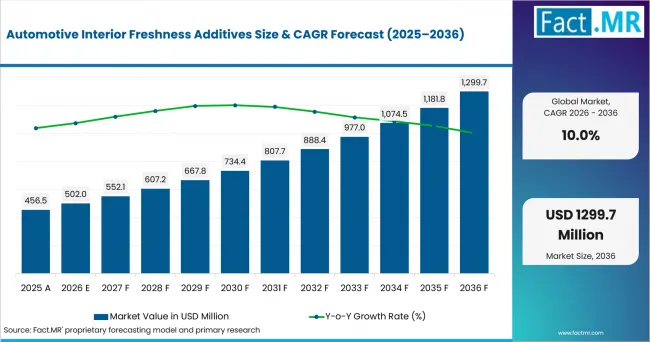
Automotive Interior Freshness Additives Value Analysis | Source: Fact.MR
What are the defining numbers behind Automotive Interior Freshness Additives Market growth?
The market offers a USD 797.7 million opportunity by 2036.
- Demand Drivers in the Market
- OEM cabin teams need odor-control additives that keep color, surface quality, and strength.
- Tier-1 molders need low-emission polymers with reliable test results. Cabin parts must meet VOC and fogging limits.
- Recycled-plastic makers need odor control in cabin parts. Additives can trap or neutralize odor.
- Key Segments Analyzed
- By Odor-Control Chemistry: Mineral adsorbent is set to hold a 30.0% share in 2026.
- By Target Odor: VOC / aldehyde is set to hold a 28.0% share in 2026.
- By Interior Polymer / Substrate: PP is expected to hold a 38.0% share in 2026.
- By Application: Automotive interiors are expected to hold a 42.0% share in 2026.
- Analyst Opinion at Fact.MR
- Shambhu Nath Jha, Principal Consultant at Fact.MR, states: “Cabin-air quality is becoming an important part of automotive material selection. OEMs and Tier-1 suppliers are evaluating odor reduction, VOC control and fogging alongside color, strength and surface quality because interior materials remain close to occupants throughout the vehicle life cycle. Mineral adsorbents, scavengers and low-emission polyurethane solutions address different parts of this requirement, while clear dosage guidance and heat-aging data help material teams qualify additives for specific cabin polymers and components.”
- Strategic Implications
- Additive makers should show results for each polymer and process temperature. This can shorten customer tests.
- Automotive compounders should separate odor masking from odor removal. They should state how each additive works.
- Tier-1 makers should test odor after heat aging. High cabin heat can release volatile compounds after production.
- OEM teams should align odor tests with VOC and fogging tests. This keeps cabin-air checks consistent.
Japan leads at 11.7% CAGR through strong vehicle production and strict cabin-quality requirements. The USA follows at 9.8% as its large vehicle base supports recurring interior-material qualification. France reaches 9.4% through new-car demand and cabin-material renewal. Germany records 8.9% as its established automotive sector supports low-emission material testing. Finland posts 7.7% as vehicle renewal and expanding EV adoption create demand for improved cabin freshness solutions.
How does the market break down by segment?
Cabin parts lead Use at 42.0%. PP leads Interior Polymer / Substrate at 38.0%.
Which Odor-Control Chemistry leads?
Mineral adsorbent is expected to account for 30.0% share in 2026.
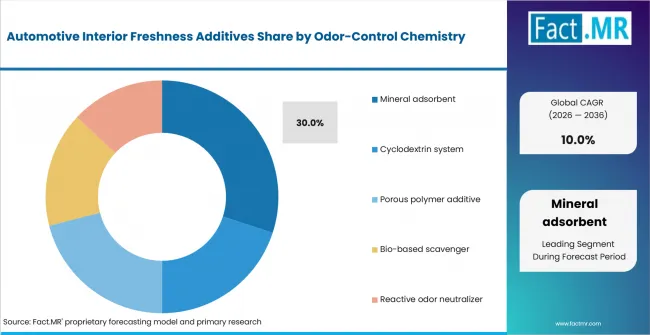
Automotive Interior Freshness Additives Analysis By Odor Control Chemistry | Source: Fact.MR
Mineral adsorbents lead because they trap odor. They can be used in compounds or masterbatches. Cyclodextrin systems trap selected organic compounds, while porous additives can reduce mineral loading. Bio-based scavengers suit renewable-material goals.
Reactive neutralizers support chemical odor removal. Buyers compare polymer compatibility, dosage, and molded-part performance. Masterbatches simplify dosing, while material teams assess odor, stiffness, color, and surface quality.
What leads the Target Odor segment?
VOC / aldehyde is projected to capture 28.0% share in 2026.
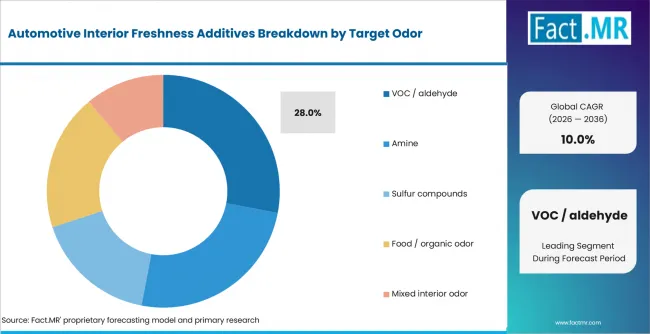
Automotive Interior Freshness Additives Analysis By Target Odor | Source: Fact.MR
VOC and aldehyde control leads because cabin tests measure emissions. Amine odors require targeted chemistry, while sulfur compounds need different scavenging systems. Recycled parts may also carry food or organic odors.
Mixed cabin odors require broader control because several interior materials can release odor simultaneously. Material teams therefore evaluate odor and emissions together during qualification.
How does Interior Polymer / Substrate shape demand?
PP is anticipated to represent 38.0% share in 2026.
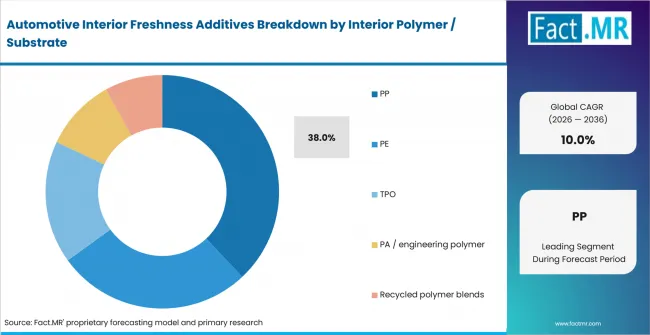
Automotive Interior Freshness Additives Analysis By Interior Polymer Substrate | Source: Fact.MR
PP leads because it is common in molded interior trim. Masterbatches also integrate effectively with PP. PE serves selected films and parts, while TPO is used in soft-touch components. PA requires heat-stable additives, and recycled blends may need additional odor control.
Avient reported in January 2025 that Maxxam reduced VOCs and fogging by up to 80% in a vehicle-cabin application. PP formulators need additives that disperse effectively while preserving part appearance.
What supports Cabin parts within Use?
Cabin parts are estimated to lead with 42.0% share in 2026.
Cabin parts lead because occupants are exposed to odors within an enclosed space. Packaging also uses odor absorbers, while consumer goods apply similar chemistry in recycled plastics. Nonwovens and industrial plastics provide additional applications.
Cabin plastics, foams, textiles, and bonded components sit close to occupants. Whole-cabin testing can therefore reveal odor issues that individual material checks may miss.
What is accelerating Automotive Interior Freshness Additives Market adoption, and what is holding it back?
Stricter cabin-air rules support demand. Complex design and testing can slow adoption.
Drivers Impact Analysis
| DRIVER | (~) % IMPACT ON CAGR | GEOGRAPHIC RELEVANCE | IMPACT TIMELINE |
|---|---|---|---|
| Stricter cabin VOC and odor rules | +1.8% | North America, Europe, East Asia | Short term (<=2 years) |
| More polymer use in vehicle cabins | +1.4% | Global | Medium term (2-4 years) |
| Low-emission polyurethane | +1.1% | Europe, East Asia | Medium term (2-4 years) |
| Use of recycled polymer blends | +0.8% | Europe, North America | Long term (>=4 years) |
| OEM cabin-quality needs | +0.6% | Global | Long term (>=4 years) |
Source: Fact.MR analysis. Updated Sep 22, 2026
Opportunity Impact Analysis
| OPPORTUNITY | (~) % IMPACT ON CAGR | GEOGRAPHIC RELEVANCE | IMPACT TIMELINE |
|---|---|---|---|
| Broad odor-control additives for recycled PP | +1.2% | Europe, North America | Medium term (2-4 years) |
| Low-aldehyde polyurethane | +0.9% | Europe, East Asia | Short term (<=2 years) |
| Polymer-specific masterbatch dosing | +0.7% | Global | Medium term (2-4 years) |
| EV cabin redesign | +0.5% | East Asia, Europe | Long term (>=4 years) |
Source: Fact.MR analysis. Updated Sep 22, 2026
Restraints Impact Analysis
| RESTRAINT | (~) % IMPACT ON CAGR | GEOGRAPHIC RELEVANCE | IMPACT TIMELINE |
|---|---|---|---|
| OEM test time and variation | -0.8% | Global | Short term (<=2 years) |
| Additive effects on color and strength | -0.6% | Global | Medium term (2-4 years) |
| Changing odor in recycled feedstock | -0.5% | Europe, North America | Medium term (2-4 years) |
| Cost pressure in high-volume cabin parts | -0.4% | Global | Long term (>=4 years) |
Source: Fact.MR analysis. Updated Sep 22, 2026
Which countries are scaling the Automotive Interior Freshness Additives Market through 2036?
- The country range spans 4.0 percentage points from 2026 to 2036.
- Japan leads the profiled countries. Domestic vehicle output supports demand for low-emission cabin parts.
- The USA has a large vehicle base and a broad auto-parts sector.
- France has large new and used car markets. This supports steady demand for cabin parts.
- Germany combines high car ownership with a large auto sector and strong parts supply.
- Finland has a smaller car market. Rising EV registrations are changing cabin part needs.
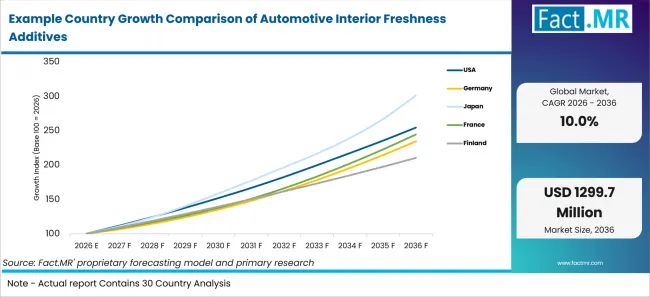
Example Country Growth Comparison Of Automotive Interior Freshness Additives | Source: Fact.MR
The report covers seven world regions.
| Country | CAGR (2026-2036) |
|---|---|
| Japan | 11.7% |
| USA | 9.8% |
| France | 9.4% |
| Germany | 8.9% |
| Finland | 7.7% |
Source: Fact.MR analysis. Updated Sep 22, 2026
What supports USA adoption?
The USA is projected to record a 9.8% CAGR through 2036, supported by its large vehicle base and recurring interior-material qualification.
The USA has a large vehicle base. FHWA reported 298 million registered motor vehicles in 2024. This supports tests for odor-control additives in PP trim, TPO parts, and cabin foams. Suppliers can support new models and vehicle updates with clear test data.
How is Germany developing demand?
Germany is expected to advance at an 8.9% CAGR through 2036 as its large car market and strict part requirements support material qualification.
Germany's auto sector supports low-emission cabin parts. KBA data show about 2.86 million new passenger-car registrations in 2025. Makers test odor, fogging, and VOC results together.
What supports Japan's growth?
Japan is anticipated to post an 11.7% CAGR through 2036, supported by vehicle production and strict cabin-quality requirements.
Japan's vehicle sector creates regular additive tests. METI reported 373,982 large passenger cars made in January 2026. Programs focus on odor after heat and long cabin use.
Makers need odor control that keeps color and strength. Stable guidance helps across plastics and foam. Heat-aging results can support wider use.
How is France scaling demand?
France is projected to expand at a 9.4% CAGR through 2036 as new-car demand and cabin-material renewal support additive use.
France supports odor-control additives in new and recycled polymers. SDES reported 1.665 million new passenger cars in 2025. Makers balance odor control with color and surface quality.
Recycled resin can have changing odor. This raises demand for additives that work across feedstock lots. Model updates also create new tests for dashboards, consoles, and trim.
What supports Finland adoption?
Finland is expected to register a 7.7% CAGR through 2036, supported by vehicle renewal and expanding EV adoption.
Finland has a smaller car market. Vehicle renewal still supports selected additive demand. Statistics Finland reported 71,890 new passenger cars in Mainland Finland in 2025. Nordic programs value low emissions and stable cabin odor.
Freshness additives can serve PP, TPO, and other cabin compounds. EV growth may raise focus on cabin quality. Makers can compete with clear data and stable results.
Who leads the Automotive Interior Freshness Additives Market?
Avient, BASF, Clariant, Evonik, and Tosaf offer parts for low-emission vehicle cabins. BASF introduced Lupragen® N 208 in December 2025. It is a low-VOC catalyst for polyurethane foams used in dashboards and armrests.
The catalyst becomes part of the polyurethane network. This can help limit VOCs linked with odor. Makers also offer parts for polymer fit and odor control.
Which companies are the key providers?
Key providers include Avient, BASF, Clariant, Evonik, and Tosaf.
- Avient
- BASF
- Clariant
- Evonik
- Tosaf
Bibliography
- BASF. (2025, December 8). BASF introduces low-VOC polyurethane catalyst Lupragen® N 208.
- Statistics Finland. (2026, February 20). In 2025 a total of 71,890 new passenger cars were registered in Mainland Finland.
- Didou, O., & Limousin, F. (2026, February 11). Immatriculations de voitures en 2025 : le marché du neuf baisse, celui de l’occasion résiste. Service des données et études statistiques.
- Ministry of Economy, Trade and Industry. (2026, March 19). Indices of industrial production.
- Kraftfahrt-Bundesamt (KBA). (2026, January 8). FZ 10 - Jahr 2025 - Neuzulassungen von Personenkraftwagen nach Marken und Modellreihen [Data set].
- Federal Highway Administration. (2026). Our Nation’s Highways 2026: Vehicles.
- Avient Corporation. (2025, January 30). Cleaner and safer internal automotive parts.
- European Parliament. (2026, June 18). New rules for a more sustainable EU automotive sector.
- Council of the European Union. (2025, June 17). Circular economy: Council adopts position on the recycling of vehicles at the end of their life.
This Report Addresses
- The report explains where odor-control additives are used in cabin plastics, foams, and related parts.
- The segment review shows the leading chemistry and odor target. It also explains the main polymer and use groups.
- The country review compares five countries. It uses the stated CAGRs and official auto data.
- The competitive review reviews makers of low-VOC parts, odor-control masterbatches, polyurethane additives, and cabin systems.
What does the market cover?
The market covers additives that reduce cabin odor or chosen VOCs in plastics, foams, and nonwovens.
The assessment covers PP and TPO trim, engineering plastics, polyurethane seats, and recycled blends. Related cabin materials are also reviewed.
What is included in the scope?
The scope includes mineral adsorbents, cyclodextrin systems, porous polymer additives, bio-based scavengers, and reactive odor neutralizers. These may be supplied in compounds or masterbatches.
The scope also includes odor control in recycled polymer blends. Related inputs include masterbatches and vehicle elastomers.
What is excluded from the scope?
The scope excludes air fresheners, fragrances, HVAC filters, air cleaners, and surface cleaners. General stabilizers are excluded unless they control odor, VOCs, or aldehydes.
How Was the Analysis Built?
The analysis draws on 120+ sources, 35+ company portfolios, 25+ countries, and more than 20 industry interviews.
- Primary Research: Primary research includes discussions with manufacturers, service providers, technology developers, distributors, end users, and subject-matter experts. These conversations examine purchasing priorities, product adoption, operational challenges, approval requirements, competitive positioning, and the factors that influence wider market acceptance.
- Desk Research: Desk research covers government statistics, regulatory publications, company filings, trade data, technical studies, industry associations, standards, public policy, and other authoritative sources. Every source used in the analysis is documented in the bibliography.
- Market Sizing and Forecasting: Market estimates combine historical performance, demand indicators, pricing and volume trends, segment shares, company participation, country-level growth, adoption patterns, investment activity, and barriers to market expansion.
- Data Validation and Update Cycle: Findings are validated by comparing primary interviews with public data, company activity, regulatory changes, trade patterns, and industry developments. Regular updates review new product launches, capacity changes, partnerships, approvals, and shifts in commercial adoption.
Segmentation
What is the report's scope and coverage?
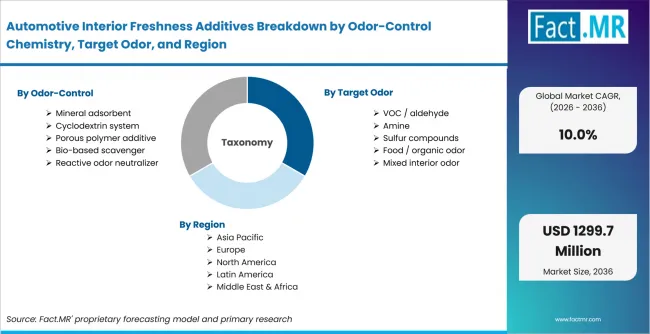
Automotive Interior Freshness Additives Breakdown By Odor Control Chemistry, Target Odor, And Region | Source: Fact.MR
| Attribute | Details |
|---|---|
| Units | USD million |
| Market Scope | Additives that reduce, trap, or neutralize odor and selected volatile emissions in vehicle cabin plastics, foams, nonwovens, and related materials. |
| Odor-Control Chemistry | Mineral adsorbent; Cyclodextrin system; Porous polymer additive; Bio-based scavenger; Reactive odor neutralizer |
| Target Odor | VOC / aldehyde; Amine; Sulfur compounds; Food / organic odor; Mixed interior odor |
| Polymer / Substrate | PP; PE; TPO; PA / engineering polymer; Recycled polymer blends |
| Use | Automotive interiors; Packaging; Consumer goods; Nonwovens; Industrial plastics |
| Regions | North America; Latin America; Western Europe; Eastern Europe; East Asia; South Asia & Pacific; Middle East & Africa |
| Countries Covered | USA; Germany; Japan; France; Finland |
| Key Companies | Avient; BASF; Clariant; Evonik; Tosaf |
| Forecast | 2026 to 2036 |
| Method | Demand and supplier review using fixed market inputs, official auto data, company checks, and use analysis. |
Source: Fact.MR analysis. Updated Sep 22, 2026
How is the market segmented?
-
By Odor-Control Chemistry
- Mineral adsorbent
- Cyclodextrin system
- Porous polymer additive
- Bio-based scavenger
- Reactive odor neutralizer
-
By Target Odor
- VOC / aldehyde
- Amine
- Sulfur compounds
- Food / organic odor
- Mixed interior odor
-
By Interior Polymer / Substrate
- PP
- PE
- TPO
- PA / engineering polymer
- Recycled polymer blends
-
By Application
- Automotive interiors
- Packaging
- Consumer goods
- Nonwovens
- Industrial plastics
-
By Region
- North America
- Latin America
- Western Europe
- Eastern Europe
- East Asia
- South Asia & Pacific
- Middle East & Africa
Frequently Asked Questions
How big is the market in 2026?
What is the market CAGR from 2026 to 2036?
Which odor-control chemistry leads the market?
Which use leads the market?
Who are the leading firms in the market?
Who worked on this report


Preview the report firsthand - request a free sample
Free SampleGet the brochure for pricing and purchase details
Download PDF