- Market Value (2025): USD 8.01 Bn
- Estimated Value (2026): USD 8.93 Bn
- Forecast Value (2036): USD 26.6 Bn
- CAGR (2026-2036): 11.5%
What is the Automotive SCC (Smart Cruise Control) Market forecast to be worth by 2036?
USD 8.9 billion in 2026 to USD 26.6 billion by 2036, at an 11.5% CAGR.
- The automotive SCC market reached USD 8.01 billion in 2025.
- As per Fact.MR analysis, sales are projected to increase from USD 8.93 billion in 2026 to USD 26.6 billion by 2036 as automakers expand factory-installed adaptive speed control.
- The market is forecast to record a 11.5% CAGR from 2026 to 2036 as automakers integrate radar-guided distance control into more passenger-car platforms.
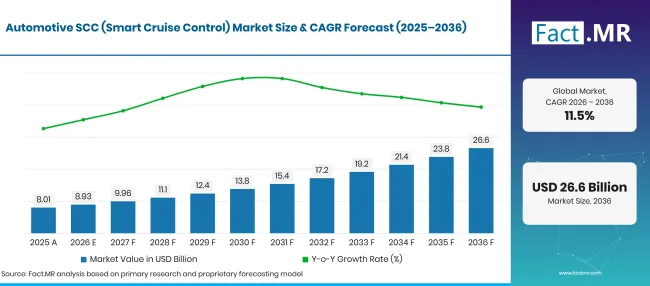
Factmr Automotive Scc Smart Cruise Control Market Forecast Global | Source: Fact.MR
| Year | Basis | Market Value (USD billion) |
|---|---|---|
| 2025 | Actual | 8.01 |
| 2026 | Estimate | 8.93 |
| 2036 | Forecast | 26.6 |
| CAGR 2026 to 2036 | Forecast period | 11.5% |
Source: Fact.MR analysis. Updated Oct 19, 2026
What are the defining numbers behind Automotive SCC Market growth?
USD 17.7 billion in additional market value between 2026 and 2036, led by sensors and passenger cars.
- Demand Drivers in the Market
- Vehicle manufacturers use front radar and camera information to manage following distance. Shared sensing hardware makes it easier to offer cruise functions alongside other driver-assistance features without building a separate sensor package.
- Passenger-car teams aim for smooth speed changes as traffic conditions shift. Drivers notice how naturally a vehicle slows down and speeds up again, making software calibration an important part of system selection.
- Fleet operators examine comfort on long journeys and the cost of unexpected downtime. Commercial-vehicle integration therefore places particular weight on dependable braking response and service access.
- Automotive engineering groups evaluate equipment against collision-warning functions and vehicle safety goals. In January 2025, NHTSA’s PARTS study reported a 49% reduction in front-to-rear crashes associated with automatic emergency braking across the model-year 2015–2023 vehicles analyzed [1].
- Key Segments Analyzed
- By Component: Sensors hold 42.3% share in 2026, reflecting their role in measuring distance and relative speed.
- By Vehicle Type: Passenger Cars hold 68.5% share in 2026, supported by factory installation across higher-volume car lines.
- By Technology: Adaptive Cruise Control accounts for 71.2% share in 2026, because it directly adjusts speed to the vehicle ahead.
- By Sales Channel: OEMs capture 81.2% share in 2026, as calibration and brake-system integration typically take place during vehicle development.
- Analyst Opinion at Fact.MR
- Shambhu Nath Jha, Principal Consultant at Fact.MR, states, “Automotive SCC suppliers are assessed on consistent following and cut-in performance. A design that shares radar information with other assistance functions is likely to improve the case for factory fitment.”
- Strategic Implications
- Automakers should test cruise behaviour on their intended vehicle platforms, including braking transitions and sensor visibility in real traffic.
- Radar manufacturers must show stable object tracking and compatible interfaces, allowing vehicle teams to reuse sensing hardware across related functions.
- Software teams should prioritize predictable acceleration and deceleration, since an uncomfortable control response can weaken driver acceptance even when detection is accurate.
- Service networks need repeatable calibration procedures after bumper or sensor repairs, particularly for vehicles whose SCC relies on front-mounted radar.
The United Kingdom is expected to grow at a 13.8% CAGR and Japan 13.5% through 2036. Brazil follows at 11.1%, the United States at 10.3%, and Germany at 9.8%. Each country has different vehicle sales channels and platform requirements that influence factory installation of adaptive cruise control.
How does the Automotive SCC (Smart Cruise Control) Market break down by segment?
Sensors hold 42.3% share in 2026, while Passenger Cars lead with 68.5% share.
Which Component holds the stated share?
Sensors hold 42.3% share in 2026.
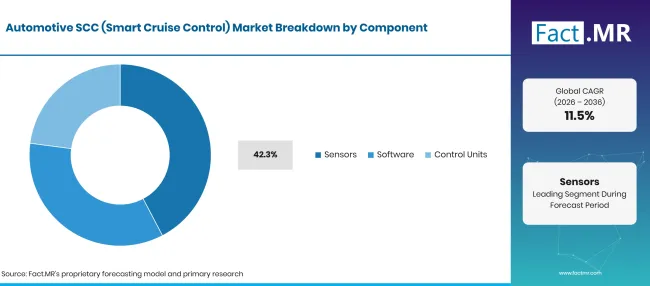
Factmr Automotive Scc Smart Cruise Control Market Breakdown Component | Source: Fact.MR
| Component holds the stated share | Share (2026) |
|---|---|
| Sensors (Leading segment) | 42.3% |
| Other segments combined | 57.7% |
| Total | 100.0% |
Source: Fact.MR analysis. Updated Oct 19, 2026
Sensors identify traffic ahead and measure closing speed before the controller changes throttle or brake inputs. Front radar is especially useful for following-distance control, while cameras helps classify lanes and nearby vehicles. Bosch describes sensor fusion as a way of improving object tracking for adaptive cruise control. Software handles tracking and response rules, while control units connect the decision to vehicle systems.
What leads the Vehicle Type segment?
Passenger Cars account for 68.5% share in 2026.
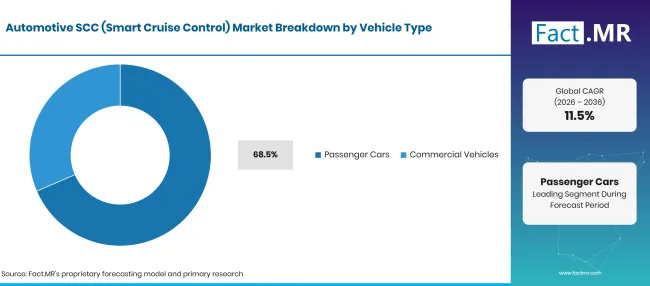
Factmr Automotive Scc Smart Cruise Control Market Breakdown Vehicle Type | Source: Fact.MR
| Vehicle Type segment | Share (2026) |
|---|---|
| Passenger Cars (Leading segment) | 68.5% |
| Other segments combined | 31.5% |
| Total | 100.0% |
Source: Fact.MR analysis. Updated Oct 19, 2026
Passenger cars provide the broadest fitment route because a single SCC design can be adapted across several trims on a shared vehicle platform. Drivers often encounter stop-start traffic and motorway travel in the same week, making consistent speed changes a visible product feature. Commercial vehicles also use adaptive cruise functions, particularly on longer routes where following distance is part of daily driving.
How does Technology shape system sales?
Adaptive Cruise Control leads with 71.2% share in 2026.
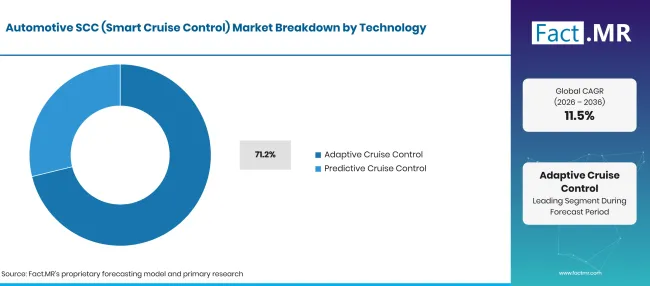
Factmr Automotive Scc Smart Cruise Control Market Breakdown Technology | Source: Fact.MR
| Technology | Share (2026) |
|---|---|
| Adaptive Cruise Control (Leading segment) | 71.2% |
| Other segments combined | 28.8% |
| Total | 100.0% |
Source: Fact.MR analysis. Updated Oct 19, 2026
Adaptive cruise control changes speed in response to the vehicle in front while keeping the gap selected by the driver. Predictive cruise control adds road or route information where the vehicle has the necessary data and controls. These categories should be distinguished from ordinary fixed-speed cruise control, which cannot automatically maintain a following gap.
Which Sales Channel accounts for most purchases?
OEM holds 81.2% share in 2026.
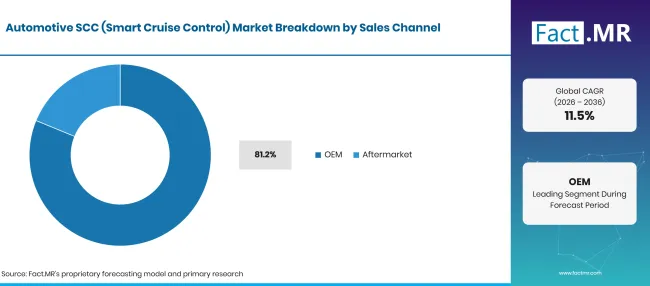
Factmr Automotive Scc Smart Cruise Control Market Breakdown Sales Channel | Source: Fact.MR
| Sales Channel accounts for most purchases | Share (2026) |
|---|---|
| OEM (Leading segment) | 81.2% |
| Other segments combined | 18.8% |
| Total | 100.0% |
Source: Fact.MR analysis. Updated Oct 19, 2026
Original equipment manufacturers choose cruise sensors and software while a vehicle model is being designed. Factory installation allows the brake and powertrain controls to be checked together before customer delivery. The aftermarket covers compatible replacements and selected retrofits, although vehicle-specific programming and calibration limit straightforward installation. Repair workshops also need suitable equipment to restore sensor alignment after front-end work.
What is accelerating Automotive SCC (Smart Cruise Control) Market adoption, and what is holding it back?
Factory ADAS integration supports SCC adoption; validation cost and sensor upkeep limit deployment.
Drivers Impact Analysis
| DRIVER | (~) % IMPACT ON CAGR | GEOGRAPHIC RELEVANCE | IMPACT TIMELINE |
|---|---|---|---|
| Factory driver-assistance integration | +1.0% | Global | Medium term (2–4 years) |
| Radar and camera reuse | +0.8% | Europe, Japan | Medium term (2–4 years) |
| Motorway driving comfort | +0.7% | Global | Short term (<= 2 years) |
| Shared vehicle platforms | +0.5% | Global | Medium term (2–4 years) |
| Commercial fleet applications | +0.4% | North America, Europe | Long term (>= 4 years) |
Source: Fact.MR analysis. Updated Oct 19, 2026
Opportunity Impact Analysis
| OPPORTUNITY | (~) % IMPACT ON CAGR | GEOGRAPHIC RELEVANCE | IMPACT TIMELINE |
|---|---|---|---|
| Predictive route control | +0.8% | Europe, Japan | Medium term (2–4 years) |
| Mainstream passenger-car trims | +0.6% | Global | Medium term (2–4 years) |
| Radar calibration services | +0.5% | North America, Europe | Short term (<= 2 years) |
| Commercial-vehicle packages | +0.4% | Global | Long term (>= 4 years) |
Source: Fact.MR analysis. Updated Oct 19, 2026
Restraints Impact Analysis
| RESTRAINT | (~) % IMPACT ON CAGR | GEOGRAPHIC RELEVANCE | IMPACT TIMELINE |
|---|---|---|---|
| Complex vehicle validation | -0.8% | Global | Medium term (2–4 years) |
| Sensor installation costs | -0.6% | Global | Short term (<= 2 years) |
| Weather and visibility limits | -0.5% | Global | Medium term (2–4 years) |
| Post-repair calibration | -0.4% | Global | Short term (<= 2 years) |
Source: Fact.MR analysis. Updated Oct 19, 2026
Which countries are scaling the Automotive SCC (Smart Cruise Control) Market through 2036?
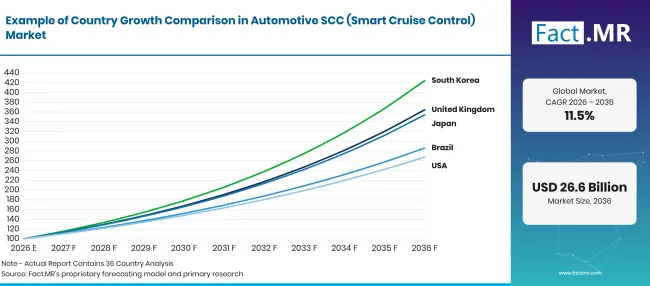
Factmr Automotive Scc Smart Cruise Control Market Growth Index | Source: Fact.MR
| Country | CAGR (2026–2036) |
|---|---|
| United Kingdom | 13.8% |
| Japan | 13.5% |
| Brazil | 11.1% |
| United States | 10.3% |
| Germany | 9.8% |
Source: Fact.MR analysis. Updated Oct 19, 2026
How is the United Kingdom expanding SCC fitment?
13.8% CAGR, shaped by vehicle-platform integration.
United Kingdom manufacturers and importers offer adaptive cruise control through factory equipment packages, so vehicle registrations help describe the pool of new cars that may carry the system. The Department for Transport reported in April 2026 that 2,617,000 vehicles were first registered in the UK during 2025 [5]. In September 2026, the department recorded 682,000 first registrations during the second quarter of 2026 [6].
What supports Japan’s SCC growth outlook?
13.5% CAGR, shaped by vehicle-platform integration.
Japanese vehicle makers place particular weight on gentle acceleration and predictable braking when developing cruise-control functions for passenger cars. Radar and camera inputs must work together when the vehicle ahead changes lanes. The Japan Ministry of Land, Infrastructure, Transport and Tourism publishes national vehicle-stock and vehicle-class data through its 2025 automotive statistical series [7].
How is Brazil developing the SCC market?
11.1% CAGR, shaped by vehicle-platform integration.
Brazilian automakers compare the cost of radar-based cruise control with the equipment package offered at each vehicle price level. The Energy Research Office reported 2.549 million light-vehicle registrations for 2025 in its 2026 outlook [2]. Vehicle programs are the main route for factory SCC installation. Engineers also have to consider service access after collision repairs because front sensor alignment affects vehicle-following performance.
What shapes SCC sales in the United States?
10.3% CAGR, shaped by vehicle-platform integration.
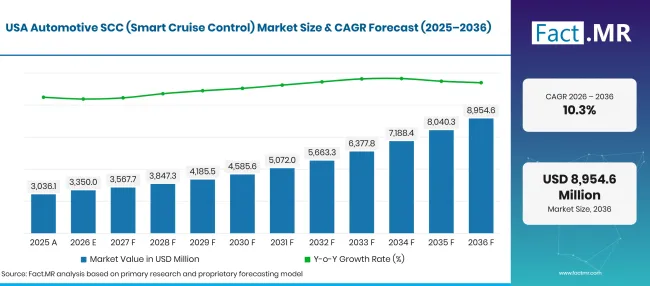
Factmr Automotive Scc Smart Cruise Control Market Forecast Usa | Source: Fact.MR
US drivers commonly encounter changing highway traffic, where cruise control that maintains a selected following distance has a clear practical use. The Federal Highway Administration reported approximately 3.3 trillion vehicle-miles of travel on US public roads in its 2026 review [3]. High road use gives automakers a reason to test comfort and braking response across different traffic conditions. Radar alignment also affects repair and service costs.
Why is Germany an established SCC engineering base?
9.8% CAGR, shaped by vehicle-platform integration.
German automotive engineers often select cruise-control sensors at the vehicle-platform stage so the same parts can serve several equipment versions. In January 2026, the German Automotive Industry Association reported that German plants produced 4.15 million passenger cars during 2025 [8]. The Federal Statistical Office also reported approximately 2.0 million new passenger cars exported during January to July 2026 [4]. Production and exports shape vehicle programs that may specify SCC.
Who leads the Automotive SCC (Smart Cruise Control) Market?
Bosch, Denso and other automotive electronics suppliers serve SCC-related functions.
Robert Bosch GmbH describes adaptive cruise control systems that use front radar to adjust speed and following distance. Denso Corporation is active in vehicle sensing and electronic control. Supplier selection depends on the automaker’s full vehicle architecture, not a single radar module alone.
Valeo SE, ZF Friedrichshafen AG, Aptiv PLC and Hyundai Mobis participate in the wider driver-assistance supply chain. Magna International Inc. and Astemo Ltd. also serve vehicle electronics or assistance systems. Mando Corporation is commonly associated with HL Mando and should be treated under its current corporate identity where relevant.
Which companies are the key providers?
Key companies include Robert Bosch GmbH; Denso Corporation; Valeo SE; ZF Friedrichshafen AG; Aptiv PLC; Hyundai Mobis; Magna International Inc.; Mando Corporation (HL Mando); Astemo Ltd.
- Robert Bosch GmbH
- Denso Corporation
- Valeo SE
- ZF Friedrichshafen AG
- Aptiv PLC
- Hyundai Mobis
- Magna International Inc.
- Mando Corporation (HL Mando)
- Astemo Ltd.
Bibliography
- [1] National Highway Traffic Safety Administration. (2025, January). PARTS: Partnership for Analytics Research in Traffic Safety—Latest study findings.
- [2] Empresa de Pesquisa Energética. (2026, March 9). Demanda de energia dos veículos leves: 2026–2035.
- [3] Federal Highway Administration. (2026). Our Nation’s Highways 2026: Travel.
- [4] Statistisches Bundesamt (Destatis). (2026, September 21). Exports of new passenger cars down 4.0% year on year in the first seven months of 2026.
- [5] Department for Transport. (2026, April 29). Vehicle licensing statistics, United Kingdom: 2025.
- [6] Department for Transport. (2026, September 23). Vehicle licensing statistics: April to June 2026.
- [7] Ministry of Land, Infrastructure, Transport and Tourism. (2025). 数字でみる自動車2025 [Automobiles in figures 2025].
- [8] German Association of the Automotive Industry. (2026, January 5). Passenger car production in 2025 slightly above previous year’s level.
This Report Answers
- The analysis examines the selection of radar sensors and control software in SCC vehicle programs.
- Component comparisons explain the role of sensors in adaptive speed control.
- Vehicle-type coverage separates passenger-car specification from commercial-vehicle use.
- The country outlook compares the United Kingdom, Japan, Brazil, United States and Germany.
- Competitive analysis reviews automotive electronics suppliers involved in cruise-related functions.
- Sales-channel coverage explains why original equipment fitment remains the main purchase route.
What does the Automotive SCC Market cover?
The market covers vehicle-integrated smart cruise control systems that automatically adjust driving speed according to traffic ahead. It includes compatible sensing equipment and the software or controllers required for that function. Conventional fixed-speed cruise control falls outside the core definition unless included within a qualifying adaptive package.
What is included in the scope?
SCC system sales cover original equipment packages and compatible aftermarket components directly associated with adaptive distance and speed control. Passenger cars and commercial vehicles are included where the function adjusts speed in response to detected traffic. Technology categories distinguish adaptive cruise from predictive packages that add route-related information. The scope is limited to equipment and software with an SCC function, while separate driver-assistance features enter only where they share an integrated package.
What is excluded from the scope?
The scope excludes basic speed-hold cruise systems without automated following-distance control. Standalone parking aids and unrelated cabin electronics are also outside the comparison. A braking or camera product is included only when it forms part of a cruise-control package or its directly associated component supply.
How Was the Analysis Built?
The analysis draws on 120+ sources, 35+ company portfolios, 25+ countries, and more than 20 industry interviews.
- Primary Research: Primary research includes discussions with manufacturers, service providers, technology developers, distributors, end users, and subject-matter experts. These conversations examine purchasing priorities, product adoption, operational challenges, approval requirements, competitive positioning, and the factors that influence wider market acceptance.
- Desk Research: Desk research covers government statistics, regulatory publications, company filings, trade data, technical studies, industry associations, standards, public policy, and other authoritative sources. Every source used in the analysis is documented in the bibliography.
- Market Sizing and Forecasting: Market estimates combine historical performance, demand indicators, pricing and volume trends, segment shares, company participation, country-level growth, adoption patterns, investment activity, and barriers to market expansion.
- Data Validation and Update Cycle: Findings are validated by comparing primary interviews with public data, company activity, regulatory changes, trade patterns, and industry developments. Regular updates review new product launches, capacity changes, partnerships, approvals, and shifts in commercial adoption.
Segmentation
What is the report’s scope and coverage?
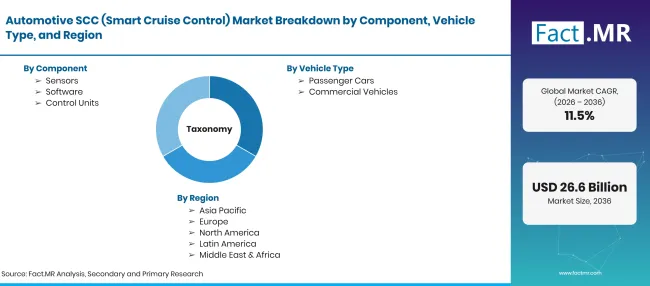
Factmr Automotive Scc Smart Cruise Control Market Taxonomy | Source: Fact.MR
| Attribute | Details |
|---|---|
| Quantitative Units | USD billion in 2026 to USD billion in 2036, at CAGR |
| Market Definition | Integrated adaptive speed-and-distance control systems for passenger and commercial vehicles |
| Component | Sensors; Software; Control Units |
| Vehicle Type | Passenger Cars; Commercial Vehicles |
| Technology | Adaptive Cruise Control; Predictive Cruise Control |
| Sales Channel | OEM; Aftermarket |
| Regions Covered | North America; Latin America; Western Europe; Eastern Europe; East Asia; South Asia & Pacific; Middle East & Africa |
| Countries Covered | Germany; Brazil; United States; United Kingdom; Japan |
| Companies Profiled | Robert Bosch GmbH; Denso Corporation; Valeo SE; ZF Friedrichshafen AG; Aptiv PLC; Hyundai Mobis; Magna International Inc.; Mando Corporation (HL Mando); Astemo Ltd. |
| Forecast Period | 2026 to 2036 |
| Approach | Technology scope, vehicle applications, published automotive data and supplier product review |
Source: Fact.MR analysis. Updated Oct 19, 2026
How is the market segmented?
-
By Component
- Sensors
- Software
- Control Units
-
By Vehicle Type
- Passenger Cars
- Commercial Vehicles
-
By Technology
- Adaptive Cruise Control
- Predictive Cruise Control
-
By Sales Channel
- OEM
- Aftermarket
-
By Region
- North America
- Latin America
- Western Europe
- Eastern Europe
- East Asia
- South Asia & Pacific
- Middle East & Africa
Frequently Asked Questions
How big is the Automotive SCC (Smart Cruise Control) Market in 2026?
What is the CAGR of the Automotive SCC (Smart Cruise Control) Market from 2026 to 2036?
Which component leads the Automotive SCC (Smart Cruise Control) Market?
Which vehicle type leads the Automotive SCC (Smart Cruise Control) Market?
Who are the leading companies in the Automotive SCC (Smart Cruise Control) Market?
Who worked on this report


Preview the report firsthand - request a free sample
Free SampleGet the brochure for pricing and purchase details
Download PDF