Autonomous Vehicle Teleoperation Services Market Size, Share, Growth and Forecast (2026 - 2036)
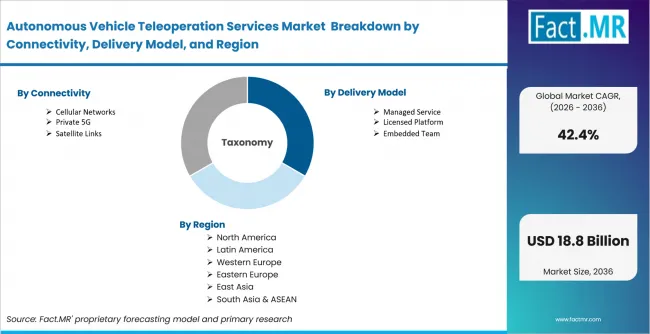
The Autonomous Vehicle Teleoperation Services Market is segmented by Service Type, by Vehicle Type, by Operating Domain, by Customer Type, by Delivery Model, by End Use, by Connectivity, and Region. Forecast for 2026 to 2036.
What is the autonomous vehicle teleoperation services market forecast to be worth by 2036?
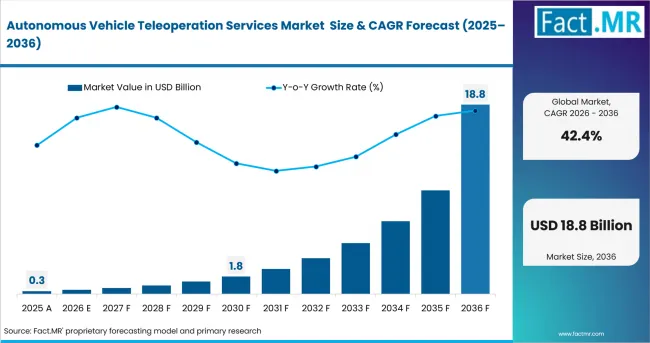
USD 0.55 billion in 2026 to USD 18.80 billion by 2036, at 42.4% CAGR.
- The autonomous vehicle teleoperation services market crossed a valuation of USD 0.39 billion in 2025.
- Demand is expected to increase from USD 0.55 billion in 2026 to USD 18.80 billion by 2036.
- The market is forecast to record a 42.4% CAGR from 2026 to 2036 as remote assistance becomes part of driverless fleet operations.
What are the defining numbers behind autonomous vehicle teleoperation services growth?
USD 18.25 billion absolute opportunity by 2036. Germany, the United Kingdom and the United States lead the country view.
- Demand Drivers in the Market
- Robotaxi fleets need remote help when vehicles pause around blocked lanes, emergency responders and curbside pickup conflicts.
- Logistics yards need supervised autonomy because short routes and controlled access reduce the risk of early commercial deployment.
- Regulators are asking for clearer human-oversight processes before driverless passenger and freight services move from pilots to paid use.
- Connectivity planning supports service demand because remote driving needs low-latency video, backup links and secure event logs.
- Key Segments Analyzed
- By Connectivity: Cellular Networks are expected to account for 52.0% of the market share in 2026, as public-road autonomous fleets are anticipated to rely on existing carrier coverage before dedicated private-network deployments become economically viable.
- By Delivery Model: Managed Service is projected to capture 44.0% of the market in 2026, driven by early adopters preferring fully supported solutions that combine platform access with operational expertise.
- By Operating Domain: Urban Roads are estimated to hold 43.0% share in 2026, owing to the high frequency of curbside interactions, complex traffic conditions, and temporary road disruptions that require remote intervention.
- By Vehicle Type: Robotaxis are likely to represent 41.0% of the market in 2026, supported by the growing need for rapid incident management across urban ride-hailing operations.
- By End Use: Robotaxi Support is forecast to secure 39.0% share in 2026, as maintaining passenger experience and service continuity increasingly depends on quick recovery from operational interruptions.
- By Service Type: Remote Assistance is anticipated to contribute 38.0% of total market revenue in 2026, reflecting the continued preference for human-guided decision support before large-scale deployment of direct tele-driving capabilities.
- By Customer Type: Fleet Operators are set to account for 36.0% of the market share in 2026, since responsibility for vehicle availability, customer response, and day-to-day operational performance primarily rests with fleet owners and operators.
- By Geography: Germany is expected to register a CAGR of 49.5% through 2036, supported by a relatively well-defined regulatory framework for remote vehicle operation that provides teleoperation service providers with a clearer commercialization pathway.
- Analyst Opinion
- Shambhu Nath Jha, Principal Analyst at Fact.MR states, "Teleoperation now acts as the service desk for autonomous mobility. I see buyers asking three practical questions. Who answers the vehicle, how quickly that answer arrives and whether regulators can audit the process."
- Strategic Implications
- Autonomous vehicle developers should design remote-assistance workflows before scaling city fleets.
- Fleet operators need service-level terms for response time, operator training and incident documentation.
- Teleoperation providers should build evidence around latency, cybersecurity and handoff procedures.
- Logistics-site operators can use private yards as the first commercial route before public-road freight expands.
Teleoperation becomes billable when an autonomous vehicle needs human context during blocked lanes and work zones. Unprotected turns or site exceptions create the same support need. Waymo reported more than 250,000 paid trips each week in May 2025. The company later described remote assistance as advice rather than control in February 2026.
Germany and the United Kingdom moved the legal base closer to commercial use. Germany prepared a remote-driving framework for public streets. The United Kingdom moved driverless pilot timing to spring 2026 and framed the Automated Vehicles Act as the route to full deployment rules from the second half of 2027.
How does the autonomous vehicle teleoperation services market break down by segment?
Cellular Networks lead at 52.0%. Managed Service follows with 44.0% share in 2026.
Which connectivity model dominates?
Cellular Networks hold 52.0% share in 2026.
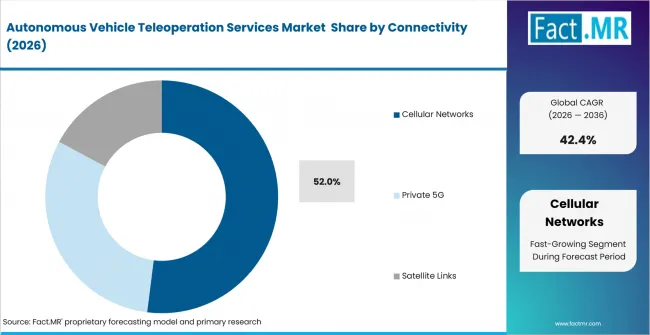
Cellular Networks are expected to hold 52.0% share in 2026 because public-road fleets need wide carrier coverage before private 5G becomes common. Ports and logistics yards still use private networks when the operator controls gates and vehicle movement. This keeps telematics control units important because they carry vehicle health and exception status into the remote-operations center.
Which delivery model dominates?
Managed Service holds 44.0% share in 2026.
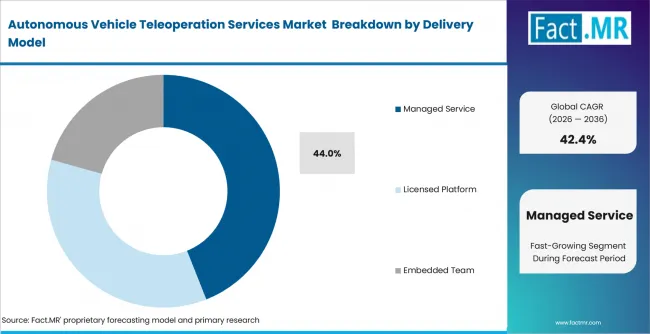
Managed Service is projected to account for 44.0% share in 2026 because early buyers need trained operators along with the platform. Monitoring, staffing and response procedures are usually purchased together during the first deployment phase. Licensed platforms are expected to gain share later as large fleet owners build internal control rooms and buy fleet management software for their own teams.
Which operating domain dominates?
Urban Roads hold 43.0% share in 2026.
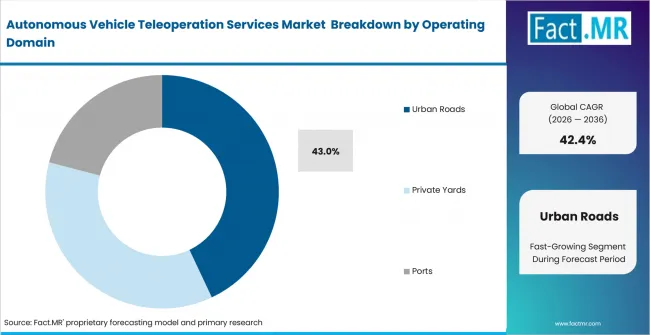
Urban Roads are forecast to account for 43.0% share in 2026 because city fleets face mixed traffic and curbside service points. Pedestrians, emergency vehicles and roadwork create more exception cases than fenced yards. Better object detection from automotive LiDAR can reduce unclear vehicle states but does not remove the need for human review.
Which vehicle type dominates?
Robotaxis hold 41.0% share in 2026.
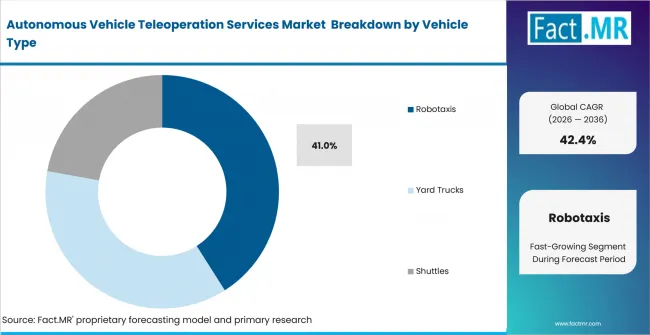
Robotaxis are likely to capture 41.0% share in 2026 because ride-hailing fleets operate for longer daily hours than most controlled pilots. A paused robotaxi also creates a direct rider-service issue when the passenger is waiting. The same supervised operating path supports autonomous trucks as freight companies move from staffed testing to monitored highway lanes.
Which end use dominates?
Robotaxi Support holds 39.0% share in 2026.
Robotaxi Support is estimated to hold 39.0% share in 2026 because passenger-facing fleets need fast recovery when vehicles stop near pickup points. Closed-site fleets create earlier safety cases because routes and access points are easier to control. Yard operations connect this model with automated guided vehicles when trailers and loading bays need remote coordination.
Which service type dominates?
Remote Assistance holds 38.0% share in 2026.
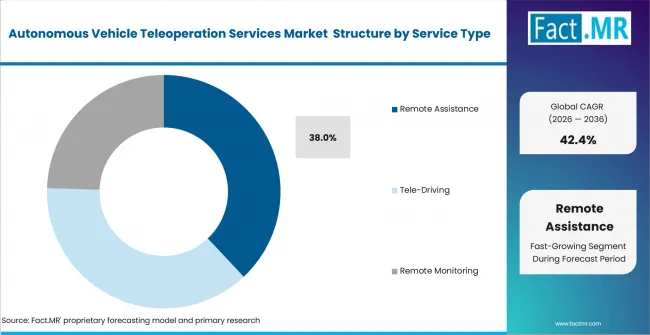
Remote Assistance is expected to hold 38.0% share in 2026 because most autonomous vehicles need human context before they need direct tele-driving. Waymo describes remote assistance as advice rather than control. The vehicle remains responsible for motion while the operator helps interpret blocked lanes and responder instructions. This places remote assistance closer to vehicle-to-everything communication support than full remote driving in most public-road cases.
Which customer type dominates?
Fleet Operators hold 36.0% share in 2026.
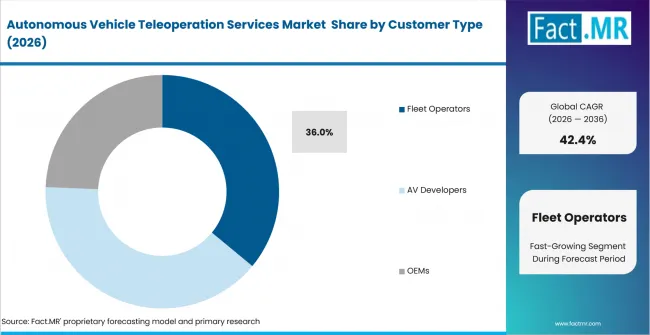
Fleet Operators are projected to hold 36.0% share in 2026 because uptime and service recovery sit with the company running the vehicle. Developers may own the autonomy stack but fleet operators manage rider complaints and missed freight windows. This makes teleoperation a daily operations layer for AV fleets rather than only a technical support function.
What is accelerating autonomous vehicle teleoperation services demand, and what is holding it back?
Robotaxi scale and remote-driving rules support demand. Latency exposure and liability allocation restrain wider use.
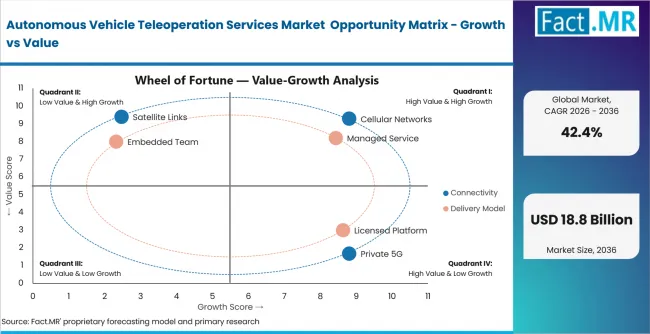
Commercial AV fleets are moving from test routes into daily service, which increases the need for supervised exception handling. Robotaxis and autonomous trucks meet blocked lanes, emergency responders and uncertain curbside instructions during normal operations. Remote-assistance teams help vehicles resolve these events without sending field staff to every stop location. Germany and the United Kingdom also give suppliers clearer legal pathways, which makes teleoperation easier to price as a service layer.
Expansion is limited by the operating risk created when a person influences an autonomous vehicle from a distance. Network delay can affect response quality during time-sensitive road events, especially when the vehicle needs immediate instruction. Liability can also become unclear when the vehicle, fleet operator and teleoperation provider share decision responsibility. Remote operation can fail commercially if latency or video quality is weak. Operator workload and cyber controls need proof before large contracts move ahead. The National Highway Traffic Safety Administration recall covering 3,871 Waymo vehicles in June 2026 shows why construction-zone handling and operating-domain limits remain central to service design.
Where do the biggest autonomous vehicle teleoperation services opportunities sit?
Robotaxi remote assistance, logistics-yard teleoperation and regulator-ready event response.
- Robotaxi Remote Assistance: Providers can sell operator coverage, event triage and audit logs to fleets that need high uptime.
- Logistics-Yard Teleoperation: Private sites give providers a practical route into autonomous yard vehicles because routes are shorter and the operator controls access.
- Regulator-Ready Event Response: Remote-operation records can become part of safety review when fleets use over-the-air vehicle control platforms to update behavior after deployment.
Which countries are scaling autonomous vehicle teleoperation services fastest?
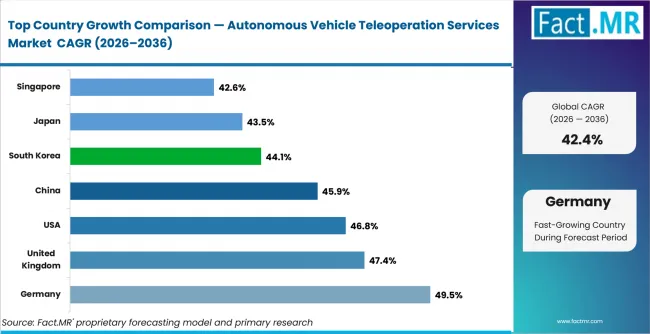
Germany 49.5% and United Kingdom 47.4% lead the country view. United States 46.8%, China 45.9% and South Korea 44.1% follow. Japan 43.5% and Singapore 42.6% complete the top seven.
Based on regional analysis, the autonomous vehicle teleoperation services market is segmented into North America and Western Europe. East Asia and South Asia and Pacific are also covered. Latin America and Middle East and Africa complete the regional scope.
.webp)
| Country | CAGR |
|---|---|
| Germany | 49.5% |
| United Kingdom | 47.4% |
| United States | 46.8% |
| China | 45.9% |
| South Korea | 44.1% |
| Japan | 43.5% |
| Singapore | 42.6% |

What powers Germany’s lead?
49.5% CAGR, supported by remote-driving rules and logistics automation demand.
Germany moved teleoperation from a technical trial topic into a road-use category. The remote-driving framework gives providers a way to design services around permission, operator qualification and documentation. FERNRIDE adds a logistics route into the market through yard automation and open-road trucking trials. Suppliers that combine vehicle control, safety evidence and customer training should gain earlier access to commercial fleets.
Why does the United Kingdom matter?
47.4% CAGR, supported by early driverless pilots and a national legal pathway.
The United Kingdom moved driverless service timing forward when the government said self-driving passenger pilots could start from spring 2026. The Department for Transport and Centre for Connected and Autonomous Vehicles also estimated that the sector could add GBP 42.0 billion by 2035 and support 38,000 jobs. That policy signal gives remote-assistance providers a route into pilot fleets before full authorization rules apply.
What supports the United States outlook?
46.8% CAGR, led by robotaxi scale and high public-road testing activity.
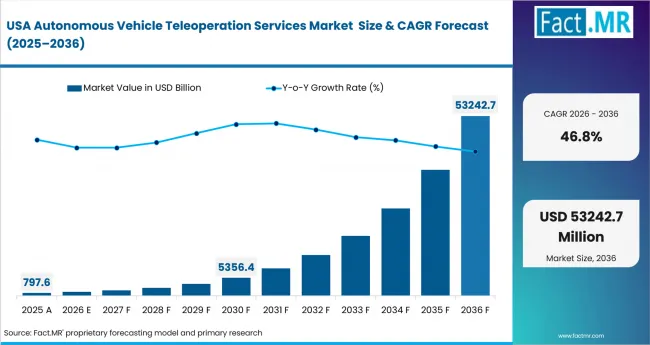
The United States has the deepest visible fleet base for near-term teleoperation revenue. California permit holders logged more than 9.0 million autonomous vehicle test miles between December 2024 and November 2025. Waymo’s remote-assistance disclosure also shows that human support can cover large fleets without acting as remote driving. Buyers should still test latency, incident procedures and freeway limits before awarding larger contracts.
How is China scaling teleoperation demand?
45.9% CAGR, supported by vehicle-road-cloud pilots and robotaxi competition.
China’s commercial path is shaped by large city pilots, robotaxi platforms and connected-road infrastructure. Vehicle-road-cloud programs have made command-center integration part of the operating model in major cities. Domestic providers have an advantage when they understand local data rules and city-level testing permissions. Service design remains policy-sensitive because operating rights can differ by city.
What makes South Korea important?
44.1% CAGR, supported by autonomous driving pilot zones and local technology depth.
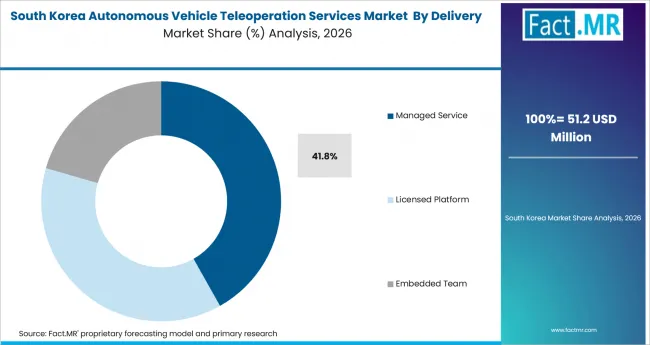
South Korea has a policy structure that supports AV testing inside designated pilot operation zones. Seoul’s Autonomous Driving Vision 2030 plans citywide autonomous driving infrastructure on roads with two or more lanes by 2026. This creates a use case for command centers, remote monitoring and human-assisted driving workflows. Domestic developers can win early work when they pair vehicle software with local-language operations support.
Why is Japan a relevant commercial market?
43.5% CAGR, supported by Level 4 mobility policy and public-transport labor pressure.
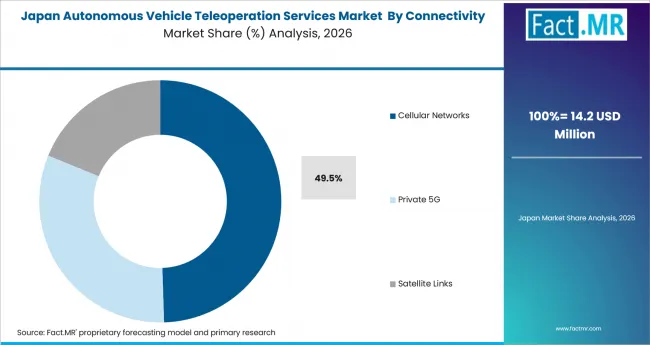
Japan’s near-term buyer is often public transport, local mobility or controlled-route service. National programs support Level 4 automated driving for community mobility, and local bus trials create a setting where remote monitoring can help manage sparse routes. Providers that understand transport-agency operations and safety documentation can build contracts in shuttle, bus and campus mobility.
How does Singapore create a testbed role?
42.6% CAGR, supported by public autonomous bus pilots and command-center readiness.
Singapore offers a compact market where public agencies can test service design before wider Asian deployment. The Land Transport Authority awarded an approximately S$8.14 million contract in October 2025 for six 16-passenger autonomous buses with remote operations systems. The country’s value is in proving procedures, passenger service standards and operator training models that can be repeated in dense cities.
Who leads the autonomous vehicle teleoperation services landscape?
Ottopia, Vay and FERNRIDE lead through platform depth and service operation. Logistics use cases add another competitive route.
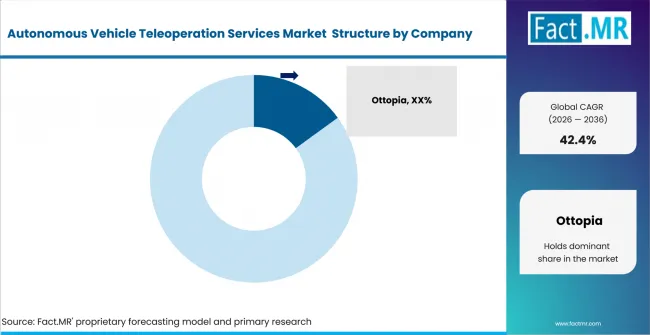
Competition is split between specialist teleoperation software providers and remote-driving service operators. Logistics automation firms and autonomous vehicle developers also compete through internal assistance centers. Buyers compare providers on operator handoff speed and video reliability. Cybersecurity, regulator acceptance and vehicle-stack integration also matter.
Ottopia focuses on teleoperation systems for autonomous vehicles and has built its offer around safe remote human assistance. Vay operates a remote-driven car service and gives the market a proof point for tele-driving as a consumer mobility service. FERNRIDE connects human-assisted autonomy with logistics yards and trucks, while mobile robot platforms show how industrial buyers already think in terms of supervised machine movement.
TIER IV offers remote-operation tools inside a broader Autoware ecosystem. Applied Intuition supports simulation, autonomy development and fleet operations for customers that need controlled deployment workflows. Heavy-duty use cases such as autonomous quarry trucks use similar logic around supervised movement and downtime reduction.
Providers that understand operating-domain limits and safety records should be better placed through 2036. Larger fleet owners may build their own centers. Outside specialists can win where buyers need staffing, tooling and compliance support together. Vehicle-level integration also matters because central controller platforms decide how remote commands and automated driving functions remain separated.
Which companies are the key players?
Ottopia, Vay and FERNRIDE are key players. TIER IV, Applied Intuition and Waymo are also profiled. Kodiak AI completes the company set.
- Ottopia
- Vay
- FERNRIDE
- TIER IV
- Applied Intuition
- Waymo
- Kodiak AI
Bibliography
- California Department of Motor Vehicles. (2026, February 20). Autonomous vehicle permit holders in California logged more than 9 million test miles between December 1, 2024 and November 30, 2025.
- Department for Transport & Centre for Connected and Autonomous Vehicles. (2025, June 10). Driving innovation – 38,000 jobs on the horizon as pilots of self-driving vehicles fast-tracked. GOV.UK.
- German Aerospace Center. (n.d.). Remote driving. German Aerospace Center.
- Land Transport Authority. (2025, October 2). LTA awards contract for the pilot deployment of autonomous buses on two public bus services.
- National Highway Traffic Safety Administration. (2026, June 17). Part 573 safety recall report 26E035.
- National Highway Traffic Safety Administration. (2024, December 20). NHTSA proposes national program for vehicles with automated driving systems.
- TIER IV. (2026, March 9). TIER IV tests Level 2+ semi-trailer truck for long-haul autonomous logistics with Yamato Transport and Mitsubishi Fuso.
- Vay. (2025, June 25). Vay and Kodiak partner to incorporate assisted autonomy technology into Kodiak’s fully autonomous technology stack.
- Vay. (2025, July 28). Vay welcomes Germany’s remote driving regulation: A breakthrough in remote driving commercialization at scale.
- Waymo. (2024, May 21). Fleet response: Lending a helpful hand to Waymo’s autonomously driven vehicles.
- Waymo. (2025, May 5). Scaling our fleet through U.S. manufacturing.
- McNamara, R. (2026, February 17). Advice, not control: The role of Remote Assistance in Waymo’s operations. Waymo.
- FERNRIDE. (2025, June 11). Bringing autonomy to the Autobahn with ATLAS-L4: A major milestone for the future of European logistics.
- Government of the United Kingdom. (2024, May 20). Automated Vehicles Act 2024. legislation.gov.uk.
- Korea Legislation Research Institute. (2024, January 9). Act on the Promotion of and Support for Commercialization of Autonomous Vehicles. Korea Law Translation Center.
This Report Address
- Strategic intelligence on autonomous vehicle teleoperation services across service type, vehicle type, operating domain and customer type.
- Segment analysis covering Cellular Networks, Managed Service, Urban Roads, Robotaxis and Remote Assistance.
- Regional outlook covering Germany, United Kingdom, United States, China, South Korea, Japan and Singapore.
- Competitive analysis of Ottopia, Vay and FERNRIDE are key players. TIER IV, Applied Intuition and Waymo are also profiled. Kodiak AI completes the company set.
- Service assessment covering remote assistance, tele-driving, event response, remote monitoring and operator training.
- Regulatory assessment covering Germany’s remote-driving framework, the United Kingdom’s Automated Vehicles Act and United States safety reporting.
- Source-led market sizing using fleet evidence, provider portfolios, public regulations and official company disclosures.
What does the autonomous vehicle teleoperation services market cover?
Remote assistance, remote driving and operator support services for autonomous vehicles operating without a driver in normal service.
The autonomous vehicle teleoperation services market covers paid services that connect trained human operators with autonomous vehicles when the automated driving system needs help. It includes remote assistance that gives context and tele-driving that controls the vehicle. Remote monitoring, operator training and event-response workflows are also included.
What is included in the scope?
Remote assistance and tele-driving. Command-center services and operator training are also included.
The scope includes remote-assistance services for robotaxis and autonomous trucks. Yard tractors, shuttles and delivery vehicles are also covered. It also includes tele-driving services and remote operations software subscriptions. Staffed monitoring centers, operator training and incident triage are included with system integration.
What is excluded from the scope?
Autonomous vehicle sales, sensor hardware and automated driving software sold without remote operations.
The scope excludes vehicle manufacturing revenue, robotaxi ride fares and autonomous driving stack licenses that do not include live human support. It excludes standalone LiDAR and radar. Camera, compute and mapping products are excluded unless bundled with teleoperation service delivery. It also excludes ordinary fleet tracking when no remote intervention or assistance workflow is provided.
How was the analysis built?
100+ sources and 45+ company or regulator pages. 25+ countries were checked with 20+ interviews.
- Primary Research: Interviews covered autonomous vehicle developers and fleet operators. Remote-operation providers and logistics-site automation buyers were also included.
- Desk Research: Desk research reviewed government releases and transport regulator pages. Company newsrooms, official legal material and provider service pages were checked.
- Market-Sizing and Forecasting: Forecasting used provider counts and active fleet evidence. Support-fee assumptions, operator staffing intensity and command-center service revenue supported the model.
- Data Validation and Update Cycle: Estimates were checked against Waymo fleet scale and Vay service evidence. FERNRIDE logistics programs, TIER IV tools and regulatory timing were also reviewed.
What is the report’s scope and coverage?
| Attribute | Details |
|---|---|
| Quantitative Units | USD Billion in services in 2026 to USD Billion by 2036 |
| Market Definition | Remote-assistance, remote-driving and fleet-response services for autonomous vehicles operating without a driver in normal service |
| Service Type | Remote Assistance, Tele-Driving, Event Response, Remote Monitoring, Operator Training |
| Vehicle Type | Robotaxis, Yard Trucks, Autonomous Trucks, Shuttles, Delivery Vehicles |
| Operating Domain | Urban Roads, Private Yards, Ports, Bus Routes, Highways |
| Customer Type | Fleet Operators, AV Developers, Logistics Operators, Public Transit, OEMs |
| Delivery Model | Managed Service, Licensed Platform, Embedded Team, Command Center |
| End Use | Robotaxi Support, Yard Automation, Freight Movement, Public Shuttles, Defense Mobility |
| Connectivity | Cellular Networks, Private 5G, Satellite Links, Hybrid Links |
| Regions Covered | North America, Western Europe, East Asia, South Asia and Pacific, Latin America, Middle East and Africa |
| Countries Covered | Germany, United Kingdom, United States, China, South Korea, Japan and Singapore |
| Key Companies Profiled | Ottopia, Vay, FERNRIDE, TIER IV, Applied Intuition, Waymo and Kodiak AI |
| Forecast Period | 2026 to 2036 |
| Approach | Hybrid top-down and bottom-up approach using fleet evidence, provider counts, regulation timing, operator staffing assumptions and company validation |
How is the market segmented?
-
By Service Type:
- Remote Assistance
- Tele-Driving
- Event Response
- Remote Monitoring
- Operator Training
-
By Vehicle Type:
- Robotaxis
- Yard Trucks
- Autonomous Trucks
- Shuttles
- Delivery Vehicles
-
By Operating Domain:
- Urban Roads
- Private Yards
- Ports
- Bus Routes
- Highways
-
By Customer Type:
- Fleet Operators
- AV Developers
- Logistics Operators
- Public Transit
- OEMs
-
By Delivery Model:
- Managed Service
- Licensed Platform
- Embedded Team
- Command Center
-
By End Use:
- Robotaxi Support
- Yard Automation
- Freight Movement
- Public Shuttles
- Defense Mobility
-
By Connectivity:
- Cellular Networks
- Private 5G
- Satellite Links
- Hybrid Links
-
By Region:
- North America
- United States
- Canada
- Mexico
- Latin America
- Brazil
- Argentina
- Rest of Latin America
- Europe
- Germany
- United Kingdom
- France
- Italy
- Spain
- Rest of Europe
- Asia Pacific
- China
- India
- Japan
- South Korea
- ASEAN
- Singapore
- Middle East & Africa
- GCC Countries
- South Africa
- UAE
- Rest of Middle East & Africa
- North America
- Frequently Asked Questions -
How large is the Autonomous Vehicle Teleoperation Services Market expected to be in 2026?
The market is expected to gain significant traction in 2026, supported by the growing deployment of autonomous vehicle fleets.
What is the long-term outlook for the Autonomous Vehicle Teleoperation Services Market?
The market is projected to expand substantially through 2036 as autonomous mobility services become increasingly commercialized.
How fast is the Autonomous Vehicle Teleoperation Services Market anticipated to grow?
The market is forecast to witness rapid growth during the assessment period, driven by rising teleoperation adoption.
Which connectivity technology is expected to dominate the market?
Cellular networks are anticipated to lead the market owing to their extensive coverage and deployment readiness.
What is the preferred delivery model in the market?
Managed services are expected to remain the leading delivery model as fleet operators seek integrated operational support.
Which country is likely to showcase the strongest growth momentum?
Germany is projected to emerge as a high-growth market, supported by a favorable regulatory landscape for remote operations.
What is the growth outlook for the United Kingdom market?
The United Kingdom is expected to experience notable expansion as autonomous vehicle pilot programs move toward commercialization.
How is the United States contributing to market growth?
The United States is anticipated to remain a key market due to increasing robotaxi deployments and remote-support requirements.
What role does China play in market development?
China is likely to witness robust growth, driven by advancements in connected mobility infrastructure and intelligent transportation systems.
What is the key factor driving market expansion?
Growing demand for human-assisted intervention during complex driving scenarios is expected to be a major market catalyst.
What is the primary challenge facing the market?
Maintaining reliable low-latency connectivity remains a critical challenge for effective teleoperation services.
Table of Content
- Executive Summary
- Global Market Outlook
- Demand to side Trends
- Supply to side Trends
- Technology Roadmap Analysis
- Analysis and Recommendations
- Market Overview
- Market Coverage / Taxonomy
- Market Definition / Scope / Limitations
- Research Methodology
- Chapter Orientation
- Analytical Lens and Working Hypotheses
- Market Structure, Signals, and Trend Drivers
- Benchmarking and Cross-market Comparability
- Market Sizing, Forecasting, and Opportunity Mapping
- Research Design and Evidence Framework
- Desk Research Programme (Secondary Evidence)
- Company Annual and Sustainability Reports
- Peer-reviewed Journals and Academic Literature
- Corporate Websites, Product Literature, and Technical Notes
- Earnings Decks and Investor Briefings
- Statutory Filings and Regulatory Disclosures
- Technical White Papers and Standards Notes
- Trade Journals, Industry Magazines, and Analyst Briefs
- Conference Proceedings, Webinars, and Seminar Materials
- Government Statistics Portals and Public Data Releases
- Press Releases and Reputable Media Coverage
- Specialist Newsletters and Curated Briefings
- Sector Databases and Reference Repositories
- Fact.MR Internal Proprietary Databases and Historical Market Datasets
- Subscription Datasets and Paid Sources
- Social Channels, Communities, and Digital Listening Inputs
- Additional Desk Sources
- Expert Input and Fieldwork (Primary Evidence)
- Primary Modes
- Qualitative Interviews and Expert Elicitation
- Quantitative Surveys and Structured Data Capture
- Blended Approach
- Why Primary Evidence is Used
- Field Techniques
- Interviews
- Surveys
- Focus Groups
- Observational and In-context Research
- Social and Community Interactions
- Stakeholder Universe Engaged
- C-suite Leaders
- Board Members
- Presidents and Vice Presidents
- R&D and Innovation Heads
- Technical Specialists
- Domain Subject-matter Experts
- Scientists
- Physicians and Other Healthcare Professionals
- Governance, Ethics, and Data Stewardship
- Research Ethics
- Data Integrity and Handling
- Primary Modes
- Tooling, Models, and Reference Databases
- Desk Research Programme (Secondary Evidence)
- Data Engineering and Model Build
- Data Acquisition and Ingestion
- Cleaning, Normalisation, and Verification
- Synthesis, Triangulation, and Analysis
- Quality Assurance and Audit Trail
- Market Background
- Market Dynamics
- Drivers
- Restraints
- Opportunity
- Trends
- Scenario Forecast
- Demand in Optimistic Scenario
- Demand in Likely Scenario
- Demand in Conservative Scenario
- Opportunity Map Analysis
- Product Life Cycle Analysis
- Supply Chain Analysis
- Investment Feasibility Matrix
- Value Chain Analysis
- PESTLE and Porter’s Analysis
- Regulatory Landscape
- Regional Parent Market Outlook
- Production and Consumption Statistics
- Import and Export Statistics
- Market Dynamics
- Global Market Analysis 2021 to 2025 and Forecast, 2026 to 2036
- Historical Market Size Value (USD Million) Analysis, 2021 to 2025
- Current and Future Market Size Value (USD Million) Projections, 2026 to 2036
- Y to o to Y Growth Trend Analysis
- Absolute $ Opportunity Analysis
- Global Market Pricing Analysis 2021 to 2025 and Forecast 2026 to 2036
- Global Market Analysis 2021 to 2025 and Forecast 2026 to 2036, By Connectivity
- Introduction / Key Findings
- Historical Market Size Value (USD Million) Analysis By Connectivity , 2021 to 2025
- Current and Future Market Size Value (USD Million) Analysis and Forecast By Connectivity , 2026 to 2036
- Cellular Networks
- Private 5G
- Satellite Links
- Cellular Networks
- Y to o to Y Growth Trend Analysis By Connectivity , 2021 to 2025
- Absolute $ Opportunity Analysis By Connectivity , 2026 to 2036
- Global Market Analysis 2021 to 2025 and Forecast 2026 to 2036, By Delivery Model
- Introduction / Key Findings
- Historical Market Size Value (USD Million) Analysis By Delivery Model, 2021 to 2025
- Current and Future Market Size Value (USD Million) Analysis and Forecast By Delivery Model, 2026 to 2036
- Managed Service
- Licensed Platform
- Embedded Team
- Managed Service
- Y to o to Y Growth Trend Analysis By Delivery Model, 2021 to 2025
- Absolute $ Opportunity Analysis By Delivery Model, 2026 to 2036
- Global Market Analysis 2021 to 2025 and Forecast 2026 to 2036, By Operating Domain
- Introduction / Key Findings
- Historical Market Size Value (USD Million) Analysis By Operating Domain, 2021 to 2025
- Current and Future Market Size Value (USD Million) Analysis and Forecast By Operating Domain, 2026 to 2036
- Urban Roads
- Private Yards
- Ports
- Urban Roads
- Y to o to Y Growth Trend Analysis By Operating Domain, 2021 to 2025
- Absolute $ Opportunity Analysis By Operating Domain, 2026 to 2036
- Global Market Analysis 2021 to 2025 and Forecast 2026 to 2036, By Vehicle Type
- Introduction / Key Findings
- Historical Market Size Value (USD Million) Analysis By Vehicle Type, 2021 to 2025
- Current and Future Market Size Value (USD Million) Analysis and Forecast By Vehicle Type, 2026 to 2036
- Robotaxis
- Yard Trucks
- Shuttles
- Robotaxis
- Y to o to Y Growth Trend Analysis By Vehicle Type, 2021 to 2025
- Absolute $ Opportunity Analysis By Vehicle Type, 2026 to 2036
- Global Market Analysis 2021 to 2025 and Forecast 2026 to 2036, By Service Type
- Introduction / Key Findings
- Historical Market Size Value (USD Million) Analysis By Service Type, 2021 to 2025
- Current and Future Market Size Value (USD Million) Analysis and Forecast By Service Type, 2026 to 2036
- Remote Assistance
- Tele-Driving
- Remote Monitoring
- Remote Assistance
- Y to o to Y Growth Trend Analysis By Service Type, 2021 to 2025
- Absolute $ Opportunity Analysis By Service Type, 2026 to 2036
- Global Market Analysis 2021 to 2025 and Forecast 2026 to 2036, By Customer Type
- Introduction / Key Findings
- Historical Market Size Value (USD Million) Analysis By Customer Type, 2021 to 2025
- Current and Future Market Size Value (USD Million) Analysis and Forecast By Customer Type, 2026 to 2036
- Fleet Operators
- AV Developers
- OEMs
- Fleet Operators
- Y to o to Y Growth Trend Analysis By Customer Type, 2021 to 2025
- Absolute $ Opportunity Analysis By Customer Type, 2026 to 2036
- Global Market Analysis 2021 to 2025 and Forecast 2026 to 2036, By Region
- Introduction
- Historical Market Size Value (USD Million) Analysis By Region, 2021 to 2025
- Current Market Size Value (USD Million) Analysis and Forecast By Region, 2026 to 2036
- North America
- Latin America
- Western Europe
- Eastern Europe
- East Asia
- South Asia and Pacific
- Middle East & Africa
- Market Attractiveness Analysis By Region
- North America Market Analysis 2021 to 2025 and Forecast 2026 to 2036, By Country
- Historical Market Size Value (USD Million) Trend Analysis By Market Taxonomy, 2021 to 2025
- Market Size Value (USD Million) Forecast By Market Taxonomy, 2026 to 2036
- By Country
- USA
- Canada
- Mexico
- By Connectivity
- By Delivery Model
- By Operating Domain
- By Vehicle Type
- By Service Type
- By Customer Type
- By Country
- Market Attractiveness Analysis
- By Country
- By Connectivity
- By Delivery Model
- By Operating Domain
- By Vehicle Type
- By Service Type
- By Customer Type
- Key Takeaways
- Latin America Market Analysis 2021 to 2025 and Forecast 2026 to 2036, By Country
- Historical Market Size Value (USD Million) Trend Analysis By Market Taxonomy, 2021 to 2025
- Market Size Value (USD Million) Forecast By Market Taxonomy, 2026 to 2036
- By Country
- Brazil
- Chile
- Rest of Latin America
- By Connectivity
- By Delivery Model
- By Operating Domain
- By Vehicle Type
- By Service Type
- By Customer Type
- By Country
- Market Attractiveness Analysis
- By Country
- By Connectivity
- By Delivery Model
- By Operating Domain
- By Vehicle Type
- By Service Type
- By Customer Type
- Key Takeaways
- Western Europe Market Analysis 2021 to 2025 and Forecast 2026 to 2036, By Country
- Historical Market Size Value (USD Million) Trend Analysis By Market Taxonomy, 2021 to 2025
- Market Size Value (USD Million) Forecast By Market Taxonomy, 2026 to 2036
- By Country
- Germany
- UK
- Italy
- Spain
- France
- Nordic
- BENELUX
- Rest of Western Europe
- By Connectivity
- By Delivery Model
- By Operating Domain
- By Vehicle Type
- By Service Type
- By Customer Type
- By Country
- Market Attractiveness Analysis
- By Country
- By Connectivity
- By Delivery Model
- By Operating Domain
- By Vehicle Type
- By Service Type
- By Customer Type
- Key Takeaways
- Eastern Europe Market Analysis 2021 to 2025 and Forecast 2026 to 2036, By Country
- Historical Market Size Value (USD Million) Trend Analysis By Market Taxonomy, 2021 to 2025
- Market Size Value (USD Million) Forecast By Market Taxonomy, 2026 to 2036
- By Country
- Russia
- Poland
- Hungary
- Balkan & Baltic
- Rest of Eastern Europe
- By Connectivity
- By Delivery Model
- By Operating Domain
- By Vehicle Type
- By Service Type
- By Customer Type
- By Country
- Market Attractiveness Analysis
- By Country
- By Connectivity
- By Delivery Model
- By Operating Domain
- By Vehicle Type
- By Service Type
- By Customer Type
- Key Takeaways
- East Asia Market Analysis 2021 to 2025 and Forecast 2026 to 2036, By Country
- Historical Market Size Value (USD Million) Trend Analysis By Market Taxonomy, 2021 to 2025
- Market Size Value (USD Million) Forecast By Market Taxonomy, 2026 to 2036
- By Country
- China
- Japan
- South Korea
- By Connectivity
- By Delivery Model
- By Operating Domain
- By Vehicle Type
- By Service Type
- By Customer Type
- By Country
- Market Attractiveness Analysis
- By Country
- By Connectivity
- By Delivery Model
- By Operating Domain
- By Vehicle Type
- By Service Type
- By Customer Type
- Key Takeaways
- South Asia and Pacific Market Analysis 2021 to 2025 and Forecast 2026 to 2036, By Country
- Historical Market Size Value (USD Million) Trend Analysis By Market Taxonomy, 2021 to 2025
- Market Size Value (USD Million) Forecast By Market Taxonomy, 2026 to 2036
- By Country
- India
- ASEAN
- Australia & New Zealand
- Rest of South Asia and Pacific
- By Connectivity
- By Delivery Model
- By Operating Domain
- By Vehicle Type
- By Service Type
- By Customer Type
- By Country
- Market Attractiveness Analysis
- By Country
- By Connectivity
- By Delivery Model
- By Operating Domain
- By Vehicle Type
- By Service Type
- By Customer Type
- Key Takeaways
- Middle East & Africa Market Analysis 2021 to 2025 and Forecast 2026 to 2036, By Country
- Historical Market Size Value (USD Million) Trend Analysis By Market Taxonomy, 2021 to 2025
- Market Size Value (USD Million) Forecast By Market Taxonomy, 2026 to 2036
- By Country
- Kingdom of Saudi Arabia
- Other GCC Countries
- Turkiye
- South Africa
- Other African Union
- Rest of Middle East & Africa
- By Connectivity
- By Delivery Model
- By Operating Domain
- By Vehicle Type
- By Service Type
- By Customer Type
- By Country
- Market Attractiveness Analysis
- By Country
- By Connectivity
- By Delivery Model
- By Operating Domain
- By Vehicle Type
- By Service Type
- By Customer Type
- Key Takeaways
- Key Countries Market Analysis
- USA
- Pricing Analysis
- Market Share Analysis, 2025
- By Connectivity
- By Delivery Model
- By Operating Domain
- By Vehicle Type
- By Service Type
- By Customer Type
- Canada
- Pricing Analysis
- Market Share Analysis, 2025
- By Connectivity
- By Delivery Model
- By Operating Domain
- By Vehicle Type
- By Service Type
- By Customer Type
- Mexico
- Pricing Analysis
- Market Share Analysis, 2025
- By Connectivity
- By Delivery Model
- By Operating Domain
- By Vehicle Type
- By Service Type
- By Customer Type
- Brazil
- Pricing Analysis
- Market Share Analysis, 2025
- By Connectivity
- By Delivery Model
- By Operating Domain
- By Vehicle Type
- By Service Type
- By Customer Type
- Chile
- Pricing Analysis
- Market Share Analysis, 2025
- By Connectivity
- By Delivery Model
- By Operating Domain
- By Vehicle Type
- By Service Type
- By Customer Type
- Germany
- Pricing Analysis
- Market Share Analysis, 2025
- By Connectivity
- By Delivery Model
- By Operating Domain
- By Vehicle Type
- By Service Type
- By Customer Type
- UK
- Pricing Analysis
- Market Share Analysis, 2025
- By Connectivity
- By Delivery Model
- By Operating Domain
- By Vehicle Type
- By Service Type
- By Customer Type
- Italy
- Pricing Analysis
- Market Share Analysis, 2025
- By Connectivity
- By Delivery Model
- By Operating Domain
- By Vehicle Type
- By Service Type
- By Customer Type
- Spain
- Pricing Analysis
- Market Share Analysis, 2025
- By Connectivity
- By Delivery Model
- By Operating Domain
- By Vehicle Type
- By Service Type
- By Customer Type
- France
- Pricing Analysis
- Market Share Analysis, 2025
- By Connectivity
- By Delivery Model
- By Operating Domain
- By Vehicle Type
- By Service Type
- By Customer Type
- India
- Pricing Analysis
- Market Share Analysis, 2025
- By Connectivity
- By Delivery Model
- By Operating Domain
- By Vehicle Type
- By Service Type
- By Customer Type
- ASEAN
- Pricing Analysis
- Market Share Analysis, 2025
- By Connectivity
- By Delivery Model
- By Operating Domain
- By Vehicle Type
- By Service Type
- By Customer Type
- Australia & New Zealand
- Pricing Analysis
- Market Share Analysis, 2025
- By Connectivity
- By Delivery Model
- By Operating Domain
- By Vehicle Type
- By Service Type
- By Customer Type
- China
- Pricing Analysis
- Market Share Analysis, 2025
- By Connectivity
- By Delivery Model
- By Operating Domain
- By Vehicle Type
- By Service Type
- By Customer Type
- Japan
- Pricing Analysis
- Market Share Analysis, 2025
- By Connectivity
- By Delivery Model
- By Operating Domain
- By Vehicle Type
- By Service Type
- By Customer Type
- South Korea
- Pricing Analysis
- Market Share Analysis, 2025
- By Connectivity
- By Delivery Model
- By Operating Domain
- By Vehicle Type
- By Service Type
- By Customer Type
- Russia
- Pricing Analysis
- Market Share Analysis, 2025
- By Connectivity
- By Delivery Model
- By Operating Domain
- By Vehicle Type
- By Service Type
- By Customer Type
- Poland
- Pricing Analysis
- Market Share Analysis, 2025
- By Connectivity
- By Delivery Model
- By Operating Domain
- By Vehicle Type
- By Service Type
- By Customer Type
- Hungary
- Pricing Analysis
- Market Share Analysis, 2025
- By Connectivity
- By Delivery Model
- By Operating Domain
- By Vehicle Type
- By Service Type
- By Customer Type
- Kingdom of Saudi Arabia
- Pricing Analysis
- Market Share Analysis, 2025
- By Connectivity
- By Delivery Model
- By Operating Domain
- By Vehicle Type
- By Service Type
- By Customer Type
- Turkiye
- Pricing Analysis
- Market Share Analysis, 2025
- By Connectivity
- By Delivery Model
- By Operating Domain
- By Vehicle Type
- By Service Type
- By Customer Type
- South Africa
- Pricing Analysis
- Market Share Analysis, 2025
- By Connectivity
- By Delivery Model
- By Operating Domain
- By Vehicle Type
- By Service Type
- By Customer Type
- USA
- Market Structure Analysis
- Competition Dashboard
- Competition Benchmarking
- Market Share Analysis of Top Players
- By Regional
- By Connectivity
- By Delivery Model
- By Operating Domain
- By Vehicle Type
- By Service Type
- By Customer Type
- Competition Analysis
- Competition Deep Dive
- Ottopia
- Overview
- Product Portfolio
- Profitability by Market Segments (Product/Age /Sales Channel/Region)
- Sales Footprint
- Strategy Overview
- Marketing Strategy
- Product Strategy
- Channel Strategy
- Vay
- FERNRIDE
- TIER IV
- Applied Intuition
- Waymo
- Ottopia
- Competition Deep Dive
- Assumptions & Acronyms Used
List Of Table
- Table 1: Global Market Value (USD Million) Forecast by Region, 2021 to 2036
- Table 2: Global Market Value (USD Million) Forecast by Connectivity, 2021 to 2036
- Table 3: Global Market Value (USD Million) Forecast by Delivery Model, 2021 to 2036
- Table 4: Global Market Value (USD Million) Forecast by Operating Domain, 2021 to 2036
- Table 5: Global Market Value (USD Million) Forecast by Vehicle Type, 2021 to 2036
- Table 6: Global Market Value (USD Million) Forecast by Service Type, 2021 to 2036
- Table 7: Global Market Value (USD Million) Forecast by Customer Type, 2021 to 2036
- Table 8: North America Market Value (USD Million) Forecast by Country, 2021 to 2036
- Table 9: North America Market Value (USD Million) Forecast by Connectivity, 2021 to 2036
- Table 10: North America Market Value (USD Million) Forecast by Delivery Model, 2021 to 2036
- Table 11: North America Market Value (USD Million) Forecast by Operating Domain, 2021 to 2036
- Table 12: North America Market Value (USD Million) Forecast by Vehicle Type, 2021 to 2036
- Table 13: North America Market Value (USD Million) Forecast by Service Type, 2021 to 2036
- Table 14: North America Market Value (USD Million) Forecast by Customer Type, 2021 to 2036
- Table 15: Latin America Market Value (USD Million) Forecast by Country, 2021 to 2036
- Table 16: Latin America Market Value (USD Million) Forecast by Connectivity, 2021 to 2036
- Table 17: Latin America Market Value (USD Million) Forecast by Delivery Model, 2021 to 2036
- Table 18: Latin America Market Value (USD Million) Forecast by Operating Domain, 2021 to 2036
- Table 19: Latin America Market Value (USD Million) Forecast by Vehicle Type, 2021 to 2036
- Table 20: Latin America Market Value (USD Million) Forecast by Service Type, 2021 to 2036
- Table 21: Latin America Market Value (USD Million) Forecast by Customer Type, 2021 to 2036
- Table 22: Western Europe Market Value (USD Million) Forecast by Country, 2021 to 2036
- Table 23: Western Europe Market Value (USD Million) Forecast by Connectivity, 2021 to 2036
- Table 24: Western Europe Market Value (USD Million) Forecast by Delivery Model, 2021 to 2036
- Table 25: Western Europe Market Value (USD Million) Forecast by Operating Domain, 2021 to 2036
- Table 26: Western Europe Market Value (USD Million) Forecast by Vehicle Type, 2021 to 2036
- Table 27: Western Europe Market Value (USD Million) Forecast by Service Type, 2021 to 2036
- Table 28: Western Europe Market Value (USD Million) Forecast by Customer Type, 2021 to 2036
- Table 29: Eastern Europe Market Value (USD Million) Forecast by Country, 2021 to 2036
- Table 30: Eastern Europe Market Value (USD Million) Forecast by Connectivity, 2021 to 2036
- Table 31: Eastern Europe Market Value (USD Million) Forecast by Delivery Model, 2021 to 2036
- Table 32: Eastern Europe Market Value (USD Million) Forecast by Operating Domain, 2021 to 2036
- Table 33: Eastern Europe Market Value (USD Million) Forecast by Vehicle Type, 2021 to 2036
- Table 34: Eastern Europe Market Value (USD Million) Forecast by Service Type, 2021 to 2036
- Table 35: Eastern Europe Market Value (USD Million) Forecast by Customer Type, 2021 to 2036
- Table 36: East Asia Market Value (USD Million) Forecast by Country, 2021 to 2036
- Table 37: East Asia Market Value (USD Million) Forecast by Connectivity, 2021 to 2036
- Table 38: East Asia Market Value (USD Million) Forecast by Delivery Model, 2021 to 2036
- Table 39: East Asia Market Value (USD Million) Forecast by Operating Domain, 2021 to 2036
- Table 40: East Asia Market Value (USD Million) Forecast by Vehicle Type, 2021 to 2036
- Table 41: East Asia Market Value (USD Million) Forecast by Service Type, 2021 to 2036
- Table 42: East Asia Market Value (USD Million) Forecast by Customer Type, 2021 to 2036
- Table 43: South Asia and Pacific Market Value (USD Million) Forecast by Country, 2021 to 2036
- Table 44: South Asia and Pacific Market Value (USD Million) Forecast by Connectivity, 2021 to 2036
- Table 45: South Asia and Pacific Market Value (USD Million) Forecast by Delivery Model, 2021 to 2036
- Table 46: South Asia and Pacific Market Value (USD Million) Forecast by Operating Domain, 2021 to 2036
- Table 47: South Asia and Pacific Market Value (USD Million) Forecast by Vehicle Type, 2021 to 2036
- Table 48: South Asia and Pacific Market Value (USD Million) Forecast by Service Type, 2021 to 2036
- Table 49: South Asia and Pacific Market Value (USD Million) Forecast by Customer Type, 2021 to 2036
- Table 50: Middle East & Africa Market Value (USD Million) Forecast by Country, 2021 to 2036
- Table 51: Middle East & Africa Market Value (USD Million) Forecast by Connectivity, 2021 to 2036
- Table 52: Middle East & Africa Market Value (USD Million) Forecast by Delivery Model, 2021 to 2036
- Table 53: Middle East & Africa Market Value (USD Million) Forecast by Operating Domain, 2021 to 2036
- Table 54: Middle East & Africa Market Value (USD Million) Forecast by Vehicle Type, 2021 to 2036
- Table 55: Middle East & Africa Market Value (USD Million) Forecast by Service Type, 2021 to 2036
- Table 56: Middle East & Africa Market Value (USD Million) Forecast by Customer Type, 2021 to 2036
List Of Figures
- Figure 1: Global Market Pricing Analysis
- Figure 2: Global Market Value (USD Million) Forecast 2021-2036
- Figure 3: Global Market Value Share and BPS Analysis by Connectivity, 2026 and 2036
- Figure 4: Global Market Y-o-Y Growth Comparison by Connectivity, 2026 to 2036
- Figure 5: Global Market Attractiveness Analysis by Connectivity
- Figure 6: Global Market Value Share and BPS Analysis by Delivery Model, 2026 and 2036
- Figure 7: Global Market Y-o-Y Growth Comparison by Delivery Model, 2026 to 2036
- Figure 8: Global Market Attractiveness Analysis by Delivery Model
- Figure 9: Global Market Value Share and BPS Analysis by Operating Domain, 2026 and 2036
- Figure 10: Global Market Y-o-Y Growth Comparison by Operating Domain, 2026 to 2036
- Figure 11: Global Market Attractiveness Analysis by Operating Domain
- Figure 12: Global Market Value Share and BPS Analysis by Vehicle Type, 2026 and 2036
- Figure 13: Global Market Y-o-Y Growth Comparison by Vehicle Type, 2026 to 2036
- Figure 14: Global Market Attractiveness Analysis by Vehicle Type
- Figure 15: Global Market Value Share and BPS Analysis by Service Type, 2026 and 2036
- Figure 16: Global Market Y-o-Y Growth Comparison by Service Type, 2026 to 2036
- Figure 17: Global Market Attractiveness Analysis by Service Type
- Figure 18: Global Market Value Share and BPS Analysis by Customer Type, 2026 and 2036
- Figure 19: Global Market Y-o-Y Growth Comparison by Customer Type, 2026 to 2036
- Figure 20: Global Market Attractiveness Analysis by Customer Type
- Figure 21: Global Market Value (USD Million) Share and BPS Analysis by Region, 2026 and 2036
- Figure 22: Global Market Y-o-Y Growth Comparison by Region, 2026 to 2036
- Figure 23: Global Market Attractiveness Analysis by Region
- Figure 24: North America Market Incremental Dollar Opportunity, 2026 to 2036
- Figure 25: Latin America Market Incremental Dollar Opportunity, 2026 to 2036
- Figure 26: Western Europe Market Incremental Dollar Opportunity, 2026 to 2036
- Figure 27: Eastern Europe Market Incremental Dollar Opportunity, 2026 to 2036
- Figure 28: East Asia Market Incremental Dollar Opportunity, 2026 to 2036
- Figure 29: South Asia and Pacific Market Incremental Dollar Opportunity, 2026 to 2036
- Figure 30: Middle East & Africa Market Incremental Dollar Opportunity, 2026 to 2036
- Figure 31: North America Market Value Share and BPS Analysis by Country, 2026 and 2036
- Figure 32: North America Market Value Share and BPS Analysis by Connectivity, 2026 and 2036
- Figure 33: North America Market Y-o-Y Growth Comparison by Connectivity, 2026 to 2036
- Figure 34: North America Market Attractiveness Analysis by Connectivity
- Figure 35: North America Market Value Share and BPS Analysis by Delivery Model, 2026 and 2036
- Figure 36: North America Market Y-o-Y Growth Comparison by Delivery Model, 2026 to 2036
- Figure 37: North America Market Attractiveness Analysis by Delivery Model
- Figure 38: North America Market Value Share and BPS Analysis by Operating Domain, 2026 and 2036
- Figure 39: North America Market Y-o-Y Growth Comparison by Operating Domain, 2026 to 2036
- Figure 40: North America Market Attractiveness Analysis by Operating Domain
- Figure 41: North America Market Value Share and BPS Analysis by Vehicle Type, 2026 and 2036
- Figure 42: North America Market Y-o-Y Growth Comparison by Vehicle Type, 2026 to 2036
- Figure 43: North America Market Attractiveness Analysis by Vehicle Type
- Figure 44: North America Market Value Share and BPS Analysis by Service Type, 2026 and 2036
- Figure 45: North America Market Y-o-Y Growth Comparison by Service Type, 2026 to 2036
- Figure 46: North America Market Attractiveness Analysis by Service Type
- Figure 47: North America Market Value Share and BPS Analysis by Customer Type, 2026 and 2036
- Figure 48: North America Market Y-o-Y Growth Comparison by Customer Type, 2026 to 2036
- Figure 49: North America Market Attractiveness Analysis by Customer Type
- Figure 50: Latin America Market Value Share and BPS Analysis by Country, 2026 and 2036
- Figure 51: Latin America Market Value Share and BPS Analysis by Connectivity, 2026 and 2036
- Figure 52: Latin America Market Y-o-Y Growth Comparison by Connectivity, 2026 to 2036
- Figure 53: Latin America Market Attractiveness Analysis by Connectivity
- Figure 54: Latin America Market Value Share and BPS Analysis by Delivery Model, 2026 and 2036
- Figure 55: Latin America Market Y-o-Y Growth Comparison by Delivery Model, 2026 to 2036
- Figure 56: Latin America Market Attractiveness Analysis by Delivery Model
- Figure 57: Latin America Market Value Share and BPS Analysis by Operating Domain, 2026 and 2036
- Figure 58: Latin America Market Y-o-Y Growth Comparison by Operating Domain, 2026 to 2036
- Figure 59: Latin America Market Attractiveness Analysis by Operating Domain
- Figure 60: Latin America Market Value Share and BPS Analysis by Vehicle Type, 2026 and 2036
- Figure 61: Latin America Market Y-o-Y Growth Comparison by Vehicle Type, 2026 to 2036
- Figure 62: Latin America Market Attractiveness Analysis by Vehicle Type
- Figure 63: Latin America Market Value Share and BPS Analysis by Service Type, 2026 and 2036
- Figure 64: Latin America Market Y-o-Y Growth Comparison by Service Type, 2026 to 2036
- Figure 65: Latin America Market Attractiveness Analysis by Service Type
- Figure 66: Latin America Market Value Share and BPS Analysis by Customer Type, 2026 and 2036
- Figure 67: Latin America Market Y-o-Y Growth Comparison by Customer Type, 2026 to 2036
- Figure 68: Latin America Market Attractiveness Analysis by Customer Type
- Figure 69: Western Europe Market Value Share and BPS Analysis by Country, 2026 and 2036
- Figure 70: Western Europe Market Value Share and BPS Analysis by Connectivity, 2026 and 2036
- Figure 71: Western Europe Market Y-o-Y Growth Comparison by Connectivity, 2026 to 2036
- Figure 72: Western Europe Market Attractiveness Analysis by Connectivity
- Figure 73: Western Europe Market Value Share and BPS Analysis by Delivery Model, 2026 and 2036
- Figure 74: Western Europe Market Y-o-Y Growth Comparison by Delivery Model, 2026 to 2036
- Figure 75: Western Europe Market Attractiveness Analysis by Delivery Model
- Figure 76: Western Europe Market Value Share and BPS Analysis by Operating Domain, 2026 and 2036
- Figure 77: Western Europe Market Y-o-Y Growth Comparison by Operating Domain, 2026 to 2036
- Figure 78: Western Europe Market Attractiveness Analysis by Operating Domain
- Figure 79: Western Europe Market Value Share and BPS Analysis by Vehicle Type, 2026 and 2036
- Figure 80: Western Europe Market Y-o-Y Growth Comparison by Vehicle Type, 2026 to 2036
- Figure 81: Western Europe Market Attractiveness Analysis by Vehicle Type
- Figure 82: Western Europe Market Value Share and BPS Analysis by Service Type, 2026 and 2036
- Figure 83: Western Europe Market Y-o-Y Growth Comparison by Service Type, 2026 to 2036
- Figure 84: Western Europe Market Attractiveness Analysis by Service Type
- Figure 85: Western Europe Market Value Share and BPS Analysis by Customer Type, 2026 and 2036
- Figure 86: Western Europe Market Y-o-Y Growth Comparison by Customer Type, 2026 to 2036
- Figure 87: Western Europe Market Attractiveness Analysis by Customer Type
- Figure 88: Eastern Europe Market Value Share and BPS Analysis by Country, 2026 and 2036
- Figure 89: Eastern Europe Market Value Share and BPS Analysis by Connectivity, 2026 and 2036
- Figure 90: Eastern Europe Market Y-o-Y Growth Comparison by Connectivity, 2026 to 2036
- Figure 91: Eastern Europe Market Attractiveness Analysis by Connectivity
- Figure 92: Eastern Europe Market Value Share and BPS Analysis by Delivery Model, 2026 and 2036
- Figure 93: Eastern Europe Market Y-o-Y Growth Comparison by Delivery Model, 2026 to 2036
- Figure 94: Eastern Europe Market Attractiveness Analysis by Delivery Model
- Figure 95: Eastern Europe Market Value Share and BPS Analysis by Operating Domain, 2026 and 2036
- Figure 96: Eastern Europe Market Y-o-Y Growth Comparison by Operating Domain, 2026 to 2036
- Figure 97: Eastern Europe Market Attractiveness Analysis by Operating Domain
- Figure 98: Eastern Europe Market Value Share and BPS Analysis by Vehicle Type, 2026 and 2036
- Figure 99: Eastern Europe Market Y-o-Y Growth Comparison by Vehicle Type, 2026 to 2036
- Figure 100: Eastern Europe Market Attractiveness Analysis by Vehicle Type
- Figure 101: Eastern Europe Market Value Share and BPS Analysis by Service Type, 2026 and 2036
- Figure 102: Eastern Europe Market Y-o-Y Growth Comparison by Service Type, 2026 to 2036
- Figure 103: Eastern Europe Market Attractiveness Analysis by Service Type
- Figure 104: Eastern Europe Market Value Share and BPS Analysis by Customer Type, 2026 and 2036
- Figure 105: Eastern Europe Market Y-o-Y Growth Comparison by Customer Type, 2026 to 2036
- Figure 106: Eastern Europe Market Attractiveness Analysis by Customer Type
- Figure 107: East Asia Market Value Share and BPS Analysis by Country, 2026 and 2036
- Figure 108: East Asia Market Value Share and BPS Analysis by Connectivity, 2026 and 2036
- Figure 109: East Asia Market Y-o-Y Growth Comparison by Connectivity, 2026 to 2036
- Figure 110: East Asia Market Attractiveness Analysis by Connectivity
- Figure 111: East Asia Market Value Share and BPS Analysis by Delivery Model, 2026 and 2036
- Figure 112: East Asia Market Y-o-Y Growth Comparison by Delivery Model, 2026 to 2036
- Figure 113: East Asia Market Attractiveness Analysis by Delivery Model
- Figure 114: East Asia Market Value Share and BPS Analysis by Operating Domain, 2026 and 2036
- Figure 115: East Asia Market Y-o-Y Growth Comparison by Operating Domain, 2026 to 2036
- Figure 116: East Asia Market Attractiveness Analysis by Operating Domain
- Figure 117: East Asia Market Value Share and BPS Analysis by Vehicle Type, 2026 and 2036
- Figure 118: East Asia Market Y-o-Y Growth Comparison by Vehicle Type, 2026 to 2036
- Figure 119: East Asia Market Attractiveness Analysis by Vehicle Type
- Figure 120: East Asia Market Value Share and BPS Analysis by Service Type, 2026 and 2036
- Figure 121: East Asia Market Y-o-Y Growth Comparison by Service Type, 2026 to 2036
- Figure 122: East Asia Market Attractiveness Analysis by Service Type
- Figure 123: East Asia Market Value Share and BPS Analysis by Customer Type, 2026 and 2036
- Figure 124: East Asia Market Y-o-Y Growth Comparison by Customer Type, 2026 to 2036
- Figure 125: East Asia Market Attractiveness Analysis by Customer Type
- Figure 126: South Asia and Pacific Market Value Share and BPS Analysis by Country, 2026 and 2036
- Figure 127: South Asia and Pacific Market Value Share and BPS Analysis by Connectivity, 2026 and 2036
- Figure 128: South Asia and Pacific Market Y-o-Y Growth Comparison by Connectivity, 2026 to 2036
- Figure 129: South Asia and Pacific Market Attractiveness Analysis by Connectivity
- Figure 130: South Asia and Pacific Market Value Share and BPS Analysis by Delivery Model, 2026 and 2036
- Figure 131: South Asia and Pacific Market Y-o-Y Growth Comparison by Delivery Model, 2026 to 2036
- Figure 132: South Asia and Pacific Market Attractiveness Analysis by Delivery Model
- Figure 133: South Asia and Pacific Market Value Share and BPS Analysis by Operating Domain, 2026 and 2036
- Figure 134: South Asia and Pacific Market Y-o-Y Growth Comparison by Operating Domain, 2026 to 2036
- Figure 135: South Asia and Pacific Market Attractiveness Analysis by Operating Domain
- Figure 136: South Asia and Pacific Market Value Share and BPS Analysis by Vehicle Type, 2026 and 2036
- Figure 137: South Asia and Pacific Market Y-o-Y Growth Comparison by Vehicle Type, 2026 to 2036
- Figure 138: South Asia and Pacific Market Attractiveness Analysis by Vehicle Type
- Figure 139: South Asia and Pacific Market Value Share and BPS Analysis by Service Type, 2026 and 2036
- Figure 140: South Asia and Pacific Market Y-o-Y Growth Comparison by Service Type, 2026 to 2036
- Figure 141: South Asia and Pacific Market Attractiveness Analysis by Service Type
- Figure 142: South Asia and Pacific Market Value Share and BPS Analysis by Customer Type, 2026 and 2036
- Figure 143: South Asia and Pacific Market Y-o-Y Growth Comparison by Customer Type, 2026 to 2036
- Figure 144: South Asia and Pacific Market Attractiveness Analysis by Customer Type
- Figure 145: Middle East & Africa Market Value Share and BPS Analysis by Country, 2026 and 2036
- Figure 146: Middle East & Africa Market Value Share and BPS Analysis by Connectivity, 2026 and 2036
- Figure 147: Middle East & Africa Market Y-o-Y Growth Comparison by Connectivity, 2026 to 2036
- Figure 148: Middle East & Africa Market Attractiveness Analysis by Connectivity
- Figure 149: Middle East & Africa Market Value Share and BPS Analysis by Delivery Model, 2026 and 2036
- Figure 150: Middle East & Africa Market Y-o-Y Growth Comparison by Delivery Model, 2026 to 2036
- Figure 151: Middle East & Africa Market Attractiveness Analysis by Delivery Model
- Figure 152: Middle East & Africa Market Value Share and BPS Analysis by Operating Domain, 2026 and 2036
- Figure 153: Middle East & Africa Market Y-o-Y Growth Comparison by Operating Domain, 2026 to 2036
- Figure 154: Middle East & Africa Market Attractiveness Analysis by Operating Domain
- Figure 155: Middle East & Africa Market Value Share and BPS Analysis by Vehicle Type, 2026 and 2036
- Figure 156: Middle East & Africa Market Y-o-Y Growth Comparison by Vehicle Type, 2026 to 2036
- Figure 157: Middle East & Africa Market Attractiveness Analysis by Vehicle Type
- Figure 158: Middle East & Africa Market Value Share and BPS Analysis by Service Type, 2026 and 2036
- Figure 159: Middle East & Africa Market Y-o-Y Growth Comparison by Service Type, 2026 to 2036
- Figure 160: Middle East & Africa Market Attractiveness Analysis by Service Type
- Figure 161: Middle East & Africa Market Value Share and BPS Analysis by Customer Type, 2026 and 2036
- Figure 162: Middle East & Africa Market Y-o-Y Growth Comparison by Customer Type, 2026 to 2036
- Figure 163: Middle East & Africa Market Attractiveness Analysis by Customer Type
- Figure 164: Global Market - Tier Structure Analysis
- Figure 165: Global Market - Company Share Analysis