Autonomous Stadium Retail Market Size, Share, Growth and Forecast (2026 - 2036)
The Autonomous Stadium Retail Market is segmented by Retail Format, by Technology Stack, by Deployment Model, by Revenue Stream, by Operating Model and Region. Forecast for 2026 to 2036.
What is the autonomous stadium retail market forecast to be worth by 2036?
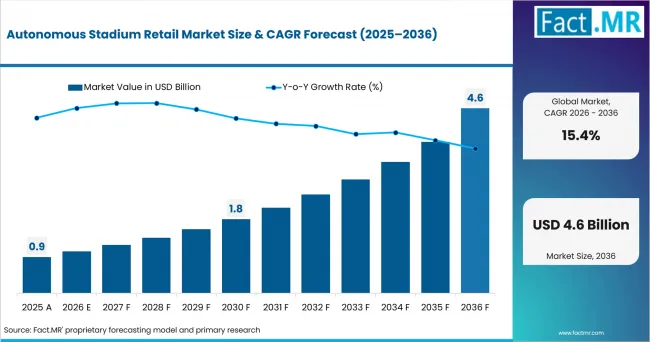
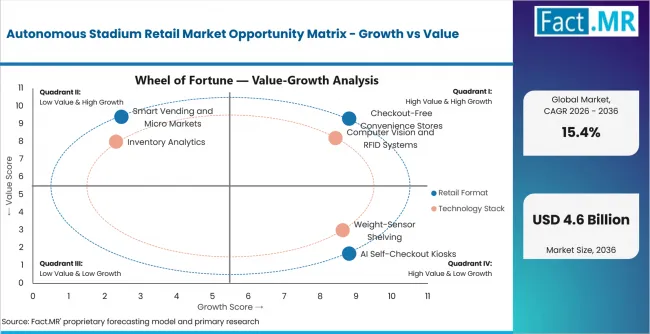
USD 1.1 billion in 2026 to USD 4.6 billion by 2036, at 15.4% CAGR.
- The autonomous stadium retail market crossed a valuation of USD 0.9 billion in 2025. Demand is expected to increase from USD 1.1 billion in 2026 to USD 4.6 billion by 2036. The market is forecast to record 15.4% CAGR from 2026 to 2036 as venue operators use checkout-free stores to reduce lines and protect sales during event peaks.
- Autonomous stadium retail covers checkout-free stores, AI self-checkout kiosks and smart unattended retail systems inside sports venues. The category connects with frictionless retail because the core value lies in removing the manual checkout step. Stadium operators first adopt these systems where queues directly reduce concession revenue.
- AiFi stated in 2024 that it served customers with frictionless checkout in 20 sports stadiums. The company also said over 74 stadium stores were planned by the end of 2024. [1] This shows how stadiums are becoming a practical testbed for autonomous checkout. Zippin announced in 2024 that AT&T Stadium had launched Zippin checkout-free technology. [2]
- The venue context matters because football stadiums have heavy event-day traffic and short service windows. Faster retail can shift fans from waiting in line to returning to seats.
What are the defining numbers behind autonomous stadium retail market growth?
USD 3.5 billion absolute opportunity by 2036, led by the United States and Saudi Arabia.
- Demand Drivers in the Market
- Stadium CIOs need retail systems that reduce queue pressure during event breaks.
- Concession directors need faster service without adding large cashier teams.
- Venue operators need retail formats that support card-first entry and automated billing.
- Merchandising teams need unattended stores for high-traffic fan zones.
- Key Segments Analyzed
- By Retail Format: Checkout-Free Convenience Stores are expected to hold 38.0% share in 2026 because fans need fast grab-and-go service.
- By Technology Stack: Computer Vision and RFID Systems lead because item detection is central to autonomous checkout. The share is projected at 42.0% in 2026.
- By Deployment Model: New Stadium Deployment is likely to account for 36.0% share in 2026 because automation is easier to design before opening.
- By Revenue Stream: Food & Beverage Retail leads with 51.0% share in 2026 because event breaks concentrate concession sales.
- By Operating Model: Managed Retail Operations are expected to hold 33.0% share in 2026 because venues need event-day support.
- By Geography: The United States is projected to record 18.2% CAGR through 2036 as league venues expand checkout-free retail.
- Analyst Opinion at Fact.MR
- Shambhu Nath Jha, Senior Analyst at Fact.MR, states, “Autonomous stadium retail is becoming a revenue protection tool for live venues. We see stadium teams using checkout-free stores to capture purchases that were previously lost to long lines. Providers that combine accurate item recognition with event-day support will gain stronger access to venue modernization budgets.”
- Strategic Implications
- Retail automation providers should design store formats for halftime surges.
- Stadium operators should test checkout accuracy before expanding to merchandise.
- Concessionaires can use autonomous stores to serve peak demand with leaner counter staffing.
- Venue technology teams should connect payment data with inventory control.
Mashgin stated in 2025 that its AI checkout systems supported over 440 million transactions across more than 4,000 locations in 2024. [3] This supports adoption of AI-based checkout formats that keep staff involved while cutting transaction time.
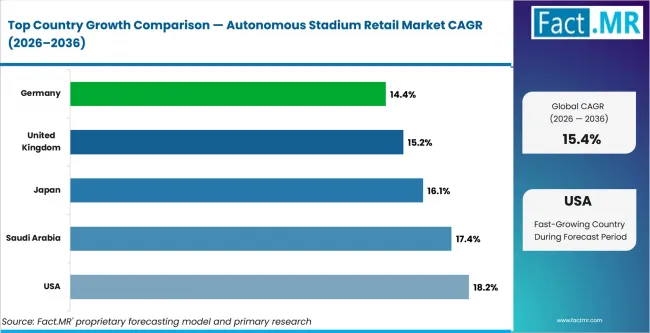
The United States is projected to record 18.2% CAGR through 2036 as NFL and arena operators expand checkout-free concession formats. Saudi Arabia is expected to post 17.4% CAGR through 2036 as new venues integrate retail automation during construction. Japan is likely to record 16.1% CAGR as compact stadiums prioritize high-throughput service. The United Kingdom is forecast to advance at 15.2% CAGR as football venues upgrade concessions. Germany is set to record 14.4% CAGR as clubs improve event-day retail flow.
How does the autonomous stadium retail market break down by segment?
Checkout-Free Convenience Stores lead at 38.0%; Computer Vision and RFID Systems lead at 42.0%.
Which retail format dominates?
Checkout-Free Convenience Stores hold 38.0% share in 2026.
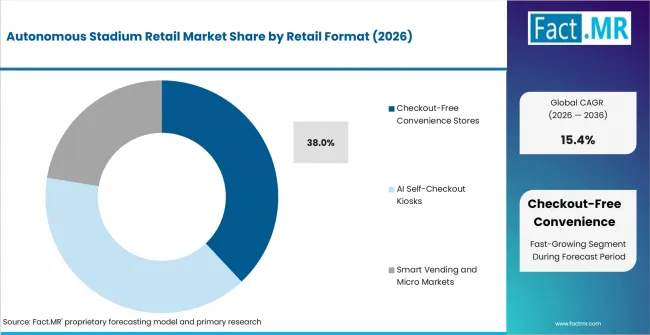
Checkout-Free Convenience Stores are expected to hold 38.0% share in 2026 because fans want to pick up food and leave without waiting for a cashier. Stadium operators prefer this format in high-traffic zones because it can process quick basket purchases. The format also supports beverages and packaged snacks. It connects with vending machines where unattended sales already shape venue retail behavior.
Which technology stack dominates?
Computer Vision and RFID Systems hold 42.0% share in 2026.
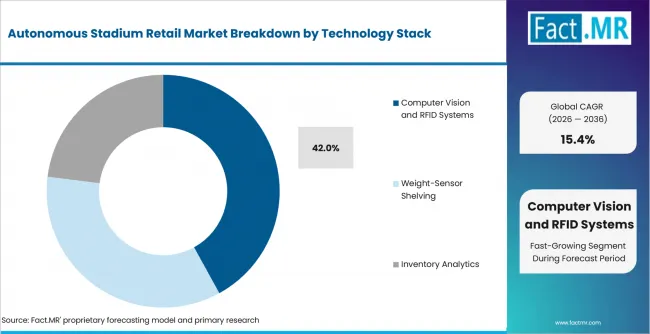
Computer Vision and RFID Systems lead because autonomous checkout needs reliable item recognition. The technology stack is projected to capture 42.0% share in 2026. Camera-based systems track product movement and shopper flow. RFID lanes are gaining because tagged merchandise can move through portable exit points. Stadium operators choose this stack where speed and transaction accuracy both matter.
Which deployment model dominates?
New Stadium Deployment holds 36.0% share in 2026.
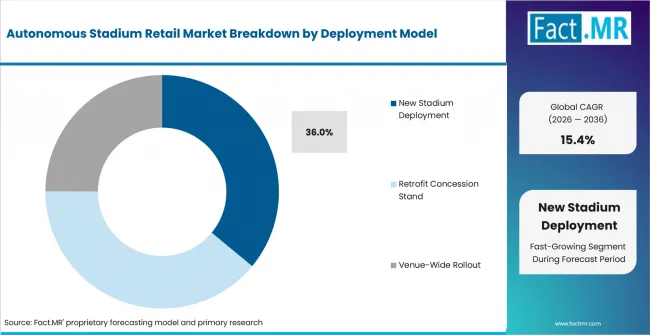
New Stadium Deployment leads because autonomous retail is easier to plan during venue design. Power layouts and camera placement can be built into the retail zone. The deployment model is projected to hold 36.0% share in 2026. Retrofitting old concessions is possible but harder because stores must work around existing walls and service counters. New venues can also connect retail systems with connected stadium infrastructure from the start.
Which revenue stream dominates?
Food & Beverage Retail holds 51.0% share in 2026.
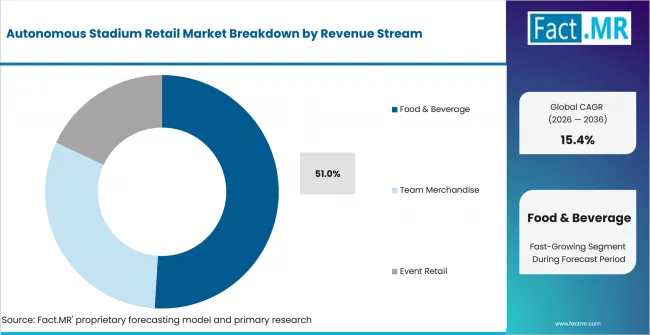
Food & Beverage Retail leads because concession sales peak during short breaks. The revenue stream is expected to hold 51.0% share in 2026. Fans buy packaged drinks and snacks first because these items suit fast autonomous checkout. Merchandise stores can scale later when item tagging becomes easier. Foodservice teams benefit when autonomous formats take pressure away from staffed counters.
Which operating model dominates?
Managed Retail Operations hold 33.0% share in 2026.
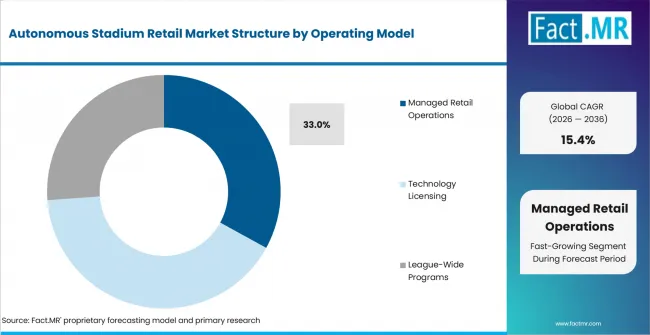
Managed Retail Operations lead because stadiums need support before and during events. The model is likely to account for 33.0% share in 2026. Providers help with store readiness and post-event issue reviews. Venue teams prefer managed support because checkout-free systems must perform during a narrow service window. The model also aligns with stadium operations planning.
What is accelerating autonomous stadium retail demand, and what is holding it back?
Short event service windows drive demand; integration complexity restrains rollout.
Short event service windows are the main driver. Fans make purchase decisions before play resumes. Autonomous retail helps venues serve more transactions during that short period. Amazon stated in 2026 that Just Walk Out technology operated at more than 360 locations across 5 countries. [4] The company also introduced portable lanes for event and pop-up retail. This supports broader use of checkout-free systems in venue settings.
365 Retail Markets / Cantaloupe stated in 2024 that its self-service and mobile-first solutions serve stadiums and entertainment venues. [5] This shows that unattended retail is expanding beyond fixed stores into flexible concession formats.
Payment integration adds another driver. Stadium operators need automated charging that works with cards and mobile wallets. The mobile point-of-sale layer remains important where staff-assisted checkout still supports autonomous lanes.
The main restraint is operational confidence. Stadium teams must trust item recognition and receipt accuracy before scaling across the venue. They also need reliable inventory replenishment between event waves.
Where do the biggest autonomous stadium retail opportunities sit?
Checkout-free concessions, retail pop-ups and merchandise automation.
- Checkout-Free Concessions: Stadium operators can use autonomous stores to reduce missed purchases during halftime.
- Retail Pop-Ups: Event organizers can deploy portable stores for temporary merchandise sales.
- Merchandise Automation: Clubs can use RFID lanes for jerseys and fan accessories.
Which countries are scaling autonomous stadium retail fastest?
United States 18.2%, Saudi Arabia 17.4%, Japan 16.1%, United Kingdom 15.2%, Germany 14.4%.
Based on regional analysis, the autonomous stadium retail market is segmented into North America, Western Europe, Asia Pacific, Latin America, and Middle East and Africa.
.webp)
| Country | CAGR |
|---|---|
| United States | 18.2% |
| Saudi Arabia | 17.4% |
| Japan | 16.1% |
| United Kingdom | 15.2% |
| Germany | 14.4% |

What is powering the United States lead?
18.2% CAGR, driven by Amazon Just Walk Out and NFL venue adoption.
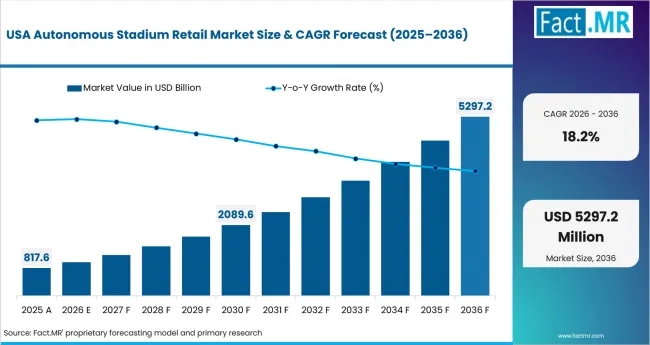
The United States is projected to record 18.2% CAGR through 2036 as stadium operators expand checkout-free concessions. NFL venues create repeatable deployment templates for high-footfall stores. Fans already use card-based entry and mobile wallets. Growth will favor providers with proven event-day uptime.
How is Saudi Arabia scaling autonomous stadium retail demand?
17.4% CAGR, led by new sports venues and digital-first event infrastructure.
Saudi Arabia is expected to post 17.4% CAGR from 2026 to 2036 because new stadiums can integrate autonomous retail during planning. This reduces retrofit barriers. Major entertainment venues can use checkout-free stores to support large visitor flows. Growth will favor partners with new-build stadium experience.
What underpins Japan’s growth?
16.1% CAGR, driven by dense urban stadiums and compact retail zones.
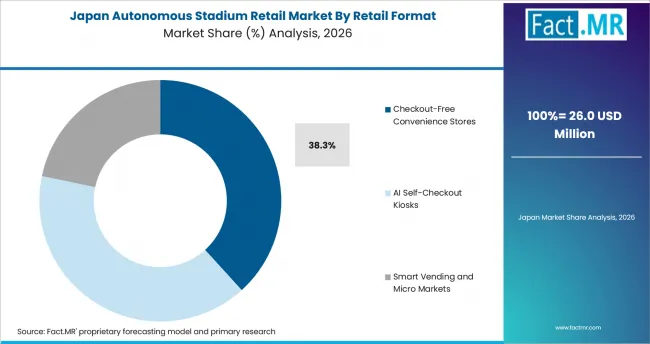
Japan is likely to record 16.1% CAGR by 2036 as compact venues need fast retail throughput. Small store formats suit camera-based checkout and RFID exits. Stadium teams need precise queue control because concourse space is limited. Growth will favor compact systems that work in tight retail footprints.
What supports the United Kingdom outlook?
15.2% CAGR, supported by football clubs and concession modernization.
The United Kingdom is forecast to advance at 15.2% CAGR through 2036 as football venues upgrade match-day foodservice. Clubs need faster retail around halftime. Autonomous formats can support premium seating zones. Growth will favor systems that connect store access with stadium payment rules.
How is Germany scaling autonomous stadium retail adoption?
14.4% CAGR, due to football venues and structured event operations.
Germany is set to record 14.4% CAGR through 2036 as stadiums improve concession flow and service reliability. Venue operators need retail systems that support crowd management. Autonomous stores can reduce pressure around concourses. Growth will favor providers that can integrate with security and access systems.
Who leads the autonomous stadium retail market?
Amazon Just Walk Out and AiFi lead through checkout-free stadium stores.
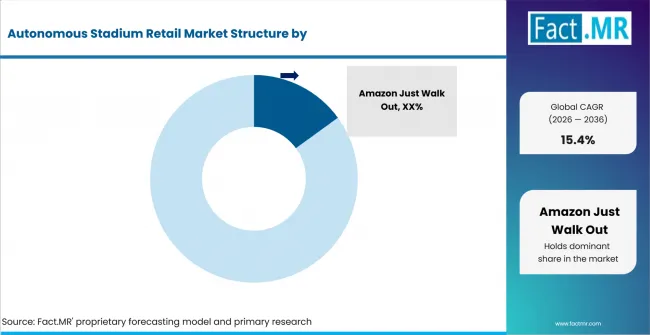
Autonomous stadium retail is supplied by checkout-free technology providers and unattended retail platforms. Amazon Just Walk Out supports cashierless stores and portable retail lanes. AiFi supports autonomous stadium stores through spatial intelligence and checkout-free systems.
Zippin is active in checkout-free stores for sports venues. Mashgin competes through AI self-checkout kiosks and high-speed item recognition. 365 Retail Markets / Cantaloupe supports self-service commerce for stadiums and entertainment venues. The company set is narrower than general retail intelligence because stadium use requires event-ready operations.
Competition through 2036 will depend on venue deployment skill. Providers need accurate item recognition and reliable payment capture. Stadium operators will also assess support quality during event peaks. The stadium access layer can become a useful integration point for fan entry and retail access.
Which companies are the key providers?
- Amazon Just Walk Out
- AiFi
- Zippin
- Mashgin
- 365 Retail Markets / Cantaloupe
Bibliography
- [1] AiFi. (2024, October 22). AiFi celebrates stadium growth with NFL partnerships and spatial intelligence expansion into new industries. AiFi.
- [2] Zippin. (2024, August 27). America’s Team goes checkout-free with Zippin. Zippin.
- [3] Mashgin. (2025, January 15). Mashgin’s AI checkout powers over 440 million transactions in 2024. Mashgin.
- [4] Amazon. (2026, January 13). Amazon’s new portable Just Walk Out lanes bring checkout-free shopping to pop-up venues. About Amazon.
- [5] Cantaloupe, Inc. (2024, May 15). Cantaloupe, Inc. to showcase self-service and mobile-first solutions at the National Restaurant Association Show. Cantaloupe, Inc.
- [6] 365 Retail Markets. (2026). Connected commerce and unattended retail solutions. 365 Retail Markets.
This Report Addresses
- Strategic intelligence on autonomous stadium retail across retail format, technology stack and operating model.
- Segment analysis covering Checkout-Free Convenience Stores, Computer Vision and RFID Systems and Food & Beverage Retail.
- Regional outlook covering the United States, Saudi Arabia, Japan, the United Kingdom and Germany.
- Competitive analysis of Amazon Just Walk Out, AiFi, Zippin, Mashgin, and 365 Retail Markets / Cantaloupe.
- Technology assessment covering computer vision, RFID lanes, AI kiosks and payment integration.
- Use case assessment covering concessions, fan merchandise and pop-up event retail.
- Primary interviews, provider checks and official source review support the forecast.
What does the autonomous stadium retail market cover?
Checkout-free and unattended retail systems used inside stadiums and arenas.
The autonomous stadium retail market covers hardware, software and managed services that enable fans to buy food or merchandise with minimal checkout friction. It includes camera-based checkout, RFID-enabled lanes, AI self-checkout kiosks and connected vending units. The scope connects with alternative retailing because stadium operators need store formats that work outside ordinary retail conditions.
The market differs from general autonomous retail because event traffic is compressed into short periods. A stadium store must handle sudden demand before kickoff and during halftime. The system must also work with venue access rules and concessionaire operations.
What is included in the scope?
Checkout-free stores and AI self-checkout systems.
The scope includes computer-vision stores, RFID retail lanes and AI checkout kiosks. It covers AI kiosks when they are deployed inside stadium concessions or merchandise areas. It also includes smart vending and micro-market systems if they support unattended stadium retail.
The scope covers store design, platform software, payment integration and managed retail support. It includes retrofit concession stands and new stadium retail zones. It also covers event-day monitoring when the provider helps the venue keep systems active under peak traffic.
What is excluded from the scope?
Ordinary POS systems without autonomous retail function.
The scope excludes conventional concession counters that depend on cashier scanning. It excludes food delivery apps unless the order is fulfilled through autonomous stadium retail. It excludes general fan engagement apps unless they connect to checkout-free commerce. It also excludes static vending machines without digital inventory control.
How was the analysis built?
100+ sources, 40+ company portfolios, 25+ countries, 20+ interviews.
- Primary Research:
- Primary research includes interviews with stadium technology heads and concession operations directors. It includes input from retail automation providers and venue foodservice integrators.
- Desk Research:
- Desk research reviews checkout-free stadium deployments and official provider sources. It covers autonomous retail stores, AI self-checkout systems and self-service kiosk adoption.
- Market-Sizing and Forecasting:
- Forecasting uses stadium modernization activity and concession technology refresh cycles. Store count expansion and managed retail attachment support the market assessment.
- Data Validation and Update Cycle:
- Forecasts are validated through provider checks and venue deployment references. Stadium store launches and event-day retail technology updates help confirm market direction.
What is the report’s scope and coverage?
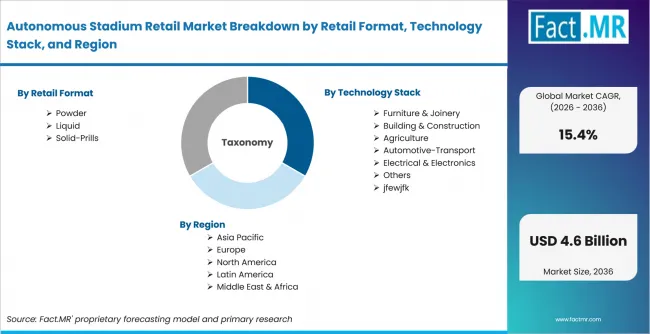
| Attribute | Details |
|---|---|
| Quantitative Units | USD Billion in 2026 to USD Billion by 2036 at CAGR |
| Market Definition | Checkout-free and unattended retail systems used inside stadiums and arenas |
| Retail Format | Checkout-Free Convenience Stores; AI Self-Checkout Kiosks; Smart Vending and Micro Markets; Grab-and-Go Beverage Lanes; Merchandise Stores |
| Technology Stack | Computer Vision and RFID Systems; Weight-Sensor Shelving; Mobile App and Wallet Integration; POS and Payment Integration; Inventory Analytics |
| Deployment Model | New Stadium Deployment; Retrofit Concession Stand; Pop-Up Event Retail; Venue-Wide Rollout; Retail-as-a-Service |
| Revenue Stream | Food & Beverage Retail; Team Merchandise; Sponsor Sampling; Premium Club Stores; Event Retail |
| Operating Model | Managed Retail Operations; Operator-Owned Systems; League-Wide Programs; Concessionaire Partnerships; Technology Licensing |
| Regions Covered | North America; Western Europe; Asia Pacific; Latin America; Middle East and Africa |
| Countries Covered | United States; Saudi Arabia; Japan; United Kingdom; Germany |
| Key Companies Profiled | Amazon Just Walk Out; AiFi; Zippin; Mashgin; 365 Retail Markets / Cantaloupe |
| Forecast Period | 2026 to 2036 |
| Approach | Hybrid top-down and bottom-up approach using stadium store deployments, concession technology refresh cycles and provider validation |
How is the market segmented?
-
By Retail Format:
- Checkout-Free Convenience Stores
- AI Self-Checkout Kiosks
- Smart Vending and Micro Markets
- Grab-and-Go Beverage Lanes
- Merchandise Stores
-
By Technology Stack:
- Computer Vision and RFID Systems
- Weight-Sensor Shelving
- Mobile App and Wallet Integration
- POS and Payment Integration
- Inventory Analytics
-
By Deployment Model:
- New Stadium Deployment
- Retrofit Concession Stand
- Pop-Up Event Retail
- Venue-Wide Rollout
- Retail-as-a-Service
-
By Revenue Stream:
- Food & Beverage Retail
- Team Merchandise
- Sponsor Sampling
- Premium Club Stores
- Event Retail
-
By Operating Model:
- Managed Retail Operations
- Operator-Owned Systems
- League-Wide Programs
- Concessionaire Partnerships
- Technology Licensing
-
Region:
- North America
- United States
- Canada
- Europe
- United Kingdom
- Germany
- France
- Spain
- Italy
- Asia Pacific
- Japan
- South Korea
- Australia
- China
- India
- Latin America
- Brazil
- Mexico
- Chile
- Middle East & Africa
- Saudi Arabia
- UAE
- South Africa
- Qatar
- North America
- Frequently Asked Questions -
Which retail format leads the Autonomous Stadium Retail Market?
Checkout-Free Convenience Stores lead with 38.0% share in 2026 because fans need fast grab-and-go service.
Which technology stack leads the Autonomous Stadium Retail Market?
Computer Vision and RFID Systems lead with 42.0% share in 2026 because item detection is central to autonomous checkout.
Which deployment model leads the Autonomous Stadium Retail Market?
New Stadium Deployment holds 36.0% share in 2026 because automation is easier to design before opening.
Which revenue stream leads the Autonomous Stadium Retail Market?
Food & Beverage Retail holds 51.0% share in 2026 because concession sales peak during short event breaks.
Which operating model leads the Autonomous Stadium Retail Market?
Managed Retail Operations hold 33.0% share in 2026 because venues need event-day support.
Which country expands fastest in the Autonomous Stadium Retail Market?
The United States is projected to record 18.2% CAGR through 2036 as checkout-free concession adoption expands.
How does Saudi Arabia perform in the Autonomous Stadium Retail Market?
Saudi Arabia is expected to post 17.4% CAGR through 2036 as new venues integrate retail automation during planning.
How does Japan perform in the Autonomous Stadium Retail Market?
Japan is likely to record 16.1% CAGR through 2036 as compact venues require fast retail throughput.
How does the United Kingdom perform in the Autonomous Stadium Retail Market?
The United Kingdom is forecast to advance at 15.2% CAGR through 2036 as football venues upgrade match-day foodservice.
How does Germany perform in the Autonomous Stadium Retail Market?
Germany is set to record 14.4% CAGR through 2036 as stadiums improve concession flow.
What is the primary driver in the Autonomous Stadium Retail Market?
The primary driver is short event service time because fans purchase food during narrow breaks.
What is the main restraint in the Autonomous Stadium Retail Market?
The main restraint is operational confidence because stadium teams must trust item recognition and billing accuracy.
Why are checkout-free stores important in this market?
Checkout-free stores are important because they help venues serve more fans during short concession windows.
Why are RFID systems gaining adoption?
RFID systems are gaining adoption because tagged items can move through portable retail lanes with faster exit processing.
Table of Content
- Key Takeaways
- Market Size and CAGR
- Top Growth Driver
- Fastest Growing Segment
- Leading Region
- Key Companies
- Emerging Opportunities
- Executive Summary
- Global Market Outlook
- Demand-side Trends
- Supply-side Trends
- Technology Roadmap Analysis
- Analysis and Recommendations
- Analyst Perspective (What is happening? Why now? What should investors know?)
- Key Questions Answered
- How large is the market?
- What is the CAGR?
- What are key trends?
- Which region dominates?
- Who are the leaders?
- Market Overview
- Market Coverage / Taxonomy
- Market Definition / Scope / Limitations
- Research Methodology
- Chapter Orientation
- Analytical Lens and Working Hypotheses
- Market Structure, Signals, and Trend Drivers
- Benchmarking and Cross-market Comparability
- Market Sizing, Forecasting, and Opportunity Mapping
- Research Design and Evidence Framework
- Desk Research Programme (Secondary Evidence)
- Expert Input and Fieldwork (Primary Evidence)
- Tooling, Models, and Reference Databases
- Data Engineering and Model Build
- Quality Assurance and Audit Trail
- Market Background
- Market Dynamics (Drivers, Restraints, Opportunity, Trends)
- Scenario Forecast (Optimistic, Likely, Conservative)
- Impact Analysis
- AI Impact
- Sustainability Impact
- Regulatory Impact
- Technology Impact
- Consumer / Buyer Analysis
- Purchase Drivers
- Adoption Barriers
- Buyer Journey
- Opportunity Map Analysis
- Product Life Cycle Analysis
- Supply Chain Analysis
- Investment Feasibility Matrix
- Value Chain Analysis
- PESTLE and Porter's Analysis
- Regulatory Landscape
- Regional Parent Market Outlook
- Production and Consumption Statistics
- Import and Export Statistics
- Global Market Analysis and Forecast, 2021 to 2036
- Historical Market Size Value (USD Billion) Analysis, 2021 to 2025
- Current and Future Market Size Value (USD Billion) Projections, 2026 to 2036
- Y-o-Y Growth Trend Analysis
- Absolute $ Opportunity Analysis
- Global Market Pricing Analysis, 2021 to 2036
- Global Market Analysis and Forecast, By Retail Format, 2021 to 2036
- Introduction / Key Findings
- Historical Market Size Value (USD Billion) Analysis By Retail Format, 2021 to 2025
- Current and Future Market Size Value (USD Billion) Analysis and Forecast By Retail Format, 2026 to 2036
- Checkout-Free Convenience Stores
- AI Self-Checkout Kiosks
- Smart Vending and Micro Markets
- Y-o-Y Growth Trend Analysis By Retail Format, 2021 to 2025
- Absolute $ Opportunity Analysis By Retail Format, 2026 to 2036
- Global Market Analysis and Forecast, By Technology Stack, 2021 to 2036
- Introduction / Key Findings
- Historical Market Size Value (USD Billion) Analysis By Technology Stack, 2021 to 2025
- Current and Future Market Size Value (USD Billion) Analysis and Forecast By Technology Stack, 2026 to 2036
- Computer Vision and RFID Systems
- Weight-Sensor Shelving
- Inventory Analytics
- Y-o-Y Growth Trend Analysis By Technology Stack, 2021 to 2025
- Absolute $ Opportunity Analysis By Technology Stack, 2026 to 2036
- Global Market Analysis and Forecast, By Deployment Model, 2021 to 2036
- Introduction / Key Findings
- Historical Market Size Value (USD Billion) Analysis By Deployment Model, 2021 to 2025
- Current and Future Market Size Value (USD Billion) Analysis and Forecast By Deployment Model, 2026 to 2036
- New Stadium Deployment
- Retrofit Concession Stand
- Venue-Wide Rollout
- Y-o-Y Growth Trend Analysis By Deployment Model, 2021 to 2025
- Absolute $ Opportunity Analysis By Deployment Model, 2026 to 2036
- Global Market Analysis and Forecast, By Revenue Stream, 2021 to 2036
- Introduction / Key Findings
- Historical Market Size Value (USD Billion) Analysis By Revenue Stream, 2021 to 2025
- Current and Future Market Size Value (USD Billion) Analysis and Forecast By Revenue Stream, 2026 to 2036
- Food & Beverage
- Team Merchandise
- Event Retail
- Y-o-Y Growth Trend Analysis By Revenue Stream, 2021 to 2025
- Absolute $ Opportunity Analysis By Revenue Stream, 2026 to 2036
- Global Market Analysis and Forecast, By Operating Model, 2021 to 2036
- Introduction / Key Findings
- Historical Market Size Value (USD Billion) Analysis By Operating Model, 2021 to 2025
- Current and Future Market Size Value (USD Billion) Analysis and Forecast By Operating Model, 2026 to 2036
- Managed Retail Operations
- Technology Licensing
- League-Wide Programs
- Y-o-Y Growth Trend Analysis By Operating Model, 2021 to 2025
- Absolute $ Opportunity Analysis By Operating Model, 2026 to 2036
- Global Market Analysis and Forecast, By Region, 2021 to 2036
- Introduction
- Historical Market Size Value (USD Billion) Analysis By Region, 2021 to 2025
- Current Market Size Value (USD Billion) Analysis and Forecast By Region, 2026 to 2036
- North America
- Latin America
- Western Europe
- Eastern Europe
- East Asia
- South Asia and Pacific
- Middle East & Africa
- Market Attractiveness Analysis By Region
- North America Market Analysis and Forecast, By Country, 2021 to 2036
- Historical Market Size Value (USD Billion) Trend Analysis By Market Taxonomy, 2021 to 2025
- Market Size Value (USD Billion) Forecast By Market Taxonomy, 2026 to 2036
- By Country
- USA
- Canada
- Mexico
- By Retail Format
- By Technology Stack
- By Deployment Model
- By Revenue Stream
- By Operating Model
- By Country
- Market Attractiveness Analysis
- By Country
- By Retail Format
- By Technology Stack
- By Deployment Model
- By Revenue Stream
- By Operating Model
- Key Takeaways
- Latin America Market Analysis and Forecast, By Country
- Historical Market Size Value (USD Billion) Trend Analysis By Market Taxonomy, 2021 to 2025
- Market Size Value (USD Billion) Forecast By Market Taxonomy, 2026 to 2036
- By Country
- Brazil
- Chile
- Rest of Latin America
- By Retail Format
- By Technology Stack
- By Deployment Model
- By Revenue Stream
- By Operating Model
- By Country
- Market Attractiveness Analysis
- By Country
- By Retail Format
- By Technology Stack
- By Deployment Model
- By Revenue Stream
- By Operating Model
- Key Takeaways
- Western Europe Market Analysis and Forecast, By Country
- Historical Market Size Value (USD Billion) Trend Analysis By Market Taxonomy, 2021 to 2025
- Market Size Value (USD Billion) Forecast By Market Taxonomy, 2026 to 2036
- By Country
- Germany
- UK
- Italy
- Spain
- France
- Nordic
- BENELUX
- Rest of Western Europe
- By Retail Format
- By Technology Stack
- By Deployment Model
- By Revenue Stream
- By Operating Model
- By Country
- Market Attractiveness Analysis
- By Country
- By Retail Format
- By Technology Stack
- By Deployment Model
- By Revenue Stream
- By Operating Model
- Key Takeaways
- Eastern Europe Market Analysis and Forecast, By Country
- Historical Market Size Value (USD Billion) Trend Analysis By Market Taxonomy, 2021 to 2025
- Market Size Value (USD Billion) Forecast By Market Taxonomy, 2026 to 2036
- By Country
- Russia
- Poland
- Hungary
- Balkan & Baltic
- Rest of Eastern Europe
- By Retail Format
- By Technology Stack
- By Deployment Model
- By Revenue Stream
- By Operating Model
- By Country
- Market Attractiveness Analysis
- By Country
- By Retail Format
- By Technology Stack
- By Deployment Model
- By Revenue Stream
- By Operating Model
- Key Takeaways
- East Asia Market Analysis and Forecast, By Country
- Historical Market Size Value (USD Billion) Trend Analysis By Market Taxonomy, 2021 to 2025
- Market Size Value (USD Billion) Forecast By Market Taxonomy, 2026 to 2036
- By Country
- China
- Japan
- South Korea
- By Retail Format
- By Technology Stack
- By Deployment Model
- By Revenue Stream
- By Operating Model
- By Country
- Market Attractiveness Analysis
- By Country
- By Retail Format
- By Technology Stack
- By Deployment Model
- By Revenue Stream
- By Operating Model
- Key Takeaways
- South Asia and Pacific Market Analysis and Forecast, By Country
- Historical Market Size Value (USD Billion) Trend Analysis By Market Taxonomy, 2021 to 2025
- Market Size Value (USD Billion) Forecast By Market Taxonomy, 2026 to 2036
- By Country
- India
- ASEAN
- Australia & New Zealand
- Rest of South Asia and Pacific
- By Retail Format
- By Technology Stack
- By Deployment Model
- By Revenue Stream
- By Operating Model
- By Country
- Market Attractiveness Analysis
- By Country
- By Retail Format
- By Technology Stack
- By Deployment Model
- By Revenue Stream
- By Operating Model
- Key Takeaways
- Middle East & Africa Market Analysis and Forecast, By Country
- Historical Market Size Value (USD Billion) Trend Analysis By Market Taxonomy, 2021 to 2025
- Market Size Value (USD Billion) Forecast By Market Taxonomy, 2026 to 2036
- By Country
- Kingdom of Saudi Arabia
- Other GCC Countries
- Turkiye
- South Africa
- Other African Union
- Rest of Middle East & Africa
- By Retail Format
- By Technology Stack
- By Deployment Model
- By Revenue Stream
- By Operating Model
- By Country
- Market Attractiveness Analysis
- By Country
- By Retail Format
- By Technology Stack
- By Deployment Model
- By Revenue Stream
- By Operating Model
- Key Takeaways
- Key Countries Market Analysis
- USA
- Pricing Analysis
- Market Share Analysis, 2025
- By Retail Format
- By Technology Stack
- By Deployment Model
- By Revenue Stream
- By Operating Model
- Canada
- Pricing Analysis
- Market Share Analysis, 2025
- By Retail Format
- By Technology Stack
- By Deployment Model
- By Revenue Stream
- By Operating Model
- Mexico
- Pricing Analysis
- Market Share Analysis, 2025
- By Retail Format
- By Technology Stack
- By Deployment Model
- By Revenue Stream
- By Operating Model
- Brazil
- Pricing Analysis
- Market Share Analysis, 2025
- By Retail Format
- By Technology Stack
- By Deployment Model
- By Revenue Stream
- By Operating Model
- Chile
- Pricing Analysis
- Market Share Analysis, 2025
- By Retail Format
- By Technology Stack
- By Deployment Model
- By Revenue Stream
- By Operating Model
- Germany
- Pricing Analysis
- Market Share Analysis, 2025
- By Retail Format
- By Technology Stack
- By Deployment Model
- By Revenue Stream
- By Operating Model
- UK
- Pricing Analysis
- Market Share Analysis, 2025
- By Retail Format
- By Technology Stack
- By Deployment Model
- By Revenue Stream
- By Operating Model
- Italy
- Pricing Analysis
- Market Share Analysis, 2025
- By Retail Format
- By Technology Stack
- By Deployment Model
- By Revenue Stream
- By Operating Model
- Spain
- Pricing Analysis
- Market Share Analysis, 2025
- By Retail Format
- By Technology Stack
- By Deployment Model
- By Revenue Stream
- By Operating Model
- France
- Pricing Analysis
- Market Share Analysis, 2025
- By Retail Format
- By Technology Stack
- By Deployment Model
- By Revenue Stream
- By Operating Model
- India
- Pricing Analysis
- Market Share Analysis, 2025
- By Retail Format
- By Technology Stack
- By Deployment Model
- By Revenue Stream
- By Operating Model
- ASEAN
- Pricing Analysis
- Market Share Analysis, 2025
- By Retail Format
- By Technology Stack
- By Deployment Model
- By Revenue Stream
- By Operating Model
- Australia & New Zealand
- Pricing Analysis
- Market Share Analysis, 2025
- By Retail Format
- By Technology Stack
- By Deployment Model
- By Revenue Stream
- By Operating Model
- China
- Pricing Analysis
- Market Share Analysis, 2025
- By Retail Format
- By Technology Stack
- By Deployment Model
- By Revenue Stream
- By Operating Model
- Japan
- Pricing Analysis
- Market Share Analysis, 2025
- By Retail Format
- By Technology Stack
- By Deployment Model
- By Revenue Stream
- By Operating Model
- South Korea
- Pricing Analysis
- Market Share Analysis, 2025
- By Retail Format
- By Technology Stack
- By Deployment Model
- By Revenue Stream
- By Operating Model
- Russia
- Pricing Analysis
- Market Share Analysis, 2025
- By Retail Format
- By Technology Stack
- By Deployment Model
- By Revenue Stream
- By Operating Model
- Poland
- Pricing Analysis
- Market Share Analysis, 2025
- By Retail Format
- By Technology Stack
- By Deployment Model
- By Revenue Stream
- By Operating Model
- Hungary
- Pricing Analysis
- Market Share Analysis, 2025
- By Retail Format
- By Technology Stack
- By Deployment Model
- By Revenue Stream
- By Operating Model
- Kingdom of Saudi Arabia
- Pricing Analysis
- Market Share Analysis, 2025
- By Retail Format
- By Technology Stack
- By Deployment Model
- By Revenue Stream
- By Operating Model
- Turkiye
- Pricing Analysis
- Market Share Analysis, 2025
- By Retail Format
- By Technology Stack
- By Deployment Model
- By Revenue Stream
- By Operating Model
- South Africa
- Pricing Analysis
- Market Share Analysis, 2025
- By Retail Format
- By Technology Stack
- By Deployment Model
- By Revenue Stream
- By Operating Model
- USA
- Market Structure Analysis
- Competition Dashboard
- Competition Benchmarking
- Market Share Analysis of Top Players
- By Regional
- By Retail Format
- By Technology Stack
- By Deployment Model
- By Revenue Stream
- By Operating Model
- Emerging Startups
- Innovation Benchmarking
- Competition Analysis
- Competition Deep Dive
- Amazon Just Walk Out
- Overview
- Product Portfolio
- Profitability by Market Segments (Product/Age /Sales Channel/Region)
- Sales Footprint
- Strategy Overview
- Marketing Strategy
- Product Strategy
- Channel Strategy
- AiFi
- Zippin
- Mashgin
- 365 Retail Markets / Cantaloupe
- Amazon Just Walk Out
- Competition Deep Dive
- Case Studies
- Success Stories
- Recent Developments
- Assumptions & Acronyms Used
List Of Table
- Table 1: Global Market Value (USD Billion) Forecast by Region, 2021-2036
- Table 2: Global Market Value (USD Billion) Forecast by Retail Format, 2021-2036
- Table 3: Global Market Value (USD Billion) Forecast by Technology Stack, 2021-2036
- Table 4: Global Market Value (USD Billion) Forecast by Deployment Model, 2021-2036
- Table 5: Global Market Value (USD Billion) Forecast by Revenue Stream, 2021-2036
- Table 6: Global Market Value (USD Billion) Forecast by Operating Model, 2021-2036
- Table 7: North America Market Value (USD Billion) Forecast by Country, 2021-2036
- Table 8: North America Market Value (USD Billion) Forecast by Retail Format, 2021-2036
- Table 9: North America Market Value (USD Billion) Forecast by Technology Stack, 2021-2036
- Table 10: North America Market Value (USD Billion) Forecast by Deployment Model, 2021-2036
- Table 11: North America Market Value (USD Billion) Forecast by Revenue Stream, 2021-2036
- Table 12: North America Market Value (USD Billion) Forecast by Operating Model, 2021-2036
- Table 13: Latin America Market Value (USD Billion) Forecast by Country, 2021-2036
- Table 14: Latin America Market Value (USD Billion) Forecast by Retail Format, 2021-2036
- Table 15: Latin America Market Value (USD Billion) Forecast by Technology Stack, 2021-2036
- Table 16: Latin America Market Value (USD Billion) Forecast by Deployment Model, 2021-2036
- Table 17: Latin America Market Value (USD Billion) Forecast by Revenue Stream, 2021-2036
- Table 18: Latin America Market Value (USD Billion) Forecast by Operating Model, 2021-2036
- Table 19: Western Europe Market Value (USD Billion) Forecast by Country, 2021-2036
- Table 20: Western Europe Market Value (USD Billion) Forecast by Retail Format, 2021-2036
- Table 21: Western Europe Market Value (USD Billion) Forecast by Technology Stack, 2021-2036
- Table 22: Western Europe Market Value (USD Billion) Forecast by Deployment Model, 2021-2036
- Table 23: Western Europe Market Value (USD Billion) Forecast by Revenue Stream, 2021-2036
- Table 24: Western Europe Market Value (USD Billion) Forecast by Operating Model, 2021-2036
- Table 25: Eastern Europe Market Value (USD Billion) Forecast by Country, 2021-2036
- Table 26: Eastern Europe Market Value (USD Billion) Forecast by Retail Format, 2021-2036
- Table 27: Eastern Europe Market Value (USD Billion) Forecast by Technology Stack, 2021-2036
- Table 28: Eastern Europe Market Value (USD Billion) Forecast by Deployment Model, 2021-2036
- Table 29: Eastern Europe Market Value (USD Billion) Forecast by Revenue Stream, 2021-2036
- Table 30: Eastern Europe Market Value (USD Billion) Forecast by Operating Model, 2021-2036
- Table 31: East Asia Market Value (USD Billion) Forecast by Country, 2021-2036
- Table 32: East Asia Market Value (USD Billion) Forecast by Retail Format, 2021-2036
- Table 33: East Asia Market Value (USD Billion) Forecast by Technology Stack, 2021-2036
- Table 34: East Asia Market Value (USD Billion) Forecast by Deployment Model, 2021-2036
- Table 35: East Asia Market Value (USD Billion) Forecast by Revenue Stream, 2021-2036
- Table 36: East Asia Market Value (USD Billion) Forecast by Operating Model, 2021-2036
- Table 37: South Asia and Pacific Market Value (USD Billion) Forecast by Country, 2021-2036
- Table 38: South Asia and Pacific Market Value (USD Billion) Forecast by Retail Format, 2021-2036
- Table 39: South Asia and Pacific Market Value (USD Billion) Forecast by Technology Stack, 2021-2036
- Table 40: South Asia and Pacific Market Value (USD Billion) Forecast by Deployment Model, 2021-2036
- Table 41: South Asia and Pacific Market Value (USD Billion) Forecast by Revenue Stream, 2021-2036
- Table 42: South Asia and Pacific Market Value (USD Billion) Forecast by Operating Model, 2021-2036
- Table 43: Middle East & Africa Market Value (USD Billion) Forecast by Country, 2021-2036
- Table 44: Middle East & Africa Market Value (USD Billion) Forecast by Retail Format, 2021-2036
- Table 45: Middle East & Africa Market Value (USD Billion) Forecast by Technology Stack, 2021-2036
- Table 46: Middle East & Africa Market Value (USD Billion) Forecast by Deployment Model, 2021-2036
- Table 47: Middle East & Africa Market Value (USD Billion) Forecast by Revenue Stream, 2021-2036
- Table 48: Middle East & Africa Market Value (USD Billion) Forecast by Operating Model, 2021-2036
List Of Figures
- Figure 1: Global Market Pricing Analysis
- Figure 2: Global Market Value (USD Billion) Forecast 2021-2036
- Figure 3: Global Market Value Share and BPS Analysis by Retail Format, 2026 and 2036
- Figure 4: Global Market Y-o-Y Growth Comparison by Retail Format, 2026-2036
- Figure 5: Global Market Attractiveness Analysis by Retail Format
- Figure 6: Global Market Value Share and BPS Analysis by Technology Stack, 2026 and 2036
- Figure 7: Global Market Y-o-Y Growth Comparison by Technology Stack, 2026-2036
- Figure 8: Global Market Attractiveness Analysis by Technology Stack
- Figure 9: Global Market Value Share and BPS Analysis by Deployment Model, 2026 and 2036
- Figure 10: Global Market Y-o-Y Growth Comparison by Deployment Model, 2026-2036
- Figure 11: Global Market Attractiveness Analysis by Deployment Model
- Figure 12: Global Market Value Share and BPS Analysis by Revenue Stream, 2026 and 2036
- Figure 13: Global Market Y-o-Y Growth Comparison by Revenue Stream, 2026-2036
- Figure 14: Global Market Attractiveness Analysis by Revenue Stream
- Figure 15: Global Market Value Share and BPS Analysis by Operating Model, 2026 and 2036
- Figure 16: Global Market Y-o-Y Growth Comparison by Operating Model, 2026-2036
- Figure 17: Global Market Attractiveness Analysis by Operating Model
- Figure 18: Global Market Value (USD Billion) Share and BPS Analysis by Region, 2026 and 2036
- Figure 19: Global Market Y-o-Y Growth Comparison by Region, 2026-2036
- Figure 20: Global Market Attractiveness Analysis by Region
- Figure 21: North America Market Incremental Dollar Opportunity, 2026-2036
- Figure 22: Latin America Market Incremental Dollar Opportunity, 2026-2036
- Figure 23: Western Europe Market Incremental Dollar Opportunity, 2026-2036
- Figure 24: Eastern Europe Market Incremental Dollar Opportunity, 2026-2036
- Figure 25: East Asia Market Incremental Dollar Opportunity, 2026-2036
- Figure 26: South Asia and Pacific Market Incremental Dollar Opportunity, 2026-2036
- Figure 27: Middle East & Africa Market Incremental Dollar Opportunity, 2026-2036
- Figure 28: North America Market Value Share and BPS Analysis by Country, 2026 and 2036
- Figure 29: North America Market Value Share and BPS Analysis by Retail Format, 2026 and 2036
- Figure 30: North America Market Y-o-Y Growth Comparison by Retail Format, 2026-2036
- Figure 31: North America Market Attractiveness Analysis by Retail Format
- Figure 32: North America Market Value Share and BPS Analysis by Technology Stack, 2026 and 2036
- Figure 33: North America Market Y-o-Y Growth Comparison by Technology Stack, 2026-2036
- Figure 34: North America Market Attractiveness Analysis by Technology Stack
- Figure 35: North America Market Value Share and BPS Analysis by Deployment Model, 2026 and 2036
- Figure 36: North America Market Y-o-Y Growth Comparison by Deployment Model, 2026-2036
- Figure 37: North America Market Attractiveness Analysis by Deployment Model
- Figure 38: North America Market Value Share and BPS Analysis by Revenue Stream, 2026 and 2036
- Figure 39: North America Market Y-o-Y Growth Comparison by Revenue Stream, 2026-2036
- Figure 40: North America Market Attractiveness Analysis by Revenue Stream
- Figure 41: North America Market Value Share and BPS Analysis by Operating Model, 2026 and 2036
- Figure 42: North America Market Y-o-Y Growth Comparison by Operating Model, 2026-2036
- Figure 43: North America Market Attractiveness Analysis by Operating Model
- Figure 44: Latin America Market Value Share and BPS Analysis by Country, 2026 and 2036
- Figure 45: Latin America Market Value Share and BPS Analysis by Retail Format, 2026 and 2036
- Figure 46: Latin America Market Y-o-Y Growth Comparison by Retail Format, 2026-2036
- Figure 47: Latin America Market Attractiveness Analysis by Retail Format
- Figure 48: Latin America Market Value Share and BPS Analysis by Technology Stack, 2026 and 2036
- Figure 49: Latin America Market Y-o-Y Growth Comparison by Technology Stack, 2026-2036
- Figure 50: Latin America Market Attractiveness Analysis by Technology Stack
- Figure 51: Latin America Market Value Share and BPS Analysis by Deployment Model, 2026 and 2036
- Figure 52: Latin America Market Y-o-Y Growth Comparison by Deployment Model, 2026-2036
- Figure 53: Latin America Market Attractiveness Analysis by Deployment Model
- Figure 54: Latin America Market Value Share and BPS Analysis by Revenue Stream, 2026 and 2036
- Figure 55: Latin America Market Y-o-Y Growth Comparison by Revenue Stream, 2026-2036
- Figure 56: Latin America Market Attractiveness Analysis by Revenue Stream
- Figure 57: Latin America Market Value Share and BPS Analysis by Operating Model, 2026 and 2036
- Figure 58: Latin America Market Y-o-Y Growth Comparison by Operating Model, 2026-2036
- Figure 59: Latin America Market Attractiveness Analysis by Operating Model
- Figure 60: Western Europe Market Value Share and BPS Analysis by Country, 2026 and 2036
- Figure 61: Western Europe Market Value Share and BPS Analysis by Retail Format, 2026 and 2036
- Figure 62: Western Europe Market Y-o-Y Growth Comparison by Retail Format, 2026-2036
- Figure 63: Western Europe Market Attractiveness Analysis by Retail Format
- Figure 64: Western Europe Market Value Share and BPS Analysis by Technology Stack, 2026 and 2036
- Figure 65: Western Europe Market Y-o-Y Growth Comparison by Technology Stack, 2026-2036
- Figure 66: Western Europe Market Attractiveness Analysis by Technology Stack
- Figure 67: Western Europe Market Value Share and BPS Analysis by Deployment Model, 2026 and 2036
- Figure 68: Western Europe Market Y-o-Y Growth Comparison by Deployment Model, 2026-2036
- Figure 69: Western Europe Market Attractiveness Analysis by Deployment Model
- Figure 70: Western Europe Market Value Share and BPS Analysis by Revenue Stream, 2026 and 2036
- Figure 71: Western Europe Market Y-o-Y Growth Comparison by Revenue Stream, 2026-2036
- Figure 72: Western Europe Market Attractiveness Analysis by Revenue Stream
- Figure 73: Western Europe Market Value Share and BPS Analysis by Operating Model, 2026 and 2036
- Figure 74: Western Europe Market Y-o-Y Growth Comparison by Operating Model, 2026-2036
- Figure 75: Western Europe Market Attractiveness Analysis by Operating Model
- Figure 76: Eastern Europe Market Value Share and BPS Analysis by Country, 2026 and 2036
- Figure 77: Eastern Europe Market Value Share and BPS Analysis by Retail Format, 2026 and 2036
- Figure 78: Eastern Europe Market Y-o-Y Growth Comparison by Retail Format, 2026-2036
- Figure 79: Eastern Europe Market Attractiveness Analysis by Retail Format
- Figure 80: Eastern Europe Market Value Share and BPS Analysis by Technology Stack, 2026 and 2036
- Figure 81: Eastern Europe Market Y-o-Y Growth Comparison by Technology Stack, 2026-2036
- Figure 82: Eastern Europe Market Attractiveness Analysis by Technology Stack
- Figure 83: Eastern Europe Market Value Share and BPS Analysis by Deployment Model, 2026 and 2036
- Figure 84: Eastern Europe Market Y-o-Y Growth Comparison by Deployment Model, 2026-2036
- Figure 85: Eastern Europe Market Attractiveness Analysis by Deployment Model
- Figure 86: Eastern Europe Market Value Share and BPS Analysis by Revenue Stream, 2026 and 2036
- Figure 87: Eastern Europe Market Y-o-Y Growth Comparison by Revenue Stream, 2026-2036
- Figure 88: Eastern Europe Market Attractiveness Analysis by Revenue Stream
- Figure 89: Eastern Europe Market Value Share and BPS Analysis by Operating Model, 2026 and 2036
- Figure 90: Eastern Europe Market Y-o-Y Growth Comparison by Operating Model, 2026-2036
- Figure 91: Eastern Europe Market Attractiveness Analysis by Operating Model
- Figure 92: East Asia Market Value Share and BPS Analysis by Country, 2026 and 2036
- Figure 93: East Asia Market Value Share and BPS Analysis by Retail Format, 2026 and 2036
- Figure 94: East Asia Market Y-o-Y Growth Comparison by Retail Format, 2026-2036
- Figure 95: East Asia Market Attractiveness Analysis by Retail Format
- Figure 96: East Asia Market Value Share and BPS Analysis by Technology Stack, 2026 and 2036
- Figure 97: East Asia Market Y-o-Y Growth Comparison by Technology Stack, 2026-2036
- Figure 98: East Asia Market Attractiveness Analysis by Technology Stack
- Figure 99: East Asia Market Value Share and BPS Analysis by Deployment Model, 2026 and 2036
- Figure 100: East Asia Market Y-o-Y Growth Comparison by Deployment Model, 2026-2036
- Figure 101: East Asia Market Attractiveness Analysis by Deployment Model
- Figure 102: East Asia Market Value Share and BPS Analysis by Revenue Stream, 2026 and 2036
- Figure 103: East Asia Market Y-o-Y Growth Comparison by Revenue Stream, 2026-2036
- Figure 104: East Asia Market Attractiveness Analysis by Revenue Stream
- Figure 105: East Asia Market Value Share and BPS Analysis by Operating Model, 2026 and 2036
- Figure 106: East Asia Market Y-o-Y Growth Comparison by Operating Model, 2026-2036
- Figure 107: East Asia Market Attractiveness Analysis by Operating Model
- Figure 108: South Asia and Pacific Market Value Share and BPS Analysis by Country, 2026 and 2036
- Figure 109: South Asia and Pacific Market Value Share and BPS Analysis by Retail Format, 2026 and 2036
- Figure 110: South Asia and Pacific Market Y-o-Y Growth Comparison by Retail Format, 2026-2036
- Figure 111: South Asia and Pacific Market Attractiveness Analysis by Retail Format
- Figure 112: South Asia and Pacific Market Value Share and BPS Analysis by Technology Stack, 2026 and 2036
- Figure 113: South Asia and Pacific Market Y-o-Y Growth Comparison by Technology Stack, 2026-2036
- Figure 114: South Asia and Pacific Market Attractiveness Analysis by Technology Stack
- Figure 115: South Asia and Pacific Market Value Share and BPS Analysis by Deployment Model, 2026 and 2036
- Figure 116: South Asia and Pacific Market Y-o-Y Growth Comparison by Deployment Model, 2026-2036
- Figure 117: South Asia and Pacific Market Attractiveness Analysis by Deployment Model
- Figure 118: South Asia and Pacific Market Value Share and BPS Analysis by Revenue Stream, 2026 and 2036
- Figure 119: South Asia and Pacific Market Y-o-Y Growth Comparison by Revenue Stream, 2026-2036
- Figure 120: South Asia and Pacific Market Attractiveness Analysis by Revenue Stream
- Figure 121: South Asia and Pacific Market Value Share and BPS Analysis by Operating Model, 2026 and 2036
- Figure 122: South Asia and Pacific Market Y-o-Y Growth Comparison by Operating Model, 2026-2036
- Figure 123: South Asia and Pacific Market Attractiveness Analysis by Operating Model
- Figure 124: Middle East & Africa Market Value Share and BPS Analysis by Country, 2026 and 2036
- Figure 125: Middle East & Africa Market Value Share and BPS Analysis by Retail Format, 2026 and 2036
- Figure 126: Middle East & Africa Market Y-o-Y Growth Comparison by Retail Format, 2026-2036
- Figure 127: Middle East & Africa Market Attractiveness Analysis by Retail Format
- Figure 128: Middle East & Africa Market Value Share and BPS Analysis by Technology Stack, 2026 and 2036
- Figure 129: Middle East & Africa Market Y-o-Y Growth Comparison by Technology Stack, 2026-2036
- Figure 130: Middle East & Africa Market Attractiveness Analysis by Technology Stack
- Figure 131: Middle East & Africa Market Value Share and BPS Analysis by Deployment Model, 2026 and 2036
- Figure 132: Middle East & Africa Market Y-o-Y Growth Comparison by Deployment Model, 2026-2036
- Figure 133: Middle East & Africa Market Attractiveness Analysis by Deployment Model
- Figure 134: Middle East & Africa Market Value Share and BPS Analysis by Revenue Stream, 2026 and 2036
- Figure 135: Middle East & Africa Market Y-o-Y Growth Comparison by Revenue Stream, 2026-2036
- Figure 136: Middle East & Africa Market Attractiveness Analysis by Revenue Stream
- Figure 137: Middle East & Africa Market Value Share and BPS Analysis by Operating Model, 2026 and 2036
- Figure 138: Middle East & Africa Market Y-o-Y Growth Comparison by Operating Model, 2026-2036
- Figure 139: Middle East & Africa Market Attractiveness Analysis by Operating Model
- Figure 140: Global Market - Tier Structure Analysis
- Figure 141: Global Market - Company Share Analysis