Over-the-Air Updatable Vehicle Control Unit Platforms Market
The Over-the-Air Updatable Vehicle Control Unit Platforms Market is analyzed by platform type, including ota-enabled central vehicle control units and telematics control units, and region, forecast 2026 to 2036.
By Fact.MR Automotive DeskLead analyst:
Shubham PatidarPublished :
14 min read
Fact-checked under the Fact.MR editorial process
Over-the-Air Updatable Vehicle Control Unit Platforms Market Forecast and Outlook By Fact.MR
In 2025, the over-the-air updatable vehicle control unit platforms market was valued at USD 4.9 billion.
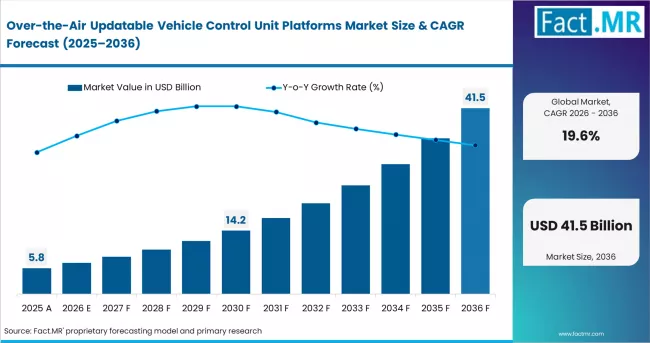
Based on Fact.MR analysis, demand for OTA updatable vehicle control unit platforms is estimated to grow to USD 5.8 billion in 2026 and USD 34.5 billion by 2036.
FACT.MR projects a CAGR of 19.6% during the forecast period.
Over The Air Updatable Vehicle Control Unit Platforms Market Market Value Analysis | Source: Fact.MR
Metric
Value
Estimated Value in 2026
USD 5.8 billion
Forecast Value in 2036
USD 34.5 billion
Forecast CAGR (2026 to 2036)
19.6%
Source: Fact.MR analysis. Updated May 11, 2026
Summary of Over-the-Air Updatable Vehicle Control Unit Platforms Market
Market Definition
Market covers OTA-enabled vehicle control unit platforms supplying software and firmware update infrastructure across connected passenger and commercial vehicle programmes globally.
Demand Drivers
UNECE WP.29 cybersecurity and software update management regulations are mandating OTA capability for all new vehicle types sold in regulated markets.
OEM software monetisation strategies are driving adoption of centralised OTA platform architectures to enable post-sale feature unlock and subscription revenue.
Commercial fleet operators are accelerating FOTA procurement to reduce physical recall cost and improve uptime across EV and hybrid fleet deployments.
Key Segments Analyzed
By Platform Type: OTA-enabled central vehicle control units lead with 40% share in 2026, driven by SDV platform consolidation.
By Update Type: SOTA leads with 65% in 2026 as OEMs prioritise application and feature-layer update delivery over firmware cycles.
By Vehicle Type: Passenger vehicles lead with 72% in 2026, anchored by connected car platform rollouts across BEV and PHEV segments.
Analyst Opinion at FACT.MR
Shambhu Nath Jha, Principal Consultant at Fact.MR, opines, ' CXOs will find that OTA platform depth and cybersecurity compliance readiness define supplier selection. SOTA-capable central VCU vendors with UNECE WP.29-validated architectures hold a structural lead in new programme awards.'
Strategic Implications
Achieve UNECE WP.29 CS and SUMS compliance certification to qualify for OEM programme awards in EU, Japan, and South Korea regulated markets.
Develop SOTA-first central VCU platform architectures that support post-sale feature monetisation and enable OEM software subscription revenue models.
Establish direct co-development agreements with EV-native OEMs in China and India to capture fast-growth emerging market OTA infrastructure procurement.
Methodology
Market sizing uses connected vehicle production volumes and OTA platform content-per-vehicle benchmarks, validated with 2024-2025 OEM programme disclosures.
Analysis includes UNECE WP.29 regulatory adoption timelines, NHTSA cybersecurity rule data, and Tier-1 supplier revenue filings.
Forecasts incorporate software-defined vehicle roadmap commitments, SOTA adoption rates, and expert interviews with OEM software procurement specialists.
The market is projected to generate USD 28.7 billion in absolute opportunity between 2026 and 2036. Growth is transformational and anchored in software-defined vehicle architecture adoption by global OEMs. Expansion is paced by cybersecurity compliance complexity and legacy ECU fleet integration constraints.
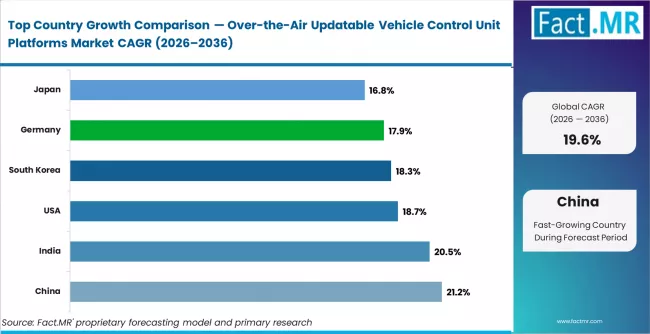
China leads at 21.2% CAGR, underpinned by the world's densest connected vehicle deployment base. India follows at 20.5% as domestic EV ecosystem expansion accelerates OTA-capable ECU procurement. South Korea records 18.3% driven by Hyundai-Kia's software-defined vehicle platform rollout. The United States grows at 18.7% on OEM vertical integration and NHTSA cybersecurity rule enforcement. Germany posts 17.9% driven by premium SDV platform investment. Japan grows at 16.8%, reflecting a deliberate hybrid-to-full-software-stack migration. Mature western European markets generate replacement demand constrained by legacy ECU retrofit complexity.
Segmental Analysis
Over-the-Air Updatable Vehicle Control Unit Platforms Market Analysis by Platform Type
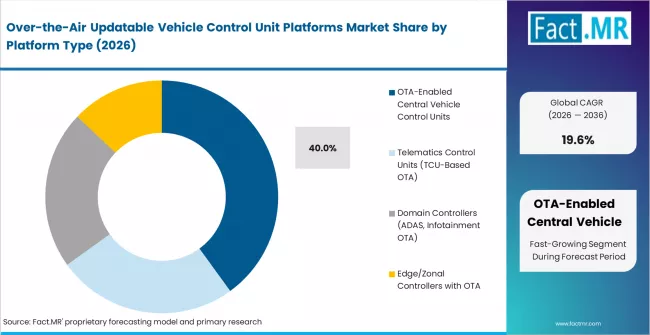
Over The Air Updatable Vehicle Control Unit Platforms Market Analysis By Platform Type | Source: Fact.MR
Based on FACT.MR's OTA updatable vehicle control unit platforms market report, OTA-enabled central vehicle control units are estimated to hold approximately 40% share in 2026. This segment leads due to OEM preference for consolidated software update orchestration across all ECU domains from a single compute platform, reducing update management complexity and enabling full-vehicle SOTA capability.
NVIDIA DRIVE Investment: NVIDIA expanded its DRIVE Orin and DRIVE Thor central compute platform supply agreements with multiple global OEMs in 2024, positioning its centralised SoC as the preferred OTA-capable VCU architecture for next-generation SDV programmes. [2]
Aptiv SDV Platform Launch: Aptiv launched its SVA (Smart Vehicle Architecture) platform in 2025, incorporating a centralised vehicle compute unit with integrated OTA software update orchestration targeting passenger BEV and PHEV OEM programmes in North America and Europe. [3]
Zonal Controller Adoption Trend: Automotive OEMs are accelerating transition from distributed ECU networks to zonal architectures in 2024-2025, with Bosch and Continental AG both disclosing zonal ECU OTA platform product lines targeting 2027-2028 vehicle programme awards. [4]
Over-the-Air Updatable Vehicle Control Unit Platforms Market Analysis by Update Type
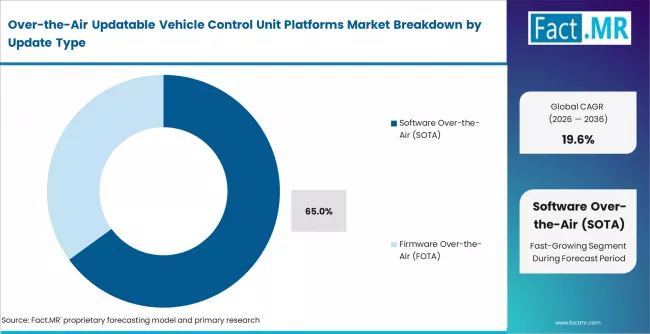
Over The Air Updatable Vehicle Control Unit Platforms Market Analysis By Update Type | Source: Fact.MR
Based on FACT.MR's report, software over-the-air (SOTA) is estimated to hold approximately 65% share in 2026. SOTA dominates because OEMs prioritise application-layer and feature-layer updates that unlock post-sale revenue and improve user experience without requiring low-level firmware replacement cycles. FOTA retains significance in cybersecurity patch delivery and ECU bootloader management across commercial fleet deployments.
Qualcomm Snapdragon SOTA Platform: Qualcomm expanded its Snapdragon Digital Chassis platform in 2024 with enhanced SOTA delivery management capabilities targeting OEM software subscription and feature-on-demand services for passenger vehicle programmes in China, the US, and Europe. [5]
Harman OTA Suite Expansion: Harman International extended its OTA update management suite in 2025, integrating SOTA and FOTA management into a unified vehicle software lifecycle platform targeting commercial fleet and passenger OEM customers in North America and Asia Pacific. [6]
FOTA Fleet Demand Trend: Commercial fleet operators in Europe and the US are increasing FOTA adoption in 2024-2025 to manage cybersecurity firmware patches across EV fleets, with NXP Semiconductors reporting rising FOTA-specific automotive MCU procurement from fleet OEM customers. [7]
Drivers, Restraints, and Opportunities
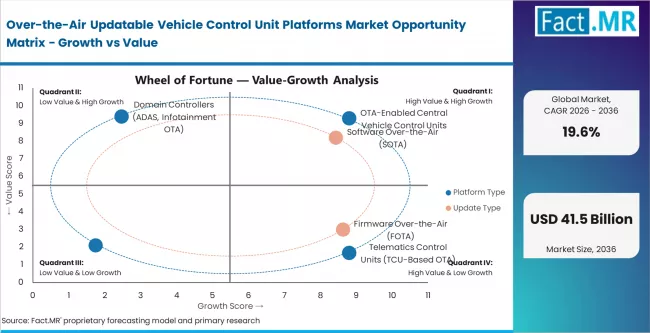
Over The Air Updatable Vehicle Control Unit Platforms Market Opportunity Matrix Growth Vs Value | Source: Fact.MR
FACT.MR analysts observe that the market is scaling as a mandatory infrastructure layer of the software-defined vehicle transition. Demand is anchored in regulatory compliance, OEM software monetisation, and fleet operational efficiency requirements. The market exists at its current scale because traditional dealership-based ECU update models are economically unsustainable as vehicle software complexity expands to hundreds of ECUs per vehicle.
The market is undergoing rapid architectural consolidation. Discrete ECU-level OTA approaches are losing ground to centralised domain controller and central VCU orchestration platforms. Standalone FOTA tools are being replaced by integrated SOTA and FOTA management systems.
UNECE WP.29 Regulatory Mandate: UNECE WP.29 Cybersecurity (CS) and Software Update Management System (SUMS) regulations became mandatory for all new vehicle types in the EU, Japan, and South Korea from July 2024. This requires OEMs to implement certified OTA update management infrastructure, creating a non-discretionary procurement driver across all regulated vehicle programmes.
OEM Software Monetisation Shift: Volkswagen Group, Stellantis, and BMW Group disclosed software subscription and OTA feature-unlock revenue targets in 2024-2025 investor communications. This is reorienting OTA platform procurement from cost reduction to revenue generation, increasing willingness to invest in premium centralised VCU update architectures.
China Connected Vehicle Scale: China's Ministry of Industry and Information Technology published the Intelligent Connected Vehicle (ICV) standard GB/T 41578-2022 implementation guidelines in 2024, requiring OTA security management capabilities for all ICV models.
Regional Analysis
The over-the-air updatable vehicle control unit platforms market is assessed across Asia Pacific, North America, Europe, Latin America, and Middle East and Africa, covering 40+ countries with demand shaped by regulatory compliance timelines, connected vehicle penetration, software-defined vehicle OEM investment, and OTA cybersecurity mandate enforcement. The full report offers market attractiveness analysis by region and country.
Top Country Growth Comparison Over The Air Updatable Vehicle Control Unit Platforms Market Cagr (2026 2036) | Source: Fact.MR
Country
CAGR (2026 to 2036)
China
21.2%
India
20.5%
United States
18.7%
South Korea
18.3%
Germany
17.9%
Japan
16.8%
Source: Fact.MR analysis. Updated May 11, 2026
Source: Fact.MR (FACT.MR) analysis, based on proprietary forecasting model and primary research
Over The Air Updatable Vehicle Control Unit Platforms Market Cagr Analysis By Country | Source: Fact.MR
Asia Pacific Over-the-Air Updatable Vehicle Control Unit Platforms Market Analysis
Asia Pacific is the global production and connected vehicle deployment epicentre. China drives regulatory OTA scale. India expands through EV adoption. South Korea leads SDV engineering depth. NVIDIA, Qualcomm, and Hyundai Mobis anchor regional supply. OTA is shifting from premium feature to regulatory baseline.
China: Policy-enforced OTA deployment supports 21.2% CAGR through 2036. Ministry of Industry and Information Technology mandated OTA cybersecurity compliance. BYD, NIO, and Li Auto operate proprietary OTA stacks. SAIC Motor and Chery procure Tier-1 solutions. Local chip players are scaling OTA-ready SoCs. Volume scale exceeds 11 million NEVs annually.
India: Regulation-backed EV expansion supports 20.5% CAGR through 2036. Bureau of Indian Standards introduced AIS-189 cybersecurity norms. Tata Motors and Mahindra & Mahindra embedded OTA-enabled ECUs. Government EV schemes are accelerating connected vehicle adoption. Cost-optimised OTA platforms are emerging for mass segments.
South Korea: SDV-led architecture transition supports 18.3% CAGR through 2036. Hyundai Motor Group is deploying full OTA capability across brands. Hyundai Mobis is developing integrated OTA domain controllers. Government digital mobility programmes are supporting infrastructure rollout. Tight ecosystem integration enables faster OTA iteration cycles.
Japan: Regulation-aligned adoption supports 16.8% CAGR through 2036. UNECE OTA compliance became mandatory in 2024. Toyota is deploying Arene OS. Honda is advancing OTA through the AFEELA programme. Government funding is supporting SDV and OTA infrastructure. Adoption is measured but structurally aligned.
Fact.MR covers Japan, South Korea, China, ASEAN, and ANZ. It includes SDV adoption and OTA deployment benchmarks.
North America Over-the-Air Updatable Vehicle Control Unit Platforms Market Analysis
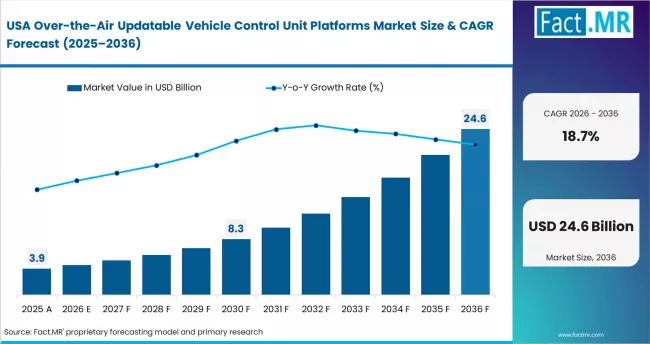
Over The Air Updatable Vehicle Control Unit Platforms Market Country Value Analysis | Source: Fact.MR
North America is a software monetisation and compliance-led market. Tesla sets OTA benchmarks. General Motors, Ford, and Stellantis are scaling SDV platforms. NVIDIA, Qualcomm, and Aptiv lead supply.
United States: Platform monetisation focus supports 18.7% CAGR through 2036. National Highway Traffic Safety Administration expanded OTA validation guidelines. Tesla leads SOTA deployment benchmarks. General Motors and Ford are scaling OTA across EV platforms. Domestic manufacturing incentives are supporting compute platform localisation.
Fact.MR covers United States, Canada, and Mexico. It includes SDV roadmap and compliance data.
Europe Over-the-Air Updatable Vehicle Control Unit Platforms Market Analysis
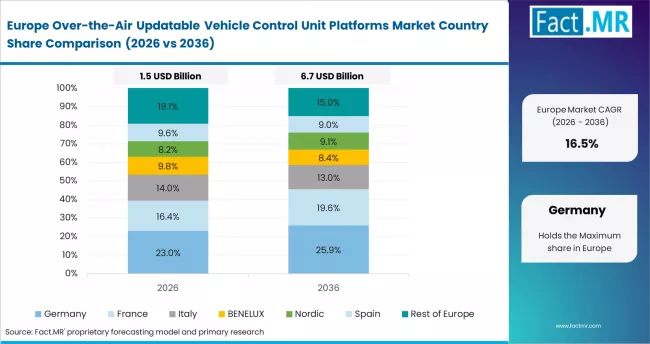
Over The Air Updatable Vehicle Control Unit Platforms Market Europe Country Market Share Analysis, 2026 & 2036 | Source: Fact.MR
Europe is the regulatory benchmark for OTA systems. UNECE WP.29 mandates drive adoption. Continental AG, Robert Bosch, and Aptiv lead supply. Certification complexity favours incumbents.
Germany: Compliance-driven deployment supports 17.9% CAGR through 2036. UNECE WP.29 mandates OTA infrastructure. Volkswagen Group is deploying unified OTA platforms. BMW is investing in OTA for next-gen platforms. Continental AG and Robert Bosch expanded OTA middleware capabilities.
Fact.MR covers Germany, France, United Kingdom, Italy, Spain, and Rest of Europe. It includes regulatory and OEM investment data.
Competitive Aligners for Market Players
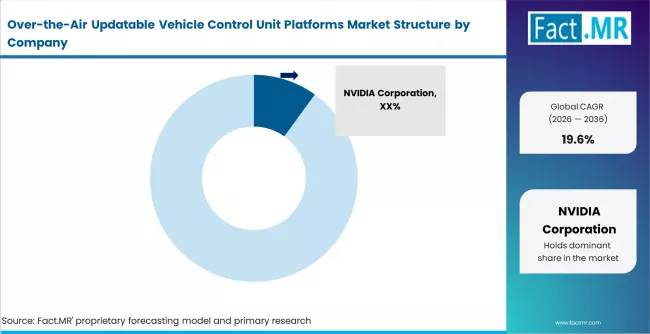
Over The Air Updatable Vehicle Control Unit Platforms Market Analysis By Company | Source: Fact.MR
Competition in the OTA updatable vehicle control unit platforms market is shifting toward software ownership rather than hardware scale. What used to be a hardware-driven space is now defined by who controls the update pipeline, data layer, and feature monetisation stack. Players that combine hardware, middleware, and cloud integration are gaining a clear edge. Companies like NVIDIA and Qualcomm are not just supplying chips. They are shaping full OTA-ready compute platforms that OEMs can build software ecosystems on top of. This gives them influence far beyond component pricing.
Traditional Tier-1 suppliers such as Robert Bosch, Continental AG, and Aptiv remain highly competitive. Their strength lies in deep OEM integration and certification capability. They are evolving quickly by adding OTA orchestration software and cybersecurity layers to their control units.
OEM behaviour is also changing. Companies like Tesla, Volkswagen Group, and General Motors are investing in in-house software platforms. This reduces dependence on external suppliers and shifts bargaining power. Switching costs are rising. Once an OTA architecture is deployed, replacing it is complex and expensive. This creates long-term revenue streams for selected suppliers.
Key Players
NVIDIA Corporation
Qualcomm Incorporated
Robert Bosch GmbH
Continental AG
Aptiv PLC
NXP Semiconductors N.V.
Harman International Industries
Denso Corporation
Visteon Corporation
Lear Corporation
Bibliography
[1] NVIDIA Corporation. DRIVE Platform OEM Partnership Expansions 2024: Centralised Compute and OTA Update Architecture Supply Agreements for SDV Programmes. NVIDIA, 2024. Available at: https://www.nvidia.com/en-us/self-driving-cars/
[3] Robert Bosch GmbH and Continental AG. Zonal ECU OTA Platform Product Line Disclosures 2024-2025. Available at: https://www.bosch-mobility.com and https://www.continental.com
[4] Qualcomm Incorporated. Snapdragon Digital Chassis Platform SOTA Capability Expansion. Qualcomm Automotive Press Release, 2024. Available at: https://www.qualcomm.com/products/automotive/snapdragon-digital-chassis
[5] Harman International Industries. OTA Software Lifecycle Management Suite Extension 2025. Harman Press Release, 2025. Available at: https://www.harman.com/press-releases
[6] NXP Semiconductors. Automotive MCU OTA Demand Update: Fleet FOTA Adoption Report. NXP Semiconductors Investor Communications, 2024. Available at: https://www.nxp.com/company/about-nxp/investors
This Report Addresses
Strategic insights on OTA platform demand across China, India, United States, South Korea, Germany, and Japan covering connected vehicle regulation, SDV platform rollout, and SOTA and FOTA adoption benchmarks.
Market forecast from USD 5.8 billion in 2026 to USD 34.5 billion by 2036, at 19.6% CAGR.
Opportunity mapping across SOTA centralised VCU platform adoption, FOTA commercial fleet procurement, UNECE WP.29 compliance investment, and China ICV mandate-driven OTA volume growth.
Segment analysis by platform type, update type, and vehicle type. Covers central VCU, TCU-based OTA, domain controllers, zonal ECUs, SOTA, and FOTA across passenger and commercial vehicle programmes.
Regional outlook covering Asia Pacific connected vehicle production leadership, North America OEM software monetisation, and Europe UNECE-mandated compliance investment.
Competitive analysis of NVIDIA, Qualcomm, Robert Bosch, Continental AG, Aptiv, NXP Semiconductors, and Harman International covering OTA platform depth, cybersecurity compliance, and SDV programme positioning.
Regulatory analysis covering UNECE WP.29 CS and SUMS mandate adoption, NHTSA cybersecurity guidance updates, China GB/T 41578-2022 ICV OTA standards, and India AIS-189 framework.
Report delivery in PDF, Excel, and presentation formats with validated data from OEM disclosures, Tier-1 revenue filings, and connected vehicle deployment benchmarks.
Over-the-Air Updatable Vehicle Control Unit Platforms Market Definition
The over-the-air updatable vehicle control unit platforms market covers hardware and software infrastructure enabling wireless delivery of software and firmware updates to ECUs, domain controllers, and central vehicle compute platforms.
Over-the-Air Updatable Vehicle Control Unit Platforms Market Inclusions
Covers global and regional forecasts from 2026 to 2036 by platform type, update type, and vehicle type. Includes SOTA and FOTA delivery infrastructure, central VCU orchestration platforms, telematics control units, domain controllers, and zonal ECU update architectures across passenger and commercial vehicles. Includes cybersecurity compliance benchmarks.
Over-the-Air Updatable Vehicle Control Unit Platforms Market Exclusions
Excludes in-vehicle infotainment content delivery not tied to control unit firmware. Standalone telematics data services and fleet tracking platforms are not included unless OTA update capability is integral. Finished vehicle platforms and branded SDV software ecosystems are excluded. Focus remains on OTA update platform supply to OEMs and Tier-1 integrators.
Over-the-Air Updatable Vehicle Control Unit Platforms Market Research Methodology
Primary Research:Interviews with OEM software platform teams, Tier-1 ECU suppliers, automotive cybersecurity specialists, and connected vehicle programme procurement leads.
Desk Research:Uses data from NVIDIA, Qualcomm, Robert Bosch, Continental AG, and Aptiv annual reports and 2024-2025 software-defined vehicle deployment data.
Market-Sizing and Forecasting:Hybrid model combining connected vehicle production volumes, OTA platform content-per-vehicle benchmarks, and software licence revenue estimates by platform type.
Data Validation and Update Cycle:Validated using OEM software programme disclosures, Tier-1 revenue filings, and connected vehicle deployment benchmarks updated through Q1 2025.
Market Breakdown
Segmentation
Scope of Report
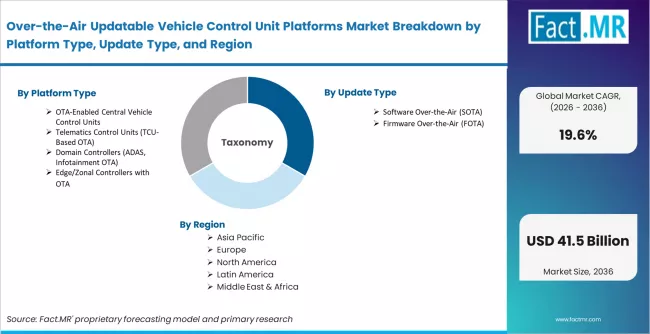
Over The Air Updatable Vehicle Control Unit Platforms Market Breakdown By Platform Type, Update Type, And Region | Source: Fact.MR
Attribute
Details
Quantitative Units
USD 5.8 billion (2026) to USD 34.5 billion (2036), at a CAGR of 19.6%
Market Definition
OTA-capable vehicle control unit platforms supplying software and firmware update infrastructure across connected passenger and commercial vehicle programmes, including SOTA and FOTA delivery, ECU orchestration, and cybersecurity compliance management.
Platform Type Segmentation
OTA-Enabled Central Vehicle Control Units, Telematics Control Units (TCU-Based OTA), Domain Controllers (ADAS, Infotainment OTA), Edge/Zonal Controllers with OTA
Connected passenger BEV and PHEV platforms, commercial EV fleet OTA management, ADAS domain controller updates, infotainment and feature-on-demand SOTA delivery, and cybersecurity patch FOTA deployment.
Regions Covered
North America, Europe, Asia Pacific, Latin America, Middle East and Africa
Countries Covered
USA, Canada, Mexico, Germany, UK, France, Italy, Spain, China, Japan, South Korea, India, ASEAN, Australia and New Zealand, Brazil, Argentina, Saudi Arabia, GCC, South Africa, Rest of MEA
Hybrid top-down and bottom-up model using connected vehicle production volumes, OTA platform content-per-vehicle benchmarks, software licence revenue estimates, UNECE WP.29 compliance adoption timelines, and primary interviews with OEM software procurement and Tier-1 platform engineering leads.
Source: Fact.MR analysis. Updated May 11, 2026
Over-the-Air Updatable Vehicle Control Unit Platforms Market by Segments
By Platform Type:
OTA-Enabled Central Vehicle Control Units
Telematics Control Units (TCU-Based OTA)
Domain Controllers (ADAS, Infotainment OTA)
Edge/Zonal Controllers with OTA
By Update Type:
Software Over-the-Air (SOTA)
Firmware Over-the-Air (FOTA)
By Vehicle Type:
Passenger Vehicles
Commercial Vehicles & Fleets
By Region:
North America
United States
Canada
Mexico
Latin America
Brazil
Mexico
Argentina
Chile
Rest of Latin America
Western Europe
Germany
United Kingdom
France
Italy
Spain
Nordic Countries
BENELUX
Rest of Western Europe
Eastern Europe
Russia
Poland
Hungary
Balkan and Baltic
Rest of Eastern Europe
East Asia
China
Japan
South Korea
South Asia and Pacific
India
ASEAN
Australia and New Zealand
Rest of South Asia and Pacific
Middle East and Africa
Kingdom of Saudi Arabia
Other GCC Countries
Turkey
South Africa
Rest of Middle East and Africa
Questions Answered
Frequently Asked Questions
How large is the global over-the-air updatable vehicle control unit platforms market in 2025?
The global over-the-air updatable vehicle control unit platforms market was valued at USD 4.9 billion in 2025.
What will the market size be in 2026?
Based on Fact.MR analysis, the market is estimated to reach USD 5.8 billion in 2026.
What is the projected market size by 2036?
The market is forecast to reach USD 34.5 billion by 2036, generating USD 28.7 billion in absolute opportunity over the forecast period.
What is the expected CAGR from 2026 to 2036?
FACT.MR projects a CAGR of 19.6% for the global OTA updatable vehicle control unit platforms market during the 2026 to 2036 forecast period.
Which platform type segment is poised to lead the market?
OTA-enabled central vehicle control units lead with approximately 40% share in 2026, driven by OEM preference for consolidated SDV software update orchestration.
Which update type segment holds the largest share?
Software over-the-air (SOTA) dominates with approximately 65% share in 2026, as OEMs prioritise application-layer and feature-on-demand update delivery.
Which country shows the fastest growth in the market?
China leads at 21.2% CAGR through 2036, driven by MIIT ICV cybersecurity mandates and the world's highest NEV production volumes.
What drives demand for OTA updatable vehicle control unit platforms?
The primary challenge is achieving UNECE WP.29 SUMS certification while managing OTA update rollout safely across heterogeneous legacy and next-generation ECU fleets.
Who are the key players in the market?
Major players include NVIDIA Corporation, Qualcomm Incorporated, Robert Bosch GmbH, Continental AG, Aptiv PLC, NXP Semiconductors N.V., and Harman International Industries.
Which vehicle type holds the largest share?
Passenger vehicles hold approximately 72% share in 2026, anchored by connected BEV and PHEV platform rollouts across global OEM programmes.
Why is centralised VCU architecture preferred by OEMs?
Centralised VCU architectures reduce software update management complexity, enable full-vehicle SOTA orchestration, and support post-sale feature monetisation that distributed ECU approaches cannot deliver efficiently.
.webp "Top Country Growth Comparison Over The Air Updatable Vehicle Control Unit Platforms Market Cagr (2026 2036)")