- Base Value(2025): 6.7 Bn
- Estimated Value(2026): 6.9 Bn
- Forecast Value (2036): 9.8 Bn
- CAGR (2026 - 2036): 3.6%
Baby Personal Care Market Forecast and Outlook 2026 to 2036
In 2025, the baby personal care market was valued at USD 6.7 billion. Based on Fact.MR’ analysis, demand for baby personal care products is estimated to grow to USD 6.9 billion in 2026 and USD 9.8 billion by 2036. FACT.MR projects a CAGR of 3.6% during the forecast period.
FACT.MR analysis indicates the baby personal care market is expected to generate an absolute dollar opportunity of USD 2.9 billion between 2026 and 2036. This steady expansion reflects consistent parental investment in infant care across birth rate growth markets in Asia Pacific and the premium naturalisation trend lifting average selling prices in developed markets. Growth is moderated by declining birth rates in Europe, Japan, and South Korea, parental trading-down pressure in cost-of-living challenged economies, and regulatory transition costs from ingredient safety compliance in the United States and European Union.
Growth in the baby personal care market is driven by rising parental awareness about ingredient safety and increasing demand for natural, gentle products. Stricter regulations on harmful chemicals and higher disposable income in emerging markets are also boosting premium product adoption. Additionally, e-commerce and parenting communities are helping organic baby care brands reach more consumers.
Country growth reflects birth rates, premium baby care adoption, and regulatory clarity for organic certifications. China leads with a 5.6% CAGR, supported by the three-child policy and strong demand for premium natural baby care products. India follows at 5.0% as urban parents increasingly prefer organic formulations. The United States grows at 4.8% with rising demand for clean-label products. Germany records 4.3% due to strict EU ingredient standards. The United Kingdom grows at 4.0%, supported by NHS guidance but constrained by declining birth rates and private label competition.
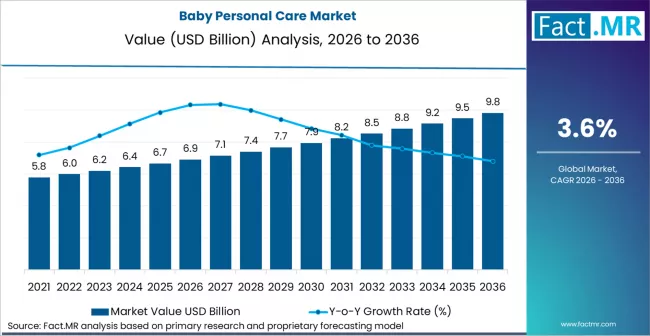
Baby Personal Care Market Market Value Analysis | Source: Fact.MR
| Metric | Value |
|---|---|
| Estimated Value in 2026 | USD 6.9 billion |
| Forecast Value in 2036 | USD 9.8 billion |
| Forecast CAGR (2026 to 2036) | 3.6% |
Source: Fact.MR analysis. Updated Mar 11, 2026
Market Definition
The baby personal care market includes skin care, hair care, toiletry, and hygiene products formulated for infants and young children up to 25 months and above. Products include lotions, creams, oils, shampoos, body wash, powders, wipes, sunscreen, and oral care items sold through pharmacies, supermarkets, baby stores, and online channels.
Market Inclusions
Includes global and regional forecasts from 2026 to 2036 by product type, nature, and age group. Covers organic/natural and synthetic formats across pharmacy, modern retail, baby specialty stores, and e-commerce channels in North America, Europe, Asia Pacific, Latin America, and Middle East and Africa.
Market Exclusions
Excludes baby food, infant formula, baby textiles, and nursery equipment. Also excludes adult personal care products not formulated for infants, medical treatment creams classified as OTC drugs, and reusable cloth care products.
Research Methodology
- Primary Research: Interviews with baby care brand managers, pharmacy buyers, paediatric dermatologists, e-commerce category managers, and organic certification bodies.
- Desk Research: Sources include FDA cosmetic regulations, EU Regulation 1223/2009, EWG Skin Deep database, OEM reports, China NMPA baby cosmetic standards, and birth rate data.
- Market Sizing and Forecasting: Hybrid model using birth rate data, per-capita baby care spending, retail sales volumes, and average selling prices by certification and channel.
- Data Validation and Update Cycle: Data validated using OEM revenue disclosures, retail sales data, regulatory filings, and official birth rate statistics.
Baby Personal Care Market Summary
- Market Definition
- Baby personal care includes skin care, hair care, and hygiene products designed for infants and young children, sold across organic and synthetic formats through pharmacy, retail, and e-commerce channels.
- Demand Drivers
- Rising awareness of infant skin sensitivity and chemical safety is increasing demand for dermatologist-certified and organic baby care products.
- China’s three-child policy and premiumisation among urban parents are expanding demand for natural baby care brands through e-commerce platforms.
- India’s growing urban middle class is increasing adoption of premium baby skin and hair care products through modern retail and online platforms.
- Key Segments Analyzed
- By Product Type: Skin care leads with about 42% share in 2026 due to high repeat demand for lotions, creams, and rash protection products.
- By Nature: Synthetic products hold about 54% share in 2026 due to lower cost and wider retail distribution.
- By Age Group: The 0-6 months’ segment leads with about 38% share in 2026 due to high newborn care product usage.
- Analyst Opinion at FACT.MR
- Shambhu Nath Jha Principal Consultant at Fact.MR notes that, market growth will be driven by premium natural products in developed markets and rising first-time adoption in emerging economies.
- Strategic Implications
- Brands should expand organic-certified baby care lines to access premium pricing and stronger retailer positioning.
- Companies should invest in subscription-based e-commerce platforms targeting new parents in China and India.
- Manufacturers should develop dermatologist-tested products for eczema-prone infant skin to capture premium segments.
- Methodology
- Market sizing used birth rate data and per-capita spending validated with OEM revenue and retail sales statistics.
- Regulatory analysis included FDA rules, EU cosmetic regulations, China NMPA standards, and EWG ingredient databases.
- Forecasts incorporated birth rate trends, organic certification growth, e-commerce penetration, and expert interviews.
Segmental Analysis
Baby Personal Care Market Analysis by Product Type
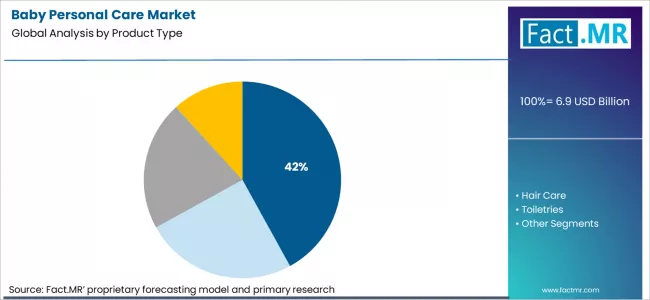
Baby Personal Care Market Analysis By Product Type | Source: Fact.MR
Based on FACT.MR analysis, skin care is expected to hold about 42% share in 2026. Frequent use of lotions, creams, and rash protection products drives high repeat purchases.
- Johnson & Johnson Skin Care Investment: In 2025, Johnson & Johnson expanded its Johnsons Baby NATURAL oat-based skin care range across the United States, Germany, and India through pharmacy chains and health stores. [5]
- Weleda Baby Care Technology Development: In 2024, Weleda launched its Baby Calendula Sensitiv skin care line with COSMOS Organic certification, targeting newborns with sensitive skin. The products were listed at Boots UK and Rossmann Germany. [6]
- Baby Toiletries Category Trend: Euromonitor 2024 data shows baby bath and body wash as the fastest-growing toiletries segment in China and India, replacing traditional soap bars with tear-free liquid formulations. [7]
Baby Personal Care Market Analysis by Nature
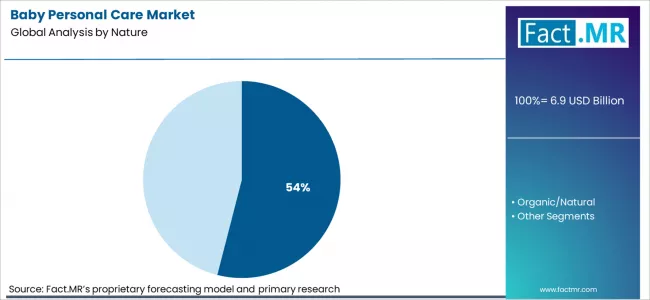
Baby Personal Care Market Analysis By Nature | Source: Fact.MR
According to FACT.MR, synthetic products will hold about 54% share in 2026. They remain dominant due to lower cost, stable formulations, and wide retail distribution.
- Procter & Gamble Natural Platform Investment: In 2025, Procter & Gamble launched Pampers Botanical Protection diapers and Pampers Natural Clean wipes in the United States and Germany targeting clean-label consumers. [8]
- Colgate Organic Baby Care Development: In 2024, Colgate-Palmolive introduced Tom’s of Maine Baby and Toddler fluoride-free toothpaste with USDA Organic certification for children aged 12 months and above. [9]
- Organic Certification Retail Channel Trend: Holland and Barrett’s 2025 category report showed organic baby care products generating 38% of baby care revenue in its European health store network, growing three times faster than non-certified products. [10]
Drivers, Restraints, and Opportunities
FACT.MR analysts note that the baby personal care market is closely linked to birth rates, parental safety awareness, and organic product regulations. Valued at USD 6.7 billion in 2025, demand remains stable as parents prioritise infant skin safety and hygiene products across income groups.
The market shows a divide between traditional synthetic products and fast-growing organic formats. Many parents in Europe and North America are avoiding products with parabens and phthalates. Organic alternatives cost 40-60% more but are growing two to three times faster, supporting revenue growth.
- EU Cosmetic Regulation Ingredient Restrictions: The EU’s 2024 update to Regulation 1223/2009 restricted 23 additional cosmetic substances for children under three. Major brands such as Procter & Gamble and Johnson & Johnson invested in product reformulation in 2025 to comply with EU rules. [2]
- China NMPA Baby Cosmetics Classification: China required special cosmetic registration for baby products claiming mild or gentle formulations from January 2024. This raised compliance standards and encouraged domestic investment by brands such as Pigeon China and Yumeijing. [3]
- India Organic Baby Care Market Growth: India’s BIS updated IS 16621 baby cosmetic standards in 2024, supporting certified natural brands such as Mamaearth and The Moms Co. Hindustan Unilever launched the Dove Baby Organic Blend range in 2025 through major retail and e-commerce channels. [4]
Regional Analysis
The baby personal care market is analysed across Asia Pacific, Europe, North America, Latin America, and Middle East and Africa, covering 40+ countries with demand profiles shaped by birth rates, parental income levels, organic certification regulatory environments, and modern retail and e-commerce channel development. The full report offers market attractiveness analysis based on birth rate trajectories, premium product adoption rates, and regulatory compliance timelines.
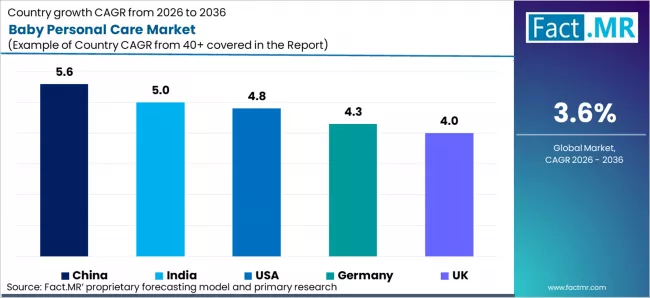
Baby Personal Care Market Cagr Analysis By Country | Source: Fact.MR
| Country | CAGR (2026-2036) |
|---|---|
| China | 5.6% |
| India | 5.0% |
| United States | 4.8% |
| Germany | 4.3% |
| United Kingdom | 4.0% |
Source: Fact.MR analysis. Updated Mar 11, 2026
Source: Fact.MR (FACT.MR) analysis, based on proprietary forecasting model and primary research
Asia Pacific Baby Personal Care Market Analysis
Asia Pacific is the largest and fastest-growing baby personal care region. Growth is supported by China’s premium natural baby care demand and India’s expanding middle-class parenting population adopting organized retail and e-commerce baby care channels.
- China: At a projected 5.6% CAGR through 2036, China leads regional growth. NMPA Special Cosmetics registration rules introduced in 2024 raised compliance standards for baby products. Pigeon expanded its NMPA-registered baby skin care range through JD.com and Tmall in 2025. Johnson & Johnson also launched the Johnsons Baby Natural Oat range through Alibaba direct-to-consumer stores.
- India: With an expected 5.0% CAGR through 2036, India continues expanding through premium baby care adoption. BIS updated IS 16621 baby cosmetic standards in 2024, supporting certified brands such as Mamaearth and The Moms Co. Hindustan Unilever launched Dove Baby Organic Blend moisturiser and body wash through Reliance Smart Bazaar, Apollo Pharmacy, and Nykaa in 2025.
FACT.MR’s Asia Pacific analysis of the baby personal care market covers China, Japan, South Korea, India, Australia and New Zealand, ASEAN, and Rest of South Asia and Pacific. Readers can find country CAGR forecasts, NMPA and BIS compliance data, e-commerce mother-and-baby channel trends, and brand penetration benchmarks by product type and nature.
Europe Baby Personal Care Market Analysis
Europe represents a mature, safety-regulation-driven baby personal care market where ingredient standards and organic certifications strongly influence product development and retail positioning.
- Germany: Germany is forecast to grow at a 4.3% CAGR through 2036. The Federal Institute for Risk Assessment updated safety guidance for baby cosmetics in 2024. Retailers such as dm and Rossmann strengthened ingredient standards. Weleda expanded its Baby Calendula Sensitiv newborn range through these pharmacy and drugstore chains in 2025.
- United Kingdom: The UK baby personal care market is expected to expand at a 4.0% CAGR through 2036. The Cosmetic, Toiletry and Perfumery Association updated baby cosmetic labelling guidance in 2024. Boots UK refreshed its baby category in 2025 and increased shelf space for NATRUE and COSMOS-certified baby care brands.
FACT.MR’s European analysis of the baby personal care market covers Germany, France, the United Kingdom, Italy, Spain, Nordic countries, BENELUX, and Rest of Western Europe. Readers can find EU Regulation 1223/2009 compliance data, COSMOS Organic adoption trends, private label baby care competition benchmarks, and country-level revenue forecasts by product type and nature.
North America Baby Personal Care Market Analysis
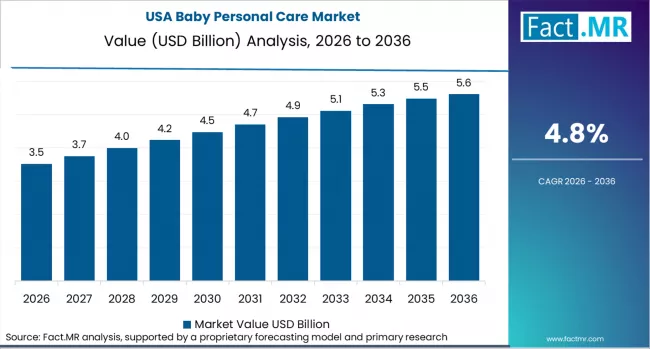
Baby Personal Care Market Country Value Analysis | Source: Fact.MR
North America remains the highest revenue-generating region due to strong demand for paediatrician-recommended and organic baby personal care products across pharmacy and mass retail channels.
- United States: The United States market is projected to grow at a 4.8% CAGR through 2036. Implementation of the FDA’s Modernization of Cosmetics Regulation Act continued during 2024 and 2025, requiring product listing and facility registration. EWG expanded its Verified baby product list to 340 items in 2024, supporting Johnsons Baby Natural and Burt’s Bees Baby product visibility at CVS, Walgreens, and Target.
FACT.MR’s North American analysis of the baby personal care market covers the United States, Canada, and Mexico. Readers can find FDA MoCRA compliance data, EWG certification adoption trends, paediatrician endorsement programme benchmarks, and country-level revenue forecasts by product type and age group.
Latin America Baby Personal Care Market Analysis Latin America is an emerging baby personal care market supported by Brazil’s urban parental consumer base and expanding retail distribution for premium and natural baby care products.
- Brazil: Brazil’s baby personal care market continues expanding through modern retail and e-commerce channels. ANVISA updated cosmetic safety standards in 2024 to align with global requirements. Johnson & Johnson Brasil expanded its Johnsons Baby NATURAL moisturiser and bath range through Drogasil, Raia, and Magazine Luiza retail channels in 2025.
FACT.MR’s Latin American analysis of the baby personal care market covers Brazil, Chile, Ecuador, and Rest of Latin America. Readers can find ANVISA regulatory compliance data, hypermarket and e-commerce expansion trends, natural baby care adoption benchmarks, and country-level revenue forecasts by product type and nature.
Competitive Aligners for Market Players
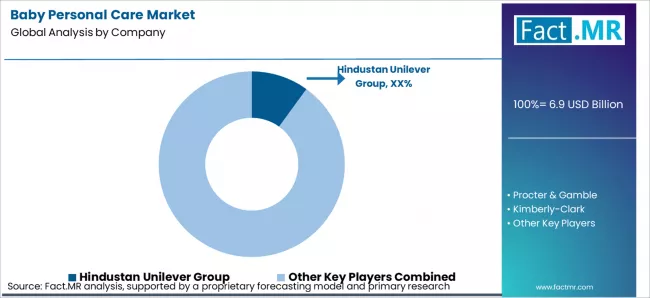
Baby Personal Care Market Analysis By Company | Source: Fact.MR
The global baby personal care market is competitive, with a few large companies dominating traditional products and several smaller brands gaining traction in the natural segment. Companies such as Johnson & Johnson, Procter & Gamble, and Kimberly-Clark hold strong positions in conventional baby lotions, shampoos, and toiletries. Their advantage comes from long-standing brand trust, paediatrician recommendations, and strong shelf presence in pharmacies and supermarkets. In the premium segment, brands like Burt’s Bees Baby, Weleda, and Me n Moms focus on organic and natural formulations certified by standards such as COSMOS and NATRUE, often selling through health stores and online channels.
Large companies also benefit from stronger regulatory and clinical capabilities. For example, Johnson & Johnson operates global testing networks and maintains compliance with regulations in multiple markets, including FDA, EU, and China requirements. This makes international expansion easier compared with smaller niche brands. In India, Hindustan Unilever benefits from its wide rural distribution network and established brand recognition through Dove Baby products.
Retailers often stock both branded and private-label baby care products to balance pricing and supply. While private labels compete in basic baby washes and lotions, premium products with clinical claims or organic certifications still maintain strong parent loyalty and pricing power.
Key Players
- Hindustan Unilever Group
- Procter & Gamble
- Kimberly-Clark
- Johnson & Johnson
- Colgate-Palmolive
- The Clorox Company
- Me n Moms Pvt. Ltd.
- Weleda AG
- Marks & Spencer PLC
- Nivea
Bibliography
- [1] European Commission. (2024). Regulation (EC) No 1223/2009 Cosmetic Products: Restricted Substances Update List 23 Additional Substances Restricted in Child Cosmetic Products Under Three Years. December 2024. ec.europa.eu
- [2] National Medical Products Administration, People’s Republic of China. (2024). Special Cosmetics Classification Enforcement for Baby and Children’s Personal Care Products: Registration Requirements and Compliance Timeline for January 2024 Implementation. January 2024. nmpa.gov.cn
- [3] Bureau of Indian Standards. (2024). IS 16621 Baby Cosmetics Standard Update: Alignment with International Safety Testing Requirements and Expanded Certification Scope for Natural Baby Personal Care Products. October 2024. bis.gov.in
- [4] Johnson & Johnson. (2025). Product Launch Release: Johnsons Baby NATURAL Oat-Based Certified Skin Care Range for United States, Germany, and India Pharmacy and Modern Trade Distribution. January 2025. jnj.com
- [5] Weleda AG. (2024). Product Launch Announcement: Weleda Baby Calendula Sensitiv Hypoallergenic COSMOS Organic Certified Newborn Skin Care Range for European Pharmacy and Natural Retail. September 2024. weleda.com
- [6] Euromonitor International. (2025). Baby and Child-Specific Products Category Report 2024: Baby Bath and Body Wash Sub-Category Growth Data for China and India Retail Markets. January 2025. euromonitor.com
- [7] Procter & Gamble Company. (2025). Product Launch Release: Pampers Baby-Dry Botanical Protection Diaper and Pampers Natural Clean Wipe for United States and Germany Clean-Label Parental Segment. January 2025. pg.com
- [8] Colgate-Palmolive Company. (2024). Product Launch Release: Tom’s of Maine Baby and Toddler USDA Organic Certified Fluoride-Free Toothpaste for 12 Months and Above U.S. Pharmacy and Natural Grocery Distribution. August 2024. colgatepalmolive.com
- [9] Holland and Barrett Retail Ltd. (2025). Annual Report 2024-25: COSMOS Organic and NATRUE-Certified Baby Personal Care Revenue Share and Year-on-Year Growth Data for UK and European Health Store Network. March 2025. hollandandbarrett.com
This Report Addresses
- Strategic intelligence on EU Regulation 1223/2009 baby cosmetic ingredient restrictions driving reformulation, China NMPA Special Cosmetics registration enforcement, India BIS IS 16621 standard update, and FDA MoCRA implementation reshaping U.S. baby personal care compliance and distribution.
- Market forecast from USD 6.9 billion in 2026 to USD 9.8 billion by 2036 at 3.6% CAGR, segmented by product type, nature, age group, and region.
- Growth opportunity mapping across China’s NMPA-certified natural baby care expansion, India’s BIS-certified premium brand distribution, Germany’s COSMOS Organic retail adoption, U.S. EWG Verified certification premium positioning, and UK Boots sustainability buying criteria impact.
- Country CAGR outlook for China 5.6%, India 5.0%, United States 4.8%, Germany 4.3%, and United Kingdom 4.0%, with key regulatory, parental demographic, and channel development drivers per country.
- Competitive analysis of Johnson & Johnson, Procter & Gamble, Hindustan Unilever, Weleda, Kimberly-Clark, and Colgate-Palmolive covering product portfolios, organic certification positions, paediatrician endorsement programmes, and e-commerce channel strategies.
- Technology tracking including COSMOS Organic and NATRUE certification formulation development, EWG Verified ingredient screening for baby personal care, microbiome-friendly infant skin care innovation, and biodegradable baby wipe substrate development.
- Regulatory analysis covering EU Regulation 1223/2009 restricted substance updates for child cosmetics, FDA MoCRA facility registration requirements, China NMPA Special Cosmetics classification, India BIS IS 16621 baby cosmetics standards, and Brazil ANVISA cosmetic registration updates.
- Report delivered in PDF, Excel datasets, PowerPoint summary, and dashboard formats supported by OEM revenue data, pharmacy and retail category sales statistics, FDA and EU cosmetic filing databases, and primary research interviews.
Segmentation
Scope of Report
| Quantitative Units | USD 6.9 billion (2026) to USD 9.8 billion (2036), at a CAGR of 3.6% |
|---|---|
| Market Definition | Personal care products formulated for infants and young children across skin care, hair care, toiletries, and other categories in organic/natural and synthetic formats. |
| Product Type Segmentation | Skin Care (42%), Hair Care, Toiletries, Others |
| Nature Segmentation | Synthetic (54%), Organic/Natural |
| Age Group Segmentation | 0-6 Months (38%), 6-12 Months, 12-24 Months, 25 Months & Above |
| Application Coverage | Infant skin moisturisation, gentle cleansing, diaper rash prevention, baby hair care, bath products, and oral hygiene across hospital, pharmacy, and modern retail channels. |
| Regions Covered | Asia Pacific, Europe, North America, Latin America, Middle East and Africa |
| Countries Covered | China, Japan, South Korea, India, Australia and New Zealand, ASEAN, Rest of South Asia and Pacific, Germany, UK, France, Italy, Spain, Nordic, BENELUX, Rest of Western Europe, Russia, Poland, Hungary, Balkan and Baltic, USA, Canada, Mexico, Brazil, Chile, Ecuador, Rest of Latin America, Saudi Arabia, GCC, Turkey, South Africa, Rest of MEA |
| Key Companies Profiled | Hindustan Unilever, Procter & Gamble, Kimberly-Clark, Johnson & Johnson, Colgate-Palmolive, The Clorox Company, Me n Moms, Weleda AG, Marks & Spencer, Nivea |
| Forecast Period | 2026 to 2036 |
| Approach | Hybrid top-down and bottom-up model using birth rate data, per-capita baby personal care spending, retail sales volumes by product type and nature, and primary interviews with brand managers and retail buyers. |
Source: Fact.MR analysis. Updated Mar 11, 2026
Baby Personal Care Market by Segments
-
By Product Type:
- Skin Care
- Hair Care
- Toiletries
- Others
-
By Nature:
- Organic/Natural
- Synthetic
-
By Age Group:
- 0-6 Months
- 6-12 Months
- 12-24 Months
- 25 Months & Above
-
By Region:
- North America
- United States
- Canada
- Mexico
- Latin America
- Brazil
- Chile
- Ecuador
- Rest of Latin America
- Western Europe
- Germany
- United Kingdom
- France
- Italy
- Spain
- Nordic
- BENELUX
- Rest of Western Europe
- Eastern Europe
- Russia
- Poland
- Hungary
- Balkan and Baltic
- Rest of Eastern Europe
- East Asia
- China
- Japan
- South Korea
- South Asia and Pacific
- India
- ASEAN
- Australia and New Zealand
- Rest of South Asia and Pacific
- Middle East and Africa
- Kingdom of Saudi Arabia
- Other GCC Countries
- Turkey
- South Africa
- Other African Union
- Rest of Middle East and Africa
- North America
Frequently Asked Questions
How large is the baby personal care market in 2025?
What will the market size be in 2026?
What is the projected market size by 2036?
What is the expected CAGR?
Which product type segment leads the market?
Which nature segment dominates?
Which age group holds the largest share?
Which country shows the fastest growth?
What is the primary restraint?
Who worked on this report


Preview the report firsthand - request a free sample
Free SampleGet the brochure for pricing and purchase details
Download PDF