- Market Value (2025): USD 3.15 Bn
- Estimated Value (2026): USD 3.34 Bn
- Forecast Value (2036): USD 5.96 Bn
- CAGR (2026-2036): 6.0%
What is the Baby Tissue Paper Market forecast to be worth by 2036?
USD 3.34 billion in 2026 to USD 6.0 billion by 2036 at a 6.0% CAGR.
- At USD 3.15 billion in 2025, the baby tissue paper market drew most of its revenue from soft facial-grade tissues and wet sheets bought for home use.
- Sales will grow from USD 3.34 billion in 2026 to USD 5.96 billion in 2036 as families trade up to thicker, lotion-treated and sensitive-skin sheets.
- Spending per child keeps rising even where births fall, so value will compound at a 6.0% CAGR between 2026 and 2036.
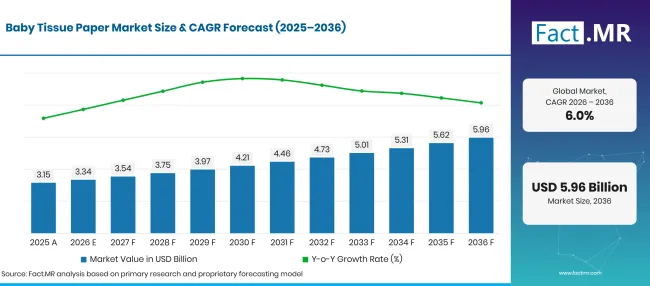
Baby Tissue Paper Market Forecast Global | Source: Fact.MR
| Year | Basis | Market Value (USD billion) |
|---|---|---|
| 2025 | Actual | 3.15 |
| 2026 | Estimate | 3.34 |
| 2036 | Forecast | 5.96 |
| CAGR 2026 to 2036 | Forecast period | 6.0% |
Source: Fact.MR analysis. Updated Oct 23, 2026
What are the defining numbers behind Baby Tissue Paper Market growth?
Between 2026 and 2036, baby tissue sales will add USD 2.7 billion, mostly through premium sheets used at home.
- Demand Drivers in the Market
- Baby tissue demand now rests on spending per child more than on the number of newborns. Eurostat reported that 3.55 million live births were recorded in the EU in 2024, with a total fertility rate of 1.34 live births per woman [1]. Smaller families give parents room to pay more for each pack, and older first-time parents tend to favor premium brands.
- Hygiene awareness pushes cleaning sheets into more daily routines. WHO and UNICEF reported in August 2025 that about 1.7 billion people still lacked basic hygiene services at home, including 611 million with no facility at all [2]. Where running water is limited, a tissue or wet sheet becomes the main way to clean a baby’s hands and face.
- Sensitive skin claims shape what parents put in the cart. Fragrance-free, dermatologist-tested and high-water-content sheets now take more shelf space, and brands use these claims to justify higher prices.
- Busy schedules favor portable formats. Pocket packs, travel tubs and single-hand dispensers let parents clean up in cars, parks and restaurants without a sink nearby.
- Retail promotions keep baby tissues in front of shoppers. Multipacks, loyalty discounts and subscription orders cut the cost per sheet and lock in repeat purchases for months at a time.
- Key Segments Analyzed
- By Product Type: Sanitary Type will draw 42.3% share in 2026, since hospitals and parents both look for sheets made under hygiene-controlled conditions for newborn skin.
- By Distribution Channel: Supermarket/Hypermarket will generate 38.4% share in 2026 because families pick up tissues during the weekly grocery run, often in bulk multipacks.
- By Application: At Home (AH) will gain 61.3% share in 2026, with nappy changes, feeding and bath time producing steady use in every household with an infant.
- Analyst Opinion at Fact.MR
- Shambhu Nath Jha, Principal Consultant at Fact.MR, states, “Fewer babies are born each year in most mature markets, yet each baby now uses better and more expensive sheets. Brands that prove skin safety and softness will keep their price premium. The next round of growth will come from online subscriptions and from formats parents can carry anywhere.”
- Strategic Implications
- Tissue converters can secure pulp and nonwoven supply on multi-year terms, so that input swings do not erode margins on low-priced packs.
- Baby care brands need clinical skin tests and clear ingredient lists on every pack, since parents compare labels before switching.
- Retailers stand to gain from bundling tissues with diapers and wipes in subscription orders, which lifts basket size and repeat visits.
- Hospital and childcare buyers ought to standardize on sanitary-grade sheets with lot traceability to simplify infection control audits.
German baby tissue demand will expand at 6.7% CAGR, as older parents spend more on each child despite fewer births. Japan follows at 5.9% as premium, thick sheets gain ground in a market with very low fertility. The United Kingdom will grow 5.3% through strong supermarket and online grocery reach. In the United States, a 4.8% rate reflects large retail volumes and steady brand switching toward sensitive lines. Brazil completes the list at 4.3%, with hospital births and pharmacy sales shaping first purchases.
How does the Baby Tissue Paper Market break down by segment?
Sanitary Type will lead Product Type at 42.3%; Supermarket/Hypermarket will top Distribution Channel at 38.4%; At Home (AH) will head Application at 61.3%.
Which Product Type dominates?
Sanitary Type forms 42.3% of 2026 value.
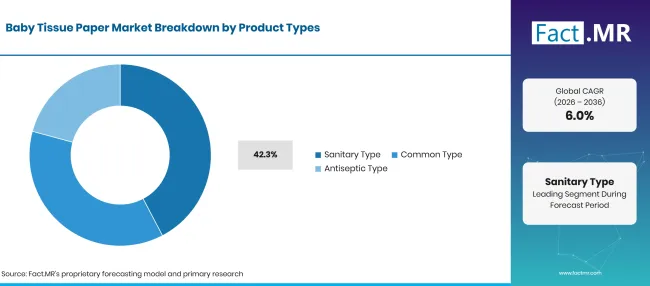
Baby Tissue Paper Market Breakdown Product Types | Source: Fact.MR
| Product Type | Share (2026) |
|---|---|
| Sanitary Type (Leading segment) | 42.3% |
| Other segments combined | 57.7%* |
| Total | 100.0% |
Source: Fact.MR analysis. Updated Oct 23, 2026
Newborn skin is thin and reacts quickly to dust, fibers and residues. Sanitary type tissues are produced under controlled hygiene conditions with low-lint virgin fiber, and parents read the label as a safety promise. Maternity wards and pediatric clinics often specify this grade, which then shapes what parents buy at home. Converters often run these lines next to folded tissues in the same plants. Pulp is the base input for every grade. FAO reported in December 2025 that global wood pulp production rose 3 percent to 189 million tonnes in 2024, while pulp trade reached a record 73 million tonnes [3]. Common type tissue serves price-focused shoppers. Antiseptic type sheets add mild cleansing agents for hands and surfaces and overlap with baby wipes.
What leads the Distribution Channel segment?
Supermarkets and hypermarkets move 38.4% of 2026 sales.
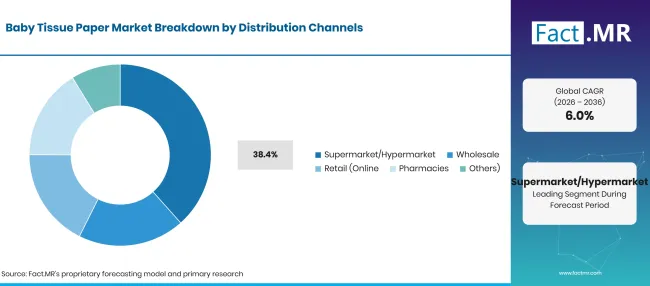
Baby Tissue Paper Market Breakdown Distribution Channels | Source: Fact.MR
| Distribution Channel | Share (2026) |
|---|---|
| Supermarket/Hypermarket (Leading segment) | 38.4% |
| Other segments combined | 61.6%* |
| Total | 100.0% |
Source: Fact.MR analysis. Updated Oct 23, 2026
Large grocery stores give baby tissues a fixed aisle next to diapers and formula. Shoppers can compare brands, pack counts and price per sheet in one place. Store brands compete hard here, which keeps pressure on branded prices. Online buying is the channel to watch. Eurostat reported that 78% of EU internet users bought or ordered goods or services online in 2025 [4]. Parents order bulky tissue packs with baby diapers to avoid carrying them home. Wholesale feeds hospitals and childcare centers, and pharmacies sell sensitive and medical-grade lines with advice.
How does Application shape demand?
At Home (AH) use makes up 61.3% of 2026 demand.
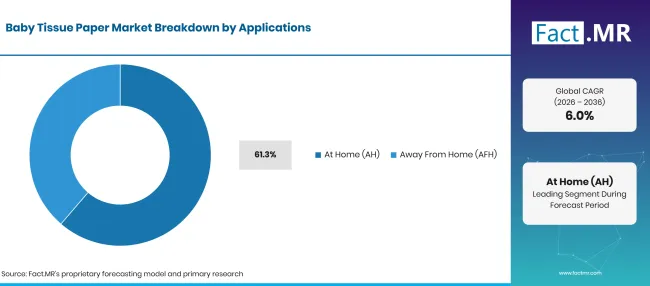
Baby Tissue Paper Market Breakdown Applications | Source: Fact.MR
| Application | Share (2026) |
|---|---|
| At Home (AH) (Leading segment) | 61.3% |
| Other segments combined | 38.7%* |
| Total | 100.0% |
Source: Fact.MR analysis. Updated Oct 23, 2026
Household use is constant. A newborn needs cleaning several times a day, and the same pack serves noses, mouths and hands as the child grows. Parents keep tissues in the nursery, kitchen and bathroom, so one home often holds several open packs. Away From Home (AFH) demand comes from hospitals, nurseries, daycare centers, restaurants and travel. Buyers there value dispenser formats and bulk cases. Contract cleaners often source these sheets with other tissue and hygiene products under one supply agreement.
What is accelerating Baby Tissue Paper Market adoption, and what is holding it back?
Adoption will grow through premium sensitive-skin sheets, online subscriptions and portable packs. Falling birth numbers, pulp price swings and strong store brands will limit how fast value can rise.
Drivers Impact Analysis
| DRIVER | (~) % IMPACT ON CAGR | GEOGRAPHIC RELEVANCE | IMPACT TIMELINE |
|---|---|---|---|
| Higher spending per child on premium and sensitive-skin sheets | +1.3% | Western Europe, East Asia, North America | Short term (<= 2 years) |
| Hygiene routines for feeding, nappy changes and hand cleaning | +1.0% | Global | Short term (<= 2 years) |
| Online subscriptions bundling tissues with diapers | +0.8% | North America, Western Europe, East Asia | Medium term (2-4 years) |
| Portable pocket packs and travel formats | +0.6% | Global | Medium term (2-4 years) |
| Hospital and childcare use of sanitary-grade sheets | +0.5% | Latin America, Western Europe | Long term (>= 4 years) |
Source: Fact.MR analysis. Updated Oct 23, 2026
Opportunity Impact Analysis
| OPPORTUNITY | (~) % IMPACT ON CAGR | GEOGRAPHIC RELEVANCE | IMPACT TIMELINE |
|---|---|---|---|
| Fragrance-free and high-water-content sheets for atopic skin | +0.8% | Western Europe, North America | Medium term (2-4 years) |
| Plant-based and plastic-free sheets with eco labels | +0.6% | Western Europe, East Asia | Long term (>= 4 years) |
| Pharmacy-led medical-grade baby tissue lines | +0.4% | Latin America, South Asia & Pacific | Medium term (2-4 years) |
Source: Fact.MR analysis. Updated Oct 23, 2026
Restraints Impact Analysis
| RESTRAINT | (~) % IMPACT ON CAGR | GEOGRAPHIC RELEVANCE | IMPACT TIMELINE |
|---|---|---|---|
| Falling birth numbers in mature markets | -0.6% | Western Europe, East Asia, North America | Long term (>= 4 years) |
| Pulp and energy cost swings that squeeze converter margins | -0.5% | Global | Short term (<= 2 years) |
| Price competition from retailer store brands | -0.4% | Western Europe, North America | Medium term (2-4 years) |
Source: Fact.MR analysis. Updated Oct 23, 2026
Which countries are scaling the Baby Tissue Paper Market through 2036?
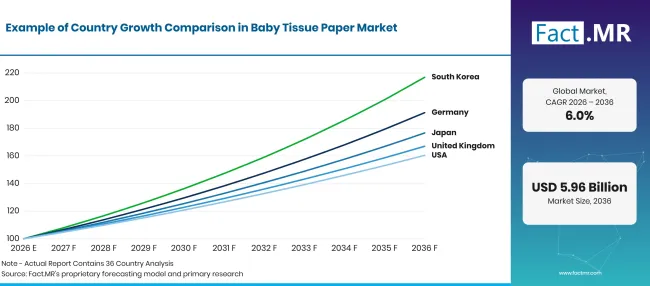
Factmr Baby Tissue Paper Market Growth Index | Source: Fact.MR
| Country | CAGR (2026 to 2036) |
|---|---|
| Germany | 6.7% |
| Japan | 5.9% |
| United Kingdom | 5.3% |
| United States | 4.8% |
| Brazil | 4.3% |
Source: Fact.MR analysis. Updated Oct 23, 2026
What supports Germany’s adoption?
6.7% CAGR, tied to older parents who spend more on each child.
German baby tissue sales depend on value per child, not volume of births. Destatis reported that about 654,300 babies were born in 2025, 3.4% fewer than in 2024 [5]. A later release put the total fertility rate at 1.32 children per woman and the mean age of mothers at 31.9 years [6]. German drugstore chains give sensitive and eco-labeled sheets wide shelf space.
How is Japan scaling demand?
5.9% CAGR, linked to premium sheets for a small newborn cohort.
Japanese parents pay for thickness, moisture and softness. The Ministry of Health, Labour and Welfare reported 671,236 births in 2025 and a total fertility rate of 1.14 [7]. With so few babies, brands compete on sheet quality and refill packs. Drugstores and online malls carry both dry tissues and thick wet sheets for nappy changes.
How is the United Kingdom developing demand?
5.3% CAGR, with supermarket and online grocery reach at its core.
UK baby tissue buyers shop mostly through grocery chains and their delivery services. The Office for National Statistics reported 585,396 live births in England and Wales in 2025, down 1.6% from 2024 [8]. Shoppers there favor fragrance-free and plastic-free claims, and store brands hold a strong position on price.
What is supporting United States adoption?
4.8% CAGR, through large retail volumes and steady trading up.
American families buy baby tissues and wipes in club packs, mass retail and online subscriptions. The National Center for Health Statistics reported 3,606,400 births in 2025, down 1% from 2024 [9]. The size of this cohort keeps volumes high, and growth comes from sensitive and hypoallergenic lines.
How does Brazil perform?
4.3% CAGR, amid hospital births and pharmacy-led first purchases.
Brazilian parents often meet a tissue brand first in the maternity ward or at the pharmacy counter. IBGE reported in December 2025 that civil registry offices recorded 2.38 million births in 2024, 5.8% fewer than in 2023 [10]. With fewer newborns each year, brands work harder to win each family at the first purchase and keep it through the toddler years. Pharmacies and supermarkets then carry the repeat purchases.
Who leads the Baby Tissue Paper Market?
Suppliers of baby tissue paper fall into three groups. Global hygiene majors combine tissue mills with baby care brands. Essity groups facial tissues and wet wipes in its Consumer Tissue business area and keeps baby care within Personal Care under a structure effective in January 2026 [11].
Procter & Gamble sells Pampers wipes and Puffs tissues, and Kimberly-Clark pairs Kleenex with Huggies wipes. Asian specialists compete on sheet quality. Unicharm launched thick Moony wipes with a new four-layer sheet in Japan in October 2025 [12]. Kao sells Merries wipes, Hengan International counts Xinxiangyin among its consumer brands, and Vinda lists both tissue and baby care among its product categories. Focused brands such as WaterWipes build on sensitive-skin claims. Kimberly-Clark added Big Dreams diapers and wipes, sold only in Amazon’s U.S. stores, in October 2026 [13]. Skin safety proof, soft sheet technology and online reach will decide who gains ground.
Which companies are the key providers?
Key companies include Kimberly-Clark Corporation; The Procter & Gamble Company; Essity AB; Hengan International Group Company Limited; Unicharm Corporation; Kao Corporation; Vinda International Holdings Limited; and WaterWipes.
- Kimberly-Clark Corporation
- The Procter & Gamble Company
- Essity AB
- Hengan International Group Company Limited
- Unicharm Corporation
- Kao Corporation
- Vinda International Holdings Limited
- WaterWipes
Bibliography
- [1] Eurostat. (2026, March). Fertility statistics.
- [2] World Health Organization. (2025, August 26). 1 in 4 people globally still lack access to safe drinking water: WHO, UNICEF.
- [3] Food and Agriculture Organization of the United Nations. (2025, December 24). Global forest products trade and production show signs of recovery in 2024.
- [4] Eurostat. (2026, February). E-commerce statistics for individuals.
- [5] Statistisches Bundesamt (Destatis). (2026, April 28). Zahl der Geburten sinkt im Jahr 2025 auf den niedrigsten Stand der Nachkriegszeit [Number of births falls in 2025 to the lowest level of the postwar period].
- [6] Statistisches Bundesamt (Destatis). (2026, July 1). Zusammengefasste Geburtenziffer sinkt im Jahr 2025 auf 1,32 Kinder je Frau [Total fertility rate falls to 1.32 children per woman in 2025].
- [7] Ministry of Health, Labour and Welfare, Japan. (2026, June).[Summary of 2025 vital statistics, monthly report annual total (provisional)].
- [8] Office for National Statistics. (2026, May 27). Births in England and Wales: 2025.
- [9] National Center for Health Statistics. (2026, April 9). U.S. Births down 1% in 2025.
- [10] Instituto Brasileiro de Geografia e Estatística (IBGE). (2025, December 10). Number of divorces falls in 2024 after rising for three years.
- [11] Essity. (2025, December 2). Proforma reporting of Essity’s new business areas.
- [12] Unicharm. (2025, October 8).[Unicharm launches Moony thick, extra-moist baby wipes].
- [13] Kimberly-Clark. (2026, October 19). Kimberly-Clark Launches Big Dreams Diapers and Wipes, exclusively in Amazon’s stores.
This Report Answers
- Market value for baby tissue paper in 2025, 2026 and 2036, with the growth path between them.
- Top product types, sales channels and use settings, with the buyer reasons behind each lead.
- Birth trends, spending per child and hygiene habits that set the pace of demand.
- Country outlooks for Germany, Japan, the United Kingdom, the United States and Brazil.
- Supplier groups, recent launches and the factors that will shape brand positions.
What does the Baby Tissue Paper Market cover?
Soft tissues made for babies and toddlers form the core of this market. That includes dry facial-grade sheets, lotion-treated tissues and wet tissue sheets sold for infant cleaning.
Demand is tracked across household and away-from-home use. Sales are measured through supermarkets and hypermarkets, wholesale, online retail, pharmacies and other outlets.
What is included in the scope?
Sanitary, common and antiseptic baby tissues sold in boxes, soft packs, pocket packs and tubs are counted. Wet tissue sheets labeled for babies are included when sold under baby care or tissue brands.
Bulk cases sold to hospitals, nurseries and daycare centers are covered. Sheets made from nonwoven wet wipe substrates are included when marketed for infant use.
What is excluded from the scope?
Diapers, training pants and changing mats fall outside the revenue boundary. General household wipes for surfaces and adult personal care wipes are excluded.
Toilet rolls and kitchen towels are not counted, even when sold under baby-themed packaging. Lotions, creams and other baby personal care products are also excluded.
How Was the Analysis Built?
The analysis draws on 120+ sources, 35+ company portfolios, 25+ countries, and more than 20 industry interviews.
- Primary Research: Primary research includes discussions with manufacturers, service providers, technology developers, distributors, end users, and subject-matter experts. These conversations examine purchasing priorities, product adoption, operational challenges, approval requirements, competitive positioning, and the factors that influence wider market acceptance.
- Desk Research: Desk research covers government statistics, regulatory publications, company filings, trade data, technical studies, industry associations, standards, public policy, and other authoritative sources. Every source used in the analysis is documented in the bibliography.
- Market Sizing and Forecasting: Market estimates combine historical performance, demand indicators, pricing and volume trends, segment shares, company participation, country-level growth, adoption patterns, investment activity, and barriers to market expansion.
- Data Validation and Update Cycle: Findings are validated by comparing primary interviews with public data, company activity, regulatory changes, trade patterns, and industry developments. Regular updates review new product launches, capacity changes, partnerships, approvals, and shifts in commercial adoption.
Segmentation
What is the report’s scope and coverage?
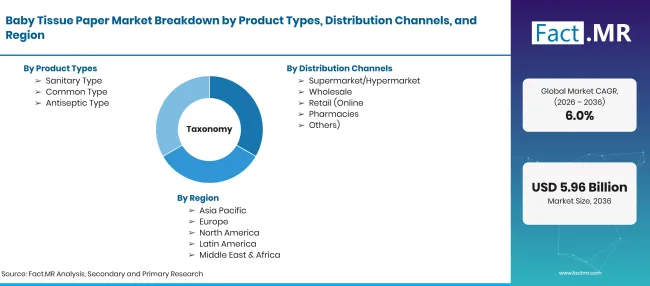
Baby Tissue Paper Market Taxonomy | Source: Fact.MR
| Attribute | Details |
|---|---|
| Quantitative Units | USD billion |
| Market Definition | Tissue paper and soft sheets made for infants and young children, including dry facial-grade baby tissues and pre-moistened baby tissue sheets. Value is counted at the first point of sale to retailers, distributors and institutional buyers. |
| Product Type | Sanitary Type; Common Type; Antiseptic Type |
| Distribution Channel | Supermarket/Hypermarket; Wholesale; Retail (Online); Pharmacies; Others |
| Application | At Home (AH); Away From Home (AFH) |
| Regions Covered | North America; Latin America; Western Europe; Eastern Europe; East Asia; South Asia & Pacific; Middle East & Africa |
| Countries Covered | Germany; Japan; United Kingdom; United States; Brazil |
| Companies Profiled | Kimberly-Clark Corporation; The Procter & Gamble Company; Essity AB; Hengan International Group Company Limited; Unicharm Corporation; Kao Corporation; Vinda International Holdings Limited; WaterWipes |
| Forecast Period | 2026 to 2036 |
| Approach | Hybrid top-down and bottom-up approach using births and children under three by country; sheets used per child per day; price per sheet by channel; pulp input costs; and supplier portfolio review. |
Source: Fact.MR analysis. Updated Oct 23, 2026
How is the market segmented?
-
By Product Type
- Sanitary Type
- Common Type
- Antiseptic Type
-
By Distribution Channel
- Supermarket/Hypermarket
- Wholesale
- Retail (Online)
- Pharmacies
- Others
-
By Application
- At Home (AH)
- Away From Home (AFH)
-
By Region
- North America
- Latin America
- Western Europe
- Eastern Europe
- East Asia
- South Asia & Pacific
- Middle East & Africa
Frequently Asked Questions
How big is the baby tissue paper market in 2026?
What is the CAGR of the baby tissue paper market from 2026 to 2036?
Which product type leads the baby tissue paper market?
Which distribution channel leads the baby tissue paper market?
Which application leads the baby tissue paper market?
Which country will grow the most in the baby tissue paper market?
Who are the main companies in the baby tissue paper market?
Who worked on this report


Preview the report firsthand - request a free sample
Free SampleGet the brochure for pricing and purchase details
Download PDF