- Market Value (2025): USD 586.0 Bn
- Estimated Value (2026): USD 604.2 Bn
- Forecast Value (2036): USD 819.9 Bn
- CAGR (2026-2036): 3.1%
What is the Base Metal Mining Market forecast to be worth by 2036?
USD 604.2 billion in 2026 to USD 819.9 billion by 2036, at 3.1% CAGR.
- The base metal mining market value stood at USD 586.0 billion in 2025, led by copper extraction and industrial metal supply channels.
- Demand is projected to increase from USD 604.2 billion in 2026 to USD 819.9 billion by 2036.
- The sector is forecast to record a 3.1% CAGR from 2026 to 2036 due to mine operators and industrial users planning around grade control and concentrate quality.
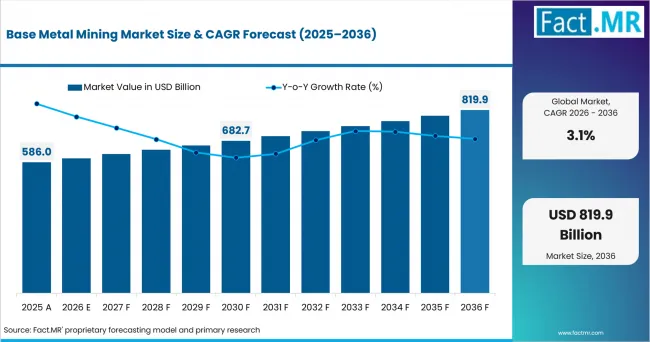
Base Metal Mining Market Market Value Analysis | Source: Fact.MR
What are the defining numbers behind Base Metal Mining Market growth?
USD 215.7 billion absolute opportunity by 2036, led by copper and smelting feedstock alongside large-scale mines.
- Demand Drivers in the Market
- Mine operators require stronger grade control supported by lower ore quality and deeper reserve conversion work.
- Smelters need predictable concentrate chemistry driven by tighter impurity control across copper and zinc feed.
- Construction material producers depend on stable copper and bauxite availability shaped by galvanized steel and aluminum demand.
- Equipment manufacturers use nickel and copper supply visibility reinforced by long mine development cycles.
- Key Segments Analyzed
- By Metal:Copper is projected to hold a 34% share in 2026, reflected by building wiring and refined metal demand.
- By Mining method: Open-pit is expected to account for 63% share in 2026, driven by open-pit copper and bauxite extraction.
- By End use: Construction is estimated to capture 31% share in2026, supported by aluminum systems and zinc-coated steel.
- By Product form: Ore and concentrate are anticipated to represent 44% share in 2026, shaped by smelter feedstock requirements.
- Analyst Opinion at Fact.MR
- Shambhu Nath Jha, Senior Analyst at Fact.MR, states, “Base metal mining has become a grade-control and project-delivery challenge. Demand is expected to favor operators proving reserve quality and smelter-ready concentrate output. Suppliers are expected to combine processing discipline and long-term offtake alignment.”
- Strategic Implications
- Mine operators are expected to prioritize water planning and tailings design before expansion approvals.
- Smelters are likely to compare concentrate impurity profiles before signing multi-year copper and nickel feed agreements.
- Equipment vendors are anticipated to align crushing and sorting systems with lower-grade ore movement.
- Investors should assess brownfield extension plans and permitting status before comparing project pipelines.
BHP announced Olympic Dam growth-enabling projects in October 2025, covering ore movement upgrades and a new oxygen plant. Development activity reflects a copper strategy built around existing ore bodies and smelter performance.
India is projected to post 4.9% CAGR through 2036, reflected by bauxite and zinc concentrate output gains. China is expected to record 4.2% CAGR by 2036, influenced by non-ferrous metal output scale and smelter feed requirements. Australia is anticipated to grow at 2.9% CAGR from 2026 to 2036, driven by copper export volume expansion. The United Kingdom is estimated to hold 2.6% CAGR during the study period, shaped by copper security planning. The U.S. is forecast to record 2.4% CAGR between 2026 and 2036, reinforced by domestic copper mining and Arizona supply depth. Germany is likely to post 2.1% CAGR to 2036 backed by basic metal manufacturing exposure. Japan is expected to expand at 1.8% CAGR to 2036, supported by overseas resource security and copper quality programs.
How does the Base Metal Mining Market break down by segment?
Open-pit is expected to garner 63% share in 2026, ore and concentrate is anticipated to represent 44% share in 2026.
Which metal is expected to lead the market?
Copper is set to represent 34% share in 2026.
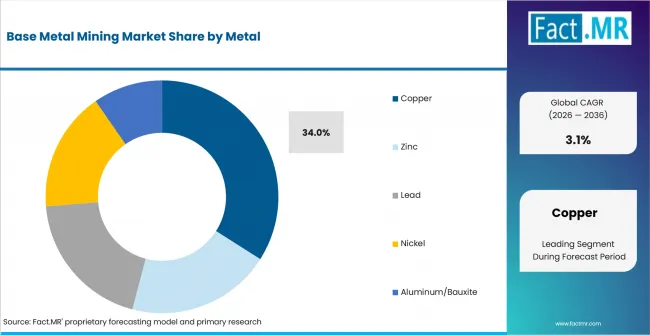
Base Metal Mining Market Analysis By Metal | Source: Fact.MR
Copper is projected to hold 34% share in 2026, driven by industrial machinery and refined metal use. Zinc follows through galvanizing and die-casting channels. Nickel remains central for stainless steel and battery-related uses. Lead retains use in industrial storage systems and selected alloys. Aluminum and bauxite remain important for construction and smelting channels. U.S. Geological Survey reported world copper mine production at 23.0 million tons in 2025 and refinery production at 29.0 million tons, confirming copper scale inside mined base metals.
What is likely to support open-pit within mining method?
Open-pit is ready to secure 63% share in 2026.
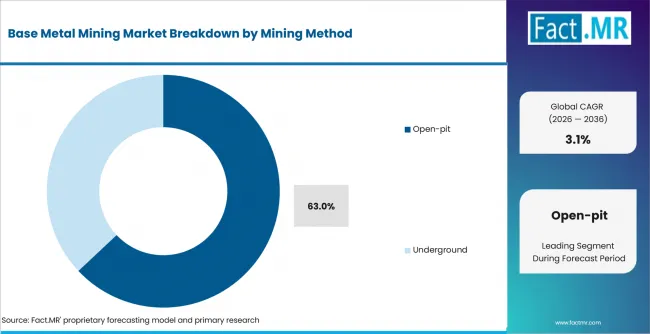
Base Metal Mining Market Analysis By Mining Method | Source: Fact.MR
Open-pit is anticipated to represent 63% share in 2026, owing to extraction across copper and bauxite deposits. Underground mining follows for deeper sulfide systems and higher-grade copper-zinc bodies. U.S. Geological Survey estimated world bauxite production at 440 million tons in 2025, keeping open-pit extraction central to aluminum feedstock planning.
What is estimated to lead the end use segment?
Construction is estimated to hold 31% share in 2026.
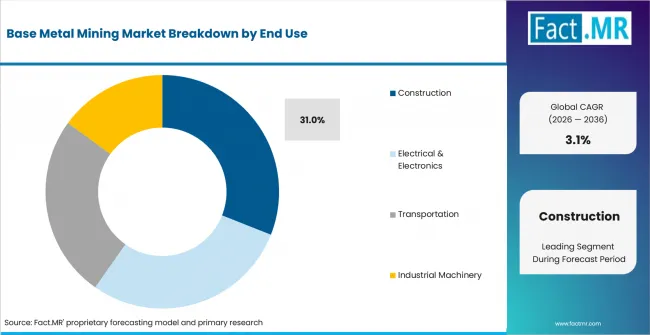
Base Metal Mining Market Analysis By End Use | Source: Fact.MR
Construction is forecast to account for31%share in2026, guided by copper wiring and zinc-coated products. Electrical and electronics follows as copper and nickel parts move into power systems and equipment. Transportation uses aluminum and zinc across vehicles and rail networks. Industrial machinery demand reflects heavy machinery and factory components. U.S. Geological Survey reported42%of U.S. copper and copper-alloy use in2025went into building construction,aligningmined copper to downstream construction activity.
What product form is expected to lead the market?
Ore and concentrate are predicted to garner 44% share in 2026.
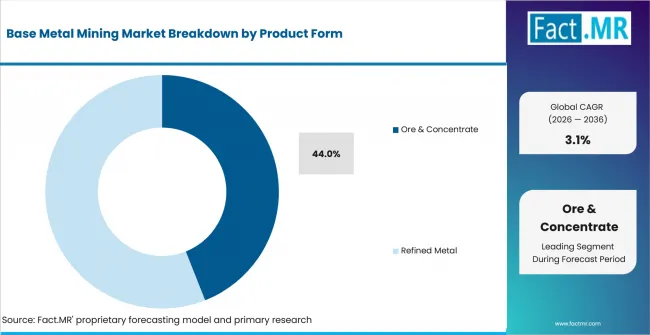
Base Metal Mining Market Analysis By Product Form | Source: Fact.MR
Ore and concentrateareexpected to account for44%share in2026, reflected by mined feedstock flows serving copper and nickel refining. Refined metal follows as industrial users convert processed output into construction and transport products. China’s statistics authority reported output of ten non-ferrous metals at27.45 milliontonnesduring January-April2026, up3.3%year over year,reinforcing smelter feedstock demand and domestic base metal processing scale.
What is accelerating Base Metal Mining Market adoption, and what is holding it back?
Copper supply pressure drives it; ore quality and permitting delays restrain it.
Drivers Impact Analysis
| Driver | (~) % Impact on CAGR | Geographic Relevance | Impact Timeline |
|---|---|---|---|
| Copper supply gap from mine pipeline limits | +0.6% | Global copper hubs | Medium term (2-4 years) |
| Grid and electrical equipment buildout | +0.5% | North America, China, India | Medium term (2-4 years) |
| Bauxite and aluminum feedstock needs | +0.4% | China, India, Australia | Short term (<= 2 years) |
| Zinc and lead concentrate requirements | +0.3% | India, U.S., Europe | Medium term (2-4 years) |
| Brownfield productivity upgrades | +0.3% | Australia, Mongolia, U.S. | Long term (>= 4 years) |
Source: Fact.MR analysis. Updated Jul 10, 2026
- Copper supply gap: Mine developers face a supply problem shaped by longer approvals and fewer easy deposits. International Energy Agency reported in May 2025, expected mined supply could leave a 30% copper deficit by 2035. Copper projects are projected to receive more capital attention as smelters and cable producers seek stable feed.
- Grid and electrical equipment buildout: Power infrastructure keeps copper demand central to mining economics. The United Kingdom’s critical minerals strategy stated in January 2026 reporting annual copper demand being anticipated to almost double by 2035. Mine planning is expected to favor deposits with lower impurity risk and reliable energy access.
- Bauxite and aluminum feedstock needs: Aluminum production depends on steady bauxite mining and alumina conversion. India’s Ministry of Mines reported in June 2025 stating bauxite output reached 2.13 MMT in April 2025, up 13.9% from April 2024. Such output gains are anticipated to support mine planning linked to aluminum smelters.
- Zinc and lead concentrate requirements: Galvanizing, die-casting, and storage applications keep zinc and lead concentrate flows active. India’s Ministry of Mines reported zinc concentrate output at 0.14 MMT in April 2025, up 7.7% from April 2024. Concentrate quality is estimated to remain central for smelters managing treatment charges and impurity penalties.
- Brownfield productivity upgrades: Existing mines offer shorter expansion paths than many greenfield discoveries. BHP’s October 2025 Olympic Dam update focused on ore movement and oxygen supply. Brownfield work is forecast to gain attention as operators seek lower execution risk.
Opportunity Impact Analysis
| Opportunity | (~) % Impact on CAGR | Geographic Relevance | Impact Timeline |
|---|---|---|---|
| Brownfield copper expansions | +0.4% | Australia, Mongolia, U.S. | Long term (>= 4 years) |
| Ore sorting and grade-control systems | +0.3% | Global mining regions | Medium term (2-4 years) |
| Copper concentrate impurity reduction | +0.3% | Japan, Chile, China | Medium term (2-4 years) |
| Nickel-copper integrated projects | +0.2% | Indonesia, Canada, Australia | Long term (>= 4 years) |
Source: Fact.MR analysis. Updated Jul 10, 2026
- Brownfield copper expansions: Existing copper districts create opportunities through deeper mine plans and processing upgrades. Rio Tinto reported in June 2025 stating Oyu Tolgoi production from Panel 0 and Panel 2 remained scheduled during 2025 and 2026. Staged mine development is projected to support concentrate supply without relying only on new district discovery.
- Ore sorting and grade-control systems: Lower grades raise demand for tighter geological models and pre-concentration. Operators are expected to use sensor sorting and plant feedback to reduce waste movement. Adoption is likely to favor mines with enough scale to justify test work and plant integration.
- Copper concentrate impurity reduction: Smelters are placing more attention on arsenic and other impurities in copper raw materials. Japan Organization for Metals and Energy Security reported in December 2025 a cooperation agreement with CODELCO for reducing impurities in copper raw materials. Such work is anticipated to influence concentrate acceptance and pricing.
- Nickel-copper integrated projects: Nickel keeps base metal mining linked with stainless steel and selected battery materials. U.S. Geological Survey estimated global nickel mine production at 3.9 million tons in 2025, up 5% from 2024. Integrated nickel-copper projects are forecast to attract selective funding as customers seek diversified metal units.
Restraints Impact Analysis
| Restraint | (~) % Impact on CAGR | Geographic Relevance | Impact Timeline |
|---|---|---|---|
| Ore grade decline and capital intensity | -0.5% | Global | Long term (>= 4 years) |
| Permitting and community approval delays | -0.4% | North America and Europe | Medium term (2-4 years) |
| Nickel oversupply pressure | -0.3% | Indonesia, Australia, global | Short term (<= 2 years) |
| Smelter feed impurity constraints | -0.2% | Japan, China, Chile | Medium term (2-4 years) |
Source: Fact.MR analysis. Updated Jul 10, 2026
- Ore grade decline: Lower grades raise waste movement and processing cost per payable metal unit. International Energy Agency linked copper supply risk in May 2025 to rising project costs and long lead times. Capital allocation is expected to favor projects with clearer reserve conversion.
- Permitting and approval delays: Mine approvals require environmental studies and community engagement. Longer review cycles slow production replacement even after favorable metal prices. Project developers are projected to advance deposits with existing infrastructure and clearer approval records.
- Nickel oversupply pressure: Nickel remains exposed to supply surges from newer producing regions. U.S. Geological Survey reported a global nickel surplus of 189,000 tons during the first 9 months of 2025, compared with 107,000 tons during the same period of 2024. Price pressure is anticipated to delay projects with weaker cost positions.
- Smelter feed impurity constraints: Copper concentrates with high impurity levels need extra treatment and stricter blending. Japan’s official resource agency described rising arsenic impurities as a challenge for copper resource stability in December 2025. Smelter qualification work is estimated to slow adoption of difficult ore bodies.
How are country markets expected to scale Base Metal Mining Market demand?
India 4.9%; China 4.2%; Australia 2.9%; United Kingdom 2.6%; U.S. 2.4%.
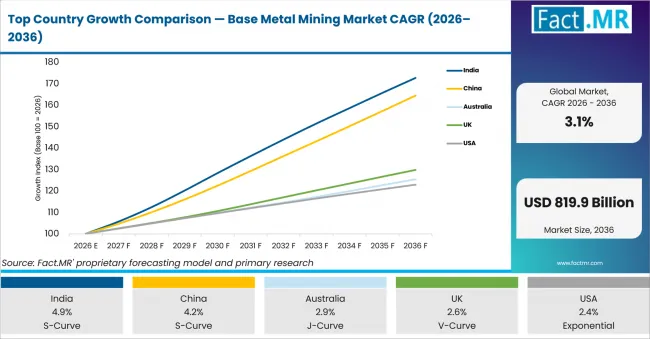
Top Country Growth Comparison Base Metal Mining Market Cagr 2026 2036 | Source: Fact.MR
Regional analysis covers North America, Latin America, Europe, East Asia, South Asia and Pacific, and Middle East and Africa.
| Country | CAGR |
|---|---|
| India | 4.9% |
| China | 4.2% |
| Australia | 2.9% |
| United Kingdom | 2.6% |
| U.S. | 2.4% |
Source: Fact.MR analysis. Updated Jul 10, 2026
What is driving India’s growth to 2036?
4.9% CAGR by 2036, driven by non-ferrous output expansion.
India combines zinc concentrate and aluminum output momentum with expanding industrial material use. Market demand is projected to record 4.9% CAGR through 2036, led by miners and smelters aligning output with construction and manufacturing needs. Ministry of Mines reported in June 2025 that refined copper production reached 0.52 lakh tonnes in April 2025, up 15.6% from April 2024, supporting domestic feedstock planning.
How is China scaling base metal mining demand?
4.2% CAGR from 2026 to 2036, supported by non-ferrous metal output scale.
China’s smelting base keeps mined feedstock planning close to industrial production cycles. National statistics reported primary aluminum output at 15.33 million tonnes during January-April 2026, up 3.5% from the prior year. Demand is expected to record 4.2% CAGR during the study period 2036, led by domestic processing scale influencing aluminum and lead inputs.
What supports the Australia outlook?
2.9% CAGR between 2026 and 2036, owing to copper export volume gains.
Australia remains a core copper and bauxite supply base linked with Asian smelters. Australia’s resources department projected copper exports to rise from 765 kt in 2024-25 to 948 kt in 2026-27. Market demand is anticipated to post 2.9% CAGR during the forecast period, driven by mine expansions and export infrastructure impacting volume gains.
What underpins United Kingdom demand?
2.6% CAGR through 2036, shaped by copper security planning.
United Kingdom mining exposure is limited, yet metal security planning affects sourcing and processing priorities. The Department for Business and Trade reported in January 2026 that yearly copper demand in the United Kingdom is anticipated to almost double by 2035. Market demand is estimated to advance at 2.6% CAGR between 2026 and 2036 as copper supply-chain planning gains priority.
How does the U.S. market perform?
2.4% CAGR during the forecast period, reinforced by domestic copper mining and Arizona supply.
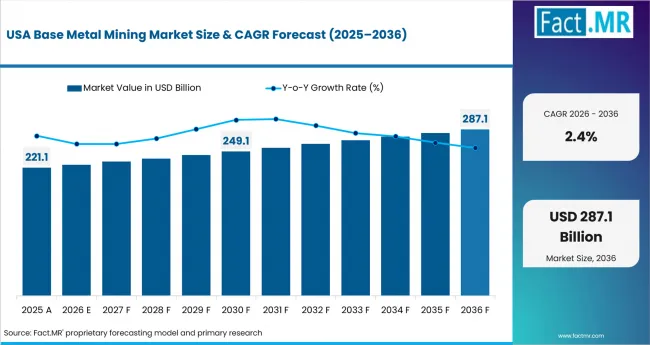
Base Metal Mining Market Country Value Analysis | Source: Fact.MR
United States copper mining remains concentrated in Arizona and linked with construction, electrical, and equipment uses. U.S. Geological Survey estimated U.S. copper mine production at 1.0 million tons in 2025, with Arizona accounting for about 70% of domestic output. Market demand is forecast to record 2.4% CAGR by 2036 since domestic concentrate and refined supply planning supports industrial users.
What shapes Germany’s outlook?
2.1% CAGR during the study period, influenced by basic metal manufacturing exposure.
Germany’s base metal demand reflects machinery, automotive components, electrical systems, and industrial manufacturing. Destatis reported in June 2026, copper and semi-finished copper products cost 24.5% more in May 2026 than a year earlier. Demand is likely to post 2.1% CAGR by 2036 due to industrial users managing price swings and metal sourcing risk.
How is Japan positioned in base metals?
1.8% CAGR during the forecast period, supported by copper quality and overseas resource security work.
Japan relies on overseas mines and copper quality programs to support industrial metal needs. Sumitomo Metal Mining stated in 2025 reporting for FY2024 copper production from mines with group interests having reached 232 kt, against a long-term 300 kt annual equity production target. Market demand is expected to advance at 1.8% CAGR to 2036, driven by Japanese players deepen resource access and impurity control.
Who leads the Base Metal Mining Market?
BHP and Rio Tinto lead direct copper growth coverage, while Freeport-McMoRan and Glencore strengthen copper, zinc, and nickel portfolios.
BHP brings copper exposure led by Copper South Australia assets and long-life mine development programs. Rio Tinto adds scale depending on Oyu Tolgoi and copper mine planning linked to long-range concentrate supply. Freeport-McMoRan remains central to copper due to Morenci and other long-life assets.
Glencore strengthens the peer set through nickel and marketing capability. Vale Base Metals supports nickel-copper exposure depending on Voisey’s Bay and Sudbury assets. Teck Resources adds copper and zinc depth based on Canadian and South American operations. Southern Copper Corporation remains active as a listed copper mining-metallurgical company with operations in Peru and Mexico.
Which companies are the key providers?
BHP and Rio Tinto are key providers. Freeport-McMoRan and Glencore are also profiled. Vale Base Metals, Teck Resources, and Southern Copper Corporation complete the company set.
- BHP
- Rio Tinto
- Freeport-McMoRan
- Glencore
- Vale Base Metals
- Teck Resources
- Southern Copper Corporation
Bibliography
- Australian Government Department of Industry, Science and Resources. (2025, December 19). Resources and energy quarterly: December 2025. Australian Government.
- BHP. (2025, October 1). BHP investing to boost Olympic Dam operations. BHP.
- Department for Business and Trade. (2026, January 23). Vision 2035: Critical minerals strategy. Government of the United Kingdom.
- Freeport-McMoRan Inc. (2026, February 18). FCX announces agreement for life of resource extension of operating rights in Grasberg Minerals District. Freeport-McMoRan Inc.
- Glencore. (2026, April 30). First quarter 2026 production report. Glencore.
- International Energy Agency. (2025, May 21). Global critical minerals outlook 2025. International Energy Agency.
- Japan Organization for Metals and Energy Security. (2025, December 8). Agreement on cooperation for technology to reduce impurities in copper raw materials with CODELCO: Expectation for stable supply of copper resources. Japan Organization for Metals and Energy Security.
- Ministry of Mines. (2025, June 4). Mineral and non-ferrous metal production on growth track in FY 2025-26. Press Information Bureau, Government of India.
- National Bureau of Statistics of China. (2026, May 19). Industrial production operation in April 2026. National Bureau of Statistics of China.
- Rio Tinto. (2025, June 6). Update on Oyu Tolgoi mine plan. Rio Tinto.
- Southern Copper Corporation. (2026, February 10). Annual report on Form 10-K for the fiscal year ended December 31, 2025. Southern Copper Corporation.
- Statistisches Bundesamt. (2026, June 19). Producer prices in May 2026: +2.2% on May 2025. Destatis.
- Sumitomo Metal Mining Co., Ltd. (2025, September 1). Integrated report 2025. Sumitomo Metal Mining Co., Ltd.
- Teck Resources Limited. (2025, January 20). Teck announces 2024 production and 2025 guidance update. Teck Resources Limited.
- Teck Resources Limited. (2025, July 23). Teck announces construction of Highland Valley Copper mine life extension to proceed. Teck Resources Limited.
- U.S. Geological Survey. (2026, February 6). Mineral commodity summaries 2026. U.S. Geological Survey.
- Vale. (2026, January 27). Vale’s production and sales in 4Q25 and 2025. Vale.
- Vale Base Metals. (2024, December 3). Vale Base Metals completes Voisey’s Bay transition to underground mining. Vale Base Metals.
This Report Addresses
- The report provides strategic intelligence on base metal mining across metal type choices shaping mined feedstock programs.
- Segment analysis covers copper and smelting feedstock as the share leaders within the 2026 market structure.
- Regional outlook evaluates India and China alongside Australia, the United Kingdom, the U.S., Germany, and Japan.
- Competitive analysis profiles BHP and Rio Tinto alongside Freeport-McMoRan and Glencore, followed by three additional active base metal providers.
- Metal type assessment covers copper and bauxite across extraction and smelter feedstock needs.
- The forecast uses official mineral statistics and company portfolio checks to interpret market values and country CAGRs.
- Primary interviews and official source reviews support final validation of segment shares and company inclusion.
What does the Base Metal Mining Market cover?
Copper, zinc, lead, nickel, and bauxite mining used for industrial metal supply.
The base metal mining market covers extraction and initial processing of non-ferrous metal ores used by smelters, refiners, alloy producers, and industrial manufacturers. Coverage includes mined ore, concentrate, and metal-bearing feedstock linked to copper, zinc, lead, nickel, and bauxite supply chains.
Market coverage differs from precious metal mining, iron ore extraction, and coal mining since commercial demand centers on industrial base metals. Recycling-only metal recovery remains outside scope unless linked directly to mined concentrate planning or primary smelting operations.
What is included in the scope?
Base metal mining operations used for copper, zinc, lead, nickel, and bauxite supply chains.
Scope includes underground mining, block caving, and selected in-situ recovery across base metal deposits. Coverage includes large-scale mines, mid-scale mines, junior mining projects, and contract mining models. End-use coverage includes construction, electrical and electronics, transportation, and industrial equipment. Commercial assessment also considers grade control, concentrate quality, water planning, mine productivity, and smelter qualification.
What is excluded from the scope?
Precious metal mining, iron ore, coal, and recycling-only metal recovery are outside the scope.
Gold-only, silver-only, platinum group metal, iron ore, and coal assets are excluded unless operated as part of a base metal deposit. Secondary recycling, scrap trading, and metal brokerage are excluded unless analysis concerns mined concentrate substitution or smelter feed planning.
How was the analysis built?
120+ sources, 45+ company portfolios, 30+ countries, 20+ interviews.
- Primary Research:
- Primary research includes interviews with mine operators, smelter sourcing teams, geological consultants, equipment vendors, metal traders, and industrial metal users. It also includes input from mine planners, plant managers, metallurgists, and project finance teams involved in copper, zinc, nickel, lead, and bauxite supply.
- Desk Research:
- Desk research reviews official mineral production statistics, country resource strategies, company mine plans, integrated reports, production updates, reserve statements, and technical project releases. Official statistics offices, geological agencies, energy agencies, and company investor materials are reviewed to assess supply, output, and project direction.
- Market-Sizing and Forecasting:
- Forecasting uses market values, country CAGRs, metal output trends, mine method exposure, reserve conversion, concentrate demand, smelter capacity, and end-use material pull. Forecast models also assess ore-grade pressure, brownfield expansion, project timing, and metal-specific supply risk.
- Data Validation and Update Cycle:
- Forecasts are validated through country evidence review, and technical interviews. Updates review official production releases, mine development changes, smelter feed trends, and company announcements to keep the market view aligned with current operating conditions.
Segmentation
What is the report’s scope and coverage?
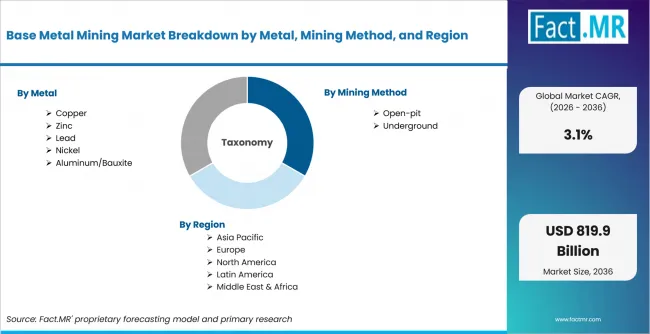
Base Metal Mining Market Breakdown By Metal, Mining Method, And Region | Source: Fact.MR
| Attribute | Details |
|---|---|
| Attribute | Details |
| Quantitative Units | USD billion in 2026 to USD billion by 2036 at CAGR |
| Market Definition | Extraction and primary processing of copper, zinc, lead, nickel, and aluminum/bauxite ores used as industrial metal feedstock |
| Metal | Copper; Zinc; Lead; Nickel; Aluminum/Bauxite |
| Mining Method | Open-pit; Underground |
| End Use | Construction; Electrical & Electronics; Transportation; Industrial Machinery |
| Product Form | Ore & Concentrate; Refined Metal |
| Regions Covered | North America; Latin America; Europe; East Asia; South Asia and Pacific; Middle East and Africa |
| Countries Covered | India; China; Australia; United Kingdom; U.S.; Germany; Japan |
| Key Companies Profiled | BHP Group Limited; Rio Tinto; Glencore; Freeport-McMoRan; Vale Base Metals; Teck Resources |
| Forecast Period | 2026 to 2036 |
| Approach | Hybrid top-down and bottom-up approach using official mineral output data; mine project pipelines; concentrate demand; smelter feed needs; ore-grade trends; country CAGRs; and company portfolio checks |
Source: Fact.MR analysis. Updated Jul 10, 2026
How is the market segmented?
-
By Metal:
- Copper
- Zinc
- Lead
- Nickel
- Aluminum/Bauxite
-
By Mining Method:
- Open-pit
- Underground
-
By End Use:
- Construction
- Electrical and electronics
- Transportation
- Industrial machinery
-
By Product Form:
- Ore and concentrate
- Refined metal
-
By Region:
- North America
- United States
- Canada
- Latin America
- Brazil
- Mexico
- Chile
- Peru
- Europe
- Germany
- United Kingdom
- France
- Italy
- Spain
- East Asia
- China
- Japan
- South Korea
- South Asia and Pacific
- India
- Australia
- Indonesia
- Middle East and Africa
- UAE
- Saudi Arabia
- South Africa
- North America
Frequently Asked Questions
Which country is expected to record the most prominent CAGR in the base metal mining market?
How is China anticipated to perform in the base metal mining market?
How is Australia estimated to lead in the base metal mining market?
How is the United Kingdom likely to expand in the base metal mining market?
How is the U.S. projected to grow in the base metal mining market?
How does Germany perform in the base metal mining market?
How does Japan perform in the Base Metal Mining Market?
What is the primary driver in the base metal mining market?
What is the main restraint in the base metal mining market?
Why is copper important in base metal mining?
Who worked on this report


Preview the report firsthand - request a free sample
Free SampleGet the brochure for pricing and purchase details
Download PDF