- Base Value(2025): 356.8 Mn
- Estimated Value(2026): 401.7 Mn
- Forecast Value (2036): 1524.6 Mn
- CAGR (2026 - 2036): 14.3%
AI-Based Torque Monitoring for Fastener Assembly Market Forecast and Outlook By Fact.MR
In 2025, the AI-based torque monitoring for fastener assembly market was valued at USD 356.8 million. Based on Fact MR analysis, demand for AI-based torque monitoring systems for fastener assembly is estimated to grow to USD 401.7 million in 2026 and USD 1,524.6 million by 2036. FMR projects a CAGR of 14.3% during the forecast period.
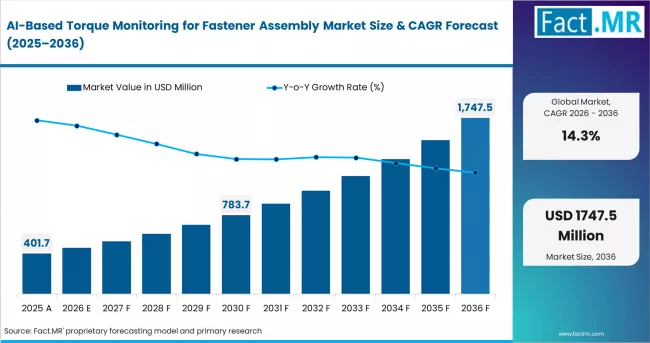
Ai Based Torque Monitoring For Fastener Assembly Market Market Value Analysis | Source: Fact.MR
Summary of the AI Based Torque Monitoring for Fastener Assembly Market
- Market Definition
- The market comprises intelligent torque measurement and analytics systems that use sensors, machine learning algorithms, and connected fastening tools to monitor tightening accuracy, detect anomalies, and ensure consistent clamping force across automated and manual assembly operations.
- Demand Drivers
- Increasing adoption of AI enabled quality assurance systems supporting zero defect fastening performance across automated assembly lines.
- Rising requirement for real time torque verification ensuring correct preload and joint integrity across safety critical components.
- Growing demand for traceability of torque data supporting compliance with industrial quality management standards.
- Expansion of automated assembly environments requiring predictive detection of fastening anomalies.
- Increasing integration of sensor enabled tightening tools supporting continuous capture of torque angle signatures.
- Rising focus on reduction of rework and warranty exposure linked to fastening inconsistencies.
- Key Segments Analyzed
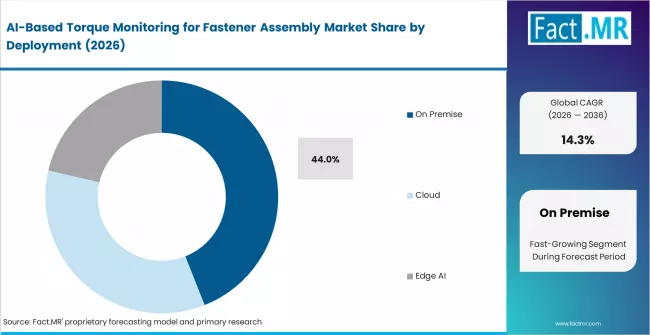
- Deployment: On premise deployment leads with 44% share supported by low latency response requirements across assembly operations.
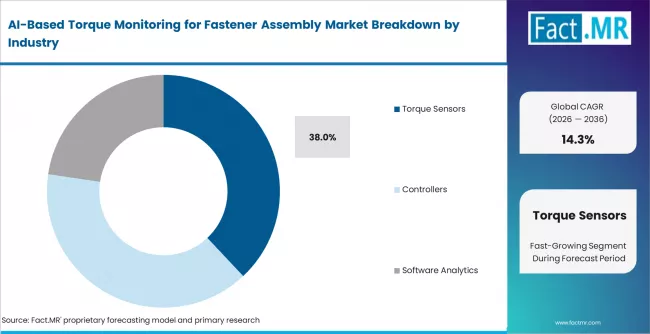
- Component: Torque sensors hold 38% share due to requirement for high accuracy rotational force measurement.
- Application Role: Automotive and electronics assembly represent primary demand due to high volume fastening requirements.
- Technology Role: AI analytics platforms support detection of under tightening, over tightening, and cross threading conditions.
- Geography: Europe and Asia Pacific maintain steady adoption supported by expansion of smart manufacturing infrastructure.
- Analyst Opinion at Fact MR
- Shambhu Nath Jha, Principal Consultant, Fact MR, opines, 'In this updated edition of the AI Based Torque Monitoring for Fastener Assembly Market report, industry participants observe increasing reliance on sensor enabled tightening tools integrated with AI analytics supporting improved fastening consistency across high volume manufacturing environments. Intelligent torque verification remains critical for maintaining assembly quality reliability through 2036.'
- Strategic Implications or Executive Takeaways
- Invest in high precision torque sensing technology supporting repeatable clamping force performance across assembly workflows.
- Strengthen AI analytics capability supporting detection of torque angle deviation patterns.
- Improve compatibility with programmable logic controllers supporting integration across automated production lines.
- Expand on premise processing architecture supporting real time feedback control across tightening operations.
- Focus on traceability architecture supporting digital recording of fastening performance parameters.
- Enhance integration capability with robotic assembly tools supporting adaptive torque optimization.
- Methodology
- Primary interviews conducted with industrial fastening tool manufacturers, automation providers, and assembly engineering specialists.
- Benchmarked against intelligent manufacturing adoption indicators influencing demand for AI enabled quality control technologies.
- Evaluated deployment patterns across automotive, electronics, and industrial equipment assembly operations.
- Hybrid modeling applied combining top down digital manufacturing demand assessment with bottom up torque monitoring deployment benchmarking.
- Validation conducted using industrial assembly analytics adoption indicators and supplier level technology implementation data.
- Peer review applied using Fact MR analytical frameworks linking intelligent fastening adoption trends with digital quality assurance requirements
AI-Based Torque Monitoring for Fastener Assembly Market
| Metric | Details |
|---|---|
| Industry Size (2026E) | USD 401.7 million |
| Industry Value (2036F) | USD 1,524.6 million |
| CAGR (2026 to 2036) | 14.3% |
Source: Fact.MR analysis. Updated Apr 13, 2026
A CAGR of 14.3% indicates transformational expansion driven by increasing adoption of AI-enabled quality assurance in automated assembly lines. Growth is supported by demand for traceability and defect reduction in automotive and electronics manufacturing, while constraints persist due to integration complexity with legacy tooling systems and validation requirements for machine learning reliability.
China leads with a projected CAGR of 15.2%, supported by increasing integration of intelligent quality control systems across high-volume manufacturing assembly lines. India follows with a CAGR of 14.8%, driven by expanding deployment of predictive torque verification systems across industrial equipment production facilities. The United Kingdom records a CAGR of 14.6%, reflecting steady adoption of AI-enabled fastening accuracy monitoring tools across precision engineering environments. Germany shows a CAGR of 14.4%, supported by consistent incorporation of smart torque analytics platforms across automotive and machinery assembly operations. The United States records the slowest growth at 14.3%, reflecting a relatively mature digital manufacturing ecosystem tied to replacement cycles within existing assembly monitoring infrastructures.
Segmental Analysis
AI-Based Torque Monitoring for Fastener Assembly Market Analysis by Deployment
Ai Based Torque Monitoring For Fastener Assembly Market Analysis By Deployment | Source: Fact.MR
- Market Overview: Based on Fact MR assessment, on premise deployment is projected to account for 44% share of the AI based torque monitoring for fastener assembly market in 2026. On site data processing architecture enables real time monitoring of torque values applied during fastening operations requiring immediate feedback control across assembly line workflows. Localized computing infrastructure supports integration with programmable logic controllers and tightening tools enabling continuous evaluation of torque signatures associated with bolt and screw fastening sequences. Deployment preference is influenced by requirement for low latency response enabling rapid detection of fastening deviations across high precision industrial assembly environments.
- Demand Drivers:
- Latency Control Requirements: On premise systems support immediate analysis of torque data enabling rapid correction of fastening inconsistencies across assembly processes.
- Data Security Parameters: Local deployment architecture supports controlled management of production data within internal manufacturing networks.
- System Integration Needs: On premise platforms demonstrate compatibility with tightening tools and control systems requiring stable communication across assembly line equipment.
AI-Based Torque Monitoring for Fastener Assembly Market Analysis by Component
Ai Based Torque Monitoring For Fastener Assembly Market Analysis By Component | Source: Fact.MR
- Market Overview: Torque sensors are estimated to hold 38% share of the AI based torque monitoring for fastener assembly market in 2026, supported by requirement for accurate measurement of rotational force applied across threaded fastener connections. Sensor modules capture torque signal data enabling analysis of fastening quality across automated assembly systems requiring controlled clamping force performance. Integration of sensor technology supports detection of under tightening and over tightening conditions affecting joint integrity across manufacturing operations requiring repeatable fastening precision.
- Demand Drivers:
- Measurement Accuracy Requirements: Torque sensors provide precise detection of rotational force enabling verification of fastening performance across assembly workflows.
- Quality Control Parameters: Sensor generated data supports evaluation of joint integrity requiring controlled clamping force consistency.
- Process Monitoring Needs: Torque sensing components enable continuous capture of fastening performance metrics across automated assembly line environments.
Key Dynamics
AI-Based Torque Monitoring for Fastener Assembly Market Drivers, Restraints, and Opportunities
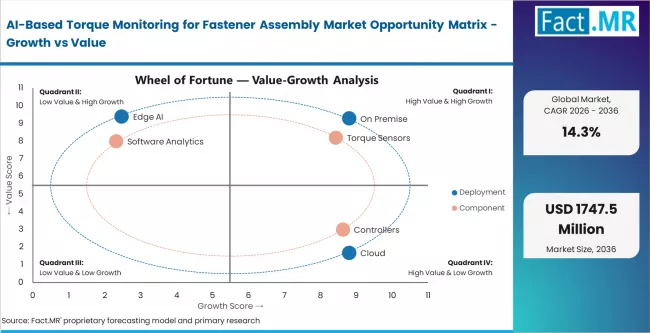
Ai Based Torque Monitoring For Fastener Assembly Market Opportunity Matrix Growth Vs Value | Source: Fact.MR
FMR analysts observe that historical torque verification in industrial fastening relied on mechanical torque tools and statistical sampling methods that provided limited real-time visibility into fastening integrity. The present market size reflects transition toward digitally monitored assembly processes where AI-enabled torque analytics improve traceability and reduce variability in critical fastening operations across automotive, aerospace, and heavy equipment production lines. Structural reality indicates a growth-phase market because tightening accuracy directly influences product safety, warranty exposure, and regulatory compliance in assemblies where fastener preload consistency determines structural reliability and fatigue resistance performance.
The current structural shift reflects declining reliance on standalone torque tools lacking connectivity as integrated sensor-based tightening systems provide continuous monitoring of torque-angle signatures and anomaly detection during assembly cycles. Higher cost per tool system incorporating embedded analytics is offset by reduced rework rates, lower recall risk, and improved statistical process control across high-volume fastening operations. Value growth remains linked to quality assurance digitization strategies rather than incremental expansion of manual fastening capacity.
- Zero-Defect Assembly: AI-based torque monitoring enables continuous validation of torque-angle curves, improving detection of cross-threading, under-tightening, and fastener seating inconsistencies.
- Quality Compliance Traceability: IATF 16949 automotive quality management requirements support adoption of digitally recorded torque data for audit verification and process repeatability validation.
- Automotive Production Base: Germany, Japan, and United States maintain strong adoption due to high-volume vehicle manufacturing requiring controlled fastening precision across safety-critical assemblies.
Regional Analysis
The AI-Based Torque Monitoring for Fastener Assembly Market is assessed across North America, Europe, and Asia Pacific, segmented by country-level demand in automated fastening validation, predictive torque analytics, assembly line quality control, and digital tightening traceability systems. Regional demand reflects expansion of smart manufacturing environments and adoption of AI-enabled process control in precision assembly operations. The full report offers market attractiveness analysis.
.webp "Top Country Growth Comparison Ai Based Torque Monitoring For Fastener Assembly Market Cagr (2026 2036)")
Top Country Growth Comparison Ai Based Torque Monitoring For Fastener Assembly Market Cagr (2026 2036) | Source: Fact.MR
| Country | CAGR (2026–2036) |
|---|---|
| China | 15.2% |
| India | 14.8% |
| United Kingdom | 14.6% |
| Germany | 14.4% |
| United States | 14.3% |
Source: Fact.MR analysis. Updated Apr 13, 2026
Source: Fact MR analysis, based on proprietary forecasting model and primary research
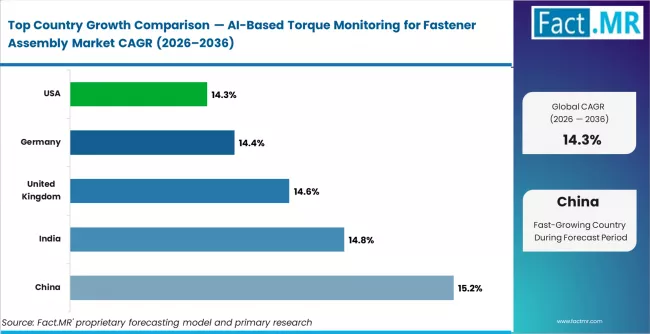
Ai Based Torque Monitoring For Fastener Assembly Market Cagr Analysis By Country | Source: Fact.MR
Asia Pacific
Asia Pacific functions as the intelligent fastening analytics adoption hub, supported by growth in automotive and electronics assembly automation. Atlas Copco AB strengthens smart torque tool integration capability. SCS Concept Group expands digital tightening validation software portfolio. Bosch Rexroth AG supports AI-driven assembly monitoring technologies.
- China: China is projected to record 15.2% CAGR in AI-based torque monitoring for fastener assembly through 2036. Intelligent Manufacturing pilot programme expansion (MIIT, March 2024) supports AI-enabled assembly verification adoption. Atlas Copco AB expanded smart torque analytics integration capability (June 2023).
- India: Implementation of AI-based torque monitoring for fastener assembly in India is forecast to grow at 14.8% CAGR through 2036. Automotive Mission Plan digital manufacturing focus update (Ministry of Heavy Industries, January 2024) supports intelligent fastening system adoption. Bosch Rexroth AG expanded assembly analytics integration engineering capability (May 2023).
Europe
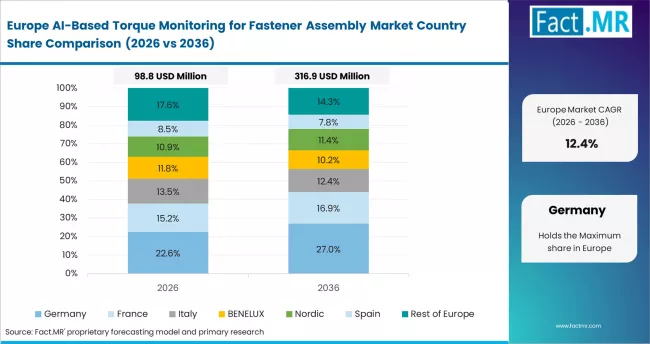
Ai Based Torque Monitoring For Fastener Assembly Market Europe Country Market Share Analysis, 2026 & 2036 | Source: Fact.MR
Europe operates as the precision fastening validation engineering center, supported by Industry 4.0 interoperability frameworks and high adoption of digital quality assurance technologies. SCS Concept Group strengthens torque traceability software positioning. Atlas Copco AB expands intelligent fastening platform capability. Desoutter Industrial Tools supports connected assembly optimization systems.
- United Kingdom: Adoption of AI-based torque monitoring for fastener assembly in United Kingdom is expected to expand at 14.6% CAGR through 2036. Made Smarter digital production initiative expansion (Department for Business and Trade, February 2024) supports AI-enabled assembly inspection integration. Desoutter Industrial Tools expanded connected fastening solution capability (July 2023).
- Germany: Germany is anticipated to observe 14.4% CAGR in AI-based torque monitoring for fastener assembly through 2036. Plattform Industrie 4.0 interoperability initiative update (BMWK, October 2023) supports digital torque traceability adoption. SCS Concept Group expanded intelligent tightening software capability (April 2023).
North America
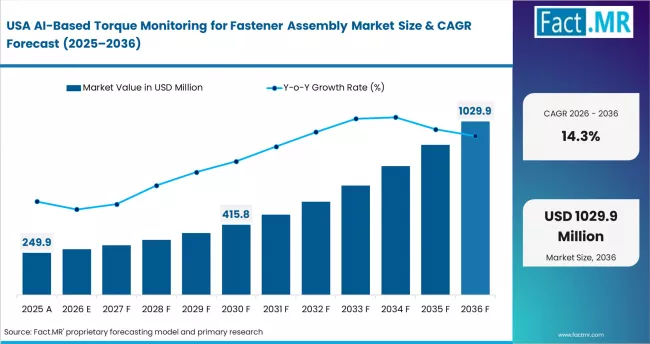
Ai Based Torque Monitoring For Fastener Assembly Market Country Value Analysis | Source: Fact.MR
North America represents the advanced assembly analytics deployment environment, supported by adoption of predictive quality control systems and integration of AI-driven process optimization platforms. Emerson Electric Co. strengthens connected assembly monitoring capability. Stanley Black & Decker Inc. expands intelligent fastening system portfolio. Honeywell International Inc. supports digital production analytics integration.
- United States: The United States is forecast to witness 14.3% CAGR in AI-based torque monitoring for fastener assembly through 2036. Manufacturing USA digital quality initiative update (NIST, April 2024) supports AI-based process validation deployment. Stanley Black & Decker Inc. expanded smart fastening analytics capability (August 2023).
Fact MR's analysis of AI-based torque monitoring for fastener assembly market in global regions consists of country-wise assessment that includes China, India, United Kingdom, Germany, and United States. Readers can find intelligent fastening trends, digital torque validation developments, AI-enabled quality assurance signals, and competitive positioning across key markets.
Competitive Landscape
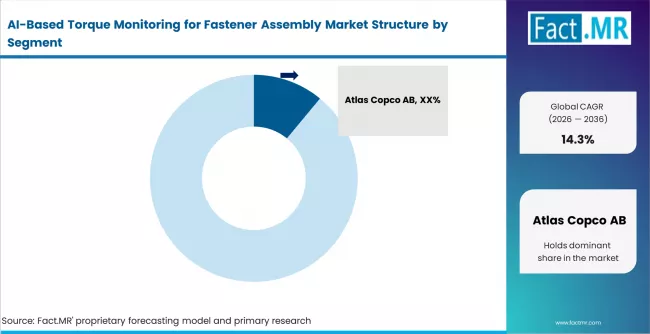
Ai Based Torque Monitoring For Fastener Assembly Market Analysis By Company | Source: Fact.MR
Competitive Structure and Buyer Dynamics in the AI-Based Torque Monitoring for Fastener Assembly Market
The competitive structure of the AI-Based Torque Monitoring for Fastener Assembly Market is moderately concentrated, with industrial tool manufacturers and precision measurement technology providers controlling a significant share of intelligent fastening system deployments. Companies such as Atlas Copco AB, Bosch Rexroth AG, Stanley Black & Decker Inc., Ingersoll Rand Inc., Desoutter Industrial Tools, Cleco, and Mountz Inc. maintain strong positions through established torque tool portfolios and integrated fastening control systems. Additional participants including Kistler Group, SCS Concept Group, and Crane Electronics Ltd contribute through sensor technology, torque measurement systems, and process validation software used in assembly environments. Competition is primarily influenced by measurement accuracy, real time analytics capability, integration with production systems, and reliability in high volume manufacturing operations.
Several companies maintain structural advantages through strong expertise in industrial fastening technology and established relationships with automotive and industrial equipment manufacturers. Firms such as Atlas Copco AB, Desoutter Industrial Tools, and Bosch Rexroth AG benefit from advanced process control capabilities and global service infrastructure supporting intelligent assembly systems. Kistler Group maintains advantages through precision sensor engineering used in torque monitoring applications. Manufacturers often adopt multi supplier sourcing strategies to reduce dependence on a single fastening technology provider and maintain production flexibility. Procurement decisions evaluate suppliers based on system precision, data traceability capability, and long term technical support, moderating supplier pricing leverage across smart assembly environments.
Key Players of the AI-Based Torque Monitoring for Fastener Assembly Market
- Atlas Copco AB
- Bosch Rexroth AG
- Stanley Black & Decker Inc.
- Ingersoll Rand Inc.
- Desoutter Industrial Tools
- Mountz Inc.
- Cleco (Apex Tool Group)
- SCS Concept Group
- Kistler Group
- Crane Electronics Ltd
Bibliographies
- [1] National Institute of Standards and Technology. (2024, April). Manufacturing USA digital quality initiative update. U.S. Department of Commerce.
- [2] Ministry of Industry and Information Technology. (2024, March). Intelligent manufacturing pilot programme expansion. Government of China.
- [3] Ministry of Heavy Industries. (2024, January). Automotive mission plan digital manufacturing focus update. Government of India.
- [4] Department for Business and Trade. (2024, February). Made Smarter digital production initiative expansion. UK Government.
- [5] Federal Ministry for Economic Affairs and Climate Action. (2023, October). Plattform Industrie 4.0 interoperability initiative update. Government of Germany.
- [6] International Automotive Task Force. (2023). IATF 16949:2016 quality management systems update. International Automotive Task Force.
This Report Addresses
- Market size forecasts for 2026 to 2036 based on adoption of AI-enabled fastening validation and digital quality assurance systems in automated assembly environments.
- Opportunity mapping across torque sensors, controllers, software analytics, and edge AI devices supporting real-time fastening accuracy monitoring.
- Segment and regional forecasts covering automotive assembly, electronics assembly, industrial equipment, aerospace assembly, and consumer goods fastening applications.
- Competition assessment based on torque measurement precision capability, analytics algorithm performance, and integration compatibility with robotic assembly systems.
- Regulatory review covering IATF 16949 quality management requirements and traceability standards influencing digital torque validation deployment.
- Report delivery in PDF, Excel, PPT, and dashboard formats for smart tool manufacturers, industrial automation providers, and assembly line quality engineers.
- Technology risk assessment covering sensor calibration complexity, machine learning validation requirements, integration with legacy tightening tools, and data reliability constraints across automated fastening workflows.
- Market size forecasts for 2026 to 2036 based on adoption of AI-enabled fastening validation and digital quality assurance systems in automated assembly environments.
- Opportunity mapping across torque sensors, controllers, software analytics, and edge AI devices supporting real-time fastening accuracy monitoring.
- Segment and regional forecasts covering automotive assembly, electronics assembly, industrial equipment, aerospace assembly, and consumer goods fastening applications.
- Competition assessment based on torque measurement precision capability, analytics algorithm performance, and integration compatibility with robotic assembly systems.
- Regulatory review covering IATF 16949 quality management requirements and traceability standards influencing digital torque validation deployment.
- Report delivery in PDF, Excel, PPT, and dashboard formats for smart tool manufacturers, industrial automation providers, and assembly line quality engineers.
- Technology risk assessment covering sensor calibration complexity, machine learning validation requirements, integration with legacy tightening tools, and data reliability constraints across automated fastening workflows.
AI-Based Torque Monitoring for Fastener Assembly Market Definition
AI-Based Torque Monitoring for Fastener Assembly Market Definition Paragraph
The AI-Based Torque Monitoring for Fastener Assembly Market includes intelligent systems that use sensors, machine learning algorithms, and connected torque tools to measure, analyze, and verify fastening torque in real time, ensuring correct preload, assembly quality, and defect prevention across automotive, aerospace, electronics, and industrial manufacturing applications.
AI-Based Torque Monitoring for Fastener Assembly Market Market Inclusions
The report includes global and regional market size estimates, forecast analysis, and segmentation by sensor type, AI analytics capability, integration architecture, fastening application, end use industry, pricing structure, and compatibility with robotic assembly and industrial automation platforms.
AI-Based Torque Monitoring for Fastener Assembly Market Market Exclusions
The scope excludes conventional torque wrenches without digital monitoring capability, fastening tools lacking AI based analytics, general machine vision systems not measuring torque performance, and mechanical fasteners not connected to torque sensing or data tracking systems.
AI-Based Torque Monitoring for Fastener Assembly Market Research Methodology
- Primary Research :Interviews were conducted with smart tool manufacturers, industrial automation providers, assembly line engineers, quality control specialists, and digital manufacturing solution vendors.
- Desk Research:Public sources included industrial automation publications, company technical documentation, standards literature on torque control, and research papers on AI assisted robotic assembly systems.
- Market-Sizing and Forecasting:A hybrid model combining top-down smart manufacturing demand evaluation and bottom-up analysis of AI enabled torque monitoring deployment across fastening applications was applied.
- Data Validation and Update Cycle:Outputs were validated through cross comparison of supplier data, expert consultation, and periodic monitoring of digital quality control adoption trends in automated assembly processes.
Segmentation
Report Scope
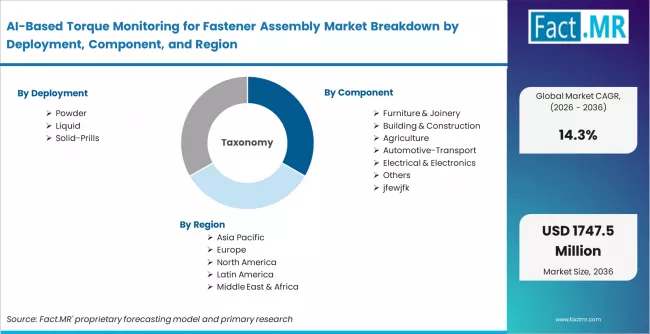
Ai Based Torque Monitoring For Fastener Assembly Market Breakdown By Deployment, Component, And Region | Source: Fact.MR
| Metric | Value |
|---|---|
| Quantitative Units | USD 401.7 million (2026) to USD 1,524.6 million (2036), at a CAGR of 14.3% |
| Market Definition | The AI-based torque monitoring for fastener assembly market includes intelligent torque measurement and analytics systems used to monitor fastening accuracy, detect anomalies, and ensure process consistency across automated and manual assembly operations through sensor data and machine learning algorithms. |
| Component Segmentation | Torque sensors, Controllers, Software analytics, Edge devices |
| Application Segmentation | Automotive assembly, Electronics assembly, Industrial equipment, Aerospace assembly, Consumer goods |
| Deployment Segmentation | On premise, Cloud, Edge AI |
| Regions Covered | North America, Latin America, Europe, East Asia, South Asia, Oceania, Middle East and Africa |
| Countries Covered | United States, Canada, Germany, France, United Kingdom, Italy, Spain, Sweden, Japan, South Korea, China, India, Singapore, Australia, Brazil, Mexico, United Arab Emirates, Saudi Arabia, and 40+ countries |
| Key Companies Profiled | Atlas Copco AB, Bosch Rexroth AG, Stanley Black & Decker Inc., Ingersoll Rand Inc., Desoutter Industrial Tools, Mountz Inc., Cleco, SCS Concept Group, Kistler Group, Crane Electronics Ltd |
| Forecast Period | 2026 to 2036 |
| Approach | Hybrid top-down and bottom-up market estimation based on smart assembly automation adoption trends, torque measurement accuracy requirements, AI-enabled quality assurance benchmarking, manufacturing process digitization rates, and validation through primary interviews with industrial tooling manufacturers, automation solution providers, and assembly system integrators. |
Source: Fact.MR analysis. Updated Apr 13, 2026
AI Based Torque Monitoring for Fastener Assembly Market Key Segments
-
Component
- Torque Sensors
- Controllers
- Software Analytics
- Edge Devices
-
Application:
- Automotive Assembly
- Electronics Assembly
- Industrial Equipment
- Aerospace Assembly
- Consumer Goods
-
Deployment:
- On Premise
- Cloud
- Edge AI
-
Region:
- North America
- USA
- Canada
- Mexico
- Europe
- Germany
- UK
- France
- Italy
- Spain
- Nordic Countries
- BENELUX
- Rest of Europe
- Asia Pacific
- China
- Japan
- South Korea
- India
- Australia
- Rest of Asia Pacific
- Latin America
- Brazil
- Argentina
- Rest of Latin America
- Middle East and Africa
- Kingdom of Saudi Arabia
- United Arab Emirates
- South Africa
- Rest of Middle East and Africa
- Other Regions
- Oceania
- Central Asia
- Other Markets
- North America
Frequently Asked Questions
How large is the demand for AI-Based Torque Monitoring for Fastener Assembly in the global market in 2026?
What will be the market size of AI-Based Torque Monitoring for Fastener Assembly in the global market by 2036?
What is the expected demand growth for AI-Based Torque Monitoring for Fastener Assembly in the global market between 2026 and 2036?
Which company is identified as a leading provider in the AI-Based Torque Monitoring for Fastener Assembly market?
Which deployment model is projected to dominate AI-based torque monitoring system adoption by 2026?
Why are AI-based torque monitoring systems widely used in fastener assembly processes?
What is driving demand for AI-based torque monitoring systems in China?
What is the growth outlook for the AI-Based Torque Monitoring for Fastener Assembly market in China?
Why is India an important market for intelligent fastening technology adoption?
What is the growth outlook for the AI-Based Torque Monitoring for Fastener Assembly market in India?
How is demand for AI-based torque monitoring evolving in the United Kingdom manufacturing sector?
What is the growth outlook for the AI-Based Torque Monitoring for Fastener Assembly market in the United Kingdom?
What is the growth outlook for the AI-Based Torque Monitoring for Fastener Assembly market in Germany?
How is the United States positioned in the AI-Based Torque Monitoring for Fastener Assembly market?
What is the growth outlook for the AI-Based Torque Monitoring for Fastener Assembly market in the United States?
What is AI-based torque monitoring for fastener assembly and what is it mainly used for?
What does the AI-Based Torque Monitoring for Fastener Assembly market include in this report?
What applications are included in the scope of the AI-Based Torque Monitoring for Fastener Assembly market?
What is excluded from the scope of the AI-Based Torque Monitoring for Fastener Assembly market report?
What does market forecast mean in the AI-Based Torque Monitoring for Fastener Assembly market report?
How is the AI-Based Torque Monitoring for Fastener Assembly market forecast developed in this report?
What does primary validation indicate in the AI-Based Torque Monitoring for Fastener Assembly market analysis?
Who worked on this report


Preview the report firsthand - request a free sample
Free SampleGet the brochure for pricing and purchase details
Download PDF