- Market Value (2025): USD 33.8 Mn
- Estimated Value (2026): USD 35.5 Mn
- Forecast Value (2036): USD 60.5 Mn
- CAGR (2026-2036): 5.0%
What is the Beluga Caviar Market forecast to be worth by 2036?
USD 35.5 million in 2026 to USD 60.5 million by 2036 at 5.0% CAGR.
- The beluga caviar market reached USD 33.8 million in 2025 as premium hospitality demand and household gifting remained active.
- Demand is projected to increase from USD 35.5 million in 2026 to USD 60.5 million by 2036.
- The market is forecast to record 5.0% CAGR from 2026 to 2036.
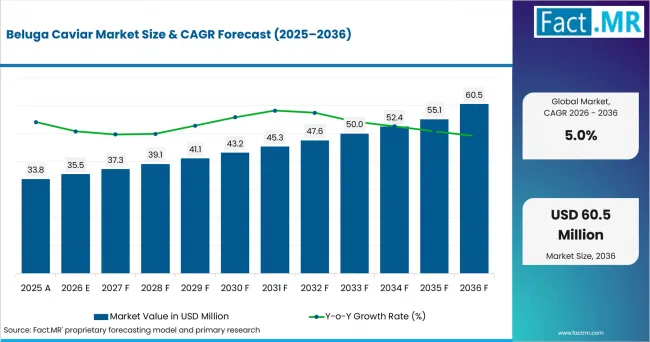
Beluga Caviar Market Value Analysis | Source: Fact.MR
What are the defining numbers behind Beluga Caviar Market growth?
USD 25.0 million absolute opportunity is expected between 2026 and 2036.
- Demand Drivers in the Market
- Restaurant orders are expected to support repeat purchasing when chefs need stable egg texture for tasting menus and plated service.
- Documented aquaculture sourcing is expected to remain important because beluga caviar depends on long-cycle sturgeon production and origin proof.
- Small tins are projected to widen household gifting since buyers test the product without a large pack commitment.
- Reliable chilled seafood logistics is expected to shape online ordering where product condition at delivery decides repeat purchase.
- Key Segments Analyzed
- By Type: Malossol Caviar is expected to hold 31.2% share in 2026 because low-salt curing fits premium taste expectations.
- By Application: Restaurants are projected to account for 63.7% share in 2026 as chef-led service creates recurring orders.
- Analyst Opinion at Fact.MR
- Shambhu Nath Jha, Senior Consultant at Fact.MR, states, “Beluga caviar purchases are expected to depend on origin proof and salting precision. Delivery reliability is expected to decide repeat orders after buyers accept the product’s price point.”
- Strategic Implications
- Suppliers can explain product origin and handling clearly so buyers understand how quality is protected.
- Premium distributors gain better fit by matching pack size with the buying occasion, since restaurants and households purchase caviar differently.
- Investors need to separate beluga caviar activity from broader gourmet seafood portfolios before comparing supplier positions.
The UK leads at 6.4% CAGR through specialty retail and luxury gifting. Australia follows at 6.0% CAGR with premium grocery and restaurant routes. The USA records 6.1% CAGR as fine-dining purchase cycles support repeat sourcing. Canada advances at 6.0% CAGR through specialty chilled retail. Germany reaches 4.2% CAGR where mature gourmet channels keep growth steady.
How does the Beluga Caviar Market break down by segment?
Malossol Caviar is expected to lead Type at 31.2% share in 2026. Restaurants are projected to lead Application at 63.7% share in 2026.
Which type dominates?
Malossol Caviar is projected to account for 31.2% share in 2026.
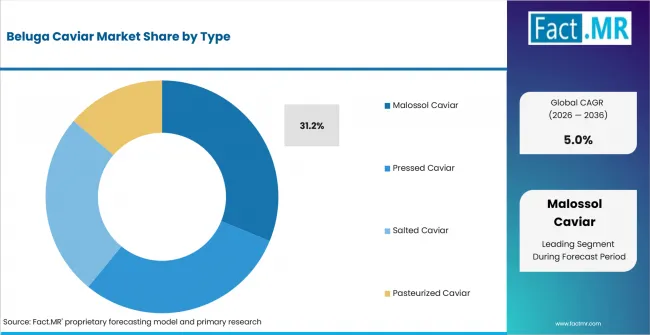
Beluga Caviar Market Analysis By Type | Source: Fact.MR
Low-salt curing gives Malossol Caviar the clearest premium signal in the type segment. Buyers use it when taste and texture are more important than broad shelf stability. Pressed Caviar serves buyers that want dense roe with stronger flavor. Pasteurized Caviar is expected to serve buyers that place more weight on handling tolerance.
Why does Restaurants lead Application?
Restaurants are expected to account for 63.7% share in 2026.
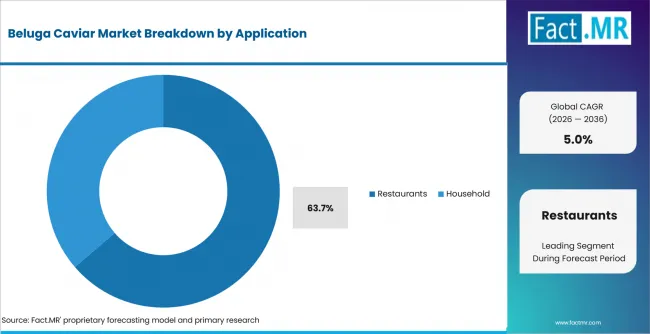
Beluga Caviar Market Analysis By Application | Source: Fact.MR
Restaurant kitchens create the largest application base because caviar service is planned around menus and repeat ordering. Chefs need stable texture before a tin reaches a table. Household purchases remain smaller because buying often depends on gifts or special meals.
What is accelerating Beluga Caviar Market adoption, and what is holding it back?
Demand is expected to grow through premium dining, controlled sourcing and improved cold-chain access. Buyers prioritize verified origin and careful handling before price, supporting supplier selection and repeat online purchases.
Drivers Impact Analysis
| DRIVER | (~) % IMPACT ON CAGR | GEOGRAPHIC RELEVANCE | IMPACT TIMELINE |
|---|---|---|---|
| Premium restaurant demand | +1.4% | UK; USA; Germany | Short term (<= 2 years) |
| Malossol preference | +1.1% | UK; Australia; Canada | Short term (<= 2 years) |
| Gift-ready small tins | +0.9% | USA; UK; Canada | Medium term (2-4 years) |
| Chilled delivery access | +0.8% | Premium urban markets | Medium term (2-4 years) |
| Origin documentation | +0.6% | Cross-border trade routes | Long term (>= 4 years) |
Source: Fact.MR analysis. Updated Aug 4, 2026
- Premium restaurant demand: Fine dining is expected to support repeat orders when chefs need consistent egg texture and dependable delivery windows.
- Malossol preference: Low-salt curing is expected to reinforce premium positioning since buyers read mild salting as a quality signal.
- Cold-chain retail access: Chilled delivery is expected to widen online reach in areas where gourmet buyers already purchase frozen seafood.
Opportunity Impact Analysis
| OPPORTUNITY | (~) % IMPACT ON CAGR | GEOGRAPHIC RELEVANCE | IMPACT TIMELINE |
|---|---|---|---|
| Gift-sized packaging | +0.7% | USA; UK; Canada | Short term (<= 2 years) |
| Traceable farm origin | +0.5% | Europe; North America | Medium term (2-4 years) |
| Restaurant education | +0.4% | Premium dining hubs | Medium term (2-4 years) |
| Online chilled delivery | +0.3% | Urban luxury channels | Long term (>= 4 years) |
Source: Fact.MR analysis. Updated Aug 4, 2026
- Gift-sized packaging: Smaller tins are expected to lower the first-purchase barrier for households without moving the product away from premium pricing.
- Origin transparency: Documented farm and processing records are projected to raise buyer confidence in cross-border trade channels.
- Restaurant education: Menu guidance is expected to help suppliers explain serving size and storage needs to foodservice buyers. Comparisons with frozen shrimp handling give suppliers a useful example of premium seafood delivery discipline.
Restraints Impact Analysis
| RESTRAINT | (~) % IMPACT ON CAGR | GEOGRAPHIC RELEVANCE | IMPACT TIMELINE |
|---|---|---|---|
| High unit price | -1.0% | Global | Short term (<= 2 years) |
| CITES permit checks | -0.8% | Cross-border trade routes | Short term (<= 2 years) |
| Limited verified supply | -0.6% | Premium channels | Medium term (2-4 years) |
| Cold handling risk | -0.4% | Online retail routes | Long term (>= 4 years) |
Source: Fact.MR analysis. Updated Aug 4, 2026
- High unit price: Premium pricing is expected to limit purchase frequency because many buyers reserve beluga caviar for special meals.
- CITES permit checks: Cross-border trade is expected to need careful documentation where sturgeon products move between regulated markets.
- Limited verified supply: Beluga caviar differs from tinned fish because long production cycles keep choices narrow for buyers that demand clear origin proof.
Which countries are scaling Beluga Caviar Market fastest?
- The country comparison spans 2.1 percentage points and separates faster luxury-food markets from steadier mature retail markets.
- The UK remains 0.3 percentage point above Australia through specialty retail and premium dining demand.
- Australia remains 0.4 percentage point above the USA as urban hospitality demand supports imported gourmet seafood sales.
- The USA remains 0.3 percentage point above Canada through fine dining and online premium food purchasing.
- Canada remains 1.1 percentage points above Germany through specialty chilled retail and measured restaurant uptake.
- Comparable CAGRs do not make each country identical. Market entry still depends on import documentation and buyer familiarity. Restaurant density and chilled distribution shape how quickly suppliers build repeat accounts.
Full report coverage includes North America and Latin America. Europe and South Asia and Pacific are covered with Middle East and Africa.
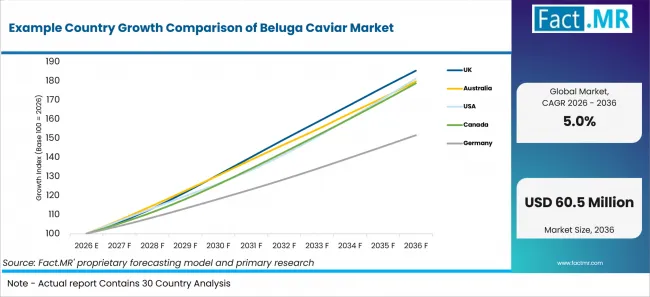
Example Country Growth Comparison Of Beluga Caviar Market | Source: Fact.MR
| Country | CAGR (2026-2036) |
|---|---|
| UK | 6.4% |
| Australia | 6.0% |
| USA | 6.1% |
| Canada | 6.0% |
| Germany | 4.2% |
Source: Fact.MR analysis. Updated Aug 4, 2026
What supports UK adoption?
6.4% CAGR, supported by specialty retail access and premium restaurant demand.
The UK’s growth reflects several routes into high-value caviar purchasing. Specialty stores can support first-time trial, while premium restaurants create repeat demand through menu use. Suppliers are likely to gain stronger account access when origin records and product authenticity are clearly documented.
How is Australia scaling demand?
6.0% CAGR, driven by imported gourmet seafood and occasion-based purchasing.
Australia’s growth is linked to premium grocery sales and restaurant demand for luxury seafood. Long delivery distances make chilled logistics especially important. Suppliers that maintain reliable temperature control and pack quality are better placed to convert initial orders into repeat business.
What is driving USA growth from 2026 to 2036?
6.1% CAGR, backed by fine dining and direct online purchasing.
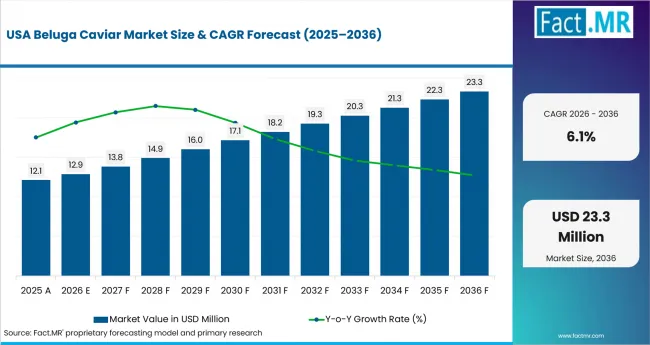
Beluga Caviar Market Country Value Analysis | Source: Fact.MR
The USA’s growth reflects demand from restaurants and consumers buying premium foods online. Clear guidance on storage, serving size and handling can improve buyer confidence. Permit requirements and species documentation remain important before suppliers can expand across wider channels.
How is Canada developing demand?
6.0% CAGR, supported by specialty retail and restaurant-led purchasing.
Canada’s growth is shaped by selective premium seafood demand across restaurants and specialist stores. Cold-weather logistics may help distributors protect chilled shipments. However, the country’s dispersed population keeps channel expansion more focused and raises the importance of dependable regional distribution.
How does Germany perform?
4.2% CAGR, led by mature gourmet retail and careful supplier review.
Germany’s growth remains measured because buyers closely compare price, origin and documentation before changing suppliers. Established premium retail channels support steady demand, but repeat purchasing depends on reliable handling records and consistent product quality.
Who leads the Beluga Caviar Market?
Caviar House & Prunier and Petrossian stand out through long-established premium caviar positioning, while Marky’s Caviar adds strong reach across restaurant and direct-purchase channels.
Caviar House & Prunier serves luxury buyers through specialist retail and hospitality connections. Petrossian brings heritage branding and a broad premium roe portfolio. Marky’s Caviar expands access through gourmet distribution and online purchasing. Sturgeon Aquafarms LLC contributes farm-based supply from controlled aquaculture operations. Sturia and Calvisius Caviar add European production depth, while Caviar de Riofrío and Caviar de Beluga strengthen the supplier mix through regional origin and premium product specialization.
Which companies are the key providers?
Key companies include Caviar House & Prunier, Marky’s Caviar, Sturgeon Aquafarms LLC, Sturgeon S.A. – Sturia, Agroittica Lombarda S.p.A. – Calvisius Caviar, Caviar de Riofrío, Caviar de Beluga, Petrossian.
- Caviar House & Prunier
- Marky’s Caviar
- Sturgeon Aquafarms LLC
- Sturgeon S.A. – Sturia
- Agroittica Lombarda S.p.A. – Calvisius Caviar
- Caviar de Riofrío
- Caviar de Beluga
- Petrossian
Bibliography
- Food and Agriculture Organization of the United Nations. (2024, June 7). FAO report: Global fisheries and aquaculture production reaches a new record high.
- European Commission. (2025, February). Commission Implementing Regulation (EU) 2025/342 on the registration of the geographical indication “Caviar d’Aquitaine” (PGI) in the Union register of geographical indications. EUR-Lex.
- European Commission Representation in France. (2025, February 18). The Commission approves “Caviar d’Aquitaine” as a new French geographical indication.
- Environment and Climate Change Canada. (2025, February 5). Canada participates in global enforcement operation to disrupt wildlife and forest crimes. Government of Canada.
This Report Answers
- The report provides strategic intelligence on the Beluga Caviar Market across type and application choices that shape premium purchase decisions.
- Segment analysis covers Malossol Caviar and Restaurants as the share leaders within the 2026 market.
- Country outlook evaluates the UK and Australia alongside the USA and Canada. Germany completes the growth comparison across the profiled markets.
- Scope analysis defines what belongs inside beluga caviar demand and what remains outside broader seafood categories.
What does the Beluga Caviar Market cover?
Beluga caviar products are assessed by type and application. Regional coverage is used to compare forecast pace across the listed countries.
The scope focuses on premium roe where origin and salting style influence purchase decisions. Handling and channel fit shape the final supplier shortlist. The fish processing and seafood packaging references provide wider context for premium seafood handling.
What is included in the scope?
The scope includes Malossol Caviar and Pressed Caviar. Salted Caviar and Pasteurized Caviar complete the type coverage.
It includes Restaurants and Household applications. Regional coverage follows the six-region structure used across the report. The forecast keeps the stated market values and segment shares unchanged.
What is excluded from the scope?
Products not positioned as beluga caviar remain outside the scope. Generic roe and unrelated gourmet foods are excluded.
Equipment-only aquaculture systems are excluded. Broad seafood spending is excluded unless the demand directly concerns beluga caviar purchase or handling.
How Was the Analysis Built?
The analysis draws on 120+ sources, 35+ company portfolios, 25+ countries, and more than 20 industry interviews.
- Primary Research: Primary research includes discussions with manufacturers, service providers, technology developers, distributors, end users, procurement teams, and subject-matter experts. These conversations examine purchasing priorities, product adoption, operational challenges, approval requirements, competitive positioning, and the factors that influence wider market acceptance.
- Desk Research: Desk research covers government statistics, regulatory publications, company filings, trade data, technical studies, industry associations, standards, public policy, and other authoritative sources. Every source used in the analysis is documented in the bibliography.
- Market Sizing and Forecasting: Market estimates combine historical performance, demand indicators, pricing and volume trends, segment shares, company participation, country-level growth, adoption patterns, investment activity, and barriers to market expansion.
- Data Validation and Update Cycle: Findings are validated by comparing primary interviews with public data, company activity, regulatory changes, trade patterns, and industry developments. Regular updates review new product launches, capacity changes, partnerships, approvals, procurement trends, and shifts in commercial adoption.
Segmentation
What is the report's scope and coverage?
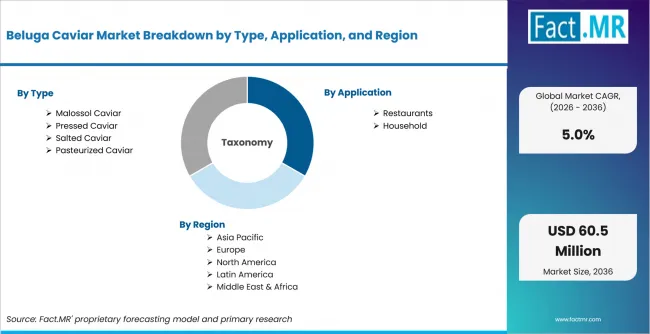
Beluga Caviar Market Breakdown By Type, Application, And Region | Source: Fact.MR
| Attribute | Details |
|---|---|
| Quantitative Units | USD million in 2026 to USD million by 2036 at CAGR |
| Market Definition | Beluga caviar products sold through premium foodservice and household luxury buying where origin proof and handling quality shape purchase decisions |
| Type | Malossol Caviar; Pressed Caviar; Salted Caviar; Pasteurized Caviar |
| Application | Restaurants; Household |
| Regions Covered | North America; Latin America; Europe; East Asia; South Asia and Pacific; Middle East and Africa |
| Countries Covered | UK; Australia; USA; Canada; Germany |
| Key Companies Profiled | Caviar House & Prunier, Marky’s Caviar, Sturgeon Aquafarms LLC, Sturgeon S.A. – Sturia, Agroittica Lombarda S.p.A. – Calvisius Caviar, Caviar de Riofrío, Caviar de Beluga, Petrossian |
| Forecast Period | 2026 to 2036 |
| Approach | Hybrid top-down and bottom-up approach using market value reconciliation; segment share review; country CAGR comparison; channel assessment; CITES documentation checks; supplier portfolio review |
Source: Fact.MR analysis. Updated Aug 4, 2026
How is the market segmented?
-
By Type:
- Malossol Caviar
- Pressed Caviar
- Salted Caviar
- Pasteurized Caviar
-
By Application:
- Restaurants
- Household
-
By Region:
- North America
- Latin America
- Europe
- East Asia
- South Asia and Oceania
- Middle East and Africa
Frequently Asked Questions
Which Type leads the market?
Which Application leads the market?
Which country records the highest listed CAGR?
What is the primary driver in this market?
What is the main restraint?
Why does Malossol Caviar lead demand?
Why do Restaurants lead Application?
Why does origin documentation matter?
What supports online purchasing?
Who worked on this report


Preview the report firsthand - request a free sample
Free SampleGet the brochure for pricing and purchase details
Download PDF