- Market Value (2025): USD 772.7 Mn
- Estimated Value (2026): USD 850.0 Mn
- Forecast Value (2036): USD 2205.0 Mn
- CAGR (2026-2036): 10.0%
What is the Bloom-Resistant Coatings Market forecast to be worth by 2036?
USD 850.0 million in 2026 to USD 2205.0 million by 2036, at 10.0% CAGR.
- The Bloom-Resistant Coatings Market reached USD 772.7 million in 2025.
- Demand is projected to increase from USD 850.0 million in 2026 to USD 2205.0 million by 2036.
- The market is forecast to record 10.0% CAGR from 2026 to 2036 as confectionery and bakery manufacturers tighten coating stability requirements.
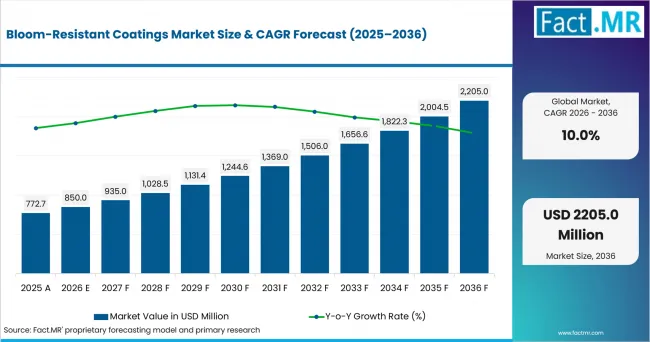
Bloom Resistant Coatings Market Value Analysis | Source: Fact.MR
What are the defining numbers behind Bloom-Resistant Coatings Market growth?
USD 1355.0 million absolute opportunity is expected between 2026 and 2036.
- Demand Drivers in the Market
- Confectionery manufacturers need bloom control that protects filled bars and coated biscuits during retail display and seasonal shipping cycles.
- Bakery processors value quick-set coating systems since faster crystallization reduces line dwell time during enrobing and drizzle applications.
- Frozen dessert makers use fat-based barrier layers to protect crunch when wafers and inclusions sit near high-moisture fillings.
- The U.S. Census Bureau reported in August 2026 that U.S. retail and food-service sales reached USD 763.6 billion in July 2026, indicating substantial consumer spending activity across retail and food-service channels.
- Key Segments Analyzed
- By Fat System: Lauric is projected to hold 38.0% share in 2026 due to quick crystallization and no-temper compound coating use.
- By Function: Heat stability is anticipated to account for 41.0% share in 2026 as manufacturers protect coatings during warm storage.
- By Application: Confectionery is estimated to represent 37.0% share in 2026 owing to use in coated bars and molded items.
- By Form: Blocks are forecast to capture 36.0% share in 2026 since plants need fats that store and melt predictably.
- Analyst Opinion at Fact.MR
- Shambhu Nath Jha, Principal Consultant at Fact.MR states, "Bloom control is now linked to formulation and line speed. Channel temperature now shapes the same decision. Manufacturers are projected to monitor crystal behavior and fat compatibility more closely as coated foods move through warmer routes. Suppliers that pair application testing with reliable specialty fat systems are expected to secure repeat specifications."
- Strategic Implications
- Fat-system suppliers should document bloom testing under realistic storage temperatures and product formats.
- Confectionery brands should match lauric and non-lauric systems to cocoa-butter contact before scaling coated items.
- Bakery manufacturers should evaluate setting time alongside gloss retention before approving a faster coating system.
- USDA NASS reported in June 2026 that U.S. soybean harvested area for 2026 was estimated at 84.4 million acres, up 5% from the previous year. Sourcing teams should connect crop availability with coating trials before locking annual fat-system choices.
The USA is projected to record 11.0% CAGR through 2036 due to retail scale and coating-cost pressure. Germany is anticipated to post 10.5% CAGR as chocolate output supports specialized coating demand. Japan is estimated at 9.8% CAGR with edible-oil supply chains supporting coating-fat trials. France is forecast to advance at 9.4% CAGR where premium bakery and confectionery applications need surface stability. Brazil is projected to record 9.0% CAGR where warm-climate distribution makes anti-bloom performance commercially useful.
How does the Bloom-Resistant Coatings Market break down by segment?
Lauric leads Fat System at 38.0%; Heat stability leads Function at 41.0%.
Which Fat System dominates?
Lauric holds 38.0% share in 2026.
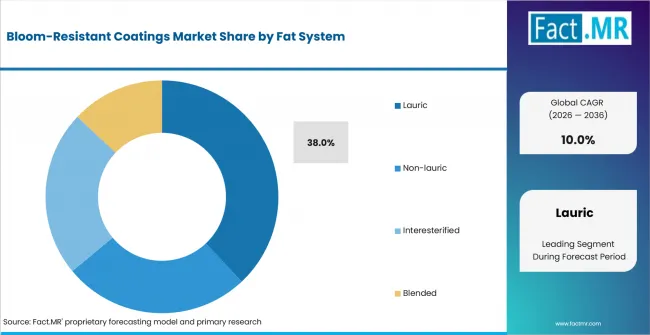
Bloom Resistant Coatings Market Analysis By Fat System | Source: Fact.MR
Lauric systems lead because they set quickly and suit compound coatings that require limited tempering work. The format helps manufacturers manage line speed while limiting surface bloom in products where cocoa butter is a smaller fat phase. That fit keeps lauric systems close to cookies and bars that carry longer retail display periods.
AAK AB positions Cebes systems for coating and molding uses where flow, setting speed and appearance are evaluated together. That application fit gives lauric fats a practical role in cookies, bars and pan-coated confectionery. Plant teams can test this route with standard melting and dosing steps.
What leads the Function segment?
Heat stability accounts for 41.0% share in 2026.
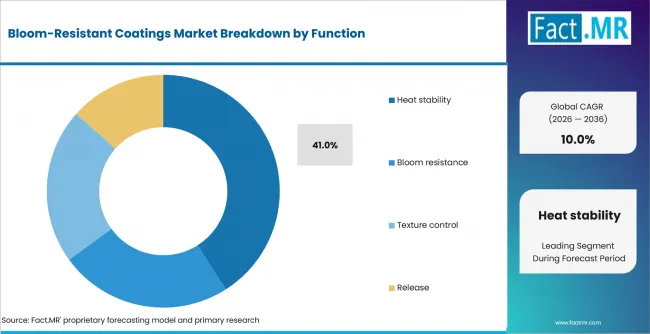
Bloom Resistant Coatings Market Analysis By Function | Source: Fact.MR
Heat stability leads because bloom often appears when coated foods move between production, storage and retail temperatures. Stable fat crystallization helps preserve gloss and texture when products pass through warm rooms or mixed-temperature transport. That makes storage testing a commercial filter before national rollouts.
Cargill, Incorporated expanded its Port Klang specialty fats facility in March 2026 with a new production line for cocoa butter equivalents and low-trans cocoa butter replacers. Cargill, Incorporated says the facility produces specialty fats for chocolate, bakery, dairy, frying and fillings applications, broadening its portfolio for customers seeking consistent taste and texture.
How does Application shape demand?
Confectionery represents 37.0% share in 2026.
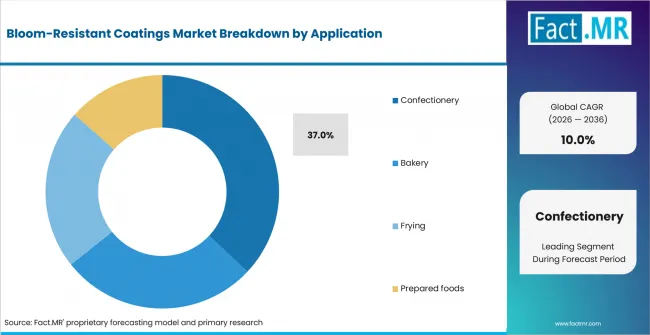
Bloom Resistant Coatings Market Analysis By Application | Source: Fact.MR
Confectionery leads because shoppers quickly notice bloom on bars, drizzled cookies and coated inclusions. Coating systems therefore carry a quality role that goes beyond sweetness or color. Appearance failures are easy to see and difficult to recover after packaging.
Cocoa-butter cost exposure is expected to keep reformulation active across coating recipes. Bloom-resistant alternatives give product teams a route to protect appearance while adjusting the fat phase behind the coating.
What supports Blocks within Form?
Blocks capture 36.0% share in 2026.
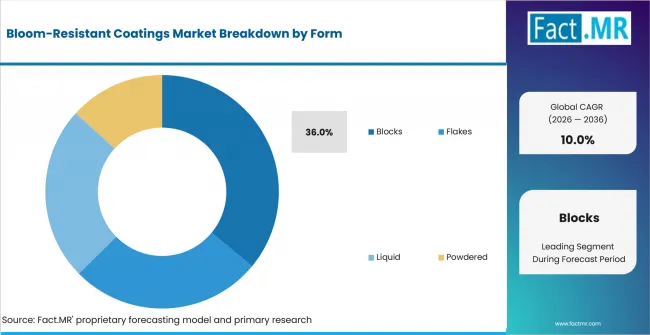
Bloom Resistant Coatings Market Analysis By Form | Source: Fact.MR
Blocks lead because industrial plants need fats that are easy to store, portion and melt into coating kettles. The format suits factories that prepare batches across several product lines. Consistent portioning also supports recipe control across multiple shifts.
Block formats also fit distribution networks where handling consistency matters before the fat reaches the plant. Vegetable-oil-based coatings and specialty fats give manufacturers predictable melting behavior before enrobing or molding.
What is accelerating Bloom-Resistant Coatings Market adoption, and what is holding it back?
Demand is rising through heat-stable coatings, cocoa-butter substitution and bakery line efficiency; adoption is constrained by fat compatibility and raw-material costs.
Drivers Impact Analysis
| DRIVER | (~) % IMPACT ON CAGR | GEOGRAPHIC RELEVANCE | IMPACT TIMELINE |
|---|---|---|---|
| Fat migration control in filled products | +1.4% | Global | Short term (<=2 years) |
| Heat-stable compound coating reformulation | +1.2% | North America, Europe, East Asia | Medium term (2-4 years) |
| No-temper coating systems for bakery lines | +0.9% | Global | Medium term (2-4 years) |
Source: Fact.MR analysis. Updated Sep 2, 2026
- Fat migration control in filled products: Filled bars and cookies create direct contact between different fat phases. Coating performance therefore depends on compatibility as much as flavor.
- Heat-stable compound coating reformulation: Warm storage and transport create a need for coatings that keep gloss and texture when real chocolate is unsuitable.
- No-temper coating systems for bakery lines: Bakery manufacturers use faster-setting coating fats when they need cleaner processing and lower rework on high-speed lines.
Opportunity Impact Analysis
| OPPORTUNITY | (~) % IMPACT ON CAGR | GEOGRAPHIC RELEVANCE | IMPACT TIMELINE |
|---|---|---|---|
| Clean-label non-hydrogenated coating fats | +1.0% | North America, Western Europe | Medium term (2-4 years) |
| Cocoa-butter alternative systems | +0.8% | Global | Short term (<=2 years) |
| Barrier coatings for bakery and frozen desserts | +0.6% | Global | Long term (>=4 years) |
Source: Fact.MR analysis. Updated Sep 2, 2026
- Clean-label non-hydrogenated coating fats: Suppliers are expected to gain specifications when manufacturers move away from hydrogenated systems and keep coating appearance stable.
- Cocoa-butter alternative systems: Specialty fats give confectionery teams more tools when cocoa-butter economics pressure product margins.
- Barrier coatings for bakery and frozen desserts: Coatings that slow moisture movement are expected to protect crunch and texture in wafers and inclusions.
Restraints Impact Analysis
| RESTRAINT | (~) % IMPACT ON CAGR | GEOGRAPHIC RELEVANCE | IMPACT TIMELINE |
|---|---|---|---|
| Lauric and cocoa-butter incompatibility risk | -0.5% | Global | Short term (<=2 years) |
| Vegetable-oil and cocoa price volatility | -0.4% | Global | Short term (<=2 years) |
| Qualification time on installed coating lines | -0.3% | Global | Medium term (2-4 years) |
Source: Fact.MR analysis. Updated Sep 2, 2026
- Lauric and cocoa-butter incompatibility risk: Lauric fats create quality problems when the coating directly touches cocoa-butter-rich components.
- Vegetable-oil and cocoa price volatility: Input swings shift formulation targets after a coating system has already passed internal testing.
- Qualification time on installed coating lines: Plant teams often need storage trials and sensory checks before replacing a working coating fat.
Which countries are scaling the Bloom-Resistant Coatings Market through 2036?
- The country comparison spans 2.0 percentage points between the USA and Brazil across the forecast period.
- The USA remains 0.5 percentage point above Germany as retail scale and confectionery pricing support coating reformulation.
- Germany remains 0.7 percentage point above Japan through chocolate output and cocoa-processing depth.
- Japan remains 0.4 percentage point above France as edible-oil supply chains support specialty fat trials.
- France remains 0.4 percentage point above Brazil due to premium bakery and confectionery applications.
- Brazil closes the displayed range through oilseed scale and warm-climate distribution needs.
Comparable CAGRs create different entry conditions due to cocoa-butter exposure, edible-oil supply, bakery line practices and storage-temperature risk. Full report coverage includes North America, Latin America, Western Europe, Eastern Europe, East Asia, South Asia & Pacific, Middle East & Africa.
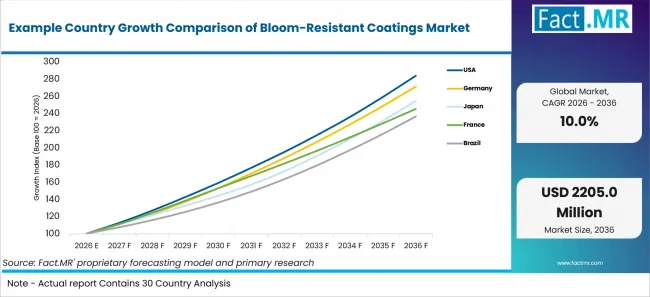
Example Country Growth Comparison Of Bloom Resistant Coatings Market | Source: Fact.MR
| Country | CAGR (2026-2036) |
|---|---|
| USA | 11.0% |
| Germany | 10.5% |
| Japan | 9.8% |
| France | 9.4% |
| Brazil | 9.0% |
Source: Fact.MR analysis. Updated Sep 2, 2026
What supports USA adoption?
11.0% CAGR, supported by retail scale and coating-cost pressure.
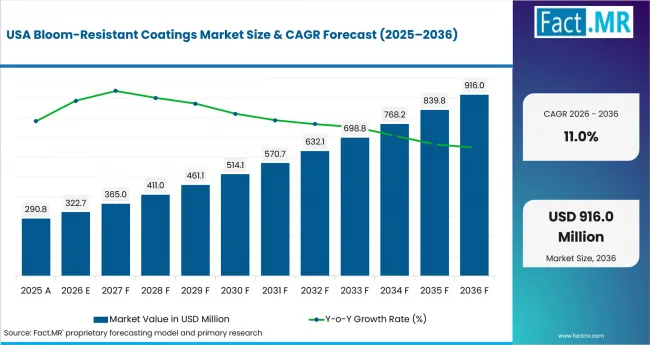
Bloom Resistant Coatings Market Country Value Analysis | Source: Fact.MR
U.S. confectionery and bakery manufacturers evaluate coating fats against finished-product appearance and line behavior. The U.S. Bureau of Labor Statistics reported in August 2026 that confectionery end-products producer prices were 7.0% higher year over year in July 2026. That price pressure is expected to keep reformulation work active where compound coatings protect margins and visual quality. Product teams are expected to favor coating systems that show stable bloom results after warehouse tests.
How is Germany scaling demand?
10.5% CAGR, supported by chocolate output and cocoa-processing depth.
Germany has a large confectionery base that makes bloom control visible in seasonal and private-label formats. Destatis reported in December 2025 that Germany produced 12.8 kilograms of chocolate per person in 2024. That production base is expected to support specialty coating trials where gloss, snap and fat compatibility decide line approval. Seasonal chocolate formats make storage performance a visible commercial filter.
What supports Japan adoption?
9.8% CAGR, supported by confectionery quality standards and edible-oil supply chains.
Japanese food manufacturers place high value on clean coating surfaces across boxed gifts, cookies and convenience-store snacks. USDA FAS reported in March 2026 that Japan imported 2.138 MMT of rapeseed in MY 2024/25. That oilseed stream supports specialty fat processing where controlled melt and storage stability are central to coated foods. Convenience-store distribution keeps packaging appearance central to coating-fat approval.
How is France developing demand?
9.4% CAGR, supported by food-processing scale and premium bakery applications.
French patisserie, biscuit and prepared-food manufacturers require coatings that protect shine across chilled and ambient channels. Agreste reported in December 2025 that French food and beverage industries commercialized €162 billion of products in 2024. That processing base is expected to support bloom-resistant systems for filled bakery and decorated confectionery. Premium display formats make gloss retention part of product value.
How does Brazil perform?
9.0% CAGR, led by oilseed scale and warm-climate distribution needs.
Brazilian processors work with warmer distribution routes where coated products face higher appearance risk before retail sale. IBGE reported in September 2025 that soybean output was expected to reach 165.9 million tonnes in 2025. That oilseed scale gives local fat processors a stronger raw-material base for coating systems used in confectionery and bakery products. Warm routes make coating stability a practical requirement for national distribution.
Who leads the Bloom-Resistant Coatings Market?
AAK AB is active through specialty fat systems for compound coatings, including Cebes products that support bloom resistance and fast crystallization. Its application work gives confectionery and bakery manufacturers a practical route from lab samples to plant trials.
Cargill, Incorporated competes through specialty fats for chocolate, confectionery, bakery, frying and fillings, supported by the expansion of its Port Klang facility in March 2026. Barry Callebaut AG provides compound coatings and fillings across confectionery and bakery applications, supported by expertise in vegetable fats, texture, workability and production performance.
Fuji Oil Co., Ltd. and Bunge Global SA further strengthen the provider landscape through specialty oils and fats for food applications. Competition increasingly reflects fat functionality, coating and filling performance, and technical support for manufacturers adapting formulations and production processes.
Which companies are the key providers?
Key companies include AAK AB; Barry Callebaut AG; Cargill, Incorporated; Fuji Oil Co., Ltd.; Bunge Global SA.
- AAK AB
- Barry Callebaut AG
- Cargill, Incorporated
- Fuji Oil Co., Ltd.
- Bunge Global SA
Bibliography
- AAK. (2025, July 11). AAK showcases innovative fat and oil solutions at IFT FIRST 2025.
- Renaud, A. (2025, December 17). Productions commercialisées des industries agroalimentaires 2024 : léger recul des ventes mais un niveau toujours élevé. Agreste.
- Brazilian Institute of Geography and Statistics. (2025, September 11). In August, IBGE previews crop of 341.2 million tonnes for 2025. IBGE News Agency.
- Cargill. (2026, March 31). Cargill strengthens global specialty fats portfolio with expansion of Port Klang, Malaysia facility.
- Federal Statistical Office (Destatis). (2025, December 2). 12,8 Kilo Schokolade pro Kopf wurden 2024 produziert [12.8 kilograms of chocolate per capita were produced in 2024].
- U.S. Bureau of Labor Statistics. (2026, August 13). Producer Price Indexes—July 2026.
- U.S. Census Bureau. (2026, August 14). Advance monthly sales for retail and food services.
- U.S. Department of Agriculture, Foreign Agricultural Service. (2026, March 31). Oilseeds and products annual: Japan (GAIN Report No. JA2026-0016).
- U.S. Department of Agriculture, National Agricultural Statistics Service. (2026, June 30). Corn planted acreage down 3% from 2025, soybean acreage up 5% from last year.
This Report Addresses
- The report explains where bloom-resistant coatings are used across fat system, function, application and form. It also covers regional and country-level adoption.
- Segment analysis identifies the traits that make lauric systems, heat stability, confectionery applications and block formats commercially relevant.
- Country analysis examines the listed markets and the official food, oilseed, cocoa and price indicators that shape coating-fat demand.
- Competitive analysis reviews current providers across specialty fats, compound coatings, confectionery coatings and application support.
- Application analysis assesses how gloss retention, fat migration, melt behavior and line speed influence product approval decisions.
What does the Bloom-Resistant Coatings Market cover?
The Bloom-Resistant Coatings Market covers fat-based coating systems that help coated foods keep a clean surface during storage and distribution. It includes specialty fats used in compound coatings, bakery drizzles, frozen dessert barriers and prepared-food coatings.
The assessment covers lauric, non-lauric, interesterified and blended systems across four functional needs. Heat stability, bloom resistance, texture control and release are evaluated across applications. Adjacent demand is linked to starch based edible coating and food processing ingredients where shelf-life protection influences buying behavior.
What is included in the scope?
The scope includes industrial coating fats, compound-coating fats and low-trans replacers sold for bloom control. Cocoa-butter alternatives and specialty systems are covered when they improve gloss, setting behavior and heat stability in confectionery and bakery plants.
What is excluded from the scope?
The scope excludes finished chocolate bars, retail confectionery and cocoa powder. Plain bulk vegetable oils sold outside coating functionality are outside the scope. Packaging coatings used beyond food-contact coating systems are also outside the assessment. Decorative toppings are outside the scope when bloom resistance is outside the product function.
How Was the Analysis Built?
The analysis draws on 120+ sources, 35+ company portfolios, 25+ countries and more than 20 industry interviews.
- Primary Research: Primary research includes discussions with specialty fat suppliers and food formulators. It also includes confectionery producers and bakery manufacturers. Distributors, buying teams and technical specialists are included in the same interview base. These conversations examine purchasing priorities and product trials. They review approval requirements, line behavior and commercial adoption barriers.
- Desk Research: Desk research covers government statistics, regulator publications and company releases. It also reviews trade data, technical studies, industry associations and standards. Every source used in the analysis is documented in the bibliography.
- Market Sizing and Forecasting: Market estimates combine historical performance, demand indicators and pricing trends. Segment shares, country-level growth, adoption patterns and investment activity are evaluated against barriers to market expansion.
- Data Validation and Update Cycle: Findings are validated by comparing interviews with public data and company activity. Regulatory changes, ingredient supply and industry developments are also reviewed. Regular updates track product launches, capacity changes, approvals and buying trends.
Segmentation
What is the report’s scope and coverage?
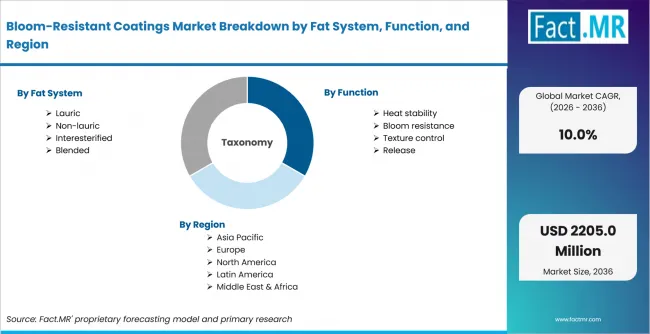
Bloom Resistant Coatings Market Breakdown By Fat System, Function, And Region | Source: Fact.MR
| Attribute | Details |
|---|---|
| Quantitative Units | USD million |
| Market Definition | Fat-based coatings and specialty coating systems used to reduce visible fat bloom, protect gloss and support heat-stable appearance in confectionery, bakery, frozen dessert and prepared-food applications. |
| Fat System | Lauric; Non-lauric; Interesterified; Blended |
| Function | Heat stability; Bloom resistance; Texture control; Release |
| Application | Confectionery; Bakery; Frying; Prepared foods |
| Form | Blocks; Flakes; Liquid; Powdered |
| Regions Covered | North America; Latin America; Western Europe; Eastern Europe; East Asia; South Asia & Pacific; Middle East & Africa |
| Countries Covered | USA; Germany; Japan; France; Brazil |
| Companies Profiled | AAK AB; Barry Callebaut AG; Cargill, Incorporated; Fuji Oil Co., Ltd.; Bunge Global SA |
| Forecast Period | 2026 to 2036 |
| Approach | Hybrid top-down and bottom-up approach using food manufacturing demand, coating applications, fat-system use, country indicators, company portfolios and formulation constraints. |
Source: Fact.MR analysis. Updated Sep 2, 2026
How is the market segmented?
-
By Fat System
- Lauric
- Non-lauric
- Interesterified
- Blended
-
By Function
- Heat stability
- Bloom resistance
- Texture control
- Release
-
By Application
- Confectionery
- Bakery
- Frying
- Prepared foods
-
By Form
- Blocks
- Flakes
- Liquid
- Powdered
-
By Region
- North America
- Latin America
- Western Europe
- Eastern Europe
- East Asia
- South Asia & Pacific
- Middle East & Africa
Frequently Asked Questions
How big is the bloom-resistant coatings market in 2026?
What is the CAGR of the bloom-resistant coatings market from 2026 to 2036?
Which fat system leads the bloom-resistant coatings market?
Which function leads the bloom-resistant coatings market?
Who are the leading companies in the bloom-resistant coatings market?
Who worked on this report


Preview the report firsthand - request a free sample
Free SampleGet the brochure for pricing and purchase details
Download PDF