- Estimated Value(2026): 16.8 Bn
- Forecast Value (2036): 25.4 Bn
- CAGR (2026 - 2036): 4.2%
Bumper Covers and Energy Absorbers Market Forecast and Outlook 2026 to 2036
In 2025, the bumper covers and energy absorbers market was valued at approximately USD 16.1 billion. Based on Fact.MR analysis, the market is estimated to reach USD 16.8 billion in 2026 and expand to USD 25.4 billion by 2036, registering a CAGR of 4.2% over the forecast period. Growth reflects steady global vehicle production, rising SUV penetration, and increasing use of multi-material bumper systems designed to meet low-speed impact and pedestrian protection requirements.
Rolling CAGR analysis indicates that growth from 2026 to 2030 is driven primarily by OEM fitment demand, as platforms transition toward modular bumper architectures combining thermoplastic covers with foam-based energy absorbers and lightweight beams. From 2030 onward, value expansion is supported by higher replacement intensity in mature markets and greater material complexity, including expanded use of EPP and engineered plastics to balance impact performance with repair cost control. Operational execution and scale remain critical in this segment. As Swamy Kotagiri, Chief Executive Officer of Magna International, noted,
“We closed 2025 with a strong fourth quarter, successfully navigating another dynamic year in our industry. Our disciplined execution and commitment to operational excellence enabled us to deliver financial results that were in line with, or exceeded, our February 2025 Outlook across all key metrics.” [1]
Fact.MR analysis views this as reflective of how large Tier 1 suppliers sustain margins in structurally steady but operationally demanding exterior systems markets.
India records growth of 5.1% CAGR, supported by rising passenger car and SUV production and localisation of exterior modules. China follows at 4.8%, driven by platform refresh cycles and material optimisation. Vietnam (4.9%) and Mexico (4.6%) benefit from export-oriented vehicle assembly, while Brazil grows at 4.3% through replacement and repair demand. Mature markets such as the United States (3.0%), Germany (2.6%), and Japan (2.0%) remain volume stable, with growth constrained by long vehicle lifecycles and high repair cost sensitivity.
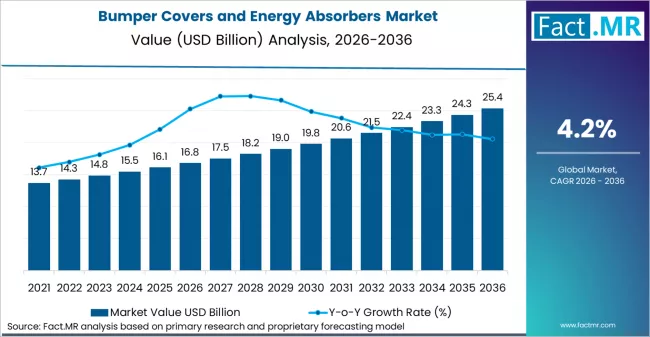
Bumper Covers And Energy Absorbers Market Market Value Analysis | Source: Fact.MR
Bumper Covers and Energy Absorbers Market Definition
The bumper covers and energy absorbers market covers exterior automotive components designed to manage impact energy during low speed and moderate collisions. Bumper covers are outer panels, usually made from plastic or composite materials, while energy absorbers sit behind the cover and compress during impact to reduce force transmitted to the vehicle structure. Performance and impact requirements for these systems are defined under vehicle safety regulations issued by the US National Highway Traffic Safety Administration and UNECE vehicle construction rules [2] These components are supplied to vehicle manufacturers for passenger and commercial vehicles.
Bumper Covers and Energy Absorbers Market Inclusions
The report covers global and regional market size estimates in volume and value terms with a forecast period from 2026 to 2036. Segmentation includes component type such as bumper covers and energy absorbing cores, material categories including plastics and foams, application by vehicle category, and end use covering original equipment and replacement demand. The scope also includes regional demand patterns, pricing benchmarks, and international trade flows for automotive exterior components.
Bumper Covers and Energy Absorbers Market Exclusions
The scope excludes complete bumper assemblies sold with reinforcement beams, brackets, sensors, or mounting hardware. Metal crash beams, structural body panels, and pedestrian protection devices are not included. Decorative trim pieces, grille inserts, and styling add ons are excluded. Motorsport specific body components, prototype impact systems, laboratory crash test equipment, and vehicle repair services are also outside the scope.
Bumper Covers and Energy Absorbers Market Research Methodology
- Primary Research: Primary research involved interviews with bumper system manufacturers, plastic molding suppliers, automotive OEM sourcing teams, and vehicle body engineers.
- Desk Research; Desk research used vehicle impact and safety regulations issued by the US National Highway Traffic Safety Administration and UNECE, vehicle production data from national transport authorities, customs trade statistics, and company annual reports and technical product disclosures filed with securities regulators.
- Market Sizing and Forecasting: Market sizing applied a hybrid top down and bottom up model using vehicle production volumes, bumper component fitment rates, and average replacement demand by vehicle category.
- Data Validation and Update Cycle: Outputs were cross checked against vehicle registration data, regulatory compliance documentation, trade statistics, and OEM supply disclosures, with updates applied when verified public data sources issue revisions.
Summary of bumper covers and energy absorbers market
- Market definition
- The bumper covers and energy absorbers market includes exterior vehicle components designed to manage low-speed and moderate collision energy, combining plastic or composite outer covers with foam or polymer energy-absorbing structures to meet mandated crash and pedestrian safety requirements.
- Demand drivers
- Demand is driven by vehicle safety regulations that define low-speed impact performance and pedestrian protection thresholds, enforced through type approval and certification systems in major automotive markets [3].
- Rising SUV and crossover production increases bumper size, material volume, and absorber complexity, lifting component value per vehicle.
- OEM focus on repair cost control and insurance-friendly designs supports wider use of modular bumper architectures with replaceable covers and absorbers.
- Key segments analyzed
- By component, bumper covers account for the leading share in 2026 due to their dual role in exterior styling integration and compliance with low-speed impact performance requirements.
- By material, thermoplastics such as PP and TPO dominate because they balance impact resistance, moldability, and weight control in high-volume production.
- By geography, Asia Pacific leads growth as expanding vehicle production and localization of exterior modules increase OEM sourcing volumes.
- Analyst opinion at Fact.MR
- Shambhu Nath Jha, Principal Consultant at Fact.MR, opines, ‘This report enables decision-makers to evaluate how crash regulation thresholds, repair economics, and material standardisation influence bumper system sourcing, cost structures, and long-term platform continuity.’
- Strategic Implications / Executive Takeaways
- Suppliers should prioritise modular bumper designs that simplify replacement and reduce downstream repair costs.
- Material strategies must align with both impact compliance and lightweighting targets to remain competitive in OEM bids.
- Scale, tooling efficiency, and regional production footprint remain critical for margin stability in this cost-sensitive segment.
- Methodology
- Market sizing is derived from vehicle production data and bumper fitment rates by vehicle class.
- Regulatory assessment references U.S. and UNECE vehicle safety frameworks.
- Estimates are validated through OEM disclosures, certification records, and replacement demand patterns.
Segmental Analysis
Bumper Covers and Energy Absorbers Market Analysis by Component
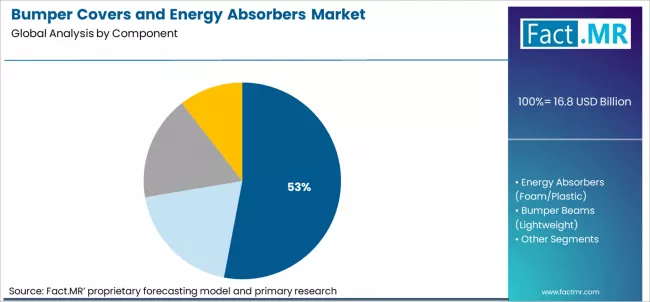
Bumper Covers And Energy Absorbers Market Analysis By Component | Source: Fact.MR
Based on Fact.MR analysis, consumption of bumper covers is estimated to hold 53% share of the global market in 2026. Fact.MR analysts note that bumper covers lead because they combine impact absorption support with styling integration, allowing OEMs to meet safety and design requirements within a single exterior component. As per Fact.MR, bumper covers address manufacturer needs for lightweight construction, aerodynamic shaping, and compatibility with pedestrian protection and low-speed impact regulations applied across passenger vehicle platforms.
- Safety regulation context: Vehicle bumper system design is influenced by low-speed impact damage and safety requirements defined under U.S. motor vehicle safety regulations.
- Design integration: Fact.MR analysts reference OEM bumper system layouts where covers integrate mounting points for sensors, grilles, and energy absorbers.
- Platform standardization: Modular bumper cover designs allow automakers to use shared structures across multiple vehicle models and trims.
Bumper Covers and Energy Absorbers Market Analysis by Material
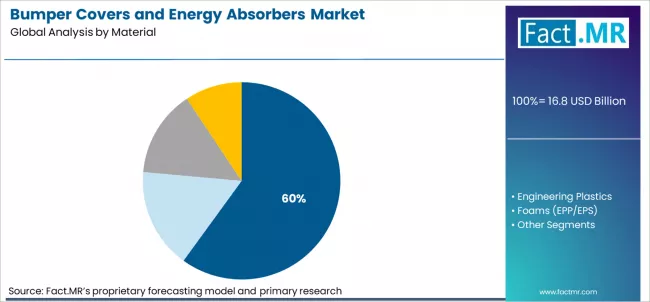
Bumper Covers And Energy Absorbers Market Analysis By Material | Source: Fact.MR
Based on Fact.MR analysis, consumption of thermoplastics such as polypropylene and thermoplastic olefins is estimated to hold 60% share of the global market in 2026. Fact.MR opines that these materials lead due to their balance of impact resistance, moldability, and recyclability in high-volume automotive production. As per Fact.MR, thermoplastics address OEM requirements for consistent part quality, corrosion resistance, and compliance with pedestrian impact and exterior component regulations.
- Regulatory framework: International vehicle regulations governing external projections and pedestrian protection influence material selection for bumper systems.
- Manufacturing practice: Fact.MR analysts note widespread use of injection-molded PP and TPO for bumper covers due to cycle time efficiency.
- Weight management: Thermoplastic materials support vehicle mass reduction targets without compromising structural performance.
Bumper Covers and Energy Absorbers Market Drivers, Restraints, And Opportunities
Fact.MR analysis indicates that the bumper covers and energy absorbers market exists as a structural safety and aesthetic components segment within automotive body systems, driven by vehicle design specifications and regulatory impact tests. As per Fact.MR assessment, bumper covers provide the external fascia while energy absorbers cushion impact forces in low-speed collisions, both of which are integrated into safety performance requirements such as UNECE Regulation No. 42, which specifies uniform provisions concerning the front and rear protective devices on vehicles including bumper impact performance criteria [4]. Fact.MR analysts observe that the market’s current scale is supported by growing vehicle production, the need to meet safety test parameters in type approval processes, and replacement demand as part of routine collision repair cycles across passenger and light commercial vehicles.
Fact.MR is of the opinion that current market dynamics reflect a transition toward advanced materials and integrated design approaches that balance energy absorption performance, weight reduction, and styling requirements. Based on Fact.MR assessment, traditional thermoplastic and elastomeric bumper systems continue to account for larger volume use due to established manufacturing processes and cost considerations, but demand for energy absorbers with enhanced crush characteristics and multi-material bumper covers is increasing in segments where safety test outcomes and customer preferences influence specification. These advanced components typically carry higher per-unit pricing because of material complexity and tooling requirements, meaning realised market value can rise even where shipment volume growth is moderate. Fact.MR analysis suggests this combination of evolving application requirements and premium unit economics will shape near-term market performance.
- Regulated impact performance criteria: Fact.MR analysts note that UNECE Regulation No. 42 influences bumper and energy absorber design by specifying protective device performance in low-speed collision scenarios
- Material and design evolution: Based on Fact.MR assessment, adoption of multi-material bumper covers and enhanced crush energy absorbers supports improved performance in test environments that simulate impact conditions, sustaining demand for premium components.
- Asia Pacific automotive production growth: Fact.MR opines that increasing light vehicle manufacturing and aftermarket repair volumes in China, India, and Southeast Asia support regional demand for both OEM supply and replacement bumper covers and energy absorbers.
Regional Analysis
Based on regional assessment, the bumper covers and energy absorbers sector is analyzed across North America, Latin America, Europe, East Asia, South Asia, and other major automotive manufacturing regions, spanning more than 40 countries. Regional performance varies according to vehicle production volumes, adoption of lightweight exterior components, and regulatory requirements related to vehicle safety and impact performance. The report also presents a comparative market attractiveness evaluation grounded in region-specific demand trends.
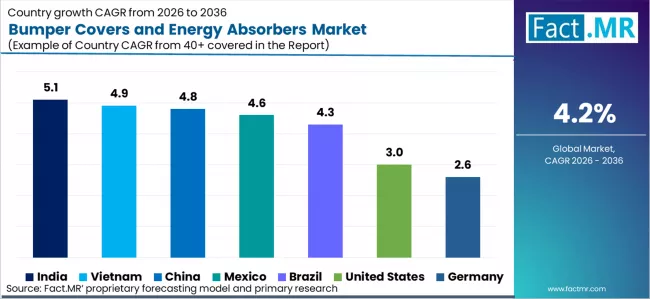
Bumper Covers And Energy Absorbers Market Cagr Analysis By Country | Source: Fact.MR
| Country | CAGR |
|---|---|
| India | 5.1% |
| Vietnam | 4.9% |
| China | 4.8% |
| Mexico | 4.6% |
| Brazil | 4.3% |
| United States | 3.0% |
| Germany | 2.6% |
| Japan | 2.0% |
Source: Fact.MR analysis. Updated Feb 18, 2026
Source: Fact.MR analysis, based on proprietary forecasting models and primary research.
Asia Pacific Bumper Covers and Energy Absorbers Market Analysis
Asia Pacific operates as a production- and compliance-driven automotive exterior components region for bumper covers and energy absorbers. Demand is governed by vehicle safety regulations, low-speed impact performance requirements, and OEM crash management specifications. Adoption is enforced through vehicle type approval systems, pedestrian safety norms, and homologation testing applied across passenger and commercial vehicle production for domestic sales and exports.
- India: Demand for bumper covers and energy absorbers in India is projected to rise at 5.1% CAGR through 2036. Application follows CMVR crash safety requirements and AIS pedestrian protection standards implemented during 2021 and reinforced through OEM compliance in vehicle production during 2022-2023, as per Fact.MR.
- Vietnam: Demand for bumper covers and energy absorbers in Vietnam is projected to rise at 4.9% CAGR through 2036. Fitment is governed by vehicle safety regulations issued by the Ministry of Transport and reinforced through domestic vehicle assembly certification applied during 2021-2022, according to Fact.MR.
- China: Demand for bumper covers and energy absorbers in China is projected to rise at 4.8% CAGR through 2036. Use follows impact performance and pedestrian protection provisions under GB automotive safety standards revised in 2021 and enforced through national type approval systems, as per Fact.MR.
Fact.MR’s analysis of the Bumper Covers and Energy Absorbers Market in Asia Pacific consists of country-wise assessment that includes India, Vietnam, and China. Readers can find safety regulations, homologation frameworks, and production-linked compliance references.
Latin America Bumper Covers and Energy Absorbers Market Analysis
Latin America functions as an OEM- and regulation-aligned automotive components region for bumper covers and energy absorbers. Demand is tied to vehicle assembly volumes and compliance with national crash safety and low-speed impact regulations. Adoption is shaped by homologation rules, inspection regimes, and export-oriented production standards for vehicles supplied to regulated markets.
- Mexico: Demand for bumper covers and energy absorbers in Mexico is projected to rise at 4.6% CAGR through 2036. Application follows NOM vehicle safety standards and reinforced through export-oriented OEM production supplying North American markets during 2022-2023, according to Fact.MR.
- Brazil: Demand for bumper covers and energy absorbers in Brazil is projected to rise at 4.3% CAGR through 2036. Use is governed by CONTRAN crash safety regulations and reinforced through domestic vehicle production and inspection requirements applied during 2021-2022, as per Fact.MR.
Fact.MR’s analysis of the Bumper Covers and Energy Absorbers Market in Latin America consists of country-wise assessment that includes Mexico and Brazil. Readers can find homologation rules, crash safety regulations, and production-based compliance documentation.
North America Bumper Covers and Energy Absorbers Market Analysis
North America operates as a standards-led automotive safety market where bumper covers and energy absorbers are governed by federal crashworthiness regulations and OEM impact performance specifications. Demand is shaped by compliance with low-speed impact requirements, vehicle certification processes, and replacement cycles linked to repair and insurance frameworks.
- United States: Demand for bumper covers and energy absorbers in the United States is projected to rise at 3.0% CAGR through 2036. Application follows FMVSS crashworthiness requirements and reinforced through OEM vehicle certification and replacement programs applied during 2021-2022, as per Fact.MR.
Fact.MR’s analysis of the Bumper Covers and Energy Absorbers Market in North America consists of country-wise assessment that includes the United States. Readers can find federal safety standards and certification references.
Europe Bumper Covers and Energy Absorbers Market Analysis
Europe functions as a regulation-led automotive exterior components market where bumper covers and energy absorbers are governed by UNECE impact regulations and EU type approval frameworks. Adoption is enforced through pedestrian protection standards, conformity assessments, and periodic inspection regimes applied across member states.
- Germany: Demand for bumper covers and energy absorbers in Germany is projected to rise at 2.6% CAGR through 2036. Application follows UNECE pedestrian protection and impact performance regulations applied in vehicle manufacturing and approval cycles during 2021-2022, according to Fact.MR.
- Japan: Demand for bumper covers and energy absorbers in Japan is projected to rise at 2.0% CAGR through 2036. Fitment is governed by Road Transport Vehicle Act crash safety provisions and enforced through national vehicle certification systems applied during 2021-2022, as per Fact.MR.
Fact.MR’s analysis of the Bumper Covers and Energy Absorbers Market in Europe consists of country-wise assessment that includes Germany and Japan. Readers can find regulatory frameworks, impact testing rules, and component compliance references.
Competitive Landscape of Bumper Covers and Energy Absorbers Market
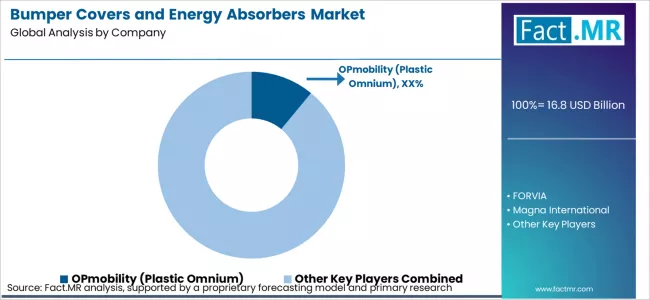
Bumper Covers And Energy Absorbers Market Analysis By Company | Source: Fact.MR
As per Fact.MR analysis, the 2026 bumper covers and energy absorbers market is defined by validated impact performance, material durability, and OEM compliance, which determine competitive advantage. OPmobility (Plastic Omnium) and FORVIA lead with high-strength, crash-tested modules, which strengthens adoption in global passenger and commercial vehicles. Magna International and Hyundai Mobis focus on lightweight, multi-material solutions with verified energy absorption, which improves fuel efficiency and crash performance. Flex-N-Gate and Toyoda Gosei emphasise validated thermal and mechanical stability, which enhances reliability across diverse climates and operating conditions. SMP (Samvardhana Motherson) and Yanfeng provide modular designs with multi-region compliance, which supports OEM program qualification. Gestamp and IAC Group offer specialized assemblies with proven installation and fit consistency, which reduces production downtime. Across the market, validated crash performance, material reliability, and supply continuity form enduring competitive moats, reducing reliance on pricing or isolated design claims.
Recent Industry Developments
- Magna International Lifts 2026 Outlook on "Smart Exterior" Growth (February 2026) On February 13, 2026, Magna International reported a strong finish to 2025 and raised its 2026 financial targets. The growth is heavily attributed to its "Power and Vision" and "Exteriors" segments. Magna is successfully pivoting toward software-defined exteriors, where bumper systems now integrate active grille shutters and sensor-transparent materials to support Level 2+ autonomous driving. [5]
- OPmobility (Plastic Omnium) Launches "Smart Face" Bumper (January 2026) OPmobility (formerly Plastic Omnium) has officially moved its "Smart Face" bumper into mass production. This development transforms the bumper cover from a "passive part" into a "sensitive skin." By using 4D imaging radar integrated directly across the large surface area of the bumper, the vehicle achieves 3D imaging capabilities similar to Lidar but at a fraction of the cost and without visible sensors. [6]
- Hyundai Mobis Unveils "Communication Lighting" Bumpers (September 2025) In late 2025, Hyundai Mobis debuted its MOBION technology demonstrator, which features "Communication Lighting" integrated into the front and rear bumper covers. These bumpers use LED arrays to project crosswalks for pedestrians and display warnings to other drivers (e.g., "Do Not Overtake"), effectively turning the bumper into a primary safety communication tool. [7]
Key Players in Bumper Covers and Energy Absorbers Market
- OPmobility (Plastic Omnium)
- FORVIA
- Magna International
- Hyundai Mobis
- Flex-N-Gate
- Toyoda Gosei
- SMP (Samvardhana Motherson)
- Yanfeng
- Gestamp
- IAC Group
Bibliography
- [1] Magna International Inc. (2026). Magna reports fourth quarter and full year 2025 results and provides 2026 outlook. Magna International Investor Relations.
- [2] U.S. Department of Transportation, National Highway Traffic Safety Administration. (2023). Road safety and vehicle crashworthiness standards. NHTSA; United Nations Economic Commission for Europe. (2023). Vehicle regulations: Construction and safety provisions. UNECE.
- [3] U.S. Department of Transportation, National Highway Traffic Safety Administration. (2023). Vehicle safety standards and low-speed impact requirements. NHTSA; United Nations Economic Commission for Europe. (2023). Vehicle regulations related to crash safety and construction. UNECE.
- [4] United Nations Economic Commission for Europe. (2018). UNECE Regulation No. 42: Uniform provisions concerning the approval of vehicles with regard to their front and rear protective devices. UNECE.
- [5] Magna International Inc. (2026). Magna announces fourth quarter 2025 results and outlines growth in smart exterior systems. Magna Newsroom.
- [6] OPmobility (Plastic Omnium). (2026). OPmobility launches Smart Face bumper systems integrating radar and sensing technologies. OPmobility Corporate Communications.
- [7] Hyundai Motor Group. (2025). Hyundai Mobis unveils MOBION technology featuring communication lighting bumpers. Hyundai Motor Group Storyroom.
Segmentation
Scope of the Report
| Metric | Value |
|---|---|
| Quantitative Units | USD 16.8 billion (2026) to USD 25.4 billion (2036), CAGR 4.2% |
| Market Definition | The bumper covers and energy absorbers market covers exterior automotive components designed to manage impact energy during low-speed and moderate collisions. Bumper covers are outer fascia panels, while energy absorbers compress during impact to reduce force transmitted to the vehicle structure. Products follow US NHTSA crash safety regulations and UNECE vehicle construction rules and are supplied to OEMs for passenger cars, SUVs, and light commercial vehicles. |
| Component Segmentation | Bumper Covers, Energy Absorbers (Foam/Plastic), Bumper Beams (Lightweight), Other |
| Material Segmentation | Thermoplastics (PP/TPO), Engineering Plastics, Foams (EPP/EPS), Other |
| Vehicle Type | Passenger Cars, SUVs/Crossovers, Light Commercial Vehicles, Other |
| Sales Channel | OEM Fitment, Aftermarket Replacement, Fleet/Body Shops, Other |
| Regions Covered | Asia Pacific, Europe, North America, Latin America, Middle East & Africa |
| Countries Covered | India, Vietnam, China, Mexico, Brazil, United States, Germany, Japan |
| Key Companies Profiled | OPmobility (Plastic Omnium), FORVIA, Magna International, Hyundai Mobis, Flex-N-Gate, Toyoda Gosei, SMP (Samvardhana Motherson), Yanfeng, Gestamp, IAC Group |
| Forecast Period | 2026 to 2036 |
| Approach | Hybrid top-down and bottom-up modeling using vehicle production, bumper component fitment rates, and replacement cycles. Desk research included UNECE R42, NHTSA crashworthiness rules, UN Comtrade trade data, and OEM production statistics. Primary interviews involved bumper system manufacturers, plastic suppliers, OEM sourcing teams, and vehicle body engineers. |
Source: Fact.MR analysis. Updated Feb 18, 2026
Bumper Covers and Energy Absorbers Market Analysis by Segments
-
By Component :
- Bumper Covers
- Energy Absorbers (Foam/Plastic)
- Bumper Beams (Lightweight)
- Other
-
By Material :
- Thermoplastics (PP/TPO)
- Engineering Plastics
- Foams (EPP/EPS)
- Other
-
By Vehicle Type :
- Passenger Cars
- SUVs/Crossovers
- Light Commercial Vehicles
- Other
-
By Sales Channel :
- OEM Fitment
- Aftermarket Replacement
- Fleet/Body Shops
- Other
-
Region :
- Asia Pacific
- India
- China
- Japan
- South Korea
- Indonesia
- Australia & New Zealand
- ASEAN
- Rest of Asia Pacific
- Europe
- Germany
- Italy
- France
- United Kingdom
- Spain
- Benelux
- Nordics
- Central & Eastern Europe
- Rest of Europe
- North America
- United States
- Canada
- Mexico
- Latin America
- Brazil
- Argentina
- Chile
- Rest of Latin America
- Middle East & Africa
- Kingdom of Saudi Arabia
- United Arab Emirates
- South Africa
- Turkey
- Rest of Middle East & Africa
- Asia Pacific
Frequently Asked Questions
How large is the bumper covers and energy absorbers market in 2026?
What will the market size be by 2036?
What is the expected CAGR for the market during 2026–2036?
What is the core factor anchoring demand in this market?
How is growth distributed across the forecast period?
Which component accounts for the largest market share?
Why do bumper covers dominate over energy absorbers?
Which material category holds the largest share of demand?
What drives the preference for thermoplastics in bumper systems?
Which vehicle category contributes most to overall demand?
Which region represents the fastest-growing market?
Which country records the highest growth rate globally?
How fast is the Vietnamese market expected to grow?
What is the growth outlook for China?
How does Mexico compare in terms of growth?
What is the expected growth rate for Brazil?
How mature is the United States market?
What is the projected growth rate for Germany?
How does Japan perform relative to other markets?
Japan records a CAGR of 2.0%, making it one of the slowest-growing markets due to long vehicle ownership cycles.
Who worked on this report


Preview the report firsthand - request a free sample
Free SampleGet the brochure for pricing and purchase details
Download PDF