- Base Value(2026): 1.3 Bn
- Forecast Value (2036): 2.1 Bn
- CAGR (2036): 5.4%
Chelated Selenium Market Size, Market Forecast and Outlook By Fact.MR
The chelated selenium market reached USD 1.2 billion in 2025. Fact MR estimates the market will expand to USD 1.3 billion in 2026 and attain USD 2.1 billion by 2036. The market is forecast to register a CAGR of 5.4% across the assessment period.
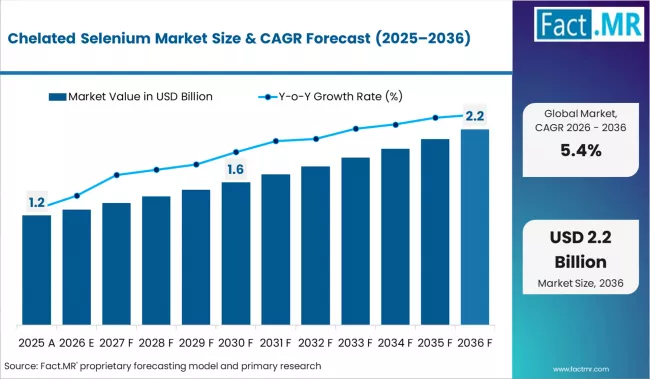
Chelated Selenium Market Market Value Analysis | Source: Fact.MR
Summary of the Chelated Selenium Market
- Market Definition
- The market includes selenium compounds chemically bound with organic or inorganic molecules to improve bioavailability, stability, and absorption efficiency. Chelated selenium is widely used in dietary supplements, pharmaceuticals, functional foods, cosmetics, and animal feed formulations to support antioxidant activity and metabolic functions in humans and animals.
- Demand Drivers
- Increasing use of trace minerals in dietary supplements supporting immune and metabolic health applications
- Rising demand for bioavailable micronutrient formulations in functional foods and nutraceutical products
- Expansion of animal nutrition formulations incorporating chelated minerals for improved absorption efficiency
- Growing use of stable mineral complexes in pharmaceutical and cosmetic ingredient formulations
- Key Segments Analyzed
- Type: Organic chelated selenium leads with around 65% share in 2026 supported by higher bioavailability characteristics
- End Use: Dietary supplements dominate with about 35% share driven by micronutrient fortification demand
- Application Scope: Feed industry and functional foods represent steady usage across nutrition related industries
- Geography: Asia Pacific shows relatively higher growth supported by livestock production and supplement demand
- Analyst Opinion at Fact MR
- Shambhu Nath Jha, Principal Consultant, Fact MR, opines, "In this updated edition of the Chelated Selenium Market report, industry participants will observe that demand remains supported by consistent inclusion of trace minerals in dietary supplements and feed formulations. Chelated selenium compounds provide improved stability and absorption performance compared to inorganic selenium alternatives. Manufacturers that optimize formulation consistency, regulatory compliance, and supply reliability are expected to maintain competitive balance as market demand expands through 2036."
- Strategic Implications/Executive Takeaways
- Invest in production capabilities supporting high purity and stable chelated mineral formulations
- Strengthen supply chain integration to manage variability in selenium raw material availability
- Expand application development across nutraceutical, feed, and pharmaceutical formulation segments
- Focus on regulatory compliance to ensure acceptance across global nutrition and feed additive markets
- Methodology
- Primary interviews conducted with nutraceutical manufacturers, feed producers, and specialty chemical suppliers
- Desk research based on chemical industry publications, company reports, regulatory databases, and trade statistics
- Market sizing derived using a hybrid approach combining bottom up production analysis with top down demand assessment
- Data validation performed through cross verification with industry datasets and internal peer review aligned with Fact MR standards
Chelated Selenium Market
| Metric | Details |
|---|---|
| Industry Size (2026E) | USD 1.3 billion |
| Industry Value (2036F) | USD 2.1 billion |
| CAGR (2026 to 2036) | 5.4% |
Source: Fact.MR analysis. Updated Mar 27, 2026
A CAGR of 5.4% across the forecast period indicates stable, incremental expansion, with limited cyclical fluctuation expected in demand patterns. Growth remains supported by consistent use in dietary supplements and animal nutrition, while moderated by regulatory compliance costs for trace mineral formulations and exposure to raw material price variability in selenium intermediates.
India leads with a projected CAGR of 6.2%, supported by expanding use of selenium amino acid complexes in dietary supplements and animal nutrition formulations. China follows with a CAGR of 5.9%, driven by increasing demand for trace mineral premixes across feed and functional food applications. Germany records a CAGR of 5.5%, reflecting steady incorporation of chelated minerals in nutraceutical and pharmaceutical grade formulations. The United Kingdom shows a CAGR of 5.3%, supported by consistent use of micronutrient fortification across health and wellness product categories. The United States records the slowest growth at 5.1%, reflecting a mature market where demand is largely tied to replacement and reformulation cycles. Mature markets generate a significant share of replacement demand as regulatory compliance and formulation optimization shape trace mineral inclusion levels across dietary supplements and feed additives.
Segmental Analysis
Chelated Selenium Market Analysis by Type
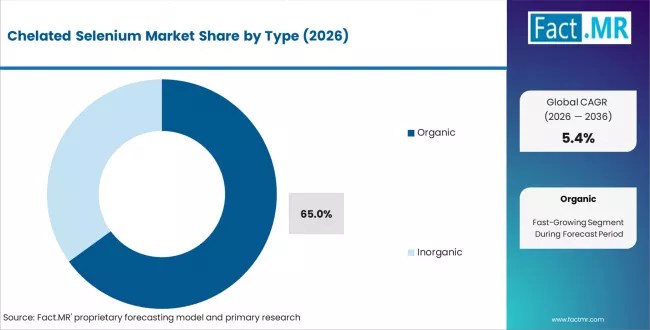
Chelated Selenium Market Analysis By Type | Source: Fact.MR
- Market Overview: Based on Fact MR assessment, organic chelated selenium is projected to account for 65% share of the chelated selenium market in 2026. Preference for organic selenium complexes is supported by higher bioavailability and improved metabolic absorption characteristics across nutraceutical and feed additive applications. Selenomethionine and selenium yeast compounds are widely incorporated into formulated products due to their compatibility with protein metabolism pathways. Demand concentration is observed in regions where micronutrient fortification standards emphasize trace mineral stability and controlled release performance across dietary formulations.
- Demand Drivers:
- Bioavailability Performance: Organic selenium complexes are absorbed through amino acid pathways, improving retention efficiency across dietary supplement and clinical nutrition applications.
- Formulation Stability: Chelated mineral structures demonstrate improved resistance to oxidation reactions during encapsulation, blending, and tablet compression processes.
- Regulatory Preference: Nutritional labeling frameworks recognize organic selenium forms as suitable for controlled dosage formulations across functional nutrition and medical nutrition products.
Chelated Selenium Market Analysis by End Use
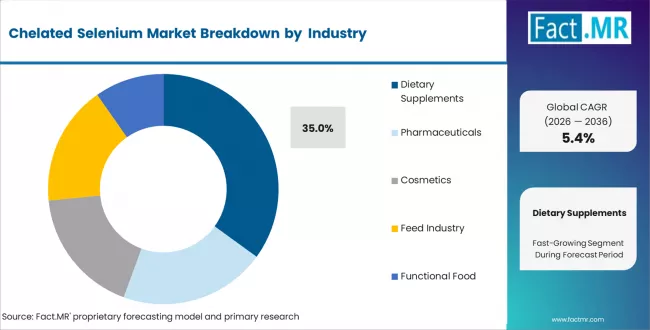
Chelated Selenium Market Analysis By End Use | Source: Fact.MR
- Market Overview: Dietary supplements are estimated to hold 35% share of the chelated selenium market in 2026, supported by increasing inclusion of trace minerals in immune support formulations and metabolic health products. Chelated selenium compounds are incorporated into capsules, tablets, and soft gel dosage formats due to stable interaction with excipients and reduced degradation risk during storage. Product demand is influenced by clinical nutrition protocols emphasizing micronutrient balance and antioxidant enzyme activity associated with selenium intake.
- Demand Drivers:
- Micronutrient Fortification Demand: Dietary supplement manufacturers incorporate selenium complexes to support glutathione peroxidase activity associated with cellular oxidative balance.
- Dosage Precision Requirements: Chelated selenium supports consistent elemental concentration per serving, improving formulation accuracy across standardized supplement production batches.
- Product Portfolio Expansion: Multivitamin producers are expanding trace mineral inclusion across combination supplements designed for immune response support and metabolic regulation.
Key Dynamics
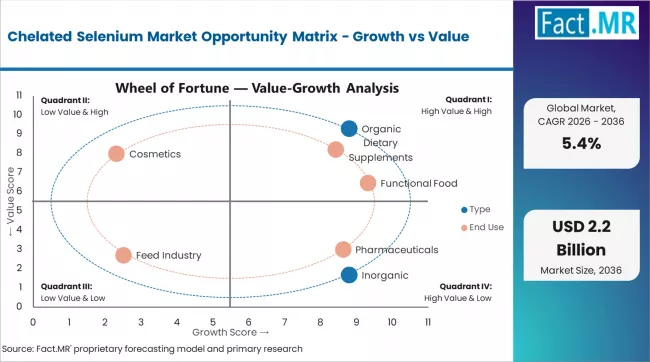
Chelated Selenium Market Opportunity Matrix Growth Vs Value | Source: Fact.MR
Chelated Selenium Market Drivers, Restraints, and Opportunities
Fact MR analysis indicates that the chelated selenium market developed from trace mineral supplementation practices used in animal nutrition and human dietary formulations. Early selenium supplementation relied on inorganic selenium salts added to livestock feed to address micronutrient deficiencies in agricultural production systems. The current market valuation reflects expanded use of organic chelated selenium compounds designed to improve bioavailability and nutrient absorption in feed additives, dietary supplements, and pharmaceutical formulations. Demand persists because selenium supports antioxidant activity and metabolic processes in both animal health and human nutrition applications.
A structural shift is occurring as conventional inorganic selenium compounds gradually lose share to chelated and organic selenium formulations with improved absorption characteristics. Inorganic selenium remains widely used in cost-sensitive feed formulations where price efficiency remains a primary consideration. Chelated selenium products involve complex binding processes that improve stability and nutrient uptake, increasing production costs relative to inorganic alternatives. These compounds command higher pricing despite moderate volume expansion. Even with stable consumption levels in livestock feed, higher-value chelated selenium ingredients contribute to gradual market value growth.
- Animal Nutrition Optimization: Feed producers incorporate chelated selenium to improve trace mineral absorption and support livestock productivity in poultry, swine, and ruminant production systems.
- Feed Additive Regulation: Regulatory frameworks such as European Food Safety Authority feed additive authorization and U.S. Food and Drug Administration feed ingredient approvals govern selenium use levels in feed formulations.
- Asia Livestock Production: China and India maintain large livestock industries that require trace mineral supplementation to support animal health and agricultural output.
Regional Analysis
The Chelated Selenium Market is assessed across North America, Europe, Asia Pacific, Latin America, and Middle East & Africa, segmented by country-level demand in dietary supplements, pharmaceuticals, feed additives, and functional food applications. Regional demand reflects trace mineral supplementation, livestock nutrition practices, and regulatory compliance frameworks. The full report offers market attractiveness analysis.
.webp "Top Country Growth Comparison Chelated Selenium Market Cagr (2026 2036)")
Top Country Growth Comparison Chelated Selenium Market Cagr (2026 2036) | Source: Fact.MR
| Country | CAGR (2026-2036) |
|---|---|
| China | 5.9% |
| India | 6.2% |
| USA | 5.1% |
| UK | 5.3% |
| Germany | 5.5% |
Source: Fact.MR analysis. Updated Mar 27, 2026
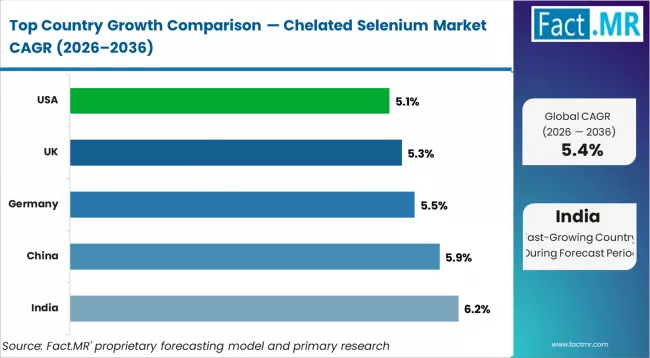
Chelated Selenium Market Cagr Analysis By Country | Source: Fact.MR
Source: Fact MR analysis, based on proprietary forecasting model and primary research
North America
North America functions as the regulated nutritional supplement and animal feed formulation hub, supported by structured ingredient approvals and strong commercial distribution. Jost Chemical Co. maintains a strong position in trace mineral compounds. Nutri-West, Inc. supports specialty mineral formulations. Watson, Inc. expands mineral ingredient production capabilities.
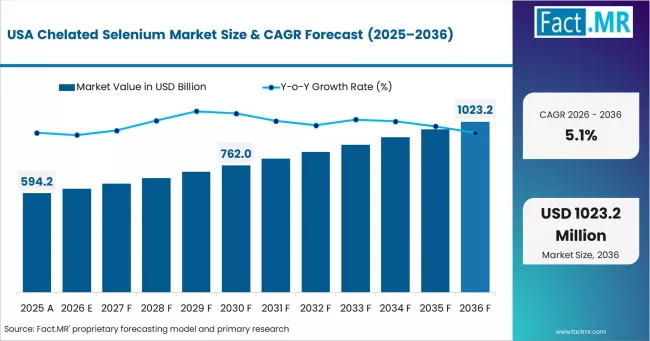
Chelated Selenium Market Country Value Analysis | Source: Fact.MR
- USA: Demand for chelated selenium in USA is projected to rise at 5.1% CAGR through 2036. Growth is supported by FDA dietary supplement regulations (U.S. FDA, ongoing), guiding trace mineral usage standards. Jost Chemical Co. expanded mineral compound production (March 2023), supporting supply.
Europe
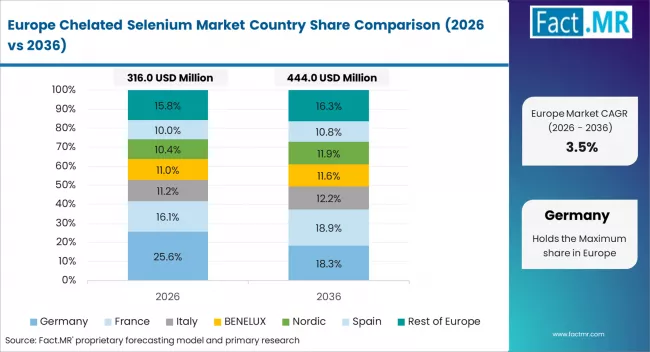
Chelated Selenium Market Europe Country Market Share Analysis, 2026 & 2036 | Source: Fact.MR
Europe operates as the regulatory and feed additive compliance base, shaped by structured approval frameworks and animal nutrition standards. Salvi Chemical Industries Ltd. supports trace mineral ingredient supply. Vitex Nutrition Ltd. expands feed additive solutions. JX Nippon Mining & Metals Corporation strengthens mineral production capabilities.
- UK: Demand for chelated selenium in UK is projected to rise at 5.3% CAGR through 2036. The UK Feed Additives Regulation framework (updated 2021) supports mineral supplement usage standards. Vitex Nutrition Ltd. expanded mineral additive portfolio (February 2023), supporting adoption.
- Germany: Demand for chelated selenium in Germany is projected to rise at 5.5% CAGR through 2036. The EU Feed Additives Regulation (European Commission, ongoing) governs trace mineral applications. Salvi Chemical Industries Ltd. expanded selenium compound production (January 2023), supporting market demand.
Asia Pacific
Asia Pacific serves as the high-growth livestock nutrition and dietary supplement market, supported by expanding feed production and health ingredient demand. Jinchuan Group International Resources Co. Ltd. strengthens mineral supply chains. Guangzhou Fineton Nonferrous Metals Co., Ltd. supports trace mineral processing. Sumitomo Metal Mining Co., Ltd. expands mineral production capacity.
- China: Demand for chelated selenium in China is projected to rise at 5.9% CAGR through 2036. The Feed and Feed Additives Regulation (Ministry of Agriculture and Rural Affairs, updated 2020) supports trace mineral use. Guangzhou Fineton Nonferrous Metals Co., Ltd. expanded selenium production capacity (April 2023), supporting supply.
- India: Demand for chelated selenium in India is projected to rise at 6.2% CAGR through 2036. The Food Safety and Standards Authority of India guidelines (updated 2022) support mineral fortification. Salvi Chemical Industries Ltd. expanded mineral ingredient production (May 2023), supporting domestic demand.
Fact MR's analysis of chelated selenium market in global regions consists of country-wise assessment that includes China, India, USA, UK, and Germany. Readers can find trace mineral demand trends, regulatory developments, production dynamics, and competitive positioning across key markets.
Competitive Landscape
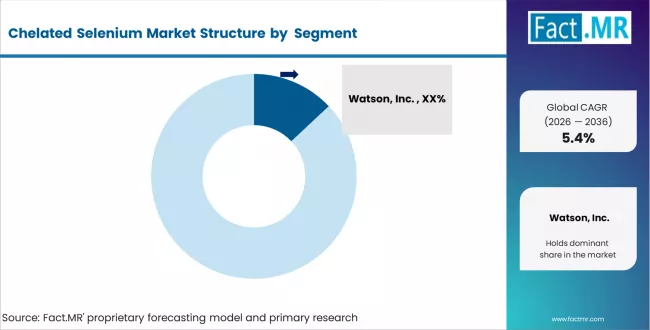
Chelated Selenium Market Analysis By Company | Source: Fact.MR
Competitive Structure and Buyer Dynamics in the Chelated Selenium Market
The competitive structure of the Chelated Selenium Market is moderately fragmented, with specialty chemical manufacturers, mining companies, and nutritional ingredient suppliers participating across the value chain. Companies such as Jost Chemical Co., Sumitomo Metal Mining Co., Ltd., Mitsubishi Corporation, and JX Nippon Mining & Metals Corporation maintain strong positions through established mineral processing and chemical manufacturing capabilities. These firms supply selenium compounds used in dietary supplements, pharmaceuticals, and animal nutrition applications. Additional participants including Watson, Inc., Spectrum Laboratory Products, Inc., Salvi Chemical Industries Ltd., Vitex Nutrition Ltd., Nutri-West, Inc., Shanghai Redbrilliant Chemical Co., Ltd., Guangzhou Fineton Nonferrous Metals Co., Ltd., PJSC MMC Norilsk Nickel, and Jinchuan Group International Resources Co. Ltd. contribute through specialty chemical production, trace mineral supply, and regional distribution networks. Competition is primarily influenced by product purity, bioavailability performance, regulatory compliance, and supply consistency across end use industries.
Several companies maintain structural advantages through access to selenium raw materials and integrated refining capabilities. Firms such as PJSC MMC Norilsk Nickel, Jinchuan Group International Resources Co. Ltd., and JX Nippon Mining & Metals Corporation benefit from established mining operations that support stable selenium feedstock supply. Chemical manufacturers such as Jost Chemical Co. and Salvi Chemical Industries Ltd. maintain advantages through formulation expertise and compliance with pharmaceutical and feed additive standards. Buyers in dietary supplements, pharmaceuticals, and animal nutrition typically maintain multi supplier sourcing strategies to reduce dependence on a single selenium provider. Procurement decisions evaluate suppliers based on product consistency, certification standards, and supply reliability. This purchasing behavior moderates supplier pricing leverage, while producers with integrated sourcing and high purity production capabilities retain moderate negotiating influence.
Key Players of the Chelated Selenium Market
- Watson, Inc.
- Spectrum Laboratory Products, Inc.
- Jost Chemical Co.
- Salvi Chemical Industries Ltd.
- Vitex Nutrition Ltd
- Sumitomo Metal Mining Co., Ltd.
- Mitsubishi Corporation
- Shanghai Redbrilliant Chemical Co., Ltd.
- PJSC MMC Norilsk Nickel
- Jinchuan Group International Resources Co. Ltd.
- JX Nippon Mining & Metals Corporation
- Guangzhou Fineton Nonferrous Metals Co., Ltd.
- Nutri-West, Inc.
Bibliographies
- [1] Fruselva. (2023, June 27). Plant-based yogurt alternatives: A tasty and convenient option. Fruselva Blog. Retrieved March 23, 2026.
- [2] Green Queen. (2023, September 3). Plant-based Greek yogurt: The 6 best, creamiest vegan brands to try. GreenQueen. Retrieved March 23, 2026.
- [3] Vegan in the Freezer. (2023, December 10). Best vegan yogurt: Tasted and reviewed. Vegan in the Freezer. Retrieved March 23, 2026.
- [4] Statista Market Insights. (2025, March 30). Yogurt – APAC | Statista market forecast. Statista. Retrieved March 23, 2026.
- [5] ReAnIn. (2024, November 15). Savory yogurt market growth drivers and analysis. ReAnIn. Retrieved March 23, 2026.
This Report Addresses
- Market size estimation and revenue forecasts for the Chelated Selenium Market from 2026 to 2036, supported by micronutrient demand trends and trace mineral consumption benchmarks.
- Growth opportunity mapping across organic and inorganic chelated selenium compounds, reflecting demand for improved bioavailability and formulation stability in nutritional and feed applications.
- Segment and regional revenue forecasts covering types, end use industries, distribution channels, and key markets including India, China, Germany, United Kingdom, and United States.
- Competition strategy assessment of leading companies such as Jost Chemical Co., Sumitomo Metal Mining Co., Ltd., Salvi Chemical Industries Ltd., JX Nippon Mining & Metals Corporation, and Nutri-West, Inc., including production capability and purity benchmarking.
- Regulatory impact analysis covering EFSA feed additive approvals, FDA dietary supplement regulations, and trace mineral compliance standards influencing formulation and commercialization.
- Market report delivery in PDF, Excel, PPT, and interactive dashboard formats designed for ingredient sourcing, formulation planning, and market evaluation.
- Supply chain vulnerability assessments examining raw material price variability in selenium intermediates, regulatory compliance costs, and dependency on mining and refining capacity impacting production stability.
Chelated Selenium Market Definition
The Chelated Selenium Market includes selenium compounds chemically bound with organic molecules to improve absorption, stability, and bioavailability in nutritional and industrial applications. Chelation enhances the effectiveness of selenium by allowing better utilization in biological systems compared to inorganic forms. Chelated selenium is widely used in dietary supplements, pharmaceuticals, animal feed, cosmetics, and functional food formulations. It supports antioxidant activity and metabolic functions in humans and animals. The primary function of chelated selenium is to provide a stable and bioavailable selenium source for health, nutrition, and feed applications.
Chelated Selenium Market Inclusions
This report covers global and regional market sizes for chelated selenium with forecast analysis for the study period. The market is segmented by type including organic and inorganic forms. Application segments include pharmaceuticals, dietary supplements, cosmetics, feed industry, and functional food products. End users include supplement manufacturers, pharmaceutical companies, feed producers, and cosmetic product developers. The report also evaluates pricing patterns, production trends, and selected trade flow analysis across major nutraceutical and feed additive markets.
Chelated Selenium Market Exclusions
The report excludes non chelated selenium compounds such as sodium selenite and other basic mineral forms used without chelation. Selenium mining and raw material extraction processes are not included. The scope also excludes finished consumer products such as dietary supplement capsules or fortified foods containing selenium as a minor ingredient. Industrial chemicals unrelated to nutritional or feed applications are outside the defined market scope, as the analysis focuses strictly on chelated selenium compounds.
Chelated Selenium Market Research Methodology
- Primary Research: Interviews were conducted with nutraceutical manufacturers, feed additive producers, pharmaceutical developers, and chemical suppliers.
- Desk Research: Public information was collected from chemical industry publications, company reports, regulatory data, and trade statistics.
- Market-Sizing and Forecasting: A hybrid model combining bottom up production analysis with top down demand assessment across nutraceutical, pharmaceutical, and feed sectors was applied.
- Data Validation and Update Cycle: Findings were cross verified using multiple industry data sources and expert inputs, with periodic updates conducted as new production and trade data becomes available.
Segmentation
Report Scope
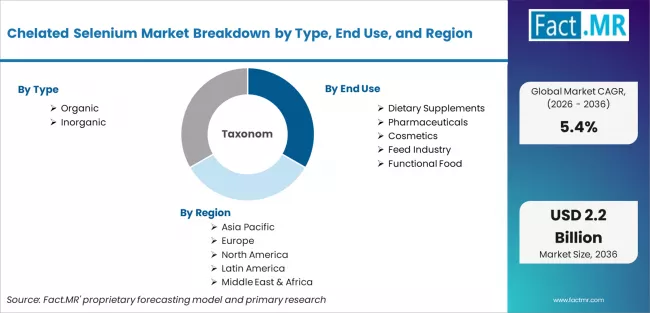
Chelated Selenium Market Breakdown By Type, End Use, And Region | Source: Fact.MR
| Metric | Value |
|---|---|
| Quantitative Units | USD 1.3 billion (2026) to USD 2.1 billion (2036), at a CAGR of 5.4% |
| Market Definition | The chelated selenium market includes selenium compounds bound to organic or inorganic molecules to improve bioavailability and stability, used in pharmaceuticals, dietary supplements, animal nutrition, cosmetics, and functional food formulations for nutritional and antioxidant applications. |
| Type Segmentation | Organic, Inorganic |
| End-use Segmentation | Pharmaceuticals, Dietary Supplements, Cosmetics, Feed Industry, Functional Food |
| Distribution Channel Segmentation | Pharmacies or Drugstores, Health and Beauty Stores, Hypermarket or Supermarket, Direct Selling, Online |
| Regions Covered | North America, Latin America, Europe, East Asia, South Asia, Oceania, Middle East and Africa |
| Countries Covered | United States, Canada, Mexico, Brazil, Germany, United Kingdom, France, Italy, Spain, China, India, Japan, South Korea, Australia, and 40+ countries |
| Key Companies Profiled | Watson, Inc., Spectrum Laboratory Products, Inc., Jost Chemical Co., Salvi Chemical Industries Ltd., Vitex Nutrition Ltd., Sumitomo Metal Mining Co., Ltd., Mitsubishi Corporation, Shanghai Redbrilliant Chemical Co., Ltd., PJSC MMC Norilsk Nickel, Jinchuan Group International Resources Co. Ltd., JX Nippon Mining and Metals Corporation, Guangzhou Fineton Nonferrous Metals Co., Ltd., Nutri-West, Inc. |
| Forecast Period | 2026 to 2036 |
| Approach | Hybrid top-down and bottom-up market modeling supported by micronutrient demand assessment, pharmaceutical ingredient usage trends, trade flow analysis, and validation through interviews with manufacturers, distributors, and industry specialists. |
Source: Fact.MR analysis. Updated Mar 27, 2026
Chelated Selenium Market Key Segments
-
Type :
- Organic
- Inorganic
-
End Use :
- Pharmaceuticals
- Dietary Supplements
- Cosmetics
- Feed Industry
- Functional Food
-
Distribution Channel :
- Pharmacies or Drugstores
- Health and Beauty Stores
- Hypermarket or Supermarket
- Direct Selling
- Online
-
Region :
- North America
- USA
- Canada
- Mexico
- Europe
- Germany
- UK
- France
- Italy
- Spain
- Nordic Countries
- BENELUX
- Rest of Europe
- Asia Pacific
- China
- Japan
- South Korea
- India
- Australia
- Rest of Asia Pacific
- Latin America
- Brazil
- Argentina
- Rest of Latin America
- Middle East and Africa
- Kingdom of Saudi Arabia
- United Arab Emirates
- South Africa
- Rest of Middle East and Africa
- Other Regions
- Oceania
- Central Asia
- Other Markets
- North America
Frequently Asked Questions
How large is the demand for Chelated Selenium in the global market in 2026?
What will be the market size of Chelated Selenium in the global market by 2036?
What is the expected demand growth for Chelated Selenium in the global market between 2026 and 2036?
Which Type Segment is poised to lead global demand by 2026?
Which Company is Identified as a Leading Participant in the Chelated Selenium Market?
What is Driving Chelated Selenium Demand in the United States?
What is the United States Growth Outlook in this Report?
Why is China an Important Market for Chelated Selenium?
What is the China Growth Outlook in this Report?
What Factors Support Chelated Selenium Demand in India?
What is the India Growth Outlook in this Report?
What Factors Support Chelated Selenium Adoption in the United Kingdom?
What is the United Kingdom Growth Outlook in this Report?
Why is Germany Considered an Important Market for Chelated Selenium in Europe?
What is the Germany Growth Outlook in this Report?
What is Chelated Selenium and What is It Mainly Used For?
What does Chelated Selenium Market Mean in this Report?
What is Included in the Scope of this Chelated Selenium Market Report?
What is Excluded from the Scope of this Report?
What does Market Forecast Mean on this Page?
How is the Chelated Selenium Market Forecast Developed in this Report?
Who worked on this report


Preview the report firsthand - request a free sample
Free SampleGet the brochure for pricing and purchase details
Download PDF