Low-pH Stable Probiotic Protection Agents for RTD Drinks Market
The Low-pH Stable Probiotic Protection Agents for RTD Drinks Market is analyzed across its key product, application and end-use segments, with regional trends and demand outlook, forecast 2026 to 2036.
By Fact.MR Food & Beverage DeskLead analyst:
S.N. JhaPublished :
Updated :
11 min read
Fact-checked under the Fact.MR editorial process
Low-pH Stable Probiotic Protection Agents for RTD Drinks Market Forecast and Outlook 2026 to 2036
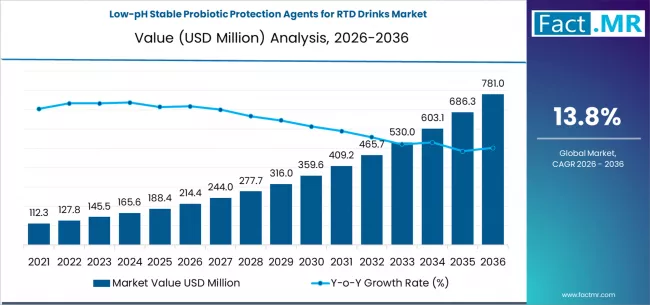
The global market for low-pH stable probiotic protection agents is a critical enabler of innovation within the functional RTD beverage sector, projected to expand from USD 214.41 million in 2026 to USD 781.05 million by 2036, advancing at a 13.8% CAGR.
Low Ph Stable Probiotic Protection Agents For Rtd Drinks Market Market Value Analysis | Source: Fact.MR
Summary of Low-pH Stable Probiotic Protection Agents for RTDDrinks Market
Market Snapshot
Global low-pH stable probiotic protection agents for RTDdrinks market revenue stood at USD 214.41 million in 2026 and is forecast to reach USD 781.05 million by 2036.
At a 13.8%CAGRfrom 2026 to 2036, this market is a critical enabler of innovation within the functionalRTDbeverage sector.
Growth is linked to escalating demand for efficacious probiotic beverages beyond traditional neutral-pH dairy drinks, spanning acidic juices,kombucha, and functional sodas.
The market is shifting from single-layer encapsulation to multi-faceted protection systems employing pH-buffering matrices and targeted-release encapsulation technologies.
Demand and Growth Drivers
Explosive consumer demand for functional, non-dairy probiotic beverages aligned with gut health and immunity trends is the primary market driver.
Stricter regulatory scrutiny and consumer advocacy for label accuracy are pushing brands to invest in technologies that ensure delivered probiotic potency matches label claims.
Expansion ofkombucha, hard seltzers with functional benefits, and fermented plant-based drinks creates new acidic application environments requiring advanced protection.
Development of next-generation encapsulation using biomaterials such as alginate and whey protein fibrils is offering improved gastric passage survival and clean-label credentials.
Strategic partnerships between probiotic culture suppliers and protection agent specialists are increasing to offer beverage makers integrated, strain-specific solutions.
Product and Segment View
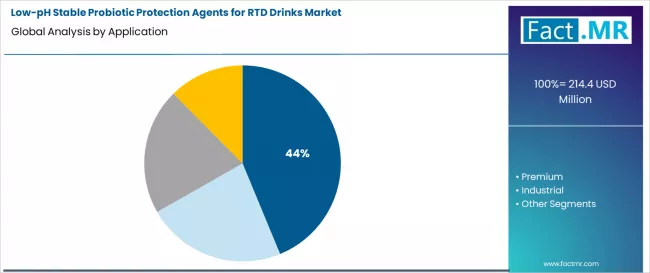
Standard application segment holds a dominant 43.8% market share in 2026, addressing high-volume needs for cost-effective protection of common probiotic strains in mainstream acidicRTDbeverages.
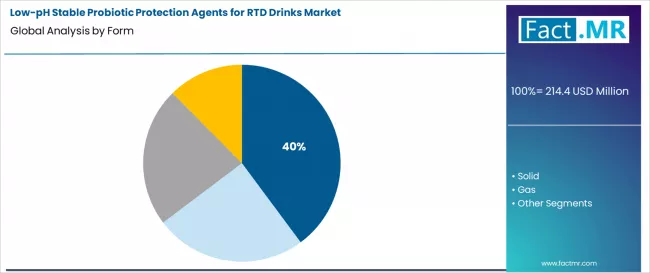
Liquid form leads with a 39.9% share in 2026, valued for superior compatibility with existing beverage manufacturing processes and ease of metering in high-speed bottling lines.
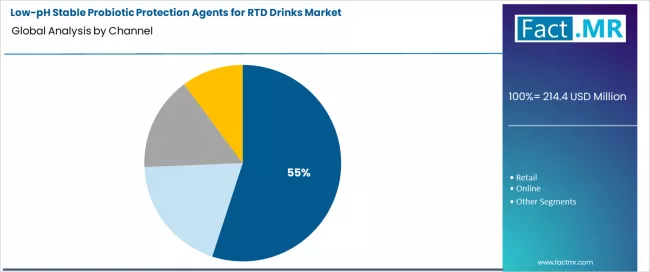
Direct sales channel leads with a 55% share in 2026, reflecting the deep technical collaboration required between agent suppliers and beverage company R&D teams.
Additional segments include Premium and Industrial applications, Solid, Gas, and Gel forms, and Retail, Online, and Distributor sales channels.
Geography and Competitive Outlook
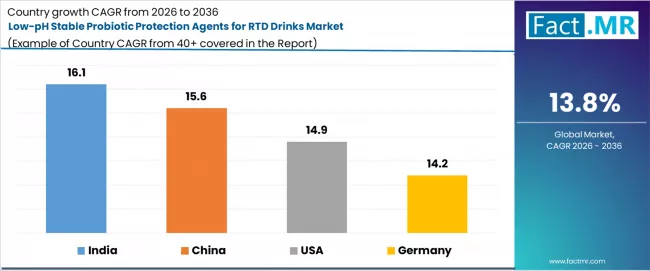
India (16.1%CAGR), China (15.6%), USA (14.9%), and Germany (14.2%) are the key growth countries highlighted on the webpage.
North America, Europe, and Asia Pacific are key growth regions, driven by mature functional beverage markets, rigorous label accuracy standards, and rapid innovation in acidic drink formats.
Market expansion is closely tied to the growth ofkombuchaand fermented drink categories, clinical substantiation of probiotic strains, and clean-label encapsulation technology.
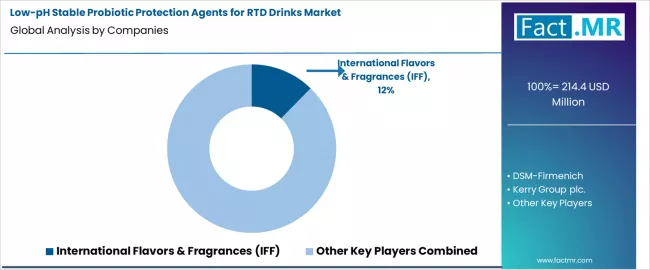
Key companies active in this market include International Flavors & Fragrances (IFF), DSM-Firmenich, Kerry Group plc., ADM,Novonesis, andLonzaGroup AG.
Low-pH Stable Probiotic Protection Agents for — At a Glance
Attribute
Details
Market Value 2026
USD 214.41 Million
Market Value 2036
USD 781.05 Million
Absolute Dollar Opportunity 2026–2036
USD 566.6 Million
Total Growth 2026–2036
264%
CAGR2026–2036
13.8%
Growth Multiple
3.6x
Key Demand Theme
Advanced encapsulation and protection of probiotic strains for viability maintenance in low-pH acidicRTDfunctional beverages
Leading Segment by Application (2026)
Standard
Application Segment Share (2026)
43.8%
Leading Segment by Form (2026)
Liquid
Form Segment Share (2026)
39.9%
Leading Segment by Channel (2026)
Direct
Channel Segment Share (2026)
55%
Key Growth Regions
North America, Europe, Asia Pacific
CountryCAGRs
India 16.1%, China 15.6%, USA 14.9%, Germany 14.2%
Top Companies
IFF, DSM-Firmenich, Kerry Group plc., ADM,Novonesis,LonzaGroup AG
Segmentation by Application
Standard, Premium, Industrial, Other
Segmentation by Form
Liquid, Solid, Gas, Gel
Segmentation by Channel
Direct, Retail, Online, Distributor
Segmentation by Region
North America, Latin America, Western Europe, Eastern Europe, East Asia, South Asia & Pacific, MEA
Source: Fact.MR analysis. Updated Apr 13, 2026
Growth is linked to the escalating demand for efficacious, scientifically credible probiotic beverages beyond the traditional domain of neutral-pH dairy drinks. The market's evolution is defined by the relentless pursuit of technological solutions that guarantee probiotic viability through two major challenges, the highly acidic environment of popular beverage formats like juices, kombucha, and functional sodas, and the extended shelf life required for retail distribution. Key trends center on the shift from single-layer encapsulation to multi-faceted protection systems. These advanced agents employ synergistic approaches, combining pH-buffering matrices, targeted-release encapsulation, and stabilizers that shield probiotic cells from acid and osmotic stress. This technological progression allows brands to make verifiable CFU guarantees on labels, transforming probiotics from a marketing claim into a measurable ingredient with clinical relevance. The development of these agents is unlocking new beverage categories, enabling the fortification of plant-based drinks, enhanced waters, and sparkling tonics with specific probiotic strains linked to immune and gut health benefits, thereby driving the next wave of functional beverage innovation.
Category
Category
Segments
Application
Standard, Premium, Industrial, Other
Form
Liquid, Solid, Gas, Gel
Channel
Direct, Retail, Online, Distributor
Region
North America, Latin America, Western Europe, Eastern Europe, East Asia, South Asia & Pacific, MEA
Source: Fact.MR analysis. Updated Apr 13, 2026
Segmental Analysis
By Application, Which Segment Demonstrates the Broadest Adoption?
Low Ph Stable Probiotic Protection Agents For Rtd Drinks Market Analysis By Application | Source: Fact.MR
The standard application segment holds a dominant 44% market share. This segment addresses the fundamental and high-volume need for reliable, cost-effective protection of common probiotic strains in mainstream acidic RTD beverages.
Standard-grade agents provide a proven, economical solution for achieving baseline viability guarantees over a typical product shelf life, meeting the essential requirements for a wide range of juice-based probiotics, value-oriented kombuchas, and functional teas. Their widespread use is driven by the balance they offer between performance and affordability for large-scale production.
By Form, Which Type Offers the Greatest Integration Ease?
Low Ph Stable Probiotic Protection Agents For Rtd Drinks Market Analysis By Form | Source: Fact.MR
Liquid-form protection agents lead the market with a 40% share, primarily due to their superior compatibility with existing beverage manufacturing processes. Liquid agents can be easily metered and blended directly into cold or post-pasteurization beverage streams, facilitating homogeneous distribution of the protective matrix around probiotic cells.
This form minimizes dust, simplifies handling in sterile environments, and is often preferred for its consistency and ease of use in high-speed bottling and canning lines, reducing operational complexity for beverage producers.
By Channel, How are Products Primarily Reaching End-Users?
Low Ph Stable Probiotic Protection Agents For Rtd Drinks Market Analysis By Channel | Source: Fact.MR
Direct sales constitute the leading channel, accounting for 55% of the market. The technical specificity of probiotic protection requires close collaboration between agent suppliers and the R&D teams at beverage companies.
Direct relationships are essential for tailoring protection systems to the exact combination of probiotic strain, beverage pH, processing parameters, and desired shelf life. Suppliers provide critical technical support, from strain compatibility testing to stability trial management, ensuring the chosen agent delivers on its viability promises in the final product formulation.
What are the Drivers, Restraints, and Key Trends of the Low-pH Stable Probiotic Protection Agents for RTD Drinks Market?
The primary market driver is the explosive consumer demand for functional, non-dairy probiotic beverages that align with gut health and immunity trends. Stricter regulatory scrutiny and consumer advocacy for label accuracy are pushing brands to invest in technologies that ensure delivered potency matches claims. The expansion of kombucha, hard seltzers with functional benefits, and fermented plant-based drinks creates new, acidic application environments that are impossible to address without advanced protection technologies.
A significant market restraint is the high cost of advanced multi-layer encapsulation and stabilization technologies, which can significantly increase the bill of materials for a finished beverage. The technical complexity of matching a specific protection system to both a unique probiotic strain and a specific beverage matrix often requires lengthy and costly application-specific R&D. There is also persistent competition from postbiotics and spore-forming probiotics that offer inherent acid stability, potentially circumventing the need for external protection agents in some formulations.
Key trends include the development of next-generation encapsulation using biomaterials like alginate and whey protein fibrils that offer improved gastric passage survival. There is a growing focus on protection systems that are themselves clean-label and derived from natural sources. The integration of real-time stability monitoring sensors within packaging is an emerging concept to verify probiotic viability at the point of consumption. Furthermore, strategic partnerships between probiotic culture suppliers and protection agent specialists are increasing to offer beverage makers integrated, strain-specific solutions from a single source.
Analysis of the Low-pH Stable Probiotic Protection Agents for RTD Drinks Market by Key Countries
Low Ph Stable Probiotic Protection Agents For Rtd Drinks Market Cagr Analysis By Country | Source: Fact.MR
Country
CAGR (2026-2036)
India
16.1%
China
15.6%
USA
14.9%
Germany
14.2%
Source: Fact.MR analysis. Updated Apr 13, 2026
How is India's Boosting Functional Beverage and Traditional Fermentation Market Influencing Growth?
A massive, young population increasingly seeking affordable, on-the-go health solutions, fuels India’s leading CAGR of 16.1%. The proliferation of local brands in functional juices, lassi, and innovative fermented drinks drives demand. India's climate and supply chain realities necessitate agents that ensure stability without consistent cold storage.
The market demands highly cost-effective yet robust protection systems that can maintain viability in diverse, often high-acid, traditional beverage formats adapted for modern RTD distribution.
What is driving Rapid Adoption in China's Innovative RTD Sector?
China's 15.6% CAGR reflects a highly competitive beverage market where rapid innovation is key. Chinese consumers enthusiastically adopt novel functional drinks, including probiotic sodas, sparkling yogurts, and herb-infused tonics.
Domestic beverage giants and startups alike seek cutting-edge protection technology to gain a competitive edge with superior product claims. The demand is for agents that support both domestic probiotic strains and international ones, enabling products that cater to a preference for scientifically advanced health ingredients.
Why does the USA's Mature Functional Beverage Landscape Sustain High Demand?
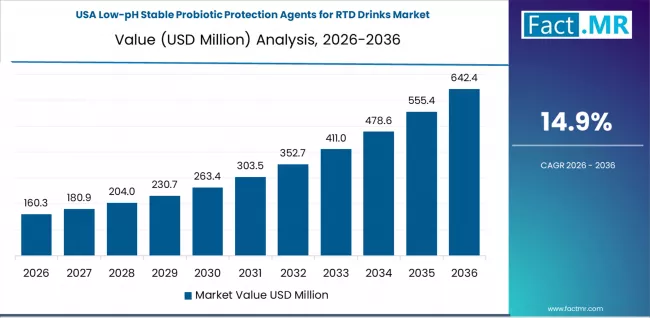
Low Ph Stable Probiotic Protection Agents For Rtd Drinks Market Country Value Analysis | Source: Fact.MR
The USA's 14.9% growth is driven by a saturated market where product differentiation hinges on proven efficacy. American consumers are well-educated on probiotics and scrutinize labels for CFU counts at expiry. This creates intense pressure on brands to use the most reliable protection systems to avoid reputational damage from failing to meet label claims.
The market demands agents with extensive clinical and stability data, driving innovation toward systems that offer not just acid protection but also stability under varied temperature conditions.
How is Germany's Quality Engineering and Regulatory Focus Shaping the Market?
Germany's 14.2% CAGR is indicative of a market governed by rigorous quality standards and a strong preference for scientific validation. German engineering prowess is applied to develop precision protection systems with highly predictable performance.
The market favors agents that are produced under strict pharmaceutical-grade quality control and can be seamlessly integrated into Germany's advanced, automated beverage production lines. Growth is tied to the ability of suppliers to provide exhaustive technical dossiers and meet the high regulatory bar for health claim substantiation in the EU.
Competitive Landscape of the Low-pH Stable Probiotic Protection Agents for RTD Drinks Market
Low Ph Stable Probiotic Protection Agents For Rtd Drinks Market Analysis By Company | Source: Fact.MR
The competitive landscape is characterized by a blend of global flavor and nutrition leaders, specialized biotechnology firms, and culture manufacturers expanding into delivery sciences. Competition is intensifying around proprietary encapsulation technologies, the breadth of strain-specific compatibility data, and the ability to provide holistic solutions that include the probiotic strain, its protective agent, and tailored application expertise.
Success increasingly depends on strategic alliances with probiotic culture banks and large beverage conglomerates to develop co-branded, optimized protection systems. Companies are also competing to establish industry-standard testing protocols for proving viability in low-pH environments, aiming to set the benchmarks that define product quality and performance.
Key Players in the Low-pH Stable Probiotic Protection Agents for RTD Drinks Market
International Flavors & Fragrances (IFF)
DSM-Firmenich
Kerry Group plc.
ADM
Novonesis
Lonza Group AG
Market Breakdown
Segmentation
Scope of Report
Items
Values
Quantitative Units
USD Million
Application
Standard, Premium, Industrial, Other
Form
Liquid, Solid, Gas, Gel
Channel
Direct, Retail, Online, Distributor
Key Countries
India, China, USA, Germany
Key Companies
International Flavors & Fragrances (IFF), DSM-Firmenich, Kerry Group plc., ADM, Novonesis, Lonza Group AG
Additional Analysis
Mechanistic analysis of cell protection under acid stress; comparative efficacy of different encapsulation materials (alginate, chitosan, lipids); impact of beverage matrix (sugar, tannins, carbonation) on protection efficacy; regulatory pathways for viability claims; shelf-life modeling and accelerated stability testing protocols; cost-benefit analysis of protection systems across different product tiers.
Source: Fact.MR analysis. Updated Apr 13, 2026
Market by Segments
Application :
Standard
Premium
Industrial
Other
Form :
Liquid
Solid
Gas
Gel
Channel :
Direct
Retail
Online
Distributor
Region :
North America
USA
Canada
Latin America
Brazil
Mexico
Argentina
Rest of Latin America
Western Europe
Germany
UK
France
Spain
Italy
BENELUX
Rest of Western Europe
Eastern Europe
Russia
Poland
Czech Republic
Rest of Eastern Europe
East Asia
China
Japan
South Korea
Rest of East Asia
South Asia & Pacific
India
ASEAN
Australia
Rest of South Asia & Pacific
MEA
Saudi Arabia
UAE
Turkiye
Rest of MEA
References
Anal, A. K., & Singh, H. (2024). Recent advances in microencapsulation of probiotics for industrial applications and targeted delivery. Trends in Food Science & Technology, 144, 104333.
Cook, M. T., Tzortzis, G., & Charalampopoulos, D. (2023). Methods for the quantification of probiotic viability in food matrices: A review. International Journal of Food Microbiology, 407, 110421.
Fenster, K., Freeburg, B., & Ouwehand, A. C. (2024). The production, viability, and stability of probiotics for non-dairy applications. Comprehensive Reviews in Food Science and Food Safety, 23(2), e13310.
Khan, I., & Kang, S. K. (2023). Survival of probiotic bacteria in acidic environments: Mechanisms and applications. Food Research International, 173(Part 1), 113281.
Liu, H., & Pan, D. (2024). Novel biomaterials for the coating and protection of probiotic cells: Performance in simulated gastrointestinal conditions. Food Hydrocolloids, 149, 109456.
Mishra, S., & Jha, A. (2023). Plant-based materials for the microencapsulation of probiotics in acidic beverages. Journal of Functional Foods, 108, 105740.
Saxelin, M., & Salminen, S. (2024). Challenges in demonstrating probiotic efficacy in low-pH foods and beverages. Beneficial Microbes, 15(1), 1-12.
Tripathi, M. K., & Giri, S. K. (2023). Probiotic functional foods: Survival of probiotics during processing and storage. Journal of Functional Foods, 52, 1-15.
Vinderola, G., & Reinheimer, J. A. (2023). Probiotics in nondairy matrices: Technological and physiological challenges. Current Opinion in Food Science, 51, 101012.
Yao, M., & Li, D. (2024). Evaluating the protective effect of different encapsulation techniques on Lactobacillus survival in fruit juice during storage. LWT - Food Science and Technology, 191, 115655.
Questions Answered
Frequently Asked Questions
How big is the low-ph stable probiotic protection agents for rtd drinks market in 2026?
The global low-ph stable probiotic protection agents for rtd drinks market is estimated to be valued at USD 214.4 million in 2026.
What will be the size of low-ph stable probiotic protection agents for rtd drinks market in 2036?
The market size for the low-ph stable probiotic protection agents for rtd drinks market is projected to reach USD 781.0 million by 2036.
How much will be the low-ph stable probiotic protection agents for rtd drinks market growth between 2026 and 2036?
The low-ph stable probiotic protection agents for rtd drinks market is expected to grow at a 13.8% CAGR between 2026 and 2036.
What are the key product types in the low-ph stable probiotic protection agents for rtd drinks market?
The key product types in low-ph stable probiotic protection agents for rtd drinks market are standard, premium, industrial and other.
Which form segment to contribute significant share in the low-ph stable probiotic protection agents for rtd drinks market in 2026?
In terms of form, liquid segment to command 39.9% share in the low-ph stable probiotic protection agents for rtd drinks market in 2026.