What is the chrome-free wash primers market forecast to be worth by 2036?
USD 275.0 million in 2026 to USD 560.0 million by 2036, at 7.4% CAGR.
- The chrome-free wash primers market crossed USD 250.0 million in 2025.
- Demand is estimated at USD 275.0 million in 2026. It is projected to reach USD 560.0 million by 2036.
- The market is forecast to record 7.4% CAGR from 2026 to 2036 owing to aerospace, marine and rail buyers replacing chromated primer systems.
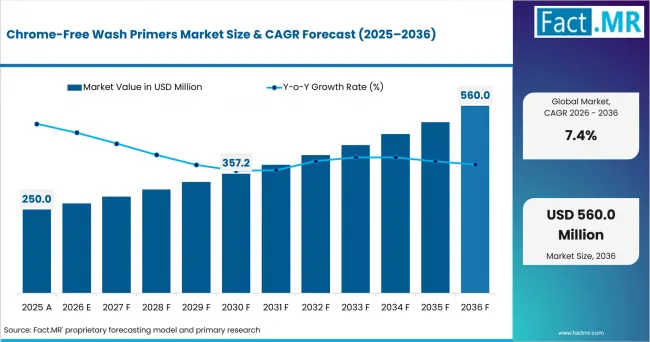
Chrome Free Wash Primers Market Market Value Analysis | Source: Fact.MR
What are the defining numbers behind chrome-free wash primers growth?
USD 285.0 million absolute opportunity by 2036, led by China and India.
- Demand Drivers in the Market
- Aerospace refinish buyers need primers that reduce chromate handling while keeping corrosion protection.
- Marine and rail users specify adhesion on mixed metals due to exposed service conditions.
- Industrial equipment makers require faster coating steps for parts that move through short paint cycles.
- Distributors gain orders when local applicators need compliant primer systems without changing spray equipment.
- Key Segments Analyzed
- By Chemistry: Phosphate-based primers are projected to hold 31.0% share in 2026 due to proven metal bonding behavior.
- By Substrate: Aluminum is anticipated to account for 34.0% share in 2026 due to aircraft and transport panel use.
- By Application: Aerospace is forecast to hold 39.0% share in 2026, supported by qualified exterior coating systems.
- By Performance Requirement: Corrosion protection is expected to hold 35.0% share in 2026 due to salt and humidity exposure.
- By Sales Channel: Direct OEM supply is estimated to represent 52.0% share in 2026 due to specification-controlled purchasing.
- By Geography: China is forecast to record 8.7% CAGR through 2036 led by vehicle and metal fabrication demand.
- Analyst Opinion at Fact.MR
- Shambhu Nath Jha, Senior Analyst at Fact.MR, states, "Chrome-free wash primers are becoming a specification question instead of a simple compliance substitute. I see coating teams asking whether the primer can remove one pretreatment step and pass corrosion testing. They also want lower chromate handling. Suppliers with qualified systems and field support are better placed than companies selling only generic metal primers."
- Strategic Implications
- Formulators need corrosion data that compares chrome-free systems with legacy wash primers.
- Distributors should train applicators on surface preparation and film thickness control.
- OEMs need approval packages that cover primer, topcoat and substrate combinations.
- Marine and rail buyers should link primer selection to maintenance intervals and hazardous waste costs.
Regulation and workplace exposure rules give this market its main business logic. The Occupational Safety and Health Administration states that hexavalent chromium compounds are used in paints and primers. Buyers therefore compare primer performance against the cost of exposure control.
China is projected to record 8.7% CAGR through 2036 due to large metal-panel coating volume. India is expected to expand at 8.4% CAGR led by automotive components and rail equipment repainting. South Korea is forecast to grow at 8.1% CAGR attributable to marine metal protection. The United States is expected to advance at 7.8% CAGR owing to aerospace repainting and defense maintenance. Germany is projected to rise at 7.2% CAGR driven by mixed-metal coating needs.
How does the chrome-free wash primers market break down by segment?
Phosphate-based chemistry leads at 31.0%. Aerospace applications lead at 39.0%.
Interest in coating pretreatment is rising due to chromate-free conversion and primer compatibility requirements. The segment mix shows a practical buyer sequence. Chemistry selection comes first. Substrate and application decide the final primer choice. Performance requirements then determine whether the product moves into OEM supply or distributor-led maintenance channels.
Which chemistry dominates?
Phosphate-based primers hold 31.0% share in 2026.
Formulators also track coating additives due to wetting and corrosion-inhibition packages that decide final primer behavior.
Phosphate-based primers lead due to established use in corrosion-inhibiting metal preparation. Buyers understand cure behavior and topcoat compatibility. Zirconium-based and silane-modified systems grow faster where users need lower sludge and cleaner application.
Which substrate dominates?
Aluminum accounts for 34.0% share in 2026.
Aluminum leads due to aerospace alloys and transport panels that need adhesion before exterior coating. Mixed metals follow owing to rail, marine and industrial equipment parts that combine steel and light alloys. Galvanized steel keeps demand in fabricated products and repair work.
Which application dominates?
Aerospace holds 39.0% share in 2026.
Aerospace leads due to qualification-heavy repaint and maintenance cycles. Aerospace users compare primer choice with aerospace coating qualification requirements before switching repaint systems. Automotive refinishing links this category with automotive OEM coatings due to paint-shop pressure for low-VOC and mixed-metal compatibility.
Which performance requirement dominates?
Corrosion protection leads with 35.0% share in 2026.
Specification teams use anti-corrosion coatings as the wider comparison set when they select primer systems for exposed metal.
Corrosion protection leads because wash primers are bought to secure the first bond between metal and the coating stack. Adhesion follows closely due to recoat and topcoat performance. Low-VOC grades gain share in North America and Europe where shop emissions are tightly reviewed.
Which sales channel dominates?
Direct OEM supply holds 52.0% share in 2026.
Direct OEM supply leads due to approved-system purchasing in aerospace and transport equipment. Distributor supply remains important for MRO, marine yards and local fabricators. Defense procurement creates smaller volumes but requires traceable approvals and technical support.
What is accelerating chrome-free wash primers demand, and what is holding it back?
Exposure rules accelerate replacement, while qualification cost slows broad conversion.
The first driver is worker exposure control. OSHA sets the chromium VI permissible exposure limit at 5 micrograms per cubic meter. That rule makes chromate handling a measurable compliance task for coating shops. Demand also connects with protective coatings due to salt and humidity resistance after removing chromates.
The main restraint is qualification time. Aerospace and defense users do not switch primer chemistry on price alone. They need corrosion data, adhesion results and approved topcoat compatibility. Smaller suppliers lose bids when they cannot fund repeated testing across substrates.
Waterborne variants draw attention from waterborne acrylic resin suppliers due to lower solvent exposure and spray-shop compliance needs.
Where do the biggest chrome-free wash primers opportunities sit?
Aerospace refinish, marine repair and process simplification.
- Aerospace Refinish: Qualified chrome-free primer stacks can win repaint work where MRO buyers need approved systems.
- Marine Repair: Shipyard and coastal repair buyers need corrosion protection that lowers hazardous material handling.
- Process Simplification: PPG states that Desoprime® CF chrome-free wash primer can be applied directly to metal substrates with no pretreatment.
Which countries are scaling chrome-free wash primer use fastest?
China leads at 8.7% CAGR. India follows at 8.4% CAGR. South Korea is forecast at 8.1% CAGR. The United States is expected at 7.8% CAGR. Germany is projected at 7.2% CAGR. Japan is forecast at 6.8% CAGR. The United Kingdom is expected at 6.5% CAGR.
Based on regional analysis, the market covers North America and Latin America. It also covers Western Europe and East Asia. South Asia and Pacific and Middle East and Africa complete the regional scope.
| Country | CAGR |
|---|---|
| China | 8.7% |
| India | 8.4% |
| South Korea | 8.1% |
| United States | 7.8% |
| Germany | 7.2% |
| Japan | 6.8% |
| United Kingdom | 6.5% |
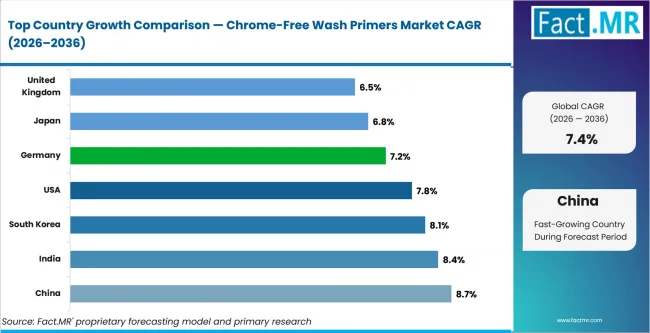
Chrome Free Wash Primers Market Cagr Analysis By Country | Source: Fact.MR
What is powering China’s lead?
8.7% CAGR, supported by vehicle and metal fabrication demand.
China has the strongest volume base due to automotive and rail production. Industrial metal fabrication adds further primer volume. The State Council reported auto production above 31.23 million units in the latest review period. China is projected to record an 8.7% CAGR through 2036, led by high metal-panel coating volume. Suppliers that localize technical service near coastal manufacturing clusters gain a channel advantage.
Why is India an important growth market?
8.4% CAGR, led by vehicle production and export-oriented component suppliers.
Indian coating teams compare primer price against application simplicity due to cost-sensitive fabrication and refinish work. The Press Information Bureau stated that vehicle production reached 28 million units in the latest reported fiscal year. India is expected to expand at 8.4% CAGR through 2036, supported by automotive components and rail equipment repainting. Local suppliers that combine small-pack availability and technical guidance gain better access to regional applicators.
What supports South Korea’s outlook?
8.1% CAGR, driven by shipbuilding and marine metal protection.
South Korea demand is shaped by high-value vessels and export-facing industrial users. The Organisation for Economic Co-operation and Development reported that Korea accounted for 27% of global ship completions in 2024. South Korea is forecast to grow at 8.1% CAGR through 2036, attributable to marine metal protection and transport coating replacement. Suppliers with marine approvals and yard-level technical service hold the better route to volume.
What supports the USA outlook?
7.8% CAGR, owing to aerospace repainting and defense maintenance.
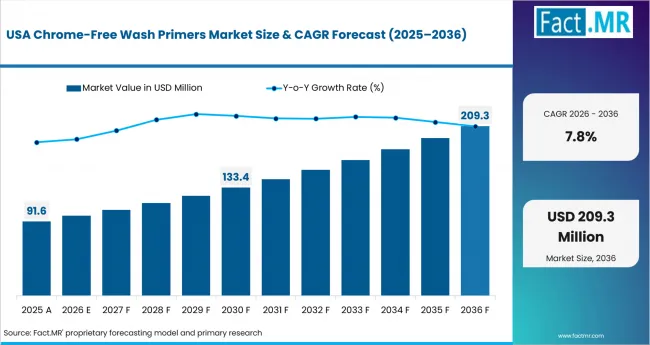
Chrome Free Wash Primers Market Country Value Analysis | Source: Fact.MR
United States demand starts with aerospace MRO and defense coating discipline. General Aviation Manufacturers Association data placed aircraft deliveries at USD 31.9 billion in the latest annual data. The United States is expected to advance at 7.8% CAGR through 2036, owing to aircraft repainting and military maintenance requirements. Suppliers that combine qualified primers and rapid technical support gain stronger access to MRO accounts.
What underpins Germany’s growth?
7.2% CAGR, driven by mixed-metal coating needs.
Germany is a specification-led market due to automotive and machinery coating standards. Rail maintenance adds another qualification route. The U.S. International Trade Administration reported that Germany had 2.8 million newly registered vehicles in 2023. Germany is projected to rise at 7.2% CAGR through 2036, driven by mixed-metal coating needs. Buyers favor suppliers that can document European chemical rule alignment and process consistency.
How does Japan perform in this market?
6.8% CAGR, supported by aerospace component repainting and conservative qualification behavior.
Japan buyers put track record before low price in aircraft and industrial coating choices. The U.S. International Trade Administration reported that Japanese suppliers support about 7 Boeing 787 aircraft per month in 2025. Japan is forecast at 6.8% CAGR through 2036, supported by aerospace component repainting and conservative qualification behavior. Suppliers gain only when test history and local support reduce buyer risk.
How does the United Kingdom perform in this market?
6.5% CAGR, led by aerospace maintenance and defense repair.
United Kingdom demand is tied to aerospace parts and defense repair. High-value manufacturing adds smaller but better-specified volume. The Office for National Statistics reported that parts of aeroplanes, helicopters or unmanned aircraft reached GBP 7.3 billion in 2024. The United Kingdom is expected to post 6.5% CAGR through 2036, led by aerospace maintenance. Suppliers with aircraft-parts access and defense documentation can defend premium accounts.
Who leads the chrome-free wash primers landscape?
PPG, AkzoNobel and Sherwin-Williams lead through qualified primer systems and application support.
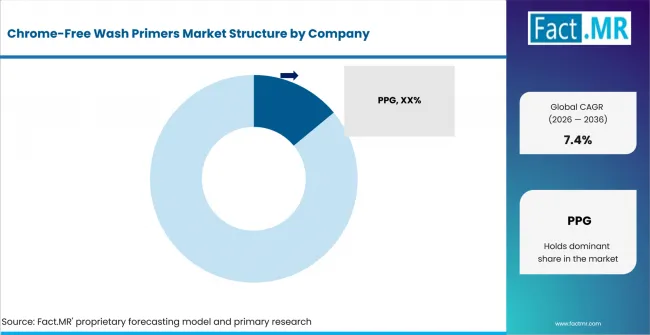
Chrome Free Wash Primers Market Analysis By Company | Source: Fact.MR
Chrome-free wash primers are used by aerospace, marine and rail buyers that need trusted adhesion evidence before switching specifications. PPG competes from an aerospace coatings base that includes Desoprime CF chrome-free wash primer and Aerocron electrocoat primer. In June 2026, PPG highlighted Aerocron as a chrome-free electrocoat primer for aerospace applications.
Sherwin-Williams has strengthened its aircraft refinish position through qualified chrome-free systems. In August 2025, the company received four AMS 3095B qualifications for complete chrome-free exterior coating systems. Buyers see this as evidence that the primer and topcoat stack can move through aviation MRO approval routes.
Smaller suppliers often compete through application support around substrate wetting additives and local surface-preparation knowledge. Entry is difficult because a wash primer must work as part of a system. The supplier has to prove adhesion and corrosion resistance on the actual substrate.
Which companies are the key players?
Key players include PPG and AkzoNobel. Sherwin-Williams and Axalta are also profiled. Kansai Paint are included.
- PPG
- AkzoNobel
- Sherwin-Williams
- Axalta
- Kansai Paint
Bibliography
- Occupational Safety and Health Administration. (2026). Hexavalent chromium. U.S. Department of Labor.
- Occupational Safety and Health Administration. (2026). 29 CFR 1910.1026: Chromium (VI). U.S. Department of Labor.
- PPG Aerospace. (2026). Desoprime® CF chrome-free wash primer.
- General Aviation Manufacturers Association. (2026). 2025 annual data.
- State Council of the People’s Republic of China. (2025, December 11). China’s auto output, sales both exceed 31 mln units in Jan-Nov.
- Press Information Bureau. (2025, March 25). Revolutionizing mobility: The Make in India auto story.
- VDA. (2025, January 5). Production and market in December 2024.
- U.S. International Trade Administration. (2025, November 18). Japan - Aircraft and related parts.
- Organisation for Economic Co-operation and Development. (2026, April 8). Peer review of the Korean shipbuilding industry 2026.
- Office for National Statistics. (2025, July 22). UK manufacturers’ sales by product: 2024.
- PPG Industries, Inc. (2026, June 9). PPG showcases aerospace innovations driving long-term organic sales growth, delivering customer productivity.
- The Sherwin-Williams Company. (2025, August 1). Sherwin-Williams Aerospace Coatings receives four additional AMS 3095B qualifications.
- AkzoNobel Aerospace Coatings. (2026). Aerodur HS 2121 CF primer.
- Axalta Coating Systems Ltd. (2026). WP207 Imron® Fleet Line Wash Primer (Chromate Free).
This Report Addresses
- Strategic intelligence on chrome-free wash primers across chemistry, substrate, and application.
- Segment analysis covers phosphate-based primers and aluminum substrates. It also covers aerospace applications and corrosion protection. Direct OEM supply is included.
- Regional outlook covers China and India. It also covers South Korea and the United States. Germany and Japan are included. The United Kingdom is also covered.
- Competitive analysis covers PPG and AkzoNobel. It also covers Sherwin-Williams and Axalta. Kansai Paint are included.
- Technology assessment covers phosphate-based, zirconium-based, silane-modified, epoxy, and waterborne primer systems.
- Regulatory assessment covering hexavalent chromium exposure controls, aerospace system qualifications and low-VOC application needs.
- Primary interviews and official source review support the forecast. Product checks and supplier validation were also used.
What does the chrome-free wash primers market cover?
Thin metal pretreatment primers that improve adhesion and corrosion protection without intentionally added hexavalent chromium.
The chrome-free wash primers market covers primers applied to prepared metal before topcoats or coating stacks. It includes phosphate-based and zirconium-based systems. It also includes silane-modified epoxy wash primers. The market differs from general primers due to its role in bare-metal adhesion and corrosion prevention.
What is included in the scope?
Chrome-free wash primers used before paint systems on metals.
The scope includes wash primers for aluminum and galvanized steel. It covers mixed metals and aerospace alloys. Low-VOC primers and fast-dry primers are included. Weld-compatible systems are included for transport and fabrication buyers.
What is excluded from the scope?
Chromated primers and decorative coatings without metal pretreatment function.
The scope excludes primers that intentionally add strontium chromate or zinc chromate. It excludes decorative paints without adhesion-promoter function. It also excludes conversion coatings sold without primer application.
How was the analysis built?
120+ sources, company portfolio checks, and interviews informed the analysis.
- Primary Research: Interviews covered coating formulators and aerospace refinish managers. Marine applicators and metal fabrication buyers were also included. Inputs focused on specification switching and application costs.
- Desk Research: Desk research reviewed official exposure rules and aerospace coating specifications. It also reviewed company product pages and country manufacturing indicators. No commercial market research numbers were used for sizing.
- Market-Sizing and Forecasting: Forecasting used bottom-up coating-system demand across aerospace and transport applications. Marine and industrial maintenance uses were added. Results were reconciled against parent coatings activity and company portfolio coverage.
- Data Validation and Update Cycle: Forecasts were validated through supplier interviews and product qualification checks. Source review used post-2024 data where available and current regulation pages where legal limits remain active.
What is the report’s scope and coverage?
| Attribute | Details |
|---|---|
| Quantitative Units | USD Million in 2026 to USD Million by 2036 at CAGR |
| Market Definition | Thin metal pretreatment primers that improve adhesion and corrosion protection without intentionally added hexavalent chromium |
| Chemistry | Phosphate-based, zirconium-based, silane-modified, epoxy wash primer and waterborne primer |
| Substrate | Aluminum, galvanized steel, mixed metals, aerospace alloys, marine metals and transportation equipment |
| Application | Aerospace, marine, rail, automotive refinishing, industrial equipment, defense and metal fabrication |
| Performance Requirement | Adhesion, corrosion protection, low-VOC, regulatory compliance, fast dry and weld compatibility |
| Sales Channel | Direct OEM supply, distributor supply, MRO supply, applicator network and defense procurement |
| Regions Covered | North America, Latin America, Western Europe, East Asia, South Asia and Pacific, and Middle East and Africa |
| Countries Covered | China, India, South Korea, United States, Germany, Japan and United Kingdom |
| Key Companies Profiled | PPG, AkzoNobel, Sherwin-Williams, Axalta, Kansai Paint |
| Forecast Period | 2026 to 2036 |
| Approach | Hybrid top-down and bottom-up approach using coating-system demand, product qualification signals, official manufacturing indicators and provider validation |
How is the market segmented?
-
By Chemistry:
- Phosphate-based
- Zirconium-based
- Silane-modified
- Epoxy wash primer
- Waterborne primer
-
By Substrate:
- Aluminum
- Galvanized steel
- Mixed metals
- Aerospace alloys
- Marine metals
- Transportation equipment
-
By Application:
- Aerospace
- Marine
- Rail
- Automotive refinishing
- Industrial equipment
- Defense
- Metal fabrication
-
By Performance Requirement:
- Adhesion
- Corrosion protection
- Low-VOC
- Regulatory compliance
- Fast dry
- Weld compatibility
-
By Sales Channel:
- Direct OEM supply
- Distributor supply
- MRO supply
- Applicator network
- Defense procurement
-
By Region:
- North America
- United States
- Canada
- Latin America
- Brazil
- Argentina
- Mexico
- Rest of Latin America
- Europe
- Germany
- United Kingdom
- France
- Italy
- Spain
- Rest of Europe
- Asia Pacific
- China
- India
- Japan
- South Korea
- ASEAN
- Middle East & Africa
- GCC Countries
- South Africa
- UAE
- Rest of Middle East & Africa
- North America