- Market Value (2025): USD 1211.0 Mn
- Estimated Value (2026): USD 1320.0 Mn
- Forecast Value (2036): USD 3125.0 Mn
- CAGR (2026-2036): 9.0%
What is the Clean Soy Isolates Market forecast to be worth by 2036?
USD 1,320.0 million in 2026 to USD 3,125.0 million by 2036 at a 9.0% CAGR.
- The Clean Soy Isolates Market was valued at USD 1,211.0 million in 2025.
- Demand is projected to increase from USD 1,320.0 million in 2026 to USD 3,125.0 million by 2036.
- The market is forecast to record 9.0% CAGR from 2026 to 2036.
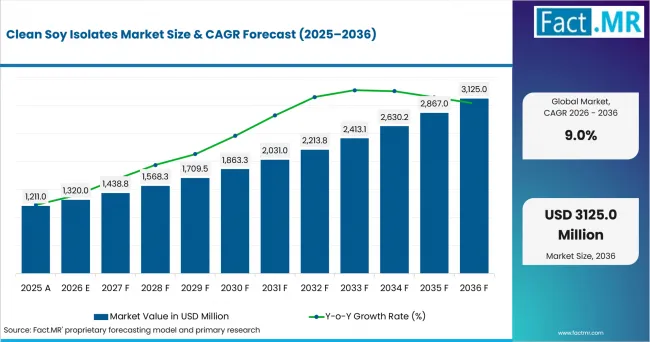
Clean Soy Isolates Market Value Analysis | Source: Fact.MR
What are the defining numbers behind Clean Soy Isolates Market growth?
An absolute opportunity of USD 1,805.0 million is expected between 2026 and 2036.
- Demand Drivers in the Market
- Beverage formulators need clean-tasting isolates that disperse smoothly in ready-to-mix powders. High solubility helps brands build dairy-free protein drinks with fewer stabilizer changes.
- Meat alternative teams require isolates that bind water and oil under heat. That function helps maintain bite and juiciness in patties, sausages and filled products.
- Nutrition brands need complete plant protein sources that work in low-sugar formats. Soy isolates help raise protein density while keeping texture manageable in bars and powders.
- The U.S. Bureau of Labor Statistics reported in June 2026 that food and beverage manufacturing is projected to add 130,000 jobs from 2024 to 2034. A larger processing base supports more pilot work for clean protein systems.
- Key Segments Analyzed
- By Product: Isolates are expected to hold 42.0% share in 2026 because they deliver higher protein concentration than concentrates and textured grades.
- By Process: Aqueous extraction is projected to account for 38.0% share in 2026 since ingredient teams prefer water-based routes for clean label positioning.
- By Function: Nutrition is anticipated to capture 36.0% share in 2026 owing to protein fortification across beverages, powders and snack formats.
- By Application: Meat alternatives are estimated to represent 35.0% share in 2026 as soy isolates support binding and texture in plant-based meat systems.
- Analyst Opinion at Fact.MR
- Shambhu Nath Jha, Principal Consultant at Fact.MR, states, “Clean soy isolate selection is becoming a formulation decision rather than a simple protein purchase. Brands are expected to evaluate taste, solubility and allergen communication together. Suppliers that pair isolate quality with process documentation and application support are better placed to win repeat trials.”
- Strategic Implications
- Ingredient manufacturers should document protein content, solubility and flavor performance across beverage and meat alternative formats.
- Application teams should test isolates under heat and shear conditions that mirror real plant processing lines.
- Sourcing teams should verify soybean origin, extraction route and allergen statements before approving commercial volumes.
- Regional distributors should connect clean soy isolates with formulation support for dairy-free nutrition and meat analogue launches. Brazil’s Ministry of Agriculture reported in April 2026 that soy complex exports reached US$ 12.13 billion in the first quarter of 2026.
The USA is expected to record 9.9% CAGR through 2036 because domestic soybean supply supports isolate availability. Germany follows at 9.5% CAGR with meat alternative processing and local soybean acreage supporting trials. Japan is projected to reach 8.8% CAGR because food-grade soybean channels already serve tofu and soy-food makers. France posts 8.5% CAGR with beverage and nutrition product development. Brazil reaches 8.1% CAGR as soybean scale supports ingredient economics.
How does the Clean Soy Isolates Market break down by segment?
Isolates lead Product at 42.0% share in 2026; meat alternatives lead Application at 35.0% share.
Which Product dominates?
Isolates are expected to hold 42.0% share in 2026.
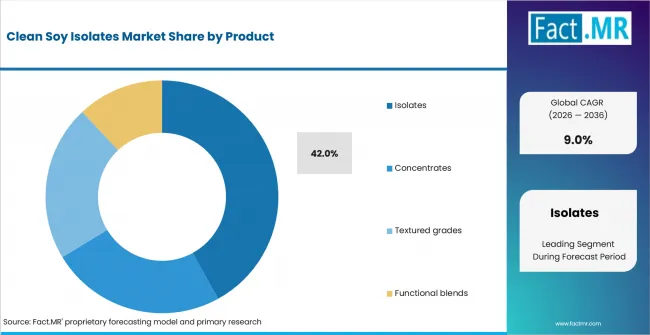
Clean Soy Isolates Market Analysis By Product | Source: Fact.MR
Isolates lead the product segment because they concentrate protein while reducing carbohydrate and fat content. Product teams use them when a formula needs a high protein claim without a heavy serving size. Concentrates remain useful where cost and texture take priority. Textured grades and functional blends serve products that need structure more than beverage clarity.
What leads the Process segment?
Aqueous extraction is projected to account for 38.0% share in 2026.
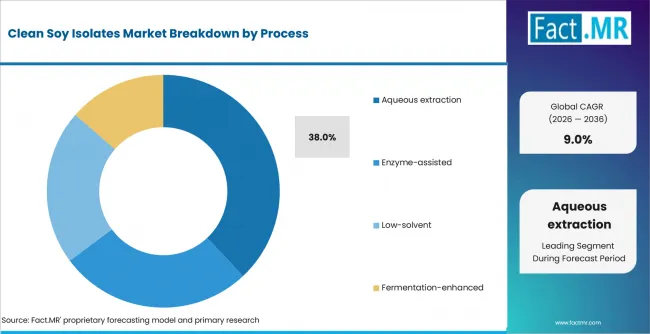
Clean Soy Isolates Market Analysis By Process | Source: Fact.MR
Aqueous extraction leads the process segment since it gives brands a clearer processing story. Clean soy isolate buyers often ask how the ingredient was separated and dried. Enzyme-assisted routes are used when digestibility or function needs adjustment. Low-solvent and fermentation-enhanced processes gain attention where technical performance must match cleaner positioning.
How does Function shape demand?
Nutrition is anticipated to lead with 36.0% share in 2026.
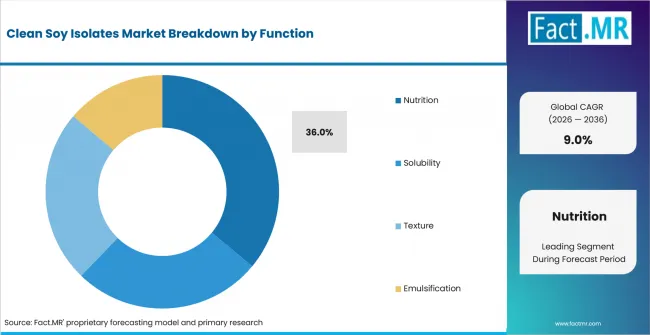
Clean Soy Isolates Market Analysis By Function | Source: Fact.MR
Nutrition leads because soy isolates allow high protein density in compact formats. Beverage makers use isolates for soluble protein delivery. Bar and powder developers use them to balance amino acid profile and mouthfeel. Solubility, texture and emulsification remain relevant functions where the formula must survive processing and storage.
What supports Meat alternatives within Application?
Meat alternatives are estimated to represent 35.0% share in 2026.
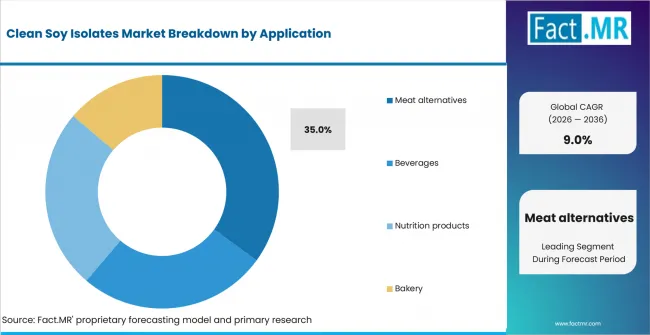
Clean Soy Isolates Market Analysis By Application | Source: Fact.MR
Meat alternatives lead application demand because soy isolates bind water and stabilize texture during cooking. Formed foods use them where bite and juiciness must survive heating. Beverages follow where solubility and taste control shape repeat purchase. BLS reported in June 2026 that beverage manufacturing is projected to add 37,800 wage and salary jobs from 2024 to 2034.
What is accelerating Clean Soy Isolates Market adoption, and what is holding it back?
Clean-label protein reformulation drives it; allergen review restrains it.
Drivers Impact Analysis
| Driver | (~) % Impact on CAGR | Geographic Relevance | Impact Timeline |
| Clean protein fortification in beverages | +1.1% | North America, East Asia | Short term (<= 2 years) |
| Meat alternative texture needs | +0.9% | Europe, North America | Medium term (2-4 years) |
| Water-based processing preference | +0.7% | Global | Medium term (2-4 years) |
| Soybean supply depth | +0.6% | USA, Brazil | Long term (>= 4 years) |
Source: Fact.MR analysis. Updated Aug 31, 2026
- Clean protein fortification in beverages: Beverage teams use soy isolates where plant protein must remain smooth after mixing. The function is expected to raise demand for isolates with high solubility and low flavor impact. Ready-to-mix formats give suppliers a clear route into sports nutrition and daily wellness drinks.
- Meat alternative texture needs: Meat-free products need water binding and heat stability to keep eating quality consistent. Soy isolates are projected to support that need in burgers, sausages and filled foods. Their role grows where protein claims and texture are evaluated in the same recipe.
- Water-based processing preference: Clean-label review places attention on the extraction route behind protein ingredients. Aqueous systems are anticipated to gain favor where brands want simpler process communication. That preference supports isolates positioned for clean formulation and food-grade documentation.
Opportunity Impact Analysis
| Opportunity | (~) % Impact on CAGR | Geographic Relevance | Impact Timeline |
| Dairy-free beverage mixes | +0.8% | USA, Japan | Short term (<= 2 years) |
| Clean meat analogue systems | +0.7% | Germany, France | Medium term (2-4 years) |
| Regional soy processing partnerships | +0.5% | Brazil, USA | Long term (>= 4 years) |
Source: Fact.MR analysis. Updated Aug 31, 2026
- Dairy-free beverage mixes: Powder drink brands need isolates that disperse with limited chalky texture. Clean soy isolates are expected to support smooth mouthfeel where dairy-free claims need stable protein delivery. Application testing remains central when sweeteners and flavors change.
- Clean meat analogue systems: Meat alternative brands need protein systems that hold moisture during cooking. Isolates are expected to support firmer bite and consistent juiciness. Application support becomes valuable when brands adjust fat content and seasonings at the same time.
- Regional soy processing partnerships: Local processing is expected to shorten ingredient approval and improve traceability. Food-grade fractionation projects gain value when brands want origin records and consistent protein quality. Regional partnerships can connect crop supply with isolate application support.
Restraints Impact Analysis
| Restraint | (~) % Impact on CAGR | Geographic Relevance | Impact Timeline |
| Soy allergen labeling review | -0.5% | Global | Short term (<= 2 years) |
| Flavor masking needs | -0.4% | USA, Japan | Medium term (2-4 years) |
| Competing plant proteins | -0.3% | Europe, North America | Long term (>= 4 years) |
Source: Fact.MR analysis. Updated Aug 31, 2026
- Soy allergen labeling review: Soy isolate adoption slows when brands must check package language and consumer restrictions. Allergen review adds time to beverage and snack approvals. Clear documentation helps product teams move faster through internal review.
- Flavor masking needs: Beany flavors are more visible in low-sugar products and clear beverage concepts. Isolates need sensory work before national launch. Suppliers that offer application testing can reduce reformulation cycles.
- Competing plant proteins: Pea, rice and wheat proteins compete where allergen position or texture is the main decision factor. Soy isolates must show a better balance of protein density and cost. That comparison is expected to remain visible in clean-label briefs.
Which countries are scaling the Clean Soy Isolates Market through 2036?
- The country comparison spans 1.8 percentage points between the USA and Brazil across the forecast period.
- The USA remains 0.4 percentage point above Germany as soybean supply and food manufacturing scale support isolate demand.
- Germany remains 0.7 percentage point above Japan because meat alternative output and local soybean acreage support product trials.
- Japan remains 0.3 percentage point above France as food-grade soybean channels support soy-food and nutrition applications.
- France remains 0.4 percentage point above Brazil where beverage development and oilseed acreage support clean protein use.
- Brazil closes the displayed range through soybean crop scale and export infrastructure.
Comparable CAGRs create different entry conditions due to soybean supply, clean-label review, allergen controls and application testing. Full report coverage includes North America, Latin America, Western Europe, Eastern Europe, East Asia, South Asia & Pacific, Middle East & Africa.
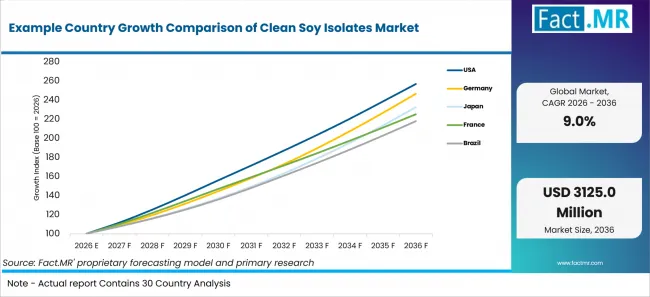
Example Country Growth Comparison Of Clean Soy Isolates Market | Source: Fact.MR
| Country | CAGR (2026-2036) |
|---|---|
| USA | 9.9% |
| Germany | 9.5% |
| Japan | 8.8% |
| France | 8.5% |
| Brazil | 8.1% |
Source: Fact.MR analysis. Updated Aug 31, 2026
What supports USA adoption?
9.9% CAGR, supported by soybean availability and food manufacturing scale.
U.S. formulators evaluate isolate performance first in beverages and meat alternatives. The USA is forecast to record 9.9% CAGR through 2036. USDA ERS reported in its August 2026 Oil Crops Outlook that U.S. soybean production for MY 2026/27 was forecast at 4.52 billion bushels.
How is Germany scaling demand?
9.5% CAGR, shaped by meat substitute production and local soy cultivation.
German food manufacturers test soy isolates where plant-based products need bite and moisture control. Germany is projected to post 9.5% CAGR through 2036. Destatis reported in May 2026 that Germany produced 124,900 tonnes of meat-substitute products in 2025.
What supports the Japan outlook?
8.8% CAGR, led by food-grade soybean channels and soy-food manufacturing.
Japan has a familiar soy-food base that helps clean isolate suppliers explain function to product developers. Japan is anticipated to reach 8.8% CAGR through 2036. USDA FAS/Tokyo reported on March 31, 2026 that Japan's MY 2025/26 soybean production area was estimated at 141,000 hectares; the report states that Japan's soybean production is focused on non-GE food-grade varieties.
What is supporting France's adoption?
8.5% CAGR, supported by beverage development and oilseed acreage.
French beverage and nutrition brands use isolates where plant protein must mix cleanly in powders and drinks. France is estimated to record 8.5% CAGR through 2036. Agreste reported in May 2026 that France’s oilseed area for 2026 was estimated at 2.3 million hectares, up about 7% year over year.
How does Brazil perform?
8.1% CAGR, supported by soybean crop scale and export infrastructure.
Brazilian processors have a large soybean base that can support food-grade fractionation when investment moves beyond crushing. Brazil is expected to reach 8.1% CAGR through 2036. IBGE estimated Brazil's 2026 soybean production at 174.8 million tonnes, a record in its time series and 5.3% above 2025.
Who leads the Clean Soy Isolates Market?
The company set profiled in this report includes ADM, Fuji Oil Co., Ltd., Wilmar International Limited and Shandong Yuwang Ecological Food Industry Co., Ltd..
ADM expanded its soy-protein portfolio in May 2026 with ProFam® 883, a soy protein isolate developed for beverages and powders and characterized by clean taste, high solubility and dispersibility.
Wilmar International Limited also participates through soy protein isolates, concentrates and texturized soy proteins, including highly soluble and readily dispersible isolates for nutritional beverages. Supplier assessment can consider product taste, solubility and dispersibility, sourcing attributes, and technical application capabilities.
Which companies are the key providers?
Key companies include ADM, Fuji Oil Co., Ltd., Wilmar International Limited and Shandong Yuwang Ecological Food Industry Co., Ltd..
- ADM
- Fuji Oil Co., Ltd.
- Wilmar International Limited
- Shandong Yuwang Ecological Food Industry Co., Ltd.
Bibliography
- ADM. (2026, May 20). ADM advances protein innovation with new ingredient solutions.
- Caray, J. (2026, May 12). Grandes cultures. Fort recul des surfaces de maïs, progression des oléagineux. Agreste.
- Hale, N., Ilic-Godfrey, S., & Mohiuddin, E. (2026, June 16). Feeding the economy: Employment growth in food and beverage manufacturing expected to continue through the 2024–34 decade. Monthly Labor Review. U.S. Bureau of Labor Statistics.
- Federal Statistical Office (Destatis). (2026, May 18). Nach jahrelangem Anstieg: Fleischersatz-Produktion sinkt 2025 um 1,2 % gegenüber dem Vorjahr.
- Brazilian Institute of Geography and Statistics. (2026, July 14). In June, IBGE estimates crops of 347.4 million tonnes for 2026. IBGE News Agency.
- Ministério da Agricultura e Pecuária. (2026, April 15). Agro brasileiro tem primeiro trimestre histórico em 2026, com mais de US$ 38 bilhões em exportações e superávit de US$ 33 bilhões.
- U.S. Department of Agriculture, National Agricultural Statistics Service. (2026, June 30). Corn planted acreage down 3% from 2025, soybean acreage up 5% from last year.
- Bukowski, M., & Swearingen, B. (2026, August 14). Oil Crops Outlook: August 2026 (OCS-26h). U.S. Department of Agriculture, Economic Research Service.
- Sasatani, D. (2026, March 31). Oilseeds and products annual: Japan (GAIN Report No. JA2026-0016). U.S. Department of Agriculture, Foreign Agricultural Service.
- Fuji Oil Co., Ltd. (2025, August 27). FUJI OIL Group Mid-Term Management Plan for FY2025–2027 “United for Growth 2027”.
This Report Answers
- The report explains where clean soy isolates are used across product and process segments. It also covers function and application demand.
- Segment analysis identifies isolates and aqueous extraction as the main data points shaping the 2026 view.
- Country analysis examines the USA, Germany, Japan, France and Brazil in relation to soybean supply and food processing needs.
- Competitive analysis reviews ADM, Fuji Oil Co., Ltd., Wilmar International Limited and Shandong Yuwang Ecological Food Industry Co., Ltd..
- Application analysis assesses how solubility, taste, binding and texture influence clean soy isolate use.
What does the Clean Soy Isolates Market cover?
The Clean Soy Isolates Market covers food-grade soy protein isolates used to increase protein density and improve function in finished foods. It includes isolates used in beverages, meat alternatives, nutrition products and bakery systems.
The assessment covers clean-label positioning where ingredient origin, extraction route and allergen communication affect approval. It separates isolate demand from broad soybean meal and animal feed uses.
What is included in the scope?
The scope includes commercial clean soy isolates sold into food and beverage formulation. It covers isolate grades used in meat alternatives, beverages, nutrition products and bakery applications.
Related formulation context includes plant protein ingredients, protein ingredients and non-GMO soy protein where those categories overlap with clean soy isolate selection.
What is excluded from the scope?
The scope excludes commodity soybean meal, animal-feed protein and edible oil products sold outside food-grade isolate applications.
It also excludes textured soy formats sold as finished meat analogues unless the isolate ingredient is separately supplied. Adjacent areas such as textured soy protein are treated as related markets when product form is the main purchase decision.
How Was the Analysis Built?
The analysis draws on 120+ sources, 35+ company portfolios, 25+ countries, and more than 20 industry interviews.
- Primary Research: Primary research includes discussions with ingredient manufacturers, distributors, food formulators, application teams, nutrition brands and meat alternative producers. These conversations examine product selection, approval needs, process route concerns and performance testing.
- Desk Research: Desk research covers government statistics, regulatory publications, company product pages, official announcements, agriculture data, food manufacturing data and public policy sources. Every source used in the analysis is listed in the bibliography.
- Market Sizing and Forecasting: Market estimates combine historical revenue, soybean availability, segment shares, application demand, country-level growth and provider participation. The model also reviews clean-label requirements and allergen communication needs.
- Data Validation and Update Cycle: Findings are validated by comparing interviews with public data, company activity, country statistics and ingredient portfolio mapping. Updates review product launches, crop shifts, application trends and changes in commercial adoption.
Segmentation
What is the report’s scope and coverage?
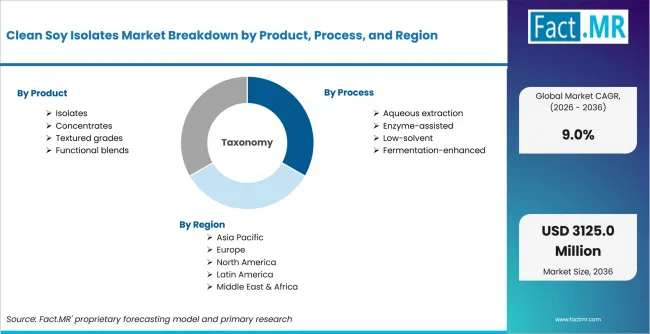
Clean Soy Isolates Market Breakdown By Product, Process, And Region | Source: Fact.MR
| Attribute | Details |
|---|---|
| Quantitative Units | USD million |
| Market Definition | Food-grade soy protein isolates positioned for cleaner ingredient lists, higher protein density and functional performance in beverages, meat alternatives, nutrition products and bakery uses. |
| Product | Isolates; Concentrates; Textured grades; Functional blends |
| Process | Aqueous extraction; Enzyme-assisted; Low-solvent; Fermentation-enhanced |
| Function | Nutrition; Solubility; Texture; Emulsification |
| Application | Meat alternatives; Beverages; Nutrition products; Bakery |
| Regions Covered | North America; Latin America; Western Europe; Eastern Europe; East Asia; South Asia & Pacific; Middle East & Africa |
| Countries Covered | USA; Germany; Japan; France; Brazil |
| Key Companies Profiled | ADM; Fuji Oil Co., Ltd.; Wilmar International Limited; Shandong Yuwang Ecological Food Industry Co., Ltd. |
| Forecast Period | 2026 to 2036 |
| Approach | Hybrid top-down and bottom-up approach using soybean availability; isolate function; application demand; country-level growth; provider portfolio review. |
Source: Fact.MR analysis. Updated Aug 31, 2026
How is the market segmented?
-
By Product:
- Isolates
- Concentrates
- Textured grades
- Functional blends
-
By Process:
- Aqueous extraction
- Enzyme-assisted
- Low-solvent
- Fermentation-enhanced
-
By Function:
- Nutrition
- Solubility
- Texture
- Emulsification
-
By Application:
- Meat alternatives
- Beverages
- Nutrition products
- Bakery
-
By Region:
- North America
- Latin America
- Western Europe
- Eastern Europe
- East Asia
- South Asia & Pacific
- Middle East & Africa
Frequently Asked Questions
How big is the clean soy isolates market in 2026?
What is the CAGR of the clean soy isolates market from 2026 to 2036?
Which product leads the clean soy isolates market?
Which process leads the clean soy isolates market?
Who are the leading companies in the clean soy isolates market?
Who worked on this report


Preview the report firsthand - request a free sample
Free SampleGet the brochure for pricing and purchase details
Download PDF