Tallow Market Size, Share, Growth and Forecast (2026 - 2036)
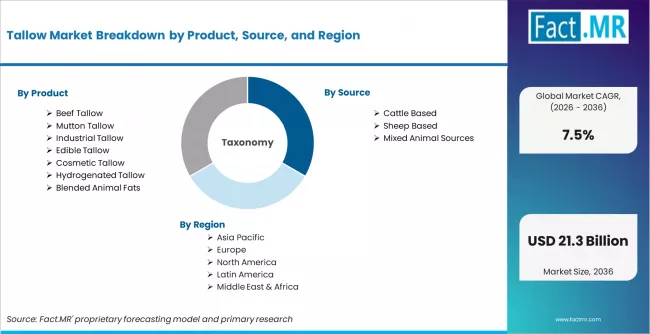
Tallow Market is segmented by Product (Beef Tallow, Mutton Tallow, Industrial Tallow, Edible Tallow, Cosmetic Tallow, Hydrogenated Tallow, Blended Animal Fats), Source (Cattle Based, Sheep Based, Mixed Animal Sources), Processing Type (Rendering Process, Purification, Refining, Hydrogenation), and Region, with forecasts covering the period from 2026 to 2036.
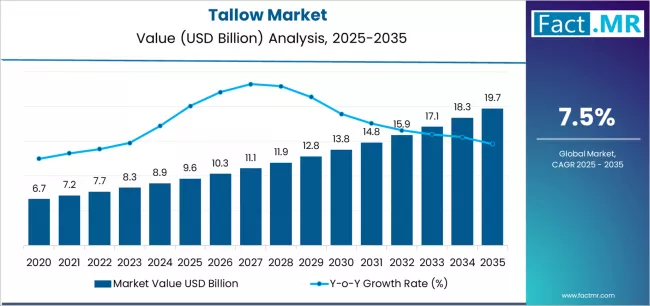
According to Fact.MR estimates, the global tallow Market was valued at USD 9.6 billion in 2025. The market is projected to reach USD 10.3 billion in 2026 and is expected to grow to USD 21.3 billion by 2036, expanding at a CAGR of 7.5%. Beef Tallow is anticipated to account for 42.0% of the product segment in 2026, while Cattle Based is expected to remain the leading application with around 72.0% share.
Tallow Market Analysis and Forecast by Fact.MR
- The global tallow market is estimated at USD 10.3 billion in 2026 and has been forecast to expand at a CAGR of 7.5% to reach USD 21.3 billion by 2036.
- Tallow encompasses rendered animal fats derived from cattle, sheep, and mixed animal sources, processed through wet rendering, dry rendering, purification, refining, hydrogenation, and fractionation methods.
- The market covers industrial, food, cosmetic, and pharmaceutical grade products used across biofuel production, food processing, personal care, industrial chemical feedstock, and animal feed applications.
- Growth is shaped by surging renewable diesel demand, food industry cooking fat revival, personal care ingredient trends favoring natural inputs, and expanding industrial oleochemical applications.
Summary of Tallow Market
- Market Snapshot
- In 2025, the global Tallow Market was valued at approximately USD 9.6 billion.
- The market is estimated to reach USD 10.3 billion in 2026 and is projected to attain USD 21.3 billion by 2036.
- The tallow market is likely to expand at a CAGR of 7.5% during the forecast period.
- The market is anticipated to create an absolute dollar opportunity of USD 11.0 billion between 2026 and 2036.
- Beef tallow accounts for 42.0% of product segment share in 2026, led by rendered beef fat and premium food-grade beef tallow.
- India (9.1%) and South Africa (8.9%) are the key growth markets during the forecast period.
- Demand and Growth Drivers
- Accelerating renewable diesel and sustainable aviation fuel demand is creating the largest volume growth opportunity for tallow as a feedstock, with major refineries expanding capacity to process animal fat inputs.
- Revival of traditional cooking fats, driven by consumer preference for natural, minimally processed food ingredients and growing skepticism of seed oils, is increasing food-grade tallow demand in North America and Europe.
- Expanding use of tallow-derived oleochemicals in personal care, soaps, and industrial applications is creating stable demand channels for processed and refined tallow grades.
- Growing animal feed industry demand for energy-dense fat additives is supporting tallow consumption in livestock and pet food manufacturing.
- Rendering industry efficiency improvements and waste-to-value programs are increasing available tallow supply from meat processing byproducts.
- Product and Segment View
- Beef tallow accounts for 42.0% of the product segment in 2026, reflecting the largest available supply volume from cattle rendering operations and the broadest application range across biofuel, food, and industrial end uses.
- Biofuel applications represent 30.0% of the end use segment in 2026, driven by growing renewable diesel refinery capacity and policy mandates requiring renewable feedstock blending in transportation fuels.
- Industrial-grade tallow holds 34.0% of the grade segment in 2026, serving as the primary feedstock for soap manufacturing, chemical processing, and oleochemical production.
- Key segmentation includes:
- Product: Beef tallow (rendered beef fat, premium food-grade), Mutton tallow (sheep-derived, rendered sheep fat), Industrial tallow (crude animal fat, stearin-rich), Edible tallow (food-grade cooking, refined culinary), Cosmetic tallow (personal care grade, skincare fat base), Hydrogenated tallow, Blended animal fats
- Source: Cattle-based (beef processing byproduct, rendering plant derived), Sheep-based (mutton processing, lamb fat rendering), Mixed animal sources
- Application: Biofuel (biodiesel feedstock, renewable diesel input), Food industry (frying fat, bakery shortening, traditional cooking fat), Personal care (soaps and cleansers, skincare products), Industrial applications (candles, lubricants, chemical feedstock), Animal feed (feed energy additive, pet food fat source)
- Grade: Industrial grade, Food grade, Cosmetic grade, Pharmaceutical grade
- These systems enable:
- Renewable feedstock supply for biodiesel and renewable diesel production at commercial refinery scale
- Natural, minimally processed cooking fat for food industry and consumer culinary applications
- Oleochemical raw material for soap, candle, lubricant, and personal care product manufacturing
- Geography and Competitive Outlook
- North America and South America are major supply and demand regions, with the USA and Brazil benefiting from large cattle rendering operations and growing renewable diesel refinery capacity.
- Europe maintains steady demand for tallow in oleochemical, soap, and biofuel applications, supported by renewable energy directives and established rendering infrastructure.
- Asia Pacific and Africa are the fastest-growing regions as India and South Africa expand industrial tallow demand, biofuel blending programs, and animal feed manufacturing.
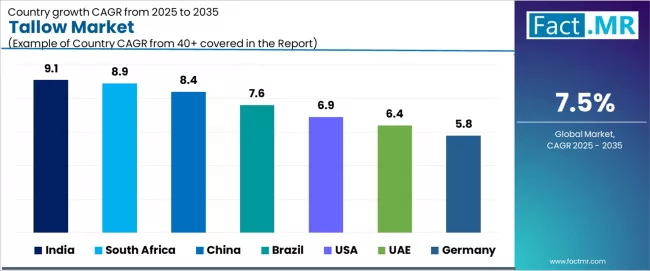
- India (9.1%) and South Africa (8.9%) lead country-level growth, while China (8.4%), Brazil (7.6%), USA (6.9%), UAE (6.4%), and Germany (5.8%) maintain steady expansion.
- Leading companies include Darling Ingredients, SARIA SE & Co. KG, Cargill, Ajinomoto Co. Inc., Vantage Specialty Chemicals, Jacob Stern & Sons, Australian Tallow Producers, Parchem, Baker Commodities Inc., and Caila & Pares.
- Analyst Opinion
- Shambhu Nath Jha, Principal Consultant at Fact.MR, says 'The tallow market is experiencing a structural revaluation as demand shifts from a low-value rendering byproduct to a strategically important renewable feedstock. The biofuel sector is the largest growth driver, with renewable diesel refineries competing with traditional soap, oleochemical, and food buyers for available supply. This demand competition is elevating tallow pricing and incentivizing rendering capacity expansion. Food-grade tallow is also experiencing a renaissance driven by the clean-label and natural cooking fat movement. Companies positioned at the intersection of reliable rendering supply, quality grading capability, and multi-channel distribution across biofuel, food, and industrial end uses will capture the strongest commercial positions through 2036.'
Key Growth Drivers, Constraints, and Opportunities
Key Factors Driving Growth
- Renewable diesel refinery capacity expansion globally is creating the largest volume demand channel for tallow, with facilities in the USA, Europe, and Asia Pacific increasingly processing animal fats as feedstock.
- Food-grade tallow demand is experiencing a consumer-driven renaissance as natural cooking fat preferences grow, supported by the clean-label movement and growing skepticism of highly processed seed oils.
- Industrial oleochemical demand remains a stable growth base, with tallow-derived fatty acids and glycerine supporting soap, candle, lubricant, and chemical manufacturing across global markets.
Key Market Constraints
- Supply is inherently linked to meat processing volumes, creating a structural ceiling on available tallow that cannot be rapidly expanded independently of livestock slaughter rates.
- Competing demand from biofuel, food, and industrial buyers is creating price volatility that challenges cost-sensitive end users, particularly in soap and animal feed applications.
- Regulatory restrictions on animal-derived products in some markets, including vegetarian and vegan consumer segments, limit addressable market expansion in food and personal care categories.
Key Opportunity Areas
- Renewable diesel and sustainable aviation fuel mandate expansion represents the highest-growth demand channel, with government policies in the USA, EU, and emerging markets creating predictable volume demand for tallow feedstock.
- Food-grade beef tallow premiumization, driven by the carnivore diet movement, clean-label cooking trends, and artisan food production, creates higher-margin product opportunities for quality-certified tallow producers.
- Emerging market rendering infrastructure development in India, South Africa, and Southeast Asia represents untapped supply-side growth that could increase global tallow availability while serving growing local industrial demand.
Segment-wise Analysis of the Tallow Market
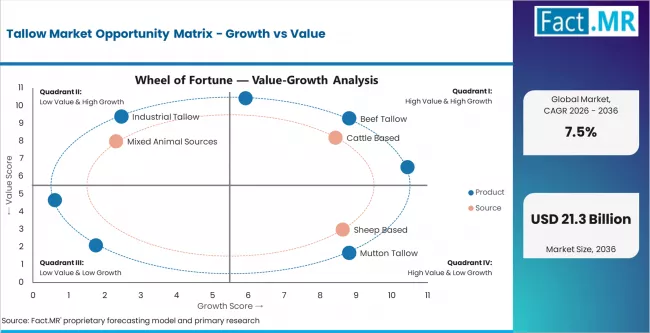
- Beef tallow holds 42.0% of the product segment in 2026, reflecting the largest supply volumes from cattle rendering operations and the broadest application versatility across biofuel, food, and industrial end uses.
- Biofuel applications represent 30.0% of the end use segment in 2026, driven by renewable diesel refinery expansion and government feedstock blending mandates.
- Cattle-based sources account for 72.0% of the source segment in 2026, reflecting the dominance of beef processing byproducts in global tallow supply.
The tallow market is segmented by product type, source, processing type, grade, application, and region. By product, the market covers beef tallow, mutton tallow, industrial tallow, edible tallow, cosmetic tallow, hydrogenated tallow, and blended animal fats. By application, coverage includes biofuel, food industry, personal care, industrial applications, and animal feed. Beef tallow leads by value because of the largest available supply volumes and broadest end-use versatility, while food-grade categories represent the highest per-unit value product tier.
Which Product Segment Dominates the Tallow Market?
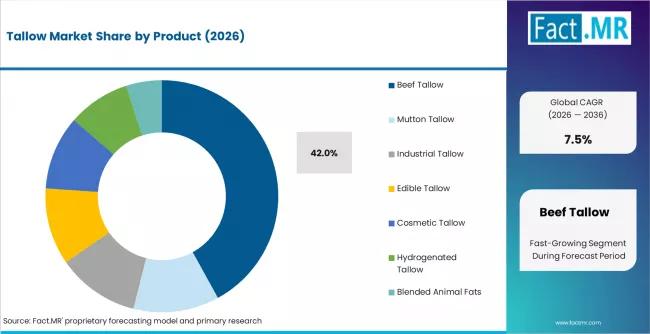
Beef tallow is expected to account for 42.0% of the product segment value in 2026. This leadership reflects the dominance of cattle processing in global meat production, which generates the largest volumes of rendering byproducts suitable for tallow production. Rendered beef fat serves as the primary feedstock for renewable diesel, the largest food-grade tallow supply source, and the main industrial oleochemical raw material.
Within beef tallow, premium food-grade variants are the fastest-growing sub-category, commanding higher pricing in retail and food service channels. Industrial-grade and mutton tallow serve more specialized applications, while blended animal fats offer cost-competitive options for price-sensitive industrial buyers. The product mix is shifting toward higher-grade categories as demand competition between biofuel and food end uses elevates overall tallow value.
Which Application Segment Dominates the Tallow Market?
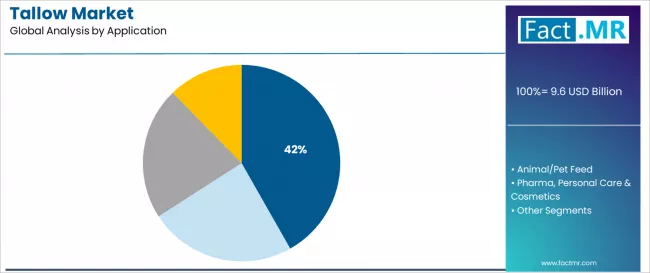
Biofuel applications are expected to hold 30.0% of the end use segment value in 2026. Demand is driven by expanding renewable diesel refinery capacity in the USA, Europe, and Asia Pacific, where animal fats including tallow serve as a cost-effective feedstock alternative to vegetable oils. Government mandates requiring renewable content in transportation fuels provide predictable demand floor.
Food industry applications represent the second largest end use, with tallow used as frying fat, bakery shortening, and traditional cooking fat. Personal care (soaps, skincare), industrial applications (candles, lubricants, chemical feedstock), and animal feed round out the end-use portfolio. The competitive tension between biofuel and food/industrial buyers for available tallow supply is a key structural feature of the market.
Which Product Trend is Shaping the Next Phase of Growth in the Tallow Market?
The convergence of renewable fuel demand and food-grade tallow revival is the defining trend shaping the market. On the biofuel side, renewable diesel refinery expansions in the USA, driven by Renewable Fuel Standard mandates and state-level low carbon fuel programs, are creating large-scale demand for tallow feedstock that competes directly with food and industrial buyers. This demand competition is structurally elevating tallow pricing above historical levels.
Simultaneously, the food-grade tallow segment is experiencing a consumer-driven renaissance. The growing skepticism of highly processed seed oils, combined with the clean-label and natural cooking fat movement, is driving demand for rendered beef tallow in both retail and food service channels. Premium food-grade tallow products are commanding significant price premiums over industrial grades. This dual demand growth from both biofuel and food channels is creating a market environment where tallow is transitioning from a low-value rendering byproduct to a strategically valued commodity with multiple competing high-value end uses.
Regional Outlook Across Key Markets
.webp)
- India leads growth at 9.1%, supported by expanding industrial demand for oleochemicals and soap manufacturing, growing biofuel blending mandates, and rendering infrastructure development.
- South Africa at 8.9% benefits from growing industrial tallow demand, animal feed manufacturing expansion, and increasing regional processing capacity.
- China (8.4%) and Brazil (7.6%) reflect strong demand from biofuel, food, and industrial sectors, while USA (6.9%) grows through renewable diesel expansion and food-grade tallow premiumization.
- UAE (6.4%) and Germany (5.8%) maintain steady growth through industrial oleochemical demand and sustainability-linked biofuel applications.
CAGR Table
| Country | CAGR (%) |
|---|---|
| India | 9.1% |
| South Africa | 8.9% |
| China | 8.4% |
| Brazil | 7.6% |
| USA | 6.9% |
| UAE | 6.4% |
| Germany | 5.8% |
Source: Fact MR (FMR) analysis, based on proprietary forecasting model and primary research.
Market Outlook for Tallow in the United States
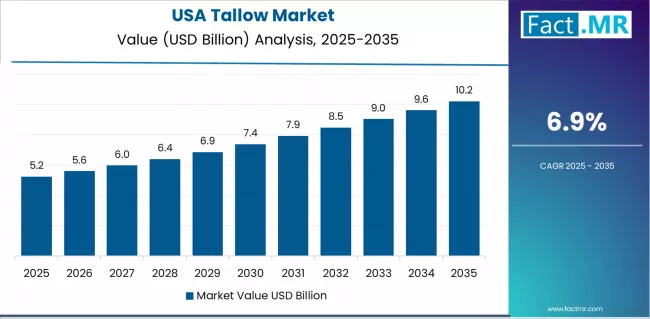
The US tallow market is projected to grow at a CAGR of 6.9% through 2036. Demand is driven by expanding renewable diesel refinery capacity, food-grade tallow premiumization, and sustained oleochemical and animal feed demand.
- Renewable diesel expansion creates large-scale feedstock demand.
- Food-grade tallow revival drives premiumization.
- Established rendering infrastructure supports reliable supply.
Tallow Demand Trends in India
The India tallow market is projected to grow at a CAGR of 9.1% through 2036, the fastest among countries studied. Growth is supported by expanding industrial oleochemical demand, soap manufacturing growth, and increasing biofuel blending mandates.
- Industrial oleochemical demand creates growing consumption base.
- Soap manufacturing growth sustains tallow procurement volumes.
- Rendering infrastructure development improves domestic supply.
China Tallow Market Growth Assessment
The China tallow market is projected to grow at a CAGR of 8.4% through 2036. Growth is driven by industrial demand for oleochemicals, biofuel feedstock procurement, and food processing applications.
- Industrial oleochemical production drives tallow consumption.
- Biofuel mandates create growing feedstock demand channels.
- Food processing applications contribute stable base demand.
Brazil Tallow Market Outlook
The Brazil tallow market is projected to grow at a CAGR of 7.6% through 2036. Demand is supported by the country's position as a major cattle producer, expanding biodiesel blending mandates, and strong domestic soap and oleochemical manufacturing.
- Major cattle production generates large rendering supply volumes.
- Biodiesel blending mandates drive feedstock demand growth.
- Soap and oleochemical manufacturing sustain industrial demand.
Germany Tallow Market Demand Analysis
The Germany tallow market is projected to grow at a CAGR of 5.8% through 2036. Demand is supported by EU renewable energy directive compliance, established oleochemical manufacturing, and pharmaceutical-grade tallow applications.
- EU renewable directives support biofuel feedstock demand.
- Oleochemical manufacturing provides stable industrial demand.
- Pharmaceutical-grade applications support premium product positioning.
Competitive Benchmarking and Company Positioning
Tallow Market Analysis By Company
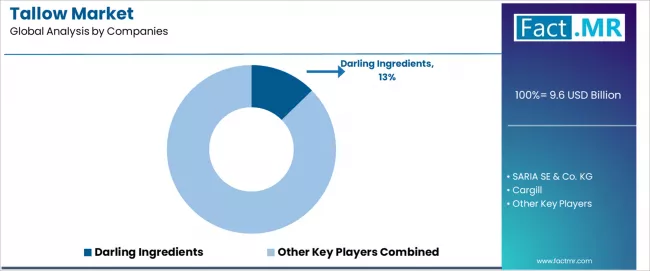
- Darling Ingredients, SARIA SE & Co. KG, and Cargill hold the strongest global positions through integrated rendering and processing operations, multi-grade product portfolios, and established distribution across biofuel, food, and industrial end-use channels.
- Ajinomoto Co. Inc., Vantage Specialty Chemicals, and Jacob Stern & Sons compete across specific grade categories and geographic markets, with differentiation shaped by product quality, application expertise, and customer relationships.
- Competition is increasingly defined by the ability to manage multi-channel demand allocation, maintain supply reliability despite competing end-use demand pressures, and offer certified quality grades across food, industrial, and biofuel specifications.
The competitive landscape is moderately fragmented, with Darling Ingredients maintaining an estimated 12.7% market share as the world's largest publicly traded rendering company. Darling's strength lies in its integrated rendering network that collects, processes, and distributes tallow across biofuel, food, and industrial channels, with its Diamond Green Diesel joint venture directly consuming tallow as renewable diesel feedstock.
SARIA SE & Co. KG and Cargill compete as major global processors with integrated supply chains spanning rendering, refining, and distribution. Baker Commodities and Australian Tallow Producers maintain strong regional positions in North America and Oceania respectively.
The growing competition between biofuel, food, and industrial buyers for available tallow supply is reshaping competitive dynamics. Companies with vertically integrated operations that span rendering through end-use processing have structural advantages in managing supply allocation and capturing value across the chain.
Strategic priorities include expanding rendering capacity to increase available supply, investing in quality grading and certification to serve premium food and pharmaceutical markets, building biofuel refinery partnerships for feedstock offtake agreements, and developing emerging market processing infrastructure to access growing demand in Asia Pacific and Africa.
Key Companies in the Tallow Market
Darling Ingredients, SARIA SE & Co. KG, and Cargill are among the leading players globally, supported by integrated rendering operations, global distribution networks, and multi-channel customer portfolios.
Ajinomoto Co. Inc., Vantage Specialty Chemicals, and Jacob Stern & Sons hold established positions across specific grades and regional markets.
Australian Tallow Producers, Parchem, Baker Commodities Inc., and Caila & Pares compete through regional processing strength and specialized grade offerings.
Recent Industry Developments
- Darling Ingredients, Renewable Diesel Capacity Expansion (2025)
- Darling Ingredients continued expanding its tallow-to-renewable diesel supply chain through the Diamond Green Diesel joint venture, increasing feedstock procurement and processing capacity to serve growing US renewable diesel demand.
- Cargill, Animal Nutrition and Rendering Operations Update (2025)
- Cargill maintained its integrated tallow processing and distribution operations across biofuel, food, and animal nutrition channels, with continued investment in rendering efficiency and supply chain optimization across multiple geographic markets.
- SARIA SE & Co. KG, European Rendering Operations Expansion (2025)
- SARIA continued expanding its European rendering and processing operations, strengthening its position as a leading supplier of tallow for biofuel, oleochemical, and industrial applications across EU markets.
Leading Companies Shaping the Tallow Market
- Darling Ingredients
- SARIA SE & Co. KG
- Cargill
- Ajinomoto Co., Inc.
- Vantage Specialty Chemicals
- Jacob Stern & Sons
- Australian Tallow Producers
- Parchem
- Baker Commodities Inc.
- Caila & Pares
Sources and Research References
- Darling Ingredients. Financial filings and Diamond Green Diesel joint venture data.
- SARIA SE & Co. KG. European rendering operations and capacity data.
- Cargill. Animal nutrition and rendering operations updates.
- US Environmental Protection Agency. Renewable Fuel Standard compliance data.
- Primary interviews with renderers, commodity traders, biofuel producers, food manufacturers, and oleochemical companies.
This bibliography is provided for reader reference and is not exhaustive. The full report contains the complete reference list and detailed citations.
Key Questions This Report Addresses
- What is the current and future size of the Tallow Market?
- How fast is the market expected to grow?
- Which product type is likely to lead?
- Which application segment is expected to account for the highest demand?
- How is renewable diesel demand reshaping the tallow market?
- Why are India and South Africa the fastest-growing markets?
- Who are the key companies active in the market?
- How does Fact.MR estimate and validate the market forecast?
Tallow Market Definition
The tallow market covers rendered animal fats derived from cattle, sheep, and mixed animal sources, processed through rendering, purification, refining, and modification methods, sold across industrial, food, cosmetic, pharmaceutical, and biofuel grade applications.
MarketTallow Market
- The scope covers global and regional market size and forecasts for 2026 to 2036 across product type, source, processing type, grade, application, and region.
- It includes regional demand analysis based on meat processing volumes, rendering capacity, biofuel blending mandates, and oleochemical industry activity.
- The report covers pricing and cost analysis across tallow grades and application categories, including feedstock pricing dynamics driven by competing end-use demand.
- It includes supply chain analysis, sustainability trends, and the competitive landscape of leading tallow renderers and traders.
Tallow Market Exclusions
- The scope excludes vegetable oils and plant-based fats that compete with tallow in some applications but are not animal-derived.
- It excludes fresh meat and unprocessed animal byproducts prior to rendering.
- The report excludes downstream finished products such as consumer soaps, candles, and biodiesel sold at retail, which use tallow as an input.
- It also excludes synthetic oleochemicals produced from petroleum-based feedstocks without animal fat content.
Tallow Market Research Methodology
- The methodology combines secondary research, primary interviews, and forecast modelling.
- It draws on 100+ secondary sources and benchmarks 45+ company product and trading portfolios.
- Market sizing covers 30+ countries through a demand-side model, supported by top-down validation.
- Key inputs include meat processing and rendering volumes, biofuel blending mandates, oleochemical production data, food-grade tallow consumption, and pricing trends.
- The model cross-checks demand with trade flow data, rendering capacity, and pricing movements.
- Primary validation includes 20+ interviews across renderers, commodity traders, biofuel producers, food manufacturers, and oleochemical companies.
- Final estimates go through trade-flow checks, supply-demand balance review, and sensitivity testing.
Scope of Analysis

| Parameter | Details |
|---|---|
| Quantitative Units | USD 10.3 billion to USD 21.3 billion, at a CAGR of 7.5% |
| Market Definition | The Tallow Market covers rendered animal fats from cattle, sheep, and mixed sources across industrial, food, cosmetic, pharmaceutical, and biofuel grade applications. |
| Regions Covered | North America, Latin America, Europe, East Asia, South Asia and Pacific, Middle East and Africa |
| Countries Covered | USA, India, South Africa, China, Brazil, UAE, Germany, 30 plus countries |
| Key Companies | Darling Ingredients, SARIA SE, Cargill, Ajinomoto, Vantage Specialty Chemicals, Jacob Stern & Sons, Australian Tallow Producers, Parchem, Baker Commodities, Caila & Pares |
| Forecast Period | 2026 to 2036 |
| Approach | Hybrid demand-side and top-down methodology built on meat processing volumes, rendering capacity data, biofuel blending mandates, oleochemical production statistics, and primary interviews across renderers, commodity traders, and end users |
Tallow Market Segmentation
-
Tallow Market Segmented by Product:
- Beef Tallow
- Rendered Beef Fat
- Premium Food Grade Beef Tallow
- Mutton Tallow
- Sheep Derived Tallow
- Rendered Sheep Fat
- Industrial Tallow
- Crude Animal Fat Tallow
- Stearin Rich Tallow
- Edible Tallow
- Food Grade Cooking Tallow
- Refined Culinary Tallow
- Cosmetic Tallow
- Personal Care Grade Tallow
- Skincare Fat Base
- Hydrogenated Tallow
- Processed Hard Fat
- Fatty Acid Modified Tallow
- Blended Animal Fats
- Tallow Lard Blends
- Animal Vegetable Fat Blends
- Beef Tallow
-
Tallow Market Segmented by Source:
- Cattle Based
- Beef Processing Byproduct
- Rendering Plant Derived Fat
- Sheep Based
- Mutton Processing Fat
- Lamb Fat Rendering
- Mixed Animal Sources
- Multi Species Rendering Facilities
- Rendering Waste Streams
- Cattle Based
-
Tallow Market Segmented by Processing Type:
- Rendering Process
- Wet Rendering
- Dry Rendering
- Purification
- Degumming Process
- Deodorization Process
- Refining
- Bleaching and Filtration
- Fractionation Process
- Hydrogenation
- Fat Hardening Process
- Fat Stability Enhancement
- Rendering Process
-
Tallow Market Segmented by Grade:
- Industrial Grade Tallow
- Soap Manufacturing Grade
- Chemical Processing Grade
- Food Grade Tallow
- Edible Cooking Fat
- Bakery Fat Ingredient
- Cosmetic Grade Tallow
- Skincare Ingredient Grade
- Balm and Lotion Base
- Pharmaceutical Grade
- Medical Ointment Base
- Functional Lipid Carrier
- Industrial Grade Tallow
-
Tallow Market Segmented by Application:
- Biofuel
- Biodiesel Feedstock
- Renewable Diesel Input
- Food Industry
- Frying Fat
- Bakery Shortening
- Traditional Cooking Fat
- Personal Care
- Soaps and Cleansers
- Skincare Products
- Industrial Applications
- Candles
- Lubricants
- Chemical Feedstock
- Animal Feed
- Feed Energy Additive
- Pet Food Fat Source
- Biofuel
-
Tallow Market by Region:
- North America
- USA
- Canada
- Mexico
- Latin America
- Brazil
- Chile
- Rest of Latin America
- Western Europe
- Germany
- UK
- Italy
- Spain
- France
- Nordic
- BENELUX
- Rest of Western Europe
- Eastern Europe
- Russia
- Poland
- Hungary
- Balkan & Baltic
- Rest of Eastern Europe
- East Asia
- China
- Japan
- South Korea
- South Asia and Pacific
- India
- ASEAN
- Australia & New Zealand
- Rest of South Asia and Pacific
- Middle East & Africa
- Kingdom of Saudi Arabia
- Other GCC Countries
- Turkiye
- South Africa
- Other African Union
- Rest of Middle East & Africa
- North America
- Frequently Asked Questions -
How big is the tallow market in 2025?
The global tallow market is estimated to be valued at USD 9.6 billion in 2025.
What will be the size of the tallow market in 2036?
The market size is projected to reach USD 21.3 billion by 2036.
How much will the tallow market grow between 2026 and 2036?
The tallow market is expected to grow at a 7.5% CAGR between 2026 and 2036.
What are the key product types?
Key product types include beef tallow, mutton tallow, industrial tallow, edible tallow, cosmetic tallow, hydrogenated tallow, and blended animal fats.
Which are the fastest-growing countries?
India (9.1%) and South Africa (8.9%) are the fastest-growing countries during the forecast period.
Table of Content
- Executive Summary
- Global Market Outlook
- Demand to side Trends
- Supply to side Trends
- Technology Roadmap Analysis
- Analysis and Recommendations
- Market Overview
- Market Coverage / Taxonomy
- Market Definition / Scope / Limitations
- Research Methodology
- Chapter Orientation
- Analytical Lens and Working Hypotheses
- Market Structure, Signals, and Trend Drivers
- Benchmarking and Cross-market Comparability
- Market Sizing, Forecasting, and Opportunity Mapping
- Research Design and Evidence Framework
- Desk Research Programme (Secondary Evidence)
- Company Annual and Sustainability Reports
- Peer-reviewed Journals and Academic Literature
- Corporate Websites, Product Literature, and Technical Notes
- Earnings Decks and Investor Briefings
- Statutory Filings and Regulatory Disclosures
- Technical White Papers and Standards Notes
- Trade Journals, Industry Magazines, and Analyst Briefs
- Conference Proceedings, Webinars, and Seminar Materials
- Government Statistics Portals and Public Data Releases
- Press Releases and Reputable Media Coverage
- Specialist Newsletters and Curated Briefings
- Sector Databases and Reference Repositories
- Fact.MR Internal Proprietary Databases and Historical Market Datasets
- Subscription Datasets and Paid Sources
- Social Channels, Communities, and Digital Listening Inputs
- Additional Desk Sources
- Expert Input and Fieldwork (Primary Evidence)
- Primary Modes
- Qualitative Interviews and Expert Elicitation
- Quantitative Surveys and Structured Data Capture
- Blended Approach
- Why Primary Evidence is Used
- Field Techniques
- Interviews
- Surveys
- Focus Groups
- Observational and In-context Research
- Social and Community Interactions
- Stakeholder Universe Engaged
- C-suite Leaders
- Board Members
- Presidents and Vice Presidents
- R&D and Innovation Heads
- Technical Specialists
- Domain Subject-matter Experts
- Scientists
- Physicians and Other Healthcare Professionals
- Governance, Ethics, and Data Stewardship
- Research Ethics
- Data Integrity and Handling
- Primary Modes
- Tooling, Models, and Reference Databases
- Desk Research Programme (Secondary Evidence)
- Data Engineering and Model Build
- Data Acquisition and Ingestion
- Cleaning, Normalisation, and Verification
- Synthesis, Triangulation, and Analysis
- Quality Assurance and Audit Trail
- Market Background
- Market Dynamics
- Drivers
- Restraints
- Opportunity
- Trends
- Scenario Forecast
- Demand in Optimistic Scenario
- Demand in Likely Scenario
- Demand in Conservative Scenario
- Opportunity Map Analysis
- Product Life Cycle Analysis
- Supply Chain Analysis
- Investment Feasibility Matrix
- Value Chain Analysis
- PESTLE and Porter’s Analysis
- Regulatory Landscape
- Regional Parent Market Outlook
- Production and Consumption Statistics
- Import and Export Statistics
- Market Dynamics
- Global Market Analysis 2021 to 2025 and Forecast, 2026 to 2036
- Historical Market Size Value (USD Million) Analysis, 2021 to 2025
- Current and Future Market Size Value (USD Million) Projections, 2026 to 2036
- Y to o to Y Growth Trend Analysis
- Absolute $ Opportunity Analysis
- Global Market Pricing Analysis 2021 to 2025 and Forecast 2026 to 2036
- Global Market Analysis 2021 to 2025 and Forecast 2026 to 2036, By Product
- Introduction / Key Findings
- Historical Market Size Value (USD Million) Analysis By Product, 2021 to 2025
- Current and Future Market Size Value (USD Million) Analysis and Forecast By Product, 2026 to 2036
- Beef Tallow
- Rendered Beef Fat
- Premium Food Grade Beef Tallow
- Mutton Tallow
- Sheep Derived Tallow
- Rendered Sheep Fat
- Industrial Tallow
- Crude Animal Fat Tallow
- Stearin Rich Tallow
- Edible Tallow
- Food Grade Cooking Tallow
- Refined Culinary Tallow
- Cosmetic Tallow
- Personal Care Grade Tallow
- Skincare Fat Base
- Hydrogenated Tallow
- Processed Hard Fat
- Fatty Acid Modified Tallow
- Blended Animal Fats
- Tallow Lard Blends
- Animal Vegetable Fat Blends
- Beef Tallow
- Y to o to Y Growth Trend Analysis By Product, 2021 to 2025
- Absolute $ Opportunity Analysis By Product, 2026 to 2036
- Global Market Analysis 2021 to 2025 and Forecast 2026 to 2036, By Source
- Introduction / Key Findings
- Historical Market Size Value (USD Million) Analysis By Source, 2021 to 2025
- Current and Future Market Size Value (USD Million) Analysis and Forecast By Source, 2026 to 2036
- Cattle Based
- Beef Processing Byproduct
- Rendering Plant Derived Fat
- Sheep Based
- Mutton Processing Fat
- Lamb Fat Rendering
- Mixed Animal Sources
- Multi Species Rendering Facilities
- Rendering Waste Streams
- Cattle Based
- Y to o to Y Growth Trend Analysis By Source, 2021 to 2025
- Absolute $ Opportunity Analysis By Source, 2026 to 2036
- Global Market Analysis 2021 to 2025 and Forecast 2026 to 2036, By Processing Type
- Introduction / Key Findings
- Historical Market Size Value (USD Million) Analysis By Processing Type, 2021 to 2025
- Current and Future Market Size Value (USD Million) Analysis and Forecast By Processing Type, 2026 to 2036
- Rendering Process
- Wet Rendering
- Dry Rendering
- Purification
- Degumming Process
- Deodorization Process
- Refining
- Bleaching and Filtration
- Fractionation Process
- Hydrogenation
- Fat Hardening Process
- Fat Stability Enhancement
- Rendering Process
- Y to o to Y Growth Trend Analysis By Processing Type, 2021 to 2025
- Absolute $ Opportunity Analysis By Processing Type, 2026 to 2036
- Global Market Analysis 2021 to 2025 and Forecast 2026 to 2036, By Grade
- Introduction / Key Findings
- Historical Market Size Value (USD Million) Analysis By Grade, 2021 to 2025
- Current and Future Market Size Value (USD Million) Analysis and Forecast By Grade, 2026 to 2036
- Industrial Grade Tallow
- Soap Manufacturing Grade
- Chemical Processing Grade
- Food Grade Tallow
- Edible Cooking Fat
- Bakery Fat Ingredient
- Cosmetic Grade Tallow
- Skincare Ingredient Grade
- Balm and Lotion Base
- Pharmaceutical Grade
- Medical Ointment Base
- Functional Lipid Carrier
- Industrial Grade Tallow
- Y to o to Y Growth Trend Analysis By Grade, 2021 to 2025
- Absolute $ Opportunity Analysis By Grade, 2026 to 2036
- Global Market Analysis 2021 to 2025 and Forecast 2026 to 2036, By Application
- Introduction / Key Findings
- Historical Market Size Value (USD Million) Analysis By Application, 2021 to 2025
- Current and Future Market Size Value (USD Million) Analysis and Forecast By Application, 2026 to 2036
- Biofuel
- Biodiesel Feedstock
- Renewable Diesel Input
- Food Industry
- Frying Fat
- Bakery Shortening
- Traditional Cooking Fat
- Personal Care
- Soaps and Cleansers
- Skincare Products
- Industrial Applications
- Candles
- Lubricants
- Chemical Feedstock
- Animal Feed
- Feed Energy Additive
- Pet Food Fat Source
- Biofuel
- Y to o to Y Growth Trend Analysis By Application, 2021 to 2025
- Absolute $ Opportunity Analysis By Application, 2026 to 2036
- Global Market Analysis 2021 to 2025 and Forecast 2026 to 2036, By Region
- Introduction
- Historical Market Size Value (USD Million) Analysis By Region, 2021 to 2025
- Current Market Size Value (USD Million) Analysis and Forecast By Region, 2026 to 2036
- North America
- Latin America
- Western Europe
- Eastern Europe
- East Asia
- South Asia and Pacific
- Middle East & Africa
- Market Attractiveness Analysis By Region
- North America Market Analysis 2021 to 2025 and Forecast 2026 to 2036, By Country
- Historical Market Size Value (USD Million) Trend Analysis By Market Taxonomy, 2021 to 2025
- Market Size Value (USD Million) Forecast By Market Taxonomy, 2026 to 2036
- By Country
- USA
- Canada
- Mexico
- By Product
- By Source
- By Processing Type
- By Grade
- By Application
- By Country
- Market Attractiveness Analysis
- By Country
- By Product
- By Source
- By Processing Type
- By Grade
- By Application
- Key Takeaways
- Latin America Market Analysis 2021 to 2025 and Forecast 2026 to 2036, By Country
- Historical Market Size Value (USD Million) Trend Analysis By Market Taxonomy, 2021 to 2025
- Market Size Value (USD Million) Forecast By Market Taxonomy, 2026 to 2036
- By Country
- Brazil
- Chile
- Rest of Latin America
- By Product
- By Source
- By Processing Type
- By Grade
- By Application
- By Country
- Market Attractiveness Analysis
- By Country
- By Product
- By Source
- By Processing Type
- By Grade
- By Application
- Key Takeaways
- Western Europe Market Analysis 2021 to 2025 and Forecast 2026 to 2036, By Country
- Historical Market Size Value (USD Million) Trend Analysis By Market Taxonomy, 2021 to 2025
- Market Size Value (USD Million) Forecast By Market Taxonomy, 2026 to 2036
- By Country
- Germany
- UK
- Italy
- Spain
- France
- Nordic
- BENELUX
- Rest of Western Europe
- By Product
- By Source
- By Processing Type
- By Grade
- By Application
- By Country
- Market Attractiveness Analysis
- By Country
- By Product
- By Source
- By Processing Type
- By Grade
- By Application
- Key Takeaways
- Eastern Europe Market Analysis 2021 to 2025 and Forecast 2026 to 2036, By Country
- Historical Market Size Value (USD Million) Trend Analysis By Market Taxonomy, 2021 to 2025
- Market Size Value (USD Million) Forecast By Market Taxonomy, 2026 to 2036
- By Country
- Russia
- Poland
- Hungary
- Balkan & Baltic
- Rest of Eastern Europe
- By Product
- By Source
- By Processing Type
- By Grade
- By Application
- By Country
- Market Attractiveness Analysis
- By Country
- By Product
- By Source
- By Processing Type
- By Grade
- By Application
- Key Takeaways
- East Asia Market Analysis 2021 to 2025 and Forecast 2026 to 2036, By Country
- Historical Market Size Value (USD Million) Trend Analysis By Market Taxonomy, 2021 to 2025
- Market Size Value (USD Million) Forecast By Market Taxonomy, 2026 to 2036
- By Country
- China
- Japan
- South Korea
- By Product
- By Source
- By Processing Type
- By Grade
- By Application
- By Country
- Market Attractiveness Analysis
- By Country
- By Product
- By Source
- By Processing Type
- By Grade
- By Application
- Key Takeaways
- South Asia and Pacific Market Analysis 2021 to 2025 and Forecast 2026 to 2036, By Country
- Historical Market Size Value (USD Million) Trend Analysis By Market Taxonomy, 2021 to 2025
- Market Size Value (USD Million) Forecast By Market Taxonomy, 2026 to 2036
- By Country
- India
- ASEAN
- Australia & New Zealand
- Rest of South Asia and Pacific
- By Product
- By Source
- By Processing Type
- By Grade
- By Application
- By Country
- Market Attractiveness Analysis
- By Country
- By Product
- By Source
- By Processing Type
- By Grade
- By Application
- Key Takeaways
- Middle East & Africa Market Analysis 2021 to 2025 and Forecast 2026 to 2036, By Country
- Historical Market Size Value (USD Million) Trend Analysis By Market Taxonomy, 2021 to 2025
- Market Size Value (USD Million) Forecast By Market Taxonomy, 2026 to 2036
- By Country
- Kingdom of Saudi Arabia
- Other GCC Countries
- Turkiye
- South Africa
- Other African Union
- Rest of Middle East & Africa
- By Product
- By Source
- By Processing Type
- By Grade
- By Application
- By Country
- Market Attractiveness Analysis
- By Country
- By Product
- By Source
- By Processing Type
- By Grade
- By Application
- Key Takeaways
- Key Countries Market Analysis
- USA
- Pricing Analysis
- Market Share Analysis, 2025
- By Product
- By Source
- By Processing Type
- By Grade
- By Application
- Canada
- Pricing Analysis
- Market Share Analysis, 2025
- By Product
- By Source
- By Processing Type
- By Grade
- By Application
- Mexico
- Pricing Analysis
- Market Share Analysis, 2025
- By Product
- By Source
- By Processing Type
- By Grade
- By Application
- Brazil
- Pricing Analysis
- Market Share Analysis, 2025
- By Product
- By Source
- By Processing Type
- By Grade
- By Application
- Chile
- Pricing Analysis
- Market Share Analysis, 2025
- By Product
- By Source
- By Processing Type
- By Grade
- By Application
- Germany
- Pricing Analysis
- Market Share Analysis, 2025
- By Product
- By Source
- By Processing Type
- By Grade
- By Application
- UK
- Pricing Analysis
- Market Share Analysis, 2025
- By Product
- By Source
- By Processing Type
- By Grade
- By Application
- Italy
- Pricing Analysis
- Market Share Analysis, 2025
- By Product
- By Source
- By Processing Type
- By Grade
- By Application
- Spain
- Pricing Analysis
- Market Share Analysis, 2025
- By Product
- By Source
- By Processing Type
- By Grade
- By Application
- France
- Pricing Analysis
- Market Share Analysis, 2025
- By Product
- By Source
- By Processing Type
- By Grade
- By Application
- India
- Pricing Analysis
- Market Share Analysis, 2025
- By Product
- By Source
- By Processing Type
- By Grade
- By Application
- ASEAN
- Pricing Analysis
- Market Share Analysis, 2025
- By Product
- By Source
- By Processing Type
- By Grade
- By Application
- Australia & New Zealand
- Pricing Analysis
- Market Share Analysis, 2025
- By Product
- By Source
- By Processing Type
- By Grade
- By Application
- China
- Pricing Analysis
- Market Share Analysis, 2025
- By Product
- By Source
- By Processing Type
- By Grade
- By Application
- Japan
- Pricing Analysis
- Market Share Analysis, 2025
- By Product
- By Source
- By Processing Type
- By Grade
- By Application
- South Korea
- Pricing Analysis
- Market Share Analysis, 2025
- By Product
- By Source
- By Processing Type
- By Grade
- By Application
- Russia
- Pricing Analysis
- Market Share Analysis, 2025
- By Product
- By Source
- By Processing Type
- By Grade
- By Application
- Poland
- Pricing Analysis
- Market Share Analysis, 2025
- By Product
- By Source
- By Processing Type
- By Grade
- By Application
- Hungary
- Pricing Analysis
- Market Share Analysis, 2025
- By Product
- By Source
- By Processing Type
- By Grade
- By Application
- Kingdom of Saudi Arabia
- Pricing Analysis
- Market Share Analysis, 2025
- By Product
- By Source
- By Processing Type
- By Grade
- By Application
- Turkiye
- Pricing Analysis
- Market Share Analysis, 2025
- By Product
- By Source
- By Processing Type
- By Grade
- By Application
- South Africa
- Pricing Analysis
- Market Share Analysis, 2025
- By Product
- By Source
- By Processing Type
- By Grade
- By Application
- USA
- Market Structure Analysis
- Competition Dashboard
- Competition Benchmarking
- Market Share Analysis of Top Players
- By Regional
- By Product
- By Source
- By Processing Type
- By Grade
- By Application
- Competition Analysis
- Competition Deep Dive
- Darling Ingredients
- Overview
- Product Portfolio
- Profitability by Market Segments (Product/Age /Sales Channel/Region)
- Sales Footprint
- Strategy Overview
- Marketing Strategy
- Product Strategy
- Channel Strategy
- SARIA SE & Co. KG
- Cargill
- Ajinomoto Co., Inc.
- Vantage Specialty Chemicals
- Jacob Stern & Sons
- Australian Tallow Producers
- Parchem
- Baker Commodities Inc.
- Cailà & Parés
- Darling Ingredients
- Competition Deep Dive
- Assumptions & Acronyms Used
List Of Table
- Table 1: Global Market Value (USD Million) Forecast by Region, 2021 to 2036
- Table 2: Global Market Value (USD Million) Forecast by Product, 2021 to 2036
- Table 3: Global Market Value (USD Million) Forecast by Source, 2021 to 2036
- Table 4: Global Market Value (USD Million) Forecast by Processing Type, 2021 to 2036
- Table 5: Global Market Value (USD Million) Forecast by Grade, 2021 to 2036
- Table 6: Global Market Value (USD Million) Forecast by Application, 2021 to 2036
- Table 7: North America Market Value (USD Million) Forecast by Country, 2021 to 2036
- Table 8: North America Market Value (USD Million) Forecast by Product, 2021 to 2036
- Table 9: North America Market Value (USD Million) Forecast by Source, 2021 to 2036
- Table 10: North America Market Value (USD Million) Forecast by Processing Type, 2021 to 2036
- Table 11: North America Market Value (USD Million) Forecast by Grade, 2021 to 2036
- Table 12: North America Market Value (USD Million) Forecast by Application, 2021 to 2036
- Table 13: Latin America Market Value (USD Million) Forecast by Country, 2021 to 2036
- Table 14: Latin America Market Value (USD Million) Forecast by Product, 2021 to 2036
- Table 15: Latin America Market Value (USD Million) Forecast by Source, 2021 to 2036
- Table 16: Latin America Market Value (USD Million) Forecast by Processing Type, 2021 to 2036
- Table 17: Latin America Market Value (USD Million) Forecast by Grade, 2021 to 2036
- Table 18: Latin America Market Value (USD Million) Forecast by Application, 2021 to 2036
- Table 19: Western Europe Market Value (USD Million) Forecast by Country, 2021 to 2036
- Table 20: Western Europe Market Value (USD Million) Forecast by Product, 2021 to 2036
- Table 21: Western Europe Market Value (USD Million) Forecast by Source, 2021 to 2036
- Table 22: Western Europe Market Value (USD Million) Forecast by Processing Type, 2021 to 2036
- Table 23: Western Europe Market Value (USD Million) Forecast by Grade, 2021 to 2036
- Table 24: Western Europe Market Value (USD Million) Forecast by Application, 2021 to 2036
- Table 25: Eastern Europe Market Value (USD Million) Forecast by Country, 2021 to 2036
- Table 26: Eastern Europe Market Value (USD Million) Forecast by Product, 2021 to 2036
- Table 27: Eastern Europe Market Value (USD Million) Forecast by Source, 2021 to 2036
- Table 28: Eastern Europe Market Value (USD Million) Forecast by Processing Type, 2021 to 2036
- Table 29: Eastern Europe Market Value (USD Million) Forecast by Grade, 2021 to 2036
- Table 30: Eastern Europe Market Value (USD Million) Forecast by Application, 2021 to 2036
- Table 31: East Asia Market Value (USD Million) Forecast by Country, 2021 to 2036
- Table 32: East Asia Market Value (USD Million) Forecast by Product, 2021 to 2036
- Table 33: East Asia Market Value (USD Million) Forecast by Source, 2021 to 2036
- Table 34: East Asia Market Value (USD Million) Forecast by Processing Type, 2021 to 2036
- Table 35: East Asia Market Value (USD Million) Forecast by Grade, 2021 to 2036
- Table 36: East Asia Market Value (USD Million) Forecast by Application, 2021 to 2036
- Table 37: South Asia and Pacific Market Value (USD Million) Forecast by Country, 2021 to 2036
- Table 38: South Asia and Pacific Market Value (USD Million) Forecast by Product, 2021 to 2036
- Table 39: South Asia and Pacific Market Value (USD Million) Forecast by Source, 2021 to 2036
- Table 40: South Asia and Pacific Market Value (USD Million) Forecast by Processing Type, 2021 to 2036
- Table 41: South Asia and Pacific Market Value (USD Million) Forecast by Grade, 2021 to 2036
- Table 42: South Asia and Pacific Market Value (USD Million) Forecast by Application, 2021 to 2036
- Table 43: Middle East & Africa Market Value (USD Million) Forecast by Country, 2021 to 2036
- Table 44: Middle East & Africa Market Value (USD Million) Forecast by Product, 2021 to 2036
- Table 45: Middle East & Africa Market Value (USD Million) Forecast by Source, 2021 to 2036
- Table 46: Middle East & Africa Market Value (USD Million) Forecast by Processing Type, 2021 to 2036
- Table 47: Middle East & Africa Market Value (USD Million) Forecast by Grade, 2021 to 2036
- Table 48: Middle East & Africa Market Value (USD Million) Forecast by Application, 2021 to 2036
List Of Figures
- Figure 1: Global Market Pricing Analysis
- Figure 2: Global Market Value (USD Million) Forecast 2021 to 2036
- Figure 3: Global Market Value Share and BPS Analysis by Product, 2026 and 2036
- Figure 4: Global Market Y-o-Y Growth Comparison by Product, 2026 to 2036
- Figure 5: Global Market Attractiveness Analysis by Product
- Figure 6: Global Market Value Share and BPS Analysis by Source, 2026 and 2036
- Figure 7: Global Market Y-o-Y Growth Comparison by Source, 2026 to 2036
- Figure 8: Global Market Attractiveness Analysis by Source
- Figure 9: Global Market Value Share and BPS Analysis by Processing Type, 2026 and 2036
- Figure 10: Global Market Y-o-Y Growth Comparison by Processing Type, 2026 to 2036
- Figure 11: Global Market Attractiveness Analysis by Processing Type
- Figure 12: Global Market Value Share and BPS Analysis by Grade, 2026 and 2036
- Figure 13: Global Market Y-o-Y Growth Comparison by Grade, 2026 to 2036
- Figure 14: Global Market Attractiveness Analysis by Grade
- Figure 15: Global Market Value Share and BPS Analysis by Application, 2026 and 2036
- Figure 16: Global Market Y-o-Y Growth Comparison by Application, 2026 to 2036
- Figure 17: Global Market Attractiveness Analysis by Application
- Figure 18: Global Market Value (USD Million) Share and BPS Analysis by Region, 2026 and 2036
- Figure 19: Global Market Y-o-Y Growth Comparison by Region, 2026 to 2036
- Figure 20: Global Market Attractiveness Analysis by Region
- Figure 21: North America Market Incremental Dollar Opportunity, 2026 to 2036
- Figure 22: Latin America Market Incremental Dollar Opportunity, 2026 to 2036
- Figure 23: Western Europe Market Incremental Dollar Opportunity, 2026 to 2036
- Figure 24: Eastern Europe Market Incremental Dollar Opportunity, 2026 to 2036
- Figure 25: East Asia Market Incremental Dollar Opportunity, 2026 to 2036
- Figure 26: South Asia and Pacific Market Incremental Dollar Opportunity, 2026 to 2036
- Figure 27: Middle East & Africa Market Incremental Dollar Opportunity, 2026 to 2036
- Figure 28: North America Market Value Share and BPS Analysis by Country, 2026 and 2036
- Figure 29: North America Market Value Share and BPS Analysis by Product, 2026 and 2036
- Figure 30: North America Market Y-o-Y Growth Comparison by Product, 2026 to 2036
- Figure 31: North America Market Attractiveness Analysis by Product
- Figure 32: North America Market Value Share and BPS Analysis by Source, 2026 and 2036
- Figure 33: North America Market Y-o-Y Growth Comparison by Source, 2026 to 2036
- Figure 34: North America Market Attractiveness Analysis by Source
- Figure 35: North America Market Value Share and BPS Analysis by Processing Type, 2026 and 2036
- Figure 36: North America Market Y-o-Y Growth Comparison by Processing Type, 2026 to 2036
- Figure 37: North America Market Attractiveness Analysis by Processing Type
- Figure 38: North America Market Value Share and BPS Analysis by Grade, 2026 and 2036
- Figure 39: North America Market Y-o-Y Growth Comparison by Grade, 2026 to 2036
- Figure 40: North America Market Attractiveness Analysis by Grade
- Figure 41: North America Market Value Share and BPS Analysis by Application, 2026 and 2036
- Figure 42: North America Market Y-o-Y Growth Comparison by Application, 2026 to 2036
- Figure 43: North America Market Attractiveness Analysis by Application
- Figure 44: Latin America Market Value Share and BPS Analysis by Country, 2026 and 2036
- Figure 45: Latin America Market Value Share and BPS Analysis by Product, 2026 and 2036
- Figure 46: Latin America Market Y-o-Y Growth Comparison by Product, 2026 to 2036
- Figure 47: Latin America Market Attractiveness Analysis by Product
- Figure 48: Latin America Market Value Share and BPS Analysis by Source, 2026 and 2036
- Figure 49: Latin America Market Y-o-Y Growth Comparison by Source, 2026 to 2036
- Figure 50: Latin America Market Attractiveness Analysis by Source
- Figure 51: Latin America Market Value Share and BPS Analysis by Processing Type, 2026 and 2036
- Figure 52: Latin America Market Y-o-Y Growth Comparison by Processing Type, 2026 to 2036
- Figure 53: Latin America Market Attractiveness Analysis by Processing Type
- Figure 54: Latin America Market Value Share and BPS Analysis by Grade, 2026 and 2036
- Figure 55: Latin America Market Y-o-Y Growth Comparison by Grade, 2026 to 2036
- Figure 56: Latin America Market Attractiveness Analysis by Grade
- Figure 57: Latin America Market Value Share and BPS Analysis by Application, 2026 and 2036
- Figure 58: Latin America Market Y-o-Y Growth Comparison by Application, 2026 to 2036
- Figure 59: Latin America Market Attractiveness Analysis by Application
- Figure 60: Western Europe Market Value Share and BPS Analysis by Country, 2026 and 2036
- Figure 61: Western Europe Market Value Share and BPS Analysis by Product, 2026 and 2036
- Figure 62: Western Europe Market Y-o-Y Growth Comparison by Product, 2026 to 2036
- Figure 63: Western Europe Market Attractiveness Analysis by Product
- Figure 64: Western Europe Market Value Share and BPS Analysis by Source, 2026 and 2036
- Figure 65: Western Europe Market Y-o-Y Growth Comparison by Source, 2026 to 2036
- Figure 66: Western Europe Market Attractiveness Analysis by Source
- Figure 67: Western Europe Market Value Share and BPS Analysis by Processing Type, 2026 and 2036
- Figure 68: Western Europe Market Y-o-Y Growth Comparison by Processing Type, 2026 to 2036
- Figure 69: Western Europe Market Attractiveness Analysis by Processing Type
- Figure 70: Western Europe Market Value Share and BPS Analysis by Grade, 2026 and 2036
- Figure 71: Western Europe Market Y-o-Y Growth Comparison by Grade, 2026 to 2036
- Figure 72: Western Europe Market Attractiveness Analysis by Grade
- Figure 73: Western Europe Market Value Share and BPS Analysis by Application, 2026 and 2036
- Figure 74: Western Europe Market Y-o-Y Growth Comparison by Application, 2026 to 2036
- Figure 75: Western Europe Market Attractiveness Analysis by Application
- Figure 76: Eastern Europe Market Value Share and BPS Analysis by Country, 2026 and 2036
- Figure 77: Eastern Europe Market Value Share and BPS Analysis by Product, 2026 and 2036
- Figure 78: Eastern Europe Market Y-o-Y Growth Comparison by Product, 2026 to 2036
- Figure 79: Eastern Europe Market Attractiveness Analysis by Product
- Figure 80: Eastern Europe Market Value Share and BPS Analysis by Source, 2026 and 2036
- Figure 81: Eastern Europe Market Y-o-Y Growth Comparison by Source, 2026 to 2036
- Figure 82: Eastern Europe Market Attractiveness Analysis by Source
- Figure 83: Eastern Europe Market Value Share and BPS Analysis by Processing Type, 2026 and 2036
- Figure 84: Eastern Europe Market Y-o-Y Growth Comparison by Processing Type, 2026 to 2036
- Figure 85: Eastern Europe Market Attractiveness Analysis by Processing Type
- Figure 86: Eastern Europe Market Value Share and BPS Analysis by Grade, 2026 and 2036
- Figure 87: Eastern Europe Market Y-o-Y Growth Comparison by Grade, 2026 to 2036
- Figure 88: Eastern Europe Market Attractiveness Analysis by Grade
- Figure 89: Eastern Europe Market Value Share and BPS Analysis by Application, 2026 and 2036
- Figure 90: Eastern Europe Market Y-o-Y Growth Comparison by Application, 2026 to 2036
- Figure 91: Eastern Europe Market Attractiveness Analysis by Application
- Figure 92: East Asia Market Value Share and BPS Analysis by Country, 2026 and 2036
- Figure 93: East Asia Market Value Share and BPS Analysis by Product, 2026 and 2036
- Figure 94: East Asia Market Y-o-Y Growth Comparison by Product, 2026 to 2036
- Figure 95: East Asia Market Attractiveness Analysis by Product
- Figure 96: East Asia Market Value Share and BPS Analysis by Source, 2026 and 2036
- Figure 97: East Asia Market Y-o-Y Growth Comparison by Source, 2026 to 2036
- Figure 98: East Asia Market Attractiveness Analysis by Source
- Figure 99: East Asia Market Value Share and BPS Analysis by Processing Type, 2026 and 2036
- Figure 100: East Asia Market Y-o-Y Growth Comparison by Processing Type, 2026 to 2036
- Figure 101: East Asia Market Attractiveness Analysis by Processing Type
- Figure 102: East Asia Market Value Share and BPS Analysis by Grade, 2026 and 2036
- Figure 103: East Asia Market Y-o-Y Growth Comparison by Grade, 2026 to 2036
- Figure 104: East Asia Market Attractiveness Analysis by Grade
- Figure 105: East Asia Market Value Share and BPS Analysis by Application, 2026 and 2036
- Figure 106: East Asia Market Y-o-Y Growth Comparison by Application, 2026 to 2036
- Figure 107: East Asia Market Attractiveness Analysis by Application
- Figure 108: South Asia and Pacific Market Value Share and BPS Analysis by Country, 2026 and 2036
- Figure 109: South Asia and Pacific Market Value Share and BPS Analysis by Product, 2026 and 2036
- Figure 110: South Asia and Pacific Market Y-o-Y Growth Comparison by Product, 2026 to 2036
- Figure 111: South Asia and Pacific Market Attractiveness Analysis by Product
- Figure 112: South Asia and Pacific Market Value Share and BPS Analysis by Source, 2026 and 2036
- Figure 113: South Asia and Pacific Market Y-o-Y Growth Comparison by Source, 2026 to 2036
- Figure 114: South Asia and Pacific Market Attractiveness Analysis by Source
- Figure 115: South Asia and Pacific Market Value Share and BPS Analysis by Processing Type, 2026 and 2036
- Figure 116: South Asia and Pacific Market Y-o-Y Growth Comparison by Processing Type, 2026 to 2036
- Figure 117: South Asia and Pacific Market Attractiveness Analysis by Processing Type
- Figure 118: South Asia and Pacific Market Value Share and BPS Analysis by Grade, 2026 and 2036
- Figure 119: South Asia and Pacific Market Y-o-Y Growth Comparison by Grade, 2026 to 2036
- Figure 120: South Asia and Pacific Market Attractiveness Analysis by Grade
- Figure 121: South Asia and Pacific Market Value Share and BPS Analysis by Application, 2026 and 2036
- Figure 122: South Asia and Pacific Market Y-o-Y Growth Comparison by Application, 2026 to 2036
- Figure 123: South Asia and Pacific Market Attractiveness Analysis by Application
- Figure 124: Middle East & Africa Market Value Share and BPS Analysis by Country, 2026 and 2036
- Figure 125: Middle East & Africa Market Value Share and BPS Analysis by Product, 2026 and 2036
- Figure 126: Middle East & Africa Market Y-o-Y Growth Comparison by Product, 2026 to 2036
- Figure 127: Middle East & Africa Market Attractiveness Analysis by Product
- Figure 128: Middle East & Africa Market Value Share and BPS Analysis by Source, 2026 and 2036
- Figure 129: Middle East & Africa Market Y-o-Y Growth Comparison by Source, 2026 to 2036
- Figure 130: Middle East & Africa Market Attractiveness Analysis by Source
- Figure 131: Middle East & Africa Market Value Share and BPS Analysis by Processing Type, 2026 and 2036
- Figure 132: Middle East & Africa Market Y-o-Y Growth Comparison by Processing Type, 2026 to 2036
- Figure 133: Middle East & Africa Market Attractiveness Analysis by Processing Type
- Figure 134: Middle East & Africa Market Value Share and BPS Analysis by Grade, 2026 and 2036
- Figure 135: Middle East & Africa Market Y-o-Y Growth Comparison by Grade, 2026 to 2036
- Figure 136: Middle East & Africa Market Attractiveness Analysis by Grade
- Figure 137: Middle East & Africa Market Value Share and BPS Analysis by Application, 2026 and 2036
- Figure 138: Middle East & Africa Market Y-o-Y Growth Comparison by Application, 2026 to 2036
- Figure 139: Middle East & Africa Market Attractiveness Analysis by Application
- Figure 140: Global Market - Tier Structure Analysis
- Figure 141: Global Market - Company Share Analysis