- Market Value (2025): USD 320.0 Mn
- Estimated Value (2026): USD 345.6 Mn
- Forecast Value (2036): USD 746.1 Mn
- CAGR (2026-2036): 8.0%
What is the Compostable Wraparound Packaging Market forecast to be worth by 2036?
USD 345.6 million in 2026 and USD 746.1 million by 2036, representing a 8.0% CAGR.
- The compostable wraparound packaging market crossed a valuation of USD 320.0 million in 2025 through certified fiber conversion programs.
- Compostable wraparound packaging demand to move from USD 345.6 million in 2026 to USD 746.1 million by 2036.
- The market is forecast to record an 8.0% CAGR from 2026 to 2036 as food brands and converters qualify finished compostable structures.
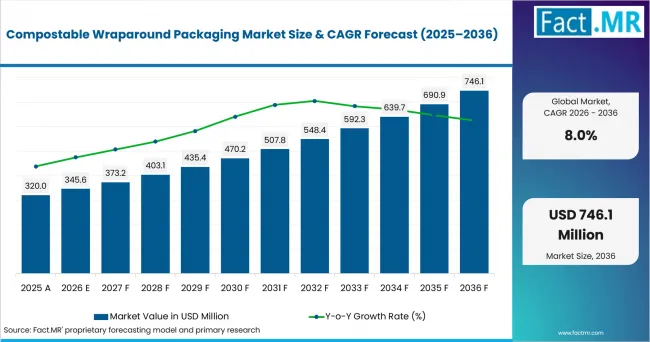
Compostable Wraparound Packaging Market Value Analysis | Source: Fact.MR
What are the defining numbers behind Compostable Wraparound Packaging Market growth?
USD 400.5 million absolute opportunity by 2036, led by Molded Pulp - Bagasse, Wraparound Cartons and Food & Beverage demand.
- Demand Drivers in the Market
- Food processors need wraps that retain compression strength during chilled handling and provide clear disposal instructions.
- Beverage brands need printable multipacks that retain barrier performance and valid finished-package certification.
- Foodservice operators need consistent packs because managed sites generate concentrated waste during repeated service cycles.
- Converters need flexible tooling because flat cartons and formed-fiber wraps use different line settings.
- Key Segments Analyzed
- By Material: Molded Pulp - Bagasse is expected to account for 44.0% share in 2026, supported by formed geometry and renewable fiber availability.
- By Product Type: Wraparound Cartons are projected to garner 36.0% share in 2026, owing to established printing and folding workflows.
- By Certification: Industrially Compostable formats are anticipated to record 65.0% share in 2026, attributable to controlled processing conditions.
- By Application: Food & Dairy is estimated to hold 38.0% share in 2026, driven by recurring chilled and grease-resistant packaging needs.
- By End Use: Food & Beverage is forecast to capture 68.0% share in 2026, reinforced by repeated pack consumption across production and service sites.
- By Sales Channel: Direct - Brand OEM is expected to represent 48.0% share in 2026, shaped by custom geometry and qualification work.
- Analyst Opinion at Fact.MR
- Principal Consultant is Principal Consultant at Fact.MR and states, “Compostable wraparound packaging draws attention because performance and disposal proof share one approval decision. Demand is expected to favor formats that survive distribution and match a verified collection route. Converters need engineering records and waste-partner coordination.”
- Strategic Implications
- Brand packaging teams should confirm the finished structure certification and then approve artwork or public disposal language for a launch.
- Converters should validate denesting and glue performance under customer line conditions prior to tooling commitment for recurring orders.
- Foodservice operators should secure a dedicated collection agreement and then direct staff to place compostable packaging beside food residues.
- Waste contractors should publish clear acceptance rules that distinguish certified packaging from look-alike fiber items and conventional coated board.
Huhtamaki launched compostable ice cream cups in July 2025. The format combines structural performance, printability and a defined end-of-life claim for frozen-dessert applications.
India is projected to record 10.5% CAGR as bagasse fibre inputs support local conversion programs. China is estimated to post 9.5% CAGR as converting scale strengthens fiber-based packaging systems. The United Kingdom is anticipated to advance at 8.4% CAGR through managed collection. Brazil is forecast to register 8.4% CAGR with food processing demand. Germany is expected to expand at 7.6% CAGR on recovery infrastructure.
How does the Compostable Wraparound Packaging Market break down by segment?
Molded Pulp - Bagasse is projected to account for 44.0% share, Wraparound Cartons are estimated to garner 36.0% share.
Which material category shapes the primary share?
Molded Pulp - Bagasse is projected to account for 44.0% share in 2026
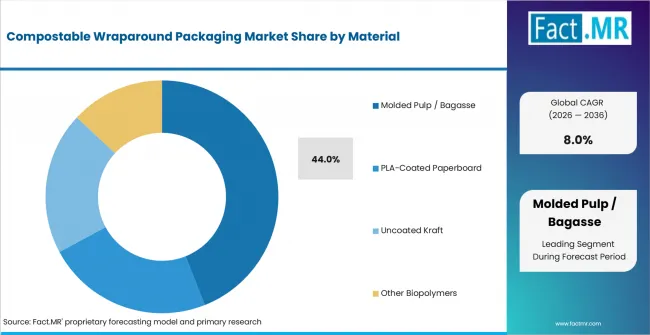
Compostable Wraparound Packaging Market Analysis By Material | Source: Fact.MR
Molded Pulp - Bagasse is anticipated to represent 44.0% share in 2026 as formed corners cushion fragile units and renewable fiber improves supply reliability. PLA-Coated Paperboard suits printed formats that need moisture resistance. Uncoated Kraft serves simple wraps with lower grease exposure across paper packaging materials.
What supports Wraparound Cartons within Product Type?
Wraparound Cartons are estimated to garner 36.0% share in 2026
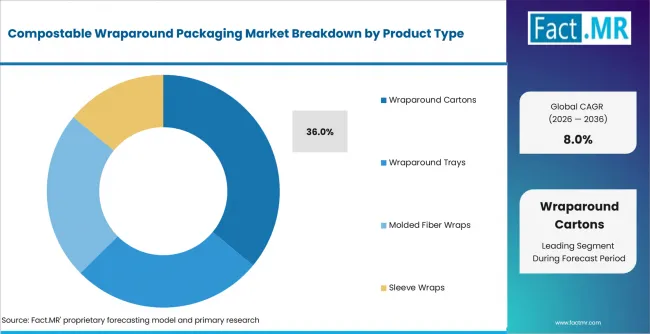
Compostable Wraparound Packaging Market Analysis By Product Type | Source: Fact.MR
Wraparound cartons are forecast to capture 36.0% share in 2026 since established folding carton formats support printing and high-output gluing. Trays protect chilled products during distribution and molded fiber wraps fit irregular shapes through formed locking surfaces.
How does Certification shape commercial approval?
Industrially Compostable formats are anticipated to record 65.0% share in 2026
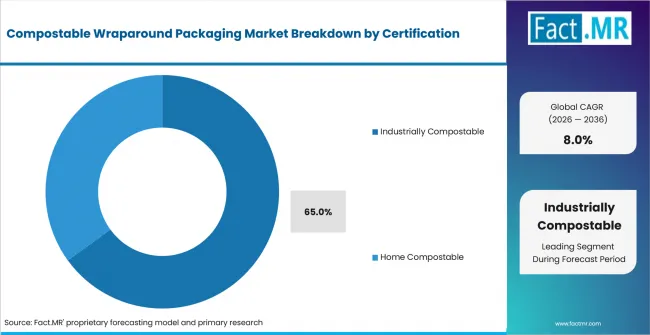
Compostable Wraparound Packaging Market Analysis By Certification | Source: Fact.MR
Industrially compostable formats are expected to hold 65.0% share in 2026 as controlled processing creates a clearer certification basis. Home Compostable structures face less predictable temperature and moisture conditions. Inks and adhesives still require finished-pack validation before commercial approval.
What supports Food & Dairy within Application?
Food & Dairy is forecast to hold 38.0% share in 2026
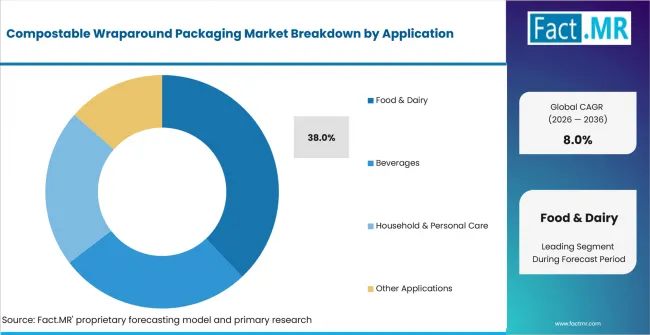
Compostable Wraparound Packaging Market Analysis By Application | Source: Fact.MR
Food & dairy is estimated to account for 38.0% share in 2026 as chilled products require protective food packaging systems with moisture and grease control. Beverage multipacks require compression strength during handling. Household formats need varied shapes and controlled artwork.
Which End Use category accounts for the primary share?
Food & Beverage is expected to capture 68.0% share in 2026
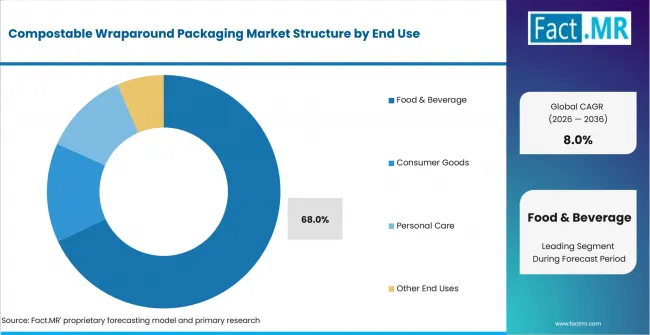
Compostable Wraparound Packaging Market Analysis By End Use | Source: Fact.MR
Food & beverage is projected to represent 68.0% share in 2026 owing to the reason that recurring sales consume packaging continuously across production and foodservice packaging channels. Consumer Goods formats prioritize presentation. Personal Care applications require protected branded containers during retail handling.
How does Direct - Brand OEM shape Sales Channel demand?
Direct - Brand OEM is estimated to represent 48.0% share in 2026, shaped by custom tooling and line qualification requirements.
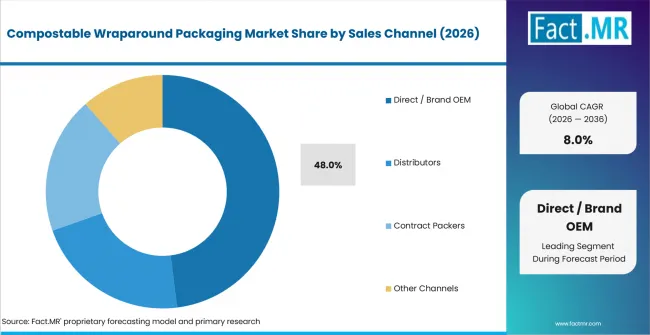
Compostable Wraparound Packaging Market Analysis By Sales Channel | Source: Fact.MR
Direct - brand OEM programs are anticipated to garner 48.0% share in 2026 since custom geometry requires technical coordination similar to mono-cardboard trays. Contract Packers influence equipment approvals and replenishment timing.
What is accelerating Compostable Wraparound Packaging Market adoption, and what is holding it back?
Certified fiber conversion drives it, collection uncertainty restrains it.
Drivers Impact Analysis
| Driver | (~) % Impact on CAGR | Geographic Relevance | Impact Timeline |
|---|---|---|---|
| Producer-responsibility rules reshaping package briefs | +1.1% | North America and Europe | Medium term (2-4 years) |
| Brand conversion from foam and difficult-to-recover plastic | +0.9% | Global food and beverage accounts | Medium term (2-4 years) |
| Molded-fiber performance across chilled applications | +0.7% | Asia Pacific and North America | Long term (4+ years) |
| Industrial composting certification for finished formats | +0.5% | Europe and selected Asia markets | Medium term (2-4 years) |
| Direct converter support for line qualification | +0.4% | Global brand programs | Short term (within 2 years) |
Source: Fact.MR analysis. Updated Aug 1, 2026
- Producer-responsibility rules: Finished-pack evidence helps brands document recovery choices and approve fiber structures with clear disposal routes.
- Plastic and foam replacement: Molded fiber and low-coating cartons offer selected food applications a clearer substitution route.
- Chilled-pack performance: Qualification strengthens when barriers preserve package shape without invalidating certified compostability claims.
- Certification discipline: Finished-pack certificates reduce ambiguity when they cover coatings, inks, adhesives, and barrier materials.
Opportunity Impact Analysis
| Opportunity | (~) % Impact on CAGR | Geographic Relevance | Impact Timeline |
|---|---|---|---|
| Package-plus-collection programs for controlled sites | +0.6% | United Kingdom and institutional accounts | Short term (within 2 years) |
| Barrier-light molded fiber for chilled food | +0.5% | North America and Asia Pacific | Medium term (2-4 years) |
| Paper multipacks replacing shrink film | +0.4% | Europe and beverage accounts | Medium term (2-4 years) |
| Localized bagasse conversion near food clusters | +0.3% | India and Brazil | Long term (4+ years) |
Source: Fact.MR analysis. Updated Aug 1, 2026
- Controlled-site programs: Managed campuses and stadiums support dedicated collection services and clear staff disposal instructions.
- Barrier-light fiber formats: Coating weight must meet the actual shelf-life requirement without unnecessary polymer content.
- Paper multipack substitution: Existing cartoning equipment can support fiber wraparound formats with limited line modification.
Restraints Impact Analysis
| Restraint | (~) % Impact on CAGR | Geographic Relevance | Impact Timeline |
|---|---|---|---|
| Collection routes do not match compostability claims | -0.8% | Global with municipal variation | Short term (within 2 years) |
| Moisture barriers complicate finished-pack certification | -0.6% | Food and dairy applications | Medium term (2-4 years) |
| Tooling and line trials extend approval cycles | -0.4% | Direct brand programs | Medium term (2-4 years) |
| Fiber quality and unit cost vary by region | -0.3% | India and Latin America | Long term (4+ years) |
Source: Fact.MR analysis. Updated Aug 1, 2026
- Collection mismatch: Compostability has limited value when sites lack accepting collectors, processors, or effective sorting practices.
- Barrier complexity: Grease protection requires every coating, ink, and adhesive to match the intended certification route.
- Tooling exposure: Modular pack designs reduce the sunk-cost risk of custom dies before production performance is proven.
Which countries are scaling Compostable Wraparound Packaging Market fastest?
United Kingdom 8.4%, Brazil 8.4%, Germany 7.6%.
Compostable Wraparound Packaging Market is segmented into North America, Europe, Asia Pacific, Latin America, and the Middle East & Africa.
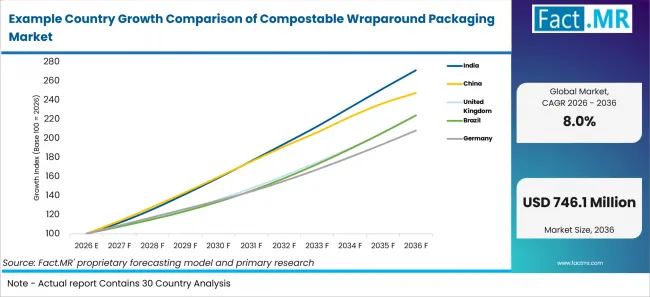
Example Country Growth Comparison Of Compostable Wraparound Packaging Market | Source: Fact.MR
| Country | CAGR |
|---|---|
| United Kingdom | 8.4% |
| Brazil | 8.4% |
| Germany | 7.6% |
Source: Fact.MR analysis. Updated Aug 1, 2026
What supports the United Kingdom outlook?
8.4% CAGR, attributable to foodservice demand and dedicated collection programs.
United Kingdom workplace food-waste rules changed during March 2025. The market is anticipated to advance at an 8.4% CAGR through 2036, aided by managed sites that utilize dedicated collection programs. Dispersed users remain more challenging to serve due to less consistent recovery infrastructure.
What underpins Brazil’s projected growth?
8.4% CAGR between 2026 and 2036, influenced by plastic recovery duties and regional food processing.
Brazil established a reverse-logistics system for plastic packaging during October 2025. The market is forecast to register an 8.4% CAGR between 2026 and 2036, supported by expanding food-processing clusters that increase demand for paper tray formats.
How does Germany balance fiber recovery and compostability?
7.6% CAGR across the forecast horizon, shaped by established recycling and strict disposal communication.
Germany’s fiber recovery system provides paperboard with established commercial recovery routes. Demand is expected to advance at a 7.6% CAGR through 2036, underpinned by mature recovery infrastructure. Compostable claims nevertheless require clear disposal instructions to maintain compliance and consumer confidence.
Who leads the Compostable Wraparound Packaging Market?
Huhtamaki Oyj and Novolex provide broad food-packaging coverage, while Graphic Packaging International and Mondi plc strengthen paperboard conversion capabilities.
Key players are focusing on expanding compostable packaging portfolios and strengthening foodservice relationships through differentiated product offerings. Huhtamaki combines paperboard and molded-fiber formats for foodservice and retail applications, while Novolex, through its Eco-Products and Vegware brands, supports managed-site collection programs and compostable packaging adoption. Sabert enhances its presence with certified molded-fiber solutions, and BioPak specializes in industrially compostable formats for foodservice operations. Graphic Packaging International integrates converted-carton production with machinery support capabilities, whereas Mondi Group leverages its board-conversion assets to serve regional commercial packaging programs and sustainability-focused customers.
Which companies are the key providers?
Some of the key players profiled include Huhtamaki Oyj, Novolex, Sabert Corporation, BioPak Pty Ltd, Graphic Packaging International, Mondi plc.
- Huhtamaki Oyj
- Novolex
- Sabert Corporation
- BioPak Pty Ltd
- Graphic Packaging International
- Mondi plc.
Bibliography
- BioPak. (2024). Raw materials. BioPak sustainability progress report.
- Department for Environment, Food & Rural Affairs. (2025, October 3). Simpler recycling: Workplace recycling in England. GOV.UK.
- Eco-Products, PBC. (2026, February 2). Eco-Products to launch environmentally responsible packaging products in the UK. Eco-Products.
- Graphic Packaging Holding Company. (2026, March 2). Annual report [Section 13 and 15(d), not S-K Item 405]. Graphic Packaging Holding Company.
- Graphic Packaging International. (2025, August 20). Graphic Packaging adds PaperSeal® Pressed MAP tray to award-winning food packaging portfolio. Graphic Packaging International.
- Huhtamaki Oyj. (2025, July 16). Huhtamaki launches new compostable ice cream cups. Huhtamaki.
- Ministry of Agriculture & Farmers Welfare. (2025, December 12). Sugarcane cultivation. Press Information Bureau, Government of India.
- Ministry of Consumer Affairs, Food & Public Distribution. (2025, May 1). To streamline regulatory framework governing Sugar Sector, Centre formulates Sugar (Control) Order, 2025. Press Information Bureau, Government of India.
- Mondi plc. (2025, November 18). Mondi launches extended corrugated and solid board portfolio for the food packaging industry. Mondi.
- Mondi plc. (2026, March 5). Mondi launches its 2025 Integrated and Sustainable Development reporting suite. Mondi.
- Novolex. (2024, April 30). Novolex announces strategic investment in reusable packaging innovator OZZI. Novolex.
- Sabert Corporation. (2024, April 9). Sabert seals in freshness and sustainability with compostable pulp produce and protein trays. Sabert.
- Sabert Corporation. (2025, November 19). Sabert Corporation’s Pulp Ultra® wins 2025 U.S. Plastics Pact Packaging Innovation Award for compostability. Sabert.
This Report Addresses
- The study contrasts material options and product type formats for the compostable wraparound packaging category.
- Buyer demand is assessed across Certification uses and Application operating conditions.
- India, China, United Kingdom, Brazil, and Germany markets frame the country-level forecast comparison.
- Company assessment considers technical capability and qualification pathways across Compostable Wraparound Packaging.
- End Use routes show where procurement activity concentrates across commercial accounts.
- Forecasts for Compostable Wraparound Packaging integrate historical movement with current adoption evidence.
- Market boundaries exclude formats outside the stated conversion scope.
What does the Compostable Wraparound Packaging Market cover?
Molded fiber, coated paperboard, kraft, and biopolymer wraparound formats used to bundle or protect commercial products.
The market covers cartons, trays, molded-fiber wraps, and sleeves that follow a verified compostability route. It includes industrially compostable structures and selected home-compostable formats.
Commercial value depends on finished-format compostability and operating performance. Conventional recyclable cartons and plastic wraps remain outside the boundary unless verified for the stated route.
What is included in the scope?
Compostable wraparound systems used across packaged food, beverages, consumer goods, and personal care applications.
The scope covers bagasse, coated paperboard, kraft, and biopolymer structures. It includes cartons, trays, molded-fiber wraps, and sleeve formats across food, beverage, consumer-goods, and personal-care applications. Relevant certification pathways and sales channels remain included.
What is excluded from the scope?
Conventional plastic shrink wrap and ordinary recyclable cartons without a compostability claim are outside the scope.
Standalone films and general transit cartons remain outside the scope. Reusable crates and rigid plastic trays are excluded. Loose molded-pulp inserts qualify only when they form a wraparound format.
How Was the Analysis Built?
The analysis draws on 120+ sources, 35+ company portfolios, 25+ countries, and more than 20 industry interviews.
- Primary Research: Primary research includes discussions with manufacturers, service providers, technology developers, distributors, end users, procurement teams, and subject-matter experts. These conversations examine purchasing priorities, product adoption, operational challenges, approval requirements, competitive positioning, and the factors that influence wider market acceptance.
- Desk Research: Desk research covers government statistics, regulatory publications, company filings, trade data, technical studies, industry associations, standards, public policy, and other authoritative sources. Every source used in the analysis is documented in the bibliography.
- Market Sizing and Forecasting: Market estimates combine historical performance, demand indicators, pricing and volume trends, segment shares, company participation, country-level growth, adoption patterns, investment activity, and barriers to market expansion.
- Data Validation and Update Cycle: Findings are validated by comparing primary interviews with public data, company activity, regulatory changes, trade patterns, and industry developments. Regular updates review new product launches, capacity changes, partnerships, approvals, procurement trends, and shifts in commercial adoption.
Segmentation
What is the report’s scope and coverage?
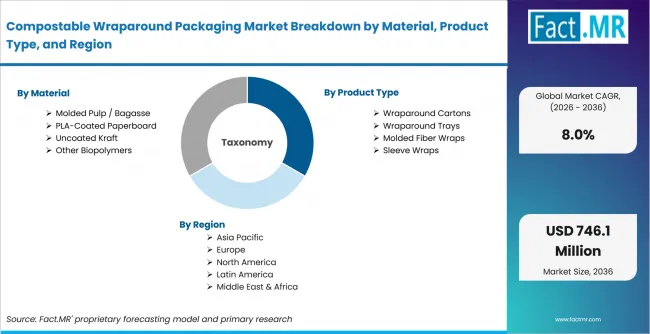
Compostable Wraparound Packaging Market Breakdown By Material, Product Type, And Region | Source: Fact.MR
| Coverage field | Report scope |
|---|---|
| Quantitative Units | USD Million |
| Market Definition | Converted wraparound cartons, trays, molded fiber wraps, and sleeves designed to pass an industrial or home compostability route for specified commercial packaging uses |
| Material | Molded Pulp - Bagasse, PLA-Coated Paperboard, Uncoated Kraft, Other Biopolymers |
| Product Type | Wraparound Cartons, Wraparound Trays, Molded Fiber Wraps, Sleeve Wraps |
| Certification | Industrially Compostable, Home Compostable |
| Application | Food & Dairy, Beverages, Household & Personal Care, Other Applications |
| End Use | Food & Beverage, Consumer Goods, Personal Care, Other End Uses |
| Sales Channel | Direct - Brand OEM, Distributors, Contract Packers, Other Channels |
| Regions Covered | North America, Europe, Asia Pacific, Latin America, Middle East & Africa |
| Countries Covered | United States, Canada, Germany, United Kingdom, France, Italy, Spain, India, China, Japan, South Korea, Australia, Brazil, Mexico, Argentina, Chile, UAE, Saudi Arabia, South Africa |
| Key Companies Profiled | Huhtamaki Oyj, Novolex, Sabert Corporation, BioPak Pty Ltd, Graphic Packaging International, Mondi plc |
| Forecast Period | 2026 to 2036 |
| Approach | Hybrid top-down and bottom-up approach using fiber availability, food and beverage packaging activity, format qualification rates, certification mix, replacement cycles, channel structure, company participation |
Source: Fact.MR analysis. Updated Aug 1, 2026
How is the market segmented?
-
By Material:
- Molded Pulp - Bagasse
- PLA-Coated Paperboard
- Uncoated Kraft
- Other Biopolymers
-
By Product Type:
- Wraparound Cartons
- Wraparound Trays
- Molded Fiber Wraps
- Sleeve Wraps
-
By Certification:
- Industrially Compostable
- Home Compostable
-
By Application:
- Food & Dairy
- Beverages
- Household & Personal Care
- Other Applications
-
By End Use:
- Food & Beverage
- Consumer Goods
- Personal Care
- Other End Uses
-
By Sales Channel:
- Direct - Brand OEM
- Distributors
- Contract Packers
- Other Channels
-
By Region:
- North America
- United States
- Canada
- Europe
- Germany
- United Kingdom
- France
- Italy
- Spain
- Asia Pacific
- Japan
- South Korea
- Australia
- Latin America
- Brazil
- Mexico
- Argentina
- Chile
- Middle East & Africa
- UAE
- Saudi Arabia
- South Africa
- North America
Frequently Asked Questions
What share is Molded Pulp - Bagasse expected to capture?
How are Wraparound Cartons positioned in Product Type?
Which certification category records the primary share?
What supports Food & Dairy within Application?
How much share is Food & Beverage forecast to capture?
How does Direct - Brand OEM perform?
How quickly is India expected to expand?
What shapes China’s projected market expansion?
What is the primary demand driver?
Who worked on this report


Preview the report firsthand - request a free sample
Free SampleGet the brochure for pricing and purchase details
Download PDF