- Base Value(2025): 6.5 Bn
- Estimated Value(2026): 6.7 Bn
- Forecast Value (2036): 9.3 Bn
- CAGR (2026 - 2036): 3.9%
Non-GMO Yogurt Market Forecast and Outlook By Fact.MR
In 2025, the non-GMO yogurt market was valued at USD 6.5 billion. Based on Fact MR analysis, demand for non-GMO yogurt is estimated to grow to USD 6.7 billion in 2026 and USD 9.3 billion by 2036. FMR projects a CAGR of 3.9% during the forecast period.
The absolute dollar growth from 2026 to 2036 is USD 2.6 billion. This increase reflects incremental expansion within the broader yogurt category rather than a structural shift in dairy consumption patterns. Non-GMO yogurt products are positioned within premium dairy segments that emphasize ingredient sourcing and labeling transparency. Demand continues to rise through retail channels that support clean label and specialty dairy products. Growth pace remains moderated by higher product pricing, limited differentiation in mature dairy markets, and competition from plant based yogurt alternatives.
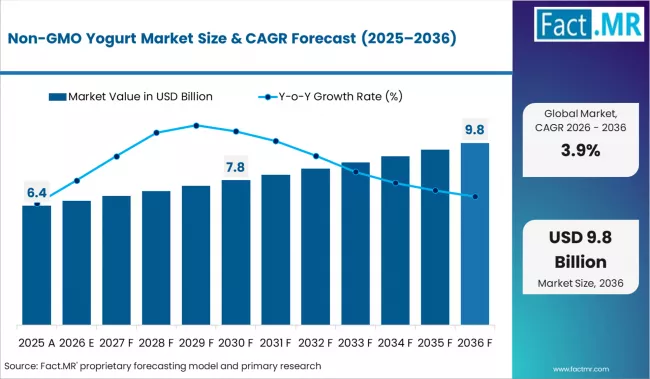
Non Gmo Yogurt Market Market Value Analysis | Source: Fact.MR
Non-GMO Yogurt Market
| Metric | Details |
|---|---|
| Industry Size (2026E) | USD 6.7 billion |
| Industry Value (2036F) | USD 9.3 billion |
| CAGR (2026 to 2036) | 3.9% |
Source: Fact.MR analysis. Updated Mar 24, 2026
India leads with a projected CAGR of 6.6%, supported by expanding dairy consumption and growing availability of packaged yogurt products across urban retail networks. Japan follows with a CAGR of 5.5%, reflecting steady demand for functional and premium yogurt products. China records a CAGR of 4.5%, driven by increasing consumption of flavored and packaged dairy products. Germany shows a CAGR of 3.2%, supported by stable demand in established dairy markets. The United States records the slowest growth at 2.6%, reflecting a mature yogurt market where non-GMO variants generate mainly replacement demand. Mature dairy markets face structural constraints from pricing pressure and competition from plant based dairy alternatives.
Summary of the Non-GMO Yogurt Market
- Market Definition
- The market comprises yogurt products produced using milk and ingredients that are not derived from genetically modified organisms. These products follow standard dairy fermentation processes while ensuring non GMO compliance across raw materials such as milk, sweeteners, and flavoring agents. Non GMO yogurt is available in multiple formats including plain, flavored, low fat, and drinkable variants. It is consumed as a dairy food product aligned with clean label requirements and ingredient traceability preferences.
- Demand Drivers
- Increasing consumer preference for clean label dairy products with transparent ingredient sourcing and certification standards.
- Rising retail availability of non GMO yogurt across supermarkets, hypermarkets, and online grocery platforms.
- Growth in household consumption of yogurt as a routine food product across urban and semi urban populations.
- Expansion of premium dairy product categories supported by demand for natural and minimally processed food products.
- Key Segments Analyzed
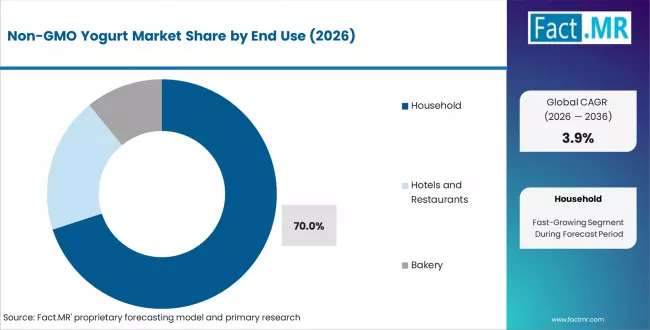
- End Use: Household consumption accounts for about 70% share supported by routine yogurt intake and retail purchase patterns.
- Distribution Channel: Supermarkets and hypermarkets represent roughly 40% share due to strong retail distribution networks and product availability.
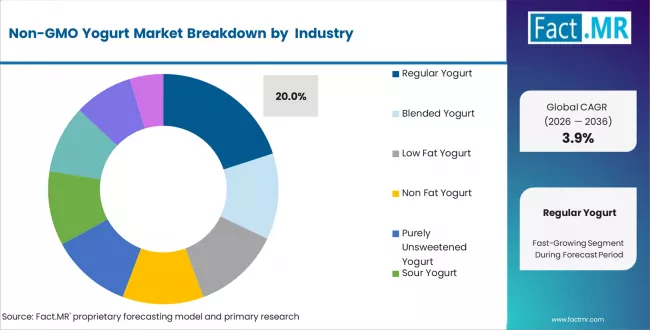
- Product Type: Regular yogurt remains a key segment supported by consistent consumption and broad consumer familiarity.
- Geography: India records the fastest expansion supported by increasing dairy consumption and expansion of organized retail distribution.
- Analyst Opinion at Fact MR
- Shambhu Nath Jha, Principal Consultant, Fact MR, opines, "In this updated edition of the Non GMO Yogurt Market report, industry participants will observe that demand remains linked to consumer preference for ingredient transparency and certified dairy sourcing practices. Non GMO yogurt products continue to be positioned within premium dairy categories where labeling and product differentiation influence purchasing decisions. Companies maintaining controlled supply chains and certification compliance will sustain stable positions in the dairy product market."
- Strategic Implications or Executive Takeaways
- Strengthen sourcing and certification processes that ensure compliance with non GMO labeling standards.
- Expand product portfolios across flavored, low fat, and drinkable yogurt formats to address diverse consumer preferences.
- Enhance retail distribution networks across supermarkets, specialty stores, and online grocery platforms.
- Maintain competitive pricing strategies to balance premium positioning with consumer affordability in mature dairy markets.
- Methodology
- Primary interviews conducted with dairy producers, yogurt manufacturers, ingredient suppliers, and retail distribution managers.
- Desk research based on dairy industry publications, company reports, regulatory guidelines, and agricultural trade data.
- Market sizing developed through a hybrid approach combining bottom up production analysis and top down consumption assessment across dairy markets.
- Findings validated through multiple dairy industry sources and expert consultations following Fact MR internal modeling standards.
Segmental Analysis
Non-GMO Yogurt Market Analysis by End Use
Non Gmo Yogurt Market Analysis By End Use | Source: Fact.MR
- Market Overview: Household consumption is projected to account for around 70% share of the non GMO yogurt market by 2026. Demand is driven by regular consumption of yogurt as part of daily diets across urban and semi urban households. Consumers purchase non GMO yogurt through supermarkets, convenience stores, and online grocery platforms for direct consumption at home. The segment benefits from increasing preference for clean label food products and transparency in ingredient sourcing. Manufacturers focus on offering packaged yogurt products in multiple flavors and formats to meet routine household consumption patterns. Refrigerated retail distribution networks support the availability of non GMO yogurt across regional markets.
- Demand Drivers:
- Daily Consumption Patterns: Yogurt is widely consumed as a breakfast item, snack, or dessert within household settings.
- Clean Label Preference: Consumers prefer non GMO yogurt products due to awareness regarding ingredient sourcing and food labeling practices.
- Retail Availability: Supermarkets, hypermarkets, and online grocery platforms provide consistent access to packaged yogurt products for household consumption.
Non-GMO Yogurt Market Analysis by Product Type
Non Gmo Yogurt Market Analysis By Product Type | Source: Fact.MR
- Market Overview: Regular yogurt is expected to represent approximately 20% share of the non GMO yogurt market in 2026. Regular yogurt products include standard fermented dairy formulations without additional flavoring or functional enhancements. These products are widely consumed due to their familiarity, affordability, and versatility in daily diets. Regular yogurt is used as a standalone food product as well as an ingredient in cooking and food preparation. Manufacturers maintain steady production of regular yogurt to meet demand across diverse consumer groups.
- Demand Drivers:
- Product Familiarity: Regular yogurt remains a widely recognized and consumed dairy product across different regions and consumer demographics.
- Versatile Usage: Consumers use regular yogurt in meals, cooking applications, and as a base for other food preparations.
- Stable Pricing Structure: Regular yogurt products are generally positioned at accessible price points, supporting consistent consumer demand.
Key Dynamics
Non-GMO Yogurt Market Drivers, Restraints, and Opportunities
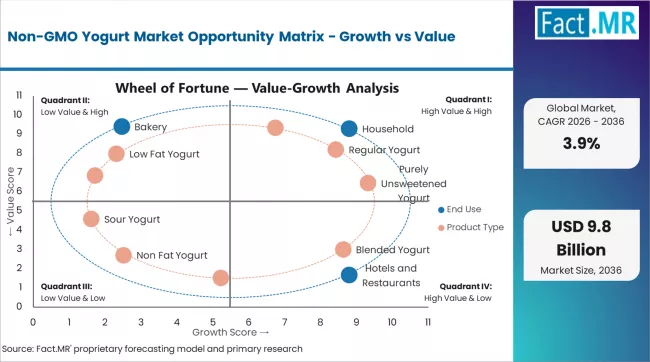
Non Gmo Yogurt Market Opportunity Matrix Growth Vs Value | Source: Fact.MR
Fact MR analysis indicates that the non-GMO yogurt market developed from broader shifts in dairy processing where ingredient sourcing and labeling transparency became more important in packaged food categories. Conventional yogurt production relied on standardized milk supply chains where genetic modification in feed inputs was not differentiated at the consumer level. The current market valuation reflects the expansion of certified non-GMO dairy supply chains where milk sourcing, feed composition, and processing standards are controlled to meet labeling requirements. Demand persists because consumers associate non-GMO labeling with ingredient traceability and controlled production practices in dairy products.
A structural shift is occurring as conventional yogurt products face competition from differentiated dairy offerings that emphasize ingredient sourcing and production standards. Standard yogurt remains widely distributed through mass retail channels where pricing and volume sales remain dominant factors. Non-GMO yogurt products require certified feed inputs, segregated supply chains, and verification processes that increase production and compliance costs. These products are priced at a premium compared with conventional yogurt even when overall consumption volumes remain moderate. Higher unit pricing offsets slower volume growth, supporting gradual value expansion within the market.
- Certified Ingredient Sourcing: Dairy producers implement controlled feed sourcing and certification processes to ensure compliance with non-GMO labeling requirements.
- Food Labeling Regulation: Standards such as the Non-GMO Project Verified certification and U.S. Food and Drug Administration labeling regulations influence product claims and consumer communication.
- North America Dairy Demand: The United States and Canada maintain strong retail demand for non-GMO dairy products supported by established certification systems and organized retail distribution networks.
Regional Analysis
The non-GMO yogurt market is assessed across North America, Europe, Asia Pacific, Latin America, and Middle East & Africa, segmented by country-level consumption trends and regulatory frameworks. Regional demand reflects dietary preferences, certification standards, and retail penetration. The full report offers market attractiveness analysis.
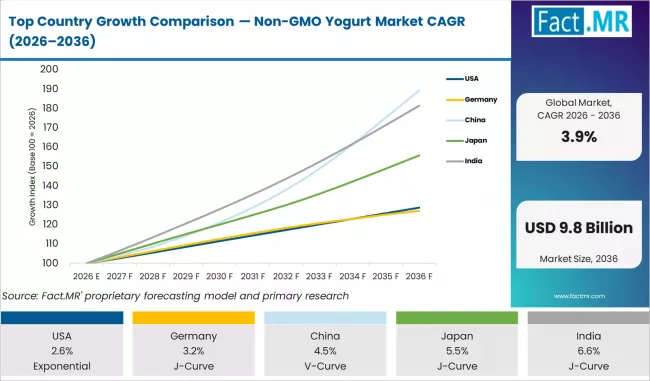
Top Country Growth Comparison Non Gmo Yogurt Market Cagr 2026 To 2036 | Source: Fact.MR
| Country | CAGR (2026-2036) |
|---|---|
| USA | 2.6% |
| Germany | 3.2% |
| China | 4.5% |
| Japan | 5.5% |
| India | 6.6% |
Source: Fact.MR analysis. Updated Mar 24, 2026
Source: Fact MR analysis, based on proprietary forecasting model and primary research
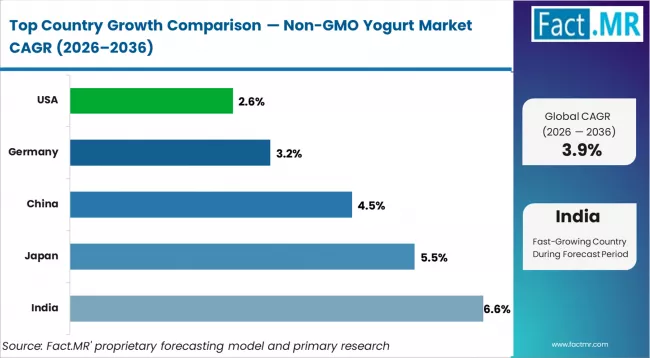
Non Gmo Yogurt Market Cagr Analysis By Country | Source: Fact.MR
North America
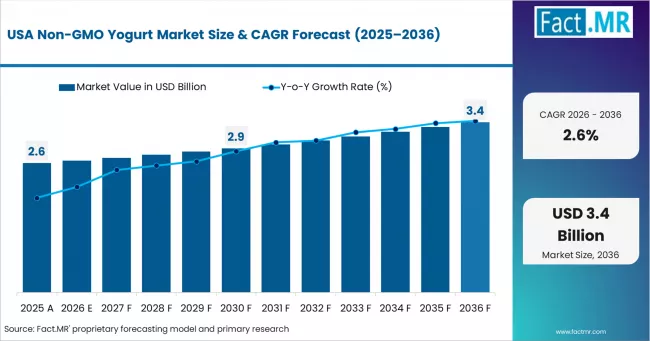
Non Gmo Yogurt Market Country Value Analysis | Source: Fact.MR
North America functions as the premium organic dairy consumption hub, supported by labeling regulations and retail scale. Chobani, LLC maintains a leading position through product diversification and strong distribution. Stonyfield Farm, Inc. focuses on certified organic offerings. General Mills, Inc. sustains scale through its yogurt portfolio.
- USA: Demand for non-GMO yogurt in USA is projected to rise at 2.6% CAGR through 2036. Growth is supported by the National Bioengineered Food Disclosure Standard implementation (USDA, January 2022), mandating GMO labeling. Chobani, LLC announced capacity expansion and product line extension (March 2023), strengthening market presence.
Europe
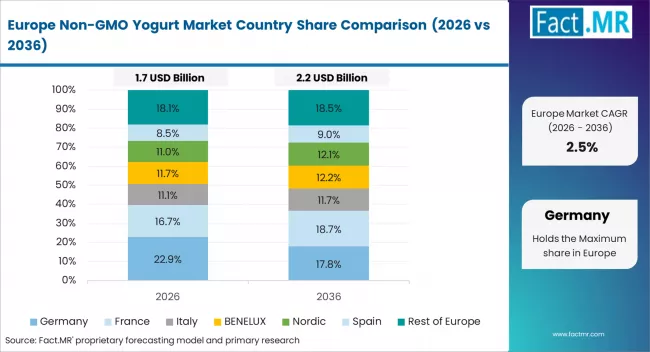
Non Gmo Yogurt Market Europe Country Market Share Analysis 2026 & 2036 | Source: Fact.MR
Europe operates as the regulatory and quality certification base, driven by strict food labeling standards and consumer preference for clean-label products. Danone S.A. leads in organic yogurt offerings. FAGE International S.A. maintains a strong premium positioning. Arla Foods amba expands non-GMO product lines.
- Germany: Demand for non-GMO yogurt in Germany is projected to rise at 3.2% CAGR through 2036. The EU Organic Regulation update (European Commission, January 2022) strengthened labeling compliance. Danone S.A. expanded organic yogurt production facilities in Europe (June 2023), supporting regional supply.
Asia Pacific
Asia Pacific serves as the high-growth consumption market, supported by dietary shifts and expanding retail networks. China Mengniu Dairy Company Limited holds a strong domestic position. Yakult Honsha Co., Ltd. leads in functional dairy products. Nestlé S.A. expands clean-label dairy offerings.
- China: Demand for non-GMO yogurt in China is projected to rise at 4.5% CAGR through 2036. The Healthy China initiative (State Council, October 2019) promotes nutritional food consumption. China Mengniu Dairy Company Limited announced investments in premium yogurt production (April 2023), supporting growth.
- Japan: Demand for non-GMO yogurt in Japan is projected to rise at 5.5% CAGR through 2036. Food labeling standards under the Consumer Affairs Agency (April 2022) strengthened transparency requirements. Yakult Honsha Co., Ltd. expanded product lines focusing on health-oriented yogurt (February 2023).
- India: Demand for non-GMO yogurt in India is projected to rise at 6.6% CAGR through 2036. The National Programme for Organic Production (APEDA, revised 2022) supports certification standards. Nestlé S.A. expanded dairy processing capacity in India (May 2023), improving supply chain reach.
Fact MR's analysis of non-GMO yogurt market in global regions consists of country-wise assessment that includes USA, Germany, China, Japan, and India. Readers can find consumption trends, regulatory developments, product positioning, and competitive landscape across key markets.
Competitive Landscape
Competitive Structure and Buyer Dynamics in the Non-GMO Yogurt Market
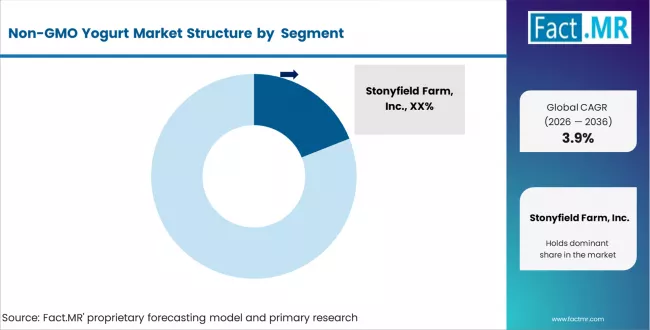
Non Gmo Yogurt Market Analysis By Company | Source: Fact.MR
The competitive structure of the Non-GMO Yogurt Market is moderately fragmented, with a mix of multinational dairy companies and regional organic yogurt producers participating in supply. Companies such as Danone S.A., General Mills, Inc., and Chobani, LLC maintain strong positions through established brands and extensive retail distribution networks. These firms supply a wide range of non GMO yogurt products across supermarkets, specialty stores, and food service channels. Additional participants including Stonyfield Farm, Inc., FAGE International S.A., Icelandic Milk & Skyr Corporation, Noosa Yoghurt, LLC, Wallaby Yogurt Company, Inc., Lifeway Foods, Inc., Redwood Hill Farm & Creamery, Inc., Maple Hill Creamery, LLC, and Springfield Creamery, Inc. operate within organic and premium dairy segments. Competition in the market is primarily influenced by product quality, ingredient sourcing transparency, brand positioning, and shelf presence across retail outlets.
Several companies maintain structural advantages through vertically integrated dairy sourcing and strong relationships with organic milk suppliers. Firms such as Danone S.A., General Mills, Inc., and Stonyfield Farm, Inc. benefit from established supply chains and access to certified non GMO milk sources. Regional producers such as Maple Hill Creamery, LLC and Redwood Hill Farm & Creamery, Inc. maintain advantages through niche positioning and direct sourcing models. Retailers often manage supplier dependency by offering multiple yogurt brands and private label alternatives to maintain pricing flexibility. Procurement decisions evaluate suppliers based on product consistency, certification standards, and consumer demand patterns. This purchasing behavior moderates supplier pricing leverage across the market. Brands with strong consumer recognition, certified sourcing practices, and reliable distribution networks retain moderate negotiating influence in retail shelf placement and supply agreements.
Key Players of the Non-GMO Yogurt Market
- Stonyfield Farm, Inc.
- Chobani, LLC
- FAGE International S.A.
- Icelandic Milk & Skyr Corporation
- Danone S.A.
- Noosa Yoghurt, LLC
- Wallaby Yogurt Company, Inc.
- General Mills, Inc.
- Lifeway Foods, Inc.
- Redwood Hill Farm & Creamery, Inc.
- Maple Hill Creamery, LLC
- Springfield Creamery, Inc.
Report Scope
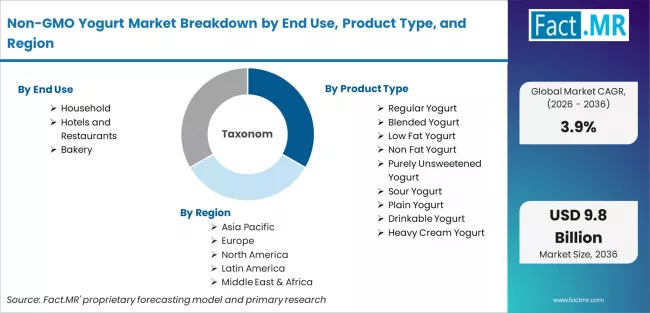
Non Gmo Yogurt Market Breakdown By End Use Product Type And Region | Source: Fact.MR
| Metric | Value |
|---|---|
| Quantitative Units | USD 6.7 billion (2026) to USD 9.3 billion (2036), at a CAGR of 3.9% |
| Market Definition | The non-GMO yogurt market includes the global production and sale of yogurt products made from milk sourced from non genetically modified feed inputs, with processing methods that avoid genetically modified organisms, catering to consumer demand for clean label, traceable, and natural dairy products. |
| Product Type Segmentation | Regular Yogurt, Blended Yogurt, Low-fat Yogurt, Non-fat Yogurt, Purely Unsweetened Yogurt, Sour Yogurt, Plain Yogurt, Drinkable Yogurt, Heavy Cream Yogurt |
| End Use Segmentation | Hotels and Restaurants, Bakery, Household |
| Distribution Channel Segmentation | Supermarket or Hypermarket, Food Service Outlets, Convenience Stores, Specialty Stores, Online Stores |
| Regions Covered | North America, Latin America, Europe, East Asia, South Asia, Oceania, Middle East and Africa |
| Countries Covered | United States, Canada, Mexico, Brazil, Argentina, Germany, France, United Kingdom, Italy, Spain, China, India, Japan, South Korea, Australia, and 40+ countries |
| Key Companies Profiled | Stonyfield Farm, Inc., Chobani, LLC, FAGE International S.A., Icelandic Milk and Skyr Corporation, Danone S.A., Noosa Yoghurt, LLC, Wallaby Yogurt Company, Inc., General Mills, Inc., Lifeway Foods, Inc., Redwood Hill Farm and Creamery, Inc., Maple Hill Creamery, LLC, Springfield Creamery, Inc. |
| Forecast Period | 2026 to 2036 |
| Approach | Hybrid top-down and bottom-up market modeling supported by dairy production data, retail sales analysis, consumer purchasing pattern assessment, and validation through interviews with dairy processors, yogurt manufacturers, and distribution channel stakeholders. |
Source: Fact.MR analysis. Updated Mar 24, 2026
Bibliographies
- [1] United States Department of Agriculture. (2022). National Bioengineered Food Disclosure Standard.
- [2] European Commission. (2022). EU Organic Regulation update.
- [3] State Council, China. (2019). Healthy China initiative.
- [4] Consumer Affairs Agency, Japan. (2022). Food labeling standards.
- [5] Ministry of Electronics and Information Technology, India. (2022). National Programme for Organic Production.
- [6] Chobani, LLC. (2023). Capacity expansion and product line extension.
- [7] Danone S.A. (2023). Organic yogurt production facilities expansion.
- [8] China Mengniu Dairy Company Limited. (2023). Premium yogurt production investments.
- [9] Non-GMO Project. (2023). Verified certification standards.
This Report Addresses
- Market size estimation and revenue forecasts for the Non-GMO Yogurt Market from 2026 to 2036, supported by dairy consumption benchmarks and certified non GMO ingredient supply indicators across retail markets.
- Growth opportunity analysis across regular, blended, low fat, non fat, unsweetened, sour, plain, drinkable, and heavy cream yogurt variants produced under non GMO sourcing standards.
- Segment and regional revenue forecasts covering household, hotels and restaurants, and bakery end use segments, along with distribution across supermarkets, convenience stores, specialty retail, food service outlets, and online grocery channels.
- Competitive strategy assessment including dairy sourcing capability, non GMO certification compliance, and retail distribution network benchmarking among global dairy producers and yogurt manufacturers.
- Regulatory and compliance evaluation covering frameworks such as Non GMO Project Verified certification standards and United States Food and Drug Administration food labeling regulations governing ingredient disclosure and product claims.
- Market report delivery in PDF, Excel, PPT, and interactive dashboard formats designed for dairy product portfolio planning, retail distribution analysis, and food ingredient sourcing evaluation.
- Supply chain and operational risk analysis identifying certified feed sourcing requirements, higher production costs linked to segregated supply chains, and competition from plant based yogurt alternatives affecting non GMO yogurt production and market growth.
Non-GMO Yogurt Market Definition
The Non-GMO Yogurt Market includes yogurt products made from milk and ingredients that are not derived from genetically modified organisms. These products are produced using conventional dairy fermentation processes while ensuring that raw materials such as milk, sweeteners, and flavoring agents meet non-GMO standards. Non-GMO yogurt is available in various forms including plain, flavored, low fat, and drinkable variants. It is widely consumed as a dairy snack or meal component by health conscious consumers. The primary function of non-GMO yogurt is to provide a fermented dairy product aligned with clean label and ingredient transparency requirements.
Non-GMO Yogurt Market Inclusions
This report covers global and regional market sizes for non-GMO yogurt with forecast analysis for the study period. The market is segmented by product type including regular yogurt, low fat yogurt, non fat yogurt, flavored yogurt, and drinkable yogurt. Application segments include household consumption, food service use, and bakery incorporation. End users include retail consumers, restaurants, and food service operators. The report also evaluates pricing patterns, production trends, distribution channels, and selected trade flow analysis across major dairy consumption regions.
Non-GMO Yogurt Market Exclusions
The report excludes yogurt products made using genetically modified feed inputs or ingredients that do not meet non-GMO certification criteria. Dairy alternatives such as plant based yogurt made from soy, almond, or coconut are not included. The scope also excludes probiotic supplements and dairy based beverages that are not classified as yogurt. Industrial dairy processing activities and raw milk production are outside the defined market scope, as the analysis focuses strictly on non-GMO certified yogurt products.
Non-GMO Yogurt Market Research Methodology
- Primary Research
- Interviews were conducted with dairy producers, yogurt manufacturers, ingredient suppliers, and retail distribution managers.
- Desk Research
- Public information was collected from dairy industry publications, company reports, regulatory guidelines, and agricultural trade data.
- Market-Sizing and Forecasting
- A hybrid model combining bottom up production analysis with top down consumption assessment across dairy markets was applied.
- Data Validation and Update Cycle
- Findings were cross verified using multiple dairy industry sources and expert inputs, with periodic updates conducted as new production and consumption data becomes available.
Segmentation
Non GMO Yogurt Market Key Segments
-
Product Type :
- Regular Yogurt
- Blended Yogurt
- Low Fat Yogurt
- Non Fat Yogurt
- Purely Unsweetened Yogurt
- Sour Yogurt
- Plain Yogurt
- Drinkable Yogurt
- Heavy Cream Yogurt
-
End Use :
- Hotels and Restaurants
- Bakery
- Household
-
Distribution Channel :
- Supermarket or Hypermarket
- Food Service Outlets
- Convenience Stores
- Specialty Stores
- Online Stores
-
Region :
- North America
- USA
- Canada
- Mexico
- Europe
- Germany
- UK
- France
- Italy
- Spain
- Nordic Countries
- BENELUX
- Rest of Europe
- Asia Pacific
- China
- Japan
- South Korea
- India
- Australia
- Rest of Asia Pacific
- Latin America
- Brazil
- Argentina
- Rest of Latin America
- Middle East and Africa
- Kingdom of Saudi Arabia
- United Arab Emirates
- South Africa
- Rest of Middle East and Africa
- Other Regions
- Oceania
- Central Asia
- Other Markets
- North America
Frequently Asked Questions
How large is the demand for Non-GMO Yogurt in the global market in 2026?
What will be the market size of Non-GMO Yogurt in the global market by 2036?
What is the expected demand growth for Non-GMO Yogurt in the global market between 2026 and 2036?
Which End Use Segment is poised to lead global demand by 2026?
Which Company is Identified as a Leading Participant in the Non-GMO Yogurt Market?
What is Driving Non-GMO Yogurt Demand in the United States?
What is the United States Growth Outlook in this Report?
Why is China an Important Market for Non-GMO Yogurt?
What is the China Growth Outlook in this Report?
What Factors Support Non-GMO Yogurt Demand in India?
What is the India Growth Outlook in this Report?
Why is Germany Considered an Important Market for Non-GMO Yogurt in Europe?
What is the Germany Growth Outlook in this Report?
Why is Japan an Important Market for Non-GMO Yogurt?
What is the Japan Growth Outlook in this Report?
What is Non-GMO Yogurt and What is It Mainly Used For?
What does Non-GMO Yogurt Market Mean in this Report?
What is Included in the Scope of this Non-GMO Yogurt Market Report?
What is Excluded from the Scope of this Report?
What does Market Forecast Mean on this Page?
How is the Non-GMO Yogurt Market Forecast Developed in this Report?
Who worked on this report


Preview the report firsthand - request a free sample
Free SampleGet the brochure for pricing and purchase details
Download PDF