- Market Value (2025): USD 144.6 Mn
- Estimated Value (2026): USD 160.0 Mn
- Forecast Value (2036): USD 440.0 Mn
- CAGR (2026-2036): 10.6%
What is the Debondable Structural Adhesives Market forecast to be worth by 2036?
USD 160.0 million in 2026 to USD 440.0 million by 2036 at 10.6% CAGR.
- The market reached USD 144.6 million in 2025 as manufacturers tested adhesives designed for repair and recycling applications.
- Demand is projected to increase to USD 160.0 million to USD 440.0 million by 2036 as heat-triggered and epoxy-based systems gain wider acceptance.
- The market is forecast to record 10.6% CAGR as manufacturers focus on repairability while maintaining bonding performance.
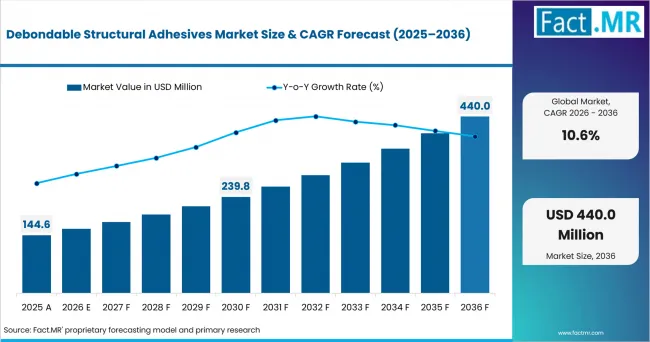
Debondable Structural Adhesives Market Market Value Analysis | Source: Fact.MR
What are the defining numbers behind Debondable Structural Adhesives Market growth?
The USD 280.0 million absolute opportunity through 2036 is led by automotive bonding.
- Demand Drivers in the Market
- Heat-triggered adhesives are becoming more common in repair and recycling applications. They help simplify component removal during servicing and processing.
- Epoxy-based adhesives are widely used in structural bonding applications. Manufacturers are familiar with their performance and testing requirements.
- Automotive is a major application due to growing focus on vehicle repair and recycling. Interest is also increasing in materials that support component recovery.
- Semi-structural adhesives are often used for product testing and evaluation. These grades are commonly assessed before wider adoption in structural applications.
- Key Segments Analyzed
- By Debonding Trigger: Heat leads with 30% share in 2026. Many manufacturers already use thermal processes during repair and product recovery.
- By Chemistry: Epoxy leads with 29% share in 2026. The material is well established across industrial bonding applications.
- By Application: Automotive contributes 36% share in 2026. Demand is linked to stronger focus on serviceable and recyclable vehicle parts.
- By Bond Strength: Semi-structural holds 30% share in 2026. Adoption is strongest in applications with lower performance requirements.
- By Buyer Type: OEMs contribute 33% share in 2026. Their purchasing decisions influence material adoption across the supply chain.
- Analyst Opinion at Fact.MR
- Shambhu Nath Jha, Senior Analyst at Fact.MR, states, “Debondable structural adhesives are becoming more common in industrial applications. They help support repair and component recovery while maintaining bonding performance.”
- Strategic Implications
- Repair and recycling applications require adhesives that allow controlled component separation. This can help reduce damage during removal.
- New products are generally evaluated against materials already in use. Bonding performance and ease of removal are often part of the review process.
- Testing data and technical records are regularly examined during product reviews. Companies often look at both bonding and debonding performance.
- Manufacturers are paying more attention to how bonded components can be removed after use. Adhesive systems used for repair and recycling are being evaluated across industrial applications.
- China is projected to record a 14.4% CAGR through 2036. India is expected to grow at a 13.3% CAGR during the forecast period. Germany is anticipated to expand at a 12.2% CAGR through 2036. Brazil is forecast to register an 11.2% CAGR over the same period. The United States is expected to post a 10.1% CAGR through 2036.
How does the Debondable Structural Adhesives Market break down by segment?
Heat leads with 30% by debonding trigger, while epoxy holds 29% by chemistry segment.
What supports Debonding Trigger adoption?
Heat holds 30% share in 2026.
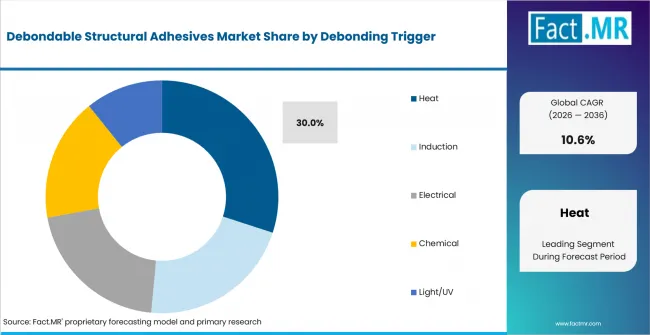
Debondable Structural Adhesives Market Analysis By Debonding Trigger | Source: Fact.MR
Heat is widely used for controlled component separation during repair and recycling. It helps remove bonded parts with minimal impact on surrounding materials. Other debonding technologies are being explored for applications with different processing requirements.
Which Chemistry dominates?
Epoxy accounts for 29% share in 2026.
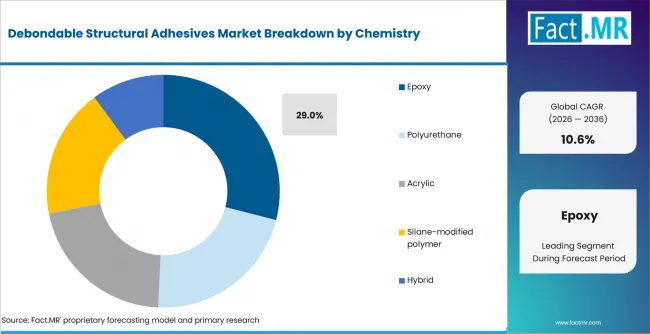
Debondable Structural Adhesives Market Analysis By Chemistry | Source: Fact.MR
Epoxy-based adhesives are used in many structural bonding applications. They remain a common choice across industrial sectors. Polyurethane, acrylic, and hybrid systems are used for applications that require different adhesive properties.
What leads the Application segment?
Automotive holds 36% share in 2026.
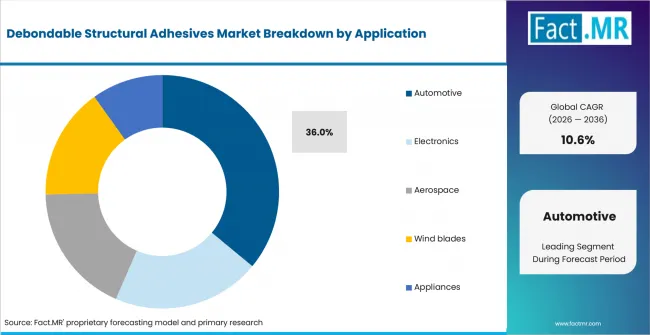
Debondable Structural Adhesives Market Analysis By Application | Source: Fact.MR
Automotive is the leading application for debondable structural adhesives. Growing use of bonded vehicle components is supporting demand for materials that allow easier repair and component removal. Electronics, aerospace, wind energy, and appliance applications also use these adhesives for different operational requirements.
How does Bond Strength shape demand?
Semi-structural leads with 30% share in 2026.
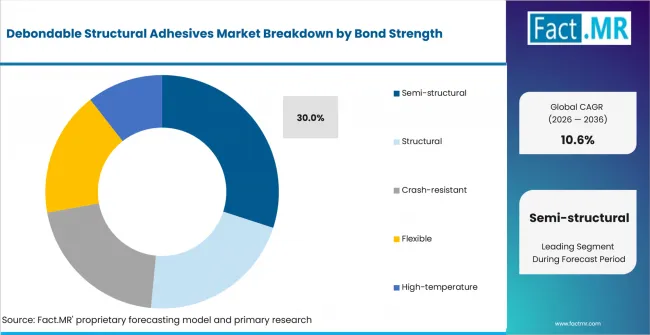
Debondable Structural Adhesives Market Analysis By Bond Strength | Source: Fact.MR
Semi-structural adhesives are commonly used during product evaluation. They offer a practical option for applications that require reliable bonding and easier component removal. Structural and high-performance grades are also used where operating requirements are more demanding.
Where is Buyer Type demand strongest?
OEMs hold 33% share in 2026.
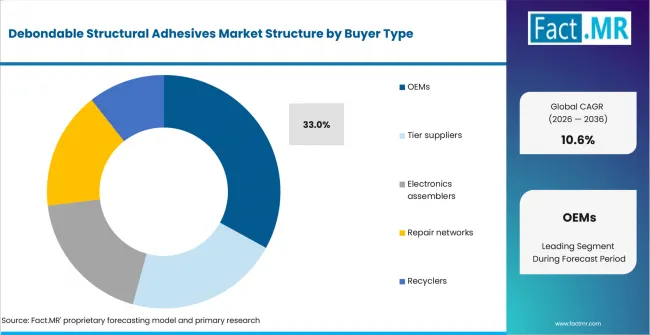
Debondable Structural Adhesives Market Analysis By Buyer Type | Source: Fact.MR
OEMs account for 33% share in 2026. Their material approval decisions influence adhesive use across manufacturing operations and supply chains. Electronics assemblers, repair networks, and recyclers also create demand through production activities, repair work, product servicing, and component recovery applications.
What is accelerating Debondable Structural Adhesives Market adoption and what is holding it back?
Repairability, component recovery, and recycling activities support market growth. Qualification requirements and application challenges may slow adoption.
Drivers Impact Analysis
| DRIVER | (~) % IMPACT ON CAGR | GEOGRAPHIC RELEVANCE | IMPACT TIMELINE |
|---|---|---|---|
| Controlled separation for repair and recycling | +0.8% | China and export suppliers | Medium term (2-4 years) |
| Validation of debonding triggers | +0.6% | Europe and North America | Short term (<= 2 years) |
| Automotive bonding approval programs | +0.5% | Asia Pacific | Medium term (2-4 years) |
| Local support near industrial users | +0.4% | Global | Long term (>= 4 years) |
Source: Fact.MR analysis. Updated Jul 14, 2026
- Controlled separation for repair and recycling: Bonded components can be difficult to remove during repair and recycling. Debondable adhesives help support easier component recovery and material reuse.
- Validation of debonding triggers: Heat, induction, electrical, chemical, and light-based systems are used across different applications. Their performance is often evaluated under operating conditions before use.
- Automotive bonding approval programs: Automotive companies are evaluating debondable adhesives for vehicle applications. Material approvals can support wider use across production programs.
- Local support near industrial users: Technical support is often provided during product testing and implementation. Application guidance can help with material selection and process setup.
Opportunity Impact Analysis
| OPPORTUNITY | (~) % IMPACT ON CAGR | GEOGRAPHIC RELEVANCE | IMPACT TIMELINE |
|---|---|---|---|
| Grades tuned for automotive bonding | +0.5% | Global | Medium term (2-4 years) |
| Application labs for epoxy systems | +0.4% | Asia Pacific and Europe | Short term (<= 2 years) |
| Rule-ready documentation | +0.4% | Europe and United Kingdom | Medium term (2-4 years) |
| Local trials with OEMs and tier suppliers | +0.3% | India and Brazil | Long term (>= 4 years) |
Source: Fact.MR analysis. Updated Jul 14, 2026
- Grades tuned for automotive bonding: Automotive applications require adhesives that perform across different vehicle components. Materials that support repair and component removal are being evaluated for wider use.
- Application labs for epoxy systems: Application testing helps assess adhesive performance under operating conditions. Product trials are often used before commercial adoption.
- Rule-ready documentation: Technical documentation is important for product reviews and approval activities. Clear records can help simplify the evaluation process.
- Local trials with OEMs and tier suppliers: Local trials allow products to be tested under actual manufacturing conditions. The results can support future use across production applications.
Restraints Impact Analysis
| RESTRAINT | (~) % IMPACT ON CAGR | GEOGRAPHIC RELEVANCE | IMPACT TIMELINE |
|---|---|---|---|
| Qualification cost | -0.4% | Global processors | Medium term (2-4 years) |
| Fit limits in epoxy | -0.3% | Global | Short term (<= 2 years) |
| Documentation burden | -0.3% | Europe and North America | Medium term (2-4 years) |
| Scale-up risk | -0.2% | High-volume plants | Long term (>= 4 years) |
Source: Fact.MR analysis. Updated Jul 14, 2026
- Qualification cost: Product qualification often involves testing bond performance and debonding behavior. These activities can increase the time and cost required before commercial use.
- Fit limits in epoxy: Epoxy systems may not be suitable for every application. Requirements related to flexibility, processing conditions, and substrate compatibility can influence material selection.
- Documentation burden: Material changes often require additional documentation and review. This can extend product evaluation and approval timelines.
- Scale-up risk: Results achieved during product trials may differ from large-scale manufacturing conditions. Processing variations can affect adhesive performance during production.
Which countries are scaling Debondable Structural Adhesives Market fastest?
China 14.4%, India 13.3%, Germany 12.2%, Brazil 11.2%, and United States 10.1%.
.webp "Top Country Growth Comparison Debondable Structural Adhesives Market Cagr (2026 2036)")
Top Country Growth Comparison Debondable Structural Adhesives Market Cagr (2026 2036) | Source: Fact.MR
| COUNTRY | CAGR |
|---|---|
| China | 14.4% |
| India | 13.3% |
| Germany | 12.2% |
| Brazil | 11.2% |
| United States | 10.1% |
Source: Fact.MR analysis. Updated Jul 14, 2026
What underpins China's growth?
14.4% CAGR, supported by growth in automotive and electronics manufacturing.
China is forecast to expand at 14.4% CAGR through 2036. The market is supported by large-scale industrial production and increasing use of bonded components across several manufacturing sectors. Debondable adhesive technologies are being explored in applications that require easier repair and component recovery.
What is driving India's growth through 2036?
13.3% CAGR, driven by growth in manufacturing and automotive production.
India is expected to record a 13.3% CAGR through 2036. Demand is growing across automotive, electronics, and industrial applications. Debondable structural adhesives are being considered for products that require easier repair and component separation.
How is Germany scaling demand?
12.2% CAGR, led by automotive and industrial demand.
Germany is expected to record a 12.2% CAGR through 2036. Machinery and electronics companies are evaluating debondable structural adhesives for repair and recycling applications. The materials are being considered for products that require easier component removal at the end of use.
What supports the Brazil outlook?
11.2% CAGR, with demand from automotive, appliance, and industrial applications.
Brazil is expected to record an 11.2% CAGR through 2036. Automotive and appliance manufacturers are considering debondable structural adhesives for repair and maintenance applications. The materials can help simplify component removal and support product servicing activities.
How is the United States developing demand?
10.1% CAGR, driven by emerging opportunities across multiple manufacturing industries.
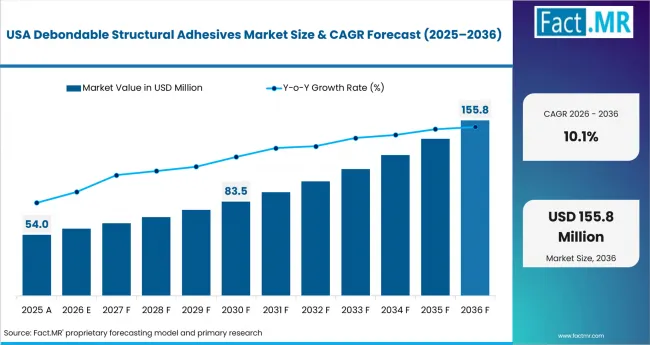
Debondable Structural Adhesives Market Country Value Analysis | Source: Fact.MR
The United States is expected to record a 10.1% CAGR through 2036. Automotive, aerospace, and electronics remain key application areas for debondable structural adhesives. Use of these materials is increasing in products that require repair and component replacement.
Who leads the Debondable Structural Adhesives Market?
Henkel and 3M are among the leading participants in the Debondable Structural Adhesives Market. Sika, Bostik, and H.B. Fuller also maintain a presence across automotive, electronics, aerospace, and industrial applications.
Companies are developing adhesive systems that combine strong bonding with controlled component separation. Product performance and technical support remain important in the market.
Manufacturers are using these products across repair and recycling applications. Adhesive performance and ease of component removal continue to influence product selection. Companies that help move products from testing to commercial use are likely to strengthen their market presence.
Which companies are the key providers?
Henkel and 3M are key providers. The wider provider list appears below for comparison.
- Henkel
- 3M
- Sika
- Bostik
- H.B. Fuller
Bibliography
BASF SE. (2026, April 29). New ecovio® portfolio for flexible packaging: Multiple barrier options combined with organic or paper recycling.
Biodegradable Products Institute. (2025, December 11). Certified compostable products: Science, standards, and the facts that matter.
European Commission. (2026, March 29). Commission publishes guidance to support implementation of the Packaging and Packaging Waste Regulation.
Michelman, Inc. (2026, May 7). UPM, Michelman, and BOBST introduce bio-based paper packaging concepts aligned with EU packaging rules.
This Report Addresses
- The report provides strategic intelligence on the market across debonding trigger and chemistry categories.
- Segment analysis covers heat-triggered systems and epoxy-based adhesives as the leading segments in 2026.
- Regional outlook evaluates China and India along with Germany, Brazil, and the United States.
- Competitive analysis assesses Henkel and 3M followed by other key companies active in the Debondable Structural Adhesives Market.
- Use-case assessment covers automotive applications and additional opportunities across electronics, aerospace, wind energy, and appliances.
- The market outlook considers repair trends, recycling activities, manufacturing developments, and application requirements across major end-use industries.
What does the Debondable Structural Adhesives Market cover?
The market covers heat-triggered, epoxy-based, and automotive-bonding use cases along with adjacent controlled-release adhesive systems used in defined commercial applications.
The market covers products used in structural adhesive and debondable adhesive applications. These materials are selected for their bonding performance and controlled component separation capabilities.
The market does not include all adhesive products. It focuses on materials where controlled debonding is a key part of product performance and application requirements.
What is included in the scope?
The scope includes structural adhesives designed for controlled debonding, repair, recycling, and component separation. It covers heat-triggered systems, epoxy-based products, and automotive applications.
The market includes products supported by technical documentation and application guidance. It covers adhesives used in automotive, electronics, repair, and recycling applications where controlled debonding is required.
What is excluded from the scope?
The scope excludes products that do not provide controlled debonding functionality. Equipment sales are not included in the market.
General adhesives, sealants, tapes, primers, and fastening products are excluded from the scope. Only products used as part of a debondable structural adhesive system are included.
How was the analysis built?
120+ sources, 35+ company portfolios, 25+ countries, and 20+ industry interviews.
- Primary Research: Primary research reflects discussions with adhesive manufacturers, distributors, industry participants, and application teams involved in structural adhesives and debondable adhesive technologies.
- Desk Research: Desk research reviews public policy, technical publications, government statistics, manufacturing data, recycling initiatives, industry reports, and company information related to debondable structural adhesives.
- Market-Sizing and Forecasting: Forecasting combines market value, growth rate, segment share, company presence, country-level trends, application demand, and adoption patterns across end-use industries.
- Data Validation and Update Cycle: Validation compares market activity with industry developments, manufacturing trends, country-level changes, application requirements, and known market restraints. The update cycle reviews changes in product adoption, application activity, and commercial developments.
Segmentation
What is the report's scope and coverage?
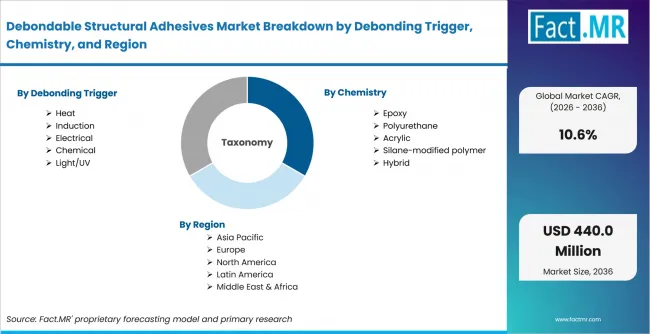
Debondable Structural Adhesives Market Breakdown By Debonding Trigger, Chemistry, And Region | Source: Fact.MR
| Attribute | Details |
|---|---|
| Quantitative Units | USD Million in 2026 to USD Million by 2036 at CAGR |
| Market Definition | Structural adhesives engineered for controlled debonding, repairability, recycling, or component separation. |
| Debonding Trigger | Heat, Induction, Electrical, Chemical, Light/UV |
| Chemistry | Epoxy, Polyurethane, Acrylic, Silane-modified polymer, Hybrid |
| Application | Automotive, Electronics, Aerospace, Wind blades, Appliances |
| Bond Strength | Semi-structural, Structural, Crash-resistant, Flexible, High-temperature |
| Buyer Type | OEMs, Tier suppliers, Electronics assemblers, Repair networks, Recyclers |
| Regions Covered | North America, Europe, Asia Pacific, Central and South America, Middle East and Africa |
| Countries Covered | China, India, Germany, Brazil, United States |
| Key Companies Profiled | Henkel, 3M, Sika, Bostik, H.B. Fuller |
| Forecast Period | 2026 to 2036 |
| Approach | Hybrid top-down and bottom-up approach using Structural Adhesives / Reworkable Adhesives, segment shares, country growth, mapping, and technical validation |
Source: Fact.MR analysis. Updated Jul 14, 2026
How is the market segmented?
-
By Debonding Trigger:
- Heat
- Induction
- Electrical
- Chemical
- Light/UV
-
By Chemistry:
- Epoxy
- Polyurethane
- Acrylic
- Silane-modified polymer
- Hybrid
-
By Application:
- Automotive
- Electronics
- Aerospace
- Wind blades
- Appliances
-
By Bond Strength:
- Semi-structural
- Structural
- Crash-resistant
- Flexible
- High-temperature
-
By Buyer Type:
- OEMs
- Tier suppliers
- Electronics assemblers
- Repair networks
- Recyclers
-
By Region:
- North America
- United States
- Canada
- Europe
- Germany
- United Kingdom
- France
- Italy
- Spain
- Asia Pacific
- China
- India
- Japan
- South Korea
- Australia
- Latin America
- Brazil
- Argentina
- Mexico
- Chile
- Middle East & Africa
- UAE
- Saudi Arabia
- South Africa
- North America
Frequently Asked Questions
Which Debonding Trigger leads the Debondable Structural Adhesives Market?
Which Chemistry leads the Debondable Structural Adhesives Market?
Which Application leads the Debondable Structural Adhesives Market?
Which country records the highest CAGR in the Debondable Structural Adhesives Market?
What is the primary driver in the Debondable Structural Adhesives Market?
What is the main restraint in the Debondable Structural Adhesives Market?
Who worked on this report


Preview the report firsthand - request a free sample
Free SampleGet the brochure for pricing and purchase details
Download PDF