- Base Value(2025): 0.5 Bn
- Estimated Value(2026): 0.6 Bn
- Forecast Value (2036): 1.3 Bn
- CAGR (2026 - 2036): 7.8%
Dental Loupe Market Forecast and Outlook By Fact.MR
- The dental loupe market was valued at USD 0.5 billion in 2025
- According to Fact.MR, demand is projected to reach USD 0.6 billion in 2026 and expand to USD 1.3 billion by 2036, reflecting a CAGR of 7.8% during the forecast period.
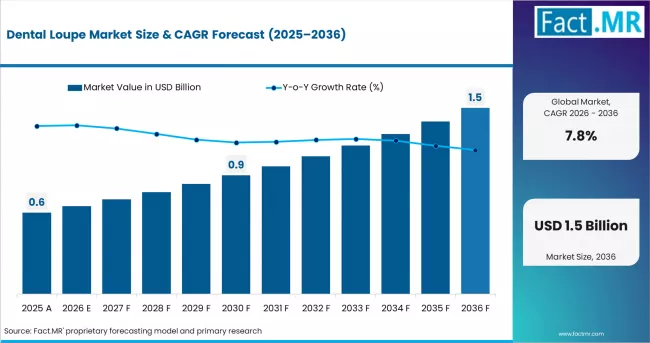
Dental Loupe Market Market Value Analysis | Source: Fact.MR
| Metric | Value |
|---|---|
| Estimated Value in 2026 | USD 0.6 billion |
| Forecast Value in 2036 | USD 1.3 billion |
| Forecast CAGR (2026 to 2036) | 7.8% |
Source: Fact.MR analysis. Updated May 15, 2026
Summary of Dental Loupe Market
- Market Definition
- The market includes wearable optical magnification systems used by dental professionals to improve visualization and ergonomics during procedures.
- Demand Drivers
- Loupes are increasingly positioned as tools that improve efficiency, visualization, and ergonomic practice.
- Fit factors such as magnification, working length, field of view, and declination angle directly influence head and neck posture.
- Dental work remains strongly exposed to neck and shoulder musculoskeletal strain, which supports adoption of better-fitted magnification systems. [2]
- Key Segments Analyzed
- By Product Type: Through-the-Lens Loupes are estimated to lead with approximately 36% share in 2026, supported by custom fit and lower bulk.
- By Magnification Range: 3.0x to 3.5x is expected to hold approximately 31% share in 2026, driven by balance between detail and field of view.
- By Application: General Dentistry is projected to account for approximately 34% share in 2026, supported by broad daily-use potential.
- By End Use: Dental Clinics are expected to contribute approximately 41% share in 2026, backed by routine magnification demand across private practice.
- By Geography: India leads growth at 8.9% CAGR through 2036, supported by rising clinical modernization.
- Analyst Opinion at FACT.MR
- Shambhu Nath Jha states, “The category reflects a shift toward clinical performance and practitioner ergonomics, not just magnification tools. Buyers are prioritizing visualization quality, reduced strain, and repeatable procedural accuracy.”
- Strategic Implications
- Invest in loupe platforms that combine ergonomic declination with optical clarity and customization.
- Build technical sales capability around posture, working distance, and field-of-view fit rather than magnification level alone.
- Position ergo and custom-fit systems where clinicians want long-session comfort and stronger procedure precision.
The market is expected to generate an absolute opportunity of USD 0.7 billion between 2026 and 2036, supported by growing adoption across dental practices and training environments. Growth is being driven by increased ergonomic awareness, wider use of magnification in both routine and specialty dental procedures, and rising adoption among dental hygienists and students. Orascoptic states that loupe magnification typically ranges from 2.5x to 6.5x, supporting applications from general visualization to high-precision work. The company also highlights that fixed magnification products commonly span 2.5x to 5.5x, where lower magnification provides a wider field of view and easier adaptation for new users, reinforcing broader market uptake. [1]
India is projected to lead with a CAGR of 8.9% through 2036, driven by expanding private dental practice, stronger training awareness, and wider adoption of ergonomics-focused equipment. China follows at 8.5%, supported by rising dental procedure volumes and increasing clinician preference for magnification. The United States is expected to grow at 7.6%, underpinned by mature clinical adoption and replacement demand. Germany records 7.1%, backed by structured ergonomics awareness and specialty-procedure use. Brazil grows at 6.8%, supported by broad dental-service activity.
Segmental Analysis
Dental Loupe Market Analysis by Product Type
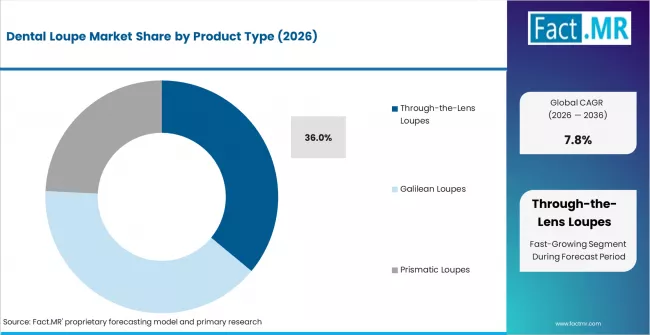
Dental Loupe Market Analysis By Product Type | Source: Fact.MR
Through-the-lens loupes are widely adopted due to their custom-fit design and ergonomic advantages in daily clinical use. Their reduced front-end bulk and alignment with practitioner posture make them suitable for long chairside procedures. Through-the-lens loupes are estimated to hold 36% share in 2026. Orascoptic states that each loupe is custom-built using facial measurements, supporting improved ergonomics and consistent clinical positioning. [3]
- TTL loupes lead because they align strongly with custom fit and lower visual obstruction.
- Flip-up loupes remain attractive where users want shared frames or adjustable optic position.
- Ergo loupes gain relevance where practitioners prioritize head posture correction and reduced neck flexion.
Dental Loupe Market Analysis by Magnification Range
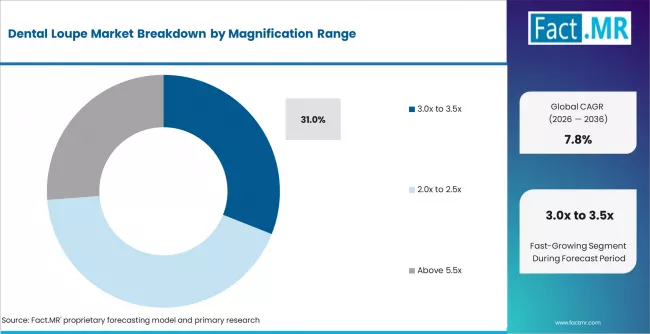
Dental Loupe Market Analysis By Magnification Range | Source: Fact.MR
3.0x to 3.5x is expected to hold 31% share in 2026, as the clinicians often need more detail than entry-level magnification without giving up too much field of view. Orascoptic states that lower magnification provides a larger field of view and easier instrument transition, while higher magnification offers greater detail but a smaller field of view.
- Mid-range magnification leads because it offers a practical balance between detail and daily usability.
- 2.0x to 2.5x remains attractive for first-time users and hygiene applications.
- Higher magnification gains relevance where endodontic and other precision-heavy procedures demand finer visual detail.
Dental Loupe Market Analysis by Application
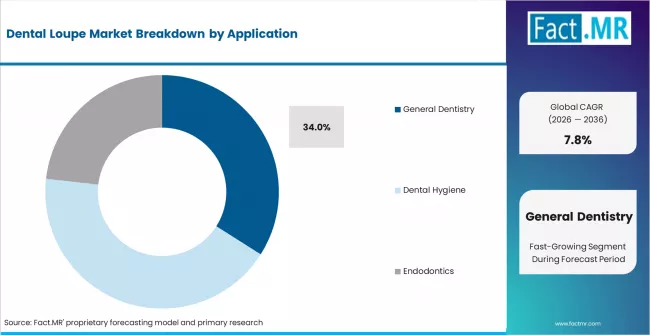
Dental Loupe Market Analysis By Application | Source: Fact.MR
General Dentistry is projected to account for 34% share in 2026. It leads because magnification use spans routine restorative, diagnostic, and preventive procedures. Orascoptic’s product positioning around a range of magnifications and broad daily practice use supports this generalist demand pattern.
- General dentistry leads because it offers the broadest day-to-day use base for loupe adoption.
- Dental hygiene remains attractive where posture, visibility, and repetitive chairside work make ergonomics especially important.
- Endodontics and specialty care gain relevance where finer detail and higher magnification are more valuable.
Dental Loupe Market Analysis by End Use
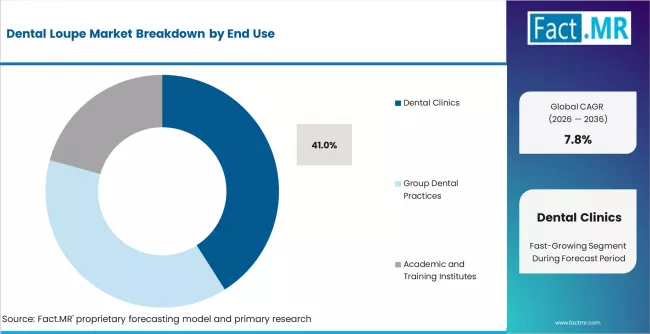
Dental Loupe Market Analysis By End Use | Source: Fact.MR
Dental Clinics are expected to contribute 41% share in 2026. This segment leads because independent and group clinics represent the broadest point of daily loupe use. The ADA ergonomics guidance on loupe fitting and operatory posture reflects how central loupe choice is at the clinic level rather than only in institutions. [4]
- Dental clinics lead because they represent the broadest recurring user base for loupe adoption and replacement.
- Academic and training institutes remain important where loupe use increasingly starts during professional training.
- Hospital dental departments gain traction where specialty and surgical dental workflows need stronger visual support.
Drivers, Restraints, and Opportunities
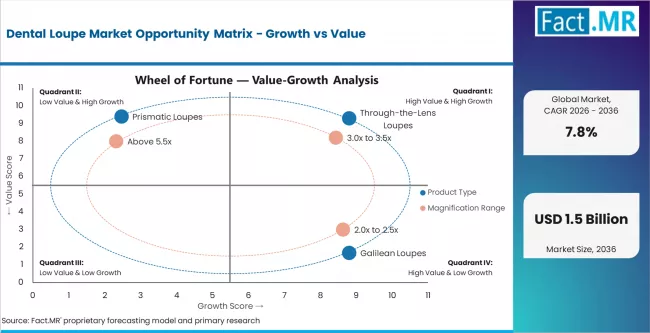
Dental Loupe Market Opportunity Matrix Growth Vs Value | Source: Fact.MR
The market is being shaped by the need to improve clinical visibility while reducing physical strain during repetitive chairside work. Structural demand is anchored in ergonomics and musculoskeletal-risk management. CDC-linked literature documents high prevalence of neck and shoulder disorders among dental professionals.
The main restraint is fitting quality and adaptation. Loupes deliver value only when magnification, declination, field of view, and working distance are properly matched to the user. ADA guidance states that loupes should ideally be fitted by a trained optical specialist in the clinician’s own operatory. This means suppliers must prove not only optical quality but also fitting accuracy and ergonomic setup.
- Ergonomic loupe adoption remains the clearest opportunity where clinicians want posture improvement during long procedures.
- Custom-fit TTL systems create stronger value where practitioners want lighter all-day wear and more stable optics.
- Mid-range and specialty magnification portfolios offer higher-value opportunity where users want procedure-specific options without moving to microscopes.
Regional Analysis
The market is assessed across North America, Europe, Asia Pacific, Latin America, and Middle East and Africa, covering 40+ countries with demand profiles shaped by dental procedure volume, ergonomics awareness, training culture, and premium equipment adoption. The country growth rates below are model-based estimates.
.webp "Top Country Growth Comparison Dental Loupe Market Cagr (2026 2036)")
Top Country Growth Comparison Dental Loupe Market Cagr (2026 2036) | Source: Fact.MR
| Country | CAGR (2026 to 2036) |
|---|---|
| India | 8.9% |
| China | 8.5% |
| United States | 7.6% |
| Germany | 7.1% |
| Brazil | 6.8% |
Source: Fact.MR analysis. Updated May 15, 2026
North America Dental Loupe Market Analysis
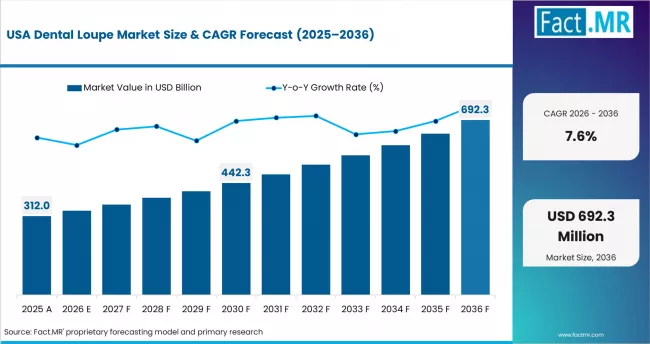
Dental Loupe Market Country Value Analysis | Source: Fact.MR
North America remains an important commercial region because it combines mature private-practice infrastructure, stronger ergonomics awareness, and broad premium-equipment adoption. ADA ergonomics materials and Orascoptic’s product depth both support the region’s continued relevance in custom-fit loupe adoption.
- United States: Strong ergonomics awareness and consistent replacement demand support growth. The market is projected to expand at around 7.6% CAGR through 2036, driven by routine use of customized loupes, higher focus on posture-related health, and continuous upgrading to lightweight, high-clarity optical systems. Demand is reinforced by specialist procedures and long chair-time treatments where visual precision matters.
Europe Dental Loupe Market Analysis
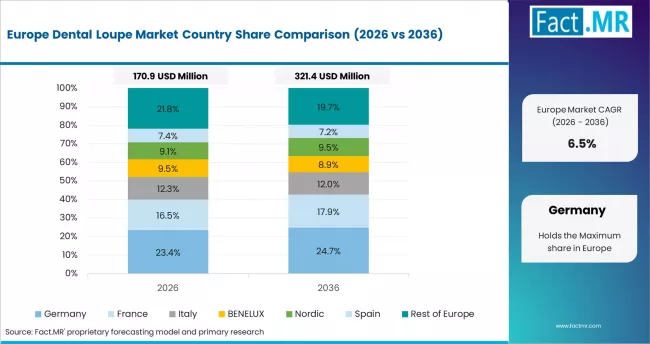
Dental Loupe Market Europe Country Market Share Analysis, 2026 & 2036 | Source: Fact.MR
Europe remains a technically structured region where adoption is closely tied to ergonomics discipline, specialty dental procedures, and preference for high-quality clinical instrumentation. Dental professionals in this region place strong emphasis on precision, posture, and long-term usability.
- Germany: Germany plays a central role in the European dental equipment landscape due to its strong clinical standards and premium instrumentation demand. The market is projected to grow at approximately 7.1% CAGR by 2036, supported by increasing use of fitted loupes in general and specialist dentistry. Adoption is driven by ergonomics awareness, procedural accuracy requirements, and preference for durable, high-performance optical systems. Dental training programs and professional guidelines further reinforce routine loupe usage in clinical practice.
Asia Pacific and Latin America Dental Loupe Market Analysis
Asia Pacific offers the strongest long-term expansion potential because it combines expanding dental-service capacity, increasing awareness of ergonomics, and rising adoption of higher-value clinical tools. As clinics modernize, there is a gradual shift from unaided visualization toward magnification-supported workflows.
- India: Clinical modernization and growing ergonomics awareness support demand. The market is projected to grow at close to 8.9% CAGR from 2026 to 2036, driven by expanding dental clinics, improving training standards, and increasing adoption of magnification tools in routine procedures.
- China: Rising dental procedure volumes and greater use of visual-enhancement tools support growth. The market is expected to expand at around 8.5% CAGR by 2036, with increasing penetration of loupes across both general and specialized dental practices.
- Brazil: Broad dental-service activity and stronger adoption of premium chairside tools support steady growth. The market is projected to grow at approximately 6.8% CAGR through 2036, driven by clinical demand for improved visualization and ergonomics in high-volume practices.
Competitive Aligners for Market Players
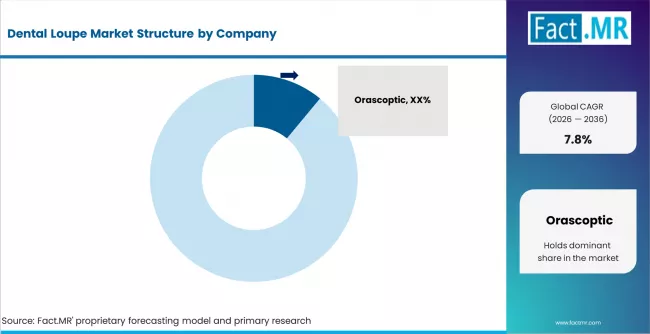
Dental Loupe Market Analysis By Company | Source: Fact.MR
The market is moderately concentrated at the optical-design, fitting, and ergonomic-platform level, while broader adoption remains clinician-controlled. Competitive strength comes from the ability to combine optical clarity, declination control, customization, and daily-wear comfort. Suppliers need more than a magnification claim. They need a clear explanation of how the loupe improves visibility and posture in real operatory settings.
Competitive advantage is defined by fit accuracy, magnification range, field of view, ergonomic geometry, and comfort during extended use. This competitive framing is an analytical view derived from current official and manufacturer materials rather than a published market-share table.
Representative Players
- Orascoptic
- LumaDent
- Designs for Vision
- SurgiTel
- Admetec
Bibliography
- [1] Orascoptic. Loupes product materials describing improved performance, efficiency, ergonomics, and magnification range from 2.5x to 6.5x.
- [2] CDC-linked ergonomics literature reviewing neck and shoulder musculoskeletal disorders among dental professionals.
- [3] Orascoptic. Fixed magnification materials describing loupe power from 2.5x to 5.5x, with lower magnification offering larger field of view and easier transition for new users.
- [4] ADA. Ergonomics guidance noting that magnification level, working length, field of view, and declination angle affect posture, and that poor-fitting loupes can worsen neck and shoulder strain.
This Report Addresses
- Strategic intelligence on dental loupe demand across visualization, ergonomics, specialty procedures, and clinic workflow improvement.
- Market forecast from USD 0.6 billion in 2026 to USD 1.3 billion by 2036 at a CAGR of 7.8%.
- Growth opportunity mapping across TTL loupes, ergonomic loupe designs, mid-range magnification systems, and specialty-use optics.
- Segment analysis by product type, magnification range, application, end use, and region.
- Regional outlook covering North America, Europe, Asia Pacific, Latin America, and Middle East and Africa.
- Competitive analysis of major participants serving dental magnification, ergonomic optics, and chairside loupe fitting ecosystems.
- Clinical-visibility and posture analysis covering magnification choice, declination, field of view, and long-session working comfort.
- Market interpretation built around stronger ergonomics awareness, broader chairside magnification use, and rising demand for custom-fit visualization tools.
Dental Loupe Market Definition
The market covers magnification devices worn by dental professionals to improve visualization, working posture, and procedural precision during chairside care. It includes fixed and variable loupe systems, flip-up and TTL configurations, ergonomic loupe designs, and associated optical customization used across general and specialty dental practice.
Dental Loupe Market Inclusions
Covers global and regional forecasts from 2026 to 2036. Includes dental loupe systems used in operative dentistry, hygiene, specialty care, student training, and ergonomics-focused clinical workflows, including products positioned around enhanced visibility, declination control, and posture improvement.
Dental Loupe Market Exclusions
Excludes surgical microscopes, stand-mounted magnification devices, illumination-only headlamps where loupe optics are not the core product role, and generic magnification eyewear not designed for dental clinical use. This exclusion logic is an analytical market boundary rather than a quoted source definition.
Dental Loupe Market Research Methodology
- Primary Research:Interviews with dentists, hygienists, dental school faculty, loupe-fitting specialists, procurement managers, and dental-equipment distributors.
- Desk Research:Uses current official materials from Orascoptic and ADA sources, plus CDC-linked ergonomic literature relevant to musculoskeletal strain in dental practice.
- Market-Sizing and Forecasting:Hybrid model using dental procedure volume growth, loupe adoption by clinicians and hygienists, ergonomics-driven replacement demand, and specialty magnification needs.
- Data Validation and Update Cycle:Validated using official product materials, ergonomics references, and recurring checks on magnification range, loupe customization, and posture-related clinical adoption.
Segmentation
Scope of Report
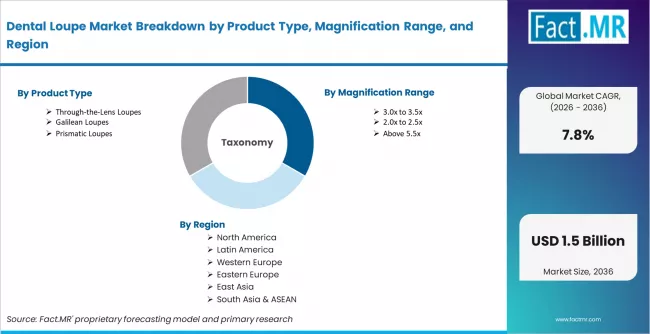
Dental Loupe Market Breakdown By Product Type, Magnification Range, And Region | Source: Fact.MR
| Attribute | Details |
|---|---|
| Quantitative Units | USD 0.6 billion (2026) to USD 1.3 billion (2036), at a CAGR of 7.8% |
| Market Definition | Wearable optical magnification systems used by dental professionals to improve visualization, posture, and procedural precision |
| Product Type Segmentation | Galilean Loupes, Prismatic Loupes, Ergo Loupes, Flip-Up Loupes, Through-the-Lens Loupes, Others |
| Magnification Range Segmentation | 2.0x to 2.5x, 3.0x to 3.5x, 4.0x to 5.5x, Above 5.5x, Others |
| Application Segmentation | General Dentistry, Dental Hygiene, Endodontics, Periodontics, Prosthodontics, Oral Surgery, Others |
| End Use Segmentation | Dental Clinics, Group Dental Practices, Academic and Training Institutes, Hospital Dental Departments, Others |
| Regions Covered | North America, Europe, Asia Pacific, Latin America, Middle East and Africa |
| Countries Covered | United States, Germany, China, India, Brazil, Japan, and 40+ countries |
| Forecast Period | 2026 to 2036 |
| Approach | Hybrid top-down and bottom-up model using dental procedure growth, ergonomics-related adoption, replacement demand, and primary interviews with clinicians, educators, and optical-fit specialists |
Source: Fact.MR analysis. Updated May 15, 2026
Dental Loupe Market by Segments
-
By Product Type:
- Galilean Loupes
- Prismatic Loupes
- Ergo Loupes
- Flip-Up Loupes
- Through-the-Lens Loupes
- Others
-
By Magnification Range:
- 2.0x to 2.5x
- 3.0x to 3.5x
- 4.0x to 5.5x
- Above 5.5x
- Others
-
By Application:
- General Dentistry
- Dental Hygiene
- Endodontics
- Periodontics
- Prosthodontics
- Oral Surgery
- Others
-
By End Use:
- Dental Clinics
- Group Dental Practices
- Academic and Training Institutes
- Hospital Dental Departments
- Others
-
By Region:
- North America
- United States
- Canada
- Mexico
- Latin America
- Brazil
- Argentina
- Chile
- Rest of Latin America
- Western Europe
- Germany
- France
- United Kingdom
- Italy
- Spain
- Nordic Countries
- BENELUX
- Rest of Western Europe
- Eastern Europe
- Russia
- Poland
- Hungary
- Balkan and Baltic
- Rest of Eastern Europe
- East Asia
- China
- Japan
- South Korea
- South Asia and Pacific
- India
- ASEAN
- Australia and New Zealand
- Rest of South Asia and Pacific
- Middle East and Africa
- Kingdom of Saudi Arabia
- Other GCC Countries
- Turkey
- South Africa
- Rest of Middle East and Africa
- North America
Frequently Asked Questions
How large is the global dental loupe market in 2025?
What will the market size be in 2026?
What is the projected market size by 2036?
What is the expected CAGR from 2026 to 2036?
Which product type is poised to lead the market?
Which application segment holds the largest share?
Which country shows the fastest growth?
What is driving demand for dental loupes?
What is the key challenge in this market?
Who worked on this report


Preview the report firsthand - request a free sample
Free SampleGet the brochure for pricing and purchase details
Download PDF