- Market Value (2025): USD 17.2 Bn
- Estimated Value (2026): USD 18.9 Bn
- Forecast Value (2036): USD 47.7 Bn
- CAGR (2026-2036): 9.7%
What is the Digital English Language Learning Market forecast to be worth by 2036?
USD 18.9 billion in 2026 to USD 47.7 billion by 2036 at a 9.7% CAGR.
- The digital English language learning market reached USD 17.2 billion in 2025.
- Demand is projected to increase from USD 18.9 billion in 2026 to USD 47.7 billion by 2036.
- The market is forecast to record 9.7% CAGR from 2026 to 2036 and create an absolute opportunity of USD 28.9 billion.
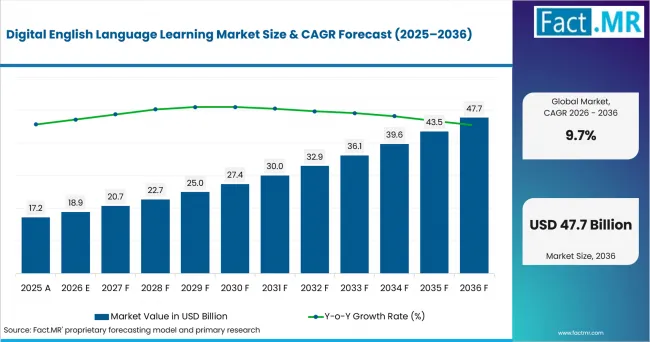
Digital English Language Learning Market Value Analysis | Source: Fact.MR
What are the defining numbers behind Digital English Language Learning Market growth?
USD 28.9 billion absolute opportunity by 2036, led by language learning apps and self-paced learning alongside K-12 education and individual learners.
- Demand Drivers in the Market
- Online and self-study formats are expected to widen English learning access beyond classroom schedules.
- English proficiency is expected to remain valuable for education and employment.
- Mobile-first course design is projected to support shorter practice sessions. This helps individual learners continue lessons without waiting for a fixed class time.
- Key Segments Analyzed
- By Learning Solution: Language Learning Apps are expected to hold 38.0% share in 2026 because app access fits daily practice and paid subscription use.
- By Learning Mode: Self-paced Learning is projected to account for 41.0% share in 2026 as learners value schedule control and repeatable lessons.
- By End-use Sector: K-12 Education is anticipated to capture 40.0% share in 2026 since schools need structured content for curriculum-based English practice.
- By User Category: Individual Learners are estimated to represent 42.0% share in 2026 due to direct subscription use and exam-led study needs.
- By Technology Platform: AI-powered Learning Platform is forecast to hold 39.0% share in 2026 as adaptive lessons and automated feedback shape product selection.
- Analyst Opinion at Fact.MR
- Shambhu Nath Jha, Principal Consultant at Fact.MR, states, “Digital English Language Learning providers need to show how each product improves practice and assessment for a defined learner group. Repeat demand is expected to depend on visible progress and steady product use instead of broad claims about online education.”
- Strategic Implications
- Platform owners need positioning that connects lessons, feedback and assessment to a clear learner outcome. A general digital education pitch is less persuasive during institutional review.
- School and institute sales teams can improve renewal discussions by showing course use and learner progress inside learning management systems.
- Enterprise providers may protect pricing when corporate training packages show completion tracking and practical English use at work.
The USA leads at 10.5% CAGR through platform spending, paid app use and institutional adoption. India follows at 10.1% through mobile-first learning and exam preparation. China reaches 9.6% through local platform demand. The UK records 9.2% through English assessment links. Canada posts 8.8%, Australia reaches 8.3% and Singapore records 7.9%.
How does the Digital English Language Learning Market break down by segment?
Language Learning Apps are expected to lead Learning Solution at 38.0% share in 2026. Self-paced Learning is projected to lead Learning Mode at 41.0% share in 2026.
Which Learning Solution dominates?
Language Learning Apps are projected to account for 38.0% share in 2026.
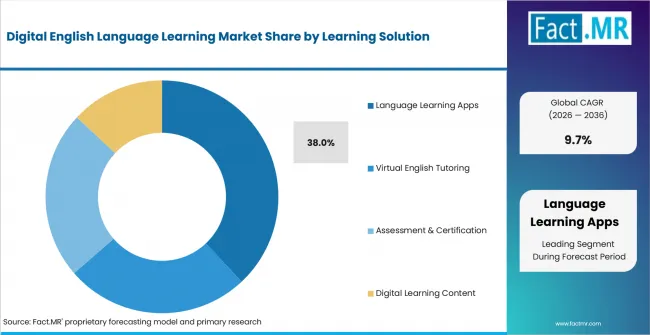
Digital English Language Learning Market Analysis By Learning Solution | Source: Fact.MR
App-led delivery gives learners frequent access to short lessons and vocabulary practice. Virtual English Tutoring remains useful when live speaking support is needed. Assessment & Certification and Digital Learning Content support buyers that need testing evidence or classroom-ready material.
What leads the Learning Mode segment?
Self-paced Learning is expected to hold 41.0% share in 2026.
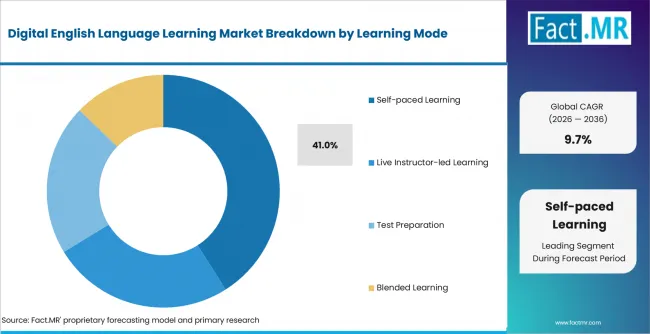
Digital English Language Learning Market Analysis By Learning Mode | Source: Fact.MR
Self-paced Learning fits learners who need flexible study without fixed class timing. Live Instructor-led Learning serves users who need guided speaking practice. Test Preparation and Blended Learning remain relevant where structured goals and teacher support matter.
How does K-12 Education shape demand?
K-12 Education is anticipated to lead End-use Sector with 40.0% share in 2026.
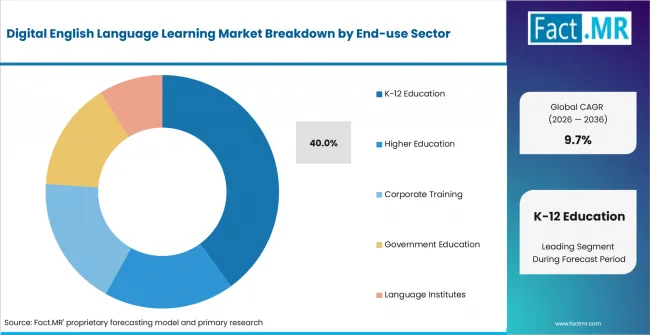
Digital English Language Learning Market Analysis By End Use Sector | Source: Fact.MR
Schools require English learning tools that support classroom lessons and homework practice. Higher Education uses digital programs for academic readiness. Corporate Training and Language Institutes create additional demand where communication skills and placement outcomes must be tracked.
What supports Individual Learners within User Category?
Individual Learners are estimated to represent 42.0% share in 2026.
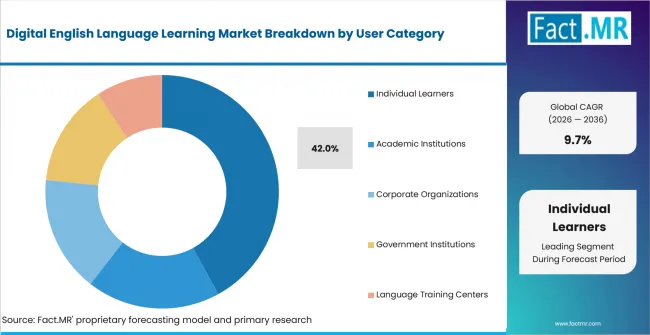
Digital English Language Learning Market Analysis By User Category | Source: Fact.MR
Individual users often purchase directly for study, career needs and test preparation. Academic Institutions compare platform control with student progress reports. Corporate Organizations and Government Institutions adopt tools when learning programs need consistent access across many users.
What supports AI-powered Learning Platform within Technology Platform?
AI-powered Learning Platform is forecast to hold 39.0% share in 2026.
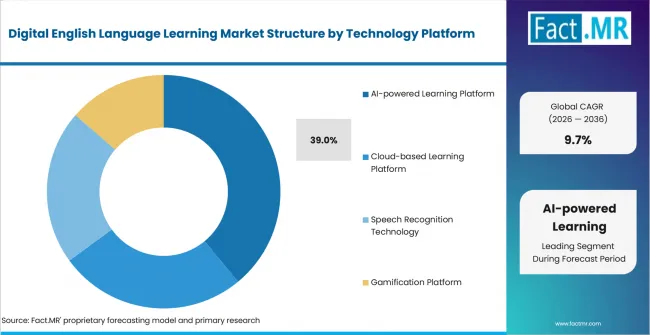
Digital English Language Learning Market Analysis By Technology Platform | Source: Fact.MR
AI-powered platforms are favored when adaptive lessons and pronunciation feedback make practice more personal. Cloud-based Learning Platform supports access across devices. Speech Recognition Technology and Gamification Platform add value when learners need speaking practice and motivation support.
What is accelerating Digital English Language Learning Market adoption, and what is holding it back?
Demand is expected to rise through mobile access, measurable learning outcomes and wider use of platform-based English programs. Growth may be limited by subscription fatigue and uneven course completion.
Drivers Impact Analysis
| DRIVER | (~) % IMPACT ON CAGR | GEOGRAPHIC RELEVANCE | IMPACT TIMELINE |
|---|---|---|---|
| Adoption and integration | +1.6% | Global | Short term (<= 2 years) |
| Regulatory and compliance support | +1.4% | USA, Germany, UK | Short term (<= 2 years) |
| Channel and access expansion | +1.1% | Global | Medium term (2-4 years) |
| Clear specification and documentation | +0.9% | USA, UK, Canada | Medium term (2-4 years) |
| Cost and efficiency gains | +0.6% | Global | Long term (>= 4 years) |
Source: Fact.MR analysis. Updated Aug 6, 2026
- Adoption and integration: Platforms that fit school systems, app stores and enterprise portals are expected to reduce onboarding friction.
- Regulatory and compliance support: Education and enterprise buyers give more weight to privacy, access control and learner-data handling before approval.
- Channel and access expansion: Mobile distribution and partner-led institutional sales are expected to improve reach across paid learner groups.
Opportunity Impact Analysis
| OPPORTUNITY | (~) % IMPACT ON CAGR | GEOGRAPHIC RELEVANCE | IMPACT TIMELINE |
|---|---|---|---|
| Emerging application expansion | +1.0% | Global | Medium term (2-4 years) |
| Premium and specialist positioning | +0.8% | USA, UK, Germany | Medium term (2-4 years) |
| Channel and partner expansion | +0.7% | Global | Long term (>= 4 years) |
| Standards and compliance alignment | +0.5% | USA, Canada, Singapore | Long term (>= 4 years) |
Source: Fact.MR analysis. Updated Aug 6, 2026
- Emerging application expansion: English learning tied to employability, migration and test readiness is expected to support new product packaging.
- Premium and specialist positioning: Providers with speaking practice and assessment tools can reach users ready to pay for clearer outcomes.
- Channel and partner expansion: Institutional partnerships are likely to improve access where direct learner acquisition is costly or uneven.
Restraints Impact Analysis
| RESTRAINT | (~) % IMPACT ON CAGR | GEOGRAPHIC RELEVANCE | IMPACT TIMELINE |
|---|---|---|---|
| Cost and complexity | -1.1% | Global | Short term (<= 2 years) |
| Specification and compliance checks | -0.9% | USA, UK, Germany | Short term (<= 2 years) |
| Substitution by lower-cost alternatives | -0.7% | Import-dependent markets | Medium term (2-4 years) |
| Supply chain and pricing pressure | -0.5% | Global | Long term (>= 4 years) |
Source: Fact.MR analysis. Updated Aug 6, 2026
- Cost and complexity: Paid subscriptions and multi-user licenses can slow adoption when buyers cannot see progress quickly.
- Specification and compliance checks: Schools and companies may delay platform approval until privacy, access control and reporting needs are clear.
- Substitution by lower-cost alternatives: Free content and informal tutoring can pressure paid platforms unless the product shows stronger outcomes.
Which countries are scaling the Digital English Language Learning Market fastest?
- The country comparison spans 2.6 percentage points and forms a clear growth ladder across the forecast period.
- The USA remains 0.4 percentage point above India through platform spending and paid app use.
- India remains 0.5 percentage point above China as mobile-first learning supports wider user growth.
- China remains 0.4 percentage point above the UK through local platform demand and institutional learning activity.
- The UK remains 0.4 percentage point above Canada through English assessment links and education-service positioning.
- Canada remains 0.5 percentage point above Australia through workplace learning and education access.
- Singapore closes the displayed range through regional education links and enterprise learning use.
Comparable CAGRs can create different entry conditions. Platform maturity and buyer budgets affect adoption. Full report coverage includes North America; Latin America; Europe; East Asia; South Asia and Pacific; Middle East and Africa.
Country CAGR (2026-2036)
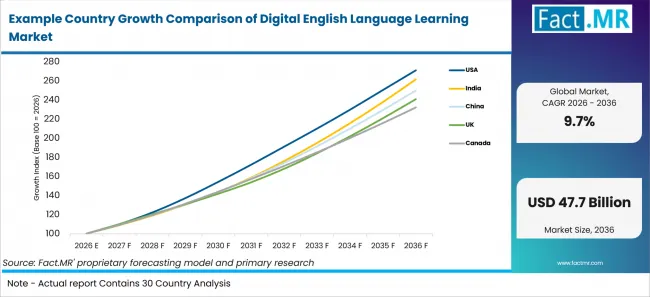
Example Country Growth Comparison Of Digital English Language Learning Market | Source: Fact.MR
| Country | CAGR (2026-2036) |
|---|---|
| USA | 10.5% |
| India | 10.1% |
| China | 9.6% |
| UK | 9.2% |
| Canada | 8.8% |
| Australia | 8.3% |
| Singapore | 7.9% |
Source: Fact.MR analysis. Updated Aug 6, 2026
What supports USA adoption?
10.5% CAGR, supported by platform spending and institutional use.
Learners in the USA often evaluate paid digital programs through progress tracking and ease of use. Schools and employers add another approval layer because they need consistent access for many users. Providers that explain completion tracking and speaking improvement are expected to gain stronger renewal opportunities.
How is India scaling demand?
10.1% CAGR, driven by mobile-first access and exam-led English learning.
India’s demand base is shaped by learners who use English for education, job mobility and competitive exams. Affordable app access is expected to matter because many users begin with self-study. Platforms that combine practice reminders with clear learning paths can convert casual use into paid demand.
What is driving China’s growth from 2026 to 2036?
9.6% CAGR, backed by institutional demand and local platform use.
China’s market is expected to depend on structured learning systems that meet school and platform requirements. Buyers are likely to review content control and data handling before approval. Localized lessons and reliable reporting can improve supplier acceptance where institutions manage large learner groups.
How is the UK developing demand?
9.2% CAGR, led by education-service strength and assessment readiness.
The UK benefits from a learning ecosystem where English teaching, testing and international education are closely connected. Digital providers are expected to compete on lesson quality and tutor availability. Products that support recognized learning goals can defend pricing in premium user groups.
How does Canada perform?
8.8% CAGR, supported by education access and workforce language needs.
Canada’s growth reflects steady use across individual learning, institutions and workplace training. Buyers are likely to prefer programs that make progress visible without heavy administration. Clear learner support can help providers maintain retention across subscription and institutional models.
What supports Australia’s growth?
8.3% CAGR, backed by education exports and learner mobility.
Australia’s demand is expected to come from students, migrants and professionals who need flexible English practice. Institutions may value content that supports placement and readiness checks. Platform providers can gain ground when the product fits both independent study and guided learning.
What supports Singapore’s growth?
7.9% CAGR, supported by regional education links and enterprise learning use.
Singapore’s compact market favors reliable platforms that serve schools, professionals and cross-border learners. Enterprise buyers are expected to review reporting and learner support before adoption. Multilingual onboarding and consistent service can help providers compete in premium learning environments.
Who leads the Digital English Language Learning Market?
Duolingo and Babbel hold strong positions through app-based language learning and subscription-led practice, while Rosetta Stone adds established digital course depth.
Cambly and EF English Live strengthen live tutoring and speaking support. The British Council and Pearson contribute assessment, certification and institutional reach. Open English expands virtual instruction across wider learner groups, while Coursera and Busuu broaden access through flexible online courses, mobile practice and career-focused English learning pathways globally.
Which companies are the key providers?
Key companies include Duolingo, Inc.; Babbel GmbH; IXL Learning – Rosetta Stone; Cambly Inc.; EF Education First – EF English Live; British Council; Open Education LLC – Open English; Pearson plc; Coursera, Inc.; and Busuu Ltd.
- Duolingo, Inc.
- Babbel GmbH
- IXL Learning – Rosetta Stone
- Cambly Inc.
- EF Education First – EF English Live
- British Council
- Open Education LLC – Open English
- Pearson plc
- Coursera, Inc.
- Busuu Ltd.
Bibliography
- Organisation for Economic Co-operation and Development. (2025, May 23). What should teachers teach and students learn in a future of powerful AI? OECD Education Spotlights, No. 20. OECD Publishing.
- United Nations Educational, Scientific and Cultural Organization. (2025, September 4). AI and education: Protecting the rights of learners.
- Fuster Rabella, M. (2025, November 21). Evolving AI capabilities and the school curriculum: Emerging implications and a case study on writing. OECD Education Working Papers, No. 338. OECD Publishing.
- United Nations Educational, Scientific and Cultural Organization. (2025, December 17). UNESCO launch of “Bhasha Matters”: State of the Education Report for India 2025 on mother tongue and multilingual education.
This Report Answers
- The report provides strategic intelligence on the Digital English Language Learning Market across Learning Solution and Learning Mode choices.
- Segment analysis covers Language Learning Apps and Self-paced Learning as the share leaders within the 2026 market.
- Country outlook evaluates the USA and India alongside China and the UK. Canada, Australia and Singapore complete the growth comparison.
- Competitive analysis profiles Duolingo, Inc. and Babbel GmbH alongside IXL Learning – Rosetta Stone and Cambly Inc. EF Education First – EF English Live; British Council; Open Education LLC – Open English; Pearson plc; Coursera, Inc.; and Busuu Ltd. complete the provider set.
- Technology assessment covers AI-powered Learning Platform and Cloud-based Learning Platform. Speech Recognition Technology and Gamification Platform complete the platform view.
What does the Digital English Language Learning Market cover?
Digital English language learning products are used for structured English practice where access, progress tracking and learner engagement determine paid adoption.
The Digital English Language Learning Market covers apps and virtual tutoring. It also includes assessments, certification support and digital learning content. Coverage extends to self-paced lessons and instructor-led programs. K-12 Education and Higher Education are included when digital English learning is sold as a defined product or service. Corporate Training, Government Education and Language Institutes follow the same inclusion rule.
What is included in the scope?
Digital English language learning is assessed across learners, institutions and workplace buyers. The scope follows products that support English practice through digital delivery.
The scope includes Learning Solution and Learning Mode alongside End-use Sector. User Category and Technology Platform complete the structure. Coverage spans Language Learning Apps and Virtual English Tutoring. Assessment & Certification and Digital Learning Content complete the solution scope. AI-powered Learning Platform and Cloud-based Learning Platform are included when they support English learning outcomes. Speech Recognition Technology and Gamification Platform follow the same rule.
What is excluded from the scope?
General education technology that does not support English language learning remains outside the scope of this market.
The scope excludes unrelated tutoring, offline-only language classes and broad school software that does not deliver English learning content. General productivity tools are excluded unless they are sold as part of a digital English learning program. Company revenue without a clear connection to digital English language learning is also excluded.
How Was the Analysis Built?
The analysis draws on 120+ sources; 35+ company portfolios; 25+ countries; and more than 20 industry interviews.
- Primary Research: Primary research includes discussions with manufacturers; service providers; technology developers; distributors; end users; procurement teams; and subject-matter experts. These conversations examine purchasing priorities; product adoption; operational challenges; approval requirements; competitive positioning; and the factors that influence wider market acceptance.
- Desk Research: Desk research covers government statistics; regulatory publications; company filings; trade data; technical studies; industry associations; standards; public policy; and other authoritative sources. Every source used in the analysis is documented in the bibliography.
- Market Sizing and Forecasting: Market estimates combine historical performance; demand indicators; pricing and volume trends; segment shares; company participation; country-level growth; adoption patterns; investment activity; and barriers to market expansion.
- Data Validation and Update Cycle: Findings are validated by comparing primary interviews with public data; company activity; regulatory changes; trade patterns; and industry developments. Regular updates review new product launches; capacity changes; partnerships; approvals; procurement trends; and shifts in commercial adoption.
Segmentation
What is the report’s scope and coverage?
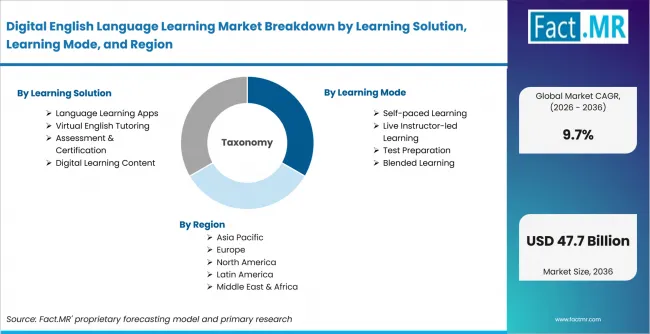
Digital English Language Learning Market Breakdown By Learning Solution, Learning Mode, And Region | Source: Fact.MR
| Attribute | Details |
|---|---|
| Quantitative Units | USD billion |
| Market Definition | Paid digital English learning delivered through apps, virtual tutoring, assessment tools, certification support, digital content and platform-led instruction. The scope covers tools used for language practice and measurable learner progress. |
| Learning Solution | Language Learning Apps; Virtual English Tutoring; Assessment & Certification; Digital Learning Content |
| Learning Mode | Self-paced Learning; Live Instructor-led Learning; Test Preparation; Blended Learning |
| End-use Sector | K-12 Education; Higher Education; Corporate Training; Government Education; Language Institutes |
| User Category | Individual Learners; Academic Institutions; Corporate Organizations; Government Institutions; Language Training Centers |
| Technology Platform | AI-powered Learning Platform; Cloud-based Learning Platform; Speech Recognition Technology; Gamification Platform |
| Regions Covered | North America; Latin America; Europe; East Asia; South Asia and Pacific; Middle East and Africa |
| Countries Covered | USA; India; China; UK; Canada; Australia; Singapore |
| Key Companies Profiled | Duolingo, Inc.; Babbel GmbH; IXL Learning – Rosetta Stone; Cambly Inc.; EF Education First – EF English Live; British Council; Open Education LLC – Open English; Pearson plc; Coursera, Inc.; Busuu Ltd. |
| Forecast Period | 2026 to 2036 |
| Approach | Hybrid top-down and bottom-up approach using paid app demand, virtual tutoring use, education platform adoption, assessment needs, institutional purchasing, learner retention, channel access, country adoption patterns and company portfolio review |
Source: Fact.MR analysis. Updated Aug 6, 2026
How is the market segmented?
-
By Learning Solution:
- Language Learning Apps
- Mobile Learning Apps
- Web-based Learning Portals
- Virtual English Tutoring
- One-to-One Tutoring
- Group Tutoring
- Assessment & Certification
- English Proficiency Tests
- Business English Certification
- Digital Learning Content
- eBooks & Interactive Modules
- Microlearning Content
- Language Learning Apps
-
By Learning Mode:
- Self-paced Learning
- Recorded Video Lessons
- Digital Course Modules
- Live Instructor-led Learning
- Live Virtual Classes
- Webinars
- Test Preparation
- IELTS Preparation
- TOEFL Preparation
- Blended Learning
- Classroom + Online Learning
- Flipped Classroom
- Self-paced Learning
-
By End-use Sector:
- K-12 Education
- Primary Schools
- Secondary Schools
- Higher Education
- Universities
- Corporate Training
- Government Education
- Public Schools
- Public Sector
- Language Institutes
- Private Institutes
- Community Learning Centers
- K-12 Education
-
By User Category:
- AI-powered Learning Platform
- Natural Language Processing
- Pronunciation Recognition
- Cloud-based Learning Platform
- Adaptive Learning Engine
- Machine Learning Analytics
- Speech Recognition Technology
- Automated Assessment Engine
- Content Recommendation Engine
- Gamification Platform
- Progress Tracking Dashboard
- Learning Analytics
- AI-powered Learning Platform
-
By Technology Platform:
- AI-powered Learning Platform
- Natural Language Processing
- Pronunciation Recognition
- Cloud-based Learning Platform
- Adaptive Learning Engine
- Machine Learning Analytics
- Speech Recognition Technology
- Automated Assessment Engine
- Content Recommendation Engine
- Gamification Platform
- Progress Tracking Dashboard
- Learning Analytics
- AI-powered Learning Platform
-
By Region:
- North America
- Latin America
- Europe
- East Asia
- South Asia and Oceania
- Middle East and Africa
Frequently Asked Questions
How big is the digital English language learning market in 2026?
What is the CAGR of the digital English language learning market from 2026 to 2036?
Which learning solution leads the digital English language learning market?
Which learning mode leads the digital English language learning market?
Who are the leading companies in the digital English language learning market?
Who worked on this report


Preview the report firsthand - request a free sample
Free SampleGet the brochure for pricing and purchase details
Download PDF