- Market Value (2025): USD 117.4 Bn
- Estimated Value (2026): USD 132.6 Bn
- Forecast Value (2036): USD 446.2 Bn
- CAGR (2026-2036): 12.9%
What is the Corporate E Learning Market forecast to be worth by 2036?
USD 132.6 billion in 2026 to USD 446.2 billion by 2036, at a 12.9% CAGR.
The enterprise learning budget should be read beside Fact.MR's Smart Education and Learning Market, since platforms and content tools increasingly share buyer attention.
- The corporate e learning market reached USD 117.4 billion in 2025 as learning and managed learning firms spent against a clear use case: repeatable employee training, onboarding, compliance and reskilling delivered at enterprise scale.
- Demand is projected to increase from USD 132.6 billion in 2026 to USD 446.2 billion by 2036, at a 12.9% CAGR.
- The market is forecast to record a 12.9% CAGR from 2026 to 2036 as companies prove repeatable employee training and reskilling delivered at enterprise scale.
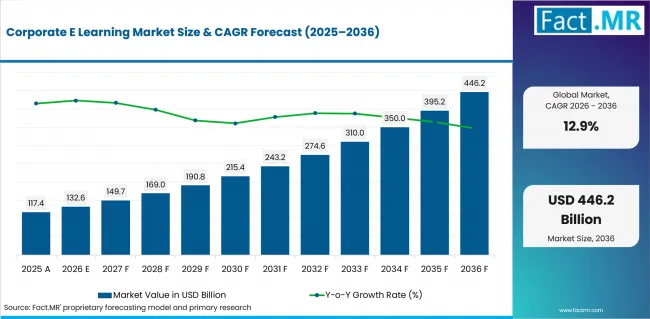
Corporate E Learning Market Value Analysis | Source: Fact.MR
What are the defining numbers behind Corporate E Learning Market growth?
USD 313.6 billion absolute opportunity is expected by 2036.
Outsourced program design connects with Fact.MR's Managed Learning Services Market, where enterprises shift training administration to specialist providers.
- Demand Drivers in the Market
- Instructor-led training leads because enterprises still need structured sessions for leadership, compliance, product and process training. Digital delivery extends the trainer rather than removing the need for guided instruction.
- Employee onboarding leads because new hires need a consistent first experience across distributed teams, hybrid work models and fast-changing operating processes.
- Large enterprises lead as they have higher learner counts, compliance exposure, LMS administration needs and budget for content libraries, analytics and managed services.
- Direct enterprise sales lead as training programs must be integrated with HR systems, identity access, role libraries, reporting and procurement controls.
- Key Segments Analyzed
- By Learning Type: Instructor-Led Training is projected to hold 38.4% share in 2026. Instructor-led training leads because high-stakes topics still require facilitation, discussion and assessment even when delivered through digital platforms.
- By End User: Large Enterprises is projected to hold 29.2% share in 2026. Large enterprises lead as scale, compliance risk and multi-location workforce needs justify enterprise learning platforms and managed services.
- By Distribution Channel: Direct Enterprise Sales is projected to hold 29.6% share in 2026. Direct enterprise sales lead as implementation depends on HR integration, security review, content mapping and reporting requirements.
- By Technology: Online Learning Platforms is projected to hold 43.5% share in 2026. Online learning platforms lead as they provide the learner access, administration, tracking and content-delivery layer that enterprises standardize around.
- Analyst Opinion at Fact.MR
- Shambhu Nath Jha, Sr. Consultant at Fact.MR, opines, "Corporate e-learning grows when the training system becomes part of workforce operations. The providers that win will prove completion, relevance and administration efficiency instead of content volume alone."
- Strategic Implications
- Vendors should sell the learning workflow: onboarding paths, compliance records, role mapping, analytics and administrator effort.
- Enterprises should separate mandatory learning, capability building and leadership development because each has different proof of value.
- Training providers should refresh content around job tasks and compliance changes instead of adding broad libraries without usage evidence.
USA continues to be the leading listed market and is projected to grow at a CAGR of 16.78%; other key markets include Japan, Germany, the UK, Canada, South Korea, and Australia.
How does the Corporate E Learning Market break down by segment?
Instructor-Led Training leads Learning Type at 38.4%.
Mobile access should be compared with Fact.MR's E-Learning App Market, because employees expect training to work outside desktop-only workflows.
Why does Instructor-Led Training lead Learning Type?
Instructor-Led Training is projected to account for 38.4% share in 2026.
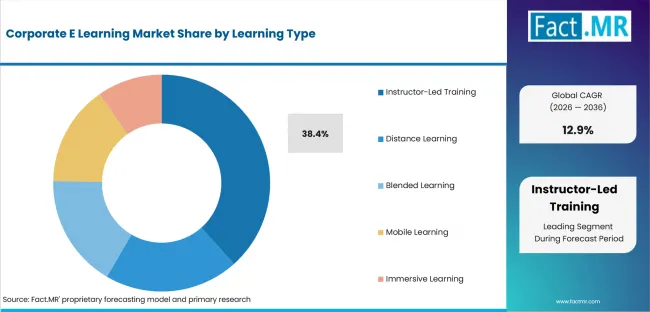
Corporate E Learning Market Analysis By Learning Type | Source: Fact.MR
Instructor-led training leads because high-stakes topics still require facilitation, discussion and assessment even when delivered through digital platforms.
Why does Large Enterprises lead End User?
Large Enterprises is projected to account for 29.2% share in 2026.
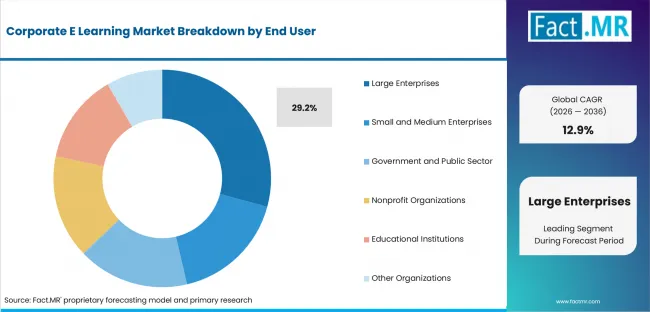
Corporate E Learning Market Analysis By End User | Source: Fact.MR
Large enterprises lead as scale, compliance risk and multi-location workforce needs justify enterprise learning platforms and managed services.
Why does Direct Enterprise Sales lead Distribution Channel?
Direct Enterprise Sales is projected to account for 29.6% share in 2026.
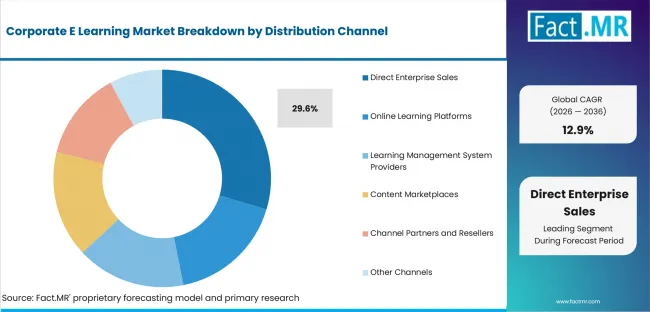
Corporate E Learning Market Analysis By Distribution Channel | Source: Fact.MR
Direct enterprise sales lead as implementation depends on HR integration, security review, content mapping and reporting requirements.
Why does Online Learning Platforms lead Technology?
Online Learning Platforms is projected to account for 43.5% share in 2026.
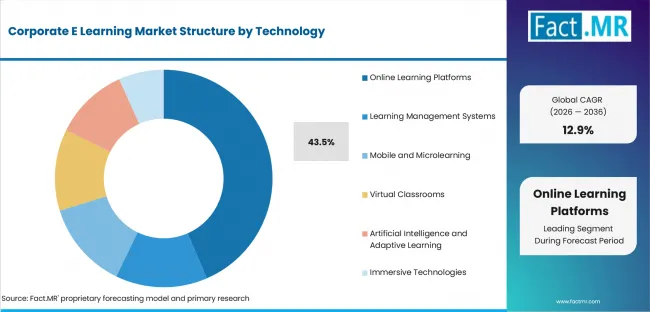
Corporate E Learning Market Analysis By Technology | Source: Fact.MR
Online learning platforms lead as they provide the learner access, administration, tracking and content-delivery layer that enterprises standardize around.
What is accelerating Corporate E Learning Market adoption, and what is holding it back?
Adoption is strongest when buyers can tie learning content to onboarding speed, compliance completion, role readiness, or reskilling needs. The main drag is doubt about completion, manager reinforcement, HR-system integration, and content relevance.
Personalized modules link to Fact.MR's Adaptive Learning Market, where content adjusts to skill gaps and learner pace.
Drivers Impact Analysis
| DRIVER | QUALITATIVE RELEVANCE | GEOGRAPHIC RELEVANCE | IMPACT TIMELINE |
|---|---|---|---|
| Structured instructor-led digital delivery | High | South Korea | Short term (<=2 years) |
| Standardized employee onboarding | High | USA | Short term (<=2 years) |
| Large-enterprise compliance training | Moderate | Canada | Medium term (2-4 years) |
| Learning analytics and role paths | Selective | Germany | Medium term (2-4 years) |
Source: Fact.MR analysis. Updated Jul 30, 2026
- Structured instructor-led digital delivery: Instructor-led training leads because enterprises still need structured sessions for leadership, compliance, product and process training. Digital delivery extends the trainer rather than removing the need for guided instruction.
- Standardized employee onboarding: Employee onboarding leads because new hires need a consistent first experience across distributed teams, hybrid work models and fast-changing operating processes.
- Large-enterprise compliance training: Large enterprises lead as they have higher learner counts, compliance exposure, LMS administration needs and budget for content libraries, analytics and managed services.
- Learning analytics and role paths: Direct enterprise sales lead as training programs must be integrated with HR systems, identity access, role libraries, reporting and procurement controls.
Opportunity Impact Analysis
| OPPORTUNITY | QUALITATIVE RELEVANCE | GEOGRAPHIC RELEVANCE | IMPACT TIMELINE |
|---|---|---|---|
| AI-assisted learning administration | High | South Korea | Medium term (2-4 years) |
| Regulated-industry compliance modules | Moderate | USA | Medium term (2-4 years) |
| Skill analytics tied to workforce planning | Selective | Canada | Medium term (2-4 years) |
Source: Fact.MR analysis. Updated Jul 30, 2026
- AI-assisted learning administration: AI-assisted content tagging and role-based learning paths can reduce administration for large training catalogs.
- Regulated-industry compliance modules: Compliance and regulated-industry modules can support recurring demand because retraining is tied to policy and audit cycles.
- Skill analytics tied to workforce planning: Learning analytics can help L&D teams defend budget by linking completion, assessment and workforce capability signals.
Restraints Impact Analysis
| RESTRAINT | QUALITATIVE RELEVANCE | GEOGRAPHIC RELEVANCE | IMPACT TIMELINE |
|---|---|---|---|
| Low completion and poor manager reinforcement | High | South Korea | Short term (<=2 years) |
| Generic content with weak role relevance | Moderate | USA | Medium term (2-4 years) |
| HRIS and LMS integration complexity | Selective | Germany | Medium term (2-4 years) |
Source: Fact.MR analysis. Updated Jul 30, 2026
- Low completion and poor manager reinforcement: Low course completion and weak manager follow-through can reduce the perceived value of large learning libraries.
- Generic content with weak role relevance: Content that is not localized or role-specific often fails to change behavior, especially in frontline and operational teams.
- HRIS and LMS integration complexity: Integration with HRIS, SSO, compliance reporting and legacy LMS estates can slow platform replacement.
Which countries are scaling Corporate E Learning Market fastest?
Country rates show where enterprise training budgets, platform proof, and implementation support are already stronger.
Budget approval remains close to Fact.MR's Corporate Training Services Market, since digital platforms compete with instructor-led and blended programs.
- USA: The market is expected to grow at a CAGR of 16.78% from 2026 to 2036. USA growth is shaped by enterprise software spending, compliance training, remote workforce needs, and a deep corporate training provider base.
- Japan: The market is expected to grow at a CAGR of 15.47% from 2026 to 2036. Japan's market is shaped by workforce aging, structured enterprise training, and demand for localized content that fits role and hierarchy.
- Germany: The market is expected to grow at a CAGR of 14.16% from 2026 to 2036. Germany's outlook is guided by vocational training culture, compliance requirements, and careful platform integration with enterprise systems.
- UK: The market is expected to grow at a CAGR of 12.90% from 2026 to 2036. UK adoption is supported by corporate reskilling, financial-services compliance, and managed learning service providers.
- Canada: The market is expected to grow at a CAGR of 11.59% from 2026 to 2036. Canada benefits from hybrid work, public-sector training needs, and regulated-industry learning requirements.
- South Korea: The market is expected to grow at a CAGR of 10.30% from 2026 to 2036. South Korea's demand is supported by digital workplace adoption, large enterprise training intensity, and strong use of online platforms.
- Australia: The market is expected to grow at a CAGR of 9.05% from 2026 to 2036. Australia's demand is tied to remote workforce coverage, compliance training, and enterprise reskilling in services, mining, and public institutions.
The full report provides country-level CAGR analysis across North America, Latin America, Europe, East Asia, South Asia and Oceania, and the Middle East and Africa.
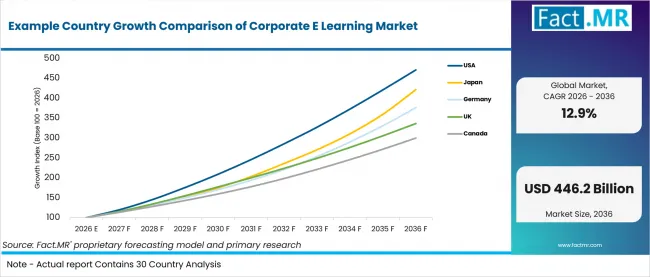
Example Country Growth Comparison Of Corporate E Learning Market | Source: Fact.MR
| Country | CAGR (2026-2036) |
|---|---|
| USA | 16.78% |
| Japan | 15.47% |
| Germany | 14.16% |
| UK | 12.90% |
| Canada | 11.59% |
| South Korea | 10.30% |
| Australia | 9.05% |
Source: Fact.MR analysis. Updated Jul 30, 2026
What is shaping USA's outlook through 2036?
16.78% CAGR from 2026 to 2036.
USA growth is shaped by enterprise software spending, compliance training, remote workforce needs, and a deep corporate training provider base.
What is shaping Japan's outlook through 2036?
15.47% CAGR from 2026 to 2036.
Japan's market is shaped by workforce aging, structured enterprise training, and demand for localized content that fits role and hierarchy.
What is shaping Germany's outlook through 2036?
14.16% CAGR from 2026 to 2036.
Germany's outlook is guided by vocational training culture, compliance requirements, and careful platform integration with enterprise systems.
What is shaping the UK's outlook through 2036?
12.90% CAGR from 2026 to 2036.
UK adoption is supported by corporate reskilling, financial-services compliance, and managed learning service providers.
What is shaping Canada's outlook through 2036?
11.59% CAGR from 2026 to 2036.
Canada benefits from hybrid work, public-sector training needs, and regulated-industry learning requirements.
What is shaping South Korea's outlook through 2036?
10.30% CAGR from 2026 to 2036.
South Korea's demand is supported by digital workplace adoption, large enterprise training intensity, and strong use of online platforms.
What is shaping Australia's outlook through 2036?
9.05% CAGR from 2026 to 2036.
Australia's demand is tied to remote workforce coverage, compliance training, and enterprise reskilling in services, mining, and public institutions.
Who leads the Corporate E Learning Market?
LinkedIn Learning; SAP SE; Oracle Corporation; Adobe Inc. are among the visible providers in the corporate e learning market.
LinkedIn Learning and SAP SE are among the most visible providers. Competition is shaped by product proof, channel access and buyer trust.
Between 2026 and 2036, market rivalry is likely to center on clearer positioning around Instructor-Led Training, stronger documentation and better support at the point of purchase.
Which companies are the key providers?
Key companies include LinkedIn Learning; SAP SE; Oracle Corporation; Adobe Inc.; Cornerstone OnDemand, Inc.; Skillsoft Corporation; Udemy, Inc.; Articulate Global, Inc.
- LinkedIn Learning
- SAP SE
- Oracle Corporation
- Adobe Inc.
- Cornerstone OnDemand, Inc.
- Skillsoft Corporation
- Udemy, Inc.
- Articulate Global, Inc.
Bibliography
- OECD, Trends in Adult Learning.
- OECD, Adult Skills and Work.
- World Economic Forum, The Future of Jobs Report 2025.
- World Economic Forum, Skills Outlook.
- Fact.MR, Managed Learning Services Market.
- Fact.MR, Corporate Training Services Market.
This Report Answers
- The report provides strategic intelligence on the Corporate E Learning Market across segment choices that shape the 2026 market structure.
- Segment analysis covers Instructor-Led Training and Employee Onboarding as the share leaders within the 2026 market.
- Country outlook evaluates the listed markets by CAGR and explains the adoption conditions in each country.
- Competitive analysis profiles the named providers and evaluates competition around product proof, channel access and buyer trust.
- Related coverage connects this report with adjacent corporate training, managed learning, e-learning app, and adaptive learning markets.
What does the Corporate E Learning Market cover?
The Corporate E Learning Market covers digital corporate training platforms, e-learning content, instructor-led virtual training, onboarding, compliance modules, learning analytics, and managed learning services used by enterprises.
Adjacent spending is included only when it is part of the same purchase decision or operating use case.
What is included in the scope?
The scope includes Learning Type, Application, End User, Distribution Channel, Technology, and regional demand. Coverage includes adjacent segment options only when they are purchased for the same defined market use.
What is excluded from the scope?
The scope excludes consumer education apps, K-12 school platforms, higher-education student learning systems, and offline training services without digital delivery or administration.
How Was the Analysis Built?
The analysis combines primary research with desk research focused on the corporate e learning market, its segment structure, and country-level demand.
Primary Research:
Interviews and validation discussions test buyer priorities, adoption barriers, pricing logic, and operating requirements.
Desk Research:
The assessment reviews company disclosures, public data sources, regulatory material, technical literature, and industry records relevant to the market.
Market Sizing and Forecasting:
Estimates combine top-down and bottom-up checks across demand signals, segment shares, country activity, company participation, and adoption constraints.
Data Validation and Update Cycle:
Findings are validated against public evidence, company activity, and country-level adoption patterns before final use.
Segmentation
What is the report's scope and coverage?
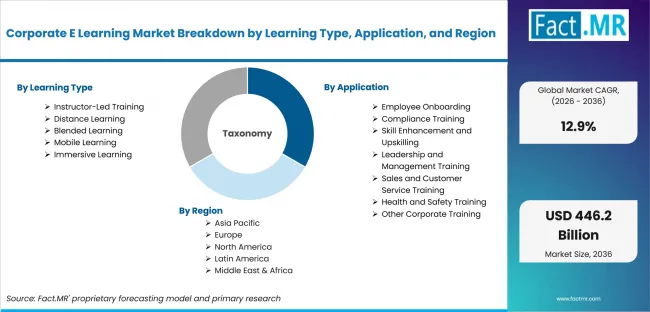
Corporate E Learning Market Breakdown By Learning Type, Application, And Region | Source: Fact.MR
| Attribute | Details |
|---|---|
| Quantitative Units | USD 132.6 billion in 2026 to USD 446.2 billion by 2036, at a 12.9% CAGR. |
| Market Definition | Corporate E Learning Market covers digital corporate training platforms, e-learning content, instructor-led virtual training, onboarding, compliance modules, learning analytics and managed learning services used by enterprises. |
| Learning Type | Instructor-Led Training; Virtual Instructor-Led Training; Live Online Classroom Training; Distance Learning; Self-Paced Online Courses; Web-Based Training; Blended Learning; Online and Classroom Learning; Hybrid Learning Programs; Mobile Learning; Mobile App-Based Learning; Mobile Microlearning; Immersive Learning; Virtual Reality Training; Augmented Reality Training |
| Application | Employee Onboarding; New Hire Training; Orientation and Induction; Compliance Training; Regulatory Compliance; Ethics and Workplace Compliance; Skill Enhancement and Upskilling; Technical Skills Training; Digital and AI Skills Training; Leadership and Management Training; Executive Development; Managerial Skills Training; Sales and Customer Service Training; Sales Enablement; Customer Service Skills; Health and Safety Training; Occupational Safety Training; Workplace Health Training; Other Corporate Training; Corporate Culture Training; Soft Skills Development |
| End User | Large Enterprises; Multinational Corporations; Global Enterprise Organizations; Small and Medium Enterprises; Small Businesses; Medium-Sized Businesses; Government and Public Sector; Federal and National Government; Local and Municipal Government; Nonprofit Organizations; Charitable Organizations; Professional Associations; Educational Institutions; Universities and Colleges; Professional Training Institutions; Other Organizations; Industry Associations; Trade Organizations |
| Distribution Channel | Direct Enterprise Sales; Direct Sales to Corporate Buyers; Enterprise Account Contracts; Online Learning Platforms; Standalone E-Learning Platforms; Specialized Corporate Learning Platforms; Learning Management System Providers; Cloud-Based LMS Platforms; On-Premise LMS Platforms; Content Marketplaces; Professional Course Marketplaces; Specialized Content Libraries; Channel Partners and Resellers; Enterprise Technology Resellers; Training and Consulting Partners; Other Channels; Industry Associations; Government Procurement Programs |
| Technology | Online Learning Platforms; Web-Based Learning Platforms; Interactive Learning Platforms; Learning Management Systems; Cloud-Based LMS; On-Premise LMS; Mobile and Microlearning; Mobile Learning Applications; Microlearning Platforms; Virtual Classrooms; Live Virtual Classrooms; Collaborative Virtual Training; Artificial Intelligence and Adaptive Learning; AI-Powered Personalization; Adaptive Learning Systems; Immersive Technologies; Virtual Reality Learning; Augmented Reality Learning |
| Regions Covered | North America; Latin America; Europe; East Asia; South Asia and Oceania; Middle East and Africa |
| Countries Covered | South Korea; USA; Canada; Australia; Germany; UK; Japan |
| Key Companies Profiled | LinkedIn Learning; SAP SE; Oracle Corporation; Adobe Inc.; Cornerstone OnDemand, Inc.; Skillsoft Corporation; Udemy, Inc.; Articulate Global, Inc. |
| Forecast Period | 2026 to 2036 |
| Approach | Hybrid top-down and bottom-up assessment using demand indicators, segment mix, country growth, company participation and public evidence relevant to the category. |
Source: Fact.MR analysis. Updated Jul 30, 2026
How is the market segmented?
-
By Learning Type:
- Instructor-Led Training
- Virtual Instructor-Led Training
- Live Online Classroom Training
- Distance Learning
- Self-Paced Online Courses
- Web-Based Training
- Blended Learning
- Online and Classroom Learning
- Hybrid Learning Programs
- Mobile Learning
- Mobile App-Based Learning
- Mobile Microlearning
- Immersive Learning
- Virtual Reality Training
- Augmented Reality Training
- Instructor-Led Training
-
By Application:
- Employee Onboarding
- New Hire Training
- Orientation and Induction
- Compliance Training
- Regulatory Compliance
- Ethics and Workplace Compliance
- Skill Enhancement and Upskilling
- Technical Skills Training
- Digital and AI Skills Training
- Leadership and Management Training
- Executive Development
- Managerial Skills Training
- Sales and Customer Service Training
- Sales Enablement
- Customer Service Skills
- Health and Safety Training
- Occupational Safety Training
- Workplace Health Training
- Other Corporate Training
- Corporate Culture Training
- Soft Skills Development
- Employee Onboarding
-
By End User:
- Large Enterprises
- Multinational Corporations
- Global Enterprise Organizations
- Small and Medium Enterprises
- Small Businesses
- Medium-Sized Businesses
- Government and Public Sector
- Federal and National Government
- Local and Municipal Government
- Nonprofit Organizations
- Charitable Organizations
- Professional Associations
- Educational Institutions
- Universities and Colleges
- Professional Training Institutions
- Other Organizations
- Industry Associations
- Trade Organizations
- Large Enterprises
-
By Distribution Channel:
- Direct Enterprise Sales
- Direct Sales to Corporate Buyers
- Enterprise Account Contracts
- Online Learning Platforms
- Standalone E-Learning Platforms
- Specialized Corporate Learning Platforms
- Learning Management System Providers
- Cloud-Based LMS Platforms
- On-Premise LMS Platforms
- Content Marketplaces
- Professional Course Marketplaces
- Specialized Content Libraries
- Channel Partners and Resellers
- Enterprise Technology Resellers
- Training and Consulting Partners
- Other Channels
- Industry Associations
- Government Procurement Programs
- Direct Enterprise Sales
-
By Technology:
- Online Learning Platforms
- Web-Based Learning Platforms
- Interactive Learning Platforms
- Learning Management Systems
- Cloud-Based LMS
- On-Premise LMS
- Mobile and Microlearning
- Mobile Learning Applications
- Microlearning Platforms
- Virtual Classrooms
- Live Virtual Classrooms
- Collaborative Virtual Training
- Artificial Intelligence and Adaptive Learning
- AI-Powered Personalization
- Adaptive Learning Systems
- Immersive Technologies
- Virtual Reality Learning
- Augmented Reality Learning
- Online Learning Platforms
-
By Region:
- North America
- Latin America
- Europe
- East Asia
- South Asia and Oceania
- Middle East and Africa
Frequently Asked Questions
Which Learning Type leads the market?
Which Application leads the market?
Which End User leads the market?
Which Distribution Channel leads the market?
Which Technology leads the market?
Which country records the highest listed CAGR?
What is the primary driver in this market?
What is the main restraint?
Who worked on this report


Preview the report firsthand - request a free sample
Free SampleGet the brochure for pricing and purchase details
Download PDF