Polyalkylene Glycols Market Size, Share, Growth and Forecast (2026 - 2036)

The Polyalkylene Glycols Market is segmented by Type (Polyethylene Glycols, Polypropylene Glycols, Higher Polyols-Adducts, and Others), Solubility (Oil-soluble, Mineral Oil, and Water), Application (Polyurethane Foam, Functional Fluids, Lubricants, Personal Care, Pharmaceuticals, Surface Active Agents, and Others), End-use Industry (Automotive, Construction, Healthcare, Personal Care & Cosmetics, Industrial Manufacturing, and Others), Distribution Channel (Direct Sales (B2B), Distributors & Traders, and Online Sales) and Region. Forecast for 2026 to 2036.

FACT.MR is of the opinion that the polyalkylene glycols market is undergoing a shift from chemistry-driven supply to application-focused demand. Commodity PAG volumes are facing margin pressure. Growth is moving toward high-performance, application-specific formulations. Automotive electrification is increasing demand for advanced lubricants and thermal fluids.

Polyalkylene Glycols Market Forecast and Outlook By Fact.MR

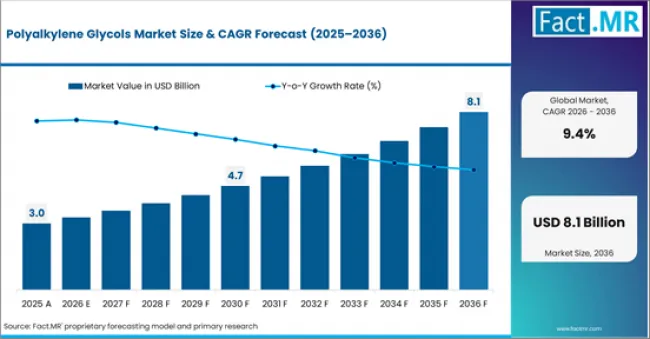
  • In 2025, the polyalkylene glycols market was valued at USD 3.0 billion.
  • Based on Fact.MR analysis, demand for polyalkylene glycols is estimated to grow to USD 3.3 billion in 2026 and USD 8.1 billion by 2036.
  • FACT.MR projects a CAGR of 9.4% during the forecast period.
Polyalkylene Glycols Market Market Value Analysis

Metric Value
Estimated Value in 2026 USD 3.3 billion
Forecast Value in 2036 USD 8.1 billion
Forecast CAGR (2026 to 2036) 9.4%

Summary of Polyalkylene Glycols Market

  • Market Definition
    • The market covers polyethylene glycols, polypropylene glycols, and higher polyol-adducts used as lubricants, foam precursors, pharmaceutical excipients, and personal care actives across automotive, healthcare, construction, and industrial manufacturing industries globally.
  • Demand Drivers
    • EV powertrain thermal management fluid reformulation is driving adoption of water-soluble PAG grades in battery cooling and e-axle lubrication applications across U.S. and European automotive OEM programmes from 2024.
    • Pharmaceutical excipient demand for PEG-grade polyalkylene glycols is expanding as regulated drug formulation markets in India and China scale generic and specialty API production through 2025.
    • Construction sector polyurethane foam demand is sustaining polypropylene glycol consumption in insulation and sealant applications as green building regulations tighten across North America and Europe.
  • Key Segments Analyzed
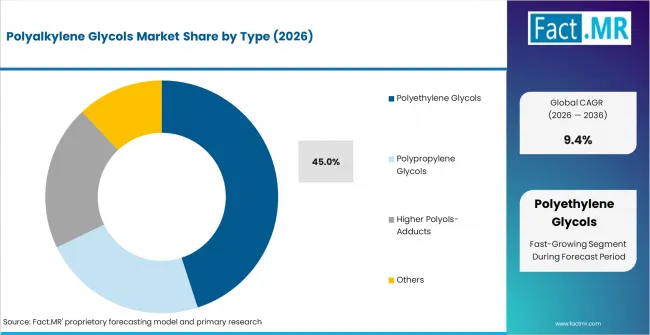
    • By Type: Polyethylene glycols lead with approximately 45% share in 2026, supported by broad usage across pharmaceutical, personal care, and industrial fluid applications globally.
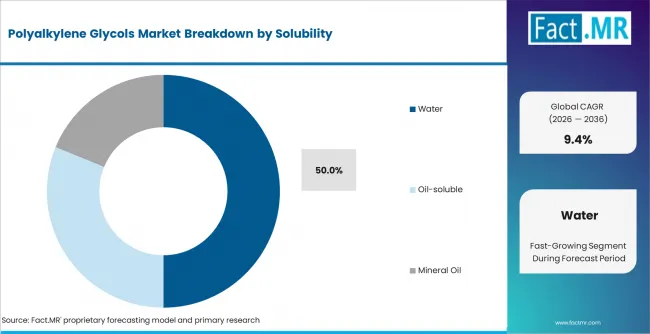
    • By Solubility: Water-soluble grades hold approximately 50% share in 2026, driven by pharmaceutical, cosmetics, and water-based lubricant demand in regulated markets.
    • By Application: Polyurethane foam leads with approximately 30% share in 2026, anchored by construction insulation and automotive structural foam adoption.
    • By End-use Industry: Automotive holds approximately 26% share in 2026, driven by lubricant, functional fluid, and EV thermal management consumption.
    • By Distribution Channel: Direct sales (B2B) hold approximately 65% share in 2026, supported by long-term industrial supply contracts and bulk procurement relationships.
    • By Geography: India leads growth at 8.2% CAGR through 2036, supported by industrialization, automotive expansion, and eco-friendly lubricant adoption.
  • Analyst Opinion at FACT.MR
    • Shambhu Nath Jha, Principal Consultant at Fact.MR, ‘CXOs should note a clear shift in competitive differentiation. The focus is moving from volume to grade compliance. Producers with pharmaceutical, food-contact, and bio-based credentials are gaining access to premium segments.’
  • Strategic Implications
    • Invest in pharmaceutical and food-contact grade PAG qualification programmes to access premium, specification-locked procurement in regulated drug formulation and personal care markets.
    • Develop bio-based and low-VOC PAG formulations to preempt European REACH and U.S. EPA sustainability mandates that are reshaping industrial lubricant procurement from 2025 onward.
    • Target India and China automotive and pharma manufacturing programmes early with application-specific PAG grades and local supply infrastructure to capture the fastest-growth country CAGRs.
  • Methodology
    • Market sizing based on PAG production volumes and ASP by grade and application, validated against BASF, Dow, and Huntsman revenue disclosures and trade flow benchmarks.
    • Incorporates European REACH compliance data, U.S. EPA voluntary sustainability guidelines, and pharmaceutical excipient standards from ICH and USP filings in 2024 and 2025.
    • Forecasts factor in bio-based substitution timelines, feedstock price exposure, pharmaceutical qualification cycles, and primary interviews with lubricant formulators and procurement executives.

Between 2026 and 2036, the market is expected to generate an absolute opportunity of USD 4.8 billion. Growth remains structural in nature. Demand is supported by EV thermal management fluids, rising pharmaceutical excipient usage, and polyurethane foam in construction. Feedstock price volatility linked to ethylene oxide and propylene oxide remains a constraint. Bio-based substitution is also putting pressure on conventional PAG volumes.

Industrial lubricant and functional fluid reformulation accelerated through 2024 and 2025. Automotive OEMs are shifting toward EV-compatible fluids. This is increasing demand for high-performance PAG formulations. Pharmaceutical and personal care grades continue to command premium pricing. Producers lacking bio-based or pharma compliance are facing margin pressure in high-value segments.

India leads with 8.2% CAGR through 2036, supported by industrialisation and automotive expansion. China follows at 7.8%, driven by manufacturing scale and vehicle production. The United States grows at 6.5%, supported by strong R&D and synthetic lubricant demand. South Korea records 6.2%, driven by electronics and industrial applications. Germany grows at 6.0%, supported by automotive engineering demand. Japan posts 5.8%, driven by precision manufacturing and specialty lubricant demand.

Segmental Analysis

Polyalkylene Glycols Market Analysis by Type
Polyalkylene Glycols Market Analysis By Type

Based on FACT.MR's polyalkylene glycols market report, polyethylene glycols are estimated to hold approximately 45% share in 2026. PEGs dominate due to broad multifunctional utility across pharmaceutical formulation, personal care, and industrial lubricant applications.

  • BASF Investment: BASF SE announced expansion of its PEG production at Ludwigshafen in 2024, targeting pharmaceutical-grade PEG supply for European drug formulation markets. The investment targets growing demand from generic API producers scaling under EMA regulatory frameworks. [1]
  • Dow Technology: Dow Inc. launched an enhanced polypropylene glycol product line for EV thermal management fluids in 2024, designed for battery cooling and e-axle lubrication compatibility in high-voltage automotive architectures. The product line targets GM and Ford EV platform procurement. [2]
  • Higher Polyols Trend: Huntsman Corporation expanded its higher polyols-adduct portfolio for specialty polyurethane systems in 2024 and 2025, targeting construction insulation and automotive seating foam applications with improved dimensional stability. Adoption across European construction OEMs increased with tighter EU energy efficiency building standards. [3]

Polyalkylene Glycols Market Analysis by Solubility
Polyalkylene Glycols Market Analysis By Solubility

Based on FACT.MR's polyalkylene glycols market report, water-soluble PAG grades are estimated to hold approximately 50% share in 2026. Water solubility drives their adoption in pharmaceutical excipient, cosmetic formulation, and water-based lubricant applications.

  • Pharma Compliance: Clariant AG obtained expanded USP and Ph. Eur. compliance certifications for its water-soluble PEG grades in 2024, enabling supply into regulated drug delivery and injectable formulation applications in the U.S. and European markets. [4]
  • Oil-Soluble Development: Shell Chemicals expanded its oil-soluble PAG lubricant base stock offering in 2024, targeting industrial gear oil and compressor lubricant formulations requiring high-temperature stability and low deposit formation. Adoption in European industrial manufacturing increased through 2025. [5]
  • Mineral Oil Segment Trend: Idemitsu Kosan reported growing demand for mineral oil-soluble PAG blends in Japanese precision manufacturing lubrication applications in 2024, driven by gear and hydraulic fluid reformulation requirements from electronics and semiconductor equipment OEMs. [6]

Polyalkylene Glycols Market Analysis by Application
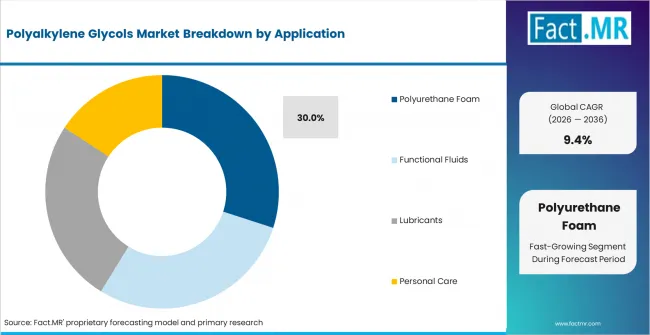
Polyalkylene Glycols Market Analysis By Application

Based on FACT.MR's polyalkylene glycols market report, polyurethane foam holds approximately 30% share in 2026. It leads due to established construction insulation and automotive structural foam workflows and broad OEM adoption.

  • PU Foam Adoption: Covestro AG disclosed expansion of polyether polyol capacity at its Antwerp facility in 2024, targeting polyurethane foam demand for construction insulation in Europe under revised EU Energy Performance of Buildings Directive requirements effective 2025. [7]
  • Functional Fluid Growth: LyondellBasell announced new PAG-based functional fluid formulations in 2025, targeting EV battery thermal management and industrial heat transfer applications across North American and European automotive OEM supply chains. [8]
  • Pharma Application Trend: Pfizer and AstraZeneca expanded use of PEG-grade polyalkylene glycols in oral solid dose and injectable drug formulations through 2024, increasing pharmaceutical-grade PAG procurement in the U.S. and EU markets as generic drug output scaled. [9]

Polyalkylene Glycols Market Analysis by End-use Industry

Based on FACT.MR's polyalkylene glycols market report, automotive holds approximately 26% share in 2026. It leads through lubricant, functional fluid, and EV thermal management consumption.

  • Automotive Expansion: General Motors disclosed expanded PAG-based thermal management fluid specifications for its Ultium EV platform in 2024, requiring water-soluble PAG grades from qualified suppliers. BASF SE and Dow Inc. were named among qualifying PAG supply partners. [10]
  • Healthcare Demand: Abbott Laboratories and Baxter International expanded pharmaceutical PEG procurement in 2024 for IV formulation and drug delivery applications. Regulatory compliance with FDA inactive ingredient guidance was a key procurement criterion driving supplier qualification timelines. [11]
  • Construction Industry Trend: Saint-Gobain and Knauf Insulation expanded polyurethane foam insulation production in 2024 and 2025, requiring increased PPG and polyol-adduct supply to meet European construction insulation output growth under the Green Deal building renovation targets. [12]

Polyalkylene Glycols Market Analysis by Distribution Channel
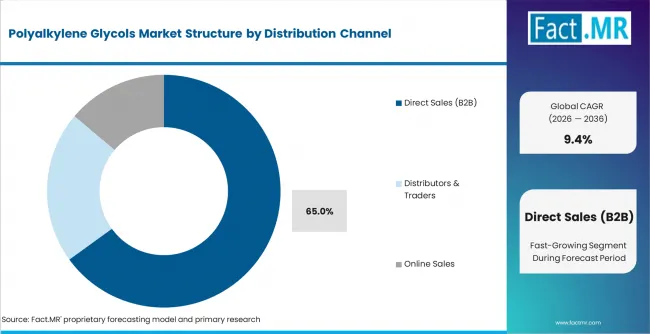
Polyalkylene Glycols Market Analysis By Distribution Channel

Based on FACT.MR's polyalkylene glycols market report, direct sales (B2B) hold approximately 65% share in 2026. Long-term industrial contracts and bulk procurement in automotive, pharmaceutical, and construction sectors entrench direct supply relationships.

  • Direct Sales Contracts: BASF SE and Dow Inc. renewed long-term PAG supply agreements with major automotive and pharmaceutical OEMs in 2024, locking in volume commitments for PEG and PPG grades across U.S. and European facilities. Multi-year agreements reinforce direct channel dominance. [1]
  • Distributor Channel: Univar Solutions expanded its specialty chemicals distribution network for PAG products in Asia Pacific in 2024, targeting mid-sized personal care formulators and industrial lubricant blenders in India and Southeast Asia. [13]
  • Online Sales Trend: Merck KGaA and Sigma-Aldrich reported growth in research-grade PEG online procurement through 2024 and 2025, driven by pharmaceutical R&D and academic research demand for USP-grade and speciality molecular weight PAG variants in small-volume orders. [14]

Drivers, Restraints, and Opportunities
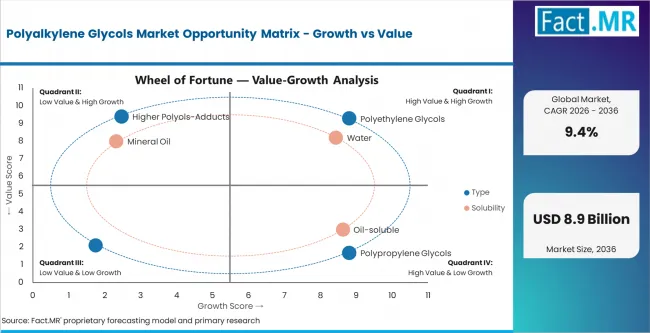
Polyalkylene Glycols Market Opportunity Matrix Growth Vs Value

FACT.MR analysis indicates the polyalkylene glycols market is transitioning from a commodity-chemical base toward an application-differentiated specialty market. Historical growth was anchored by broad industrial lubricant volumes and construction sector polyurethane foam consumption.

The core tension lies between high-margin pharmaceutical and EV-fluid PAG grades and commoditising general-purpose lubricant and foam volumes. Water-soluble PEG grades command premiums in regulated drug and cosmetic formulation.

  • EV Thermal Fluid Demand: Electric vehicle powertrain cooling requirements are generating structurally new PAG demand in battery thermal management and e-axle lubrication. IEA data from 2024 shows global EV sales exceeding 17 million units, creating direct incremental demand for water-soluble PAG functional fluids. [2]
  • REACH and EPA Sustainability Mandates: European REACH Regulation SVHCs list updates in 2024 created substitution pressure on conventional mineral oil lubricants, increasing demand for PAG-based synthetic alternatives in European industrial manufacturing.
  • Asia Pacific Industrial Growth: India's PLI scheme for chemicals and pharmaceuticals is expanding domestic PAG consumption as API and specialty chemical producers scale through 2025.

Regional Analysis

The polyalkylene glycols market is assessed across Asia Pacific, North America, Europe, Latin America, and Middle East and Africa, covering 40+ countries segmented by industrial lubricant maturity, pharmaceutical procurement frameworks, and automotive production scale. The full report offers market attractiveness analysis by region and country.

Top Country Growth Comparison Polyalkylene Glycols Market Cagr (2026 2036)

Country CAGR (2026 to 2036)
India 8.2%
China 7.8%
United States 6.5%
South Korea 6.2%
Germany 6.0%
Japan 5.8%

Source: Fact.MR (FACT.MR) analysis, based on proprietary forecasting model and primary research
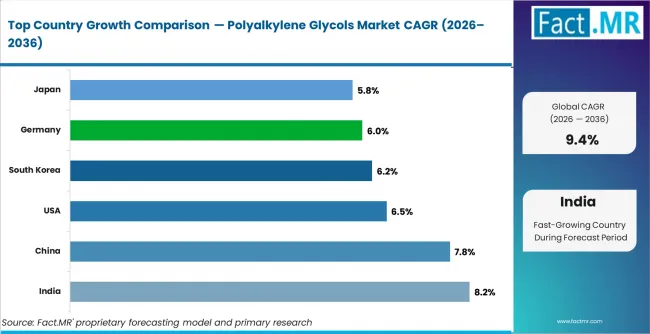
Polyalkylene Glycols Market Cagr Analysis By Country

Asia Pacific Polyalkylene Glycols Market Analysis

Asia Pacific remains the core growth region for polyalkylene glycols. Demand is linked to EV adoption, pharma expansion, and industrial upgrades. Policy support and domestic capacity additions are accelerating market expansion.

  • India: Industrial expansion is driving growth at 8.2% CAGR through 2036. Specialty chemical incentives are supporting PEG and PPG capacity additions. Gujarat Alkalies and Chemicals Limited and Aarti Industries are expanding production. Pharmaceutical demand for USP-grade PEG is rising. EV policies are increasing demand for PAG-based cooling fluids.
  • China: Manufacturing scale anchors growth at 7.8% CAGR through 2036. EV production is creating large demand for PAG-based thermal fluids. Automakers such as BYD Company are increasing usage. Industrial policies are promoting synthetic lubricant adoption. Construction insulation demand is supporting PPG consumption.
  • Japan: Precision-driven demand defines growth at 5.8% CAGR through 2036. Electronics and semiconductor sectors require high-purity PAG lubricants. Idemitsu Kosan Co., Ltd. is expanding specialty formulations. Pharmaceutical demand remains stable under strict regulatory standards. Qualification cycles remain longer due to performance requirements.
  • South Korea: Electronics-driven demand supports 6.2% CAGR through 2036. Semiconductor manufacturing requires high-purity PAG lubricants. Samsung Electronics and SK Hynix drive precision demand. Hyundai Motor Company is adopting PAG fluids for EV platforms. Regulatory updates are accelerating synthetic lubricant usage.

FACT.MR’s Asia Pacific analysis includes China, India, Japan, South Korea, ASEAN, and ANZ. It highlights EV fluids, pharma demand, and industrial trends.

North America Polyalkylene Glycols Market Analysis
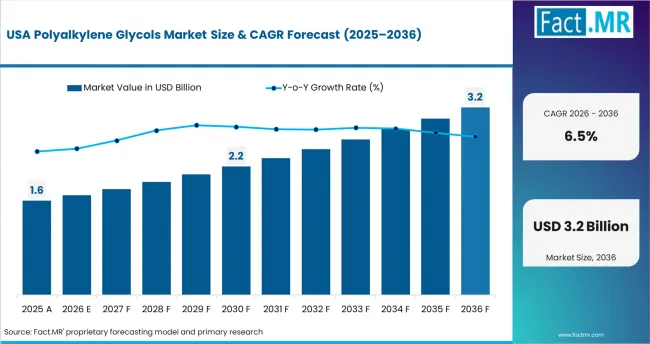
Polyalkylene Glycols Market Country Value Analysis

North America represents a high-value, innovation-led PAG market. Demand is driven by EV fluids and pharmaceutical-grade applications. Regulatory frameworks are shaping product specifications.

  • United States: Innovation-led demand supports 6.5% CAGR through 2036. EPA standards are accelerating PAG-based lubricant adoption. Automakers such as Ford Motor Company and General Motors are specifying PAG fluids for EV platforms. Dow Inc. and BASF SE are key suppliers. Pharmaceutical PEG demand remains strong under updated FDA guidance.

FACT.MR’s North America analysis includes the United States, Canada, and Mexico. It covers sustainability standards, EV adoption, and pharma demand.

Europe Polyalkylene Glycols Market Analysis
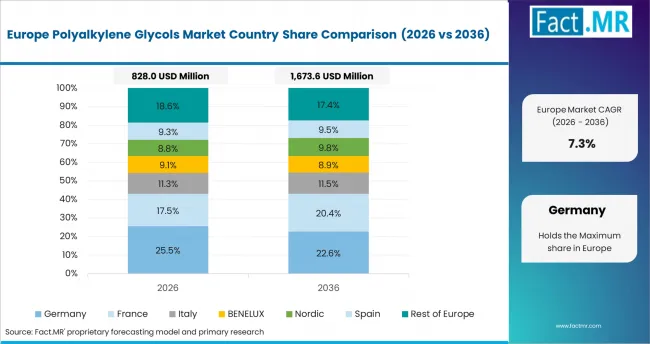
Polyalkylene Glycols Market Europe Country Market Share Analysis, 2026 & 2036

Europe acts as the regulatory benchmark and bio-based transition hub. Automotive and construction sectors are driving high-specification demand. Compliance frameworks are influencing procurement patterns.

  • Germany: Engineering-led demand supports 6.0% CAGR through 2036. EV platforms are increasing need for PAG-based lubricants. Volkswagen Group is expanding e-axle lubricant specifications. BASF remains a key supplier. Construction insulation demand is rising under climate policies.

FACT.MR’s Europe analysis includes Germany, France, the United Kingdom, Italy, Spain, and the rest of Europe. It captures regulatory shifts, EV demand, and industrial applications.

Competitive Aligners for Market Players
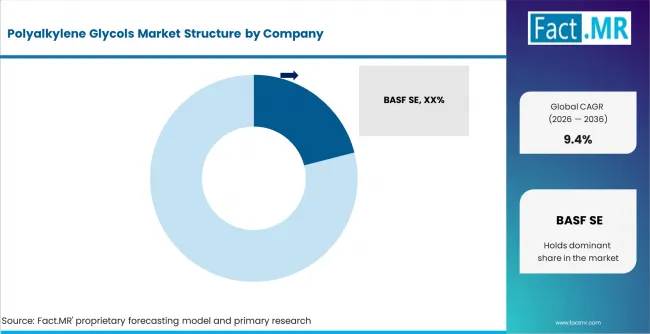
Polyalkylene Glycols Market Analysis By Company

The polyalkylene glycols market is no longer competing purely on volume or scale. The shift is clearly toward application expertise and compliance-driven value. Large players such as BASF SE, Dow Inc., Clariant AG, and Idemitsu Kosan Co., Ltd. continue to dominate, but their advantage now comes from how well they align products to end-use needs rather than how much they produce.

A major change is the move toward application-specific formulations. Companies are designing PAGs for EV thermal fluids, pharmaceutical excipients, and high-performance lubricants. These segments demand tighter specifications and offer better margins. This naturally favors players with strong R&D and customer collaboration capabilities. At the same time, regulatory compliance has become a gatekeeper. Pharmaceutical-grade, food-contact, and bio-based certifications are now essential to access premium markets. Producers without these credentials are increasingly limited to lower-margin commodity segments.

Sustainability is also shaping competition. Bio-based PAGs and environmentally friendly lubricants are gaining traction, especially in Europe and North America. Companies investing early in green chemistry are positioning themselves ahead of regulatory shifts. Another important factor is customer integration. Automotive OEMs and pharmaceutical firms prefer long-term partnerships with suppliers who can support formulation, testing, and performance validation. This is pushing the market toward fewer but deeper supplier relationships, where technical capability matters as much as production scale.

Key Players

  • BASF SE
  • Dow Inc.
  • Royal Dutch Shell plc
  • Clariant AG
  • Idemitsu Kosan Co., Ltd.
  • Covestro AG
  • Huntsman Corporation
  • LyondellBasell Industries


Bibliography

  • [1] BASF SE. (2024). Press Release: PEG Production Capacity Expansion at Ludwigshafen for Pharmaceutical and Personal Care Grade Supply Targeting European Regulated Formulation Markets. June 2024. basf.com/investors
  • [2] Dow Inc. (2024). Product Launch: DOWTHERM PAG-Based Electric Vehicle Thermal Management Fluid Qualified for GM Ultium and Ford EV Platform Battery Cooling Applications. September 2024. dow.com/news
  • [3] Huntsman Corporation. (2024). Annual Report 2024: Higher Polyols-Adduct Portfolio Expansion for Specialty Polyurethane Systems Including Construction Insulation and Automotive Seating Foam Under EU Energy Efficiency Building Standards. December 2024. huntsman.com/investors
  • [4] Clariant AG. (2024). Regulatory Compliance Update: Expanded USP and Ph. Eur. Certifications for Water-Soluble PEG Grades Enabling Supply Into Regulated Drug Delivery and Injectable Formulation Markets. March 2024. clariant.com/news
  • [5] Shell Chemicals. (2024). Product Portfolio Update: Oil-Soluble PAG Lubricant Base Stock Expansion for Industrial Gear Oil and Compressor Fluid Formulations Requiring High-Temperature Stability. July 2024. shell.com/chemicals
  • [6] Idemitsu Kosan Co., Ltd. (2024). Market Report: Growing Demand for Mineral Oil-Soluble PAG Blends in Japanese Precision Manufacturing Lubrication for Electronics and Semiconductor Equipment OEM Applications. October 2024. idemitsu.com/en/news
  • [7] Covestro AG. (2024). Press Release: Polyether Polyol Capacity Expansion at Antwerp Facility Targeting Polyurethane Foam Demand for EU Construction Insulation Under Revised Energy Performance of Buildings Directive. November 2024. covestro.com/investors
  • [8] LyondellBasell Industries. (2025). Product Launch: PAG-Based Functional Fluid Formulations for EV Battery Thermal Management and Industrial Heat Transfer Targeting North American and European Automotive OEM Supply Chains. January 2025. lyondellbasell.com/news
  • [9] AstraZeneca plc. (2024). Annual Report 2024: PEG-Grade Polyalkylene Glycol Procurement Expansion for Oral Solid Dose and Injectable Drug Formulations Across U.S. and EU Manufacturing Facilities. December 2024. astrazeneca.com/investors

This Report Addresses

  • Strategic intelligence on polyalkylene glycols demand across type, solubility, application, end-use industry, and distribution channel segments in automotive, healthcare, construction, and industrial manufacturing globally.
  • Market forecast from USD 3.3 billion in 2026 to USD 8.1 billion by 2036 at a CAGR of 9.4%.
  • Growth opportunity mapping across India PLI-linked chemical investment, China NEV thermal fluid adoption, U.S. EV platform PAG qualification, Germany automotive lubricant reformulation, and South Korea electronics manufacturing demand.
  • Segment analysis by type (PEG, PPG, higher polyols), solubility (water, oil, mineral oil), application (PU foam, lubricants, functional fluids, pharma, personal care), end-use industry, and distribution channel.
  • Regional outlook covering Asia Pacific volume and policy-led growth, North America EV and pharmaceutical demand, Europe REACH-driven lubricant substitution, and emerging market industrial expansion.
  • Competitive landscape of BASF SE, Dow Inc., Shell, Clariant, Huntsman, Covestro, Idemitsu Kosan, and LyondellBasell covering feedstock integration, application-grade portfolios, OEM supply positions, and pricing strategy.
  • Regulatory analysis covering European REACH SVHC updates, U.S. EPA Design for Environment standards, EU Energy Performance of Buildings Directive, ICH and USP pharmaceutical excipient standards, and China MIIT synthetic lubricant guidelines.
  • Report delivered in PDF, Excel, and presentation formats supported by validated production data, OEM procurement benchmarks, and industry expert primary research.


Polyalkylene Glycols Market Definition

The polyalkylene glycols market covers water-soluble and oil-soluble polymer compounds derived from ethylene oxide and propylene oxide. These materials serve as lubricants, functional fluids, pharmaceutical excipients, and polyurethane foam precursors.

Polyalkylene Glycols Market Inclusions

Covers global and regional forecasts from 2026 to 2036. Includes polyethylene glycols, polypropylene glycols, higher polyols-adducts, and related PAG variants. Segments by type, solubility, application, end-use industry, and distribution channel. Covers OEM supply, distributor, and online procurement channels.

Polyalkylene Glycols Market  Exclusions

Excludes ethylene oxide and propylene oxide feedstock markets. Omits downstream finished personal care and pharmaceutical formulations. Excludes polyester polyols and polycarbonate polyols unless in hybrid PAG blends. Also omits post-processing additives not directly formulated using PAG intermediates.

Polyalkylene Glycols Market Research Methodology

  • Primary Research
    • Interviews with PAG procurement managers, automotive lubricant engineers, pharmaceutical excipient buyers, and industrial manufacturing purchasing executives across key adoption markets.
  • Desk Research
    • Uses BASF SE, Dow Inc., and Huntsman Corporation public filings. Includes specialty chemical industry output data and pharmaceutical excipient standards from 2024 to 2025.
  • Market-Sizing and Forecasting
    • Hybrid top-down and bottom-up model. Based on PAG production volumes, average selling prices by grade and application, and adoption rates across end-use industries and regions.
  • Data Validation and Update Cycle
    • Validated using producer shipment data, trade flow statistics, and industry association benchmarks. Cross-checked with expert interviews and updated on a regular cycle.

Scope of Report

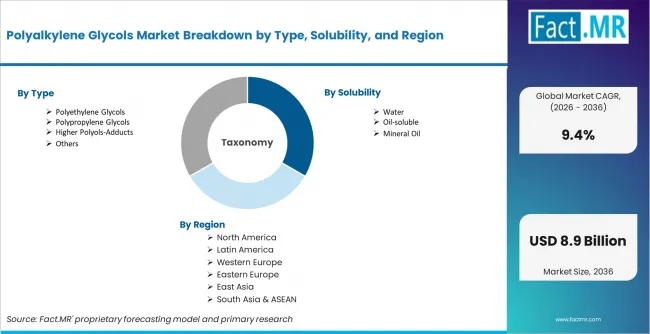
Polyalkylene Glycols Market Breakdown By Type, Solubility, And Region

Attribute Details
Quantitative Units USD 3.3 billion (2026) to USD 8.1 billion (2036), at a CAGR of 9.4%
Market Definition PAG compounds including PEG, PPG, and higher polyols-adducts used as lubricants, foam precursors, pharmaceutical excipients, and personal care actives across automotive, healthcare, construction, and industrial manufacturing globally.
Type Segmentation Polyethylene Glycols, Polypropylene Glycols, Higher Polyols-Adducts, Others
Solubility Segmentation Oil-soluble, Mineral Oil, Water
Application Segmentation Polyurethane Foam, Functional Fluids, Lubricants, Personal Care, Pharmaceuticals, Surface Active Agents, Others
End-use Industry Segmentation Automotive, Construction, Healthcare, Personal Care & Cosmetics, Industrial Manufacturing, Others
Distribution Channel Segmentation Direct Sales (B2B), Distributors & Traders, Online Sales
Application Coverage Automotive EV thermal fluid supply, pharmaceutical excipient procurement, construction PU foam production, personal care formulation, and industrial lubricant substitution applications.
Regions Covered North America, Europe, Asia Pacific, Latin America, Middle East and Africa
Countries Covered USA, Canada, Mexico, Germany, UK, France, Italy, Spain, Nordic, BENELUX, China, Japan, South Korea, India, ASEAN, Australia and New Zealand, Brazil, Argentina, Chile, Saudi Arabia, UAE, South Africa, Rest of MEA
Key Companies Profiled BASF SE, Dow Inc., Royal Dutch Shell plc, Clariant AG, Idemitsu Kosan Co. Ltd., Covestro AG, Huntsman Corporation, LyondellBasell Industries
Forecast Period 2026 to 2036
Approach Hybrid top-down and bottom-up model using PAG production volumes, ASP by grade and application, producer revenue data, application adoption rates, and primary interviews with lubricant formulators, pharmaceutical buyers, and automotive procurement executives.


Polyalkylene Glycols Market by Segments

  • By Type:

    • Polyethylene Glycols
    • Polypropylene Glycols
    • Higher Polyols-Adducts
    • Others
  • By Solubility:

    • Oil-soluble
    • Mineral Oil
    • Water
  • By Application:

    • Polyurethane Foam
    • Functional Fluids
    • Lubricants
    • Personal Care
    • Pharmaceuticals
    • Surface Active Agents
    • Others
  • By End-use Industry:

    • Automotive
    • Construction
    • Healthcare
    • Personal Care & Cosmetics
    • Industrial Manufacturing
    • Others
  • By Distribution Channel:

    • Direct Sales (B2B)
    • Distributors & Traders
    • Online Sales
  • By Region:

    • North America
      • United States
      • Canada
      • Mexico
    • Latin America
      • Brazil
      • Argentina
      • Chile
      • Rest of Latin America
    • Western Europe
      • Germany
      • United Kingdom
      • France
      • Italy
      • Spain
      • Nordic Countries
      • BENELUX
      • Rest of Western Europe
    • Eastern Europe
      • Russia
      • Poland
      • Hungary
      • Balkan and Baltic
      • Rest of Eastern Europe
    • East Asia
      • China
      • Japan
      • South Korea
    • South Asia and Pacific
      • India
      • ASEAN
      • Australia and New Zealand
      • Rest of South Asia and Pacific
    • Middle East and Africa
      • Kingdom of Saudi Arabia
      • UAE
      • South Africa
      • Rest of Middle East and Africa

- Frequently Asked Questions -

How large is the global polyalkylene glycols market in 2025?

The global polyalkylene glycols market was valued at USD 3.0 billion in 2025.

What will the market size be in 2026?

Based on Fact.MR analysis, demand is estimated to grow to USD 3.3 billion in 2026.

What is the projected market size by 2036?

The market is projected to reach USD 8.1 billion by 2036, generating USD 4.8 billion in absolute dollar opportunity over the forecast period.

What is the expected CAGR from 2026 to 2036?

FACT.MR projects a CAGR of 9.4% for the global polyalkylene glycols market during the 2026 to 2036 forecast period.

Which type segment is poised to lead the market?

Polyethylene glycols lead with approximately 45% share in 2026, driven by broad pharmaceutical, personal care, and industrial lubricant application acceptance and regulatory compliance advantages.

Which application segment holds the largest share?

Polyurethane foam holds approximately 30% share in 2026, anchored by construction insulation and automotive structural foam demand, with functional fluids the fastest-growing sub-segment.

Which country shows the fastest growth in the market?

India leads at 8.2% CAGR through 2036, driven by PLI-linked specialty chemical investment, pharmaceutical sector API expansion, and automotive eco-friendly lubricant adoption programmes.

What are the primary uses of polyalkylene glycols in industrial settings?

Industrial PAG applications include automotive thermal management fluids, gear and compressor lubricants, polyurethane foam precursors for construction, pharmaceutical drug delivery excipients, and personal care emollient actives across global manufacturing supply chains.

Table of Content

  1. Executive Summary
    • Global Market Outlook
    • Demand to side Trends
    • Supply to side Trends
    • Technology Roadmap Analysis
    • Analysis and Recommendations
  2. Market Overview
    • Market Coverage / Taxonomy
    • Market Definition / Scope / Limitations
  3. Research Methodology
    • Chapter Orientation
    • Analytical Lens and Working Hypotheses
      • Market Structure, Signals, and Trend Drivers
      • Benchmarking and Cross-market Comparability
      • Market Sizing, Forecasting, and Opportunity Mapping
    • Research Design and Evidence Framework
      • Desk Research Programme (Secondary Evidence)
        • Company Annual and Sustainability Reports
        • Peer-reviewed Journals and Academic Literature
        • Corporate Websites, Product Literature, and Technical Notes
        • Earnings Decks and Investor Briefings
        • Statutory Filings and Regulatory Disclosures
        • Technical White Papers and Standards Notes
        • Trade Journals, Industry Magazines, and Analyst Briefs
        • Conference Proceedings, Webinars, and Seminar Materials
        • Government Statistics Portals and Public Data Releases
        • Press Releases and Reputable Media Coverage
        • Specialist Newsletters and Curated Briefings
        • Sector Databases and Reference Repositories
        • Fact.MR Internal Proprietary Databases and Historical Market Datasets
        • Subscription Datasets and Paid Sources
        • Social Channels, Communities, and Digital Listening Inputs
        • Additional Desk Sources
      • Expert Input and Fieldwork (Primary Evidence)
        • Primary Modes
          • Qualitative Interviews and Expert Elicitation
          • Quantitative Surveys and Structured Data Capture
          • Blended Approach
        • Why Primary Evidence is Used
        • Field Techniques
          • Interviews
          • Surveys
          • Focus Groups
          • Observational and In-context Research
          • Social and Community Interactions
        • Stakeholder Universe Engaged
          • C-suite Leaders
          • Board Members
          • Presidents and Vice Presidents
          • R&D and Innovation Heads
          • Technical Specialists
          • Domain Subject-matter Experts
          • Scientists
          • Physicians and Other Healthcare Professionals
        • Governance, Ethics, and Data Stewardship
          • Research Ethics
          • Data Integrity and Handling
      • Tooling, Models, and Reference Databases
    • Data Engineering and Model Build
      • Data Acquisition and Ingestion
      • Cleaning, Normalisation, and Verification
      • Synthesis, Triangulation, and Analysis
    • Quality Assurance and Audit Trail
  4. Market Background
    • Market Dynamics
      • Drivers
      • Restraints
      • Opportunity
      • Trends
    • Scenario Forecast
      • Demand in Optimistic Scenario
      • Demand in Likely Scenario
      • Demand in Conservative Scenario
    • Opportunity Map Analysis
    • Product Life Cycle Analysis
    • Supply Chain Analysis
    • Investment Feasibility Matrix
    • Value Chain Analysis
    • PESTLE and Porter’s Analysis
    • Regulatory Landscape
    • Regional Parent Market Outlook
    • Production and Consumption Statistics
    • Import and Export Statistics
  5. Global Market Analysis 2021 to 2025 and Forecast, 2026 to 2036
    • Historical Market Size Value (USD Million) Analysis, 2021 to 2025
    • Current and Future Market Size Value (USD Million) Projections, 2026 to 2036
      • Y to o to Y Growth Trend Analysis
      • Absolute $ Opportunity Analysis
  6. Global Market Pricing Analysis 2021 to 2025 and Forecast 2026 to 2036
  7. Global Market Analysis 2021 to 2025 and Forecast 2026 to 2036, By Firm Size
    • Introduction / Key Findings
    • Historical Market Size Value (USD Million) Analysis By Firm Size , 2021 to 2025
    • Current and Future Market Size Value (USD Million) Analysis and Forecast By Firm Size , 2026 to 2036
      • 11–50 Employees
      • More than 50 Employees
      • Less than 10 Employees
    • Y to o to Y Growth Trend Analysis By Firm Size , 2021 to 2025
    • Absolute $ Opportunity Analysis By Firm Size , 2026 to 2036
  8. Global Market Analysis 2021 to 2025 and Forecast 2026 to 2036, By End User
    • Introduction / Key Findings
    • Historical Market Size Value (USD Million) Analysis By End User, 2021 to 2025
    • Current and Future Market Size Value (USD Million) Analysis and Forecast By End User, 2026 to 2036
      • Residential
      • Commercial
    • Y to o to Y Growth Trend Analysis By End User, 2021 to 2025
    • Absolute $ Opportunity Analysis By End User, 2026 to 2036
  9. Global Market Analysis 2021 to 2025 and Forecast 2026 to 2036, By Service Type
    • Introduction / Key Findings
    • Historical Market Size Value (USD Million) Analysis By Service Type, 2021 to 2025
    • Current and Future Market Size Value (USD Million) Analysis and Forecast By Service Type, 2026 to 2036
      • Interior Designing & Space Planning
      • Consulting Services
      • Project Management
      • Turnkey Solutions
    • Y to o to Y Growth Trend Analysis By Service Type, 2021 to 2025
    • Absolute $ Opportunity Analysis By Service Type, 2026 to 2036
  10. Global Market Analysis 2021 to 2025 and Forecast 2026 to 2036, By Project Type
    • Introduction / Key Findings
    • Historical Market Size Value (USD Million) Analysis By Project Type, 2021 to 2025
    • Current and Future Market Size Value (USD Million) Analysis and Forecast By Project Type, 2026 to 2036
      • Renovation & Remodeling
      • New Construction
    • Y to o to Y Growth Trend Analysis By Project Type, 2021 to 2025
    • Absolute $ Opportunity Analysis By Project Type, 2026 to 2036
  11. Global Market Analysis 2021 to 2025 and Forecast 2026 to 2036, By Price Range
    • Introduction / Key Findings
    • Historical Market Size Value (USD Million) Analysis By Price Range, 2021 to 2025
    • Current and Future Market Size Value (USD Million) Analysis and Forecast By Price Range, 2026 to 2036
      • Mid-range Segment
      • Premium/Luxury Segment
      • Budget Segment
    • Y to o to Y Growth Trend Analysis By Price Range, 2021 to 2025
    • Absolute $ Opportunity Analysis By Price Range, 2026 to 2036
  12. Global Market Analysis 2021 to 2025 and Forecast 2026 to 2036, By Region
    • Introduction
    • Historical Market Size Value (USD Million) Analysis By Region, 2021 to 2025
    • Current Market Size Value (USD Million) Analysis and Forecast By Region, 2026 to 2036
      • North America
      • Latin America
      • Western Europe
      • Eastern Europe
      • East Asia
      • South Asia and Pacific
      • Middle East & Africa
    • Market Attractiveness Analysis By Region
  13. North America Market Analysis 2021 to 2025 and Forecast 2026 to 2036, By Country
    • Historical Market Size Value (USD Million) Trend Analysis By Market Taxonomy, 2021 to 2025
    • Market Size Value (USD Million) Forecast By Market Taxonomy, 2026 to 2036
      • By Country
        • USA
        • Canada
        • Mexico
      • By Firm Size
      • By End User
      • By Service Type
      • By Project Type
      • By Price Range
    • Market Attractiveness Analysis
      • By Country
      • By Firm Size
      • By End User
      • By Service Type
      • By Project Type
      • By Price Range
    • Key Takeaways
  14. Latin America Market Analysis 2021 to 2025 and Forecast 2026 to 2036, By Country
    • Historical Market Size Value (USD Million) Trend Analysis By Market Taxonomy, 2021 to 2025
    • Market Size Value (USD Million) Forecast By Market Taxonomy, 2026 to 2036
      • By Country
        • Brazil
        • Chile
        • Rest of Latin America
      • By Firm Size
      • By End User
      • By Service Type
      • By Project Type
      • By Price Range
    • Market Attractiveness Analysis
      • By Country
      • By Firm Size
      • By End User
      • By Service Type
      • By Project Type
      • By Price Range
    • Key Takeaways
  15. Western Europe Market Analysis 2021 to 2025 and Forecast 2026 to 2036, By Country
    • Historical Market Size Value (USD Million) Trend Analysis By Market Taxonomy, 2021 to 2025
    • Market Size Value (USD Million) Forecast By Market Taxonomy, 2026 to 2036
      • By Country
        • Germany
        • UK
        • Italy
        • Spain
        • France
        • Nordic
        • BENELUX
        • Rest of Western Europe
      • By Firm Size
      • By End User
      • By Service Type
      • By Project Type
      • By Price Range
    • Market Attractiveness Analysis
      • By Country
      • By Firm Size
      • By End User
      • By Service Type
      • By Project Type
      • By Price Range
    • Key Takeaways
  16. Eastern Europe Market Analysis 2021 to 2025 and Forecast 2026 to 2036, By Country
    • Historical Market Size Value (USD Million) Trend Analysis By Market Taxonomy, 2021 to 2025
    • Market Size Value (USD Million) Forecast By Market Taxonomy, 2026 to 2036
      • By Country
        • Russia
        • Poland
        • Hungary
        • Balkan & Baltic
        • Rest of Eastern Europe
      • By Firm Size
      • By End User
      • By Service Type
      • By Project Type
      • By Price Range
    • Market Attractiveness Analysis
      • By Country
      • By Firm Size
      • By End User
      • By Service Type
      • By Project Type
      • By Price Range
    • Key Takeaways
  17. East Asia Market Analysis 2021 to 2025 and Forecast 2026 to 2036, By Country
    • Historical Market Size Value (USD Million) Trend Analysis By Market Taxonomy, 2021 to 2025
    • Market Size Value (USD Million) Forecast By Market Taxonomy, 2026 to 2036
      • By Country
        • China
        • Japan
        • South Korea
      • By Firm Size
      • By End User
      • By Service Type
      • By Project Type
      • By Price Range
    • Market Attractiveness Analysis
      • By Country
      • By Firm Size
      • By End User
      • By Service Type
      • By Project Type
      • By Price Range
    • Key Takeaways
  18. South Asia and Pacific Market Analysis 2021 to 2025 and Forecast 2026 to 2036, By Country
    • Historical Market Size Value (USD Million) Trend Analysis By Market Taxonomy, 2021 to 2025
    • Market Size Value (USD Million) Forecast By Market Taxonomy, 2026 to 2036
      • By Country
        • India
        • ASEAN
        • Australia & New Zealand
        • Rest of South Asia and Pacific
      • By Firm Size
      • By End User
      • By Service Type
      • By Project Type
      • By Price Range
    • Market Attractiveness Analysis
      • By Country
      • By Firm Size
      • By End User
      • By Service Type
      • By Project Type
      • By Price Range
    • Key Takeaways
  19. Middle East & Africa Market Analysis 2021 to 2025 and Forecast 2026 to 2036, By Country
    • Historical Market Size Value (USD Million) Trend Analysis By Market Taxonomy, 2021 to 2025
    • Market Size Value (USD Million) Forecast By Market Taxonomy, 2026 to 2036
      • By Country
        • Kingdom of Saudi Arabia
        • Other GCC Countries
        • Turkiye
        • South Africa
        • Other African Union
        • Rest of Middle East & Africa
      • By Firm Size
      • By End User
      • By Service Type
      • By Project Type
      • By Price Range
    • Market Attractiveness Analysis
      • By Country
      • By Firm Size
      • By End User
      • By Service Type
      • By Project Type
      • By Price Range
    • Key Takeaways
  20. Key Countries Market Analysis
    • USA
      • Pricing Analysis
      • Market Share Analysis, 2025
        • By Firm Size
        • By End User
        • By Service Type
        • By Project Type
        • By Price Range
    • Canada
      • Pricing Analysis
      • Market Share Analysis, 2025
        • By Firm Size
        • By End User
        • By Service Type
        • By Project Type
        • By Price Range
    • Mexico
      • Pricing Analysis
      • Market Share Analysis, 2025
        • By Firm Size
        • By End User
        • By Service Type
        • By Project Type
        • By Price Range
    • Brazil
      • Pricing Analysis
      • Market Share Analysis, 2025
        • By Firm Size
        • By End User
        • By Service Type
        • By Project Type
        • By Price Range
    • Chile
      • Pricing Analysis
      • Market Share Analysis, 2025
        • By Firm Size
        • By End User
        • By Service Type
        • By Project Type
        • By Price Range
    • Germany
      • Pricing Analysis
      • Market Share Analysis, 2025
        • By Firm Size
        • By End User
        • By Service Type
        • By Project Type
        • By Price Range
    • UK
      • Pricing Analysis
      • Market Share Analysis, 2025
        • By Firm Size
        • By End User
        • By Service Type
        • By Project Type
        • By Price Range
    • Italy
      • Pricing Analysis
      • Market Share Analysis, 2025
        • By Firm Size
        • By End User
        • By Service Type
        • By Project Type
        • By Price Range
    • Spain
      • Pricing Analysis
      • Market Share Analysis, 2025
        • By Firm Size
        • By End User
        • By Service Type
        • By Project Type
        • By Price Range
    • France
      • Pricing Analysis
      • Market Share Analysis, 2025
        • By Firm Size
        • By End User
        • By Service Type
        • By Project Type
        • By Price Range
    • India
      • Pricing Analysis
      • Market Share Analysis, 2025
        • By Firm Size
        • By End User
        • By Service Type
        • By Project Type
        • By Price Range
    • ASEAN
      • Pricing Analysis
      • Market Share Analysis, 2025
        • By Firm Size
        • By End User
        • By Service Type
        • By Project Type
        • By Price Range
    • Australia & New Zealand
      • Pricing Analysis
      • Market Share Analysis, 2025
        • By Firm Size
        • By End User
        • By Service Type
        • By Project Type
        • By Price Range
    • China
      • Pricing Analysis
      • Market Share Analysis, 2025
        • By Firm Size
        • By End User
        • By Service Type
        • By Project Type
        • By Price Range
    • Japan
      • Pricing Analysis
      • Market Share Analysis, 2025
        • By Firm Size
        • By End User
        • By Service Type
        • By Project Type
        • By Price Range
    • South Korea
      • Pricing Analysis
      • Market Share Analysis, 2025
        • By Firm Size
        • By End User
        • By Service Type
        • By Project Type
        • By Price Range
    • Russia
      • Pricing Analysis
      • Market Share Analysis, 2025
        • By Firm Size
        • By End User
        • By Service Type
        • By Project Type
        • By Price Range
    • Poland
      • Pricing Analysis
      • Market Share Analysis, 2025
        • By Firm Size
        • By End User
        • By Service Type
        • By Project Type
        • By Price Range
    • Hungary
      • Pricing Analysis
      • Market Share Analysis, 2025
        • By Firm Size
        • By End User
        • By Service Type
        • By Project Type
        • By Price Range
    • Kingdom of Saudi Arabia
      • Pricing Analysis
      • Market Share Analysis, 2025
        • By Firm Size
        • By End User
        • By Service Type
        • By Project Type
        • By Price Range
    • Turkiye
      • Pricing Analysis
      • Market Share Analysis, 2025
        • By Firm Size
        • By End User
        • By Service Type
        • By Project Type
        • By Price Range
    • South Africa
      • Pricing Analysis
      • Market Share Analysis, 2025
        • By Firm Size
        • By End User
        • By Service Type
        • By Project Type
        • By Price Range
  21. Market Structure Analysis
    • Competition Dashboard
    • Competition Benchmarking
    • Market Share Analysis of Top Players
      • By Regional
      • By Firm Size
      • By End User
      • By Service Type
      • By Project Type
      • By Price Range
  22. Competition Analysis
    • Competition Deep Dive
      • Aecom
        • Overview
        • Product Portfolio
        • Profitability by Market Segments (Product/Age /Sales Channel/Region)
        • Sales Footprint
        • Strategy Overview
          • Marketing Strategy
          • Product Strategy
          • Channel Strategy
      • Areen Design Services Ltd
      • CallisonRTKL Inc.
      • Cannon Design
      • DB&B
      • DP Architects Pte Ltd
      • Foster Partners Group Ltd
      • Gensler
      • Gold Mantis Technical Works LLC
      • HDR Inc.
      • Hirsch Bedner Associates
      • HOK
      • IA Interior Architects
      • Jacobs Engineering Group Inc.
  23. Assumptions & Acronyms Used

List Of Table

  • Table 1: Global Market Value (USD Million) Forecast by Region, 2021 to 2036
  • Table 2: Global Market Value (USD Million) Forecast by Firm Size, 2021 to 2036
  • Table 3: Global Market Value (USD Million) Forecast by End User, 2021 to 2036
  • Table 4: Global Market Value (USD Million) Forecast by Service Type, 2021 to 2036
  • Table 5: Global Market Value (USD Million) Forecast by Project Type, 2021 to 2036
  • Table 6: Global Market Value (USD Million) Forecast by Price Range, 2021 to 2036
  • Table 7: North America Market Value (USD Million) Forecast by Country, 2021 to 2036
  • Table 8: North America Market Value (USD Million) Forecast by Firm Size, 2021 to 2036
  • Table 9: North America Market Value (USD Million) Forecast by End User, 2021 to 2036
  • Table 10: North America Market Value (USD Million) Forecast by Service Type, 2021 to 2036
  • Table 11: North America Market Value (USD Million) Forecast by Project Type, 2021 to 2036
  • Table 12: North America Market Value (USD Million) Forecast by Price Range, 2021 to 2036
  • Table 13: Latin America Market Value (USD Million) Forecast by Country, 2021 to 2036
  • Table 14: Latin America Market Value (USD Million) Forecast by Firm Size, 2021 to 2036
  • Table 15: Latin America Market Value (USD Million) Forecast by End User, 2021 to 2036
  • Table 16: Latin America Market Value (USD Million) Forecast by Service Type, 2021 to 2036
  • Table 17: Latin America Market Value (USD Million) Forecast by Project Type, 2021 to 2036
  • Table 18: Latin America Market Value (USD Million) Forecast by Price Range, 2021 to 2036
  • Table 19: Western Europe Market Value (USD Million) Forecast by Country, 2021 to 2036
  • Table 20: Western Europe Market Value (USD Million) Forecast by Firm Size, 2021 to 2036
  • Table 21: Western Europe Market Value (USD Million) Forecast by End User, 2021 to 2036
  • Table 22: Western Europe Market Value (USD Million) Forecast by Service Type, 2021 to 2036
  • Table 23: Western Europe Market Value (USD Million) Forecast by Project Type, 2021 to 2036
  • Table 24: Western Europe Market Value (USD Million) Forecast by Price Range, 2021 to 2036
  • Table 25: Eastern Europe Market Value (USD Million) Forecast by Country, 2021 to 2036
  • Table 26: Eastern Europe Market Value (USD Million) Forecast by Firm Size, 2021 to 2036
  • Table 27: Eastern Europe Market Value (USD Million) Forecast by End User, 2021 to 2036
  • Table 28: Eastern Europe Market Value (USD Million) Forecast by Service Type, 2021 to 2036
  • Table 29: Eastern Europe Market Value (USD Million) Forecast by Project Type, 2021 to 2036
  • Table 30: Eastern Europe Market Value (USD Million) Forecast by Price Range, 2021 to 2036
  • Table 31: East Asia Market Value (USD Million) Forecast by Country, 2021 to 2036
  • Table 32: East Asia Market Value (USD Million) Forecast by Firm Size, 2021 to 2036
  • Table 33: East Asia Market Value (USD Million) Forecast by End User, 2021 to 2036
  • Table 34: East Asia Market Value (USD Million) Forecast by Service Type, 2021 to 2036
  • Table 35: East Asia Market Value (USD Million) Forecast by Project Type, 2021 to 2036
  • Table 36: East Asia Market Value (USD Million) Forecast by Price Range, 2021 to 2036
  • Table 37: South Asia and Pacific Market Value (USD Million) Forecast by Country, 2021 to 2036
  • Table 38: South Asia and Pacific Market Value (USD Million) Forecast by Firm Size, 2021 to 2036
  • Table 39: South Asia and Pacific Market Value (USD Million) Forecast by End User, 2021 to 2036
  • Table 40: South Asia and Pacific Market Value (USD Million) Forecast by Service Type, 2021 to 2036
  • Table 41: South Asia and Pacific Market Value (USD Million) Forecast by Project Type, 2021 to 2036
  • Table 42: South Asia and Pacific Market Value (USD Million) Forecast by Price Range, 2021 to 2036
  • Table 43: Middle East & Africa Market Value (USD Million) Forecast by Country, 2021 to 2036
  • Table 44: Middle East & Africa Market Value (USD Million) Forecast by Firm Size, 2021 to 2036
  • Table 45: Middle East & Africa Market Value (USD Million) Forecast by End User, 2021 to 2036
  • Table 46: Middle East & Africa Market Value (USD Million) Forecast by Service Type, 2021 to 2036
  • Table 47: Middle East & Africa Market Value (USD Million) Forecast by Project Type, 2021 to 2036
  • Table 48: Middle East & Africa Market Value (USD Million) Forecast by Price Range, 2021 to 2036

List Of Figures

  • Figure 1: Global Market Pricing Analysis
  • Figure 2: Global Market Value (USD Million) Forecast 2021-2036
  • Figure 3: Global Market Value Share and BPS Analysis by Firm Size, 2026 and 2036
  • Figure 4: Global Market Y-o-Y Growth Comparison by Firm Size, 2026-2036
  • Figure 5: Global Market Attractiveness Analysis by Firm Size
  • Figure 6: Global Market Value Share and BPS Analysis by End User, 2026 and 2036
  • Figure 7: Global Market Y-o-Y Growth Comparison by End User, 2026-2036
  • Figure 8: Global Market Attractiveness Analysis by End User
  • Figure 9: Global Market Value Share and BPS Analysis by Service Type, 2026 and 2036
  • Figure 10: Global Market Y-o-Y Growth Comparison by Service Type, 2026-2036
  • Figure 11: Global Market Attractiveness Analysis by Service Type
  • Figure 12: Global Market Value Share and BPS Analysis by Project Type, 2026 and 2036
  • Figure 13: Global Market Y-o-Y Growth Comparison by Project Type, 2026-2036
  • Figure 14: Global Market Attractiveness Analysis by Project Type
  • Figure 15: Global Market Value Share and BPS Analysis by Price Range, 2026 and 2036
  • Figure 16: Global Market Y-o-Y Growth Comparison by Price Range, 2026-2036
  • Figure 17: Global Market Attractiveness Analysis by Price Range
  • Figure 18: Global Market Value (USD Million) Share and BPS Analysis by Region, 2026 and 2036
  • Figure 19: Global Market Y-o-Y Growth Comparison by Region, 2026-2036
  • Figure 20: Global Market Attractiveness Analysis by Region
  • Figure 21: North America Market Incremental Dollar Opportunity, 2026-2036
  • Figure 22: Latin America Market Incremental Dollar Opportunity, 2026-2036
  • Figure 23: Western Europe Market Incremental Dollar Opportunity, 2026-2036
  • Figure 24: Eastern Europe Market Incremental Dollar Opportunity, 2026-2036
  • Figure 25: East Asia Market Incremental Dollar Opportunity, 2026-2036
  • Figure 26: South Asia and Pacific Market Incremental Dollar Opportunity, 2026-2036
  • Figure 27: Middle East & Africa Market Incremental Dollar Opportunity, 2026-2036
  • Figure 28: North America Market Value Share and BPS Analysis by Country, 2026 and 2036
  • Figure 29: North America Market Value Share and BPS Analysis by Firm Size, 2026 and 2036
  • Figure 30: North America Market Y-o-Y Growth Comparison by Firm Size, 2026-2036
  • Figure 31: North America Market Attractiveness Analysis by Firm Size
  • Figure 32: North America Market Value Share and BPS Analysis by End User, 2026 and 2036
  • Figure 33: North America Market Y-o-Y Growth Comparison by End User, 2026-2036
  • Figure 34: North America Market Attractiveness Analysis by End User
  • Figure 35: North America Market Value Share and BPS Analysis by Service Type, 2026 and 2036
  • Figure 36: North America Market Y-o-Y Growth Comparison by Service Type, 2026-2036
  • Figure 37: North America Market Attractiveness Analysis by Service Type
  • Figure 38: North America Market Value Share and BPS Analysis by Project Type, 2026 and 2036
  • Figure 39: North America Market Y-o-Y Growth Comparison by Project Type, 2026-2036
  • Figure 40: North America Market Attractiveness Analysis by Project Type
  • Figure 41: North America Market Value Share and BPS Analysis by Price Range, 2026 and 2036
  • Figure 42: North America Market Y-o-Y Growth Comparison by Price Range, 2026-2036
  • Figure 43: North America Market Attractiveness Analysis by Price Range
  • Figure 44: Latin America Market Value Share and BPS Analysis by Country, 2026 and 2036
  • Figure 45: Latin America Market Value Share and BPS Analysis by Firm Size, 2026 and 2036
  • Figure 46: Latin America Market Y-o-Y Growth Comparison by Firm Size, 2026-2036
  • Figure 47: Latin America Market Attractiveness Analysis by Firm Size
  • Figure 48: Latin America Market Value Share and BPS Analysis by End User, 2026 and 2036
  • Figure 49: Latin America Market Y-o-Y Growth Comparison by End User, 2026-2036
  • Figure 50: Latin America Market Attractiveness Analysis by End User
  • Figure 51: Latin America Market Value Share and BPS Analysis by Service Type, 2026 and 2036
  • Figure 52: Latin America Market Y-o-Y Growth Comparison by Service Type, 2026-2036
  • Figure 53: Latin America Market Attractiveness Analysis by Service Type
  • Figure 54: Latin America Market Value Share and BPS Analysis by Project Type, 2026 and 2036
  • Figure 55: Latin America Market Y-o-Y Growth Comparison by Project Type, 2026-2036
  • Figure 56: Latin America Market Attractiveness Analysis by Project Type
  • Figure 57: Latin America Market Value Share and BPS Analysis by Price Range, 2026 and 2036
  • Figure 58: Latin America Market Y-o-Y Growth Comparison by Price Range, 2026-2036
  • Figure 59: Latin America Market Attractiveness Analysis by Price Range
  • Figure 60: Western Europe Market Value Share and BPS Analysis by Country, 2026 and 2036
  • Figure 61: Western Europe Market Value Share and BPS Analysis by Firm Size, 2026 and 2036
  • Figure 62: Western Europe Market Y-o-Y Growth Comparison by Firm Size, 2026-2036
  • Figure 63: Western Europe Market Attractiveness Analysis by Firm Size
  • Figure 64: Western Europe Market Value Share and BPS Analysis by End User, 2026 and 2036
  • Figure 65: Western Europe Market Y-o-Y Growth Comparison by End User, 2026-2036
  • Figure 66: Western Europe Market Attractiveness Analysis by End User
  • Figure 67: Western Europe Market Value Share and BPS Analysis by Service Type, 2026 and 2036
  • Figure 68: Western Europe Market Y-o-Y Growth Comparison by Service Type, 2026-2036
  • Figure 69: Western Europe Market Attractiveness Analysis by Service Type
  • Figure 70: Western Europe Market Value Share and BPS Analysis by Project Type, 2026 and 2036
  • Figure 71: Western Europe Market Y-o-Y Growth Comparison by Project Type, 2026-2036
  • Figure 72: Western Europe Market Attractiveness Analysis by Project Type
  • Figure 73: Western Europe Market Value Share and BPS Analysis by Price Range, 2026 and 2036
  • Figure 74: Western Europe Market Y-o-Y Growth Comparison by Price Range, 2026-2036
  • Figure 75: Western Europe Market Attractiveness Analysis by Price Range
  • Figure 76: Eastern Europe Market Value Share and BPS Analysis by Country, 2026 and 2036
  • Figure 77: Eastern Europe Market Value Share and BPS Analysis by Firm Size, 2026 and 2036
  • Figure 78: Eastern Europe Market Y-o-Y Growth Comparison by Firm Size, 2026-2036
  • Figure 79: Eastern Europe Market Attractiveness Analysis by Firm Size
  • Figure 80: Eastern Europe Market Value Share and BPS Analysis by End User, 2026 and 2036
  • Figure 81: Eastern Europe Market Y-o-Y Growth Comparison by End User, 2026-2036
  • Figure 82: Eastern Europe Market Attractiveness Analysis by End User
  • Figure 83: Eastern Europe Market Value Share and BPS Analysis by Service Type, 2026 and 2036
  • Figure 84: Eastern Europe Market Y-o-Y Growth Comparison by Service Type, 2026-2036
  • Figure 85: Eastern Europe Market Attractiveness Analysis by Service Type
  • Figure 86: Eastern Europe Market Value Share and BPS Analysis by Project Type, 2026 and 2036
  • Figure 87: Eastern Europe Market Y-o-Y Growth Comparison by Project Type, 2026-2036
  • Figure 88: Eastern Europe Market Attractiveness Analysis by Project Type
  • Figure 89: Eastern Europe Market Value Share and BPS Analysis by Price Range, 2026 and 2036
  • Figure 90: Eastern Europe Market Y-o-Y Growth Comparison by Price Range, 2026-2036
  • Figure 91: Eastern Europe Market Attractiveness Analysis by Price Range
  • Figure 92: East Asia Market Value Share and BPS Analysis by Country, 2026 and 2036
  • Figure 93: East Asia Market Value Share and BPS Analysis by Firm Size, 2026 and 2036
  • Figure 94: East Asia Market Y-o-Y Growth Comparison by Firm Size, 2026-2036
  • Figure 95: East Asia Market Attractiveness Analysis by Firm Size
  • Figure 96: East Asia Market Value Share and BPS Analysis by End User, 2026 and 2036
  • Figure 97: East Asia Market Y-o-Y Growth Comparison by End User, 2026-2036
  • Figure 98: East Asia Market Attractiveness Analysis by End User
  • Figure 99: East Asia Market Value Share and BPS Analysis by Service Type, 2026 and 2036
  • Figure 100: East Asia Market Y-o-Y Growth Comparison by Service Type, 2026-2036
  • Figure 101: East Asia Market Attractiveness Analysis by Service Type
  • Figure 102: East Asia Market Value Share and BPS Analysis by Project Type, 2026 and 2036
  • Figure 103: East Asia Market Y-o-Y Growth Comparison by Project Type, 2026-2036
  • Figure 104: East Asia Market Attractiveness Analysis by Project Type
  • Figure 105: East Asia Market Value Share and BPS Analysis by Price Range, 2026 and 2036
  • Figure 106: East Asia Market Y-o-Y Growth Comparison by Price Range, 2026-2036
  • Figure 107: East Asia Market Attractiveness Analysis by Price Range
  • Figure 108: South Asia and Pacific Market Value Share and BPS Analysis by Country, 2026 and 2036
  • Figure 109: South Asia and Pacific Market Value Share and BPS Analysis by Firm Size, 2026 and 2036
  • Figure 110: South Asia and Pacific Market Y-o-Y Growth Comparison by Firm Size, 2026-2036
  • Figure 111: South Asia and Pacific Market Attractiveness Analysis by Firm Size
  • Figure 112: South Asia and Pacific Market Value Share and BPS Analysis by End User, 2026 and 2036
  • Figure 113: South Asia and Pacific Market Y-o-Y Growth Comparison by End User, 2026-2036
  • Figure 114: South Asia and Pacific Market Attractiveness Analysis by End User
  • Figure 115: South Asia and Pacific Market Value Share and BPS Analysis by Service Type, 2026 and 2036
  • Figure 116: South Asia and Pacific Market Y-o-Y Growth Comparison by Service Type, 2026-2036
  • Figure 117: South Asia and Pacific Market Attractiveness Analysis by Service Type
  • Figure 118: South Asia and Pacific Market Value Share and BPS Analysis by Project Type, 2026 and 2036
  • Figure 119: South Asia and Pacific Market Y-o-Y Growth Comparison by Project Type, 2026-2036
  • Figure 120: South Asia and Pacific Market Attractiveness Analysis by Project Type
  • Figure 121: South Asia and Pacific Market Value Share and BPS Analysis by Price Range, 2026 and 2036
  • Figure 122: South Asia and Pacific Market Y-o-Y Growth Comparison by Price Range, 2026-2036
  • Figure 123: South Asia and Pacific Market Attractiveness Analysis by Price Range
  • Figure 124: Middle East & Africa Market Value Share and BPS Analysis by Country, 2026 and 2036
  • Figure 125: Middle East & Africa Market Value Share and BPS Analysis by Firm Size, 2026 and 2036
  • Figure 126: Middle East & Africa Market Y-o-Y Growth Comparison by Firm Size, 2026-2036
  • Figure 127: Middle East & Africa Market Attractiveness Analysis by Firm Size
  • Figure 128: Middle East & Africa Market Value Share and BPS Analysis by End User, 2026 and 2036
  • Figure 129: Middle East & Africa Market Y-o-Y Growth Comparison by End User, 2026-2036
  • Figure 130: Middle East & Africa Market Attractiveness Analysis by End User
  • Figure 131: Middle East & Africa Market Value Share and BPS Analysis by Service Type, 2026 and 2036
  • Figure 132: Middle East & Africa Market Y-o-Y Growth Comparison by Service Type, 2026-2036
  • Figure 133: Middle East & Africa Market Attractiveness Analysis by Service Type
  • Figure 134: Middle East & Africa Market Value Share and BPS Analysis by Project Type, 2026 and 2036
  • Figure 135: Middle East & Africa Market Y-o-Y Growth Comparison by Project Type, 2026-2036
  • Figure 136: Middle East & Africa Market Attractiveness Analysis by Project Type
  • Figure 137: Middle East & Africa Market Value Share and BPS Analysis by Price Range, 2026 and 2036
  • Figure 138: Middle East & Africa Market Y-o-Y Growth Comparison by Price Range, 2026-2036
  • Figure 139: Middle East & Africa Market Attractiveness Analysis by Price Range
  • Figure 140: Global Market - Tier Structure Analysis
  • Figure 141: Global Market - Company Share Analysis

Polyalkylene Glycols Market