RNA-Directed Foliar Pest Silence Spray Market
RNA-Directed Foliar Pest Silence Spray Market Size and Share Forecast Outlook 2026 to 2036
Rna-directed foliar pest silence spray market is projected to grow from USD 0.2 billion in 2026 to USD 1.1 billion by 2036, at a CAGR of 19.7%. Chewing Insects (Lepidoptera, Coleoptera) will dominate with a 37.0% market share, while dsrna-based sprays will lead the rna technology type segment with a 44.0% share.
RNA-Directed Foliar Pest Silence Spray Market Forecast and Outlook 2026 to 2036
The global RNA-directed foliar pest silence spray market is projected to grow from USD 0.18 billion in 2026 to approximately USD 1.10 billion by 2036, recording a forecast CAGR of 19.7%. The chewing insects segment leads target pest category with a 37% share, dsRNA-based sprays dominate RNA technology type with 44%, and fruits & vegetables command the crop type segment with a 35% market share.
Key Takeaways from the RNA-Directed Foliar Pest Silence Spray Market Report
- RNA-Directed Foliar Pest Silence Spray Market Value (2026): USD 0.18 billion
- RNA-Directed Foliar Pest Silence Spray Market Forecast Value (2036): USD 1.10 billion
- RNA-Directed Foliar Pest Silence Spray Market Forecast CAGR (2026 to 2036): 19.7%
- Leading Target Pest Category: Chewing Insects (Lepidoptera, Coleoptera) (37%)
- Leading RNA Technology Type: dsRNA-based Sprays (44.0%)
- Leading Crop Type: Fruits & Vegetables (35.00%)
- Key Growth Regions: North America, Latin America, Western Europe, Eastern Europe, East Asia, South Asia & Pacific, Middle East & Africa
- Key Players: Bayer CropScience, Syngenta Group, BASF SE, Corteva Agriscience, GreenLight Biosciences, Others

This growth trajectory signifies a paradigm shift in crop protection, moving from broad-spectrum neurotoxins to precise genetic silencing mechanisms. These sprays utilize RNA interference (RNAi) to selectively disrupt essential genes in target pests, offering species-specific control without affecting beneficial insects or leaving chemical residues.
Commercial scalability breakthroughs in RNA production, notably enzymatic synthesis, are drastically reducing costs and enabling practical agricultural use. Mounting regulatory and consumer pressure against conventional pesticides, coupled with rising pest resistance, creates a powerful demand for this next-generation solution. The technology's inherent compatibility with integrated pest management and organic farming principles broadens its potential adoption base.
Strategic partnerships between agri-biotech firms and established agrochemical distributors are crucial for market access and farmer education. The convergence of advanced formulation science to protect RNA molecules on the leaf surface and digital tools for precise application timing will unlock the full potential of this disruptive technology across global agriculture.
RNA-Directed Foliar Pest Silence Spray Market
| Metric | Value |
|---|---|
| Estimated Value (2026E) | USD 0.18 billion |
| Forecast Value (2036F) | USD 1.10 billion |
| Forecast CAGR (2026 to 2036) | 19.7% |
Category
| Category | Segments |
|---|---|
| Target Pest Category | Chewing Insects (Lepidoptera, Coleoptera), Sap-Sucking Pests (Aphids, Whiteflies), Mites & Thrips, Nematodes, Others |
| RNA Technology Type | dsRNA-based Sprays, siRNA-based Formulations, RNA Nanocarrier-Enabled Systems, Spray-Induced Gene Silencing (SIGS) Blends, Others |
| Crop Type | Fruits & Vegetables, Cereals & Grains, Oilseeds & Pulses, Plantation & Specialty Crops, Others |
| Region | North America, Latin America, Western Europe, Eastern Europe, East Asia, South Asia & Pacific, Middle East & Africa |
Segmental Analysis
Which Target Pest Category is the Dominant Segment in the RNA-Directed Foliar Pest Silence Spray Market?

Chewing insects, particularly Lepidoptera (caterpillars) and Coleoptera (beetles), lead the target pest category with a 37% share. These pests cause direct, visible damage to leaves, fruits, and stems, resulting in significant economic losses and representing well-characterized targets for RNAi. Their larval stages, which are often the most destructive, exhibit high RNAi susceptibility due to their active feeding and specific gut physiology.
The substantial market for controlling these pests in high-value crops like corn, cotton, and vegetables justifies the early R&D investment. Successful commercialization against these targets, such as the Colorado potato beetle, provides a critical proof-of-concept, building regulatory and grower confidence for expanding the technology to other pest categories.
What establishes dsRNA as the Foundational Technology for Agricultural RNA Applications?
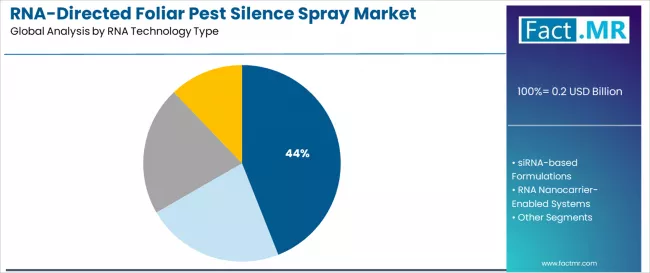
dsRNA-based sprays dominate the technology segment with a 44% share, serving as the primary molecule for inducing RNA interference in pests. Their double-stranded structure provides stability compared to single-stranded RNAs and is effectively processed by the insect's cellular machinery to initiate gene silencing. Production methods for long dsRNA molecules have achieved the scale and cost-effectiveness required for agriculture.
This technology platform is versatile, allowing for the design of sequences targeting a wide range of pests. Its role as the core active ingredient in most first-generation commercial products solidifies its current market leadership, though it faces future competition from more advanced, stabilized formulations.
Why are Fruits & Vegetables the Primary Crop Segment for Precision Pest Control?

The fruits and vegetables segment commands a 35% share, driven by an acute need for precision control. These high-value crops suffer severe quality and yield damage from pest feeding, and export markets enforce strict limits on chemical residues and pest incidence. RNAi sprays offer a targeted solution that can control resistant pests without leaving undesirable residues, preserving market access.
The smaller scale and higher management intensity of fruit and vegetable production allow for closer monitoring and more precise application, optimizing the effectiveness of this still-premium technology. Growers in this segment are often early adopters willing to invest in innovative solutions that protect crop quality and ensure compliance with rigorous food safety standards.
What are the Drivers, Restraints, and Key Trends of the RNA-Directed Foliar Pest Silence Spray Market?
The market is primarily driven by the critical need to combat pervasive pest resistance to conventional insecticides and acaricides. Demand for residue-free produce and stringent environmental regulations further accelerate adoption. A significant restraint is the current high cost of RNA active ingredient production and formulation compared to established chemicals.
Technical challenges include ensuring RNA stability under field conditions (UV degradation, rainfastness) and achieving consistent uptake across different pest species and plant surfaces. Regulatory pathways for this novel class of pesticides are also evolving and can be complex.
Key trends focus on overcoming these barriers: advancing nanocarrier and formulation technologies to protect RNA and enhance leaf penetration; developing broader-spectrum RNAi triggers that work across multiple pest species; and creating integrated digital platforms to identify pest pressure and optimize spray timing for maximum efficacy and cost-effectiveness.
Analysis of the RNA-Directed Foliar Pest Silence Spray Market by Key Countries
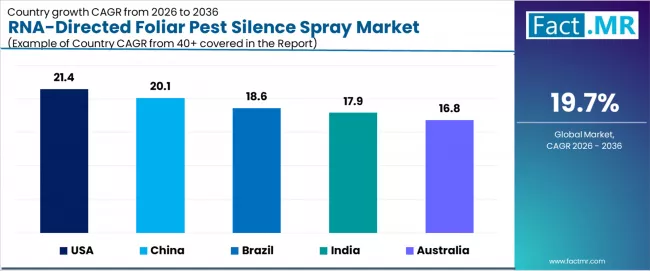
| Country | CAGR (2026-2036) |
|---|---|
| USA | 21.40% |
| China | 20.10% |
| Brazil | 18.60% |
| India | 17.90% |
| Australia | 16.80% |
How does the USA Lead Commercialization with Advanced Ag-Tech Integration?
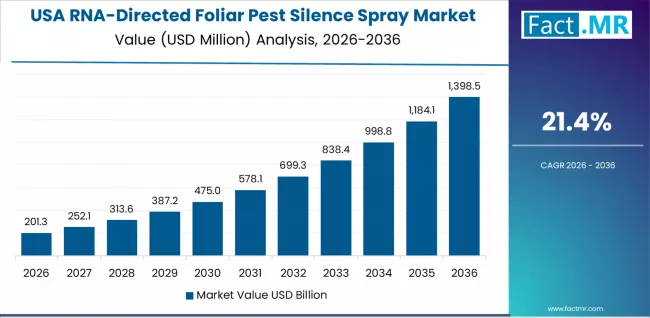
The USA exhibits the highest CAGR of 21.40%, serving as the primary launchpad for this technology. This is due to its advanced regulatory framework for biopesticides, strong venture capital investment in agri-tech, and large-scale farming operations adept at integrating precision tools.
Early approvals for RNAi-based products target major pests in corn and potatoes. The presence of leading agribiotech firms and a grower base facing significant resistance issues in key pests create an ideal ecosystem for rapid adoption and scaling of this disruptive technology.
What Fuels China's Pursuit of Technological Leadership in RNAi?
China follows with a 20.10% CAGR, driven by substantial government and corporate investment in agricultural biotechnology as a strategic priority. National goals for food security and pesticide reduction align perfectly with RNAi's potential.
Chinese research institutes and companies are actively developing their own RNAi platforms and products, particularly for pests in rice, cotton, and greenhouse vegetables. The vast scale of its agricultural sector provides a massive testing and adoption ground for domestically developed solutions.
Why does Brazil's Resistance-Prone Agriculture Present a Key Market?
Brazil's market grows at an 18.60% CAGR, fueled by some of the most severe cases of pest resistance in the world, especially in its massive soybean and corn sectors. The high pest pressure and limited chemical options make Brazilian growers urgent adopters of novel modes of action.
The country's progressive biosafety regulations and experience with biotech crops facilitate a pathway for evaluating and approving RNAi-based sprays, positioning it as a critical early-adoption market for global companies.
What drives India's Growth Potential in High-Value Horticulture?
India's CAGR of 17.90% is driven by the dual challenges of pest resistance in cotton and vegetables and the need for export-compliant, residue-free produce from its expanding horticulture sector.
While cost sensitivity is a factor, the dire need for solutions against resistant pests like the cotton bollworm and tomato pinworm creates a compelling case for adoption. Partnerships for local manufacturing and tailored product development for regional pests will be key to unlocking this high-growth potential market.
How does Australia's Unique Biosecurity Needs Foster Niche Adoption?
Australia, with a CAGR of 16.80%, presents a specialized market driven by its strict biosecurity regulations and isolated ecosystems. RNAi technology offers a potentially valuable tool for managing invasive species or resistant pests in high-value crops like canola, fruits, and vineyards with minimal off-target impact.
The technology's specificity aligns with Australia's careful approach to environmental management, though adoption will be measured and focused on high-priority targets where other options are failing.
Competitive Landscape of the RNA-Directed Foliar Pest Silence Spray Market
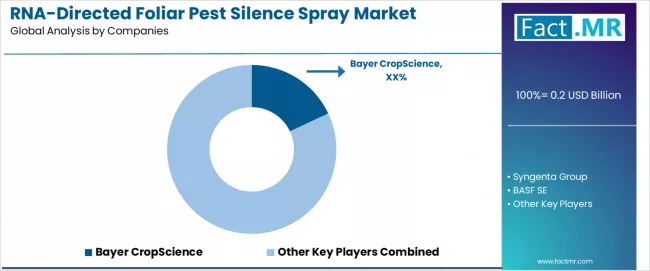
The competitive landscape is defined by a race between established agrochemical giants with vast distribution networks and nimble biotechnology startups specializing in RNA platform technology. Competition hinges on intellectual property around key RNA sequences, delivery formulations, and cost-effective production processes. Strategic alliances are commonplace, with large corporations licensing technology from or acquiring innovative startups to accelerate market entry.
A major focus is on building robust regulatory data packages across different regions to secure product approvals. Given the novelty of the technology, companies are investing heavily in farmer education and demonstration trials to prove efficacy and build trust. Success will depend on creating integrated solutions that combine the RNAi trigger with optimized adjuvant systems and clear application guidance within modern IPM programs.
Key Players Profiled in the RNA-Directed Foliar Pest Silence Spray Market
- Bayer CropScience
- Syngenta Group
- BASF SE
- Corteva Agriscience
- GreenLight Biosciences
Scope of the Report
| Items | Values |
|---|---|
| Quantitative Units (2026) | USD 0.18 Billion |
| Target Pest Category | Chewing Insects (Lepidoptera, Coleoptera), Sap-Sucking Pests (Aphids, Whiteflies), Mites & Thrips, Nematodes, Others |
| RNA Technology Type | dsRNA-based Sprays, siRNA-based Formulations, RNA Nanocarrier-Enabled Systems, Spray-Induced Gene Silencing (SIGS) Blends, Others |
| Crop Type | Fruits & Vegetables, Cereals & Grains, Oilseeds & Pulses, Plantation & Specialty Crops, Others |
| Regions Covered | North America, Latin America, Western Europe, Eastern Europe, East Asia, South Asia & Pacific, Middle East & Africa |
| Countries Covered | USA, China, Brazil, India, Australia and others |
| Key Companies Profiled | Bayer CropScience, Syngenta Group, BASF SE, Corteva Agriscience, GreenLight Biosciences |
| Additional Attributes | Dollar sales by pest category, technology type, and crop type; regional demand analysis; competitive landscape; regulatory pathway analysis; technology adoption barriers and drivers; R&D focus on delivery systems |
Key Segments List
-
Target Pest Category :
- Chewing Insects (Lepidoptera, Coleoptera)
- Sap-Sucking Pests (Aphids, Whiteflies)
- Mites & Thrips
- Nematodes
- Others
-
RNA Technology Type :
- dsRNA-based Sprays
- siRNA-based Formulations
- RNA Nanocarrier-Enabled Systems
- Spray-Induced Gene Silencing (SIGS) Blends
- Others
-
Crop Type :
- Fruits & Vegetables
- Cereals & Grains
- Oilseeds & Pulses
- Plantation & Specialty Crops
- Others
-
Region :
-
North America
- USA
- Canada
-
Latin America
- Brazil
- Mexico
- Argentina
- Chile
- Rest of Latin America
-
Western Europe
- Germany
- UK
- France
- Spain
- Italy
- BENELUX
- Rest of Western Europe
-
Eastern Europe
- Poland
- Czech Republic
- Austria
- Hungary
- Rest of Eastern Europe
-
East Asia
- China
- Japan
- South Korea
- Rest of East Asia
-
South Asia & Pacific
- India
- Indonesia
- Australia
- Rest of South Asia & Pacific
-
MEA
- Saudi Arabia
- UAE
- Türkiye
- Rest of MEA
-
Table of Content
- Executive Summary
- Global Market Outlook
- Demand to side Trends
- Supply to side Trends
- Technology Roadmap Analysis
- Analysis and Recommendations
- Market Overview
- Market Coverage / Taxonomy
- Market Definition / Scope / Limitations
- Market Background
- Market Dynamics
- Drivers
- Restraints
- Opportunity
- Trends
- Scenario Forecast
- Demand in Optimistic Scenario
- Demand in Likely Scenario
- Demand in Conservative Scenario
- Opportunity Map Analysis
- Product Life Cycle Analysis
- Supply Chain Analysis
- Investment Feasibility Matrix
- Value Chain Analysis
- PESTLE and Porter’s Analysis
- Regulatory Landscape
- Regional Parent Market Outlook
- Production and Consumption Statistics
- Import and Export Statistics
- Market Dynamics
- Global Market Analysis 2021 to 2025 and Forecast, 2026 to 2036
- Historical Market Size Value (USD Million) Analysis, 2021 to 2025
- Current and Future Market Size Value (USD Million) Projections, 2026 to 2036
- Y to o to Y Growth Trend Analysis
- Absolute $ Opportunity Analysis
- Global Market Pricing Analysis 2021 to 2025 and Forecast 2026 to 2036
- Global Market Analysis 2021 to 2025 and Forecast 2026 to 2036, By Target Pest Category
- Introduction / Key Findings
- Historical Market Size Value (USD Million) Analysis By Target Pest Category, 2021 to 2025
- Current and Future Market Size Value (USD Million) Analysis and Forecast By Target Pest Category, 2026 to 2036
- Chewing Insects (Lepidoptera, Coleoptera)
- Sap-Sucking Pests (Aphids, Whiteflies)
- Mites & Thrips
- Nematodes
- Others
- Chewing Insects (Lepidoptera, Coleoptera)
- Y to o to Y Growth Trend Analysis By Target Pest Category, 2021 to 2025
- Absolute $ Opportunity Analysis By Target Pest Category, 2026 to 2036
- Global Market Analysis 2021 to 2025 and Forecast 2026 to 2036, By RNA Technology Type
- Introduction / Key Findings
- Historical Market Size Value (USD Million) Analysis By RNA Technology Type, 2021 to 2025
- Current and Future Market Size Value (USD Million) Analysis and Forecast By RNA Technology Type, 2026 to 2036
- dsRNA-based Sprays
- siRNA-based Formulations
- RNA Nanocarrier-Enabled Systems
- Spray-Induced Gene Silencing (SIGS) Blends
- dsRNA-based Sprays
- Y to o to Y Growth Trend Analysis By RNA Technology Type, 2021 to 2025
- Absolute $ Opportunity Analysis By RNA Technology Type, 2026 to 2036
- Global Market Analysis 2021 to 2025 and Forecast 2026 to 2036, By Crop Type
- Introduction / Key Findings
- Historical Market Size Value (USD Million) Analysis By Crop Type, 2021 to 2025
- Current and Future Market Size Value (USD Million) Analysis and Forecast By Crop Type, 2026 to 2036
- Fruits & Vegetables
- Cereals & Grains
- Oilseeds & Pulses
- Plantation & Specialty Crops
- Others
- Fruits & Vegetables
- Y to o to Y Growth Trend Analysis By Crop Type, 2021 to 2025
- Absolute $ Opportunity Analysis By Crop Type, 2026 to 2036
- Global Market Analysis 2021 to 2025 and Forecast 2026 to 2036, By Region
- Introduction
- Historical Market Size Value (USD Million) Analysis By Region, 2021 to 2025
- Current Market Size Value (USD Million) Analysis and Forecast By Region, 2026 to 2036
- North America
- Latin America
- Western Europe
- Eastern Europe
- East Asia
- South Asia and Pacific
- Middle East & Africa
- Market Attractiveness Analysis By Region
- North America Market Analysis 2021 to 2025 and Forecast 2026 to 2036, By Country
- Historical Market Size Value (USD Million) Trend Analysis By Market Taxonomy, 2021 to 2025
- Market Size Value (USD Million) Forecast By Market Taxonomy, 2026 to 2036
- By Country
- USA
- Canada
- Mexico
- By Target Pest Category
- By RNA Technology Type
- By Crop Type
- By Country
- Market Attractiveness Analysis
- By Country
- By Target Pest Category
- By RNA Technology Type
- By Crop Type
- Key Takeaways
- Latin America Market Analysis 2021 to 2025 and Forecast 2026 to 2036, By Country
- Historical Market Size Value (USD Million) Trend Analysis By Market Taxonomy, 2021 to 2025
- Market Size Value (USD Million) Forecast By Market Taxonomy, 2026 to 2036
- By Country
- Brazil
- Chile
- Rest of Latin America
- By Target Pest Category
- By RNA Technology Type
- By Crop Type
- By Country
- Market Attractiveness Analysis
- By Country
- By Target Pest Category
- By RNA Technology Type
- By Crop Type
- Key Takeaways
- Western Europe Market Analysis 2021 to 2025 and Forecast 2026 to 2036, By Country
- Historical Market Size Value (USD Million) Trend Analysis By Market Taxonomy, 2021 to 2025
- Market Size Value (USD Million) Forecast By Market Taxonomy, 2026 to 2036
- By Country
- Germany
- UK
- Italy
- Spain
- France
- Nordic
- BENELUX
- Rest of Western Europe
- By Target Pest Category
- By RNA Technology Type
- By Crop Type
- By Country
- Market Attractiveness Analysis
- By Country
- By Target Pest Category
- By RNA Technology Type
- By Crop Type
- Key Takeaways
- Eastern Europe Market Analysis 2021 to 2025 and Forecast 2026 to 2036, By Country
- Historical Market Size Value (USD Million) Trend Analysis By Market Taxonomy, 2021 to 2025
- Market Size Value (USD Million) Forecast By Market Taxonomy, 2026 to 2036
- By Country
- Russia
- Poland
- Hungary
- Balkan & Baltic
- Rest of Eastern Europe
- By Target Pest Category
- By RNA Technology Type
- By Crop Type
- By Country
- Market Attractiveness Analysis
- By Country
- By Target Pest Category
- By RNA Technology Type
- By Crop Type
- Key Takeaways
- East Asia Market Analysis 2021 to 2025 and Forecast 2026 to 2036, By Country
- Historical Market Size Value (USD Million) Trend Analysis By Market Taxonomy, 2021 to 2025
- Market Size Value (USD Million) Forecast By Market Taxonomy, 2026 to 2036
- By Country
- China
- Japan
- South Korea
- By Target Pest Category
- By RNA Technology Type
- By Crop Type
- By Country
- Market Attractiveness Analysis
- By Country
- By Target Pest Category
- By RNA Technology Type
- By Crop Type
- Key Takeaways
- South Asia and Pacific Market Analysis 2021 to 2025 and Forecast 2026 to 2036, By Country
- Historical Market Size Value (USD Million) Trend Analysis By Market Taxonomy, 2021 to 2025
- Market Size Value (USD Million) Forecast By Market Taxonomy, 2026 to 2036
- By Country
- India
- ASEAN
- Australia & New Zealand
- Rest of South Asia and Pacific
- By Target Pest Category
- By RNA Technology Type
- By Crop Type
- By Country
- Market Attractiveness Analysis
- By Country
- By Target Pest Category
- By RNA Technology Type
- By Crop Type
- Key Takeaways
- Middle East & Africa Market Analysis 2021 to 2025 and Forecast 2026 to 2036, By Country
- Historical Market Size Value (USD Million) Trend Analysis By Market Taxonomy, 2021 to 2025
- Market Size Value (USD Million) Forecast By Market Taxonomy, 2026 to 2036
- By Country
- Kingdom of Saudi Arabia
- Other GCC Countries
- Turkiye
- South Africa
- Other African Union
- Rest of Middle East & Africa
- By Target Pest Category
- By RNA Technology Type
- By Crop Type
- By Country
- Market Attractiveness Analysis
- By Country
- By Target Pest Category
- By RNA Technology Type
- By Crop Type
- Key Takeaways
- Key Countries Market Analysis
- USA
- Pricing Analysis
- Market Share Analysis, 2025
- By Target Pest Category
- By RNA Technology Type
- By Crop Type
- Canada
- Pricing Analysis
- Market Share Analysis, 2025
- By Target Pest Category
- By RNA Technology Type
- By Crop Type
- Mexico
- Pricing Analysis
- Market Share Analysis, 2025
- By Target Pest Category
- By RNA Technology Type
- By Crop Type
- Brazil
- Pricing Analysis
- Market Share Analysis, 2025
- By Target Pest Category
- By RNA Technology Type
- By Crop Type
- Chile
- Pricing Analysis
- Market Share Analysis, 2025
- By Target Pest Category
- By RNA Technology Type
- By Crop Type
- Germany
- Pricing Analysis
- Market Share Analysis, 2025
- By Target Pest Category
- By RNA Technology Type
- By Crop Type
- UK
- Pricing Analysis
- Market Share Analysis, 2025
- By Target Pest Category
- By RNA Technology Type
- By Crop Type
- Italy
- Pricing Analysis
- Market Share Analysis, 2025
- By Target Pest Category
- By RNA Technology Type
- By Crop Type
- Spain
- Pricing Analysis
- Market Share Analysis, 2025
- By Target Pest Category
- By RNA Technology Type
- By Crop Type
- France
- Pricing Analysis
- Market Share Analysis, 2025
- By Target Pest Category
- By RNA Technology Type
- By Crop Type
- India
- Pricing Analysis
- Market Share Analysis, 2025
- By Target Pest Category
- By RNA Technology Type
- By Crop Type
- ASEAN
- Pricing Analysis
- Market Share Analysis, 2025
- By Target Pest Category
- By RNA Technology Type
- By Crop Type
- Australia & New Zealand
- Pricing Analysis
- Market Share Analysis, 2025
- By Target Pest Category
- By RNA Technology Type
- By Crop Type
- China
- Pricing Analysis
- Market Share Analysis, 2025
- By Target Pest Category
- By RNA Technology Type
- By Crop Type
- Japan
- Pricing Analysis
- Market Share Analysis, 2025
- By Target Pest Category
- By RNA Technology Type
- By Crop Type
- South Korea
- Pricing Analysis
- Market Share Analysis, 2025
- By Target Pest Category
- By RNA Technology Type
- By Crop Type
- Russia
- Pricing Analysis
- Market Share Analysis, 2025
- By Target Pest Category
- By RNA Technology Type
- By Crop Type
- Poland
- Pricing Analysis
- Market Share Analysis, 2025
- By Target Pest Category
- By RNA Technology Type
- By Crop Type
- Hungary
- Pricing Analysis
- Market Share Analysis, 2025
- By Target Pest Category
- By RNA Technology Type
- By Crop Type
- Kingdom of Saudi Arabia
- Pricing Analysis
- Market Share Analysis, 2025
- By Target Pest Category
- By RNA Technology Type
- By Crop Type
- Turkiye
- Pricing Analysis
- Market Share Analysis, 2025
- By Target Pest Category
- By RNA Technology Type
- By Crop Type
- South Africa
- Pricing Analysis
- Market Share Analysis, 2025
- By Target Pest Category
- By RNA Technology Type
- By Crop Type
- USA
- Market Structure Analysis
- Competition Dashboard
- Competition Benchmarking
- Market Share Analysis of Top Players
- By Regional
- By Target Pest Category
- By RNA Technology Type
- By Crop Type
- Competition Analysis
- Competition Deep Dive
- Bayer CropScience
- Overview
- Product Portfolio
- Profitability by Market Segments (Product/Age /Sales Channel/Region)
- Sales Footprint
- Strategy Overview
- Marketing Strategy
- Product Strategy
- Channel Strategy
- Syngenta Group
- BASF SE
- Corteva Agriscience
- GreenLight Biosciences
- Others
- Bayer CropScience
- Competition Deep Dive
- Assumptions & Acronyms Used
- Research Methodology
List Of Table
- Table 1: Global Market Value (USD Million) Forecast by Region, 2021 to 2036
- Table 2: Global Market Value (USD Million) Forecast by Target Pest Category, 2021 to 2036
- Table 3: Global Market Value (USD Million) Forecast by RNA Technology Type, 2021 to 2036
- Table 4: Global Market Value (USD Million) Forecast by Crop Type, 2021 to 2036
- Table 5: North America Market Value (USD Million) Forecast by Country, 2021 to 2036
- Table 6: North America Market Value (USD Million) Forecast by Target Pest Category, 2021 to 2036
- Table 7: North America Market Value (USD Million) Forecast by RNA Technology Type, 2021 to 2036
- Table 8: North America Market Value (USD Million) Forecast by Crop Type, 2021 to 2036
- Table 9: Latin America Market Value (USD Million) Forecast by Country, 2021 to 2036
- Table 10: Latin America Market Value (USD Million) Forecast by Target Pest Category, 2021 to 2036
- Table 11: Latin America Market Value (USD Million) Forecast by RNA Technology Type, 2021 to 2036
- Table 12: Latin America Market Value (USD Million) Forecast by Crop Type, 2021 to 2036
- Table 13: Western Europe Market Value (USD Million) Forecast by Country, 2021 to 2036
- Table 14: Western Europe Market Value (USD Million) Forecast by Target Pest Category, 2021 to 2036
- Table 15: Western Europe Market Value (USD Million) Forecast by RNA Technology Type, 2021 to 2036
- Table 16: Western Europe Market Value (USD Million) Forecast by Crop Type, 2021 to 2036
- Table 17: Eastern Europe Market Value (USD Million) Forecast by Country, 2021 to 2036
- Table 18: Eastern Europe Market Value (USD Million) Forecast by Target Pest Category, 2021 to 2036
- Table 19: Eastern Europe Market Value (USD Million) Forecast by RNA Technology Type, 2021 to 2036
- Table 20: Eastern Europe Market Value (USD Million) Forecast by Crop Type, 2021 to 2036
- Table 21: East Asia Market Value (USD Million) Forecast by Country, 2021 to 2036
- Table 22: East Asia Market Value (USD Million) Forecast by Target Pest Category, 2021 to 2036
- Table 23: East Asia Market Value (USD Million) Forecast by RNA Technology Type, 2021 to 2036
- Table 24: East Asia Market Value (USD Million) Forecast by Crop Type, 2021 to 2036
- Table 25: South Asia and Pacific Market Value (USD Million) Forecast by Country, 2021 to 2036
- Table 26: South Asia and Pacific Market Value (USD Million) Forecast by Target Pest Category, 2021 to 2036
- Table 27: South Asia and Pacific Market Value (USD Million) Forecast by RNA Technology Type, 2021 to 2036
- Table 28: South Asia and Pacific Market Value (USD Million) Forecast by Crop Type, 2021 to 2036
- Table 29: Middle East & Africa Market Value (USD Million) Forecast by Country, 2021 to 2036
- Table 30: Middle East & Africa Market Value (USD Million) Forecast by Target Pest Category, 2021 to 2036
- Table 31: Middle East & Africa Market Value (USD Million) Forecast by RNA Technology Type, 2021 to 2036
- Table 32: Middle East & Africa Market Value (USD Million) Forecast by Crop Type, 2021 to 2036
List Of Figures
- Figure 1: Global Market Pricing Analysis
- Figure 2: Global Market Value (USD Million) Forecast 2021 to 2036
- Figure 3: Global Market Value Share and BPS Analysis by Target Pest Category, 2026 and 2036
- Figure 4: Global Market Y to o to Y Growth Comparison by Target Pest Category, 2026 to 2036
- Figure 5: Global Market Attractiveness Analysis by Target Pest Category
- Figure 6: Global Market Value Share and BPS Analysis by RNA Technology Type, 2026 and 2036
- Figure 7: Global Market Y to o to Y Growth Comparison by RNA Technology Type, 2026 to 2036
- Figure 8: Global Market Attractiveness Analysis by RNA Technology Type
- Figure 9: Global Market Value Share and BPS Analysis by Crop Type, 2026 and 2036
- Figure 10: Global Market Y to o to Y Growth Comparison by Crop Type, 2026 to 2036
- Figure 11: Global Market Attractiveness Analysis by Crop Type
- Figure 12: Global Market Value (USD Million) Share and BPS Analysis by Region, 2026 and 2036
- Figure 13: Global Market Y to o to Y Growth Comparison by Region, 2026 to 2036
- Figure 14: Global Market Attractiveness Analysis by Region
- Figure 15: North America Market Incremental Dollar Opportunity, 2026 to 2036
- Figure 16: Latin America Market Incremental Dollar Opportunity, 2026 to 2036
- Figure 17: Western Europe Market Incremental Dollar Opportunity, 2026 to 2036
- Figure 18: Eastern Europe Market Incremental Dollar Opportunity, 2026 to 2036
- Figure 19: East Asia Market Incremental Dollar Opportunity, 2026 to 2036
- Figure 20: South Asia and Pacific Market Incremental Dollar Opportunity, 2026 to 2036
- Figure 21: Middle East & Africa Market Incremental Dollar Opportunity, 2026 to 2036
- Figure 22: North America Market Value Share and BPS Analysis by Country, 2026 and 2036
- Figure 23: North America Market Value Share and BPS Analysis by Target Pest Category, 2026 and 2036
- Figure 24: North America Market Y to o to Y Growth Comparison by Target Pest Category, 2026 to 2036
- Figure 25: North America Market Attractiveness Analysis by Target Pest Category
- Figure 26: North America Market Value Share and BPS Analysis by RNA Technology Type, 2026 and 2036
- Figure 27: North America Market Y to o to Y Growth Comparison by RNA Technology Type, 2026 to 2036
- Figure 28: North America Market Attractiveness Analysis by RNA Technology Type
- Figure 29: North America Market Value Share and BPS Analysis by Crop Type, 2026 and 2036
- Figure 30: North America Market Y to o to Y Growth Comparison by Crop Type, 2026 to 2036
- Figure 31: North America Market Attractiveness Analysis by Crop Type
- Figure 32: Latin America Market Value Share and BPS Analysis by Country, 2026 and 2036
- Figure 33: Latin America Market Value Share and BPS Analysis by Target Pest Category, 2026 and 2036
- Figure 34: Latin America Market Y to o to Y Growth Comparison by Target Pest Category, 2026 to 2036
- Figure 35: Latin America Market Attractiveness Analysis by Target Pest Category
- Figure 36: Latin America Market Value Share and BPS Analysis by RNA Technology Type, 2026 and 2036
- Figure 37: Latin America Market Y to o to Y Growth Comparison by RNA Technology Type, 2026 to 2036
- Figure 38: Latin America Market Attractiveness Analysis by RNA Technology Type
- Figure 39: Latin America Market Value Share and BPS Analysis by Crop Type, 2026 and 2036
- Figure 40: Latin America Market Y to o to Y Growth Comparison by Crop Type, 2026 to 2036
- Figure 41: Latin America Market Attractiveness Analysis by Crop Type
- Figure 42: Western Europe Market Value Share and BPS Analysis by Country, 2026 and 2036
- Figure 43: Western Europe Market Value Share and BPS Analysis by Target Pest Category, 2026 and 2036
- Figure 44: Western Europe Market Y to o to Y Growth Comparison by Target Pest Category, 2026 to 2036
- Figure 45: Western Europe Market Attractiveness Analysis by Target Pest Category
- Figure 46: Western Europe Market Value Share and BPS Analysis by RNA Technology Type, 2026 and 2036
- Figure 47: Western Europe Market Y to o to Y Growth Comparison by RNA Technology Type, 2026 to 2036
- Figure 48: Western Europe Market Attractiveness Analysis by RNA Technology Type
- Figure 49: Western Europe Market Value Share and BPS Analysis by Crop Type, 2026 and 2036
- Figure 50: Western Europe Market Y to o to Y Growth Comparison by Crop Type, 2026 to 2036
- Figure 51: Western Europe Market Attractiveness Analysis by Crop Type
- Figure 52: Eastern Europe Market Value Share and BPS Analysis by Country, 2026 and 2036
- Figure 53: Eastern Europe Market Value Share and BPS Analysis by Target Pest Category, 2026 and 2036
- Figure 54: Eastern Europe Market Y to o to Y Growth Comparison by Target Pest Category, 2026 to 2036
- Figure 55: Eastern Europe Market Attractiveness Analysis by Target Pest Category
- Figure 56: Eastern Europe Market Value Share and BPS Analysis by RNA Technology Type, 2026 and 2036
- Figure 57: Eastern Europe Market Y to o to Y Growth Comparison by RNA Technology Type, 2026 to 2036
- Figure 58: Eastern Europe Market Attractiveness Analysis by RNA Technology Type
- Figure 59: Eastern Europe Market Value Share and BPS Analysis by Crop Type, 2026 and 2036
- Figure 60: Eastern Europe Market Y to o to Y Growth Comparison by Crop Type, 2026 to 2036
- Figure 61: Eastern Europe Market Attractiveness Analysis by Crop Type
- Figure 62: East Asia Market Value Share and BPS Analysis by Country, 2026 and 2036
- Figure 63: East Asia Market Value Share and BPS Analysis by Target Pest Category, 2026 and 2036
- Figure 64: East Asia Market Y to o to Y Growth Comparison by Target Pest Category, 2026 to 2036
- Figure 65: East Asia Market Attractiveness Analysis by Target Pest Category
- Figure 66: East Asia Market Value Share and BPS Analysis by RNA Technology Type, 2026 and 2036
- Figure 67: East Asia Market Y to o to Y Growth Comparison by RNA Technology Type, 2026 to 2036
- Figure 68: East Asia Market Attractiveness Analysis by RNA Technology Type
- Figure 69: East Asia Market Value Share and BPS Analysis by Crop Type, 2026 and 2036
- Figure 70: East Asia Market Y to o to Y Growth Comparison by Crop Type, 2026 to 2036
- Figure 71: East Asia Market Attractiveness Analysis by Crop Type
- Figure 72: South Asia and Pacific Market Value Share and BPS Analysis by Country, 2026 and 2036
- Figure 73: South Asia and Pacific Market Value Share and BPS Analysis by Target Pest Category, 2026 and 2036
- Figure 74: South Asia and Pacific Market Y to o to Y Growth Comparison by Target Pest Category, 2026 to 2036
- Figure 75: South Asia and Pacific Market Attractiveness Analysis by Target Pest Category
- Figure 76: South Asia and Pacific Market Value Share and BPS Analysis by RNA Technology Type, 2026 and 2036
- Figure 77: South Asia and Pacific Market Y to o to Y Growth Comparison by RNA Technology Type, 2026 to 2036
- Figure 78: South Asia and Pacific Market Attractiveness Analysis by RNA Technology Type
- Figure 79: South Asia and Pacific Market Value Share and BPS Analysis by Crop Type, 2026 and 2036
- Figure 80: South Asia and Pacific Market Y to o to Y Growth Comparison by Crop Type, 2026 to 2036
- Figure 81: South Asia and Pacific Market Attractiveness Analysis by Crop Type
- Figure 82: Middle East & Africa Market Value Share and BPS Analysis by Country, 2026 and 2036
- Figure 83: Middle East & Africa Market Value Share and BPS Analysis by Target Pest Category, 2026 and 2036
- Figure 84: Middle East & Africa Market Y to o to Y Growth Comparison by Target Pest Category, 2026 to 2036
- Figure 85: Middle East & Africa Market Attractiveness Analysis by Target Pest Category
- Figure 86: Middle East & Africa Market Value Share and BPS Analysis by RNA Technology Type, 2026 and 2036
- Figure 87: Middle East & Africa Market Y to o to Y Growth Comparison by RNA Technology Type, 2026 to 2036
- Figure 88: Middle East & Africa Market Attractiveness Analysis by RNA Technology Type
- Figure 89: Middle East & Africa Market Value Share and BPS Analysis by Crop Type, 2026 and 2036
- Figure 90: Middle East & Africa Market Y to o to Y Growth Comparison by Crop Type, 2026 to 2036
- Figure 91: Middle East & Africa Market Attractiveness Analysis by Crop Type
- Figure 92: Global Market - Tier Structure Analysis
- Figure 93: Global Market - Company Share Analysis
- FAQs -
How big is the rna-directed foliar pest silence spray market in 2026?
The global rna-directed foliar pest silence spray market is estimated to be valued at USD 0.2 billion in 2026.
What will be the size of rna-directed foliar pest silence spray market in 2036?
The market size for the rna-directed foliar pest silence spray market is projected to reach USD 1.1 billion by 2036.
How much will be the rna-directed foliar pest silence spray market growth between 2026 and 2036?
The rna-directed foliar pest silence spray market is expected to grow at a 19.7% CAGR between 2026 and 2036.
What are the key product types in the rna-directed foliar pest silence spray market?
The key product types in rna-directed foliar pest silence spray market are chewing insects (lepidoptera, coleoptera), sap-sucking pests (aphids, whiteflies), mites & thrips, nematodes and others.
Which rna technology type segment to contribute significant share in the rna-directed foliar pest silence spray market in 2026?
In terms of rna technology type, dsrna-based sprays segment to command 44.0% share in the rna-directed foliar pest silence spray market in 2026.