- Market Value (2025): USD 2.4 Bn
- Estimated Value (2026): USD 2.8 Bn
- Forecast Value (2036): USD 11.9 Bn
- CAGR (2026-2036): 15.6%
What is the Disaggregated Memory Architecture for AI Data Centers Market forecast to be worth by 2036?
USD 2.8 billion in 2026 to USD 11.9 billion by 2036 at 15.6% CAGR.
- The disaggregated memory architecture for AI data centers market reached USD 2.4 billion in 2025 as teams tested new memory tiers.
- Demand is projected to increase from USD 2.8 billion in 2026 to USD 11.9 billion by 2036.
- The market is forecast to record 15.6% CAGR from 2026 to 2036.
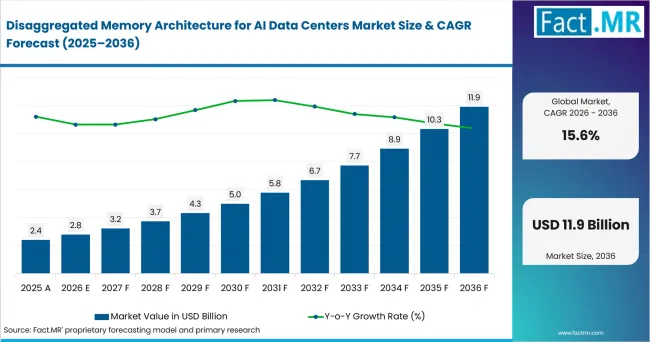
Disaggregated Memory Architecture For Ai Data Centers Market Value Analysis | Source: Fact.MR
What are the defining numbers behind Disaggregated Memory Architecture for AI Data Centers Market growth?
USD 9.1 billion absolute opportunity by 2036.
- Demand Drivers in the Market
- AI clusters need memory expansion methods that reduce idle capacity trapped inside individual servers.
- CXL-based designs are expected to help operators add capacity without replacing every compute node.
- Training systems require predictable bandwidth when accelerators wait on memory access or data movement.
- Cloud buyers are expected to prefer validation proof across processors and controllers. Firmware and operating support must be clear before approval.
- Key Segments Analyzed
- By Memory Architecture: CXL-based Memory Architecture is expected to hold 44.0% share in 2026 because it gives AI clusters a clearer route to pooled memory expansion.
- By AI Infrastructure: AI Training Clusters is projected to account for 43.0% share in 2026 as large model development carries the highest capacity pressure.
- By End-use Industry: Hyperscale Data Centers is anticipated to capture 46.0% share in 2026 due to cloud AI infrastructure spending.
- By Customer Category: Hyperscale Cloud Providers is estimated to represent 42.0% share in 2026 since they operate the broadest AI compute fleets.
- By Interconnect Technology: Compute Express Link (CXL) is forecast to hold 45.0% share in 2026 because it supports memory expansion.
- Analyst Opinion at Fact.MR
- Shambhu Nath Jha, Senior Consultant at Fact.MR, states, “Disaggregated memory platforms must show that pooled capacity improves utilization without disrupting bandwidth or compatibility across AI clusters. Production acceptance is expected to depend on controller behavior, firmware stability and CXL interoperability through demanding workloads rather than headline memory capacity alone.”
- Strategic Implications
- Platform providers should organize sales materials around training, inference and memory pooling use cases.
- Memory suppliers need validation paths that show controller behavior, firmware stability and CPU compatibility.
- Cloud and enterprise data center teams should compare total cost through utilization gains and upgrade timing. Avoided stranded capacity is expected to matter during budget approval.
- Channel partners can build differentiation by supporting proof-of-concept work, configuration guidance and lifecycle documentation.
The USA records the highest country CAGR at 16.8% by 2036. South Korea follows at 16.1%. Japan is projected at 15.4%. Germany is forecast at 14.8%. Canada is estimated at 14.2%. Singapore is estimated at 13.7%. Taiwan is estimated at 13.1%.
How does the Disaggregated Memory Architecture for AI Data Centers Market break down by segment?
CXL-based Memory Architecture is expected to lead Memory Architecture with 44.0% share in 2026. AI Training Clusters is projected to lead AI Infrastructure with 43.0% share in 2026.
Why does CXL-based Memory Architecture lead Memory Architecture?
CXL-based Memory Architecture is projected to account for 44.0% share in 2026.
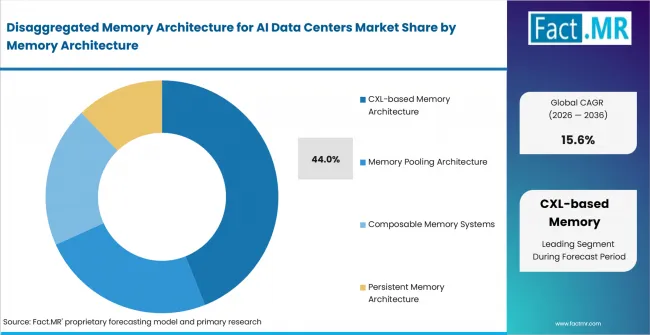
Disaggregated Memory Architecture For Ai Data Centers Market Analysis By Memory Architecture | Source: Fact.MR
CXL-based Memory Architecture leads because it lets operators attach memory outside fixed server boundaries. Buyers reviewing data center SSD planning are expected to value designs that reduce stranded capacity before new server purchases are approved.
Why does AI Training Clusters lead AI Infrastructure?
AI Training Clusters are expected to hold 43.0% share in 2026.
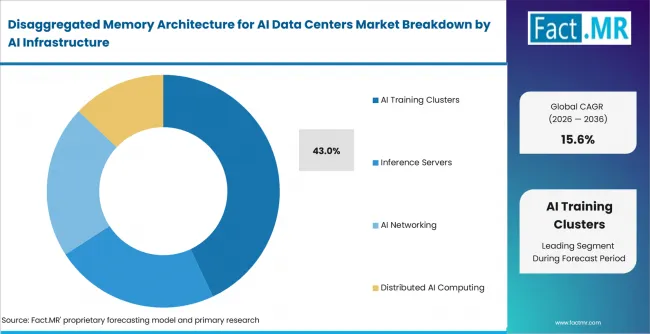
Disaggregated Memory Architecture For Ai Data Centers Market Analysis By Ai Infrastructure | Source: Fact.MR
Training clusters carry long memory-access cycles when large models move data across many nodes. Demand from prefabricated AI pods can add pressure for compact designs that need predictable memory access across dense equipment groups.
Why does Hyperscale Data Centers lead End-use Industry?
At 46.0% share in 2026, Hyperscale Data Centers are anticipated to lead End-use Industry.
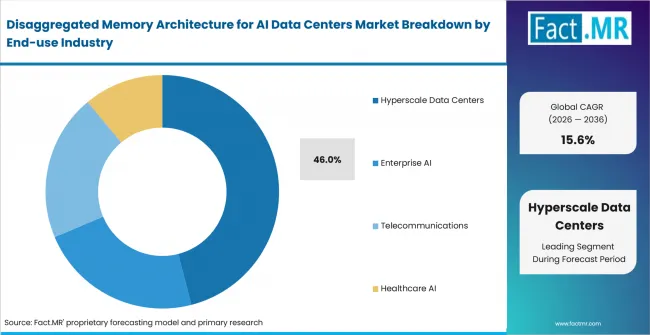
Disaggregated Memory Architecture For Ai Data Centers Market Analysis By End Use Industry | Source: Fact.MR
Hyperscale operators run dense AI platforms across broad fleets. Their planning touches 3D semiconductor packaging because advanced AI hardware depends on coordination among compute chips, memory and interconnect decisions.
Why does Hyperscale Cloud Providers lead Customer Category?
Hyperscale Cloud Providers are estimated to represent 42.0% share in 2026.
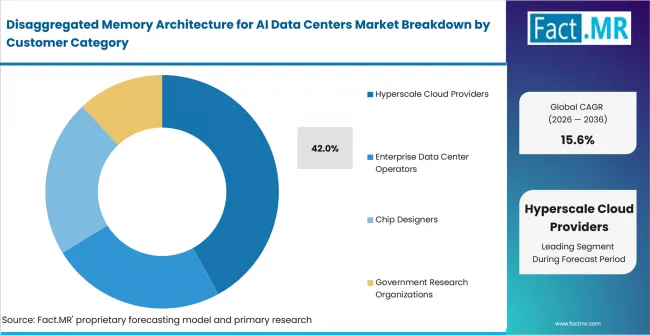
Disaggregated Memory Architecture For Ai Data Centers Market Analysis By Customer Category | Source: Fact.MR
Hyperscale cloud providers lead because they need repeatable configuration models for large AI fleets. Enterprise operators remain selective when new memory fabrics must fit existing power and cooling plans for AI power supply units.
Why does Compute Express Link (CXL) lead Interconnect Technology?
Compute Express Link (CXL) is forecast to hold 45.0% share in 2026.
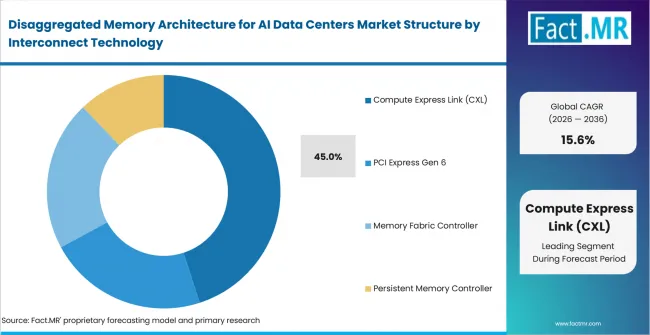
Disaggregated Memory Architecture For Ai Data Centers Market Analysis By Interconnect Technology | Source: Fact.MR
Compute Express Link (CXL) leads because it supports coherent communication between processors and memory devices. Demand for through-glass via TGV interposers shows how interconnect choices shape advanced hardware planning.
What is accelerating Disaggregated Memory Architecture for AI Data Centers Market adoption, and what is holding it back?
Demand is expected to rise through AI cluster memory pressure and maturing CXL support. Integration complexity and stricter validation may slow production rollout.
Drivers Impact Analysis
| DRIVER | (~) % IMPACT ON CAGR | GEOGRAPHIC RELEVANCE | IMPACT TIMELINE |
|---|---|---|---|
| Adoption and integration | +1.6% | Global | Short term (<= 2 years) |
| Regulatory and compliance support | +1.4% | USA, Germany, UK | Short term (<= 2 years) |
| Channel and access expansion | +1.1% | Global | Medium term (2-4 years) |
| Clear specification and documentation | +0.9% | USA, UK, Canada | Medium term (2-4 years) |
| Cost and efficiency gains | +0.6% | Global | Long term (>= 4 years) |
- Adoption and integration: Early CXL memory expansion work is expected to move from testing to procurement when buyers see stable host-device behavior.
- Regulatory and compliance support: Security documentation and interoperability evidence are expected to help customers approve new memory tiers in controlled environments.
- Channel and access expansion: Wider system integration support should reduce trial friction for cloud operators and enterprise data center buyers.
Opportunity Impact Analysis
| OPPORTUNITY | (~) % IMPACT ON CAGR | GEOGRAPHIC RELEVANCE | IMPACT TIMELINE |
|---|---|---|---|
| Emerging application expansion | +1.0% | Global | Medium term (2-4 years) |
| Premium and specialist positioning | +0.8% | USA, UK, Germany | Medium term (2-4 years) |
| Channel and partner expansion | +0.7% | Global | Long term (>= 4 years) |
| Standards and compliance alignment | +0.5% | USA, Canada, Singapore | Long term (>= 4 years) |
- Emerging application expansion: Memory pooling is expected to appeal to inference environments where larger context windows create pressure on local memory.
- Premium and specialist positioning: Suppliers with tested controller designs and workload documentation can defend higher pricing in demanding accounts.
- Channel and partner expansion: Better coordination with CPU, accelerator and server partners should make platform qualification easier for operators.
Restraints Impact Analysis
| RESTRAINT | (~) % IMPACT ON CAGR | GEOGRAPHIC RELEVANCE | IMPACT TIMELINE |
|---|---|---|---|
| Cost and complexity | -1.1% | Global | Short term (<= 2 years) |
| Specification and compliance checks | -0.9% | USA, UK, Germany | Short term (<= 2 years) |
| Substitution by lower-cost alternatives | -0.7% | Import-dependent markets | Medium term (2-4 years) |
| Supply chain and pricing pressure | -0.5% | Global | Long term (>= 4 years) |
- Cost and complexity: Integration work can delay adoption when buyers must test hardware and firmware with orchestration software.
- Specification and compliance checks: Customers may slow procurement if memory devices cannot prove CXL compatibility and operational reliability.
- Supply chain and pricing pressure: Component availability and memory price movements can complicate deployment timing for import-dependent markets.
Which countries are scaling the Disaggregated Memory Architecture for AI Data Centers Market fastest?
- The country comparison spans 3.7% points and forms a tiered growth range across the forecast period.
- The USA remains 0.7% point above South Korea through hyperscale AI infrastructure and early platform validation.
- South Korea remains 0.7% point above Japan as memory manufacturing depth supports faster qualification work.
- Japan remains 0.6% point above Germany through component engineering strength and supplier coordination.
- Germany remains 0.6% point above Canada as industrial data center buyers require controlled memory expansion.
- Canada remains 0.5% point above Singapore through enterprise AI adoption and cloud infrastructure planning.
- Singapore remains 0.6% point above Taiwan through data center concentration and nearby integration support.
Comparable CAGRs can create different entry conditions due to cloud scale, memory supply depth and validation requirements.
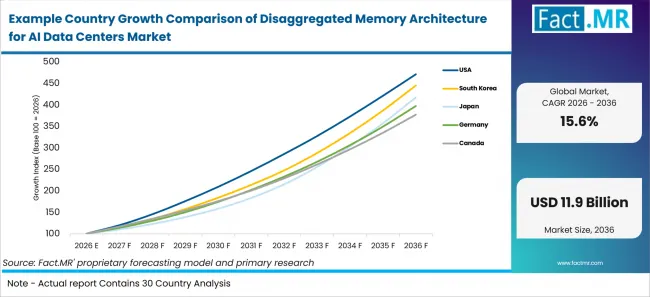
Example Country Growth Comparison Of Disaggregated Memory Architecture For Ai Data Centers Market | Source: Fact.MR
| Country | CAGR (2026-2036) |
|---|---|
| USA | 16.8% |
| South Korea | 16.1% |
| Japan | 15.4% |
| Germany | 14.8% |
| Canada | 14.2% |
| Singapore | 13.7% |
| Taiwan | 13.1% |
What is driving USA's growth through 2036?
16.8% CAGR, supported by hyperscale AI infrastructure and early CXL validation.
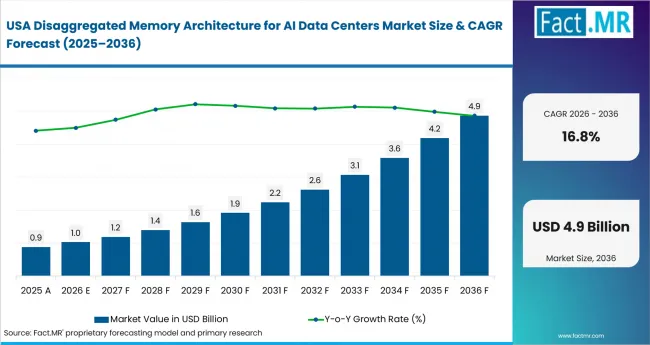
Disaggregated Memory Architecture For Ai Data Centers Market Country Value Analysis | Source: Fact.MR
The USA growth profile reflects large cloud operators that test memory expansion inside AI clusters before wider deployment. Procurement should remain selective until each design fits the operator's workload and service model.
What is driving South Korea's growth through 2036?
16.1% CAGR, led by memory manufacturing depth and AI server demand.
South Korea benefits from a dense memory supply base and close engineering ties across advanced servers. Adoption should gain pace where memory suppliers and platform partners reduce integration work for customers.
What is driving Japan's growth through 2036?
15.4% CAGR, backed by advanced components and reliable engineering support.
Japan is expected to scale through customers that value stable components and careful qualification. Cost checks may keep deployment focused on accounts with clear utilization problems.
What is driving Germany's growth through 2036?
14.8% CAGR, supported by enterprise AI infrastructure and compliance-led purchasing.
Germany shows demand from enterprises that need controlled infrastructure for industrial AI workloads. Longer review cycles may slow orders when architectures affect existing data center operations.
What is driving Canada's growth through 2036?
14.2% CAGR, driven by cloud expansion and enterprise AI workloads.
Canada growth is expected to come from operators that need scalable memory access without overbuilding server capacity. Purchasing may remain measured where infrastructure budgets favor proven upgrades first.
What is driving Singapore's growth through 2036?
13.7% CAGR, led by regional data center concentration and integration support.
Singapore has a compact data center base where cloud and colocation providers operate close to technical partners. Higher costs are expected to keep buyers focused on utilization gains that can be measured quickly.
What is driving Taiwan's growth through 2036?
13.1% CAGR, supported by semiconductor manufacturing strength and AI hardware supply chains.
Taiwan benefits from proximity to chip design and AI hardware manufacturing. Demand is expected to remain selective because production teams prioritize platform stability before architectural change.
Who leads the Disaggregated Memory Architecture for AI Data Centers Market?
Samsung Electronics Co., Ltd. and SK hynix Inc. bring direct memory relevance. Micron Technology, Inc. and Astera Labs, Inc. strengthen the low-power memory and CXL controller field. Intel Corporation and Advanced Micro Devices, Inc. shape CPU-platform readiness. Microchip Technology Inc., Marvell Technology, Inc., Rambus Inc. and Kioxia Corporation extend the wider AI infrastructure set.
Competition is expected to center on interoperability proof and deployment support. Buyers reviewing microfluidic chip cooling and coolant distribution units face a similar approval pattern. Lifecycle planning around GPU asset lifecycle and refurbishment services can influence AI cluster refresh timing.
Which companies are the key providers?
Key companies include Samsung Electronics Co., Ltd.; SK hynix Inc.; Micron Technology, Inc.; Intel Corporation; Advanced Micro Devices, Inc.; Astera Labs, Inc.; Microchip Technology Inc.; Marvell Technology, Inc.; Rambus Inc.; Kioxia Corporation.
- Samsung Electronics Co., Ltd.
- SK hynix Inc.
- Micron Technology, Inc.
- Intel Corporation
- Advanced Micro Devices, Inc.
- Astera Labs, Inc.
- Microchip Technology Inc.
- Marvell Technology, Inc.
- Rambus Inc.
- Kioxia Corporation
Bibliography
- Astera Labs, Inc. (2025, November 18). Astera Labs’ Leo CXL Smart Memory Controllers on Microsoft Azure M-Series Virtual Machines Overcome the Memory Wall.
- Compute Express Link Consortium (2025, November 18). CXL Consortium Releases the Compute Express Link 4.0 Specification Increasing Speed and Bandwidth.
- Intel Corporation (2026, May 31). Intel Puts Agentic AI to Work with Xeon 6+, Networking, and AI Systems.
- Marvell Technology, Inc. (2026, March 17). Marvell Launches Next-generation CXL Switch, Enabling Memory Pooling to Break Through the AI “Memory Wall”.
- Micron Technology, Inc. (2025, October 22). Micron Delivers Industry’s Highest Capacity SOCAMM2 for Low-Power DRAM in the AI Data Center.
This Report Answers
- The report provides strategic intelligence across Memory Architecture and AI Infrastructure choices.
- Segment analysis covers CXL-based Memory Architecture and AI Training Clusters as 2026 share leaders.
- Country outlook evaluates the seven profiled countries.
- Competitive analysis profiles the listed providers across memory, CPU platforms and CXL controllers.
- Architecture assessment covers CXL expansion, memory pooling and persistent memory configurations alongside coolant distribution units.
What does the Disaggregated Memory Architecture for AI Data Centers Market cover?
Disaggregated memory architecture separates memory from a single fixed server through expansion, pooling or composable access. The market covers architectures used in AI data centers where memory capacity affects training and inference efficiency.
The Disaggregated Memory Architecture for AI Data Centers Market covers CXL-based memory designs, pooling systems and composable access. Hyperscale and enterprise buyers are included where platform validation decides adoption.
What is included in the scope?
The scope includes architectures that support AI data centers through CXL expansion and memory pooling. It includes supporting interconnect technologies that allow processors, accelerators and memory devices to communicate coherently.
Coverage spans the five listed segment groups. It includes hyperscale data centers and enterprise AI environments.
What is excluded from the scope?
Standard server DRAM without disaggregated architecture relevance remains outside the scope of this market.
The scope excludes consumer memory products and storage-only devices. Generic data center equipment is excluded unless it changes memory access architecture.
How Was the Analysis Built?
The analysis draws on 120+ sources, 35+ company portfolios, 25+ countries, and more than 20 interviews.
- Primary Research: Interviews with manufacturers, retailers, salon operators, and experts examine purchase priorities, adoption, approval requirements, and competitive positioning.
- Desk Research: Desk research covers government statistics, regulatory publications, company filings, trade data, technical studies, industry associations, standards, and public policy.
- Market Sizing and Forecasting: Estimates combine historical performance, demand indicators, pricing, segment shares, company participation, country growth, adoption patterns, and barriers to expansion.
- Data Validation and Update Cycle: Findings are validated against public data, company activity, regulatory changes, product launches, recalls, and adoption shifts.
What is the report’s scope and coverage?
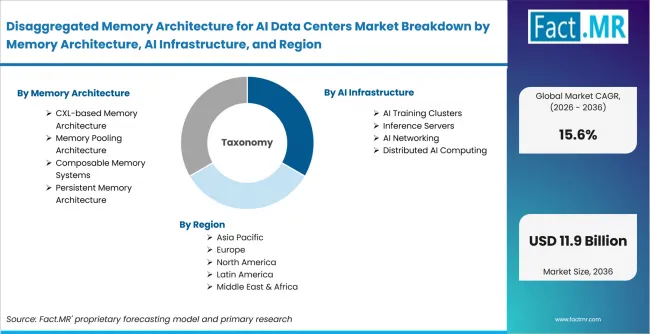
Disaggregated Memory Architecture For Ai Data Centers Market Breakdown By Memory Architecture, Ai Infrastructure, And Region | Source: Fact.MR
| Attribute | Details |
|---|---|
| Quantitative Units | USD billion in 2026 to USD billion by 2036 at CAGR |
| Market Definition | Memory architectures that separate memory capacity from fixed server nodes for AI data centers where pooling, expansion and composable access affect infrastructure planning |
| Memory Architecture | CXL-based Memory Architecture; Memory Pooling Architecture; Composable Memory Systems; Persistent Memory Architecture |
| AI Infrastructure | AI Training Clusters; Inference Servers; AI Networking; Distributed AI Computing |
| End-use Industry | Hyperscale Data Centers; Enterprise AI; Telecommunications; Healthcare AI |
| Customer Category | Hyperscale Cloud Providers; Enterprise Data Center Operators; Chip Designers; Government Research Organizations |
| Interconnect Technology | Compute Express Link (CXL); PCI Express Gen 6; Memory Fabric Controller; Persistent Memory Controller |
| Regions Covered | North America; Latin America; Europe; East Asia; South Asia & Pacific; Middle East & Africa |
| Countries Covered | USA; South Korea; Japan; Germany; Canada; Singapore; Taiwan |
| Key Companies Profiled | The ten listed companies in the key providers section |
| Forecast Period | 2026 to 2036 |
| Approach | Hybrid top-down and bottom-up approach using AI infrastructure demand; CXL standard activity; memory expansion; country adoption patterns; and company portfolio review |
How is the market segmented?
-
By Memory Architecture
- CXL-based Memory Architecture
- Memory Pooling Architecture
- Composable Memory Systems
- Persistent Memory Architecture
-
By AI Infrastructure
- AI Training Clusters
- Inference Servers
- AI Networking
- Distributed AI Computing
-
By End-use Industry
- Hyperscale Data Centers
- Enterprise AI
- Telecommunications
- Healthcare AI
-
By Customer Category
- Hyperscale Cloud Providers
- Enterprise Data Center Operators
- Chip Designers
- Government Research Organizations
-
By Interconnect Technology
- Compute Express Link (CXL)
- PCI Express Gen 6
- Memory Fabric Controller
- Persistent Memory Controller
-
By Region
- North America
- Latin America
- Europe
- East Asia
- South Asia and Oceania
- Middle East and Africa