Disinfectant Fogging and Misting Chemicals Market (2026 - 2036)
Disinfectant Fogging and Misting Chemicals Market Size and Share Forecast Outlook 2026 to 2036
Core Findings
Disinfectant Fogging and Misting Chemicals Market Forecast and Outlook 2026 to 2036
The global disinfectant fogging and misting chemicals market is valued at USD 1,458.0 million in 2026 and is projected to reach USD 3,089.9 million by 2036, expanding at a 7.8% CAGR.
Disinfectant Fogging and Misting Chemicals Market Key Takeaways
- Disinfectant Fogging and Misting Chemicals Market Value (2026): USD 1,458.0 million
- Disinfectant Fogging and Misting Chemicals Market Forecast Value (2036): USD 3,089.9 million
- Disinfectant Fogging and Misting Chemicals Market Forecast CAGR (2026-2036): 7.8%
- Leading Active Chemistry by Demand Share: Hydrogen Peroxide / Peracetic Systems (33.0%)
- Key Growth Region: Asia Pacific
- Key Market Participants: Ecolab, Diversey, Clorox, Reckitt, 3M, SC Johnson Professional
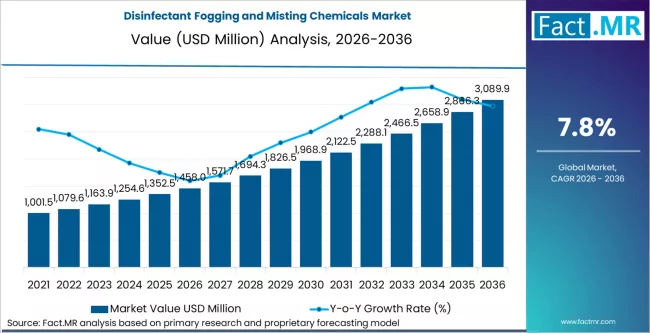
This trajectory reflects a decisive shift away from mass-saturation fogging toward precision-controlled, validated decontamination systems built around vapor and fine mist delivery. Between 2024 and 2026, regulatory scrutiny and operational risk reshaped procurement behavior.
Healthcare, food processing, and life sciences operators increasingly rejected wet fogging methods that leave residues and fail efficacy validation. Ecolab accelerated this transition through its Bioquell platform, positioning Vaporized Hydrogen Peroxide as a gas-phase solution capable of reaching occluded surfaces and sensitive equipment with verifiable biological inactivation. Christophe Beck, Chief Executive Officer of Ecolab, has stated that “science-based solutions and measurable outcomes are what customers now demand in critical hygiene environments,” reinforcing the market’s pivot toward data-backed efficacy.
Diversey advanced adoption through no-rinse misting chemistries that reduce downtime and water use, while autonomous systems from Advantech embedded disinfection into robotics-led workflows. Updates to EPA List N in 2025 further validated mist- and vapor-compatible formulations, accelerating institutional adoption. Growth is anchored in air disinfection applications and compliance-driven automation, where proof of performance now outweighs visual assurance.
Disinfectant Fogging and Misting Chemicals Market
| Metric | Value |
|---|---|
| Estimated Value in (2026E) | USD 1458.0 million |
| Forecast Value in (2036F) | USD 3089.9 million |
| Forecast CAGR 2026 to 2036 | 7.8% |
Category
| Category | Segments |
|---|---|
| Active Chemistry | Hydrogen Peroxide / Peracetic Systems; Quaternary Ammonium (Fogging Grade); Other Actives (Alcohol Blends); Chlorine Dioxide & Oxidizers |
| Deployment | ULV Fogging Fluids; Electrostatic Spraying Solutions; Thermal Fogging Fluids; Other Deployment Fluids |
| End-Use Setting | Healthcare & Labs; Industrial & Warehousing; Hospitality & Public Venues; Transport (Aviation, Rail, Transit) |
| Concentration | Concentrates for Dilution; Ready-to-Use (RTU) |
| Region | North America; Europe; Asia Pacific; Latin America; Middle East & Africa |
Segmental Analysis
What Is the Impact of Active Chemistry on the Disinfectant Fogging and Misting Chemicals Market?
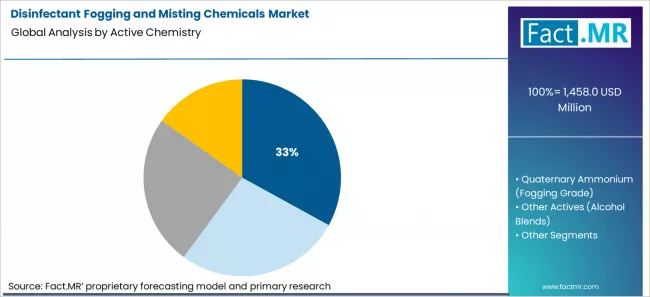
In the disinfectant fogging and misting chemicals market, active chemistry determines microbial efficacy, material compatibility, and safety during aerosolized application. Hydrogen peroxide and peracetic acid systems hold a 33.0% share because they deliver broad-spectrum disinfection while decomposing into non-residual byproducts. These chemistries are preferred in healthcare facilities, pharmaceutical cleanrooms, and food processing areas where residue buildup and corrosion risk must be minimized. Their effectiveness against spores, viruses, and biofilms under low contact times aligns with fogging protocols designed for rapid space decontamination without post-treatment wipe-down requirements.
How Does Deployment Method Influence Demand in the Disinfectant Fogging and Misting Chemicals Market?
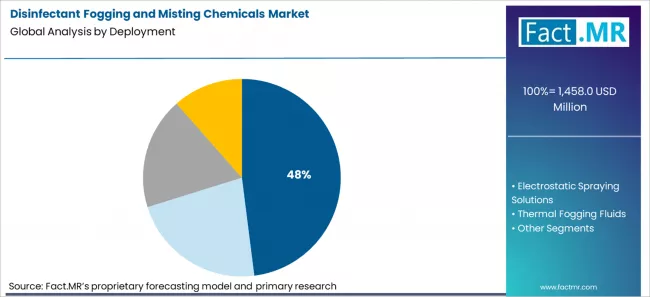
Deployment method directly influences chemical formulation demand by defining droplet size, airborne dwell time, and surface coverage efficiency. ULV fogging fluids account for a 48.0% share due to their ability to generate micron-level droplets that remain suspended long enough to reach complex geometries. These fluids are widely used in hospitals, airports, laboratories, and large commercial spaces where uniform disinfection of enclosed volumes is critical. ULV-compatible chemistries enable rapid room turnover, reduced chemical consumption, and consistent coverage, making them the preferred choice for routine and outbreak-response disinfection programs.
What are the Drivers, Restraints, and Key Trends in the Disinfectant Fogging and Misting Chemicals Market?
- Drivers: Demand in the disinfectant fogging and misting chemicals market is shaped by requirements for broad-area surface sanitation in healthcare, institutional and commercial environments where manual cleaning cannot access complex geometries. Buyers in hospitals, aged care facilities and clean rooms specify these chemistries to control pathogens in air and on surfaces with minimal labor intensity. Growth in facility hygiene protocols following documented outbreaks of airborne and surface-borne illnesses has increased uptake of aerosolized disinfectants formulated for compatibility with automated fogging systems. Procurement decisions prioritize active ingredients with proven efficacy against a spectrum of bacteria, viruses and fungi under regulated test methods, and solutions that work with thermal and cold fogging delivery technologies.
- Restraints: Adoption is constrained where formulations that perform well in fogging systems create compatibility challenges with certain sensitive materials and finishes. Some potent disinfectants can degrade plastics, soft metals and coatings present in equipment or furnishings, prompting facility managers to conduct spot testing that delays product deployment. Worker safety considerations and regulatory reporting obligations for respiratory exposure influence purchasing where ventilation standards vary and personal protective equipment is needed during application. Cost pressures affect uptake among smaller organizations with limited hygiene budgets, as calibrated fogging chemistries are priced above conventional liquid cleaners and require dedicated equipment investment.
- Trend 1: Development of disinfectant fogging and misting chemistries optimized for electrostatic sprayer compatibility, enabling charged droplets to adhere more effectively to complex surfaces and deliver consistent coverage with reduced chemical consumption per square meter.
- Trend 2: Growth in broad-spectrum, low-residue formulations that provide rapid kill rates while minimizing residue build-up on high-touch surfaces and equipment, addressing calls from end users for hygiene solutions that lower recontamination risk between cleaning cycles.
Analysis of the Disinfectant Fogging and Misting Chemicals Market by Key Country
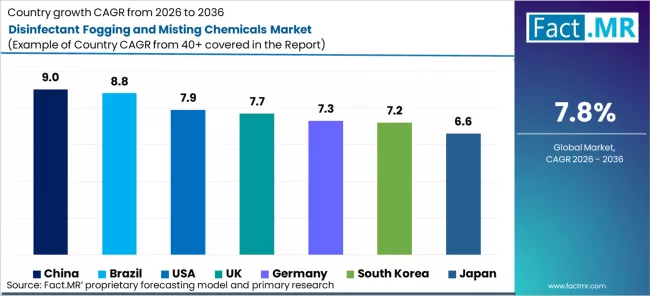
| Country | CAGR (%) |
|---|---|
| China | 9.0% |
| Brazil | 8.8% |
| USA | 7.9% |
| UK | 7.7% |
| Germany | 7.3% |
| South Korea | 7.2% |
| Japan | 6.6% |
The report covers an in-depth analysis of 40+ countries; top-performing countries are highlighted below.
What drives growth in China for disinfectant fogging and misting chemicals?
China is projected to grow at 9.0% CAGR, supported by strengthened public health infrastructure and widespread adoption of automated disinfection technologies in public transit, commercial complexes, and institutional facilities. China’s Ministry of Housing and Urban-Rural Development has encouraged upgraded sanitation protocols that include fogging and misting in high-traffic indoor spaces to reduce pathogen transmission risk. Domestic manufacturers have scaled production of EPA-listed and GB/T-certified fogging chemicals designed for cold-fog and thermal-fog equipment.
“In large urban centers where population density is high, fogging and misting chemistries provide a practical, scalable solution to maintaining a hygienic built environment,” explains Wang Lei, Senior Product Director at a Chinese specialty chemicals company. The integration of disinfection standards into building codes and facility maintenance contracts reinforces strong base-load demand.
What fuels the rapid rise in Brazil?
Brazil’s market is expected to grow at 8.8% CAGR, underpinned by expanding commercial infrastructure and heightened sanitation requirements in public and private facilities. Municipal governments in major urban centers are incorporating fogging and misting chemistries into routine cleaning protocols for airports, shopping centers, and transportation hubs to address public health concerns. Brazilian standards such as ABNT NBR 15575 encourage the use of validated cleaning and disinfection products in building maintenance.
“Extended use of fogging disinfectants in large, shared spaces has become part of standard facility risk management, especially in high-density areas,” states Marcos Oliveira, Director of Facility Operations at a major Brazilian airport operator. This institutional emphasis on pathogen control supports recurring demand for chemistries compatible with automated delivery systems.
How is the USA market evolving in the Disinfectant Fogging and Misting Chemicals sector?
The USA market is forecast to grow at 7.9%, reflecting sustained demand for enhanced environmental hygiene solutions in healthcare, education, commercial, and industrial settings. Growth is driven by increasing awareness of pathogen transmission risks and institutional procurement of fogging chemicals that deliver broad-spectrum surface sanitation with rapid deployment. According to the Centers for Disease Control and Prevention (CDC), facility disinfection protocols incorporating misting technologies can improve coverage in complex environments, reinforcing fogging adoption in infection control strategies.
“Facility managers are adopting fogging and misting chemistries not as a one-off response but as a core part of cleaning protocols to reduce microbial load efficiently,” says Dr. Karen Mitchell, Director of Environmental Health at a major U.S. hospital network. Despite improvements in HVAC and airflow management, the need for thorough surface disinfection continues to drive investment in proven chemistries compatible with automated delivery systems.
Why is the UK market critical for fogging and misting disinfectants?
The UK market is expanding at 7.7%, driven by rigorous public sector cleaning standards and strong adoption of technologically advanced disinfectant delivery systems across healthcare, education, and transport sectors. The UK Health Security Agency (UKHSA) has repeatedly highlighted the importance of comprehensive surface disinfection in enclosed spaces to mitigate infection risks, prompting procurement of fogging and misting chemistries with validated efficacy against designated pathogens.
“Fogging technologies paired with modern chemistries provide consistent bioburden reduction across large surface areas, which is essential in institutions such as hospitals and mass transit facilities,” says Dr. Sarah Lewis, Head of Infection Prevention at a UK NHS Trust. Robust regulatory alignment with EU harmonized standards for biocidal products strengthens confidence in product selection and performance benchmarking.
What is driving expansion in Germany?
Germany is projected to grow at 7.3% CAGR, supported by strong regulatory frameworks for biocides and a proactive approach to infection prevention, particularly in healthcare and eldercare environments. The German Federal Institute for Occupational Safety and Health has included high-efficacy disinfection products in recommended hygiene protocols, boosting demand for fogging and misting solutions that offer validated microbial reduction on complex surfaces.
“In institutional settings, using fogging and misting chemistries with proven efficacy enhances overall hygiene and supports workforce safety,” explains Dr. Petra Hoffmann, Head of Infection Control at a German medical center. Germany’s precision industrial and institutional markets emphasize reliable performance data and product certification, fueling adoption of scientifically backed chemistries.
How is South Korea shaping demand for fogging and misting disinfectants?
South Korea’s market is growing at 7.2% CAGR, driven by comprehensive public health strategies and widespread implementation of disinfection systems in transportation, commercial, and educational environments. National standards encourage regular sanitation of public spaces, and advanced fogging systems paired with effective chemistries are widely used to address both viral and bacterial contamination concerns. South Korea’s public health campaigns highlight the role of surface disinfection in controlling outbreaks, reinforcing year-round demand.
“Facility operators increasingly adopt automated misting solutions with disinfectants certified for broad efficacy, addressing both routine sanitation and outbreak response,” says Ji-Hoon Park, Public Health Advisor at a major South Korean city authority. Export-oriented manufacturing facilities also specify fogging chemistries to meet global hygiene expectations.
What fuels the gradual rise in Japan?
Japan’s disinfectant fogging and misting chemicals market is forecast to grow at 6.6% CAGR, reflecting a disciplined approach to hygiene and infection control across healthcare, education, and commercial buildings. The Ministry of Health, Labour and Welfare advocates thorough surface sanitation measures, including vapor and mist techniques, particularly in high-risk indoor settings. Japan’s institutional buyers emphasize products with proven efficacy and safety profiles compatible with automated fogging equipment.
“In Japan, rigorous cleaning standards coupled with advanced delivery systems support ongoing adoption of fogging chemistries that reduce microbial contamination without compromising material compatibility,” notes Aiko Tanaka, Senior Technical Specialist at a Japanese hygiene solutions firm. Conservative procurement cycles temper explosive growth, but consistent emphasis on evidence-based hygiene practices sustains expansion.
Strategic Moves Are Defining Competitive Landscape?
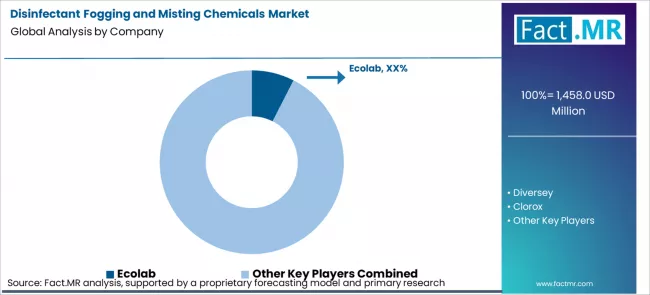
The competitive landscape of the disinfectant fogging and misting chemicals market is defined by a rapid transition toward autonomous bio-decontamination as a service while defending legacy liquid chemical franchises. Fact.MR analysis indicates that strategic pivots are intensifying as manufacturers seek to integrate high-frequency automated fogging systems with IoT-based environmental monitoring. The focus is no longer just on surface saturation but on the precision of airborne delivery and "zero-residue" bio-decontamination which represents the next frontier of value creation in controlled environments. Lisa Thompson, a strategic leader at Ecolab, notes the acceleration toward proactive intervention.
"The facility shifted from reactive firefighting to proactive contamination control. This preventive approach was critical for their long-term success." - Lisa Thompson, Strategic Technical Consultant Lead at Ecolab
Companies like Ecolab and Steris are leveraging their early lead in "Contamination Control Strategy" (CCS) and automated generators to set the standard for high-tech industrial hygiene. The specialty chemical players like Evonik and Lanxess are developing biosurfactants and biodegradable active oxygens to capture the demand for sustainable but high-efficacy misting solutions. This strategic shift ensures they remain relevant in a market that is rapidly moving away from periodic manual fogging toward a 24/7 autonomous bio-assurance model.
Key Players in the Disinfectant Fogging and Misting Chemicals Market
- Ecolab
- Diversey
- Clorox
- Reckitt
- 3M
- SC Johnson Professional
- Steris
- Neogen
- Evonik
- Lanxess
Scope of the Report
| Items | Values |
|---|---|
| Quantitative Units | USD million |
| Active Chemistry | Hydrogen Peroxide / Peracetic Systems; Quaternary Ammonium (Fogging Grade); Other Actives (Alcohol Blends); Chlorine Dioxide & Oxidizers |
| Deployment | ULV Fogging Fluids; Electrostatic Spraying Solutions; Thermal Fogging Fluids; Other Deployment Fluids |
| End-Use Setting | Healthcare & Labs; Industrial & Warehousing; Hospitality & Public Venues; Transport (Aviation, Rail, Transit) |
| Concentration | Concentrates for Dilution; Ready-to-Use (RTU) |
| Regions Covered | Asia Pacific, Europe, North America, Latin America, Middle East & Africa |
| Countries Covered | China, Brazil, USA, UK, Germany, South Korea, Japan, and 40+ countries |
| Key Companies Profiled | Ecolab; Diversey; Clorox; Reckitt; 3M; SC Johnson Professional; STERIS; Neogen; Evonik; LANXESS |
| Additional Attributes | Dollar sales by active chemistry, deployment method, and end-use setting; demand influenced by infection prevention protocols across healthcare, transport, and public venues; preference shift toward hydrogen peroxide and peracetic systems due to residue-free performance and regulatory acceptance; rising adoption of ULV fogging and electrostatic spraying in large-area disinfection workflows; procurement driven by service contractors and institutional buyers prioritizing efficacy validation, material compatibility, and worker exposure compliance. |
Disinfectant Fogging and Misting Chemicals Market Key Segment
-
Active Chemistry :
- Hydrogen Peroxide / Peracetic Systems
- Quaternary Ammonium (Fogging Grade)
- Other Actives (Alcohol Blends)
- Chlorine Dioxide & Oxidizers
-
Deployment :
- ULV Fogging Fluids
- Electrostatic Spraying Solutions
- Thermal Fogging Fluids
- Other Deployment Fluids
-
End-Use Setting :
- Healthcare & Labs
- Industrial & Warehousing
- Hospitality & Public Venues
- Transport (Aviation, Rail, Transit)
-
Concentration :
- Concentrates for Dilution
- Ready-to-Use (RTU)
-
Region :
- North America
- USA
- Canada
- Mexico
- Europe
- Germany
- UK
- France
- Italy
- Spain
- Nordic Countries
- BENELUX
- Rest of Europe
- Asia Pacific
- China
- Japan
- South Korea
- India
- Australia
- Rest of Asia Pacific
- Latin America
- Brazil
- Argentina
- Rest of Latin America
- Middle East and Africa
- Kingdom of Saudi Arabia
- United Arab Emirates
- South Africa
- Rest of Middle East and Africa
- Other Regions
- Oceania
- Central Asia
- Other Markets
- North America
Bibliographies
- U.S. Environmental Protection Agency. (2023). List N: Disinfectants for use against emerging viral pathogens. U.S. Environmental Protection Agency.
- European Chemicals Agency. (2023). Biocidal Products Regulation (EU) No 528/2012: Active substance approval and product authorization guidance. ECHA.
- World Health Organization. (2023). Cleaning and disinfection of environmental surfaces in the context of infection prevention and control. World Health Organization.
- International Organization for Standardization. (2023). ISO 17272: Chemical disinfectants and antiseptics-Methods of airborne disinfection. ISO.
- International Organization for Standardization. (2024). ISO 14644-5: Cleanrooms and associated controlled environments-Operations. ISO.
Table of Content
- Executive Summary
- Global Market Outlook
- Demand to side Trends
- Supply to side Trends
- Technology Roadmap Analysis
- Analysis and Recommendations
- Market Overview
- Market Coverage / Taxonomy
- Market Definition / Scope / Limitations
- Research Methodology
- Chapter Orientation
- Analytical Lens and Working Hypotheses
- Market Structure, Signals, and Trend Drivers
- Benchmarking and Cross-market Comparability
- Market Sizing, Forecasting, and Opportunity Mapping
- Research Design and Evidence Framework
- Desk Research Programme (Secondary Evidence)
- Company Annual and Sustainability Reports
- Peer-reviewed Journals and Academic Literature
- Corporate Websites, Product Literature, and Technical Notes
- Earnings Decks and Investor Briefings
- Statutory Filings and Regulatory Disclosures
- Technical White Papers and Standards Notes
- Trade Journals, Industry Magazines, and Analyst Briefs
- Conference Proceedings, Webinars, and Seminar Materials
- Government Statistics Portals and Public Data Releases
- Press Releases and Reputable Media Coverage
- Specialist Newsletters and Curated Briefings
- Sector Databases and Reference Repositories
- FMR Internal Proprietary Databases and Historical Market Datasets
- Subscription Datasets and Paid Sources
- Social Channels, Communities, and Digital Listening Inputs
- Additional Desk Sources
- Expert Input and Fieldwork (Primary Evidence)
- Primary Modes
- Qualitative Interviews and Expert Elicitation
- Quantitative Surveys and Structured Data Capture
- Blended A9oach
- Why Primary Evidence is Used
- Field Techniques
- Interviews
- Surveys
- Focus Groups
- Observational and In-context Research
- Social and Community Interactions
- Stakeholder Universe Engaged
- C-suite Leaders
- Board Members
- Presidents and Vice Presidents
- R&D and Innovation Heads
- Technical Specialists
- Domain Subject-matter Experts
- Scientists
- Physicians and Other Healthcare Professionals
- Governance, Ethics, and Data Stewardship
- Research Ethics
- Data Integrity and Handling
- Primary Modes
- Tooling, Models, and Reference Databases
- Desk Research Programme (Secondary Evidence)
- Data Engineering and Model Build
- Data Acquisition and Ingestion
- Cleaning, Normalisation, and Verification
- Synthesis, Triangulation, and Analysis
- Quality Assurance and Audit Trail
- Market Background
- Market Dynamics
- Drivers
- Restraints
- Opportunity
- Trends
- Scenario Forecast
- Demand in Optimistic Scenario
- Demand in Likely Scenario
- Demand in Conservative Scenario
- Opportunity Map Analysis
- Product Life Cycle Analysis
- Supply Chain Analysis
- Investment Feasibility Matrix
- Value Chain Analysis
- PESTLE and Porter’s Analysis
- Regulatory Landscape
- Regional Parent Market Outlook
- Production and Consumption Statistics
- Import and Export Statistics
- Market Dynamics
- Global Market Analysis 2021 to 2025 and Forecast, 2026 to 2036
- Historical Market Size Value (USD Million) Analysis, 2021 to 2025
- Current and Future Market Size Value (USD Million) Projections, 2026 to 2036
- Y to o to Y Growth Trend Analysis
- Absolute $ Opportunity Analysis
- Global Market Pricing Analysis 2021 to 2025 and Forecast 2026 to 2036
- Global Market Analysis 2021 to 2025 and Forecast 2026 to 2036, By Active Chemistry
- Introduction / Key Findings
- Historical Market Size Value (USD Million) Analysis By Active Chemistry, 2021 to 2025
- Current and Future Market Size Value (USD Million) Analysis and Forecast By Active Chemistry, 2026 to 2036
- Hydrogen Peroxide / Peracetic Systems
- Quaternary Ammonium (Fogging Grade)
- Other Actives (Alcohol Blends)
- Chlorine Dioxide & Oxidizers
- Hydrogen Peroxide / Peracetic Systems
- Y to o to Y Growth Trend Analysis By Active Chemistry, 2021 to 2025
- Absolute $ Opportunity Analysis By Active Chemistry, 2026 to 2036
- Global Market Analysis 2021 to 2025 and Forecast 2026 to 2036, By Deployment
- Introduction / Key Findings
- Historical Market Size Value (USD Million) Analysis By Deployment, 2021 to 2025
- Current and Future Market Size Value (USD Million) Analysis and Forecast By Deployment, 2026 to 2036
- ULV Fogging Fluids
- Electrostatic Spraying Solutions
- Thermal Fogging Fluids
- Other Deployment Fluids
- ULV Fogging Fluids
- Y to o to Y Growth Trend Analysis By Deployment, 2021 to 2025
- Absolute $ Opportunity Analysis By Deployment, 2026 to 2036
- Global Market Analysis 2021 to 2025 and Forecast 2026 to 2036, By End-Use Setting
- Introduction / Key Findings
- Historical Market Size Value (USD Million) Analysis By End-Use Setting, 2021 to 2025
- Current and Future Market Size Value (USD Million) Analysis and Forecast By End-Use Setting, 2026 to 2036
- Healthcare & Labs
- Industrial & Warehousing
- Hospitality & Public Venues
- Transport (Aviation, Rail, Transit)
- Healthcare & Labs
- Y to o to Y Growth Trend Analysis By End-Use Setting, 2021 to 2025
- Absolute $ Opportunity Analysis By End-Use Setting, 2026 to 2036
- Global Market Analysis 2021 to 2025 and Forecast 2026 to 2036, By Concentration
- Introduction / Key Findings
- Historical Market Size Value (USD Million) Analysis By Concentration, 2021 to 2025
- Current and Future Market Size Value (USD Million) Analysis and Forecast By Concentration, 2026 to 2036
- Concentrates for Dilution
- Ready-to-Use (RTU)
- Concentrates for Dilution
- Y to o to Y Growth Trend Analysis By Concentration, 2021 to 2025
- Absolute $ Opportunity Analysis By Concentration, 2026 to 2036
- Global Market Analysis 2021 to 2025 and Forecast 2026 to 2036, By Region
- Introduction
- Historical Market Size Value (USD Million) Analysis By Region, 2021 to 2025
- Current Market Size Value (USD Million) Analysis and Forecast By Region, 2026 to 2036
- North America
- Latin America
- Western Europe
- Eastern Europe
- East Asia
- South Asia and Pacific
- Middle East & Africa
- Market Attractiveness Analysis By Region
- North America Market Analysis 2021 to 2025 and Forecast 2026 to 2036, By Country
- Historical Market Size Value (USD Million) Trend Analysis By Market Taxonomy, 2021 to 2025
- Market Size Value (USD Million) Forecast By Market Taxonomy, 2026 to 2036
- By Country
- USA
- Canada
- Mexico
- By Active Chemistry
- By Deployment
- By End-Use Setting
- By Concentration
- By Country
- Market Attractiveness Analysis
- By Country
- By Active Chemistry
- By Deployment
- By End-Use Setting
- By Concentration
- Key Takeaways
- Latin America Market Analysis 2021 to 2025 and Forecast 2026 to 2036, By Country
- Historical Market Size Value (USD Million) Trend Analysis By Market Taxonomy, 2021 to 2025
- Market Size Value (USD Million) Forecast By Market Taxonomy, 2026 to 2036
- By Country
- Brazil
- Chile
- Rest of Latin America
- By Active Chemistry
- By Deployment
- By End-Use Setting
- By Concentration
- By Country
- Market Attractiveness Analysis
- By Country
- By Active Chemistry
- By Deployment
- By End-Use Setting
- By Concentration
- Key Takeaways
- Western Europe Market Analysis 2021 to 2025 and Forecast 2026 to 2036, By Country
- Historical Market Size Value (USD Million) Trend Analysis By Market Taxonomy, 2021 to 2025
- Market Size Value (USD Million) Forecast By Market Taxonomy, 2026 to 2036
- By Country
- Germany
- UK
- Italy
- Spain
- France
- Nordic
- BENELUX
- Rest of Western Europe
- By Active Chemistry
- By Deployment
- By End-Use Setting
- By Concentration
- By Country
- Market Attractiveness Analysis
- By Country
- By Active Chemistry
- By Deployment
- By End-Use Setting
- By Concentration
- Key Takeaways
- Eastern Europe Market Analysis 2021 to 2025 and Forecast 2026 to 2036, By Country
- Historical Market Size Value (USD Million) Trend Analysis By Market Taxonomy, 2021 to 2025
- Market Size Value (USD Million) Forecast By Market Taxonomy, 2026 to 2036
- By Country
- Russia
- Poland
- Hungary
- Balkan & Baltic
- Rest of Eastern Europe
- By Active Chemistry
- By Deployment
- By End-Use Setting
- By Concentration
- By Country
- Market Attractiveness Analysis
- By Country
- By Active Chemistry
- By Deployment
- By End-Use Setting
- By Concentration
- Key Takeaways
- East Asia Market Analysis 2021 to 2025 and Forecast 2026 to 2036, By Country
- Historical Market Size Value (USD Million) Trend Analysis By Market Taxonomy, 2021 to 2025
- Market Size Value (USD Million) Forecast By Market Taxonomy, 2026 to 2036
- By Country
- China
- Japan
- South Korea
- By Active Chemistry
- By Deployment
- By End-Use Setting
- By Concentration
- By Country
- Market Attractiveness Analysis
- By Country
- By Active Chemistry
- By Deployment
- By End-Use Setting
- By Concentration
- Key Takeaways
- South Asia and Pacific Market Analysis 2021 to 2025 and Forecast 2026 to 2036, By Country
- Historical Market Size Value (USD Million) Trend Analysis By Market Taxonomy, 2021 to 2025
- Market Size Value (USD Million) Forecast By Market Taxonomy, 2026 to 2036
- By Country
- India
- ASEAN
- Australia & New Zealand
- Rest of South Asia and Pacific
- By Active Chemistry
- By Deployment
- By End-Use Setting
- By Concentration
- By Country
- Market Attractiveness Analysis
- By Country
- By Active Chemistry
- By Deployment
- By End-Use Setting
- By Concentration
- Key Takeaways
- Middle East & Africa Market Analysis 2021 to 2025 and Forecast 2026 to 2036, By Country
- Historical Market Size Value (USD Million) Trend Analysis By Market Taxonomy, 2021 to 2025
- Market Size Value (USD Million) Forecast By Market Taxonomy, 2026 to 2036
- By Country
- Kingdom of Saudi Arabia
- Other GCC Countries
- Turkiye
- South Africa
- Other African Union
- Rest of Middle East & Africa
- By Active Chemistry
- By Deployment
- By End-Use Setting
- By Concentration
- By Country
- Market Attractiveness Analysis
- By Country
- By Active Chemistry
- By Deployment
- By End-Use Setting
- By Concentration
- Key Takeaways
- Key Countries Market Analysis
- USA
- Pricing Analysis
- Market Share Analysis, 2025
- By Active Chemistry
- By Deployment
- By End-Use Setting
- By Concentration
- Canada
- Pricing Analysis
- Market Share Analysis, 2025
- By Active Chemistry
- By Deployment
- By End-Use Setting
- By Concentration
- Mexico
- Pricing Analysis
- Market Share Analysis, 2025
- By Active Chemistry
- By Deployment
- By End-Use Setting
- By Concentration
- Brazil
- Pricing Analysis
- Market Share Analysis, 2025
- By Active Chemistry
- By Deployment
- By End-Use Setting
- By Concentration
- Chile
- Pricing Analysis
- Market Share Analysis, 2025
- By Active Chemistry
- By Deployment
- By End-Use Setting
- By Concentration
- Germany
- Pricing Analysis
- Market Share Analysis, 2025
- By Active Chemistry
- By Deployment
- By End-Use Setting
- By Concentration
- UK
- Pricing Analysis
- Market Share Analysis, 2025
- By Active Chemistry
- By Deployment
- By End-Use Setting
- By Concentration
- Italy
- Pricing Analysis
- Market Share Analysis, 2025
- By Active Chemistry
- By Deployment
- By End-Use Setting
- By Concentration
- Spain
- Pricing Analysis
- Market Share Analysis, 2025
- By Active Chemistry
- By Deployment
- By End-Use Setting
- By Concentration
- France
- Pricing Analysis
- Market Share Analysis, 2025
- By Active Chemistry
- By Deployment
- By End-Use Setting
- By Concentration
- India
- Pricing Analysis
- Market Share Analysis, 2025
- By Active Chemistry
- By Deployment
- By End-Use Setting
- By Concentration
- ASEAN
- Pricing Analysis
- Market Share Analysis, 2025
- By Active Chemistry
- By Deployment
- By End-Use Setting
- By Concentration
- Australia & New Zealand
- Pricing Analysis
- Market Share Analysis, 2025
- By Active Chemistry
- By Deployment
- By End-Use Setting
- By Concentration
- China
- Pricing Analysis
- Market Share Analysis, 2025
- By Active Chemistry
- By Deployment
- By End-Use Setting
- By Concentration
- Japan
- Pricing Analysis
- Market Share Analysis, 2025
- By Active Chemistry
- By Deployment
- By End-Use Setting
- By Concentration
- South Korea
- Pricing Analysis
- Market Share Analysis, 2025
- By Active Chemistry
- By Deployment
- By End-Use Setting
- By Concentration
- Russia
- Pricing Analysis
- Market Share Analysis, 2025
- By Active Chemistry
- By Deployment
- By End-Use Setting
- By Concentration
- Poland
- Pricing Analysis
- Market Share Analysis, 2025
- By Active Chemistry
- By Deployment
- By End-Use Setting
- By Concentration
- Hungary
- Pricing Analysis
- Market Share Analysis, 2025
- By Active Chemistry
- By Deployment
- By End-Use Setting
- By Concentration
- Kingdom of Saudi Arabia
- Pricing Analysis
- Market Share Analysis, 2025
- By Active Chemistry
- By Deployment
- By End-Use Setting
- By Concentration
- Turkiye
- Pricing Analysis
- Market Share Analysis, 2025
- By Active Chemistry
- By Deployment
- By End-Use Setting
- By Concentration
- South Africa
- Pricing Analysis
- Market Share Analysis, 2025
- By Active Chemistry
- By Deployment
- By End-Use Setting
- By Concentration
- USA
- Market Structure Analysis
- Competition Dashboard
- Competition Benchmarking
- Market Share Analysis of Top Players
- By Regional
- By Active Chemistry
- By Deployment
- By End-Use Setting
- By Concentration
- Competition Analysis
- Competition Deep Dive
- Ecolab
- Overview
- Product Portfolio
- Profitability by Market Segments (Product/Age /Sales Channel/Region)
- Sales Footprint
- Strategy Overview
- Marketing Strategy
- Product Strategy
- Channel Strategy
- Diversey
- Clorox
- Reckitt
- 3M
- SC Johnson Professional
- Steris
- Neogen
- Evonik
- Fein
- Ecolab
- Competition Deep Dive
- Assumptions & Acronyms Used
List Of Table
- Table 1: Global Market Value (USD Million) Forecast by Region, 2021 to 2036
- Table 2: Global Market Value (USD Million) Forecast by Active Chemistry, 2021 to 2036
- Table 3: Global Market Value (USD Million) Forecast by Deployment, 2021 to 2036
- Table 4: Global Market Value (USD Million) Forecast by End-Use Setting, 2021 to 2036
- Table 5: Global Market Value (USD Million) Forecast by Concentration, 2021 to 2036
- Table 6: North America Market Value (USD Million) Forecast by Country, 2021 to 2036
- Table 7: North America Market Value (USD Million) Forecast by Active Chemistry, 2021 to 2036
- Table 8: North America Market Value (USD Million) Forecast by Deployment, 2021 to 2036
- Table 9: North America Market Value (USD Million) Forecast by End-Use Setting, 2021 to 2036
- Table 10: North America Market Value (USD Million) Forecast by Concentration, 2021 to 2036
- Table 11: Latin America Market Value (USD Million) Forecast by Country, 2021 to 2036
- Table 12: Latin America Market Value (USD Million) Forecast by Active Chemistry, 2021 to 2036
- Table 13: Latin America Market Value (USD Million) Forecast by Deployment, 2021 to 2036
- Table 14: Latin America Market Value (USD Million) Forecast by End-Use Setting, 2021 to 2036
- Table 15: Latin America Market Value (USD Million) Forecast by Concentration, 2021 to 2036
- Table 16: Western Europe Market Value (USD Million) Forecast by Country, 2021 to 2036
- Table 17: Western Europe Market Value (USD Million) Forecast by Active Chemistry, 2021 to 2036
- Table 18: Western Europe Market Value (USD Million) Forecast by Deployment, 2021 to 2036
- Table 19: Western Europe Market Value (USD Million) Forecast by End-Use Setting, 2021 to 2036
- Table 20: Western Europe Market Value (USD Million) Forecast by Concentration, 2021 to 2036
- Table 21: Eastern Europe Market Value (USD Million) Forecast by Country, 2021 to 2036
- Table 22: Eastern Europe Market Value (USD Million) Forecast by Active Chemistry, 2021 to 2036
- Table 23: Eastern Europe Market Value (USD Million) Forecast by Deployment, 2021 to 2036
- Table 24: Eastern Europe Market Value (USD Million) Forecast by End-Use Setting, 2021 to 2036
- Table 25: Eastern Europe Market Value (USD Million) Forecast by Concentration, 2021 to 2036
- Table 26: East Asia Market Value (USD Million) Forecast by Country, 2021 to 2036
- Table 27: East Asia Market Value (USD Million) Forecast by Active Chemistry, 2021 to 2036
- Table 28: East Asia Market Value (USD Million) Forecast by Deployment, 2021 to 2036
- Table 29: East Asia Market Value (USD Million) Forecast by End-Use Setting, 2021 to 2036
- Table 30: East Asia Market Value (USD Million) Forecast by Concentration, 2021 to 2036
- Table 31: South Asia and Pacific Market Value (USD Million) Forecast by Country, 2021 to 2036
- Table 32: South Asia and Pacific Market Value (USD Million) Forecast by Active Chemistry, 2021 to 2036
- Table 33: South Asia and Pacific Market Value (USD Million) Forecast by Deployment, 2021 to 2036
- Table 34: South Asia and Pacific Market Value (USD Million) Forecast by End-Use Setting, 2021 to 2036
- Table 35: South Asia and Pacific Market Value (USD Million) Forecast by Concentration, 2021 to 2036
- Table 36: Middle East & Africa Market Value (USD Million) Forecast by Country, 2021 to 2036
- Table 37: Middle East & Africa Market Value (USD Million) Forecast by Active Chemistry, 2021 to 2036
- Table 38: Middle East & Africa Market Value (USD Million) Forecast by Deployment, 2021 to 2036
- Table 39: Middle East & Africa Market Value (USD Million) Forecast by End-Use Setting, 2021 to 2036
- Table 40: Middle East & Africa Market Value (USD Million) Forecast by Concentration, 2021 to 2036
List Of Figures
- Figure 1: Global Market Pricing Analysis
- Figure 2: Global Market Value (USD Million) Forecast 2021 to 2036
- Figure 3: Global Market Value Share and BPS Analysis by Active Chemistry, 2026 and 2036
- Figure 4: Global Market Y to o to Y Growth Comparison by Active Chemistry, 2026 to 2036
- Figure 5: Global Market Attractiveness Analysis by Active Chemistry
- Figure 6: Global Market Value Share and BPS Analysis by Deployment, 2026 and 2036
- Figure 7: Global Market Y to o to Y Growth Comparison by Deployment, 2026 to 2036
- Figure 8: Global Market Attractiveness Analysis by Deployment
- Figure 9: Global Market Value Share and BPS Analysis by End-Use Setting, 2026 and 2036
- Figure 10: Global Market Y to o to Y Growth Comparison by End-Use Setting, 2026 to 2036
- Figure 11: Global Market Attractiveness Analysis by End-Use Setting
- Figure 12: Global Market Value Share and BPS Analysis by Concentration, 2026 and 2036
- Figure 13: Global Market Y to o to Y Growth Comparison by Concentration, 2026 to 2036
- Figure 14: Global Market Attractiveness Analysis by Concentration
- Figure 15: Global Market Value (USD Million) Share and BPS Analysis by Region, 2026 and 2036
- Figure 16: Global Market Y to o to Y Growth Comparison by Region, 2026 to 2036
- Figure 17: Global Market Attractiveness Analysis by Region
- Figure 18: North America Market Incremental Dollar Opportunity, 2026 to 2036
- Figure 19: Latin America Market Incremental Dollar Opportunity, 2026 to 2036
- Figure 20: Western Europe Market Incremental Dollar Opportunity, 2026 to 2036
- Figure 21: Eastern Europe Market Incremental Dollar Opportunity, 2026 to 2036
- Figure 22: East Asia Market Incremental Dollar Opportunity, 2026 to 2036
- Figure 23: South Asia and Pacific Market Incremental Dollar Opportunity, 2026 to 2036
- Figure 24: Middle East & Africa Market Incremental Dollar Opportunity, 2026 to 2036
- Figure 25: North America Market Value Share and BPS Analysis by Country, 2026 and 2036
- Figure 26: North America Market Value Share and BPS Analysis by Active Chemistry, 2026 and 2036
- Figure 27: North America Market Y to o to Y Growth Comparison by Active Chemistry, 2026 to 2036
- Figure 28: North America Market Attractiveness Analysis by Active Chemistry
- Figure 29: North America Market Value Share and BPS Analysis by Deployment, 2026 and 2036
- Figure 30: North America Market Y to o to Y Growth Comparison by Deployment, 2026 to 2036
- Figure 31: North America Market Attractiveness Analysis by Deployment
- Figure 32: North America Market Value Share and BPS Analysis by End-Use Setting, 2026 and 2036
- Figure 33: North America Market Y to o to Y Growth Comparison by End-Use Setting, 2026 to 2036
- Figure 34: North America Market Attractiveness Analysis by End-Use Setting
- Figure 35: North America Market Value Share and BPS Analysis by Concentration, 2026 and 2036
- Figure 36: North America Market Y to o to Y Growth Comparison by Concentration, 2026 to 2036
- Figure 37: North America Market Attractiveness Analysis by Concentration
- Figure 38: Latin America Market Value Share and BPS Analysis by Country, 2026 and 2036
- Figure 39: Latin America Market Value Share and BPS Analysis by Active Chemistry, 2026 and 2036
- Figure 40: Latin America Market Y to o to Y Growth Comparison by Active Chemistry, 2026 to 2036
- Figure 41: Latin America Market Attractiveness Analysis by Active Chemistry
- Figure 42: Latin America Market Value Share and BPS Analysis by Deployment, 2026 and 2036
- Figure 43: Latin America Market Y to o to Y Growth Comparison by Deployment, 2026 to 2036
- Figure 44: Latin America Market Attractiveness Analysis by Deployment
- Figure 45: Latin America Market Value Share and BPS Analysis by End-Use Setting, 2026 and 2036
- Figure 46: Latin America Market Y to o to Y Growth Comparison by End-Use Setting, 2026 to 2036
- Figure 47: Latin America Market Attractiveness Analysis by End-Use Setting
- Figure 48: Latin America Market Value Share and BPS Analysis by Concentration, 2026 and 2036
- Figure 49: Latin America Market Y to o to Y Growth Comparison by Concentration, 2026 to 2036
- Figure 50: Latin America Market Attractiveness Analysis by Concentration
- Figure 51: Western Europe Market Value Share and BPS Analysis by Country, 2026 and 2036
- Figure 52: Western Europe Market Value Share and BPS Analysis by Active Chemistry, 2026 and 2036
- Figure 53: Western Europe Market Y to o to Y Growth Comparison by Active Chemistry, 2026 to 2036
- Figure 54: Western Europe Market Attractiveness Analysis by Active Chemistry
- Figure 55: Western Europe Market Value Share and BPS Analysis by Deployment, 2026 and 2036
- Figure 56: Western Europe Market Y to o to Y Growth Comparison by Deployment, 2026 to 2036
- Figure 57: Western Europe Market Attractiveness Analysis by Deployment
- Figure 58: Western Europe Market Value Share and BPS Analysis by End-Use Setting, 2026 and 2036
- Figure 59: Western Europe Market Y to o to Y Growth Comparison by End-Use Setting, 2026 to 2036
- Figure 60: Western Europe Market Attractiveness Analysis by End-Use Setting
- Figure 61: Western Europe Market Value Share and BPS Analysis by Concentration, 2026 and 2036
- Figure 62: Western Europe Market Y to o to Y Growth Comparison by Concentration, 2026 to 2036
- Figure 63: Western Europe Market Attractiveness Analysis by Concentration
- Figure 64: Eastern Europe Market Value Share and BPS Analysis by Country, 2026 and 2036
- Figure 65: Eastern Europe Market Value Share and BPS Analysis by Active Chemistry, 2026 and 2036
- Figure 66: Eastern Europe Market Y to o to Y Growth Comparison by Active Chemistry, 2026 to 2036
- Figure 67: Eastern Europe Market Attractiveness Analysis by Active Chemistry
- Figure 68: Eastern Europe Market Value Share and BPS Analysis by Deployment, 2026 and 2036
- Figure 69: Eastern Europe Market Y to o to Y Growth Comparison by Deployment, 2026 to 2036
- Figure 70: Eastern Europe Market Attractiveness Analysis by Deployment
- Figure 71: Eastern Europe Market Value Share and BPS Analysis by End-Use Setting, 2026 and 2036
- Figure 72: Eastern Europe Market Y to o to Y Growth Comparison by End-Use Setting, 2026 to 2036
- Figure 73: Eastern Europe Market Attractiveness Analysis by End-Use Setting
- Figure 74: Eastern Europe Market Value Share and BPS Analysis by Concentration, 2026 and 2036
- Figure 75: Eastern Europe Market Y to o to Y Growth Comparison by Concentration, 2026 to 2036
- Figure 76: Eastern Europe Market Attractiveness Analysis by Concentration
- Figure 77: East Asia Market Value Share and BPS Analysis by Country, 2026 and 2036
- Figure 78: East Asia Market Value Share and BPS Analysis by Active Chemistry, 2026 and 2036
- Figure 79: East Asia Market Y to o to Y Growth Comparison by Active Chemistry, 2026 to 2036
- Figure 80: East Asia Market Attractiveness Analysis by Active Chemistry
- Figure 81: East Asia Market Value Share and BPS Analysis by Deployment, 2026 and 2036
- Figure 82: East Asia Market Y to o to Y Growth Comparison by Deployment, 2026 to 2036
- Figure 83: East Asia Market Attractiveness Analysis by Deployment
- Figure 84: East Asia Market Value Share and BPS Analysis by End-Use Setting, 2026 and 2036
- Figure 85: East Asia Market Y to o to Y Growth Comparison by End-Use Setting, 2026 to 2036
- Figure 86: East Asia Market Attractiveness Analysis by End-Use Setting
- Figure 87: East Asia Market Value Share and BPS Analysis by Concentration, 2026 and 2036
- Figure 88: East Asia Market Y to o to Y Growth Comparison by Concentration, 2026 to 2036
- Figure 89: East Asia Market Attractiveness Analysis by Concentration
- Figure 90: South Asia and Pacific Market Value Share and BPS Analysis by Country, 2026 and 2036
- Figure 91: South Asia and Pacific Market Value Share and BPS Analysis by Active Chemistry, 2026 and 2036
- Figure 92: South Asia and Pacific Market Y to o to Y Growth Comparison by Active Chemistry, 2026 to 2036
- Figure 93: South Asia and Pacific Market Attractiveness Analysis by Active Chemistry
- Figure 94: South Asia and Pacific Market Value Share and BPS Analysis by Deployment, 2026 and 2036
- Figure 95: South Asia and Pacific Market Y to o to Y Growth Comparison by Deployment, 2026 to 2036
- Figure 96: South Asia and Pacific Market Attractiveness Analysis by Deployment
- Figure 97: South Asia and Pacific Market Value Share and BPS Analysis by End-Use Setting, 2026 and 2036
- Figure 98: South Asia and Pacific Market Y to o to Y Growth Comparison by End-Use Setting, 2026 to 2036
- Figure 99: South Asia and Pacific Market Attractiveness Analysis by End-Use Setting
- Figure 100: South Asia and Pacific Market Value Share and BPS Analysis by Concentration, 2026 and 2036
- Figure 101: South Asia and Pacific Market Y to o to Y Growth Comparison by Concentration, 2026 to 2036
- Figure 102: South Asia and Pacific Market Attractiveness Analysis by Concentration
- Figure 103: Middle East & Africa Market Value Share and BPS Analysis by Country, 2026 and 2036
- Figure 104: Middle East & Africa Market Value Share and BPS Analysis by Active Chemistry, 2026 and 2036
- Figure 105: Middle East & Africa Market Y to o to Y Growth Comparison by Active Chemistry, 2026 to 2036
- Figure 106: Middle East & Africa Market Attractiveness Analysis by Active Chemistry
- Figure 107: Middle East & Africa Market Value Share and BPS Analysis by Deployment, 2026 and 2036
- Figure 108: Middle East & Africa Market Y to o to Y Growth Comparison by Deployment, 2026 to 2036
- Figure 109: Middle East & Africa Market Attractiveness Analysis by Deployment
- Figure 110: Middle East & Africa Market Value Share and BPS Analysis by End-Use Setting, 2026 and 2036
- Figure 111: Middle East & Africa Market Y to o to Y Growth Comparison by End-Use Setting, 2026 to 2036
- Figure 112: Middle East & Africa Market Attractiveness Analysis by End-Use Setting
- Figure 113: Middle East & Africa Market Value Share and BPS Analysis by Concentration, 2026 and 2036
- Figure 114: Middle East & Africa Market Y to o to Y Growth Comparison by Concentration, 2026 to 2036
- Figure 115: Middle East & Africa Market Attractiveness Analysis by Concentration
- Figure 116: Global Market - Tier Structure Analysis
- Figure 117: Global Market - Company Share Analysis
- FAQs -
How big is the disinfectant fogging and misting chemicals market in 2026?
The global disinfectant fogging and misting chemicals market is estimated to be valued at USD 1,458.0 million in 2026.
What will be the size of disinfectant fogging and misting chemicals market in 2036?
The market size for the disinfectant fogging and misting chemicals market is projected to reach USD 3,089.9 million by 2036.
How much will be the disinfectant fogging and misting chemicals market growth between 2026 and 2036?
The disinfectant fogging and misting chemicals market is expected to grow at a 7.8% CAGR between 2026 and 2036.
What are the key product types in the disinfectant fogging and misting chemicals market?
The key product types in disinfectant fogging and misting chemicals market are hydrogen peroxide / peracetic systems, quaternary ammonium (fogging grade), other actives (alcohol blends) and chlorine dioxide & oxidizers.
Which deployment segment to contribute significant share in the disinfectant fogging and misting chemicals market in 2026?
In terms of deployment, ulv fogging fluids segment to command 48.0% share in the disinfectant fogging and misting chemicals market in 2026.