- Base Value(2025): 390.3 Mn
- Estimated Value(2026): 404.7 Mn
- Forecast Value (2036): 582.1 Mn
- CAGR (2026 - 2036): 3.7%
Disinfection Caps Market Analysis and Forecast by Fact.MR
According to Fact.MR estimates, the global disinfection caps market market was valued at USD 390.3 million in 2025. The market is projected to reach USD 404.7 million in 2026 and is expected to grow to USD 582.1 million by 2036, expanding at a CAGR of 3.7%. Disinfecting Caps for Needleless Connectors is anticipated to account for 57.0% of the product segment in 2026, while IV Line Infection Prevention is expected to remain the leading application with around 61.0% share.
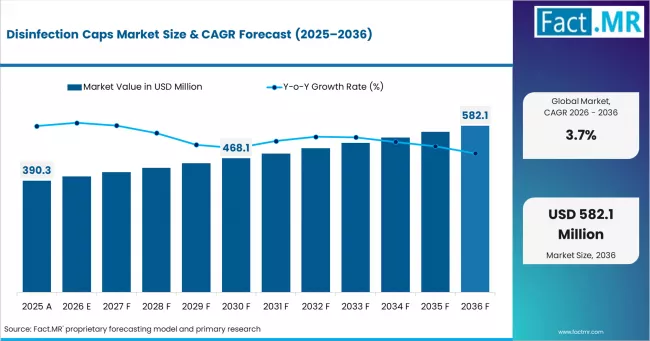
Disinfection Caps Market Market Value Analysis | Source: Fact.MR
Summary of Disinfection Caps Market
- Market Snapshot
- The disinfection caps market was valued at USD 390.30 million in 2025.
- By 2036, the Disinfection Caps Market is expected to be worth USD 582.06 million.
- From 2026 to 2036, the market is projected to expand at a CAGR of 3.7%.
- The market is projected to create an incremental opportunity of USD 177.31 million between 2026 and 2036.
- In 2026, disinfecting caps for needleless connectors are expected to account for 57% of the product segment, driven by CRBSI prevention protocols in hospital settings.
- China (5.0%) and India (4.62%) are two of the fastest growing markets in the world.
- Demand and Growth Drivers
- Demand is shaped by hospital infection control protocols mandating passive disinfection of needleless connectors to prevent catheter-related bloodstream infections.
- Growth reflects expanding CLABSI and CRBSI prevention standards across acute care, ICU, and dialysis settings globally.
- Adoption is increasing due to growing home healthcare IV therapy volumes and expanding ambulatory infusion care beyond traditional hospital settings.
- Product and Segment View
- Disinfecting caps for needleless connectors lead the product segment with a 57% share in 2026, supported by broad CRBSI prevention protocol adoption.
- IV line infection prevention holds 61% of the application segment, anchored by central line maintenance and catheter-related bloodstream infection prevention.
- Hospitals account for 64% of end-use demand, while ICU and critical care units, dialysis centers, and home healthcare form secondary channels.
- Geography and Competitive Outlook
- North America remains the largest regional market, supported by strict CRBSI prevention protocols, high central line usage rates, and broad Joint Commission infection control requirements.
- Asia Pacific is the fastest-growing region, led by China where expanding acute care capacity, rising infection control standards, and growing dialysis networks are all supporting cap demand.
- The competitive field is led by 3M Company and ICU Medical with an estimated 30% combined share, followed by Becton Dickinson and Company, Merit Medical, B. Braun Melsungen AG, and Excelsior Medical LLC.
- Analyst Opinion
- Disinfection caps represent a high-volume consumable category that sits at the center of hospital infection control economics, and this positioning creates distinct commercial dynamics. The category is structurally attractive because cap adoption is tied directly to clinical outcome metrics that hospitals are required to report and that affect reimbursement under Medicare value-based payment programs. The commercial lever that matters most is clinical evidence depth and value analysis committee support, because caps compete as infection prevention tools rather than commodity consumables when proper CRBSI outcome data is available. Players that combine strong clinical evidence portfolios with hospital infection prevention team relationships and bundled service offerings will capture premium positioning, while commodity cap manufacturers face pricing pressure from group purchasing organization dynamics and private-label alternatives.
Why is Disinfection Caps Market Growing?
- Growth reflects strict CRBSI prevention protocols across acute care, ICU, and dialysis settings globally.
- Demand is shaped by reimbursement pressure tied to CLABSI outcome metrics under Medicare value-based payment programs.
- Adoption is increasing due to expanding home healthcare IV therapy volumes and ambulatory infusion care growth.
The demand base rests on hospital infection control protocols that mandate passive disinfection of needleless connectors as part of CLABSI and CRBSI prevention bundles. CDC guidelines, Joint Commission patient safety goals, and INS infusion therapy standards all support passive disinfection cap use, which has become standard of care across US hospitals. International adoption is following US protocols as infection control standards tighten globally. This regulatory and guideline-driven demand creates sustained baseline consumption.
The second structural driver is reimbursement pressure. Medicare penalizes hospitals for high CLABSI rates through value-based payment programs, which creates direct financial incentive for hospitals to adopt effective passive disinfection protocols. CLABSI rate reporting is public under CMS Hospital Compare and other transparency initiatives, which adds reputational incentive to infection prevention investment. These reimbursement and transparency pressures sustain cap adoption even in budget-constrained hospital environments.
The third driver is expanding home healthcare IV therapy and ambulatory infusion care. Outpatient infusion centers, home health nursing providers, and ambulatory surgical centers are all growing, and each of these settings requires disinfection cap protocols for safe IV access management. As acute care shifts toward shorter hospital stays with more IV therapy completed in outpatient or home settings, cap consumption expands beyond the traditional hospital-centric demand base.
Segment-wise Analysis of Disinfection Caps Market
- Disinfecting caps for needleless connectors lead the product segment with 57% share in 2026, anchored by broad CRBSI prevention protocol adoption.
- Active scrubbing caps represent the fastest-growing premium sub-segment, driven by clinical evidence for mechanical cleaning combined with chemical disinfection.
- IV line infection prevention holds 61% of the application segment, followed by dialysis and infusion therapy and home healthcare as secondary use cases.
The segmentation view shows a category where passive alcohol-impregnated caps dominate volume while active scrubbing designs represent the premium growth frontier. Competitive advantage rests on clinical evidence depth, hospital infection prevention team relationships, and group purchasing organization positioning. Growth over the forecast period is expected to tilt toward active scrubbing designs and specialty application caps as hospitals prioritize CRBSI rate reduction and clinical differentiation emerges from outcome data.
Why Do Disinfecting Caps for Needleless Connectors Lead the Product Segment?
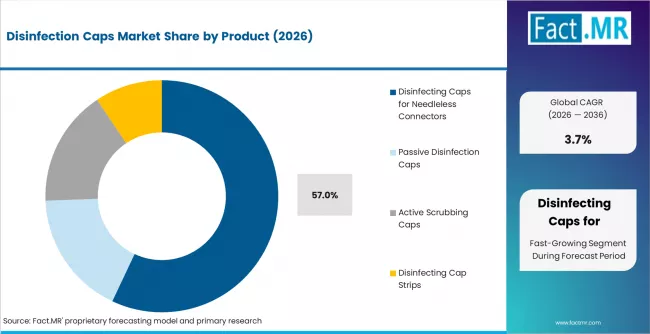
Disinfection Caps Market Analysis By Product | Source: Fact.MR
Disinfecting caps for needleless connectors lead the product segment because needleless connector disinfection is the primary site of CRBSI risk in modern IV therapy. Every access to a central line, peripheral IV, or dialysis line through a needleless connector creates potential contamination risk, which is why CDC guidelines, Joint Commission standards, and INS infusion therapy guidelines all specifically recommend passive disinfection caps at these sites. This clinical evidence and guideline foundation supports dominant segment positioning.
The segment leadership is reinforced by scalable consumption patterns. Hospitalized patients on IV therapy receive multiple medication accesses per day, each of which requires cap replacement as part of disinfection protocols. ICU patients with multiple central line lumens can generate 20 to 50 cap uses per day, while dialysis patients and home infusion patients also generate significant cap consumption. The combination of high per-patient consumption and broad protocol adoption creates sustained segment leadership.
Why are Active Scrubbing Caps the Fastest-Growing Premium Sub-Segment?
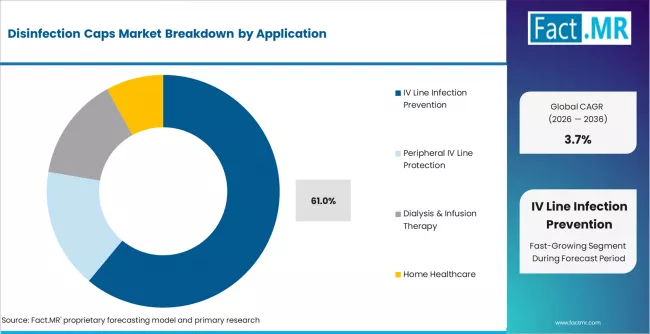
Disinfection Caps Market Analysis By Application | Source: Fact.MR
Active scrubbing caps are the fastest-growing premium sub-segment because they address clinical evidence suggesting mechanical scrubbing combined with chemical disinfection provides superior disinfection outcomes relative to passive disinfection alone. Dual action cleaning caps that incorporate both mechanical cleaning elements and chemical disinfectants have shown improved CRBSI outcomes in clinical studies, which supports premium pricing relative to basic alcohol-impregnated passive caps.
Growth within active scrubbing caps is being lifted by hospital value analysis committees that prioritize CRBSI outcome data when making product selection decisions. Manufacturers with strong clinical evidence supporting active scrubbing effectiveness can command premium positioning in hospital procurement decisions, while commodity passive caps face pricing pressure from group purchasing organization negotiations and private-label alternatives. This clinical differentiation dynamic supports sustained premium segment growth.
Key Growth Drivers, Constraints, and Market Scope
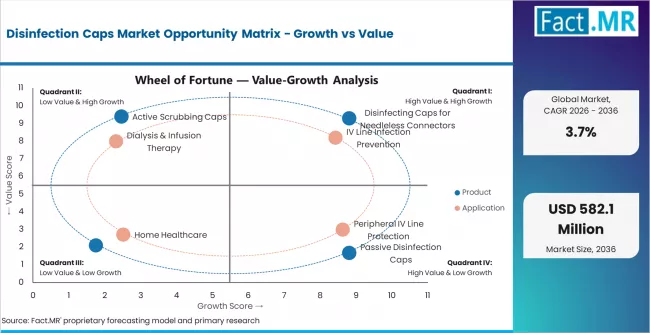
Disinfection Caps Market Opportunity Matrix Growth Vs Value | Source: Fact.MR
- CRBSI prevention protocols and Medicare value-based payment pressure are the structural demand foundations.
- Active scrubbing cap adoption and home healthcare IV therapy expansion are the key compositional shifts driving premium growth.
- Product commoditization, GPO pricing pressure, and budget-constrained hospital procurement remain the leading constraints.
The market scope is shaped by the combination of high-volume hospital cap consumption tied to infection prevention protocols and premium growth in active scrubbing and specialty application segments. Competitive advantage sits in clinical evidence depth, hospital infection prevention team relationships, and GPO positioning.
Growth Drivers
The primary driver is strict CRBSI prevention protocols and Medicare value-based payment pressure that reward hospitals for low CLABSI rates. A second driver is expanding home healthcare IV therapy and ambulatory infusion care, which broadens cap consumption beyond traditional hospital settings. A third driver is rising infection control standards in emerging markets as healthcare infrastructure matures and international guidelines are adopted. These three forces combine to deliver a steady low to mid single-digit growth trajectory with premium uplift from active scrubbing cap segments.
Constraints
The leading constraint is product commoditization. Basic alcohol-impregnated passive caps have largely commoditized, with private-label retailers and low-cost manufacturers creating pricing pressure on branded products. A second constraint is GPO pricing pressure. Group purchasing organizations such as Vizient, Premier, and HealthTrust negotiate aggressive pricing for commodity infection prevention products, which limits margin expansion for manufacturers that do not have clinical differentiation. A third constraint is budget-constrained hospital procurement, particularly in non-acute care settings and emerging markets where CRBSI rate reporting requirements are less stringent and infection prevention budgets are tighter.
Opportunities
The strongest opportunity lies in active scrubbing cap portfolio expansion, where clinical evidence supporting dual action cleaning can capture premium positioning. A second opportunity is home healthcare and ambulatory infusion channel expansion, where growing IV therapy volumes outside traditional hospital settings create incremental cap demand. A third opportunity is emerging market penetration, particularly in China and India, where expanding acute care capacity and rising infection control standards both support cap demand across hospital and dialysis channels.
Regional Outlook Across Key Markets
.webp "Top Country Growth Comparison Disinfection Caps Market Cagr (2026 2036)")
Top Country Growth Comparison Disinfection Caps Market Cagr (2026 2036) | Source: Fact.MR
- China leads country-level growth at 5.0% CAGR, supported by expanding acute care capacity, rising infection control standards, and growing dialysis networks.
- India follows at 4.62%, driven by private hospital network expansion, growing dialysis center networks, and rising infection control protocol adoption.
- North America remains the largest regional pool by absolute value, with the USA at 3.52% supported by strict CRBSI prevention protocols and broad value-based payment program coverage.
- European demand is led by Germany at 4.25% and the UK at 3.15%, with both countries showing active hospital infection control program deployment.
Country CAGR Table
| Country | CAGR (%) |
|---|---|
| China | 5.00% |
| India | 4.62% |
| Germany | 4.25% |
| Brazil | 3.88% |
| USA | 3.52% |
| UK | 3.15% |
| Japan | 2.77% |
Source: Fact.MR analysis. Updated Apr 27, 2026
Source: Fact.MR analysis, based on proprietary forecasting model and primary research.
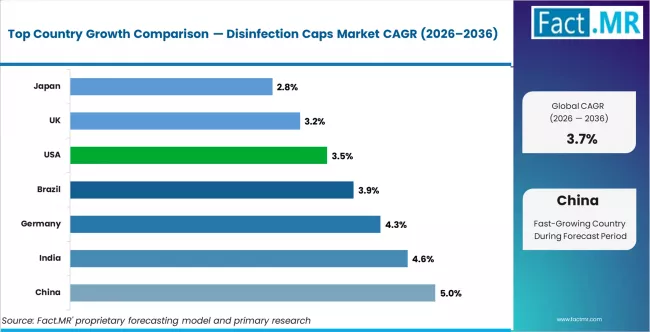
Disinfection Caps Market Cagr Analysis By Country | Source: Fact.MR
Regional dynamics split into three profiles. Asia Pacific leads on growth rate, pulled by acute care capacity expansion and rising infection control standards. Europe grows at steady low to mid single-digit rates driven by mature hospital infection control programs and active CRBSI prevention protocols. North America remains the largest dollar market, anchored by strict CRBSI prevention protocols, high central line usage rates, and broad Joint Commission infection control requirements.
United States
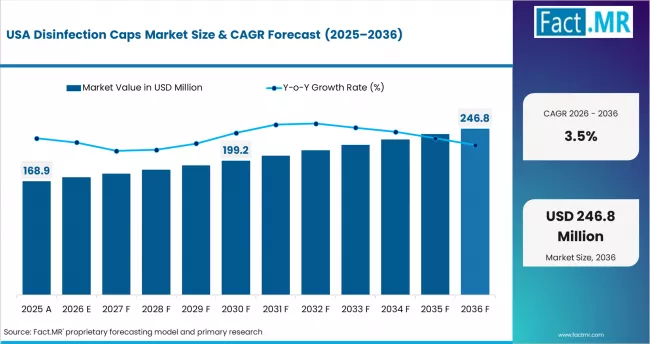
Disinfection Caps Market Country Value Analysis | Source: Fact.MR
The United States anchors global demand through its strict CRBSI prevention protocols, high central line usage rates across ICU and acute care settings, and broad Joint Commission infection control requirements. 3M Company, ICU Medical, Becton Dickinson and Company, and Excelsior Medical LLC lead the clinical channel, while GPO contracting dynamics shape competitive positioning. Medicare CLABSI reporting and value-based payment programs create sustained financial incentive for cap adoption across US hospitals.
- Strict CRBSI prevention protocols support broad cap adoption across US hospitals.
- High central line usage rates drive sustained cap consumption volumes.
- GPO contracting dynamics shape competitive positioning and pricing.
Canada
Canada represents a steady growth market shaped by provincial hospital infection control standards, provincial health system procurement patterns, and cross-border distribution relationships with US manufacturers. Provincial health systems support hospital infection control investment, while academic medical centers and larger hospital networks drive concentrated cap procurement. Home healthcare and ambulatory infusion settings are also expanding cap demand.
- Provincial hospital infection control standards support cap adoption.
- Academic medical centers drive concentrated cap procurement.
- Home healthcare expansion supports cap demand beyond hospital settings.
United Kingdom
The United Kingdom market is shaped by NHS England's infection prevention and control standards, Epic 3 guidelines for catheter-related infection prevention, and mixed NHS and private hospital channel dynamics. NHS trusts deploy caps across hospital infection control programs, while private healthcare groups such as BUPA Healthcare and HCA Healthcare UK support additional consumption. Home healthcare expansion is also supporting cap demand.
- NHS infection prevention standards support cap adoption across hospital settings.
- Private healthcare providers expand cap consumption beyond NHS channels.
- Home healthcare expansion supports cap demand in ambulatory infusion settings.
Germany
Germany leads European growth on the strength of mature hospital infection control programs, statutory insurance coverage for infection prevention products, and strict hospital-acquired infection surveillance requirements. German hospitals deploy caps across ICU, acute care, and dialysis settings as standard infection prevention practice. B. Braun Melsungen AG has strong home-country operations, while 3M Company and ICU Medical also compete actively in the German market.
- Mature hospital infection control programs support broad cap adoption.
- Statutory insurance coverage provides predictable reimbursement for infection prevention.
- Strong domestic manufacturing through B. Braun anchors the German market.
China
China is the fastest-growing country in the forecast, driven by expanding acute care capacity, rising infection control standards, and growing dialysis networks. Tier-1 hospital systems in Beijing, Shanghai, Guangzhou, and other major cities are adopting CRBSI prevention protocols aligned with international standards, while domestic cap manufacturers are building competitive positions. Chinese dialysis center expansion also creates sustained cap demand for hemodialysis line protection applications.
- Expanding acute care capacity supports cap adoption across tier-1 and tier-2 hospitals.
- Rising infection control standards drive CRBSI prevention protocol adoption.
- Growing dialysis networks sustain cap demand for hemodialysis line protection.
India
India represents a strong growth market driven by private hospital network expansion, growing dialysis center networks, and rising infection control protocol adoption. Apollo Hospitals, Fortis Healthcare, Max Healthcare, and other corporate hospital chains are deploying advanced infection control protocols as part of international accreditation efforts. NephroPlus and other dialysis chain operators also drive cap demand for hemodialysis line protection.
- Private hospital network expansion drives cap adoption in corporate hospital chains.
- Growing dialysis center networks sustain cap demand for hemodialysis protection.
- Rising infection control protocol adoption supports cap consumption growth.
Competitive Benchmarking and Company Positioning
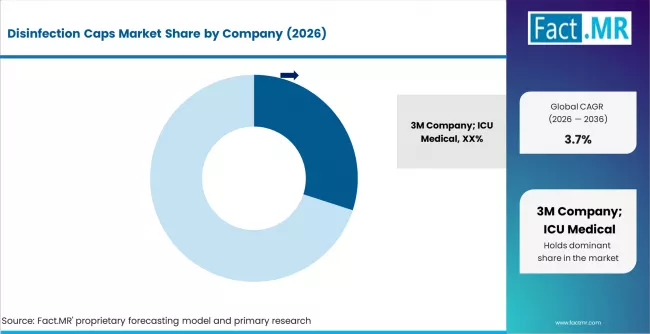
Disinfection Caps Market Analysis By Company | Source: Fact.MR
- 3M Company and ICU Medical together lead with an estimated 30% combined share, supported by established clinical evidence portfolios and strong hospital channel relationships.
- Becton Dickinson and Company, Merit Medical, B. Braun Melsungen AG, and Excelsior Medical LLC compete through differentiated product portfolios and channel strength.
- Specialty players such as Agilent Technologies Inc., Biocrates Life Sciences AG, Henry Schein, and JCM MED hold focused positions in specific market segments.
The competitive field is moderately concentrated, with 3M Company and ICU Medical holding leading positions through established clinical evidence portfolios and strong hospital channel relationships. 3M's Curos platform and ICU Medical's SwabCap platform are both widely deployed across US and international hospital infection prevention protocols. Clinical evidence supporting both platforms creates meaningful competitive advantages in value analysis committee decisions.
Becton Dickinson and Company competes through its broader infection prevention portfolio extended into disinfection cap applications. Merit Medical holds specialty positions across cardiology and vascular access applications. B. Braun Melsungen AG competes through its broader IV therapy portfolio integrated with cap offerings. Excelsior Medical LLC and specialty competitors maintain positions through focused product portfolios and regional channel strength. Henry Schein holds distribution positions across medical products.
Strategic priorities across the field include expanding active scrubbing cap portfolios, deepening clinical evidence depth, and investing in emerging market distribution. Scaled manufacturers with strong clinical evidence and hospital infection prevention team relationships will capture the bulk of forecast period growth, while commodity cap producers without clinical differentiation face pricing pressure from GPO dynamics and private-label alternatives.
Competitive Analysis
Competitive positioning rests on three dimensions: clinical evidence depth, hospital infection prevention team relationships, and GPO contracting positioning. 3M Company and ICU Medical lead on clinical evidence through published CRBSI outcome studies. Becton Dickinson and Company competes through broader infection prevention portfolio depth. B. Braun Melsungen AG and Merit Medical hold specialty positions across specific applications.
Second-tier competitors maintain relevance through specialized product designs, focused clinical application strategies, or regional channel concentration. Private-label manufacturers serve GPO and hospital-specific contract positions. The gap between clinically differentiated branded manufacturers and commodity producers continues to influence pricing and margin dynamics across GPO contracts.
Benchmarking Table
| Company | Scale Reach | Product Portfolio | Clinical Evidence | Hospital Channel |
|---|---|---|---|---|
| 3M Company | Global | Focused | Strong | Strong |
| ICU Medical | Global | Focused | Strong | Strong |
| Becton Dickinson and Company | Global | Broad | Medium-Strong | Strong |
| Merit Medical | Global | Medium | Medium | Medium-Strong |
| B. Braun Melsungen AG | Global | Broad | Medium-Strong | Strong |
| Excelsior Medical LLC | Regional | Focused | Medium | Medium |
| Henry Schein | Global | Medium | Low | Strong |
Source: Fact.MR analysis. Updated Apr 27, 2026
Recent Developments
- In 2025, 3M Company continued expanding its Curos disinfection cap platform through product line updates and expanded clinical evidence publications supporting CRBSI reduction.
- In 2025, ICU Medical advanced its SwabCap platform through product portfolio expansion targeting specialized applications including dialysis and ambulatory infusion settings.
- In 2026, B. Braun Melsungen AG strengthened its infection prevention portfolio through product line updates and expanded integration with its broader IV therapy platform.
Leading Companies Shaping Disinfection Caps Market
-
Major Players
- 3M Company
- ICU Medical
- Becton Dickinson and Company
- Merit Medical
- B. Braun Melsungen AG
- Excelsior Medical LLC
- Henry Schein
- Thermo Fisher Scientific Inc.
-
Emerging Players
- Agilent Technologies Inc.
- Biocrates Life Sciences AG
- JCM MED
- Medline Industries
- Teleflex
- Nexus Medical
- Pursuit Vascular
- CareFusion
Sources and Research References
- Centers for Disease Control and Prevention (CDC) - Guidelines on CLABSI and Central Line Infection Prevention
- United States Food and Drug Administration (FDA) - 510(k) Database for Disinfection Cap Devices
- World Health Organization (WHO) - Healthcare-Associated Infection Prevention Publications
- Infusion Nurses Society (INS) - Infusion Therapy Standards of Practice
- Joint Commission - National Patient Safety Goals on Healthcare-Associated Infections
- 3M Company - Curos Platform Clinical Evidence Publications
- Primary interviews with hospital infection control preventionists, ICU nursing leaders, dialysis center managers, and value analysis committee members
This bibliography is provided for reader reference and is not exhaustive. The full report contains the complete reference list and detailed citations.
Key Questions This Report Addresses
- What is the current and future size of the disinfection caps market?
- How fast is the market expected to grow between 2026 and 2036?
- Which product segment is likely to lead the market by 2026?
- Which application segment will account for the highest demand by 2026?
- How are CRBSI prevention protocols reshaping demand patterns?
- Why are China and India emerging as the fastest-growing markets?
- Which countries are projected to show the fastest growth through 2036?
- Who are the key companies active in the disinfection caps market?
- How is active scrubbing cap technology changing the competitive dynamics?
Disinfection Caps Market Definition
The disinfection caps market covers single-use passive disinfection devices that attach to needleless connectors, catheter hubs, and IV line access points to provide continuous antimicrobial protection between clinical accesses. This includes alcohol-impregnated caps, chlorhexidine-based caps, passive disinfection caps, active scrubbing caps, and disinfecting cap strips. The market spans hospitals, ICU and critical care units, dialysis centers, acute care hospitals, hemodialysis clinics, surgical centers, renal care centers, ambulatory surgical centers, and home healthcare across primary use cases including IV line infection prevention, central line maintenance, CRBSI prevention, peripheral IV line protection, and dialysis and infusion therapy.
Disinfection Caps Market Inclusions
The scope includes disinfecting caps for needleless connectors across alcohol-impregnated caps including 70% isopropyl alcohol caps and chlorhexidine-based caps, passive disinfection caps including standard protective caps and barrier protection caps, active scrubbing caps including mechanical scrubbing caps and dual action cleaning caps, and disinfecting cap strips including multi-cap strips for IV poles and bulk clinical use caps. It covers applications across IV line infection prevention, central line maintenance, catheter-related bloodstream infection (CRBSI) prevention, peripheral IV line protection, short-term IV therapy, hospital ward applications, dialysis and infusion therapy, hemodialysis line protection, outpatient infusion care, home healthcare self IV care management, and long-term IV therapy. Coverage spans hospitals, ICU and critical care units, inpatient wards, dialysis centers, hemodialysis clinics, renal care centers, surgical centers, ambulatory surgical centers, outpatient infusion units, day care surgical facilities, and home healthcare from 2026 to 2036.
Disinfection Caps Market Exclusions
The scope excludes needleless connectors themselves, IV catheters, central line kits, and peripheral IV insertion devices, which are separate medical device categories. It also excludes general skin antisepsis products such as prep pads and preoperative antiseptic solutions, surgical site disinfectants, and hard surface disinfection products. Intravenous administration sets, tubing, and pump equipment are outside the scope, as are dialysis equipment and complete infusion therapy systems sold without disinfection cap components.
Disinfection Caps Market Research Methodology
- Primary Research: Interviews with hospital infection control preventionists, ICU nursing leaders, dialysis center managers, value analysis committee members, and cap manufacturers to validate adoption patterns and pricing dynamics.
- Desk Research: Review of CDC guidelines on CLABSI prevention, Joint Commission NPSGs, INS infusion therapy standards, Medicare CLABSI reporting requirements, and published CRBSI outcome studies.
- Market Sizing: Demand-side model built on central line days, needleless connector access frequencies, hospital bed counts, dialysis patient counts, ambulatory infusion volumes, per-cap pricing across branded and private-label segments, triangulated with top-down shipment disclosures.
- Data Validation: Cross-validation across primary interviews, regulatory filings, CDC NHSN surveillance data, and hospital infection prevention society publications, with sensitivity analysis on home healthcare IV therapy expansion and emerging market infection control investment.
Segmentation
Scope of Analysis
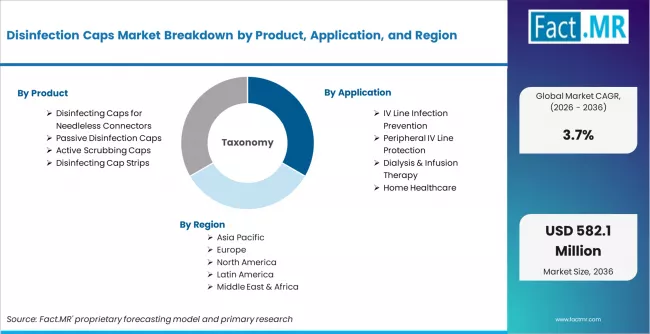
Disinfection Caps Market Breakdown By Product, Application, And Region | Source: Fact.MR
| Parameter | Details |
|---|---|
| Quantitative Units | USD 404.75 million to USD 582.06 million, at a CAGR of 3.7% |
| Market Definition | The disinfection caps market covers single-use passive disinfection devices that attach to needleless connectors, catheter hubs, and IV line access points to provide continuous antimicrobial protection, spanning alcohol-impregnated caps, chlorhexidine-based caps, passive disinfection caps, active scrubbing caps, and disinfecting cap strips. |
| Regions Covered | North America, Latin America, Europe, East Asia, South Asia and Pacific, Middle East and Africa |
| Countries Covered | USA, Canada, UK, Germany, China, India, Brazil, Japan, 30 plus countries |
| Key Companies | 3M Company, ICU Medical, Becton Dickinson and Company, Merit Medical, B. Braun Melsungen AG, Excelsior Medical LLC, Henry Schein, Thermo Fisher Scientific Inc. |
| Forecast Period | 2026 to 2036 |
| Approach | Hybrid demand-side and top-down methodology built on central line days, needleless connector access frequencies, hospital bed counts, dialysis patient counts, ambulatory infusion volumes, per-cap pricing across branded and private-label segments, and primary interviews across hospital infection control preventionists, ICU nursing leaders, dialysis center managers, and value analysis committee members |
Source: Fact.MR analysis. Updated Apr 27, 2026
Market Segmentation Analysis
-
Disinfection Caps Market Market Segmented by Product:
- Disinfecting Caps for Needleless Connectors
- Alcohol-Impregnated Caps
- 70% Isopropyl Alcohol Caps
- Chlorhexidine-Based Caps
- Alcohol-Impregnated Caps
- Passive Disinfection Caps
- Standard Protective Caps
- Barrier Protection Caps
- Standard Protective Caps
- Active Scrubbing Caps
- Mechanical Scrubbing Caps
- Dual Action Cleaning Caps
- Mechanical Scrubbing Caps
- Disinfecting Cap Strips
- Multi-Cap Strips for IV Poles
- Bulk Clinical Use Caps
- Multi-Cap Strips for IV Poles
- Disinfecting Caps for Needleless Connectors
-
Disinfection Caps Market Market Segmented by Application:
- IV Line Infection Prevention
- Central Line Maintenance
- Catheter-Related Bloodstream Infection (CRBSI) Prevention
- Central Line Maintenance
- Peripheral IV Line Protection
- Short-Term IV Therapy
- Hospital Ward Applications
- Short-Term IV Therapy
- Dialysis & Infusion Therapy
- Hemodialysis Line Protection
- Long-Term Infusion Care
- Hemodialysis Line Protection
- Home Healthcare
- Self IV Care Management
- Chronic Therapy Use
- Self IV Care Management
- IV Line Infection Prevention
-
Disinfection Caps Market Market Segmented by End Use:
- Hospitals
- ICU & Critical Care Units
- Inpatient Wards
- ICU & Critical Care Units
- Dialysis Centers
- Hemodialysis Clinics
- Renal Care Centers
- Hemodialysis Clinics
- Ambulatory Surgical Centers
- Outpatient Infusion Units
- Day Care Surgical Facilities
- Outpatient Infusion Units
- Home Healthcare
- Long-Term IV Therapy Patients
- Home Nursing Services
- Long-Term IV Therapy Patients
- Hospitals
-
Disinfection Caps Market Market Segmented by Technology:
- Alcohol-Based Disinfection Technology
- Isopropyl Alcohol (IPA) Infused Caps
- Continuous Disinfection Systems
- Isopropyl Alcohol (IPA) Infused Caps
- Passive Barrier Protection Technology
- Sealed Cap Barrier Systems
- Microbial Isolation Caps
- Sealed Cap Barrier Systems
- Active Scrubbing Technology
- Mechanical Cleaning Mechanisms
- Dual Action Disinfection Caps
- Mechanical Cleaning Mechanisms
- Alcohol-Based Disinfection Technology
-
Disinfection Caps Market Market Segmented by Distribution Channel:
- Direct Sales
- Hospital Procurement Contracts
- Group Purchasing Organizations
- Hospital Procurement Contracts
- Medical Distributors
- Healthcare Supply Vendors
- Infection Control Suppliers
- Healthcare Supply Vendors
- Online Medical Supply
- B2B Healthcare Platforms
- E-Procurement Systems
- B2B Healthcare Platforms
- Direct Sales
-
Disinfection Caps Market Market by Region:
- North America
- USA
- Canada
- Mexico
- Latin America
- Brazil
- Chile
- Rest of Latin America
- Western Europe
- Germany
- UK
- Italy
- Spain
- France
- Nordic
- BENELUX
- Rest of Western Europe
- Eastern Europe
- Russia
- Poland
- Hungary
- Balkan & Baltic
- Rest of Eastern Europe
- East Asia
- China
- Japan
- South Korea
- South Asia and Pacific
- India
- ASEAN
- Australia & New Zealand
- Rest of South Asia and Pacific
- Middle East & Africa
- Kingdom of Saudi Arabia
- Other GCC Countries
- Turkiye
- South Africa
- Other African Union
- Rest of Middle East & Africa
- North America
Frequently Asked Questions
How big is the disinfection caps market in 2026?
What will be the size of the disinfection caps market in 2036?
How much will the disinfection caps market grow between 2026 and 2036?
Which product segment is expected to lead the market in 2026?
Which country is the fastest-growing market?
Why is India a key growth market?
What does the disinfection caps market cover?
How is the market forecast estimated and validated?
Who worked on this report


Preview the report firsthand - request a free sample
Free SampleGet the brochure for pricing and purchase details
Download PDF