- Base Value(2025): 0.8 Bn
- Estimated Value(2026): 0.8 Bn
- Forecast Value (2036): 1.5 Bn
- CAGR (2026 - 2036): 5.9%
Sperm Processing Media Market Analysis and Forecast by Fact.MR
- The Sperm Processing Media Market is expected to grow from USD 0.8 billion in 2026 to USD 1.5 billion by 2036, at a 5.9% CAGR.
- driven by expanding institutional procurement, rising clinical adoption across acute and chronic care settings, and integration of advanced technology platforms into established care delivery workflows, with sperm washing media accounting for 64.1% share and in vitro fertilization procedures contributing 48.2%.
- share as organizations prioritize operational efficiency, clinical accuracy, and regulatory compliance.
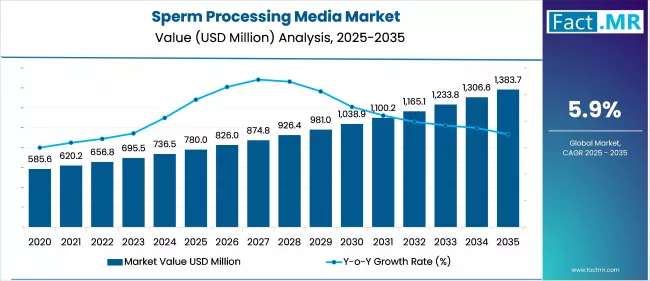
Sperm Processing Media Market Value Analysis | Source: Fact.MR
Summary of Sperm Processing Media Market
- Market Snapshot
- In 2025, the global Sperm Processing Media Market was valued at approximately USD 0.8 billion.
- The market is estimated to reach USD 0.8 billion in 2026 and is projected to attain USD 1.5 billion by 2036.
- The sperm processing media market is likely to expand at a CAGR of 5.9% during the forecast period.
- The market is anticipated to create an absolute dollar opportunity of USD 0.6 billion between 2026 and 2036.
- Sperm Washing Media accounts for 64.1% of product segment share in 2026.
- China (8.0%) and India (7.4%) are the key growth markets during the forecast period.
- Demand and Growth Drivers
- Rising global infertility rates, affecting approximately 15% of couples of reproductive age, are increasing demand for IVF procedures and associated sperm processing consumables across fertility clinic networks.
- Expansion of assisted reproductive technology programs in Asia Pacific and the Middle East, supported by government fertility treatment subsidies and private clinic investment, is generating incremental demand for sperm washing and preparation media.
- Development of advanced sperm selection media incorporating hyaluronic acid binding and microfluidic-based sorting is increasing per-cycle consumable value and supporting premium product adoption.
- Growing acceptance of donor sperm programs and fertility preservation services, including sperm cryopreservation for medical and elective reasons, is broadening the clinical application scope for processing media.
- Regulatory tightening around IVF laboratory quality standards, including EU Tissue and Cells Directive compliance and FDA-registered facility requirements, is driving procurement toward certified, GMP-grade media products.
- Product and Segment View
- Sperm Washing Media account for 64.1% of the product segment in 2026, led by broad institutional adoption and established procurement patterns.
- In Vitro Fertilization Procedures represents 48.2% of the application segment in 2026, reflecting sustained demand across clinical and institutional settings.
- Key segmentation includes:
- Product: Sperm Washing Media, Cryopreservation Media, Sperm Preparation Media, Specialty Processing Media
- Application: In Vitro Fertilization Procedures, Artificial Insemination Procedures, Fertility Preservation Applications, Research Applications
- End Use: Fertility Clinics, Cryobanks & Sperm Banks, Hospitals, Research Institutes
- These systems enable:
- Standardized clinical workflows across multi-site institutional networks
- Improved diagnostic accuracy and treatment response monitoring
- Expanded accessibility in decentralized and resource-limited care settings
- Geography and Competitive Outlook
- North America accounts for a leading share of global demand, supported by established institutional infrastructure, regulatory clarity, and high per-capita healthcare spending.
- Europe maintains steady demand, with Germany and the UK supported by structured compliance requirements and hospital modernization programs.
- Asia Pacific is the fastest-growing region, with China and India expanding capacity through government health programs and private investment.
- China (8.0%) and India (7.4%) are the fastest-growing country markets through 2036.
- Key companies include Cooper Surgical Fertility Solutions, HI-TECH SOLUTIONS, Wondersperm, FUJIFILM Irvine Scientific, Vitrolife, gynotec, GYNEMED GmbH & Co. KG., Cryo-Genie India Pvt. Ltd..
- Analyst Opinion
- Shambhu Nath Jha, Principal Consultant at Fact.MR, says 'The sperm processing media landscape is shifting from volume-driven procurement toward value-based purchasing, where institutions evaluate total cost of ownership, clinical integration capability, and service network coverage alongside unit pricing. Companies that combine reliable product performance with digital connectivity and responsive after-sales support are positioned to capture a larger share of institutional budgets. The most commercially significant growth pockets over the forecast period are concentrated in markets where healthcare infrastructure investment is creating new facility demand alongside replacement cycles in established networks.'
Key Growth Drivers, Constraints, and Opportunities
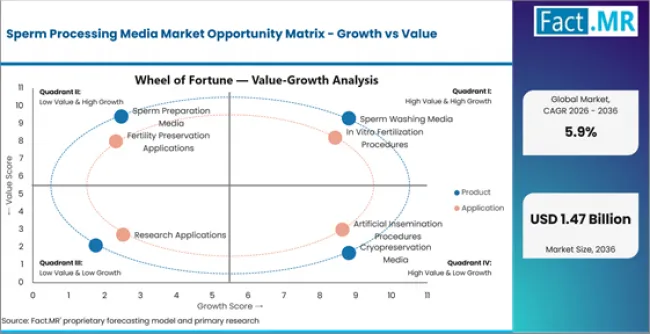
Sperm Processing Media Market Opportunity Matrix Growth Vs Value | Source: Fact.MR
Key Factors Driving Growth
- Global IVF cycle volumes exceeding 2.5 million annually are generating sustained consumable demand for sperm washing, gradient preparation, and cryopreservation media across fertility laboratory networks.
- Expansion of fertility clinic chains in India, China, and the Middle East, supported by medical tourism and government subsidies, is creating large-scale institutional procurement for GMP-grade media products.
- Development of single-step culture media systems that simplify laboratory workflows and reduce handling errors is driving product differentiation and supporting premium pricing in established markets.
Key Market Constraints
- High per-cycle consumable costs and limited insurance coverage for IVF procedures in several markets constrain treatment volumes and associated sperm processing media demand.
- Quality control challenges and regulatory scrutiny around culture media formulation integrity, highlighted by recent product recalls, create procurement risk and increase laboratory validation costs.
- Concentration of IVF laboratory media supply among a small number of global manufacturers creates supply chain vulnerability and limits competitive pricing dynamics.
Key Opportunity Areas
- Expansion of fertility tourism and cross-border reproductive care programs is generating demand for internationally certified, GMP-grade sperm processing media in destination clinic markets.
- Microfluidic-based sperm sorting and selection technologies integrated into processing media workflows are creating high-value consumable categories with improved clinical outcomes.
- Growing demand for fertility preservation services, including oncofertility and elective sperm banking, is broadening the clinical application scope beyond traditional IVF treatment cycles.
Segment-wise Analysis of the Sperm Processing Media Market
- Sperm Washing Media hold 64.1% of the product segment in 2026, supported by broad institutional procurement and established clinical adoption.
- In Vitro Fertilization Procedures represents 48.2% of the application segment in 2026, reflecting high-volume demand across acute and institutional care settings.
- Fertility Clinics account for 66.1% of the end use segment, reflecting concentration of procurement within multi-specialty institutional networks.
The sperm processing media market is segmented by product, application, end use, technology, formulation, distribution channel, and region. Sperm Washing Media lead the market by value in 2026 due to their established clinical role, broad institutional adoption, and steady procurement cycles across both public and private healthcare systems.
Which Product Segment Dominates the Sperm Processing Media Market?
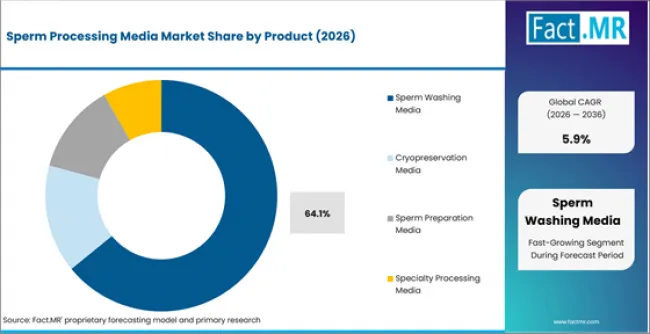
Sperm Processing Media Market Analysis By Product | Source: Fact.MR
Sperm Washing Media are expected to account for 64.1% of the product segment in 2026. This leadership is supported by sustained procurement across hospital systems, established clinical protocols, and broad regulatory acceptance in major markets. These products serve as the primary functional category within institutional care workflows, and their demand is directly tied to patient volumes and clinical throughput.
The segment benefits from ongoing government investment in healthcare infrastructure, where standardized equipment configurations include sperm washing media as core components. Replacement cycles for aging systems in developed markets further reinforce volume stability, while new facility construction in emerging markets generates incremental demand.
Which Application Segment Dominates the Sperm Processing Media Market?
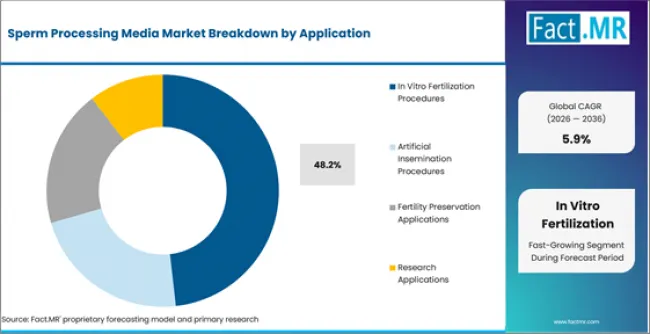
Sperm Processing Media Market Analysis By Application | Source: Fact.MR
In Vitro Fertilization Procedures is expected to lead the application segment with a 48.2% share of market value in 2026. This segment captures the highest volume of institutional demand, reflecting the concentration of clinical activity in acute care, emergency response, and specialized treatment settings.
Demand is supported by continued expansion of institutional capacity in both mature and developing healthcare systems. The segment absorbs a growing share of equipment and technology spending as institutions invest in higher-specification systems to meet updated regulatory and accreditation requirements.
Which Technology Trend is Shaping the Next Phase of Growth in the Sperm Processing Media Market?
Density Gradient Technology represent an evolving part of the sperm processing media market landscape. Their adoption is accelerating as institutions seek higher-specification, digitally integrated equipment that supports real-time data capture, connectivity, and workflow optimization. This shift reflects broader changes in institutional procurement behavior, where buyers increasingly evaluate technology integration capability alongside core clinical performance.
The transition toward connected, data-enabled platforms is creating a premium growth layer within the market. Institutions investing in digital infrastructure are prioritizing equipment that supports remote monitoring, centralized data management, and interoperability with existing hospital information systems. As these capabilities become standard procurement criteria, they are positioned to influence a growing share of total capital spending per facility.
Regional Outlook Across Key Markets
- China leads growth at 8.0%, supported by expanding IVF clinic networks, government fertility treatment subsidies in select provinces, and rising domestic demand for assisted reproductive technology consumables.
- India at 7.4% benefits from growing private fertility clinic investment, medical tourism-driven IVF demand, and Ayushman Bharat coverage exploration for assisted reproduction services.
- North America accounts for a leading share, sustained by high IVF utilization rates, established fertility clinic networks, CooperSurgical market leadership, and insurance coverage expansion for fertility treatment.
- Europe maintains steady demand, supported by EU Tissue and Cells Directive compliance requirements, national health insurance IVF coverage in Germany, France, and Scandinavia, and established laboratory media procurement frameworks.
.webp "Top Country Growth Comparison Sperm Processing Media Market Cagr (2026 2036)")
Top Country Growth Comparison Sperm Processing Media Market Cagr (2026 2036) | Source: Fact.MR
CAGR Table
| Country | CAGR (%) |
|---|---|
| China | 8.0% |
| India | 7.4% |
| Germany | 6.8% |
| Brazil | 6.2% |
| USA | 5.6% |
Source: Fact.MR analysis. Updated Jun 5, 2026
Source: Fact MR (FMR) analysis, based on proprietary forecasting model and primary research.
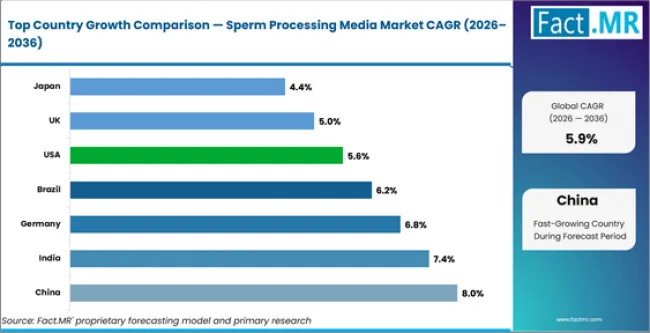
Sperm Processing Media Market Cagr Analysis By Country | Source: Fact.MR
Market Outlook for Sperm Processing Media in China
The China Sperm Processing Media Market is projected to grow at a CAGR of 8.0% through 2036. Provincial fertility treatment subsidies and expanding IVF clinic networks across tier-1 and tier-2 cities are generating institutional demand for sperm processing media in China.
- Provincial government fertility treatment subsidies and expanding IVF clinic networks in tier-1 and tier-2 cities generate institutional procurement for GMP-grade sperm processing media.
- Domestic media manufacturers entering the market with NMPA-approved products provide cost-competitive alternatives to established international brands.
India Sperm Processing Media Demand Trends
The India Sperm Processing Media Market is projected to grow at a CAGR of 7.4% through 2036. Private fertility clinic proliferation in medical tourism hubs and growing domestic IVF utilization are creating multi-channel procurement for sperm processing consumables in India.
- Private fertility clinic proliferation in urban medical tourism hubs and growing domestic IVF demand are creating multi-channel procurement for sperm washing and cryopreservation media.
- Cost-sensitive institutional procurement in government-supported fertility programs favors value-tier media products while private clinics adopt premium formulations.
Sperm Processing Media Growth Assessment in Germany
The Germany Sperm Processing Media Market is projected to grow at a CAGR of 6.8% through 2036. GKV-covered IVF treatment cycles and EU Tissue and Cells Directive laboratory compliance requirements shape structured procurement for certified sperm processing media in Germany.
- GKV-covered IVF cycles and EU Tissue and Cells Directive compliance create structured procurement requirements for certified sperm processing media in accredited laboratories.
- Hospital-based reproductive medicine departments and academic fertility centers maintain rigorous quality standards that favor established media brands with documented lot-to-lot consistency.
Brazil Sperm Processing Media Market Analysis
The Brazil Sperm Processing Media Market is projected to grow at a CAGR of 6.2% through 2036. ANVISA regulatory standards for IVF laboratory consumables and growing private fertility clinic investment govern institutional media procurement in Brazil.
- ANVISA regulatory requirements for IVF laboratory consumables and growing private fertility clinic investment shape institutional market access for sperm processing media.
- Rising domestic IVF utilization supported by expanding private insurance coverage for fertility treatment generates incremental media procurement demand.
Sperm Processing Media Opportunity Outlook in USA
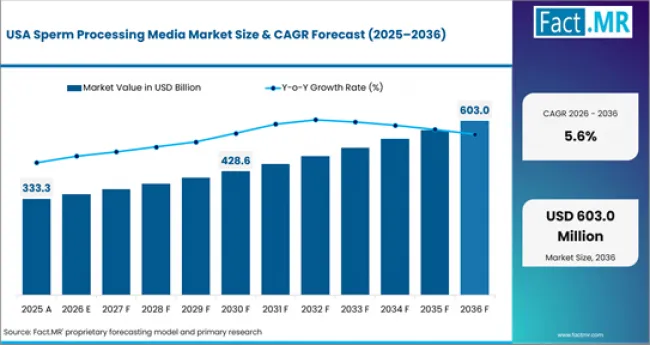
Sperm Processing Media Market Country Value Analysis | Source: Fact.MR
The USA Sperm Processing Media Market is projected to grow at a CAGR of 5.6% through 2036. Established fertility clinic networks, expanding insurance mandates for IVF coverage, and CooperSurgical ORIGIO media market leadership sustain the largest sperm processing media market in the United States.
- Established fertility clinic networks, CooperSurgical ORIGIO media leadership, and expanding insurance mandates for IVF coverage sustain the largest single-country sperm processing media market.
- FDA-registered facility requirements and AATB accreditation standards drive procurement toward certified, GMP-grade media products with documented quality management systems.
Competitive Benchmarking and Company Positioning
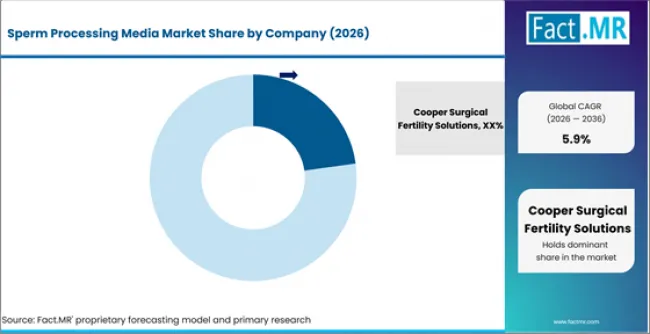
Sperm Processing Media Market Analysis By Company | Source: Fact.MR
Sperm Processing Media Market Analysis By Company
- Cooper Surgical Fertility Solutions, HI-TECH SOLUTIONS, Wondersperm, FUJIFILM Irvine Scientific hold strong positions in the global sperm processing media market through broad product portfolios, established distribution networks, and institutional procurement relationships.
- Vitrolife, gynotec, GYNEMED GmbH & Co. KG., Cryo-Genie India Pvt. Ltd. participate meaningfully across specific segments, geographies, and price tiers, with competition shaped by clinical performance, regulatory compliance, and service coverage.
- Technology integration, digital connectivity, and after-sales service quality create competitive differentiation, particularly in institutional procurement where total cost of ownership influences purchasing decisions.
The competitive landscape is moderately fragmented, with a mix of established global manufacturers and regional specialists. Cooper Surgical Fertility Solutions, with a 22.8% share, leads through broad product coverage, institutional relationships, and geographic reach. Below the leading positions, Vitrolife, gynotec, GYNEMED GmbH & Co. KG. compete through pricing, product specialization, and regional distribution strength.
Strategic priorities across the market include expanding digitally connected product portfolios, strengthening institutional service networks, improving regulatory approval timelines, and widening reach through direct-to-institution and e-commerce distribution channels.
Key Companies in the Sperm Processing Media Market
- Cooper Surgical Fertility Solutions, HI-TECH SOLUTIONS, Wondersperm, FUJIFILM Irvine Scientific are among the leading participants in the sperm processing media market, supported by broad product portfolios, global distribution, and established institutional procurement relationships.
- Vitrolife, gynotec, GYNEMED GmbH & Co. KG., Cryo-Genie India Pvt. Ltd. hold established positions across specific product segments and regional markets, supported by clinical performance and channel coverage.
- Sperm Processor Pvt Ltd continue to compete through focused product offerings, price-point coverage, and niche specialization in specific clinical applications.
Recent Industry Developments
- CooperSurgical, ZyMot Fertility Acquisition (2025)
- CooperSurgical acquired ZyMot Fertility, a subsidiary of DxNow Inc., adding microfluidic-based sperm sorting technology to its fertility solutions portfolio and expanding its sperm processing product range.
- FUJIFILM Irvine Scientific, IVF Media Portfolio Expansion (2025)
- FUJIFILM Irvine Scientific continued expanding its IVF culture media and sperm processing product portfolio, reinforcing its position in the global fertility laboratory consumable supply chain.
- CooperSurgical, ASRM 2025 Conference Portfolio Showcase (October 2025)
- CooperSurgical presented its comprehensive fertility solutions portfolio at the American Society for Reproductive Medicine 2025 Annual Meeting, including sperm processing media, culture systems, and laboratory equipment.
Leading Companies Shaping the Sperm Processing Media Market
- Cooper Surgical Fertility Solutions
- HI-TECH SOLUTIONS
- Wondersperm
- FUJIFILM Irvine Scientific
- Vitrolife
- gynotec
- GYNEMED GmbH & Co. KG.
- Cryo-Genie India Pvt. Ltd.
- Sperm Processor Pvt Ltd
Sources and Research References
- Company annual reports, product catalogs, and institutional procurement disclosures from 2024 to 2025.
- Government health ministry publications, regulatory agency databases, and institutional accreditation body reports.
- Industry association data, trade publications, and healthcare equipment procurement records.
- National and regional healthcare infrastructure investment reports, clinical adoption studies, and market access assessments.
- Primary interviews with institutional buyers, clinicians, procurement officers, manufacturers, and distributors.
This bibliography is provided for reader reference and is not exhaustive. The full report contains the complete reference list and detailed citations.
Key Questions This Report Addresses
- What is the current and future size of the Sperm Processing Media Market?
- How fast is the Sperm Processing Media Market expected to grow between 2026 and 2036?
- Which product segment is likely to lead the market by 2026?
- Which application segment is expected to account for the highest demand by 2026?
- What factors are driving demand globally?
- How is the shift toward digitally connected systems influencing the market?
- Why is China emerging as one of the fastest-growing markets?
- How are government healthcare programs supporting procurement demand?
- Which countries are projected to show the fastest growth through 2036?
- What is driving market expansion in China and India?
- Who are the key companies active in the Sperm Processing Media Market?
- How does Fact.MR estimate and validate the market forecast?
Sperm Processing Media Market Definition
The sperm processing media market covers sperm washing media, in vitro fertilization procedures, and associated equipment and consumables used across institutional, clinical, and field-based care settings. It includes products and systems deployed across hospitals, specialty clinics, ambulatory care centers, and government health programs globally.
Sperm Processing Media Market Inclusions
- The scope covers global and regional market size and forecasts for 2026 to 2036 across product, application, end use, technology, and region.
- It includes regional demand analysis across major geographies, based on institutional procurement, regulatory standards, clinical adoption rates, and healthcare infrastructure investment.
- The report includes pricing and cost analysis across entry-level, mid-range, and premium product tiers, covering both capital equipment and recurring consumable components.
- It covers technology trends, market drivers and constraints, and the competitive landscape, including product portfolios, pricing strategy, geographic reach, and distribution positioning of leading companies.
Sperm Processing Media Market Exclusions
- The scope excludes general-purpose equipment not specifically designed or classified for sperm processing media applications.
- It excludes standalone software platforms, mobile applications, and analytics tools sold without hardware components.
- The report excludes custom-built, non-commercial systems without market-facing sales activity.
- It also excludes informal unbranded products, rental-only services without equipment sales, and legacy systems no longer in active production.
Sperm Processing Media Market Research Methodology
- The methodology combines secondary research, primary interviews, and forecast modelling.
- It draws on 120+ secondary sources and benchmarks 60+ company product portfolios.
- Market sizing covers 30+ countries through a demand-side model, supported by top-down validation.
- Key inputs include institutional procurement data, clinical adoption rates, regulatory approval timelines, and healthcare infrastructure investment patterns.
- The model cross-checks demand with shipment volumes, pricing trends, channel mix, and product launch timelines.
- Primary validation includes 25+ interviews across manufacturers, distributors, institutional buyers, clinicians, and procurement officials.
- Final estimates go through trade-flow checks, sales-pattern review, and sensitivity testing.
Segmentation
Scope of Analysis
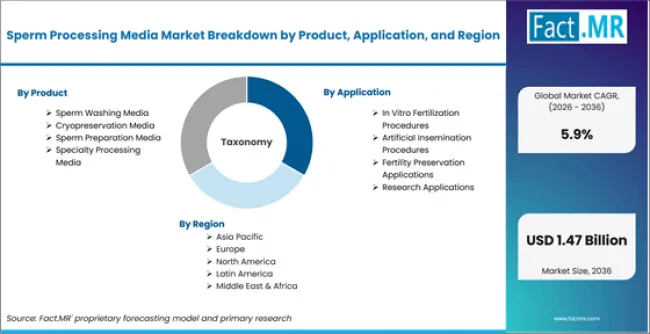
Sperm Processing Media Market Breakdown By Product, Application, And Region | Source: Fact.MR
| Parameter | Details |
|---|---|
| Quantitative Units | USD 0.8 billion to USD 1.5 billion, at a CAGR of 5.9% |
| Market Definition | The sperm processing media market covers sperm washing media and related systems used across institutional, clinical, and field-based care settings globally. |
| Regions Covered | North America, Latin America, Europe, East Asia, South Asia and Pacific, Middle East and Africa |
| Countries Covered | China, India, Germany, Brazil, USA, 30 plus countries |
| Key Companies | Cooper Surgical Fertility Solutions, HI-TECH SOLUTIONS, Wondersperm, FUJIFILM Irvine Scientific, Vitrolife, gynotec, GYNEMED GmbH & Co. KG., Cryo-Genie India Pvt. Ltd., Sperm Processor Pvt Ltd |
| Forecast Period | 2026 to 2036 |
| Approach | Hybrid demand-side and top-down methodology built on country-level institutional demand, product benchmarking, pricing analysis, shipment validation, and primary interviews |
Source: Fact.MR analysis. Updated Jun 5, 2026
Sperm Processing Media Market Segmentation
-
Sperm Processing Media Market Segmented by Product:
- Sperm Washing Media
- Density Gradient Washing Media
- Single Layer Gradient Media
- Dual Layer Gradient Media
- Buffered Washing Media
- HEPES Buffered Media
- Bicarbonate Buffered Media
- Density Gradient Washing Media
- Cryopreservation Media
- Glycerol Based Cryomedia
- Slow Freeze Cryomedia
- Rapid Freeze Cryomedia
- Protein Enriched Cryomedia
- Albumin Supplemented Media
- Synthetic Protein Cryomedia
- Glycerol Based Cryomedia
- Sperm Preparation Media
- Swim Up Media
- Direct Swim Up Media
- Layered Swim Up Media
- IVF Preparation Media
- Gamete Handling Media
- Fertilization Support Media
- Swim Up Media
- Specialty Processing Media
- Antioxidant Enriched Media
- Reactive Oxygen Reduction Media
- DNA Protection Processing Media
- Low Endotoxin Media
- Clinical Grade Purified Media
- Embryology Compatible Media
- Antioxidant Enriched Media
- Sperm Washing Media
-
Sperm Processing Media Market Segmented by Application:
- In Vitro Fertilization Procedures
- Gamete Preparation Procedures
- Oocyte Fertilization Preparation
- Sperm Selection Procedures
- Embryology Laboratory Procedures
- Embryo Culture Preparation
- ICSI Support Procedures
- Gamete Preparation Procedures
- Artificial Insemination Procedures
- Intrauterine Insemination Procedures
- Processed Semen Insemination
- Motility Enhanced Insemination
- Donor Insemination Procedures
- Frozen Donor Insemination
- Fresh Donor Insemination
- Intrauterine Insemination Procedures
- Fertility Preservation Applications
- Sperm Banking Procedures
- Long Term Cryostorage Processing
- Pre Treatment Fertility Preservation
- Oncology Fertility Applications
- Chemotherapy Preservation Procedures
- Radiotherapy Fertility Storage
- Sperm Banking Procedures
- Research Applications
- Clinical Research Procedures
- Male Infertility Research
- Media Optimization Studies
- Academic Research Applications
- Reproductive Biology Research
- Cryobiology Research Procedures
- Clinical Research Procedures
- In Vitro Fertilization Procedures
-
Sperm Processing Media Market Segmented by End Use:
- Fertility Clinics
- Private Fertility Centers
- Standalone IVF Clinics
- Multi Specialty Fertility Centers
- Hospital Based Fertility Units
- Academic Hospital IVF Units
- Corporate Hospital Fertility Units
- Private Fertility Centers
- Cryobanks & Sperm Banks
- Commercial Sperm Banks
- Donor Sperm Storage Facilities
- Private Cryostorage Centers
- Research Cryobanks
- Clinical Research Storage Units
- University Cryopreservation Labs
- Commercial Sperm Banks
- Hospitals
- Public Hospitals
- Government Reproductive Centers
- Regional Infertility Hospitals
- Private Hospitals
- Advanced Reproductive Hospitals
- Urban Specialty Hospitals
- Public Hospitals
- Research Institutes
- Academic Research Institutes
- Reproductive Science Laboratories
- Cell Biology Research Centers
- Biotechnology Research Centers
- Fertility Technology Development Labs
- Cryopreservation Innovation Facilities
- Academic Research Institutes
- Fertility Clinics
-
Sperm Processing Media Market Segmented by Technology:
- Density Gradient Technology
- Colloidal Silica Gradient Systems
- Low Osmolality Gradient Systems
- High Recovery Gradient Systems
- Multi Layer Gradient Systems
- Two Step Gradient Platforms
- Continuous Gradient Platforms
- Colloidal Silica Gradient Systems
- Cryopreservation Technology
- Controlled Rate Freezing Systems
- Programmable Cryofreezing Systems
- Slow Cooling Preservation Platforms
- Vitrification Preservation Systems
- Ultra Rapid Cooling Platforms
- Ice Crystal Prevention Systems
- Controlled Rate Freezing Systems
- Sperm Selection Technology
- Motility Based Selection Systems
- Microfluidic Motility Selection
- Swim Up Separation Systems
- Morphology Selection Systems
- Microscopic Morphology Analysis
- AI Assisted Morphology Screening
- Motility Based Selection Systems
- Media Sterilization Technology
- Filtration Sterilization Systems
- Membrane Filter Sterilization
- Microbial Elimination Filtration
- Aseptic Processing Systems
- Closed System Media Production
- Cleanroom Media Manufacturing
- Filtration Sterilization Systems
- Density Gradient Technology
-
Sperm Processing Media Market Segmented by Formulation:
- Protein Supplemented Formulations
- Albumin Based Formulations
- Human Serum Albumin Media
- Recombinant Albumin Media
- Synthetic Protein Formulations
- Chemically Defined Media
- Animal Component Free Media
- Albumin Based Formulations
- Buffered Formulations
- HEPES Buffered Systems
- Room Temperature Handling Media
- Extended Handling Stability Media
- Bicarbonate Buffered Systems
- CO2 Incubator Media
- Physiological pH Stabilized Media
- HEPES Buffered Systems
- Antioxidant Formulations
- ROS Reduction Formulations
- Oxidative Stress Protection Media
- DNA Integrity Preservation Media
- Vitamin Enriched Formulations
- Vitamin C Supplemented Media
- Vitamin E Stabilized Media
- ROS Reduction Formulations
- Antibiotic Integrated Formulations
- Broad Spectrum Antibiotic Media
- Penicillin Streptomycin Media
- Gentamicin Supplemented Media
- Antifungal Integrated Media
- Amphotericin Supplemented Media
- Contamination Prevention Media
- Broad Spectrum Antibiotic Media
- Protein Supplemented Formulations
-
Sperm Processing Media Market Segmented by Distribution Channel:
- Direct Institutional Sales
- Fertility Clinic Procurement
- IVF Center Supply Agreements
- Chain Fertility Network Contracts
- Hospital Procurement Channels
- Public Hospital Tenders
- Private Hospital Supply Contracts
- Fertility Clinic Procurement
- Medical Device Distributors
- National Healthcare Distributors
- Reproductive Media Suppliers
- Clinical Consumable Distributors
- Regional Laboratory Suppliers
- Local Fertility Product Distributors
- Independent Medical Suppliers
- National Healthcare Distributors
- Online B2B Platforms
- Manufacturer Direct Platforms
- Digital Clinical Procurement Portals
- Subscription Reagent Platforms
- Third Party E Commerce Platforms
- Laboratory Supply Marketplaces
- Healthcare Procurement Platforms
- Manufacturer Direct Platforms
- Research Supply Networks
- Academic Distribution Channels
- University Research Procurement
- Government Lab Supply Systems
- Biotech Supply Networks
- Clinical Trial Supply Chains
- Research Consumable Distribution Systems
- Academic Distribution Channels
- Direct Institutional Sales
-
Sperm Processing Media Market by Region:
- North America
- USA
- Canada
- Mexico
- Latin America
- Brazil
- Chile
- Rest of Latin America
- Western Europe
- Germany
- UK
- Italy
- Spain
- France
- Nordic
- BENELUX
- Rest of Western Europe
- Eastern Europe
- Russia
- Poland
- Hungary
- Balkan & Baltic
- Rest of Eastern Europe
- East Asia
- China
- Japan
- South Korea
- South Asia and Pacific
- India
- ASEAN
- Australia & New Zealand
- Rest of South Asia and Pacific
- Middle East & Africa
- Kingdom of Saudi Arabia
- Other GCC Countries
- Turkiye
- South Africa
- Other African Union
- Rest of Middle East & Africa
- North America
Frequently Asked Questions
How big is the sperm processing media market in 2026?
What will be the size of sperm processing media market in 2036?
How much will be the sperm processing media market growth between 2026 and 2036?
What are the key product types in the sperm processing media market?
Which application segment is expected to contribute significant share in the sperm processing media market in 2026?
Who worked on this report


Preview the report firsthand - request a free sample
Free SampleGet the brochure for pricing and purchase details
Download PDF