- Market Value (2025): USD 2.0 Bn
- Estimated Value (2026): USD 2.2 Bn
- Forecast Value (2036): USD 5.6 Bn
- CAGR (2026-2036): 9.7%
What is the Drug Reference Apps Market forecast to be worth by 2036?
USD 2.2 billion in 2026 to USD 5.6 billion by 2036 at 9.7% CAGR.
- The drug reference apps market reached USD 2.0 billion in 2025 as clinicians relied more on current digital drug content.
- Demand is projected to increase from USD 2.2 billion in 2026 to USD 5.6 billion by 2036.
- The market is forecast to record 9.7% CAGR from 2026 to 2036 as medication lookup shifts toward mobile and enterprise workflows.
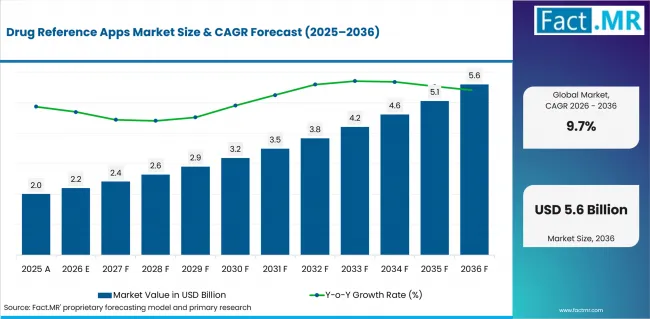
Drug Reference Apps Market Value Analysis | Source: Fact.MR
What are the defining numbers behind Drug Reference Apps Market growth?
USD 3.4 billion absolute opportunity by 2036.
- Demand Drivers in the Market
- Medication decisions are becoming harder to support through static references. Clinicians need current labels and dosing guidance during care.
- Hospital buyers need drug content that shows editorial control before subscription renewal. A clear update process reduces approval friction.
- Mobile workflows support short lookup sessions. Physicians and pharmacists need reliable answers without returning to a fixed workstation.
- Key Segments Analyzed
- By Product Type: Mobile Drug Reference Apps are expected to hold 34.0% share in 2026 since portable lookup remains the fastest route to repeated clinical use.
- By Application: Drug Information Lookup is projected to account for 31.0% share in 2026. Monographs and identification checks remain the entry tasks for most users.
- By End User: Hospitals are anticipated to capture 36.0% share in 2026. Enterprise access can serve clinical and pharmacy teams under one license.
- Analyst Opinion at Fact.MR
- Shambhu Nath Jha, Principal Consultant at Fact.MR, states, “Premium adoption depends on update discipline and integration support. AI answers need citations before clinical users can trust them. The validation issue has a related care-technology pattern in psychiatric digital biomarkers when digital evidence needs clinical review.”
- Strategic Implications
- Hospital buyers can define approval criteria around content provenance before price comparison begins. E-prescribing systems matter when drug information needs to appear inside ordering routines.
- Vendors need clear evidence that interaction checks remain current after formulary changes. Digital therapeutics shows why care software must prove workflow fit before paid use expands.
- Investors can separate drug-reference exposure from broad digital health traffic by reviewing renewals and implementation depth. Healthcare cloud computing becomes relevant when licensed content needs secure multi-site delivery.
The USA is expected to record a 10.6% CAGR from 2026 to 2036. Japan is projected at 10.3% through local-label alignment. Germany is anticipated at 10.0% through connected prescribing. The UK is forecast at 9.7% through institutional safety routines. Canada is estimated at 9.4% through provincial purchasing. Australia is expected at 9.1% through mobile clinical access. Brazil is projected at 8.8% through retail pharmacy use.
How does the Drug Reference Apps Market break down by segment?
Mobile Drug Reference Apps lead Product Type with 34.0% share in 2026. Drug Information Lookup leads Application with 31.0% share in 2026.
Which product type dominates?
Mobile Drug Reference Apps are projected to account for 34.0% share in 2026.
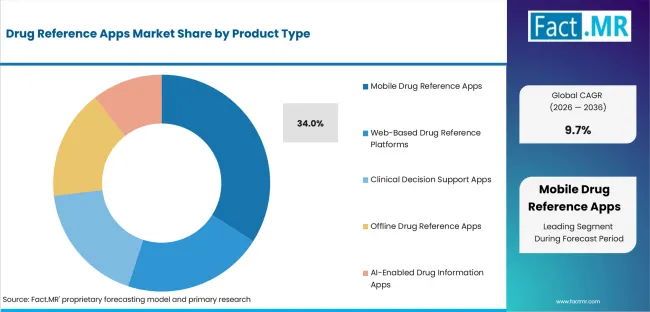
Drug Reference Apps Market Analysis By Product Type | Source: Fact.MR
Mobile apps fit repeated clinical lookup. Users can check a monograph or dose note without leaving the care routine. Portable access gives mobile apps the clearer frequency advantage.
What leads the Application segment?
Drug Information Lookup is expected to hold 31.0% share in 2026.
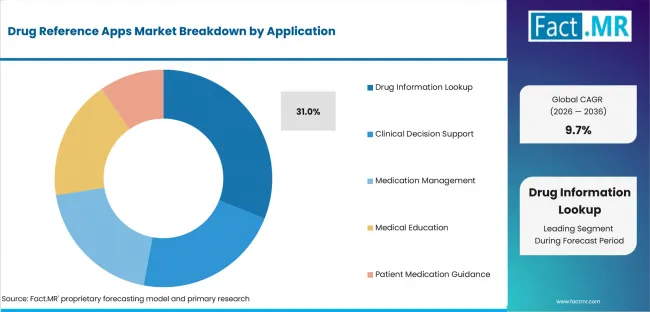
Drug Reference Apps Market Analysis By Application | Source: Fact.MR
Most users start with identity and indication checks before interaction review. This makes lookup the gateway task for individual subscriptions and enterprise licenses.
What supports Hospitals within End User?
Hospitals are anticipated to represent 36.0% share in 2026.
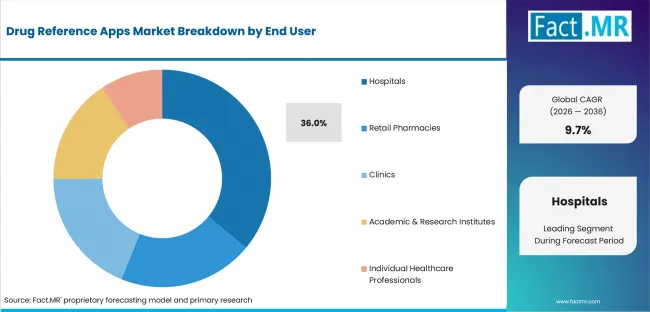
Drug Reference Apps Market Analysis By End User | Source: Fact.MR
Hospitals concentrate spending through system-wide licenses. One contract can serve clinical teams and medication-safety users under the same access model.
How does Direct Subscription shape distribution?
Direct Subscription is expected to remain the most visible enterprise route.
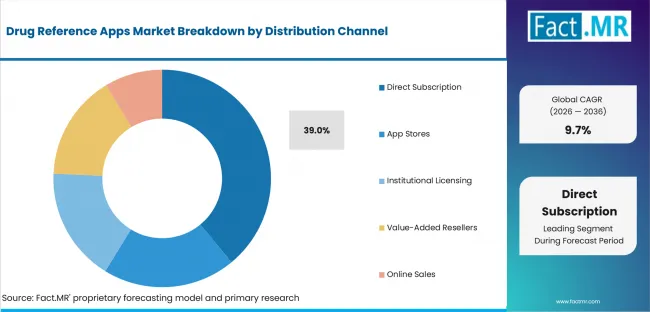
Drug Reference Apps Market Analysis By Distribution Channel | Source: Fact.MR
Direct subscription fits buyers that need user control and renewal visibility. Larger buyers prefer contracts that clarify access terms and support responsibilities.
What supports Mobile Platform demand?
Mobile Platform use is likely to remain central to repeated clinical lookup.
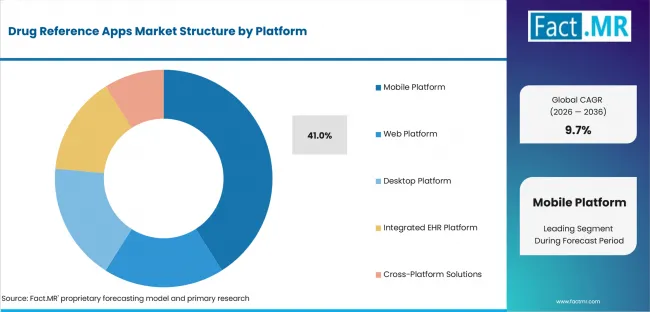
Drug Reference Apps Market Analysis By Platform | Source: Fact.MR
Mobile access supports rounds and dispensing checks. It supports patient counseling when users need a quick answer during care.
What is accelerating Drug Reference Apps Market adoption, and what is holding it back?
Demand is expected to rise as healthcare providers improve medication safety and add drug information to clinical workflows. Growth may be limited by free alternatives and high integration costs.
Drivers Impact Analysis
| DRIVER | (~) % IMPACT ON CAGR | GEOGRAPHIC RELEVANCE | IMPACT TIMELINE |
|---|---|---|---|
| Medication-safety workflow pressure | +2.8% | USA, UK, Canada | Short term (<= 2 years) |
| Enterprise content governance | +2.1% | USA and Germany | Medium term (2-4 years) |
| Mobile point-of-care lookup | +1.8% | Global | Short term (<= 2 years) |
| EHR and prescribing workflow integration | +1.5% | USA, Germany, Japan | Medium term (2-4 years) |
| Local drug data and language support | +1.0% | Japan and Brazil | Long term (>= 4 years) |
Source: Fact.MR analysis. Updated Aug 3, 2026
- Medication-safety workflow pressure: Clinicians need fast access to current drug information when medication lists and dosing questions change during care.
- Enterprise content governance: Health systems are expected to favor vendors that show editorial control and a traceable update process.
- Mobile point-of-care lookup: App-based access is expected to improve repeated use when common medicine questions appear away from fixed terminals.
Opportunity Impact Analysis
| OPPORTUNITY | (~) % IMPACT ON CAGR | GEOGRAPHIC RELEVANCE | IMPACT TIMELINE |
|---|---|---|---|
| Validated AI with local clinical integration | +1.6% | USA and Japan | Medium term (2-4 years) |
| Hospital formulary integration | +1.1% | North America and Europe | Medium term (2-4 years) |
| Pharmacist-led medication review workflows | +0.9% | UK and Canada | Medium term (2-4 years) |
| Offline and mobile expansion | +0.7% | Australia and Brazil | Long term (>= 4 years) |
Source: Fact.MR analysis. Updated Aug 3, 2026
- Validated AI with local clinical integration: Governed retrieval is expected to help users find cited answers faster. AI drug repurposing shows a similar need for source traceability when algorithms influence therapeutic questions.
- Hospital formulary integration: Vendors that place drug content near formulary status are expected to improve renewal discussions.
- Pharmacist-led medication review workflows: Medication review programs are likely to raise demand for clear interaction and dosing explanations.
Restraints Impact Analysis
| RESTRAINT | (~) % IMPACT ON CAGR | GEOGRAPHIC RELEVANCE | IMPACT TIMELINE |
|---|---|---|---|
| Free alternatives and public labels | -1.3% | Global | Short term (<= 2 years) |
| Enterprise integration cost | -1.0% | USA and Germany | Medium term (2-4 years) |
| Clinical governance and liability review | -0.8% | Regulated healthcare systems | Medium term (2-4 years) |
| Local language and update burden | -0.6% | Japan and Brazil | Long term (>= 4 years) |
Source: Fact.MR analysis. Updated Aug 3, 2026
- Free alternatives and public labels: Basic questions can often be answered through official labels and free clinician apps.
- Enterprise integration cost: Paid vendors must justify implementation work across identity management and clinical governance teams.
- Clinical governance and liability review: Hospitals may delay adoption when AI summaries cannot be audited by source and update date.
Which countries are scaling Drug Reference Apps Market fastest?
- The USA leads through health-system licensing and demand for transparent decision support, while Japan follows through strict labeling and pharmacy review.
- Germany and the UK grow through connected prescribing and institutional medication-safety needs. Canada benefits from provincial purchasing across hospital and community pharmacies.
- Australia gains from mobile clinical access and remote care. Brazil relies more on affordable mobile tools, retail pharmacy use and local-language content. Integration proof supports scaling.
The full report provides country-level CAGR analysis across North America and Latin America. Coverage extends to Western Europe and Eastern Europe. East Asia and South Asia and Pacific are included. The Middle East and Africa are covered.
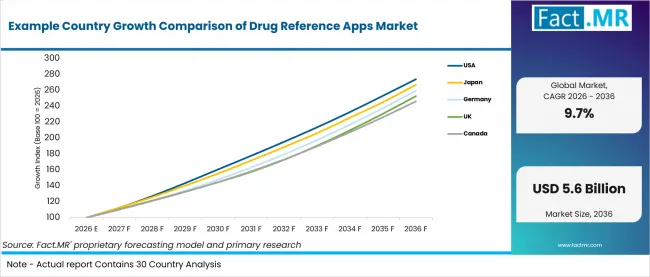
Example Country Growth Comparison Of Drug Reference Apps Market | Source: Fact.MR
| Country | CAGR (2026-2036) |
|---|---|
| USA | 10.6% |
| Japan | 10.3% |
| Germany | 10.0% |
| UK | 9.7% |
| Canada | 9.4% |
| Australia | 9.1% |
| Brazil | 8.8% |
Source: Fact.MR analysis. Updated Aug 3, 2026
What supports USA adoption?
10.6% CAGR, supported by health-system licensing and EHR-connected decision support.
USA buyers evaluate update proof and integration burden before approving new tools. Demand moves through subscriptions and health-system licenses. EHR integrations create another route. Source transparency matters since clinical teams must trust the answer.
How is Japan scaling demand?
10.3% CAGR, driven by local-label alignment and pharmacy workflow discipline.
Japanese buyers place high value on approved local labeling. Supplier credibility depends on precise localization and frequent updates. Pharmacy teams are expected to prefer tools that match local medicine names.
What is shaping Germany’s outlook?
10.0% CAGR, backed by e-prescription use and medication-list workflows.
German providers evaluate drug information as part of connected prescribing and patient-record routines. Integration proof remains central since users need content inside daily care work.
How does the UK perform?
9.7% CAGR, led by institutional medication-safety expectations.
UK adoption is shaped by NHS terminology and centralized safety expectations. Institutional purchasing remains important alongside individual clinician use. Vendors need clear source traceability and update review.
What supports Canada’s growth?
9.4% CAGR, supported by provincial workflows and pharmacy-led information needs.
Canadian buyers combine provincial healthcare workflows with hospital and community pharmacy use. Demand builds when tools can serve both settings without separate content standards.
How is Australia developing demand?
9.1% CAGR, backed by mobile clinical access and remote-care needs.
Australia’s growth reflects demand across hospital and remote-care environments. Mobile access has value when clinicians need drug information away from a desk.
What supports Brazil’s growth?
8.8% CAGR, driven by mobile reach and retail pharmacy use.
Brazil’s growth reflects mobile-first access and affordability needs. Retail pharmacy use expands the value of simple medicine lookup. Local-language support influences paid conversion.
Who leads the Drug Reference Apps Market?
Merative and Elsevier compete through content depth and workflow integration. Wolters Kluwer, through UpToDate Lexidrug and UpToDate strengthen enterprise clinical use. Epocrates and Medscape extend mobile access. Drugs.com and MIMS support broad web or regional reach. Skyscape and Unbound Medicine serve portable medical libraries.
From 2026 to 2036, competition is expected to depend on editorial update frequency and implementation support. The comparison has a related clinical-content theme in erythropoietin drugs since therapy selection depends on context and dosing practice.
Which companies are the key providers?
Key companies include Merative (Micromedex), Elsevier and Epocrates. UpToDate (Wolters Kluwer), MIMS and Medscape are included. Drugs.com, Wolters Kluwer, through UpToDate Lexidrug and Skyscape are included with Unbound Medicine.
- Merative (Micromedex)
- Elsevier
- Epocrates
- UpToDate (Wolters Kluwer)
- MIMS
- Medscape
- Drugs.com
- Wolters Kluwer, through UpToDate Lexidrug
- Skyscape
- Unbound Medicine
Bibliography
- Elsevier. (2025, March). Elsevier expands ClinicalKey AI with Epic integration and mobile application.
- Merative. (2025, September). Micromedex launches AI-powered search across drug information and toxicology content.
- U.S. Centers for Disease Control and Prevention. (2024, November 18). About medication safety.
This Report Answers
- The report provides strategic intelligence on the Drug Reference Apps Market across Product Type and Application choices that shape medication-information access.
- Segment analysis covers Mobile Drug Reference Apps and Drug Information Lookup as the share leaders within the 2026 market.
- Country outlook evaluates the USA and Japan alongside Germany and the UK. Canada and Australia are covered with Brazil.
- Competitive analysis profiles Merative and Elsevier alongside Epocrates and UpToDate. MIMS and Medscape complete the view with Drugs.com. Wolters Kluwer, through UpToDate Lexidrug, Skyscape and Unbound Medicine complete the provider set.
- Workflow assessment covers interaction checks and drug monographs. Dose guidance and drug identification complete the reference view alongside clinical decision support.
What does the Drug Reference Apps Market cover?
Drug reference applications and platforms provide current medication information when lookup and dosing support affect prescribing or dispensing. The market has a related workflow boundary with digital pathology when clinical information needs traceable review.
The Drug Reference Apps Market covers revenue from mobile apps and web platforms. It covers institutional licenses and content databases. API-connected drug data services are included. Coverage extends to monographs and interaction checks. It covers identification and dosing support.
What is included in the scope?
Drug reference platforms are used across hospitals and physicians. Hospital pharmacists and retail pharmacies are included when the paid product provides drug data or lookup functionality.
The scope includes Product Type and Application. End User and Distribution Channel are included. Platform completes the market view. Coverage spans mobile apps and web platforms. It includes monographs and identification. Clinical decision support and app-store access are included.
What is excluded from the scope?
General wellness content and broad healthcare software remain outside the scope of this market when drug-reference revenue cannot be separated.
It excludes bundled EHR content and general wellness tools. Company revenue is excluded without a clear connection to medication lookup or safety guidance.
How Was the Analysis Built?
The analysis draws on 120+ sources and 35+ company portfolios. It covers 25+ countries and more than 20 interviews.
- Primary Research: Interviews cover suppliers and users. Procurement teams are included. The review examines purchasing priorities and approval requirements.
- Desk Research: Desk research reviews government statistics and filings. It checks company material and technical studies. Associations and standards are used when relevant.
- Market Sizing and Forecasting: Estimates combine historical performance and demand indicators. Pricing trends are reviewed with segment shares. Adoption barriers are checked before final values are reconciled.
- Data Validation and Update Cycle: Findings are checked against interviews and public data. Updates review launches and procurement trends.
Segmentation
What is the report’s scope and coverage?
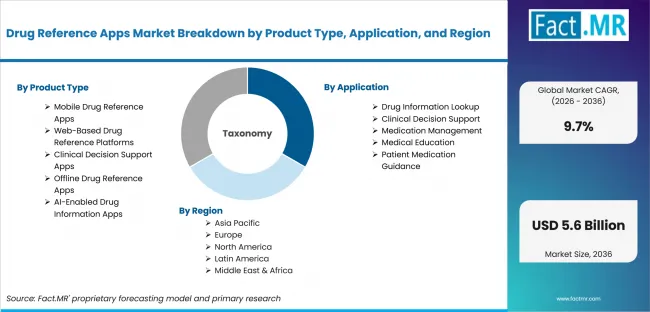
Drug Reference Apps Market Breakdown By Product Type, Application, And Region | Source: Fact.MR
| Attribute | Details |
|---|---|
| Quantitative Units | USD billion in 2026 to USD billion by 2036 at CAGR |
| Market Definition | Paid drug-reference app and platform revenue, including licensed medication content and API-connected drug data used for clinical lookup and point-of-care decisions |
| Product Type | Mobile Drug Reference Apps; iOS Applications; Android Applications; Web-Based Drug Reference Platforms |
| Application | Drug Information Lookup; Drug Monographs; Drug Identification; Clinical Decision Support |
| End User | Hospitals; Physicians; Hospital Pharmacists; Retail Pharmacies |
| Distribution Channel | Direct Subscription; Individual Subscription; Enterprise Subscription; App Stores |
| Platform | Mobile Platform; iOS; Android; Web Platform |
| Regions Covered | North America; Latin America; Europe; East Asia; South Asia and Pacific; Middle East and Africa |
| Countries Covered | USA; Japan; Germany; UK; Canada; Australia; Brazil |
| Key Companies Profiled | Merative (Micromedex); Elsevier; Epocrates; UpToDate (Wolters Kluwer); MIMS; Medscape; Drugs.com; Wolters Kluwer, through UpToDate Lexidrug; Skyscape; Unbound Medicine |
| Forecast Period | 2026 to 2036 |
| Approach | Hybrid top-down and bottom-up approach using subscription revenue; renewal patterns; mobile and web adoption; hospital and pharmacy licensing; drug-content update requirements; EHR and prescribing integration; medication-safety workflows; platform use; country adoption patterns and company portfolio review |
Source: Fact.MR analysis. Updated Aug 3, 2026
How is the market segmented?
-
By Product Type:
- Mobile Drug Reference Apps
- iOS Applications
- Android Applications
- Web-Based Drug Reference Platforms
- Browser-Based Platforms
- Cloud-Based Platforms
- Clinical Decision Support Apps
- Drug Interaction Checkers
- Dosage Calculators
- Offline Drug Reference Apps
- Offline Databases
- Downloadable Drug Libraries
- AI-Enabled Drug Information Apps
- Generative AI Search
- Personalized Drug Recommendations
- Mobile Drug Reference Apps
-
By Application:
- Drug Information Lookup
- Drug Monographs
- Drug Identification
- Clinical Decision Support
- Drug Interaction Analysis
- Dosage Recommendations
- Medication Management
- Prescription Verification
- Medication Reconciliation
- Medical Education
- Pharmacology Learning
- CME Resources
- Patient Medication Guidance
- Medication Counseling
- Adherence Support
- Drug Information Lookup
-
By End User:
- Hospitals
- Physicians
- Hospital Pharmacists
- Retail Pharmacies
- Community Pharmacies
- Chain Pharmacies
- Clinics
- Primary Care Clinics
- Specialty Clinics
- Academic & Research Institutes
- Medical Universities
- Research Organizations
- Individual Healthcare Professionals
- Nurses
- Independent Physicians
- Hospitals
-
By Distribution Channel:
- Direct Subscription
- Individual Subscription
- Enterprise Subscription
- App Stores
- Apple App Store
- Google Play Store
- Institutional Licensing
- Hospital Licensing
- University Licensing
- Value-Added Resellers
- Healthcare IT Partners
- Medical Software Vendors
- Online Sales
- Official Websites
- Digital Marketplaces
- Direct Subscription
-
By Platform:
- Mobile Platform
- iOS
- Android
- Web Platform
- Cloud-Based
- Browser-Based
- Desktop Platform
- Windows
- macOS
- Integrated EHR Platform
- Hospital Information Systems
- Clinical Information Systems
- Cross-Platform Solutions
- Hybrid Applications
- Multi-Device Synchronization
- Mobile Platform
-
By Region:
- North America
- Latin America
- Western Europe
- Eastern Europe
- East Asia
- South Asia and Pacific
- Middle East and Africa
Frequently Asked Questions
Which Product Type leads the market?
Which Application leads the market?
Which End User leads the market?
Which country records the highest listed CAGR?
What is the primary driver in this market?
What is the main restraint?
Why do hospitals lead demand?
Who worked on this report


Preview the report firsthand - request a free sample
Free SampleGet the brochure for pricing and purchase details
Download PDF