- Market Value (2025): USD 169.1 Mn
- Estimated Value (2026): USD 180.4 Mn
- Forecast Value (2036): USD 343.4 Mn
- CAGR (2026-2036): 6.7%
What is the Dural Repair Market forecast to be worth by 2036?
USD 180.4 million in 2026 to USD 343.4 million by 2036 at a 6.7% CAGR.
- Fact.MR estimates that the dural repair market reached USD 169.1 million in 2025, with collagen grafts for cranial closure forming most of that base.
- Revenue will climb from USD 180.4 million in 2026 to USD 343.4 million by 2036 as more cranial and spinal cases end with a graft or sealant.
- A 6.7% CAGR is set to carry the market through 2036, since spine surgery in older patients adds to steady cranial demand.
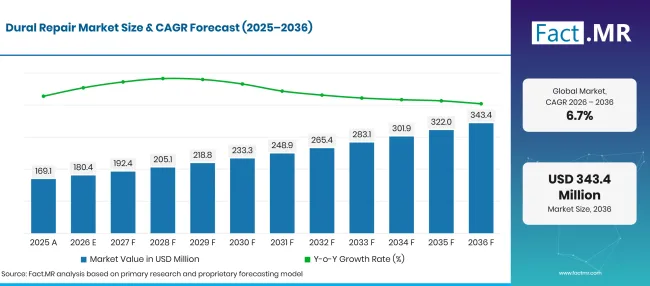
Factmr Dural Repair Market Forecast Global | Source: Fact.MR
| Year | Basis | Market Value (USD million) |
|---|---|---|
| 2025 | Actual | 169.1 |
| 2026 | Estimate | 180.4 |
| 2036 | Forecast | 343.4 |
| CAGR 2026 to 2036 | Forecast period | 6.7% |
Source: Fact.MR analysis. Updated Oct 16, 2026
What are the defining numbers behind Dural Repair Market growth?
The 2026 to 2036 period adds USD 163.0 million in new value, concentrated in hospital neurosurgery and spine closure.
- Demand Drivers in the Market
- Neurological disease keeps cranial surgery volumes high. The World Health Organization reported in October 2025 that neurological conditions affect more than 40% of the global population, or over 3 billion people [1]. Tumor resection, hemorrhage evacuation and Chiari decompression often end with a dural graft or sealant at closure.
- Trauma creates a steady need for emergency craniotomy and spinal stabilization. A WHO fact sheet dated July 2026 states that about 1.16 million people die in road crashes each year, while 20 to 50 million more are injured [2]. Head injuries from crashes and falls often leave dural tears that surgeons must close.
- Spine surgery adds a second source of product sales. Incidental durotomy during decompression and fusion needs prompt repair. Surgeons increasingly place a sealant over the suture line to lower the risk of a postoperative leak.
- Product design is moving toward faster closure. Onlay grafts that need no sutures and spray sealants that set in seconds shorten the final stage of surgery. Hospitals value these gains as operating room time grows more expensive.
- Key Segments Analyzed
- By Product Type: Biologic Dural Repair Products will hold 62.0% share in 2026, as surgeons trust bovine collagen grafts with decades of cranial use behind them.
- By Application: Neurosurgery will capture 52.8% share in 2026, since tumor and hemorrhage cases leave large dural defects that need grafting.
- By End-User: Hospitals will command 58.6% share in 2026, given that emergency head injuries and brain tumor cases cannot move to outpatient settings.
- Analyst Opinion at Fact.MR
- Shambhu Nath Jha, Principal Consultant at Fact.MR, states, “Dural repair will remain a closure decision that surgeons make in almost every open cranial case. Collagen grafts will keep their lead, while synthetic patches and hydrogel sealants gain use in spine work. Suppliers that pair a graft with a sealant and train surgeons on both will win more hospital contracts.”
- Strategic Implications
- Device makers should offer graft and sealant sets matched to cranial and spinal closure, given that surgeons often use both products in one case.
- Hospital purchasing teams should weigh leak rates and reoperation costs alongside unit price when they select dural products.
- Ambulatory surgical center operators should stock onlay grafts and sealants for spine cases as payers move more spinal procedures to outpatient settings.
- Distributors in Brazil and other emerging markets should fund surgeon training on sealant use, since product choice in public hospitals depends on clinical familiarity.
Germany will stay ahead at 8.4% CAGR, backed by an aging population and high spending on hospital care. Brazil will follow at 7.7% as public hospitals expand elective surgery. The United States will record 6.9% with outpatient spine growth and steady trauma care volumes. Rising hospital admissions will carry the United Kingdom to 6.2%, while Japan will close at 5.5% where a large elderly population sustains cranial and spinal procedures.
How does the Dural Repair Market break down by segment?
Biologic Dural Repair Products will lead Product Type at 62.0%; Neurosurgery will head Application at 52.8%; Hospitals will top End-User at 58.6%.
Which Product Type dominates?
Biologic Dural Repair Products will take 62.0% of 2026 sales.
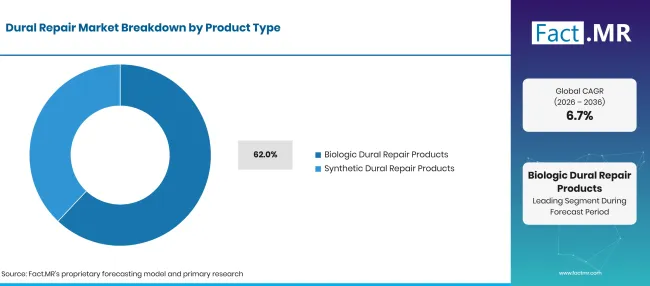
Factmr Dural Repair Market Breakdown Product Type | Source: Fact.MR
| Product Type | Share (2026) |
|---|---|
| Biologic Dural Repair Products (Leading segment) | 62.0% |
| Other segments combined | 38.0%* |
| Total | 100.0% |
Source: Fact.MR analysis. Updated Oct 16, 2026
Neurosurgeons favor collagen matrices from bovine tendon, dermis and pericardium, which hydrate in seconds and act as a scaffold for new dural tissue. Each matrix also conforms to irregular defects at the skull base. A biologic dural graft can be laid as an onlay or sutured into place. That choice lets one product serve both routine and complex cases. Synthetic products include polyesterurethane fleece, absorbable polymer membranes and PEG hydrogel sealants. They avoid animal-derived material and give consistent strength from lot to lot. Synthetic closure also overlaps with the wider tissue glue and bio-adhesive sealant category, where surgeons seek watertight seals in less time.
What leads the Application segment?
Neurosurgery is set to claim 52.8% of the 2026 total.
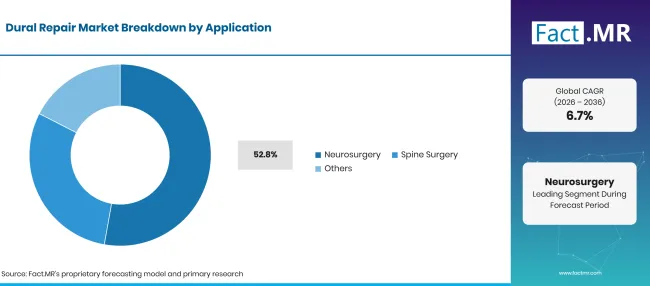
Factmr Dural Repair Market Breakdown Application | Source: Fact.MR
| Application | Share (2026) |
|---|---|
| Neurosurgery (Leading segment) | 52.8% |
| Other segments combined | 47.2%* |
| Total | 100.0% |
Source: Fact.MR analysis. Updated Oct 16, 2026
Almost every craniotomy opens the dura, so each cranial case creates a closure step at the end. Tumor resection, aneurysm surgery and decompressive craniectomy all end with dural closure. Surgeons often combine a graft with a fibrin sealant or a synthetic sealant to secure the suture line. Product adoption in spine surgery follows population aging and the volume of decompression and fusion cases. The World Health Organization reported in October 2025 that the number of people aged 60 and older will reach about 2.1 billion by 2050, roughly double the 2020 level [3]. Degenerative disease in older patients raises the use of spine devices in fusion surgery. Each fusion or decompression carries a risk of incidental durotomy.
How does End-User shape demand?
Hospitals will account for 58.6% of 2026 revenue.
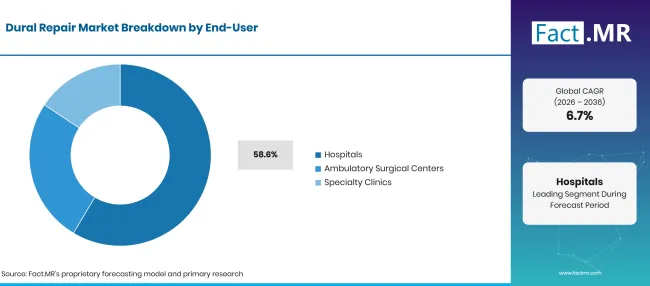
Factmr Dural Repair Market Breakdown End User | Source: Fact.MR
| End-User | Share (2026) |
|---|---|
| Hospitals (Leading segment) | 58.6% |
| Other segments combined | 41.4%* |
| Total | 100.0% |
Source: Fact.MR analysis. Updated Oct 16, 2026
Trauma craniotomy, tumor surgery and complex spine reconstruction all take place in hospital operating rooms. These cases need neurosurgical teams and intensive care beds on site. Hospital buyers often source dural products alongside hemostasis and tissue sealing agents under group purchasing contracts. Ambulatory surgical centers are gaining spine volume in the United States. The Centers for Medicare & Medicaid Services finalized its 2026 outpatient rule in November 2025, removing 285 mostly musculoskeletal procedures from the inpatient only list [4]. That rule also added 289 procedures to the ASC covered procedures list [4]. Specialty clinics use dural products in smaller volumes for selected minimally invasive procedures.
What is accelerating Dural Repair Market adoption, and what is holding it back?
Demand will rise with cranial surgery for neurological disease and trauma, with more spine surgery in older patients and with wider use of sealants. Growth is limited by the price of premium grafts and sealants and by strict rules for animal-derived implants.
Drivers Impact Analysis
| DRIVER | (~) % IMPACT ON CAGR | GEOGRAPHIC RELEVANCE | IMPACT TIMELINE |
|---|---|---|---|
| Neurological disease and tumor surgery volumes that require dural closure | +1.6% | Global | Long term (>= 4 years) |
| Spine surgery growth in aging populations | +1.3% | North America, Western Europe, East Asia | Medium term (2-4 years) |
| Trauma craniotomy after road crashes and falls | +1.0% | Latin America, South Asia & Pacific, Middle East & Africa | Short term (<= 2 years) |
| Wider use of sealants as an adjunct to sutured dural repair | +0.8% | North America, Western Europe | Short term (<= 2 years) |
Source: Fact.MR analysis. Updated Oct 16, 2026
Opportunity Impact Analysis
| OPPORTUNITY | (~) % IMPACT ON CAGR | GEOGRAPHIC RELEVANCE | IMPACT TIMELINE |
|---|---|---|---|
| Graft and sealant sets for spine surgery in ambulatory surgical centers | +0.8% | North America | Medium term (2-4 years) |
| Synthetic absorbable grafts for surgeons who avoid animal tissue | +0.6% | Western Europe, East Asia | Long term (>= 4 years) |
| Public hospital tenders in emerging health systems | +0.5% | Latin America, South Asia & Pacific | Medium term (2-4 years) |
Source: Fact.MR analysis. Updated Oct 16, 2026
Restraints Impact Analysis
| RESTRAINT | (~) % IMPACT ON CAGR | GEOGRAPHIC RELEVANCE | IMPACT TIMELINE |
|---|---|---|---|
| Premium graft and sealant prices under hospital budget limits | -0.6% | Global | Short term (<= 2 years) |
| Approval burden for animal-derived and implantable devices under EU MDR | -0.5% | Western Europe, Eastern Europe | Medium term (2-4 years) |
| Recalls and supply gaps at single-source plants | -0.4% | North America | Short term (<= 2 years) |
Source: Fact.MR analysis. Updated Oct 16, 2026
Which countries are scaling the Dural Repair Market through 2036?
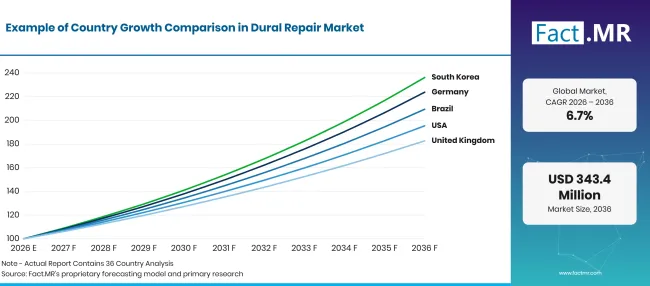
Factmr Dural Repair Market Growth Index | Source: Fact.MR
| Country | CAGR (2026–2036) |
|---|---|
| Germany | 8.4% |
| Brazil | 7.7% |
| United States | 6.9% |
| United Kingdom | 6.2% |
| Japan | 5.5% |
Source: Fact.MR analysis. Updated Oct 16, 2026
What supports Germany adoption?
8.4% CAGR, backed by an aging population and high hospital spending.
German hospitals perform a large volume of cranial and spinal surgery for an older population. Destatis reported in October 2026 that direct disease costs reached EUR 528.5 billion in 2024, with musculoskeletal diseases accounting for EUR 54.3 billion [5]. People aged 65 and older accounted for 53.8% of total disease costs in the same year [5]. Hospitals pay for dural grafts and sealants out of DRG case payments.
How is Brazil scaling demand?
7.7% CAGR, driven by public investment in elective and specialist surgery.
Brazil’s unified health system, the SUS, funds most neurosurgery and spine surgery in the country. The Ministry of Health reported in its 2025 integrated management report that the SUS performed more than 14.5 million elective surgeries in the year, a record for the system [6]. Wider access to specialist surgery in public hospitals will bring more cranial and spinal cases that need dural closure. ANVISA registration governs the entry of imported grafts and sealants.
What supports United States growth?
6.9% CAGR, helped by outpatient spine growth, an older population and steady trauma care volumes.
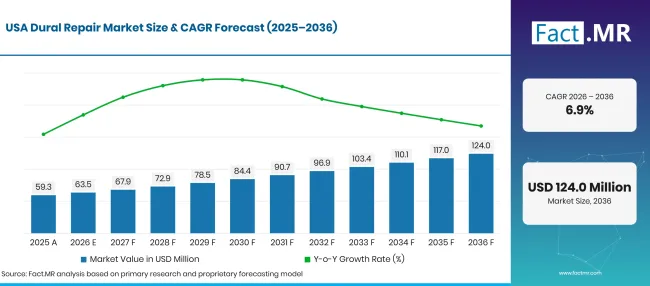
Factmr Dural Repair Market Forecast Usa | Source: Fact.MR
The U.S. Census Bureau reported in June 2025 that the population aged 65 and older reached 61.2 million in 2024, up 3.1% from 2023 [7]. Older adults face higher rates of spinal degeneration and fall-related head injury. The CDC reported more than 69,000 deaths related to traumatic brain injury in the United States in 2021 [8]. Falls account for nearly half of hospital stays for these injuries, according to the same page [8]. The FDA regulates dural grafts and sealants as medical devices.
How is the United Kingdom developing demand?
6.2% CAGR, on the back of rising hospital admissions in England.
NHS England reported in September 2025 that hospitals in England recorded 22.6 million finished consultant episodes in 2024-25, up 5.2% from the prior year [9]. The Office for National Statistics reported that the UK population reached an estimated 69.3 million in mid-2024 [10]. Across all four UK nations, the number of people aged 65 and over rose over the same year [10]. Regional NHS neurosurgery centers carry most cranial and complex spine cases.
How does Japan perform?
5.5% CAGR, reflecting a large elderly population and steady surgical volumes.
The Statistics Bureau of Japan reported in September 2026 that people aged 65 and older numbered 36.24 million, or 29.6% of the population [11]. Japan’s Ministry of Health, Labour and Welfare reported that national medical care expenditure reached JPY 48.09 trillion in fiscal 2023, up 3.0% from the prior year [12]. Japanese surgeons also use domestic absorbable dura substitutes made by Gunze.
Who leads the Dural Repair Market?
Competition runs across three groups. Broad neurosurgery suppliers such as Integra LifeSciences and Stryker compete on full ranges of collagen grafts and dural sealants.
Integra presented the Durepair Dura Regeneration Matrix at the CNS Annual Meeting in October 2025 as a recent addition to its dural graft and sealant portfolio [13]. The company also named DuraGen among the products behind organic growth in its neurosurgery sales for the third quarter of 2025 [14]. Stryker pairs DuraMatrix collagen membranes with Adherus AutoSpray dural sealants. Surgical suppliers such as B. Braun, through Aesculap, and Baxter compete with bovine pericardium patches and polyesterurethane fleece sold under broad hospital contracts. Material specialists such as Gunze and W. L. Gore compete on synthetic absorbable or non-biological membranes, with a strong base in Japan. Supplier standing will turn on watertight closure, handling time in the operating room and secure supply.
Which companies are the key providers?
Key companies include Integra LifeSciences Holdings Corporation; Stryker Corporation; B. Braun SE (Aesculap); Baxter International Inc.; W. L. Gore & Associates, Inc.; and Gunze Limited.
- Integra LifeSciences Holdings Corporation
- Stryker Corporation
- B. Braun SE (Aesculap)
- Baxter International Inc.
- W. L. Gore & Associates, Inc.
- Gunze Limited
Bibliography
- [1] World Health Organization. (2025, October 14). 11 million lives lost each year: urgent action needed on neurological care.
- [2] World Health Organization. (2026, July 20). Road traffic injuries.
- [3] World Health Organization. (2025, October 1). Ageing and health.
- [4] Centers for Medicare & Medicaid Services. (2025, November 21). Calendar Year 2026 Hospital Outpatient Prospective Payment System (OPPS) and Ambulatory Surgical Center Final Rule (CMS-1834-FC).
- [5] Statistisches Bundesamt (Destatis). (2026, October 8). Krankheitskosten im Jahr 2024 um 7,6 % gestiegen [Disease costs rose by 7.6% in 2024].
- [6] Ministério da Saúde, Brazil. (2026). Relatório Integrado de Gestão 2025 [Integrated Management Report 2025].
- [7] U.S. Census Bureau. (2025, June 26). Older Adults Outnumber Children in 11 States and Nearly Half of U.S. Counties.
- [8] Centers for Disease Control and Prevention. (2025, August 4). Facts About TBI.
- [9] NHS England. (2025, September 25). Hospital Admitted Patient Care Activity, 2024-25.
- [10] Office for National Statistics. (2025, September 26). Population estimates for the UK, England, Wales, Scotland and Northern Ireland: mid-2024.
- [11] Statistics Bureau of Japan, Ministry of Internal Affairs and Communications. (2026, September 20). 統計トピックス No.149 統計からみた我が国の高齢者 [Statistical Topics No. 149: Japan’s Elderly from a Statistical Perspective].
- [12] Ministry of Health, Labour and Welfare, Japan. (2025, October 10). 令和5(2023)年度 国民医療費を公表します [Release of the FY2023 National Medical Care Expenditure].
- [13] Integra LifeSciences. (2025, October 8). Integra LifeSciences to Spotlight Neurosurgical Product Portfolio at the Congress of Neurological Surgeons (CNS) Annual Meeting.
- [14] Integra LifeSciences. (2025, October 30). Integra LifeSciences Reports Third Quarter 2025 Financial Results.
This Report Answers
- Product use is mapped by product type, application and end-user.
- Each segment leader is named alongside the clinical factors behind its 2026 share.
- Population aging, hospital activity and public surgical capacity frame the comparison of the five listed countries.
- Which suppliers actively sell dural grafts, patches and sealants, and with which product lines, is set out by company.
- Readers see how onlay grafts, synthetic membranes and spray sealants change dural closure practice.
What does the Dural Repair Market cover?
Products that close or reinforce the dura mater after it is opened or torn during surgery form this market. Relevant products include collagen grafts, pericardium patches, synthetic membranes and dural sealants.
The assessment tracks neurosurgery and spine surgery across hospitals, ambulatory surgical centers and specialty clinics. Sales are measured at the value of products used in each care setting.
What is included in the scope?
Suturable grafts, onlay matrices, absorbable and non-absorbable dura substitutes and sealants indicated as an adjunct to sutured dural repair fall within the boundary. Products sold through direct sales, distributors and hospital tenders are included.
Sealants are counted only when they are labeled for dural closure in cranial or spinal procedures. General surgical sealants used elsewhere in the same operation are counted outside this market.
What is excluded from the scope?
Hemostatic agents, bone graft substitutes and nerve repair conduits are left out. Plates, screws and meshes used in cranio maxillofacial fixation are also excluded.
Surgical instruments, neuronavigation systems and drainage catheters fall outside the revenue boundary. Surgeon fees and hospital service charges are also excluded.
How Was the Analysis Built?
The analysis draws on 120+ sources, 35+ company portfolios, 25+ countries, and more than 20 industry interviews.
- Primary Research: Primary research includes discussions with manufacturers, service providers, technology developers, distributors, end users, and subject-matter experts. These conversations examine purchasing priorities, product adoption, operational challenges, approval requirements, competitive positioning, and the factors that influence wider market acceptance.
- Desk Research: Desk research covers government statistics, regulatory publications, company filings, trade data, technical studies, industry associations, standards, public policy, and other authoritative sources. Every source used in the analysis is documented in the bibliography.
- Market Sizing and Forecasting: Market estimates combine historical performance, demand indicators, pricing and volume trends, segment shares, company participation, country-level growth, adoption patterns, investment activity, and barriers to market expansion.
- Data Validation and Update Cycle: Findings are validated by comparing primary interviews with public data, company activity, regulatory changes, trade patterns, and industry developments. Regular updates review new product launches, capacity changes, partnerships, approvals, and shifts in commercial adoption.
Segmentation
What is the report’s scope and coverage?
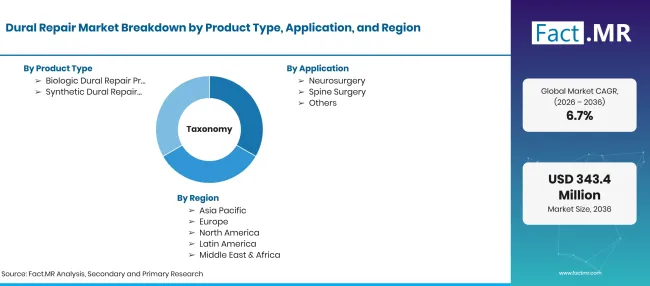
Factmr Dural Repair Market Taxonomy | Source: Fact.MR
| Attribute | Details |
|---|---|
| Quantitative Units | USD million |
| Market Definition | Implantable grafts, patches, onlay matrices and sealants used to repair or reinforce the dura mater and prevent cerebrospinal fluid leakage after cranial and spinal surgery. The scope covers biologic and synthetic products sold to hospitals, ambulatory surgical centers and specialty clinics. |
| Product Type | Biologic Dural Repair Products; Synthetic Dural Repair Products; Others |
| Application | Neurosurgery; Spine Surgery |
| End-User | Hospitals; Ambulatory Surgical Centers; Specialty Clinics |
| Regions Covered | North America; Latin America; Western Europe; Eastern Europe; East Asia; South Asia & Pacific; Middle East & Africa |
| Countries Covered | Germany; Brazil; United States; United Kingdom; Japan |
| Companies Profiled | Integra LifeSciences Holdings Corporation; Stryker Corporation; B. Braun SE (Aesculap); Baxter International Inc.; W. L. Gore & Associates, Inc.; Gunze Limited |
| Forecast Period | 2026 to 2036 |
| Approach | Hybrid top-down and bottom-up approach using cranial and spinal procedure volumes; dural repair use rates per procedure; graft and sealant pricing; care setting split; country growth; and supplier portfolio review. |
Source: Fact.MR analysis. Updated Oct 16, 2026
How is the market segmented?
-
By Product Type:
- Biologic Dural Repair Products
- Synthetic Dural Repair Products
- Others
-
By Application:
- Neurosurgery
- Spine Surgery
-
By End-User:
- Hospitals
- Ambulatory Surgical Centers
- Specialty Clinics
-
By Region:
- North America
- Latin America
- Western Europe
- Eastern Europe
- East Asia
- South Asia & Pacific
- Middle East & Africa
Frequently Asked Questions
How big is the dural repair market in 2026?
What is the CAGR of the dural repair market from 2026 to 2036?
Which product type leads the dural repair market?
Which application leads the dural repair market?
Which end-user leads the dural repair market?
Which country will grow the most in the dural repair market?
Who are the main companies in the dural repair market?
Who worked on this report


Preview the report firsthand - request a free sample
Free SampleGet the brochure for pricing and purchase details
Download PDF