- Market Value (2025): USD 3.3 Bn
- Estimated Value (2026): USD 3.7 Bn
- Forecast Value (2036): USD 12.8 Bn
- CAGR (2026-2036): 13.2%
What is the Edge AI Medical Software Market forecast to be worth by 2036?
USD 3.3 billion to USD 12.8 billion by 2036 at a 13.2% CAGR.
- The edge AI medical software market reached USD 3.3 billion in 2025.
- Demand is projected to increase from USD 3.7 billion in 2026 to USD 12.8 billion by 2036.13.2% CAGR
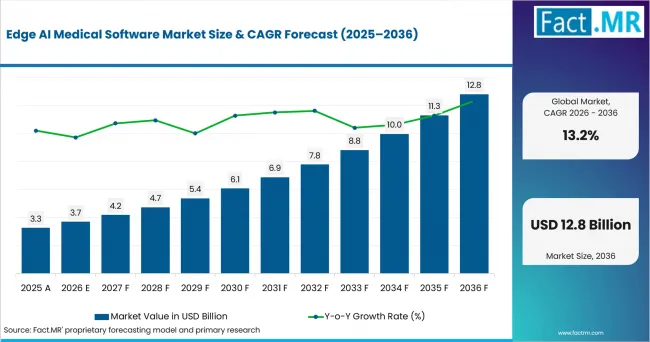
Edge Ai Medical Software Market Value Analysis | Source: Fact.MR
What are the defining numbers behind Edge AI Medical Software Market growth?
An absolute opportunity of USD 9.1 billion is expected between 2026 and 2036.
- Demand Drivers in the Market
- Rising use of AI-enabled imaging, bedside monitoring and point-of-care diagnostics is increasing demand for software that can process clinical data locally and return results with minimal delay.
- Hospitals and medical-device developers are adopting edge AI to reduce reliance on continuous cloud connectivity, limit transmission of sensitive patient data and support real-time decision-making close to the patient.
- Key Segments Analyzed
- Edge AI Diagnostic Software accounts for 41.0% of the Software Type segment in 2026, supported by demand for rapid clinical interpretation at the point of care.
- Medical Imaging Analysis holds 44.0% of the Clinical Application segment in 2026 as imaging systems generate large data volumes that benefit from low-latency processing.
- Hospitals represent 43.0% of the End-use Facility segment in 2026 due to their concentration of imaging equipment, monitoring systems and clinical decision workflows.
- Healthcare Providers account for 40.0% of the Customer Category segment in 2026 as they directly deploy edge AI tools within diagnostic and patient-care environments.
- On-device AI Inference holds 42.0% of the AI Deployment Framework segment in 2026 because it enables local analysis with faster response times and lower dependence on continuous cloud connectivity.
- Analyst Opinion at Fact.MR
- Shambhu Nath Jha, Principal Consultant at Fact.MR, states, “Edge AI Medical Software companies need to show how the product fits each use case rather than compete on generic claims. Leading positioning supports premium demand, but repeat sales are expected to depend on consistent quality, clear documentation and a measurable outcome.”
- Strategic Implications
- Brand owners should position offerings by application fit rather than generic capability claims. Clearer articulation of the specific use case and the supporting evidence is expected to shorten the buying decision and strengthen pricing power.
- Suppliers can strengthen retention by documenting specification, compliance and performance in simple customer-facing materials. Transparent documentation reduces evaluation friction and supports repeat purchasing, particularly in compliance-heavy regions.
- Distributors should plan channel strategies around the leading segment and the fastest-growing use cases. Aligning inventory, pricing and promotion with the share leaders is expected to improve margin capture.
- Pricing strategy should reflect the value of documented outcomes rather than raw capacity. Differentiating on reliability, compliance and committed service levels is expected to protect margins against lower-cost substitutes.
How does the Edge AI Medical Software Market break down by segment?
Edge AI Diagnostic Software leads Software Type with 41.0% share in 2026.
Medical Imaging Analysis leads Clinical Application with 44.0% share in 2026. Hospitals leads End-use Facility with 43.0% share in 2026. Healthcare Providers leads Customer Category with 40.0% share in 2026. On-device AI Inference leads AI Deployment Framework with 42.0% share in 2026
Why does Edge AI Diagnostic Software lead Software Type?
Edge AI Diagnostic Software is projected to account for a 41.0% share in 2026.
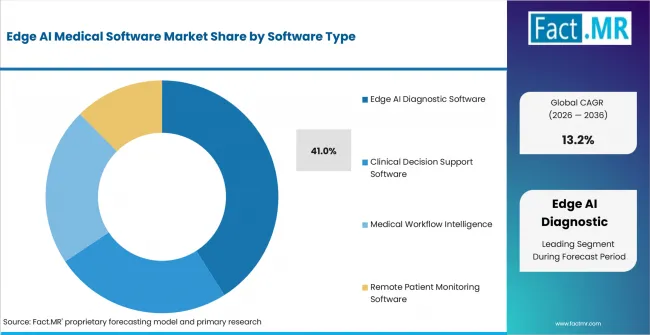
Edge Ai Medical Software Market Analysis By Software Type | Source: Fact.MR
The segment leads because diagnostic applications often require results while the patient is still being examined. Running AI models close to an imaging device or point-of-care system reduces the delay associated with transferring large clinical files to remote infrastructure. This supports use cases such as image triage, abnormality detection and bedside alerts.
The regulatory pipeline also shows that diagnostic AI has moved beyond experimentation. The FDA maintains a dedicated list of AI-enabled medical devices authorized for marketing, while WHO/Europe reported that 74% of EU countries were already using AI in diagnostics in 2026. Edge deployment becomes relevant when these applications must operate reliably within clinical environments and continue functioning during limited network connectivity.
Why does Medical Imaging Analysis lead Clinical Application?
Medical Imaging Analysis is projected to account for a 44.0% share in 2026.
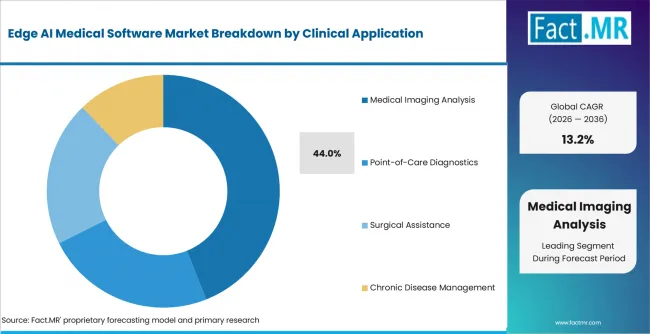
Edge Ai Medical Software Market Analysis By Clinical Application | Source: Fact.MR
Medical imaging leads because radiology produces data-intensive files that must often be reviewed rapidly. Edge AI can process X-rays, CT scans or ultrasound images near the acquisition system and flag suspected abnormalities before the complete study is transferred to central storage.
The FDA identifies reader studies as a primary method for evaluating AI-enabled devices that assist clinical decision-making in medical imaging. This reflects the maturity of imaging as an AI use case and the need to demonstrate whether the technology improves clinician performance in real workflows.
Why do Hospitals lead End-use Facility?
Hospitals are projected to account for a 43.0% share in 2026.
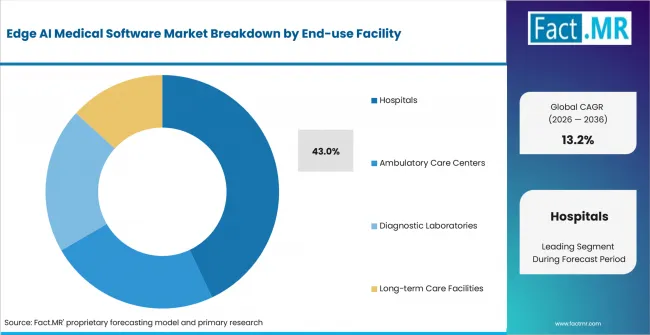
Edge Ai Medical Software Market Analysis By End Use Facility | Source: Fact.MR
Hospitals lead because they concentrate imaging systems, bedside monitors and clinical information platforms within the same environment. They also manage emergency and inpatient workflows where delayed analysis can reduce the value of an alert or diagnostic recommendation. Local inference allows hospitals to process selected data without transmitting every raw image or physiological signal outside the facility. This can improve responsiveness and reduce dependence on external connectivity, although hospitals must still manage cybersecurity and clinical validation requirements.
Why do Healthcare Providers lead Customer Category?
Healthcare Providers are projected to account for a 40.0% share in 2026.
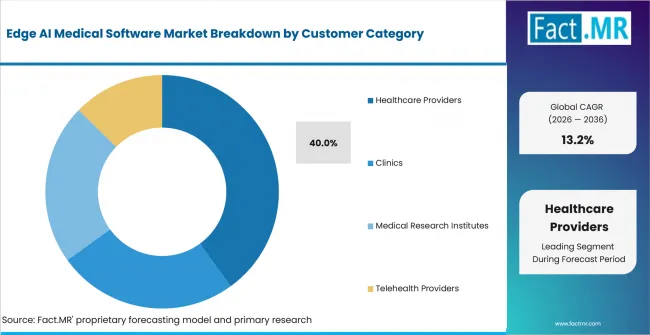
Edge Ai Medical Software Market Analysis By Customer Category | Source: Fact.MR
Healthcare providers lead because they are responsible for integrating diagnostic software into patient-care workflows and assessing whether its output is clinically useful. Their purchasing decisions depend on accuracy, interoperability and the ability to maintain human oversight. WHO emphasizes that health AI must be evaluated around safety and effectiveness while remaining available to clinicians who need it. Providers therefore favour software that produces timely outputs within existing systems and provides enough transparency for clinicians to interpret or challenge a result.
Why does On-device AI Inference lead AI Deployment Framework?
On-device AI Inference is projected to account for a 42.0% share in 2026.
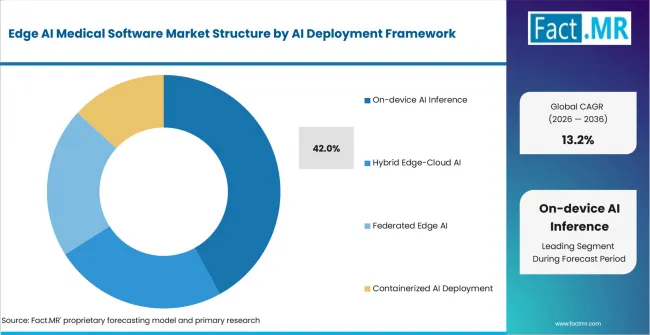
Edge Ai Medical Software Market Analysis By Ai Deployment Framework | Source: Fact.MR
On-device inference leads because the model runs directly on the medical device or nearby computing hardware. This reduces round-trip communication with the cloud and allows diagnostic or monitoring functions to continue when connectivity is interrupted. Local processing can also limit the transmission of raw patient information by sending selected findings instead of complete datasets. Research on health-oriented edge computing identifies lower latency and greater control over confidential data as practical benefits, especially for real-time monitoring and resource-constrained settings.
What is accelerating Edge AI Medical Software Market adoption, and what is holding it back?
Drivers Impact Analysis
| Driver | (~) % Impact on CAGR | Geographic Relevance | Impact Timeline |
|---|---|---|---|
| Adoption and integration | +1.6% | Global | Short term (≤ 2 years) |
| Regulatory and compliance support | +1.4% | USA, Germany and UK | Short term (≤ 2 years) |
| Channel and access expansion | +1.1% | Global | Medium term (2–4 years) |
| Clear specification and documentation | +0.9% | USA, UK and Canada | Medium term (2–4 years) |
| Cost and efficiency gains | +0.6% | Global | Long term (≥ 4 years) |
Source: Fact.MR analysis. Updated Aug 6, 2026
Restraints Impact Analysis
| Restraint | (~) % Impact on CAGR | Geographic Relevance | Impact Timeline |
|---|---|---|---|
| Cost and complexity | -1.1% | Global | Short term (≤ 2 years) |
| Specification and compliance checks | -0.9% | USA, UK and Germany | Short term (≤ 2 years) |
| Substitution by lower-cost alternatives | -0.7% | Import-dependent markets | Medium term (2–4 years) |
| Supply chain and pricing pressure | -0.5% | Global | Long term (≥ 4 years) |
| Cost and complexity | -1.1% | Global | Short term (≤ 2 years) |
| Specification and compliance checks | -0.9% | USA, UK and Germany | Short term (≤ 2 years) |
Source: Fact.MR analysis. Updated Aug 6, 2026
Opportunity Impact Analysis
| Opportunity | (~) % Impact on CAGR | Geographic Relevance | Impact Timeline |
|---|---|---|---|
| Emerging application expansion | +1.0% | Global | Medium term (2–4 years) |
| Premium and specialist positioning | +0.8% | USA, UK and Germany | Medium term (2–4 years) |
| Channel and partner expansion | +0.7% | Global | Long term (≥ 4 years) |
| Standards and compliance alignment | +0.5% | USA, Canada and Singapore | Long term (≥ 4 years) |
Source: Fact.MR analysis. Updated Aug 6, 2026
Which countries are scaling the Edge AI Medical Software Market fastest?
- USA: The FDA’s expanding list of authorized AI-enabled medical devices shows that clinical AI is moving into regulated use, with radiology forming a major part of the device pipeline. This supports edge software that can process imaging data near scanners and return findings without routing every study through remote cloud infrastructure.
- Germany: Germany had 1,874 hospitals and more than 17.2 million inpatient cases in 2023. This large hospital base creates demand for locally deployed AI that can support imaging and monitoring workflows while integrating with existing clinical infrastructure.
- Japan: Japan is promoting the development of medical devices that use AI and other digital technologies as part of its medical-device industry strategy. This policy support is improving the environment for diagnostic software designed to operate within devices and hospital systems.
- UK: AI is used to interpret acute stroke brain scans across all stroke units in England, while half of hospital trusts are deploying AI to assist with diagnoses such as lung cancer. Wider clinical deployment increases demand for software that can deliver low-latency analysis within hospital imaging workflows.
- Canada: Canada’s medical-device market, excluding in-vitro diagnostics, was estimated at USD 10.06 billion in 2024, with imaging and diagnostic products forming part of the industry base. Health Canada’s recent guidance for machine-learning-enabled devices also provides a clearer regulatory route for higher-risk AI software.
- South Korea: The K-CURE programme supports AI research using clinical data accumulated across medical institutions. Access to structured health data can accelerate the development and validation of edge diagnostic applications that must function within care settings.
- Singapore: Singapore is developing healthcare AI guidelines centred on patient safety and clinical effectiveness, while public healthcare initiatives are applying AI to risk assessment and diagnostic workflows. Its coordinated national health system provides a practical environment for testing and deploying edge AI across hospitals and primary-care facilities.
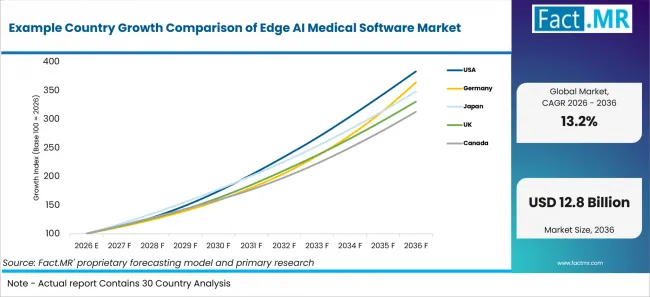
Example Country Growth Comparison Of Edge Ai Medical Software Market | Source: Fact.MR
| Country | CAGR (2026-2036) |
|---|---|
| USA | 14.4% |
| Germany | 13.8% |
| Japan | 13.3% |
| UK | 12.7% |
| Canada | 12.1% |
| South Korea | 11.6% |
| Singapore | 11.0% |
Source: Fact.MR analysis. Updated Aug 6, 2026
What is driving USA’s growth through 2036?
The USA is forecast to expand at a 14.4% CAGR from 2026 to 2036.
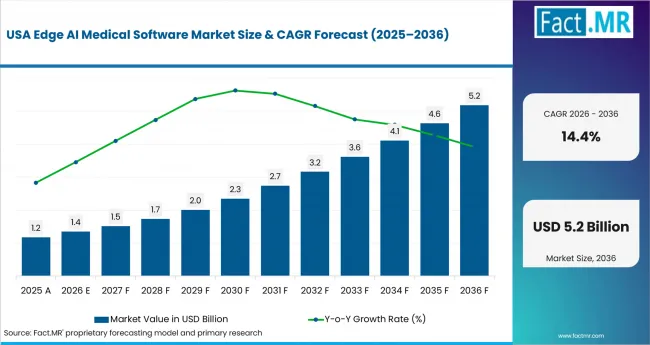
Edge Ai Medical Software Market Country Value Analysis | Source: Fact.MR
Growth is supported by a maturing regulatory pathway for AI-enabled medical software. FDA guidance now addresses lifecycle management and planned model changes, giving developers a clearer framework for software that may be updated after deployment. This is relevant to edge AI because models embedded in imaging systems and point-of-care devices must remain controlled as clinical data and algorithms evolve.
What is driving Germany’s growth through 2036?
Germany is forecast to expand at a 13.8% CAGR from 2026 to 2036.
Germany’s national digital-health strategy aims to raise hospital digital maturity and expand the use of connected patient records and AI-supported services. The strategy set a goal for 50% of hospitals funded under the Future Hospitals Fund to improve their digital maturity by the end of 2025, creating a stronger technical base for locally deployed diagnostic and monitoring software.
What is driving Japan’s growth through 2036?
Japan is forecast to expand at a 13.3% CAGR from 2026 to 2036.
Japan is working to clarify healthcare AI regulation and support adoption of AI products within medical settings. Government policy also identifies the combination of high-quality clinical data with digital technology as an opportunity for medical innovation. This supports edge software that can operate within hospital equipment while meeting domestic review and safety requirements.
What is driving the UK’s growth through 2036?
The UK is forecast to expand at a 12.7% CAGR from 2026 to 2036.
The NHS is moving from individual AI pilots toward system-wide imaging deployment. AI-powered X-ray tools are planned for all NHS trusts in England by 2029, backed by GBP 20 million, approximately USD 27 million, in government funding. This creates demand for software capable of delivering rapid analysis close to imaging equipment and integrating with hospital workflows.
What is driving Canada’s growth through 2036?
Canada is forecast to expand at a 12.1% CAGR from 2026 to 2036.
Health Canada has introduced dedicated pre-market guidance for Class II, III and IV machine-learning-enabled medical devices. The framework includes predetermined change control plans, allowing manufacturers to describe certain planned model changes in advance. Greater regulatory clarity can support investment in edge diagnostic software that requires controlled updating after installation.
What is driving South Korea’s growth through 2036?
South Korea is forecast to expand at an 11.6% CAGR from 2026 to 2036.
South Korea has established specific review guidance for AI-based medical devices used to diagnose, manage or predict disease. The framework explicitly covers clinical decision-support and computer-aided detection software, providing a defined route for products intended for imaging systems and other local clinical environments.
What is driving Singapore’s growth through 2036?
Singapore is forecast to expand at an 11.0% CAGR from 2026 to 2036.
Singapore plans to scale imaging AI across its public healthcare system, including tools used for chest X-rays and mammograms. Updated national AI-in-healthcare guidance also clarifies the responsibilities of institutions and professionals deploying these systems, supporting broader adoption of clinically validated edge software.
Who leads the Edge AI Medical Software Market?
NVIDIA Corporation is positioned as a leading technology provider through its medical-imaging computing platforms and edge inference infrastructure. Its role centres on the processors and software frameworks used by medical-device manufacturers and healthcare developers to run AI models near scanners, diagnostic equipment and point-of-care systems.
GE HealthCare, Siemens Healthineers, Philips and FUJIFILM compete through installed imaging systems and established hospital relationships. Their position allows AI capabilities to be integrated into radiology equipment and clinical workflows instead of being deployed as separate software layers.
Aidoc, Viz.ai and Qure.ai focus more directly on clinical AI applications such as imaging triage and workflow prioritisation. Butterfly Network combines software with portable ultrasound hardware, while Microsoft supports hybrid edge-cloud deployment and healthcare data integration.
Competition depends on clinical validation, processing latency and compatibility with hospital systems. Regulatory readiness also matters because medical AI must maintain reliable performance after deployment and provide evidence that clinicians can interpret its output. The OECD reported that only 10% of member countries had scaled medical-imaging AI nationally, indicating that suppliers still face a sizeable gap between successful pilots and broad health-system deployment.
Evidence quality will increasingly influence purchasing and regulatory decisions. OECD analysis found that 75% of healthcare AI solutions evaluated through randomised controlled trials showed a positive effect. Providers that combine strong trial evidence with local inference and secure model-management capabilities are better placed to move from isolated installations to wider clinical use.
Which companies are the key providers?
Key companies include NVIDIA Corporation; GE HealthCare Technologies Inc.; Siemens Healthineers AG; Koninklijke Philips N.V.; FUJIFILM Holdings Corporation; Aidoc Medical Ltd.; Viz.ai, Inc.; Butterfly Network, Inc.; Qure.ai Technologies Pvt. Ltd.; and Microsoft Corporation.
- NVIDIA Corporation
- GE HealthCare Technologies Inc.
- Siemens Healthineers AG
- Koninklijke Philips N.V.
- FUJIFILM Holdings Corporation
- Aidoc Medical Ltd.
- Viz.ai, Inc.
- Butterfly Network, Inc.
- Qure.ai Technologies Pvt. Ltd.
- Microsoft Corporation
Bibliography
- Health Canada. (2026). Pre-market guidance for machine learning-enabled medical devices. Government of Canada.
- OECD. (2026). Scaling Artificial Intelligence in Health. OECD Publishing.
- U.S. Food and Drug Administration. (2025). Artificial Intelligence in Software as a Medical Device. U.S. Department of Health and Human Services.
- U.S. Food and Drug Administration. (2026). Artificial Intelligence-Enabled Medical Devices. U.S. Department of Health and Human Services.
- World Health Organization. (2023). Regulatory considerations on artificial intelligence for health. World Health Organization.
This Report Answers
- The report provides strategic intelligence on the Edge AI Medical Software Market across the covered segments that shape product positioning.
- Segment analysis covers the leading segments and their share within the 2026 market.
- Country outlook evaluates the highest-growth markets and the wider regional comparison.
- Competitive analysis profiles the named providers in the edge ai medical software space.
- Application assessment covers the covered use cases with attention to channel access and product fit.
What does the Edge AI Medical Software Market cover?
Edge AI Medical Software products are sold across the covered segments and applications.
The Edge AI Medical Software Market covers products identified by the covered segments and sold in the assessed formats for the leading applications. The assessment includes the leading segments, the segment share leaders and the countries that drive the fastest growth. Other uses are included when the product is sold within the assessed scope.
What is included in the scope?
Edge AI Medical Software is assessed across the covered segments and regions with company coverage tied to named providers.
The scope includes the covered segments and regions. Coverage spans the leading segments and the application base that drives demand. The country view includes the listed countries and their projected growth, while the regional view covers North America, Latin America, Europe, East Asia, South Asia and Pacific, and the Middle East and Africa. Company coverage includes the named providers listed in the competitive section.
What is excluded from the scope?
Products outside the assessed segments and applications are outside this market.
The scope excludes products that do not sit within the covered segments. General alternatives and adjacent categories are outside the scope unless sold within the assessed definition. Related services and supporting equipment that are not directly tied to the covered product are excluded, keeping the market sizing consistent with the stated definition.
How Was the Analysis Built?
The analysis draws on 120+ sources and 35+ company portfolios. It covers 25+ countries and more than 20 industry interviews.
- Primary Research: Primary research includes discussions with manufacturers and service providers. It covers distributors, end users and subject-matter experts. These conversations examine purchasing priorities and channel requirements.
- Desk Research: Desk research covers official statistics and regulatory publications. It reviews company literature, trade data and standards. Every source used in the analysis is documented in the bibliography.
- Market Sizing and Forecasting: Market estimates combine historical performance with demand indicators. The model reviews pricing trends, segment shares and country-level growth. Barriers to market expansion are tested before the forecast is finalized.
- Data Validation and Update Cycle: Findings are validated by comparing interviews with public data and company activity. Regular updates review launches, sourcing shifts and changes in customer adoption.
Segmentation
What is the report's scope and coverage?
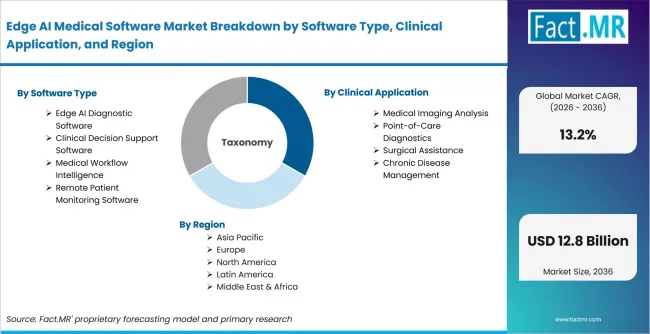
Edge Ai Medical Software Market Breakdown By Software Type, Clinical Application, And Region | Source: Fact.MR
| Attribute | Details |
|---|---|
| Quantitative Units | USD billion in 2026 to USD billion by 2036 at a CAGR |
| Market Definition | Edge AI Medical Software products sold across the covered segments and applications |
| Segments Covered | Software Type; Clinical Application; End-use Facility; Customer Category; AI Deployment Framework |
| Regions Covered | North America; Latin America; Europe; East Asia; South Asia and Pacific; Middle East and Africa |
| Countries Covered | USA; Germany; Japan; UK; Canada; South Korea; Singapore |
| Key Companies Profiled | NVIDIA Corporation; GE HealthCare Technologies Inc.; Siemens Healthineers AG; Koninklijke Philips N.V.; FUJIFILM Holdings Corporation; and others |
| Forecast Period | 2026 to 2036 |
| Approach | Hybrid top-down and bottom-up approach using segment demand; share; country growth; channel visibility; pricing; and company portfolio review |
Source: Fact.MR analysis. Updated Aug 6, 2026
How is the market segmented?
-
By Software Type:
- Edge AI Diagnostic Software
- Computer Vision Algorithms
- Deep Learning Models
- Clinical Decision Support Software
- Real-time Decision Support
- Predictive Analytics Engine
- Medical Workflow Intelligence
- Clinical Workflow Automation
- Resource Optimization
- Remote Patient Monitoring Software
- Vital Signs Monitoring
- AI-enabled Alert System
- Edge AI Diagnostic Software
-
By Clinical Application:
- Medical Imaging Analysis
- X-ray Interpretation
- CT Scan Analysis
- Point-of-Care Diagnostics
- Bedside Patient Monitoring
- Wearable Health Monitoring
- Surgical Assistance
- Robot-assisted Surgery
- Minimally Invasive Procedures
- Chronic Disease Management
- Cardiac Monitoring
- Diabetes Management
- Medical Imaging Analysis
-
By End-use Facility:
- Hospitals
- Tertiary Care Hospitals
- Diagnostic Imaging Centers
- Ambulatory Care Centers
- Outpatient Facilities
- Home Healthcare
- Diagnostic Laboratories
- Pathology Laboratories
- Genomics Laboratories
- Long-term Care Facilities
- Rehabilitation Centers
- Skilled Nursing Facilities
- Hospitals
-
By Customer Category:
- Healthcare Providers
- Hospital Networks
- Diagnostic Service Providers
- Clinics
- Ambulatory Care Providers
- Home Healthcare Providers
- Medical Research Institutes
- Clinical Researchers
- Academic Medical Centers
- Telehealth Providers
- Remote Care Providers
- Digital Health Providers
- Healthcare Providers
-
By AI Deployment Framework:
- On-device AI Inference
- GPU-accelerated Edge AI
- Hardware-optimized AI Runtime
- Hybrid Edge-Cloud AI
- Private Edge Infrastructure
- Embedded AI Runtime
- Federated Edge AI
- Privacy-preserving AI
- Low-latency AI Processing
- Containerized AI Deployment
- Kubernetes Edge Platform
- Model Lifecycle Management
- On-device AI Inference
-
By Region:
- North America
- Latin America
- Western Europe
- Eastern Europe
- East Asia
- South Asia and Pacific
- Middle East & Africa
Frequently Asked Questions
Which Software Type leads the market?
Which Clinical Application leads the market?
Which End-use Facility leads the market?
Which Customer Category leads the market?
Which AI Deployment Framework leads the market?
Which country records the highest listed CAGR?
Who worked on this report


Preview the report firsthand - request a free sample
Free SampleGet the brochure for pricing and purchase details
Download PDF