- Market Value (2025): USD 866.0 Mn
- Estimated Value (2026): USD 940.0 Mn
- Forecast Value (2036): USD 2133.2 Mn
- CAGR (2026-2036): 8.5%
What is the Embedded Hydrophilic Polymer Additives Market forecast to be worth by 2036?
USD 940.0 million in 2026 to USD 2133.2 million by 2036 at an 8.5% CAGR.
- The Embedded Hydrophilic Polymer Additives Market reached USD 866.0 million in 2025.
- Demand is projected to increase from USD 940.0 million in 2026 to USD 2133.2 million by 2036.
- The market is forecast to record 8.5% CAGR from 2026 to 2036 as converters specify durable wetting performance inside resin systems.
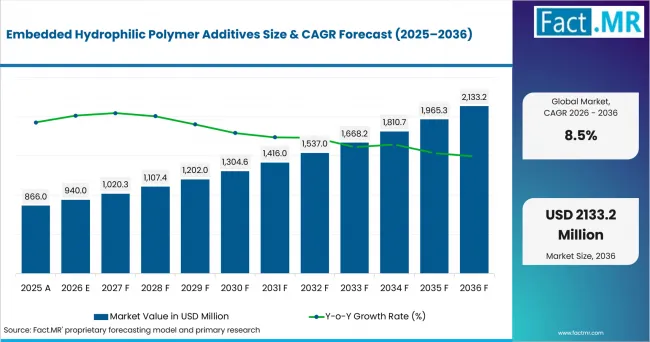
Embedded Hydrophilic Polymer Additives Value Analysis | Source: Fact.MR
What are the defining numbers behind Embedded Hydrophilic Polymer Additives Market growth?
An absolute opportunity of USD 1193.2 million is expected between 2026 and 2036.
- Demand Drivers in the Market
- Nonwoven converters need repeatable strike-through control as hygiene and medical fabrics depend on predictable fluid transfer at the contact layer.
- Film producers are expected to prefer additive formats that disperse through host resin while avoiding a separate coating station.
- Medical textile producers need low-extractable additives since skin-contact applications require stronger documentation before line approval.
- Compounders value hydrophilic systems that work across PP, PE and PET while keeping familiar extrusion conditions.
- Eurostat data extracted in August 2026 show that the EU’s value of sold industrial production amounted to nearly EUR 6.1 trillion in 2025.
- Key Segments Analyzed
- By Embedded Additive Platform: Migratory surfactant masterbatch is expected to hold 36.0% share in 2026 because pellet dosing fits existing extrusion and fiber lines.
- By Host Polymer: PP is projected to account for 39.0% share in 2026 as polypropylene remains common in spunbond and meltblown nonwoven structures.
- By Application: Nonwovens are anticipated to capture 41.0% share in 2026, supported by hygiene and medical fabrics that require controlled wetting.
- By Performance: Wicking speed is estimated to represent 36.0% share in 2026 owing to the need for fast liquid movement in absorbent products.
- Analyst Opinion at Fact.MR
- Shambhu Nath Jha, Principal Consultant at Fact.MR, states, “The commercial value in this market is repeatable wetting after compounding. Brands are asking for polymer additives that work inside the resin and stay consistent on high-volume lines. Suppliers are expected to combine resin knowledge, application testing and documentation so converters can approve new hydrophilic systems with confidence.”
- Strategic Implications
- Masterbatch suppliers should document addition rates by resin family and target wetting outcome.
- Nonwoven converters should test hydrophilic performance after storage since migration behavior affects shelf-life confidence.
- Medical and hygiene brands should request extractables data before approving new additive platforms.
- Compounders should build sample programs around PP first and then extend validated formulations into PE and PET applications.
- The U.S. Census Bureau reported on September 2, 2026 that U.S. manufacturing shipments reached USD 658.8 billion in July 2026.
South Korea is projected to record 10.0% CAGR through export-oriented materials manufacturing. The Netherlands follows at 9.4% with specialty compounding and circular-plastics programs. The USA posts 8.5% through large-scale plastics processing and medical nonwovens. Japan reaches 8.0% on precision polymer production. Germany records 7.5% as mature industrial textile and plastics producers approve additives through targeted trials.
How does the Embedded Hydrophilic Polymer Additives Market break down by segment?
Nonwovens are projected to lead Application at 41.0% share in 2026; PP leads Host Polymer at 39.0% share.
Which embedded additive platform dominates?
Migratory surfactant masterbatch is expected to hold 36.0% share in 2026.
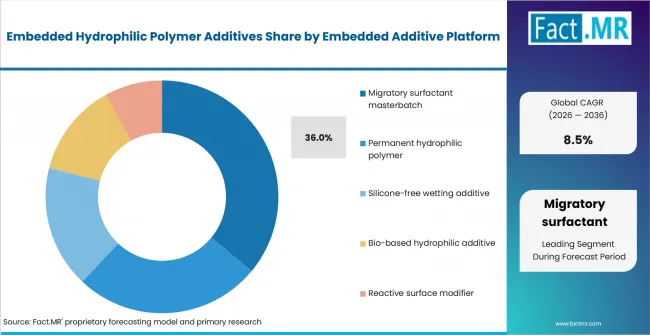
Embedded Hydrophilic Polymer Additives Analysis By Embedded Additive Platform | Source: Fact.MR
Migratory surfactant masterbatch leads because converters can meter pellets into standard polymer processing systems. The route gives nonwoven and film producers a familiar path to hydrophilicity ahead of liquid-finishing decisions.
Masterbatch form also helps suppliers control additive loading across different line speeds. Avient markets Cesa Fiber Additives for nonwovens, including solutions that provide a hydrophilic effect, while Ampacet markets ProVital masterbatch and additive solutions for medical and pharmaceutical plastics.
What leads the host polymer segment?
PP is projected to account for 39.0% share in 2026.
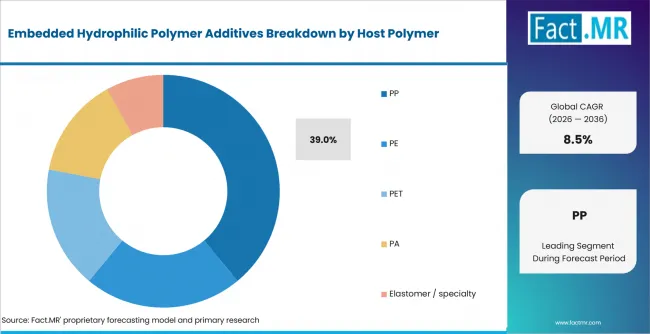
Embedded Hydrophilic Polymer Additives Analysis By Host Polymer | Source: Fact.MR
PP leads the host polymer segment because polypropylene is widely used in spunbond and meltblown nonwoven structures. Hydrophilic additives are valuable in PP since the base polymer resists water and needs modification for absorbent uses.
PP processing benefits when hydrophilic additives can enter through host resin or concentrate routes. That fit keeps trial work close to standard polyolefin extrusion practice.
How do nonwovens shape application demand?
Nonwovens are anticipated to capture 41.0% share in 2026.
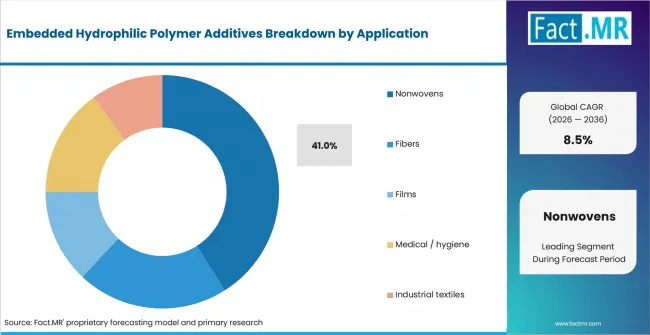
Embedded Hydrophilic Polymer Additives Analysis By Application | Source: Fact.MR
Nonwovens shape application demand because hydrophilic behavior directly affects liquid handling in diapers, feminine hygiene products and medical gowns. The additive becomes part of the performance claim that brands review during qualification.
EDANA reported on April 7, 2026 that overall nonwovens production in Greater Europe reached 2,919,000 tonnes in 2025.
What performance attribute leads specification work?
Wicking speed is estimated to represent 36.0% share in 2026.
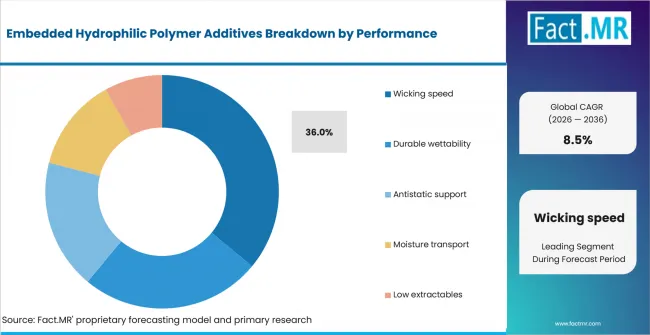
Embedded Hydrophilic Polymer Additives Analysis By Performance | Source: Fact.MR
Wicking speed leads specification work because absorbent products need liquid to move quickly from the contact layer into the core. Faster response helps converters manage rewet risk and comfort while keeping the full fabric structure in place.
Performance testing separates permanent hydrophilic polymers from surface-active systems that lose effect after aging. Test data therefore carries weight during supplier selection for hygiene and medical materials.
What is accelerating Embedded Hydrophilic Polymer Additives Market adoption, and what is holding it back?
Demand is expected to rise through embedded wetting needs and PP masterbatch familiarity. Qualification cycles, resin compatibility and documentation cost shape the pace of wider adoption.
Drivers Impact Analysis
| DRIVER | (~) % IMPACT ON CAGR | GEOGRAPHIC RELEVANCE | IMPACT TIMELINE |
|---|---|---|---|
| Shift from topical finishes to embedded wetting additives | +1.4% | Global | Short term (<= 2 years) |
| Nonwoven hygiene and medical fabric qualification | +1.1% | North America, East Asia, Western Europe | Medium term (2-4 years) |
| PP and PE converter familiarity with masterbatch dosing | +0.9% | Global | Short term (<= 2 years) |
| Circular-material reformulation needs in Europe | +0.7% | Western Europe | Long term (>= 4 years) |
Opportunity Impact Analysis
| OPPORTUNITY | (~) % IMPACT ON CAGR | GEOGRAPHIC RELEVANCE | IMPACT TIMELINE |
|---|---|---|---|
| Permanent hydrophilic polymers for durable wettability | +1.0% | Japan, South Korea, USA | Medium term (2-4 years) |
| Bio-based hydrophilic additives for brand programs | +0.8% | Western Europe, North America | Long term (>= 4 years) |
| Low-extractable additives for medical and hygiene use | +0.6% | USA, Germany, Japan | Short term (<= 2 years) |
Restraints Impact Analysis
| RESTRAINT | (~) % IMPACT ON CAGR | GEOGRAPHIC RELEVANCE | IMPACT TIMELINE |
|---|---|---|---|
| Performance drift from additive migration or blooming | -0.6% | Global | Short term (<= 2 years) |
| Compatibility limits across PP, PE, PET and PA | -0.5% | Global | Medium term (2-4 years) |
| Higher documentation burden for skin-contact applications | -0.4% | USA, Europe, Japan | Long term (>= 4 years) |
Which countries are scaling the Embedded Hydrophilic Polymer Additives Market through 2036?
- The country comparison spans 2.5 percentage points and forms three practical growth bands across the forecast period.
- South Korea remains 0.6 percentage point above the Netherlands through export-oriented materials manufacturing.
- The Netherlands remains 0.9 percentage point above the USA as specialty compounding supports polymer reformulation.
- The USA remains 0.5 percentage point above Japan through broad plastics and nonwoven conversion demand.
- Japan remains 0.5 percentage point above Germany through precision polymer production and hygiene product quality standards.
- Germany closes the displayed range as established converters approve new additives through technical trials.
Comparable CAGRs can create different entry conditions due to converter depth, medical-material qualification, polymer processing habits and circular-material programs. Full report coverage includes North America, Latin America, Western Europe, Eastern Europe, East Asia, South Asia & Pacific, Middle East & Africa.
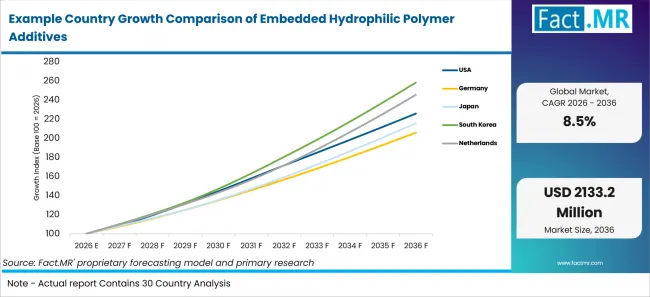
Example Country Growth Comparison Of Embedded Hydrophilic Polymer Additives | Source: Fact.MR
| Country | CAGR (2026-2036) |
|---|---|
| South Korea | 10.0% |
| Netherlands | 9.4% |
| USA | 8.5% |
| Japan | 8.0% |
| Germany | 7.5% |
How is South Korea scaling demand?
10.0% CAGR, supported by export-oriented materials manufacturing.
MOTIR reported on August 3, 2026 that Korea’s exports reached USD 98.89 billion in July 2026. This export scale supports specialty-material demand by strengthening production activity across advanced manufacturing sectors, where polymer compounds, performance additives and technical materials are qualified for domestic processing and international supply chains.
What supports the Netherlands’ growth?
9.4% CAGR, driven by specialty compounding and circular-plastics programs.
Statistics Netherlands reported on March 10, 2026 that Dutch manufacturing output in January 2026 was 1.1% higher year over year. This manufacturing momentum supports specialty compounding and circular-plastics programs, where converters increasingly evaluate advanced polymer formulations, recycled-content integration and material performance across industrial production applications.
What supports USA adoption?
8.5% CAGR, backed by broad plastics and nonwoven conversion demand.
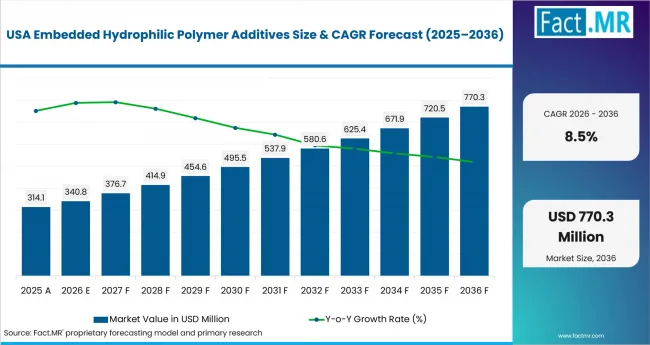
Embedded Hydrophilic Polymer Additives Country Value Analysis | Source: Fact.MR
The U.S. Census Bureau reported on September 2, 2026 that new orders for manufactured goods reached USD 663.6 billion in July 2026. This manufacturing scale supports demand across plastics and nonwoven conversion, where processors require specialty materials that deliver consistent performance across high-volume industrial and consumer applications.
How does Japan perform?
8.0% CAGR, led by precision polymer processing and hygiene quality standards.
The Statistics Bureau of Japan reported that the population aged 65 or older reached 36.202 million as of March 1, 2026. This demographic profile supports hygiene-related material demand, while Japan’s precision polymer-processing capabilities encourage adoption of formulations requiring consistent quality, controlled performance and reliable conversion characteristics.
What is supporting Germany’s adoption?
7.5% CAGR, shaped by industrial production depth and technical material qualification.
Eurostat data extracted in August 2026 show that Germany accounted for 26% of the EU’s value of sold production in 2025. This substantial manufacturing base supports technical material qualification across polymer processing, nonwovens and industrial applications where suppliers must demonstrate consistent formulation performance and reliable conversion behavior.
Who leads the Embedded Hydrophilic Polymer Additives Market?
Avient Corporation is directly active in hydrophilic additives for nonwoven applications. Its Cesa™ Fiber Additives portfolio includes hydrophilic functionality, and a November 2024 case study documents the use of Cesa Fiber Additives to provide highly hydrophilic performance in PP nonwoven medical face masks.
Ampacet Corporation supplies masterbatch and additive solutions for healthcare, pharmaceutical packaging and medical plastics. At MD&M West 2026, the company highlighted its ProVital healthcare portfolio, which includes anti-static, anti-slip, anti-microbial, UVA-light-blocking and device-marking solutions. Its ProVital+ medical-grade range includes products such as Permstat for permanent antistatic performance, GermsClean for antimicrobial functionality and LaserMark for medical-device marking.
Techmer PM has direct public evidence for TechSurf® melt-blendable additives that impart hydrophilicity to polyolefin fibers, nonwoven fabrics and specialty plastic applications. Competitive differentiation includes documented hydrophilic performance, compatibility with target polymer systems, additive dispersion and technical support during converter development and qualification trials.
Which companies are the key providers?
Companies profiled in the competitive landscape include Avient Corporation; Ampacet Corporation; Polyvel; PODDAR PIGMENTS; Qibo Technology; and Techmer PM LLC.
- Avient Corporation
- Ampacet Corporation
- Polyvel
- PODDAR PIGMENTS
- Qibo Technology
- Techmer PM LLC
Bibliography
- U.S. Census Bureau. (2026, September 2). Monthly full report on manufacturers’ shipments, inventories, & orders (Release No. CB26-135).
- Cossio Cuartero, F. (2026, April 7). 2025 nonwoven production in Greater Europe: European nonwovens industry remains strong amid challenging market conditions. EDANA.
- Ministry of Trade, Industry and Resources. (2026, August 3). July 2026 exports reach $98.89 billion, second-highest on record.
- Statistics Netherlands. (2026, March 10). Manufacturing output in January over 1 percent higher year on year.
- Eurostat. (2026, August 24). Industrial production statistics.
- Avient Corporation. (2024, November 11). Hydrophilic additives - face masks [Case study].
- Avient Corporation. (2026, January 20). Avient to highlight non-PFAS additives and sustainable polymer solutions at Pharmapack 2026.
This Report Answers
- The report explains where embedded hydrophilic polymer additives are used across additive platform and host polymer. It also covers application, performance and end-use position.
- Segment analysis identifies the leading subsegments and the technical reasons converters prioritize them.
- Country analysis examines the listed markets and the manufacturing or qualification mechanisms supporting additive adoption.
- Competitive analysis reviews current providers across masterbatch, polymer additives, hydrophilic finishes and healthcare plastics.
- Application analysis assesses how wetting speed and durable wettability influence material approval. It also considers low extractables and resin compatibility.
What does the Embedded Hydrophilic Polymer Additives Market cover?
The Embedded Hydrophilic Polymer Additives Market covers hydrophilic additives embedded in polymer systems to improve liquid interaction at the material level. It includes additive masterbatches, permanent hydrophilic polymers, silicone-free wetting additives and reactive surface modifiers used by converters.
The assessment covers PP, PE, PET, PA and specialty polymers across nonwovens, fibers and films. Adjacent coverage of medical nonwoven disposables is relevant because absorbent fabrics create direct demand for wetting speed and low-extractable performance.
What is included in the scope?
The scope includes embedded additives sold through concentrates, masterbatch carriers or polymer-compatible modifier systems. It covers hydrophilic additives used in hygiene products, medical materials, personal care components, industrial textiles and specialty packaging.
It includes additive systems that support wicking speed, durable wettability, antistatic support and moisture transport. Related coverage of polymer reactive-extrusion additives and recycled polymer additives helps frame the wider additive selection context while keeping this market boundary clear.
What is excluded from the scope?
The scope excludes finished diapers, medical gowns, wipes, hygiene brands and nonwoven roll goods sold as finished substrates. It excludes coatings applied after polymer conversion when the additive is purely external to the resin matrix.
Standard pigments, fillers, flame retardants and antimicrobial additives fall outside the scope unless they provide hydrophilic performance. Commodity polymers are excluded when sold apart from a wetting or moisture-transport additive function.
How Was the Analysis Built?
The analysis draws on 120+ sources, 35+ company portfolios, 25+ countries, and more than 20 industry interviews.
- Primary Research: Primary research includes discussions with manufacturers, service providers, technology developers, distributors, end users and subject-matter experts across adoption priorities and approval requirements.
- Desk Research: Desk research covers government statistics, regulatory publications, company filings, trade data, technical studies, standards and public policy. Selected public references used in this summary are documented in the bibliography.
- Market Sizing and Forecasting: Market estimates combine historical performance, demand indicators, segment shares, company participation, country-level growth, adoption patterns and investment activity.
- Data Validation and Update Cycle: Findings are validated by comparing primary interviews with public data, company activity and regulatory changes. Regular updates review launches, capacity changes, partnerships and approvals.
What is the report’s scope and coverage?
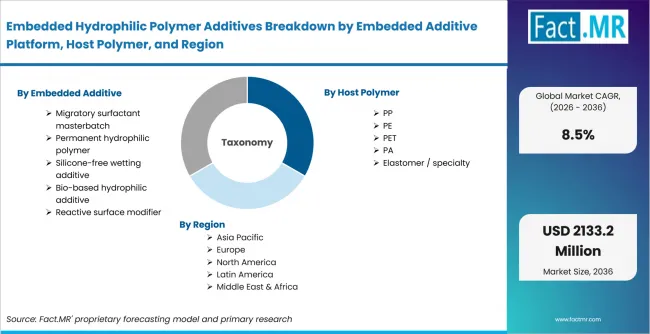
Embedded Hydrophilic Polymer Additives Breakdown By Embedded Additive Platform, Host Polymer, And Region | Source: Fact.MR
| Attribute | Details |
|---|---|
| Quantitative Units | USD million |
| Market Definition | Additives compounded into polymer systems to create or improve hydrophilic behavior, including wetting speed, durable wettability, antistatic support, moisture transport and low-extractable performance. |
| Embedded Additive Platform | Migratory surfactant masterbatch; Permanent hydrophilic polymer; Silicone-free wetting additive; Bio-based hydrophilic additive; Reactive surface modifier |
| Host Polymer | PP; PE; PET; PA; Elastomer / specialty |
| Application | Nonwovens; Fibers; Films; Medical / hygiene; Industrial textiles |
| Performance | Wicking speed; Durable wettability; Antistatic support; Moisture transport; Low extractables |
| End-Use | Hygiene products; Medical materials; Personal care; Industrial textiles; Specialty packaging |
| Regions Covered | North America; Latin America; Western Europe; Eastern Europe; East Asia; South Asia & Pacific; Middle East & Africa |
| Countries Covered | South Korea; Netherlands; USA; Japan; Germany |
| Key Companies Profiled | Avient Corporation; Ampacet Corporation; Polyvel; PODDAR PIGMENTS; Qibo Technology; Techmer PM LLC |
| Forecast Period | 2026 to 2036 |
| Approach | Hybrid top-down and bottom-up approach using polymer conversion demand, nonwoven use, resin compatibility, additive platform mix, country-level adoption and provider portfolio review. |
How is the market segmented?
-
By Embedded Additive Platform
- Migratory surfactant masterbatch
- Permanent hydrophilic polymer
- Silicone-free wetting additive
- Bio-based hydrophilic additive
- Reactive surface modifier
-
By Host Polymer
- PP
- PE
- PET
- PA
- Elastomer / specialty
-
By Application
- Nonwovens
- Fibers
- Films
- Medical / hygiene
- Industrial textiles
-
By Performance
- Wicking speed
- Durable wettability
- Antistatic support
- Moisture transport
- Low extractables
-
By End-Use
- Hygiene products
- Medical materials
- Personal care
- Industrial textiles
- Specialty packaging
-
By Region
- North America
- Latin America
- Western Europe
- Eastern Europe
- East Asia
- South Asia & Pacific
- Middle East & Africa