- Base Value(2025): 4.5 Bn
- Estimated Value(2026): 4.9 Bn
- Forecast Value (2036): 11.2 Bn
- CAGR (2026 - 2036): 8.6%
Embolotherapy Market Forecast and Outlook By FACT MR
- In 2025, the embolotherapy market crossed a valuation of USD 4.5 billion. Based on Fact.MR analysis, demand for embolotherapy products is estimated to grow to USD 4.9 billion in 2026 and USD 11.2 billion by 2036. Fact.MR projects a CAGR of 8.6% during the forecast period.
- The market is projected to generate nearly USD 6.3 billion in additional revenue between 2026 and 2036. Rising demand for minimally invasive cancer treatment and expanding interventional radiology capacity support long-term market growth.
- High device cost and limited imaging infrastructure continue to slow adoption in lower-income healthcare systems.
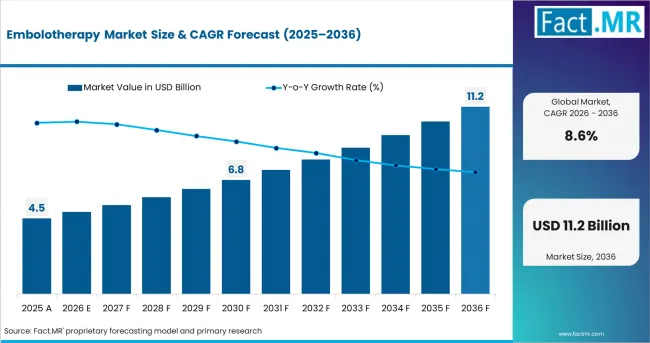
Embolotherapy Market Value Analysis | Source: Fact.MR
Summary of Embolotherapy Market
- Demand Drivers
- Rising liver cancer cases in Asia Pacific and North America are increasing transarterial chemoembolization procedure at major oncology hospitals. Liver cancer treatment remains the largest demand source for embolic agents globally.
- Minimally invasive embolization procedures are replacing open vascular surgery in interventional radiology departments. Hospitals prefer catheter-based systems due to lower complication rates and faster patient recovery.
- Drug-eluting microsphere use is increasing in liver tumor and renal cancer treatment programs. Precision drug delivery and controlled release capability is supporting stronger clinical preference for advanced embolic products.
- Key Segments Analyzed
- By Product Type: Embolic agents hold 46% share in 2026 because tumor embolization and vascular occlusion procedures continue generating strong demand across oncology care centers.
- By Disease Indication: Cancer indications account for 52% share in 2026 due to rising embolization procedure use in liver tumor and metastatic colorectal cancer treatment.
- By Procedure: TACE holds 41% share in 2026 as hepatocellular carcinoma treatment remains the largest embolotherapy application globally.
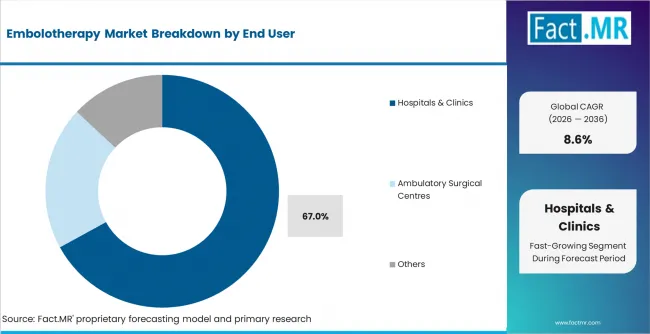
- By End User: Hospitals and clinics capture 67% share in 2026 since embolization procedures require advanced imaging systems and interventional radiology infrastructure.
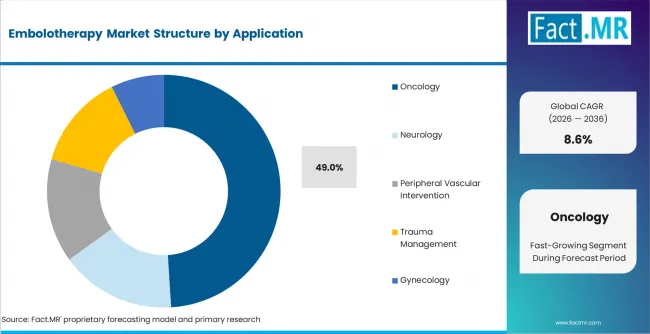
- By Application: Oncology applications account for 49% share in 2026 due to increasing adoption of minimally invasive cancer treatment across interventional radiology departments.
- Analyst Opinion at Fact.MR
- Shambhu Nath Jha, Principal Consultant at Fact.MR, opines, 'CXOs will observe that the embolotherapy market is shifting from a specialty procedural segment toward a broader oncology infrastructure investment category. Drug-eluting microsphere capability and TACE treatment coverage are becoming major competitive differentiators across leading cancer centers.'
- Strategic Implications
- Device manufacturers should expand drug-eluting microsphere portfolios for hepatocellular carcinoma and renal tumor treatment. Precision embolic delivery remains the fastest-growing area in hospital embolotherapy demand.
- Companies should strengthen interventional radiology training and procedural support in India and China. Catheter-based oncology procedure are raising faster than specialist availability in both markets.
- Manufacturers targeting ambulatory surgical centers should develop compact embolic delivery systems for outpatient care. Payer pressure on inpatient embolization cost is shifting some procedures toward outpatient sites.
| Metric | Value |
|---|---|
| Estimated Value in 2026 | USD 4.9 billion |
| Forecast Value in 2036 | USD 11.2 billion |
| Forecast CAGR (2026 to 2036) | 8.6% |
Source: Fact.MR analysis. Updated Jun 2, 2026
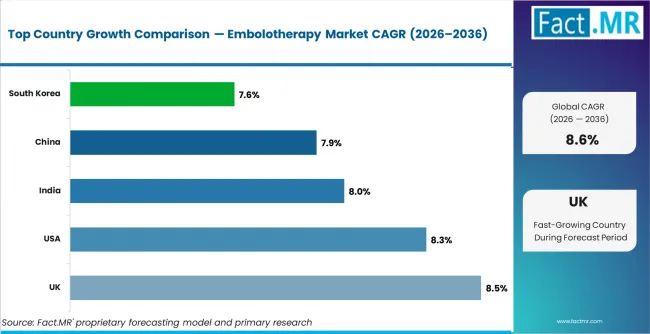
The United Kingdom is projected to grow at 8.5% CAGR through 2036 due to expanding NHS interventional radiology investment and stronger adoption of TACE procedures across oncology centers. The United States is forecast to expand at 8.3% CAGR as reimbursement coverage and outpatient embolotherapy procedures continue increasing. China is projected to grow at 7.9% CAGR because domestic device manufacturing and liver cancer treatment demand remain strong. India is expected to advance at 8.0% CAGR as private hospitals expand catheter-based oncology services across metropolitan healthcare networks. South Korea is forecast to register 7.6% CAGR due to updated hepatic embolization treatment protocols across tertiary hospitals.
Segmental Analysis
Embolotherapy Market Analysis by Product Type
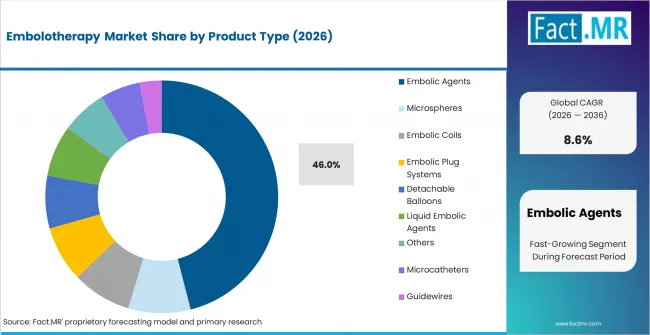
Embolotherapy Market Analysis By Product Type | Source: Fact.MR
Embolic agents hold 46% share in 2026 because tumor embolization and vascular occlusion procedures continue to create strong clinical demand. Interventional oncology departments remain the main users of embolic products globally. Medtronic plc enrolled the first patient in its Onyx Liquid Embolic IDE clinical study for treating arterial hemorrhage in peripheral vasculature. The study supports growing adoption of liquid embolic technologies for minimally invasive bleeding control and vascular embolization procedures. [1]
- Drug-eluting Microsphere Adoption: Hospitals are increasing use of drug-eluting microspheres for precision tumor embolization and controlled drug delivery.
- Liquid Embolic Expansion: Liquid embolic products continue gaining wider use across vascular and tumor embolization procedures.
- Coil Technology Development: Interventional radiology centers are increasing adoption of advanced detachable coil systems for precise embolization procedures.
Embolotherapy Market Analysis by Disease Indication
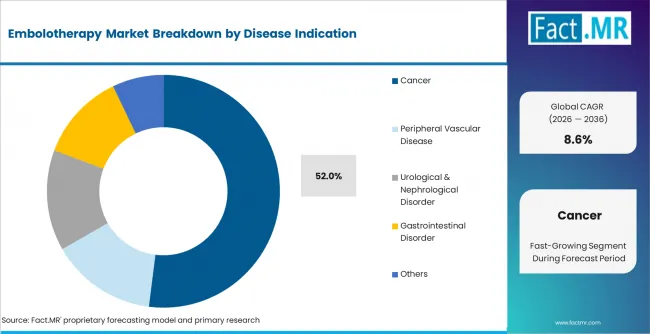
Embolotherapy Market Analysis By Disease Indication | Source: Fact.MR
Cancer indications account for 52% share in 2026 due to growing use of embolization in liver tumor and metastatic cancer treatment. Hepatocellular carcinoma remains the main treatment indication globally. Penumbra, Inc. highlighted expanding clinical adoption of advanced embolization technologies for stroke management and peripheral vascular interventions. [2]
- HCC Procedure Expansion: Updated liver cancer treatment guidelines are increasing patient eligibility for TACE procedures.
- Peripheral Vascular Growth: Peripheral vascular embolization procedures are increasing across outpatient intervention programs.
- Uterine Fibroid Embolization Demand: Gynecology departments are increasing referrals for minimally invasive uterine fibroid embolization procedures.
Embolotherapy Market Analysis by Procedure
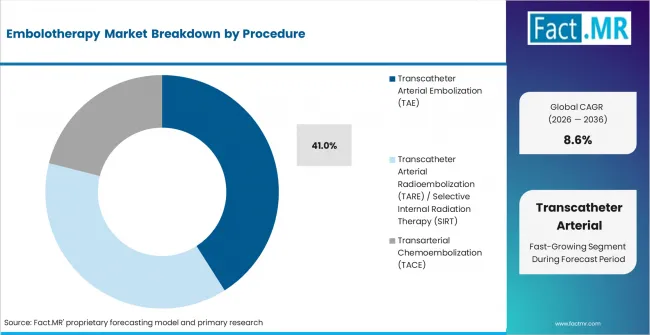
Embolotherapy Market Analysis By Procedure | Source: Fact.MR
TACE holds 41% share in 2026 as hepatocellular carcinoma treatment remains the largest embolotherapy procedure area worldwide. Tumor-directed embolization is gaining preference for inoperable liver cancer. Medtronic plc received FDA approval for reduced preparation shake time for its Onyx 18 and Onyx 34 liquid embolic systems, helping improve procedural efficiency during embolization treatments. [3]
- TARE Adoption Growth: Oncology centers are increasing TARE procedure use for liver metastasis and advanced tumor management.
- Renal Tumor Embolization Expansion: Urology and oncology centers are expanding preoperative embolization procedures for renal tumor treatment.
- Private Hospital Capacity Addition: Private healthcare networks are increasing interventional oncology infrastructure investment across emerging markets.
Embolotherapy Market Analysis by End User
Embolotherapy Market Analysis By End User | Source: Fact.MR
Hospitals and clinics capture 67% share in 2026 because embolization procedures need advanced imaging systems and interventional radiology infrastructure. Large healthcare centers remain the main embolotherapy providers globally.
- Interventional Oncology Expansion: Academic medical centers are increasing dedicated embolotherapy procedure capacity.
- Outpatient Migration Trend: Lower-complexity embolization procedures are gradually shifting toward ambulatory surgical centers.
- Centralized Purchasing Programs: Large healthcare systems are consolidating embolotherapy device procurement through system-level purchasing programs.
Embolotherapy Market Analysis by Application
Embolotherapy Market Analysis By Application | Source: Fact.MR
Oncology applications account for 49% share in 2026 as minimally invasive cancer treatment gains use in interventional radiology departments. Embolization protocols are expanding beyond liver cancer into other solid tumors. Sirtex Medical Limited received expanded CE Mark approval for SIR-Spheres Y-90 resin microspheres to treat both primary and secondary liver metastases. The approval supports growing adoption of radioembolization therapies for minimally invasive liver cancer treatment and interventional oncology procedures. [5]
- Neuroendocrine Tumor Procedures: Hospitals are increasing hepatic embolization procedures for metastatic neuroendocrine tumor management.
- Neurovascular Procedure Growth: Stroke centers are increasing minimally invasive aneurysm embolization procedures.
- Gynecology Referral Expansion: Uterine artery embolization referrals are rising across gynecology and women’s health departments.
Drivers, Restraints, and Opportunities
Embolotherapy Market Opportunity Matrix Growth Vs Value | Source: Fact.MR
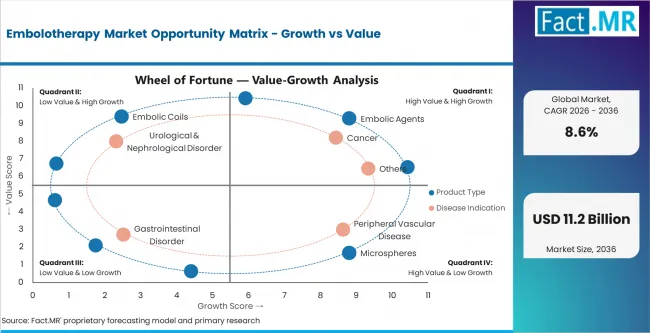
The embolotherapy market continues expanding due to rising liver cancer treatment demand and wider use of minimally invasive oncology procedures. Investment in interventional radiology infrastructure is also improving procedure access in developing healthcare systems. Terumo Corporation strengthened its neurovascular and interventional portfolio through advanced embolization and catheter-based treatment technologies. The company highlighted growing demand for minimally invasive embolotherapy solutions for aneurysm treatment and peripheral vascular interventions. [4]
- Outpatient Embolization Growth: Expanding ambulatory reimbursement coverage is increasing adoption of outpatient embolotherapy procedures for selected vascular and gynecological conditions.
- Interventional Radiology Expansion: Hospitals across Asia Pacific and the Middle East continue increasing investment in catheterization laboratories and oncology imaging infrastructure.
- High Infrastructure Cost: Advanced imaging systems and interventional radiology setup costs continue limiting faster adoption across lower-income healthcare markets.
Regional Analysis
.webp "Top Country Growth Comparison Embolotherapy Market Cagr (2026 2036)")
Top Country Growth Comparison Embolotherapy Market Cagr (2026 2036) | Source: Fact.MR
The embolotherapy market is assessed across North America, Europe, Asia Pacific, Latin America, and the Middle East and Africa covering 40+ countries segmented by interventional radiology infrastructure, oncology procedure volume, reimbursement policy, and device regulatory access. The full report offers market attractiveness analysis by region and country.
| Country | CAGR (2026 to 2036) |
|---|---|
| United Kingdom | 8.5% |
| United States | 8.3% |
| India | 8.0% |
| China | 7.9% |
| South Korea | 7.6% |
Source: Fact.MR analysis. Updated Jun 2, 2026
Source: Fact.MR analysis, based on proprietary forecasting model and primary research
Embolotherapy Market Cagr Analysis By Country | Source: Fact.MR
Europe Embolotherapy Market Analysis
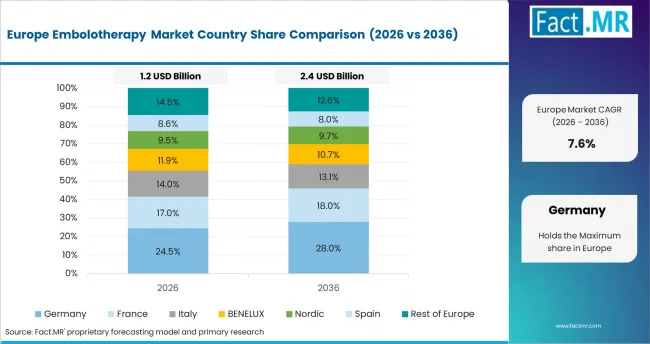
Embolotherapy Market Europe Country Market Share Analysis, 2026 & 2036 | Source: Fact.MR
Europe has well- structured reimbursement and clinical guideline system for embolotherapy procedures. National health systems and oncology treatment guidelines shape embolic device purchasing decisions across regional hospitals. Interventional oncology investment and liver cancer treatment demand remain major growth drivers across the region.
- United Kingdom: The United Kingdom is projected to grow at 8.5% CAGR through 2036. NHS cancer recovery programs are expanding interventional radiology capacity across regional oncology centers. Updated guidance for drug-eluting bead TACE procedures is increasing hospital use of advanced embolic microsphere. Workforce expansion for interventional radiology specialists are improving embolotherapy access beyond major referral hospitals.
North America Embolotherapy Market Analysis
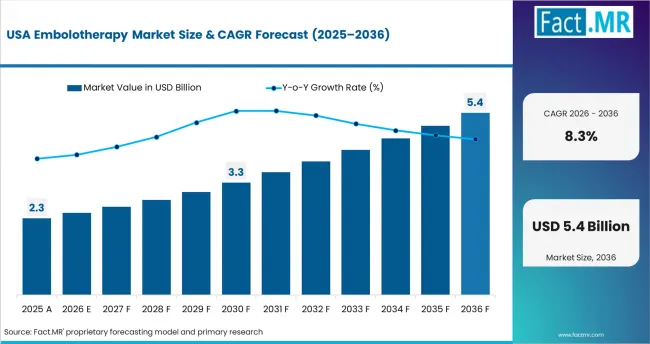
Embolotherapy Market Country Value Analysis | Source: Fact.MR
North America remains the largest revenue market for embolotherapy due to strong reimbursement support and high procedure volume in liver cancer and uterine fibroid treatment. Large academic hospitals and integrated healthcare systems continue to drive embolic agents and interventional radiology systems.
- United States: The United States is projected to expand at 8.3% CAGR by 2036. Updated outpatient reimbursement coverage for liver-directed embolotherapy procedures is increasing adoption in ambulatory surgical centers and hospital outpatient departments. Early-stage liver cancer detection programs are increasing the eligible patient pool for TACE treatment. Growing outpatient migration for selected embolization procedures continues to support embolic device demand.
Asia Pacific Embolotherapy Market Analysis
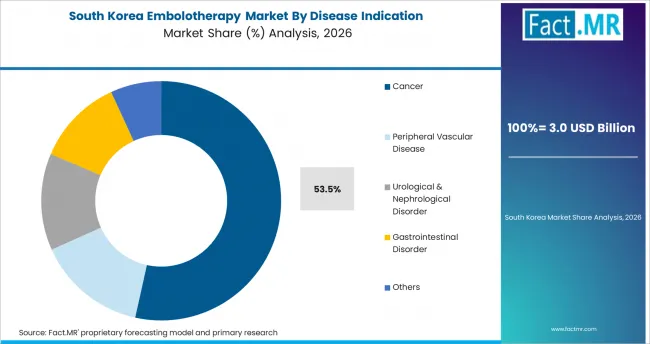
Embolotherapy Market South Korea Market Share Analysis By Disease Indication | Source: Fact.MR
Asia Pacific is the fastest-growing embolotherapy market due to high liver cancer cases and rising interventional radiology investment in private hospitals. Regional device makers and global suppliers are increasing partnerships with oncology center and expanding embolic product lines.
- India: India is projected to grow at 8.0% CAGR from 2026 to 2036. Private hospital groups are expanding catheterization labs and interventional oncology programs in major cities. Wider reimbursement coverage for TACE procedures is improving access for lower-income liver cancer patients in empaneled hospitals.
- China: China is forecast to expand at 7.9% CAGR by 2036. The country records high liver cancer treatment volume due to strong hepatocellular carcinoma incidence. Domestic approval of drug-eluting microsphere systems is improving access to cost-competitive embolotherapy products in regional hospitals.
- South Korea: South Korea is projected to grow at 7.6% CAGR through 2036. Updated hepatic embolization guidelines are improving procedure standardization in tertiary hospitals and national cancer centers. Demand for advanced embolic devices continues rising within specialized liver cancer programs.
Competitive Aligners for Market Players
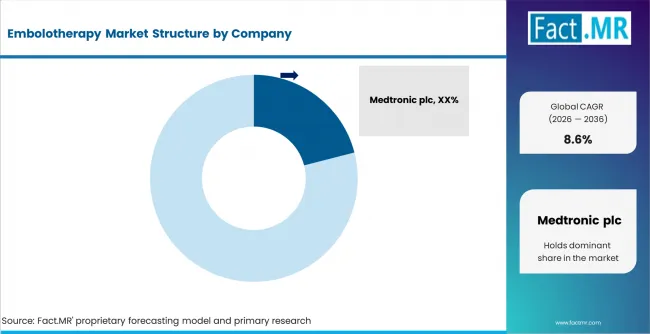
Embolotherapy Market Analysis By Company | Source: Fact.MR
Embolotherapy device manufacturers are focusing more on precision embolic technologies and interventional oncology partnerships. Drug-eluting microspheres and advanced liquid embolic systems are gaining stronger clinical use in liver cancer and metastatic tumor treatment. Companies with oncology-focused embolic portfolios can gain better access to high-value hospital contracts.
Interventional radiology infrastructure expansion remains a major growth driver in Asia Pacific and North America. Hospitals are investing in catheterization labs and advanced imaging systems to support more minimally invasive oncology procedure. Manufacturers offering physician training and procedure support can build stronger hospital relationships.
TACE and TARE procedure growth is increasing demand for microcatheters, embolic coils, and precision delivery systems. Suppliers with broad portfolios covering embolic agents and support devices are gaining stronger preference in integrated healthcare networks. Consolidated hospital sourcing programs favor vendors that support multiple embolotherapy applications through one supplier agreement.
Outpatient embolization is creating opportunity for compact and efficient delivery systems. Companies developing embolic platforms for ambulatory surgical centers can improve competitiveness as healthcare systems reduce inpatient procedure use. Regional manufacturing expansion across China and India is also improving pricing competitiveness and local market access for embolotherapy suppliers.
Key Players
- Medtronic plc
- Boston Scientific Corporation
- Penumbra, Inc.
- Terumo Corporation
- Sirtex Medical Limited
- Merit Medical Systems, Inc.
Bibliography
- Medtronic. (2025, July 16). Medtronic enrolls first patient in Onyx™ Liquid Embolic IDE Clinical Study for embolization of arterial hemorrhage in peripheral vasculature.
- Amin, S., Guidry, R. M., Jr., Gunn, A. J., El Khudari, H., Oderich, G. S., & Koh, E. Y. (2024, February). Penumbra embolization platform: A coil for every case. Endovascular Today, 23(2), 27–32.
- Endovascular Today. (2026, May 19). FDA approves reduced shake time for Medtronic’s Onyx 18 and Onyx 34.
- Terumo Corporation. (2024, November 12). Terumo Blood and Cell Technologies merges therapeutics units to enhance patient care across treatment journey.
- Endovascular Today. (2025, September 10). Sirtex SIR-Spheres receive expanded CE Mark approval to treat liver cancer.
This Report Addresses
- Strategic analysis of embolotherapy demand across hepatocellular carcinoma treatment, peripheral vascular occlusion, uterine fibroid embolization, cerebral aneurysm coiling, and neuroendocrine tumor management.
- Market forecast from USD 4.9 billion in 2026 to USD 11.2 billion by 2036 at 8.6% CAGR with segment-level growth analysis by product type, procedure, indication, end user, and application.
- Opportunity assessment across the United Kingdom, United States, India, China, and South Korea based on interventional radiology infrastructure investment and cancer treatment program expansion.
- Segment analysis by product type, disease indication, procedure, end user, and application with regional and country-level CAGR forecasts through 2036.
- Competitive analysis of Medtronic plc, Boston Scientific Corporation, Stryker, Merit Medical Systems, Inc., Cook Medical, Penumbra, Inc. Inc., Abbott, Johnson & Johnson, BTG, and Terumo Corporation covering drug-eluting microsphere portfolios and institutional contract strategies.
- Regulatory analysis covering CMS reimbursement updates, NICE technology appraisals, NMPA device approvals, and clinical guideline revisions affecting embolotherapy procedure eligibility and device purchasing across key markets.
- Report delivered in PDF, Excel, and presentation formats supported by OEM revenue data, procedure volume databases, and primary interviews with interventional radiology and hospital procurement specialists.
Embolotherapy Market Definition
The embolotherapy market covers minimally invasive medical procedures and the devices used to deliberately occlude blood vessels. Embolic agents, coils, microspheres, and plug systems are delivered through micro catheters to block tumor blood supply or treat vascular abnormalities. Interventional radiologists perform these procedures across oncology, urology, neurology, and gynecology settings.
Embolotherapy Market Inclusions
Covers global and regional forecasts from 2026 to 2036 across product type, disease indication, procedure type, end user, and application segments. Includes embolic agents, microspheres, coils, plug systems, detachable balloons, liquid embolic agents, microcatheters, and guidewires across hospital and ambulatory surgical center settings for oncology, vascular, neurological, and gynecological applications.
Embolotherapy Market Exclusions
Excludes surgical ligation procedures and open-access vascular occlusion methods not relying on catheter-based delivery. Omits imaging equipment used during embolization procedures unless bundled with embolic device revenue. Standalone diagnostic catheterization without therapeutic occlusion intent is outside scope. Downstream oncology drug revenues from systemic chemotherapy are excluded even when combined with embolization protocols.
Embolotherapy Market Research Methodology
- Primary Research
- Interviews with interventional radiologists, hospital procurement departments, ambulatory surgery center directors, and value analysis committee members across the United States, United Kingdom, China, India, and South Korea.
- Desk Research
- Analysis of Medtronic plc, Boston Scientific Corporation, Stryker, and Merit Medical Systems, Inc. public filings and earnings transcripts. Supplemented by CMS reimbursement databases, NICE technology appraisals, and interventional oncology clinical trial registries from 2024 and 2025.
- Market-Sizing and Forecasting
- Hybrid model combining top-down device company embolotherapy revenue estimates with bottom-up procedure volume data by indication and end user. Embolic agent and support device revenue streams are modelled independently and aggregated by region.
- Data Validation and Update Cycle
- Validated through OEM annual report revenue disclosures, hospital procedure volume databases, and national cancer registry embolization procedure counts. Updated annually with earnings filings and clinical guideline revision announcements.
Segmentation
Scope of the Report
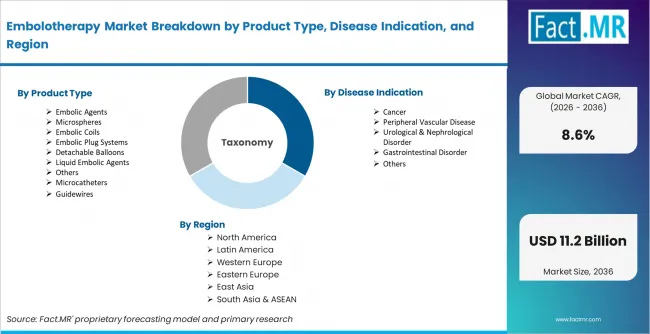
Embolotherapy Market Breakdown By Product Type, Disease Indication, And Region | Source: Fact.MR
| Attribute | Details |
|---|---|
| Quantitative Units | USD 4.9 billion (2026) to USD 11.2 billion (2036) at a CAGR of 8.6% |
| Market Definition | Catheter-based vascular occlusion devices and embolic materials used across oncology, vascular, neurological, and gynecological interventional radiology procedures in hospital and ambulatory surgical settings globally. |
| Product Type Segmentation | Embolic Agents, Microspheres, Embolic Coils, Embolic Plug Systems, Detachable Balloons, Liquid Embolic Agents, Others, Microcatheters, Guidewires |
| Disease Indication Segmentation | Cancer, Peripheral Vascular Disease, Urological & Nephrological Disorder, Gastrointestinal Disorder, Others |
| Procedure Segmentation | Transcatheter Arterial Embolization (TAE), Transcatheter Arterial Radioembolization / SIRT, Transarterial Chemoembolization (TACE) |
| End User Segmentation | Hospitals & Clinics, Ambulatory Surgical Centres, Others |
| Application Segmentation | Oncology, Neurology, Peripheral Vascular Intervention, Trauma Management, Gynecology |
| Regions Covered | North America, Europe, Asia Pacific, Latin America, Middle East and Africa |
| Countries Covered | United Kingdom, Canada, Mexico, Germany, United Kingdom, France, Italy, Spain, Nordic, BENELUX, China, Japan, South Korea, India, ASEAN, Australia and New Zealand, Brazil, Argentina, Saudi Arabia, UAE, South Africa |
| Key Companies Profiled | Medtronic plc, Boston Scientific Corporation, Penumbra, Inc., Terumo Corporation, Sirtex Medical Limited, Merit Medical Systems, Inc. |
| Forecast Period | 2026 to 2036 |
| Approach | Hybrid top-down and bottom-up model using OEM embolotherapy device revenues, procedure volume data by indication and end user, and primary interviews with interventional radiologists and hospital procurement departments. |
Source: Fact.MR analysis. Updated Jun 2, 2026
Embolotherapy Market by Segment
-
By Product Type:
- Embolic Agents
- Microspheres
- Embolic Coils
- Embolic Plug Systems
- Detachable Balloons
- Liquid Embolic Agents
- Others
- Microcatheters
- Guidewires
-
By Disease Indication:
- Cancer
- Peripheral Vascular Disease
- Urological & Nephrological Disorder
- Gastrointestinal Disorder
- Others
-
By Procedure:
- Transcatheter Arterial Embolization (TAE)
- Transcatheter Arterial Radioembolization (TARE) / Selective Internal Radiation Therapy (SIRT)
- Transarterial Chemoembolization (TACE)
-
By End User:
- Hospitals & Clinics
- Ambulatory Surgical Centres
- Others
-
By Application:
- Oncology
- Neurology
- Peripheral Vascular Intervention
- Trauma Management
- Gynecology
-
By Region:
- North America
- United States
- Canada
- Mexico
- Latin America
- Brazil
- Argentina
- Colombia
- Rest of Latin America
- Western Europe
- Germany
- United Kingdom
- France
- Italy
- Spain
- Nordic Countries
- BENELUX
- Rest of Western Europe
- Eastern Europe
- Russia
- Poland
- Hungary
- Balkan and Baltic
- Rest of Eastern Europe
- East Asia
- China
- Japan
- South Korea
- South Asia and Pacific
- India
- ASEAN
- Australia and New Zealand
- Rest of South Asia and Pacific
- Middle East and Africa
- Kingdom of Saudi Arabia
- UAE
- South Africa
- Rest of Middle East and Africa
- North America
Frequently Asked Questions
How large is the global embolotherapy market in 2025?
What will the embolotherapy market size be in 2026?
What is the projected embolotherapy market size by 2036?
What is the expected CAGR for the embolotherapy market from 2026 to 2036?
Which product type segment is poised to lead the embolotherapy market?
Which disease indication holds the largest share in the embolotherapy market?
Which country shows the fastest growth in the embolotherapy market?
Who worked on this report


Preview the report firsthand - request a free sample
Free SampleGet the brochure for pricing and purchase details
Download PDF