- Market Value (2025): USD 44.9 Mn
- Estimated Value (2026): USD 46.1 Mn
- Forecast Value (2036): USD 59.9 Mn
- CAGR (2026-2036): 2.7%
What is the Vindesine Market forecast to be worth by 2036?
USD 46.1 million in 2026 to USD 59.9 million by 2036 at a 2.7% CAGR.
- Fact.MR estimates the vindesine market at USD 44.9 million for 2025, a base built almost entirely on hospital oncology use in Europe and Japan.
- Value will move from USD 46.1 million in 2026 to USD 59.9 million by 2036 as licence holders restore steady shipments and specialist regimens keep a place for the drug.
- A 2.7% CAGR reflects a mature, low-volume product whose growth comes from supply recovery and pharmacy-prepared doses, not from new indications.
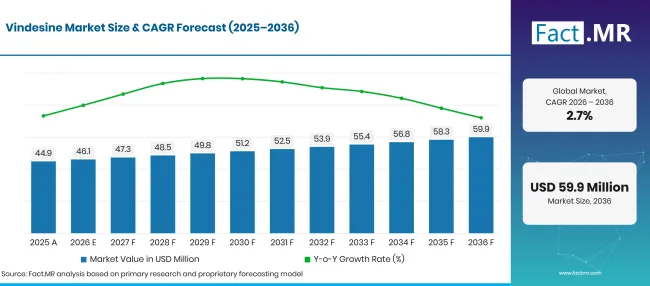
Vindesine Market Forecast Global | Source: Fact.MR
| Year | Basis | Market Value (USD million) |
|---|---|---|
| 2025 | Actual | 44.9 |
| 2026 | Estimate | 46.1 |
| 2036 | Forecast | 59.9 |
| CAGR 2026 to 2036 | Forecast period | 2.7% |
Source: Fact.MR analysis. Updated Nov 2, 2026
What are the defining numbers behind Vindesine Market growth?
Between 2026 and 2036 the market will add USD 13.8 million in new value, most of it through hospital pharmacies serving leukemia, lymphoma and thoracic cancer units.
- Demand Drivers in the Market
- Safe-handling rules are pulling vindesine into pharmacy-prepared formats. NHS Specialist Pharmacy Service guidance published on June 13, 2025 covers vincristine, vinblastine, vindesine and vinorelbine and requires products to leave pharmacy ready to administer, in a 50 mL minibag for adults and adolescents [1].
- Japan keeps a broad labelled role for the drug. The current Fildesin label, revised in September 2026, lists acute leukemia, malignant lymphoma, lung cancer and esophageal cancer as indications [2].
- Restored supply is lifting dispensed volumes. Nichi-Iko announced the resumption of Fildesin shipments in June 2026 after a suspension that began in October 2024 [3].
- Hospital-only prescribing concentrates purchasing in specialist centres. In France, Eldisine is restricted to hospital prescription by oncology, hematology or cancer specialists, which ties demand to formulary decisions in those units [4].
- Key Segments Analyzed
- By Product Type: Solution will hold 58.4% share in 2026, since pharmacies now issue vindesine as a ready-to-administer infusion.
- By Application: Cancer Treatment will account for 68.2% of 2026 value, given the drug’s labelled use in leukemia, lymphoma and thoracic tumours.
- By Distribution Channel: Hospitals will take 45.8% in 2026 because inpatient pharmacies control cytotoxic preparation and storage.
- Analyst Opinion at Fact.MR
- Shambhu Nath Jha, Principal Consultant at Fact.MR, states, “Vindesine will stay a niche hospital medicine, and its revenue will track how reliably the few licence holders can ship product. The 2024 to 2026 supply gaps in Europe and Japan showed that one API process problem can empty shelves across several countries at once. Companies that secure a second qualified API route and keep labels current will hold their formulary places through 2036.”
- Strategic Implications
- Manufacturers should qualify a backup API process and file the variation early, since one failed process has already removed the product across the EU.
- Hospital pharmacies should build vindesine into minibag preparation protocols and stock alternatives named in national shortage guidance.
- Distributors should hold allocation plans for hospital-only cytotoxics and keep cold-chain and segregation records ready for audit.
- Investors should value licence holders on supply reliability and label maintenance, as volume upside in a 2.7% market is limited.
Japan will grow at 3.5%, the quickest pace in the comparison, helped by restored domestic shipments and a wide labelled indication set. Brazil follows at 3.1% as the public health system organises access to oncology medicines through a dedicated programme. Germany tracks the global rate at 2.7%, with demand tied to EU supply recovery. The United States trails at 2.3% because vindesine has no FDA-approved product there, leaving research and special-access use. The United Kingdom closes the set at 1.9%, where strict vinca alkaloid controls and established alternatives limit new use.
How does the Vindesine Market break down by segment?
Solution will lead Product Type at 58.4%; Cancer Treatment will head Application at 68.2%; Hospitals will hold Distribution Channel at 45.8% in 2026.
Which Product Type leads?
Solution holds 58.4% of 2026 sales.
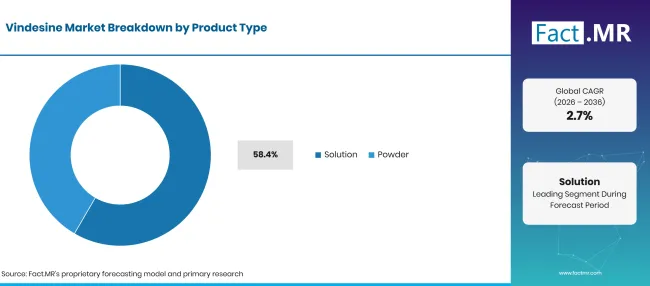
Vindesine Market Breakdown Product Type | Source: Fact.MR
| Product Type | Share (2026) |
|---|---|
| Solution (Leading segment) | 58.4% |
| Other segments combined | 41.6%* |
| Total | 100.0% |
Source: Fact.MR analysis. Updated Nov 2, 2026
Pharmacy teams reconstitute the freeze-dried vial and issue a diluted infusion, so most value is captured in ready-to-administer solution form. UK guidance asks that vinca alkaloids reach the ward in a minibag of sodium chloride 0.9% or glucose 5%, labelled for intravenous use only, so nurses do not dilute them further [1]. Aseptic units that run sterile compounding services handle most of this work. Powder remains the format in which licence holders ship the drug. The French Eldisine presentation is a single glass vial holding 5 mg of powder [4]. Powder gives longer shelf life and simpler transport, but it adds a reconstitution step inside containment isolators or safety cabinets before use.
What supports Cancer Treatment within Application?
Cancer Treatment represents 68.2% of 2026 revenue.
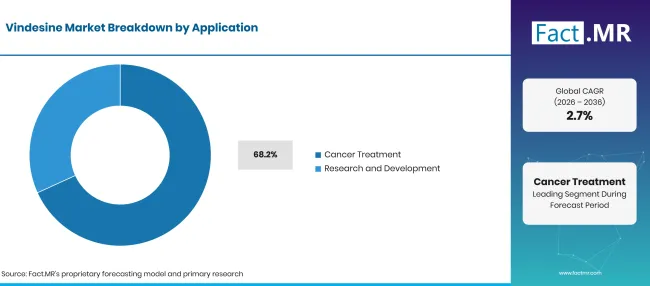
Vindesine Market Breakdown Application | Source: Fact.MR
| Application | Share (2026) |
|---|---|
| Cancer Treatment (Leading segment) | 68.2% |
| Other segments combined | 31.8%* |
| Total | 100.0% |
Source: Fact.MR analysis. Updated Nov 2, 2026
Clinicians use vindesine in combination regimens for relapsed acute lymphoblastic leukemia, refractory lymphoma and some non-small cell lung cancer protocols. Its place is often as a substitute for or follow-on to vincristine, and it shares the oncology budget lines that also fund cytotoxic chemotherapy agents. When product is unavailable, regimen changes are immediate: the EMA notes that no other vindesine-containing medicine is available in the EU [5]. Research and Development covers laboratory-grade vindesine sulfate used in tubulin binding studies, drug-resistance models and combination screening. Buyers here are academic groups and pharmaceutical research teams, and orders are small and irregular. This channel holds steady during shortages because research material comes from different suppliers than clinical vials. Demand from formulation scientists studying stability, degradation products and new delivery forms adds a small but repeat order base.
How does Distribution Channel shape demand?
Hospitals account for 45.8% of 2026 value.
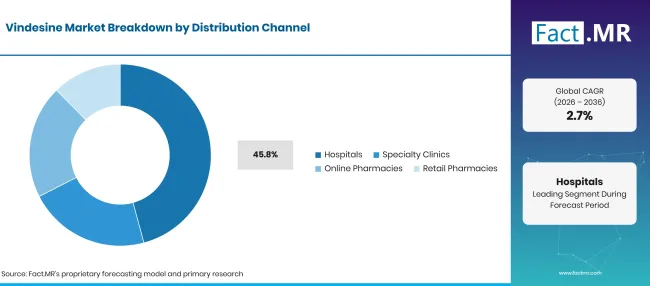
Vindesine Market Breakdown Distribution Channel | Source: Fact.MR
| Distribution Channel | Share (2026) |
|---|---|
| Hospitals (Leading segment) | 45.8% |
| Other segments combined | 54.2%* |
| Total | 100.0% |
Source: Fact.MR analysis. Updated Nov 2, 2026
Inpatient pharmacies buy, store and prepare cytotoxic drugs under one controlled process, which keeps vindesine purchasing inside the hospital. Pharmacists also log each prepared dose, check the route label and release it only to trained staff, which adds cost but protects the channel from outside competition. Treatment typically runs alongside other agents such as those in the doxorubicin class within lymphoma and leukemia protocols. Specialty clinics serve day-case oncology patients and draw on the same prepared doses. Online and retail pharmacies carry a minor role because the product is restricted to hospital prescription in several markets, including France [4]. Their volume is mostly linked to research orders and reimbursement routing.
What is accelerating Vindesine Market adoption, and what is holding it back?
Steady use in leukemia and lymphoma regimens, pharmacy-prepared infusions and restored shipments in Japan support demand. Supply fragility holds it back: the EMA reports that the active substance maker cannot produce new batches with the current process, which has affected every EU member state where Eldisine is sold [5]. Cytotoxic handling costs and established alternatives add further limits, and several large markets have no approved product at all.
Drivers Impact Analysis
| DRIVER | (~) % IMPACT ON CAGR | GEOGRAPHIC RELEVANCE | IMPACT TIMELINE |
|---|---|---|---|
| Continued use in relapsed leukemia and refractory lymphoma regimens | +0.9% | Global | Short term (<= 2 years) |
| Shift to pharmacy-prepared ready-to-administer infusions | +0.7% | Western Europe, East Asia | Medium term (2-4 years) |
| Restored product shipments after supply interruptions | +0.5% | East Asia, Western Europe | Short term (<= 2 years) |
| Laboratory demand in vinca alkaloid and resistance research | +0.3% | North America, Western Europe, East Asia | Long term (>= 4 years) |
Source: Fact.MR analysis. Updated Nov 2, 2026
Opportunity Impact Analysis
| OPPORTUNITY | (~) % IMPACT ON CAGR | GEOGRAPHIC RELEVANCE | IMPACT TIMELINE |
|---|---|---|---|
| Qualification of a second API manufacturing route | +0.6% | Western Europe | Medium term (2-4 years) |
| Wider access through public oncology programmes | +0.5% | Latin America | Medium term (2-4 years) |
| Prefilled or ready-to-use presentations for pharmacies | +0.4% | Western Europe, East Asia | Long term (>= 4 years) |
| Supply to research and formulation laboratories | +0.2% | North America, East Asia | Long term (>= 4 years) |
Source: Fact.MR analysis. Updated Nov 2, 2026
Restraints Impact Analysis
| RESTRAINT | (~) % IMPACT ON CAGR | GEOGRAPHIC RELEVANCE | IMPACT TIMELINE |
|---|---|---|---|
| API process failures and shipment suspensions | -0.5% | Global | Short term (<= 2 years) |
| Cytotoxic preparation and handling costs | -0.3% | Global | Short term (<= 2 years) |
| Substitution by vincristine and newer regimens | -0.2% | North America, Western Europe | Medium term (2-4 years) |
| No approved product in several large markets | -0.2% | North America, Latin America | Long term (>= 4 years) |
Source: Fact.MR analysis. Updated Nov 2, 2026
Which countries are scaling the Vindesine Market through 2036?
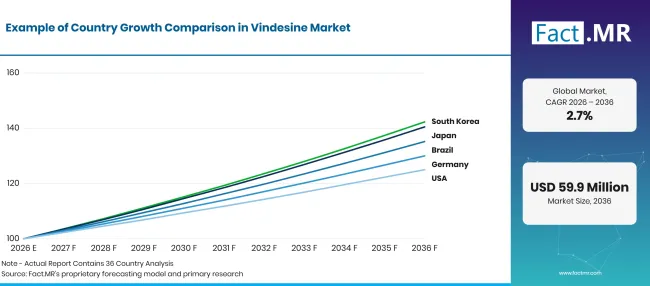
Vindesine Market Growth Index | Source: Fact.MR
| Country | CAGR (2026 to 2036) |
|---|---|
| Japan | 3.5% |
| Brazil | 3.1% |
| Germany | 2.7% |
| United States | 2.3% |
| United Kingdom | 1.9% |
Source: Fact.MR analysis. Updated Nov 2, 2026
What supports Japan’s adoption?
3.5% CAGR, helped by restored domestic supply and a four-indication label.
Japan’s cancer burden gives vindesine a steady clinical base. Projections published in March 2026 put new cancer cases in 2025 at about 1,023,100 and cancer deaths at about 395,500 [6]. Fildesin carries indications in acute leukemia, malignant lymphoma, lung cancer and esophageal cancer, with a label revision in September 2026 [2]. Resumed shipments since June 2026 let hospitals return patients to established protocols [3].
How is Brazil developing demand?
3.1% CAGR, as public oncology purchasing becomes more organised.
Brazil’s Ministry of Health began piloting its AF-Onco oncology medicine programme at 13 health services in October 2026. The programme covers 23 medicines and 25 new treatment indications, reaches about 111,000 patients and carries an estimated annual budget of R$ 2.1 billion [7]. The National Cancer Institute has also updated its incidence estimates for the 2026 to 2028 triennium [8]. Structured public purchasing gives older cytotoxics a clearer route into SUS hospitals.
What is supporting Germany’s growth?
2.7% CAGR, reflecting EU supply recovery and specialist hospital use.
Cancer caused about 228,800 deaths in Germany in 2025, the second most common cause of death [9]. Lung cancer alone accounted for 45,168 of those deaths [10], and thoracic and hematology units are where vindesine regimens are used. STADA Arzneimittel AG manufactures Eldisine in Bad Vilbel, so restored EU supply will reach German hospitals first. STADAPHARM GmbH holds the German licence, and university hospital pharmacies remain the main buyers.
What is supporting United States adoption?
2.3% CAGR, driven mainly by research and special-access use.
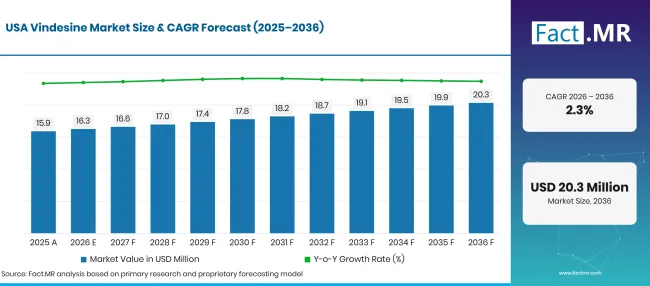
Vindesine Market Forecast Usa | Source: Fact.MR
The National Cancer Institute estimated 2,041,910 new cancer cases and 618,120 cancer deaths in the United States for 2025 [11]. Vindesine has no FDA-approved finished product, so clinical use runs through imports for named patients and investigational protocols. Research laboratories studying tubulin binders and resistance to cytarabine and daunorubicin regimens add a stable laboratory demand.
How is the United Kingdom scaling demand?
1.9% CAGR, given strict vinca alkaloid controls and established alternatives.
NHS England reported that 80.5% of patients with suspected cancer received a diagnosis or had cancer ruled out within 28 days in February 2026, a record for the service [12]. Faster diagnosis brings more patients to treatment sooner, but UK oncology teams mostly prefer vincristine and newer agents. Vindesine use is limited to specialist lymphoma and diffuse large B-cell lymphoma salvage settings under the SPS handling rules [1].
Who leads the Vindesine Market?
Competition falls into two tiers. Finished-dose licence holders form the first: STADA Arzneimittel AG manufactures Eldisine for Europe, with STADAPHARM GmbH holding the German licence and EG Labo the French one, while Aspen Pharmacare sponsors the product in Australia.
Nichi-Iko Pharmaceutical serves Japan with Fildesin and announced resumed shipments in June 2026 after a long suspension [3]. These companies compete on licence coverage, label upkeep and the ability to keep vials moving. The second tier is API supply, where Minakem lists vindesine among its Belgian-made high-potency anticancer substances. This tier is thin, and the EMA has linked the EU shortage to an API maker that cannot produce new batches under its current process [5]. Because both tiers depend on so few sites, buyers judge suppliers on reliability before price. Through 2036, the holders that qualify alternate API routes and keep documentation current will keep their formulary places.
Which companies are the key providers?
Key companies in the Vindesine Market include STADA Arzneimittel AG, STADAPHARM GmbH, EG Labo, Nichi-Iko Pharmaceutical, Aspen Pharmacare and Minakem.
- STADA Arzneimittel AG
- STADAPHARM GmbH
- EG Labo
- Nichi-Iko Pharmaceutical
- Aspen Pharmacare
- Minakem
Bibliography
- [1] NHS Specialist Pharmacy Service. (2025, June 13). Preventing harm from incorrect vinca alkaloid administration.
- [2] Pharmaceuticals and Medical Devices Agency. (2026, September). 注射用フィルデシン1mg/注射用フィルデシン3mg.
- [3] Nichi-Iko Pharmaceutical Co., Ltd. (2026, September 29). 注射用フィルデシン3mg.
- [4] Agence nationale de sécurité du médicament et des produits de santé. (2026, September 29). ELDISINE 5 mg, poudre pour solution injectable.
- [5] European Medicines Agency. (2025, November 3). Eldisine: supply shortage.
- [6] Foundation for Promotion of Cancer Research. (2026, March). Cancer Statistics in Japan 2026.
- [7] Ministério da Saúde. (2026, October 2). Ministério da Saúde inicia no Icesp, em São Paulo, projeto-piloto para ampliar acesso a medicamentos contra o câncer no SUS.
- [8] Instituto Nacional de Câncer. (2026, February 5). Estimativa.
- [9] Statistisches Bundesamt. (2026, October 9). Todesursachen 2025: Weniger Verstorbene aufgrund von Herz-Kreislauf-Erkrankungen.
- [10] Statistisches Bundesamt. (2026, October 9). Häufigste Todesfälle durch Krebs.
- [11] National Cancer Institute. (2025, May 7). Cancer Statistics.
- [12] NHS England. (2026, April). March was busiest month ever for A&Es amid meningitis outbreak.
This Report Answers
- How large will vindesine revenue be in 2026 and 2036, and what pace links the two?
- Why do pharmacy-prepared solutions capture more value than the powder vials that leave the factory?
- Which cancers and regimens keep vindesine in clinical use despite older-drug status?
- How do Japan, Brazil, Germany, the United States and the United Kingdom differ in growth and access?
- Which licence holders and API makers keep the product available, and where is supply weakest?
- What do recent EU and Japanese supply interruptions mean for buyers through 2036?
What does the Vindesine Market cover?
This study values vindesine sulfate sold as finished medicines and as research-grade material. Finished products are freeze-dried vials such as Eldisine and Fildesin, which hospital pharmacies reconstitute and dilute before use.
Value is counted at the point of sale to hospitals, clinics, pharmacies and research buyers. Pharmacy-prepared doses are counted under the Solution segment, so the split reflects how the drug reaches patients and not only how it leaves the plant.
What is included in the scope?
Finished vindesine sulfate powder vials and ready-to-administer solutions dispensed for intravenous use.
Vindesine sulfate API sold to licence holders and formulators.
Research-grade vindesine purchased by academic and industrial laboratories.
Sales through hospitals, specialty clinics, online pharmacies and retail pharmacies across all seven regions.
What is excluded from the scope?
Other vinca alkaloids such as vincristine, vinblastine and vinorelbine, even where they replace vindesine in a regimen.
Combination regimens priced as a package, except for the vindesine component itself.
Pharmacy compounding services, equipment, closed transfer devices and consumables used in preparation.
Hospital treatment fees, nursing time and other costs of delivering chemotherapy.
How Was the Analysis Built?
The analysis draws on 120+ sources, 35+ company portfolios, 25+ countries, and more than 20 industry interviews.
- Primary Research: Primary research includes discussions with manufacturers, service providers, technology developers, distributors, end users, and subject-matter experts. These conversations examine purchasing priorities, product adoption, operational challenges, approval requirements, competitive positioning, and the factors that influence wider market acceptance.
- Desk Research: Desk research covers government statistics, regulatory publications, company filings, trade data, technical studies, industry associations, standards, public policy, and other authoritative sources. Every source used in the analysis is documented in the bibliography.
- Market Sizing and Forecasting: Market estimates combine historical performance, demand indicators, pricing and volume trends, segment shares, company participation, country-level growth, adoption patterns, investment activity, and barriers to market expansion.
- Data Validation and Update Cycle: Findings are validated by comparing primary interviews with public data, company activity, regulatory changes, trade patterns, and industry developments. Regular updates review new product launches, capacity changes, partnerships, approvals, and shifts in commercial adoption.
Segmentation
What is the report’s scope and coverage?
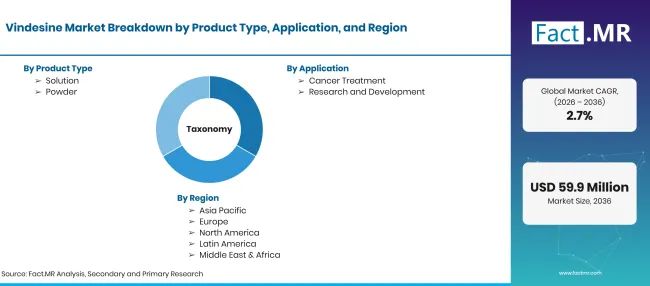
Vindesine Market Taxonomy | Source: Fact.MR
| Attribute | Details |
|---|---|
| Quantitative Units | USD million in 2026 to USD million by 2036 at CAGR |
| Market Definition | Revenue from vindesine sulfate finished products and research-grade material used in cancer treatment and pharmaceutical research. |
| Product Type | Solution; Powder |
| Application | Cancer Treatment; Research and Development |
| Distribution Channel | Hospitals; Specialty Clinics; Online Pharmacies; Retail Pharmacies |
| Regions Covered | North America; Latin America; Western Europe; Eastern Europe; East Asia; South Asia & Pacific; Middle East & Africa |
| Countries Covered | Japan; Brazil; Germany; United States; United Kingdom |
| Companies Profiled | STADA Arzneimittel AG; STADAPHARM GmbH; EG Labo; Nichi-Iko Pharmaceutical; Aspen Pharmacare; Minakem |
| Forecast Period | 2026 to 2036 |
| Approach | Product registrations and supply status by country, combined with hospital oncology use patterns and pharmacy preparation practice. |
Source: Fact.MR analysis. Updated Nov 2, 2026
How is the market segmented?
-
By Product Type
- Solution
- Powder
-
By Application
- Cancer Treatment
- Research and Development
-
By Distribution Channel
- Hospitals
- Specialty Clinics
- Online Pharmacies
- Retail Pharmacies
-
By Region
- North America
- Latin America
- Western Europe
- Eastern Europe
- East Asia
- South Asia & Pacific
- Middle East & Africa
Frequently Asked Questions
How large is the vindesine market in 2026?
What growth rate will the vindesine market record?
Which product type leads?
Which application leads?
Which distribution channel leads?
Which country will grow quickest?
Who are the main companies?
What holds the market back?
Who worked on this report


Preview the report firsthand - request a free sample
Free SampleGet the brochure for pricing and purchase details
Download PDF